Approach to Polyuria
Dr Angadi Wasim Akram
MD, Dept. Of Paediatrics
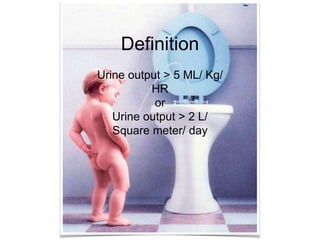
Definition
Urine output > 5 ML/ Kg/
HR
or
Urine output > 2 L/
Square meter/ day
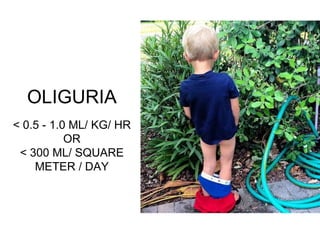
OLIGURIA
< 0.5 - 1.0 ML/ KG/ HR
OR
< 300 ML/ SQUARE
METER / DAY
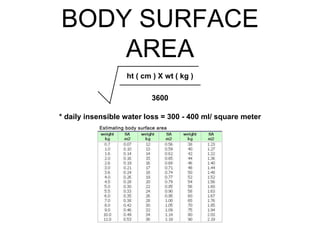
BODY SURFACE
AREA
ht ( cm ) X wt ( kg )
3600
* daily insensible water loss = 300 - 400 ml/ square meter
CAUSES OF
POLYURIA
• INCREASED FLUID INTAKE
• INCREASED URINARY
SOLUTE EXCRETION
• IMPAIRED URINARY
CONCENTRATION
INCREASED FLUID
INTAKE
• IATROGENIC
• COMPULSIVE WATER
DRINKING ( PSYCHOGENIC
POLYDIPSIA )
INCREASED URINARY
SOLUTE EXCRETION
• OSMOTIC DIURESIS
1. DIABETES MELLITUS
2. MANNITOL TREATMENT
• SALT LOSS
1. ADRENAL INSUFFICIENCY
2. DIURETICS
3. CEREBRAL SALT WASTING
4. ALDOSTERONE
RESISTANCE
IMPAIRED URINARY
CONCENTRATION
• INEFFICIENT ADH ACTION (
DIABETES INSIPIDUS )
1. CENTRAL
2. NEPHROGENIC
• RENAL DISORDERS
1. R T A
2. BARTTER SYNDROME
3. GITELMAN SYNDROME
INEFFICIENT ADH ACTION
( DIABETES INSIPIDUS )
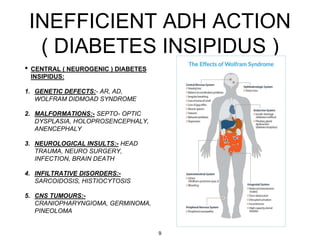
• CENTRAL ( NEUROGENIC ) DIABETES
INSIPIDUS:
1. GENETIC DEFECTS:- AR, AD,
WOLFRAM DIDMOAD SYNDROME
2. MALFORMATIONS:- SEPTO- OPTIC
DYSPLASIA, HOLOPROSENCEPHALY,
ANENCEPHALY
3. NEUROLOGICAL INSULTS:- HEAD
TRAUMA, NEURO SURGERY,
INFECTION, BRAIN DEATH
4. INFILTRATIVE DISORDERS:-
SARCOIDOSIS, HISTIOCYTOSIS
5. CNS TUMOURS:-
CRANIOPHARYNGIOMA, GERMINOMA,
PINEOLOMA
9
INEFFICIENT ADH ACTION
( DIABETES INSIPIDUS )
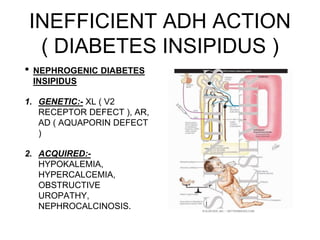
• NEPHROGENIC DIABETES
INSIPIDUS
1. GENETIC:- XL ( V2
RECEPTOR DEFECT ), AR,
AD ( AQUAPORIN DEFECT
)
2. ACQUIRED:-
HYPOKALEMIA,
HYPERCALCEMIA,
OBSTRUCTIVE
UROPATHY,
NEPHROCALCINOSIS.
APPROACH
1. HISTORY
CLINICAL EXAMINATION
INVESTIGATIONS
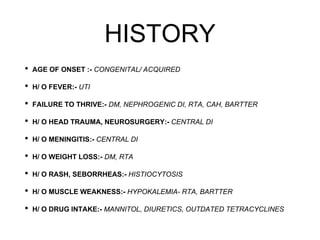
HISTORY
• AGE OF ONSET :- CONGENITAL/ ACQUIRED
• H/ O FEVER:- UTI
• FAILURE TO THRIVE:- DM, NEPHROGENIC DI, RTA, CAH, BARTTER
• H/ O HEAD TRAUMA, NEUROSURGERY:- CENTRAL DI
• H/ O MENINGITIS:- CENTRAL DI
• H/ O WEIGHT LOSS:- DM, RTA
• H/ O RASH, SEBORRHEAS:- HISTIOCYTOSIS
• H/ O MUSCLE WEAKNESS:- HYPOKALEMIA- RTA, BARTTER
• H/ O DRUG INTAKE:- MANNITOL, DIURETICS, OUTDATED TETRACYCLINES
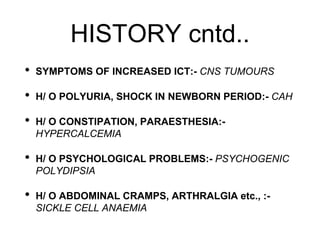
HISTORY cntd..
• SYMPTOMS OF INCREASED ICT:- CNS TUMOURS
• H/ O POLYURIA, SHOCK IN NEWBORN PERIOD:- CAH
• H/ O CONSTIPATION, PARAESTHESIA:-
HYPERCALCEMIA
• H/ O PSYCHOLOGICAL PROBLEMS:- PSYCHOGENIC
POLYDIPSIA
• H/ O ABDOMINAL CRAMPS, ARTHRALGIA etc., :-
SICKLE CELL ANAEMIA
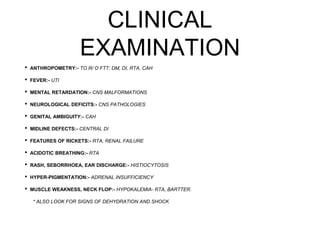
CLINICAL
EXAMINATION
• ANTHROPOMETRY:- TO R/ O FTT: DM, DI, RTA, CAH
• FEVER:- UTI
• MENTAL RETARDATION:- CNS MALFORMATIONS
• NEUROLOGICAL DEFICITS:- CNS PATHOLOGIES
• GENITAL AMBIGUITY:- CAH
• MIDLINE DEFECTS:- CENTRAL DI
• FEATURES OF RICKETS:- RTA, RENAL FAILURE
• ACIDOTIC BREATHING:- RTA
• RASH, SEBORRHOEA, EAR DISCHARGE:- HISTIOCYTOSIS
• HYPER-PIGMENTATION:- ADRENAL INSUFFICIENCY
• MUSCLE WEAKNESS, NECK FLOP:- HYPOKALEMIA- RTA, BARTTER.
* ALSO LOOK FOR SIGNS OF DEHYDRATION AND SHOCK
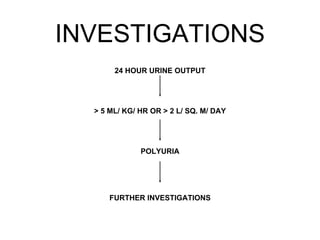
INVESTIGATIONS
24 HOUR URINE OUTPUT
> 5 ML/ KG/ HR OR > 2 L/ SQ. M/ DAY
POLYURIA
FURTHER INVESTIGATIONS
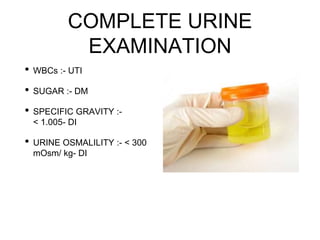
COMPLETE URINE
EXAMINATION
• WBCs :- UTI
• SUGAR :- DM
• SPECIFIC GRAVITY :-
< 1.005- DI
• URINE OSMALILITY :- < 300
mOsm/ kg- DI
OTHER
INVESTIGATIONS
• UREA, CREATININE
• SERUM ELECTROLYTES
• CALCIUM
• BLOOD GAS ANALYSIS
• BLOOD GLUCOSE
• PLASMA OSMOLALITY
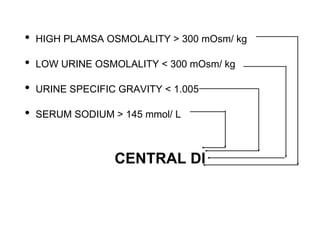
• HIGH PLAMSA OSMOLALITY > 300 mOsm/ kg
• LOW URINE OSMOLALITY < 300 mOsm/ kg
• URINE SPECIFIC GRAVITY < 1.005
• SERUM SODIUM > 145 mmol/ L
CENTRAL DI
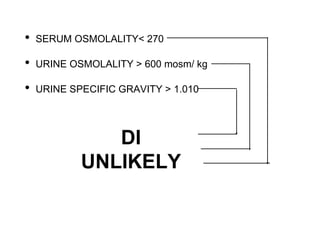
• SERUM OSMOLALITY< 270
• URINE OSMOLALITY > 600 mosm/ kg
• URINE SPECIFIC GRAVITY > 1.010
DI
UNLIKELY
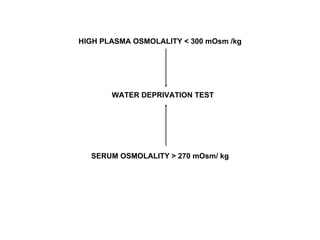
HIGH PLASMA OSMOLALITY < 300 mOsm /kg
WATER DEPRIVATION TEST
SERUM OSMOLALITY > 270 mOsm/ kg
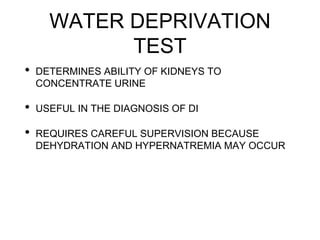
WATER DEPRIVATION
TEST
• DETERMINES ABILITY OF KIDNEYS TO
CONCENTRATE URINE
• USEFUL IN THE DIAGNOSIS OF DI
• REQUIRES CAREFUL SUPERVISION BECAUSE
DEHYDRATION AND HYPERNATREMIA MAY OCCUR
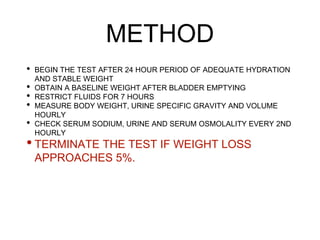
METHOD
• BEGIN THE TEST AFTER 24 HOUR PERIOD OF ADEQUATE HYDRATION
AND STABLE WEIGHT
• OBTAIN A BASELINE WEIGHT AFTER BLADDER EMPTYING
• RESTRICT FLUIDS FOR 7 HOURS
• MEASURE BODY WEIGHT, URINE SPECIFIC GRAVITY AND VOLUME
HOURLY
• CHECK SERUM SODIUM, URINE AND SERUM OSMOLALITY EVERY 2ND
HOURLY
• TERMINATE THE TEST IF WEIGHT LOSS
APPROACHES 5%.
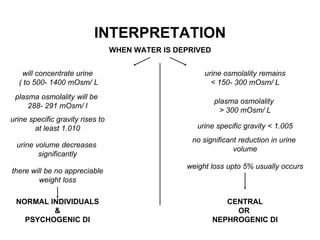
INTERPRETATION
WHEN WATER IS DEPRIVED
will concentrate urine
( to 500- 1400 mOsm/ L
urine osmolality remains
< 150- 300 mOsm/ L
plasma osmolality will be
288- 291 mOsm/ l
urine specific gravity rises to
at least 1.010
urine volume decreases
significantly
there will be no appreciable
weight loss
NORMAL INDIVIDUALS
&
PSYCHOGENIC DI
plasma osmolality
> 300 mOsm/ L
urine specific gravity < 1.005
no significant reduction in urine
volume
weight loss upto 5% usually occurs
CENTRAL
OR
NEPHROGENIC DI
NEPHROGENIC DI
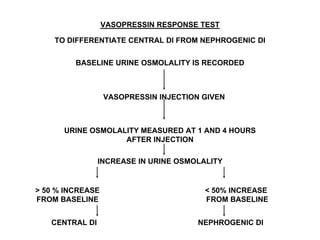
VASOPRESSIN RESPONSE TEST
TO DIFFERENTIATE CENTRAL DI FROM NEPHROGENIC DI
BASELINE URINE OSMOLALITY IS RECORDED
VASOPRESSIN INJECTION GIVEN
URINE OSMOLALITY MEASURED AT 1 AND 4 HOURS
AFTER INJECTION
INCREASE IN URINE OSMOLALITY
> 50 % INCREASE
FROM BASELINE
< 50% INCREASE
FROM BASELINE
CENTRAL DI
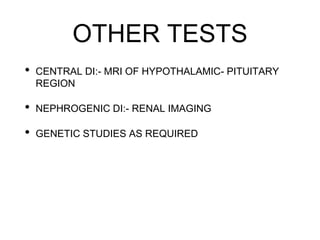
OTHER TESTS
• CENTRAL DI:- MRI OF HYPOTHALAMIC- PITUITARY
REGION
• NEPHROGENIC DI:- RENAL IMAGING
• GENETIC STUDIES AS REQUIRED
TREATMENT
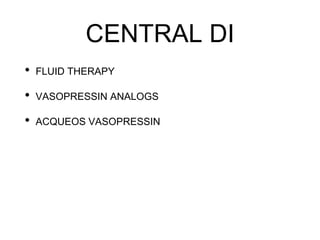
CENTRAL DI
• FLUID THERAPY
• VASOPRESSIN ANALOGS
• ACQUEOS VASOPRESSIN
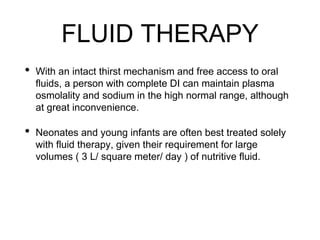
FLUID THERAPY
• With an intact thirst mechanism and free access to oral
fluids, a person with complete DI can maintain plasma
osmolality and sodium in the high normal range, although
at great inconvenience.
• Neonates and young infants are often best treated solely
with fluid therapy, given their requirement for large
volumes ( 3 L/ square meter/ day ) of nutritive fluid.
VASOPRESSIN
ANALOGS
• Treatment of Central DI in older children is best accomplished with the
use of DDAVP.
• DDAVP is available in an intranasal preparation ( onset 5- 10 min) and as
tablets ( 15-30 min).
• The intranasal preparation of DDAVP ( 10 microgram/ 0.1 ml) can be
administered by rhinal tube ( allowing dose titration) or by nasal spray.
• Use of oral tablets requires at least 10 fold increase in the dosage
compared with intranasal preparation.
• To prevent water intoxication, patients should have at least 1 hr of urinary
breakthrough between doses each day and be advised to drink in
response to thirst sensation.
ACQUEOS
VASOPRESSIN
• Central DI of acute onset following neurosurgery is best managed with
continuous administration of synthetic aqueous vasopressin ( Pitressin
).
• Under most circumstances, total fluid intake must be limited to 1 L/
square meter/ day during antidiuresis.
• A typical dosage of intravenous vasopressin therapy is 1.5 mU/kg/hr,
which results in a blood vasopressin concentration of approximately 10
pg/ml.
• On occasion, following hypothalamic ( but not transspheniodal) surgery,
higher initial concentrations of vasopressin may be required, which has
been attributed to the release of a vasopressin inhibitory substance.
NEPHROGENIC DI
• The treatment of acquired NDI focuses on eliminating, if
possible, the underlying disorder, such as offending drugs,
hypercalcemia, hypokalemia, or ureteral obstruction.
• Congenital DI is often difficult to treat.
• The main goals are to ensure that intake of adequate calories
for growth and to avoid severe dehydration.
• Foods with highest ratio of caloric content to osmotic load (
Na <1 mmol/ kg/ 24 hr) should be ingested to maximise
growth and to minimise the urine volume required to excrete
the solute load.
• Pharmacologic approaches to the treatment of NDI include the
use of thiazide diuretics and are intended to decrease the overall
urine output.
• Thiazides appear to induce a state of mild volume depletion by
enhancing sodium excretion at the expense of water and by
causing a decrease in the glomerular filtration rate, which results
in proximal tubular sodium and water reabsorption.
• Indomethacin and amiloride may be used in combination with
thiazides to further reduce polyuria.
• High dose DDAVP therapy, in combination with indomethacin,
has been used in some subjects with NDI. This treatment could
prove useful in patients with genetic defects in the V2 receptor
associated with a reduced binding affinity for vasopressin.
– Henny Youngman
“ I told the doctor that i broke my leg in
two places.
He told me to quit going to those
places.”
THANK YOU

Polyuria approach

  • 1.
    Approach to Polyuria DrAngadi Wasim Akram MD, Dept. Of Paediatrics
  • 2.
    Definition Urine output >5 ML/ Kg/ HR or Urine output > 2 L/ Square meter/ day
  • 3.
    OLIGURIA < 0.5 -1.0 ML/ KG/ HR OR < 300 ML/ SQUARE METER / DAY
  • 4.
    BODY SURFACE AREA ht (cm ) X wt ( kg ) 3600 * daily insensible water loss = 300 - 400 ml/ square meter
  • 5.
    CAUSES OF POLYURIA • INCREASEDFLUID INTAKE • INCREASED URINARY SOLUTE EXCRETION • IMPAIRED URINARY CONCENTRATION
  • 6.
    INCREASED FLUID INTAKE • IATROGENIC •COMPULSIVE WATER DRINKING ( PSYCHOGENIC POLYDIPSIA )
  • 7.
    INCREASED URINARY SOLUTE EXCRETION •OSMOTIC DIURESIS 1. DIABETES MELLITUS 2. MANNITOL TREATMENT • SALT LOSS 1. ADRENAL INSUFFICIENCY 2. DIURETICS 3. CEREBRAL SALT WASTING 4. ALDOSTERONE RESISTANCE
  • 8.
    IMPAIRED URINARY CONCENTRATION • INEFFICIENTADH ACTION ( DIABETES INSIPIDUS ) 1. CENTRAL 2. NEPHROGENIC • RENAL DISORDERS 1. R T A 2. BARTTER SYNDROME 3. GITELMAN SYNDROME
  • 9.
    INEFFICIENT ADH ACTION (DIABETES INSIPIDUS ) • CENTRAL ( NEUROGENIC ) DIABETES INSIPIDUS: 1. GENETIC DEFECTS:- AR, AD, WOLFRAM DIDMOAD SYNDROME 2. MALFORMATIONS:- SEPTO- OPTIC DYSPLASIA, HOLOPROSENCEPHALY, ANENCEPHALY 3. NEUROLOGICAL INSULTS:- HEAD TRAUMA, NEURO SURGERY, INFECTION, BRAIN DEATH 4. INFILTRATIVE DISORDERS:- SARCOIDOSIS, HISTIOCYTOSIS 5. CNS TUMOURS:- CRANIOPHARYNGIOMA, GERMINOMA, PINEOLOMA 9
  • 10.
    INEFFICIENT ADH ACTION (DIABETES INSIPIDUS ) • NEPHROGENIC DIABETES INSIPIDUS 1. GENETIC:- XL ( V2 RECEPTOR DEFECT ), AR, AD ( AQUAPORIN DEFECT ) 2. ACQUIRED:- HYPOKALEMIA, HYPERCALCEMIA, OBSTRUCTIVE UROPATHY, NEPHROCALCINOSIS.
  • 11.
  • 12.
  • 13.
    HISTORY • AGE OFONSET :- CONGENITAL/ ACQUIRED • H/ O FEVER:- UTI • FAILURE TO THRIVE:- DM, NEPHROGENIC DI, RTA, CAH, BARTTER • H/ O HEAD TRAUMA, NEUROSURGERY:- CENTRAL DI • H/ O MENINGITIS:- CENTRAL DI • H/ O WEIGHT LOSS:- DM, RTA • H/ O RASH, SEBORRHEAS:- HISTIOCYTOSIS • H/ O MUSCLE WEAKNESS:- HYPOKALEMIA- RTA, BARTTER • H/ O DRUG INTAKE:- MANNITOL, DIURETICS, OUTDATED TETRACYCLINES
  • 14.
    HISTORY cntd.. • SYMPTOMSOF INCREASED ICT:- CNS TUMOURS • H/ O POLYURIA, SHOCK IN NEWBORN PERIOD:- CAH • H/ O CONSTIPATION, PARAESTHESIA:- HYPERCALCEMIA • H/ O PSYCHOLOGICAL PROBLEMS:- PSYCHOGENIC POLYDIPSIA • H/ O ABDOMINAL CRAMPS, ARTHRALGIA etc., :- SICKLE CELL ANAEMIA
  • 15.
    CLINICAL EXAMINATION • ANTHROPOMETRY:- TOR/ O FTT: DM, DI, RTA, CAH • FEVER:- UTI • MENTAL RETARDATION:- CNS MALFORMATIONS • NEUROLOGICAL DEFICITS:- CNS PATHOLOGIES • GENITAL AMBIGUITY:- CAH • MIDLINE DEFECTS:- CENTRAL DI • FEATURES OF RICKETS:- RTA, RENAL FAILURE • ACIDOTIC BREATHING:- RTA • RASH, SEBORRHOEA, EAR DISCHARGE:- HISTIOCYTOSIS • HYPER-PIGMENTATION:- ADRENAL INSUFFICIENCY • MUSCLE WEAKNESS, NECK FLOP:- HYPOKALEMIA- RTA, BARTTER. * ALSO LOOK FOR SIGNS OF DEHYDRATION AND SHOCK
  • 16.
    INVESTIGATIONS 24 HOUR URINEOUTPUT > 5 ML/ KG/ HR OR > 2 L/ SQ. M/ DAY POLYURIA FURTHER INVESTIGATIONS
  • 17.
    COMPLETE URINE EXAMINATION • WBCs:- UTI • SUGAR :- DM • SPECIFIC GRAVITY :- < 1.005- DI • URINE OSMALILITY :- < 300 mOsm/ kg- DI
  • 18.
    OTHER INVESTIGATIONS • UREA, CREATININE •SERUM ELECTROLYTES • CALCIUM • BLOOD GAS ANALYSIS • BLOOD GLUCOSE • PLASMA OSMOLALITY
  • 19.
    • HIGH PLAMSAOSMOLALITY > 300 mOsm/ kg • LOW URINE OSMOLALITY < 300 mOsm/ kg • URINE SPECIFIC GRAVITY < 1.005 • SERUM SODIUM > 145 mmol/ L CENTRAL DI
  • 20.
    • SERUM OSMOLALITY<270 • URINE OSMOLALITY > 600 mosm/ kg • URINE SPECIFIC GRAVITY > 1.010 DI UNLIKELY
  • 21.
    HIGH PLASMA OSMOLALITY< 300 mOsm /kg WATER DEPRIVATION TEST SERUM OSMOLALITY > 270 mOsm/ kg
  • 22.
    WATER DEPRIVATION TEST • DETERMINESABILITY OF KIDNEYS TO CONCENTRATE URINE • USEFUL IN THE DIAGNOSIS OF DI • REQUIRES CAREFUL SUPERVISION BECAUSE DEHYDRATION AND HYPERNATREMIA MAY OCCUR
  • 23.
    METHOD • BEGIN THETEST AFTER 24 HOUR PERIOD OF ADEQUATE HYDRATION AND STABLE WEIGHT • OBTAIN A BASELINE WEIGHT AFTER BLADDER EMPTYING • RESTRICT FLUIDS FOR 7 HOURS • MEASURE BODY WEIGHT, URINE SPECIFIC GRAVITY AND VOLUME HOURLY • CHECK SERUM SODIUM, URINE AND SERUM OSMOLALITY EVERY 2ND HOURLY • TERMINATE THE TEST IF WEIGHT LOSS APPROACHES 5%.
  • 24.
    INTERPRETATION WHEN WATER ISDEPRIVED will concentrate urine ( to 500- 1400 mOsm/ L urine osmolality remains < 150- 300 mOsm/ L plasma osmolality will be 288- 291 mOsm/ l urine specific gravity rises to at least 1.010 urine volume decreases significantly there will be no appreciable weight loss NORMAL INDIVIDUALS & PSYCHOGENIC DI plasma osmolality > 300 mOsm/ L urine specific gravity < 1.005 no significant reduction in urine volume weight loss upto 5% usually occurs CENTRAL OR NEPHROGENIC DI
  • 25.
    NEPHROGENIC DI VASOPRESSIN RESPONSETEST TO DIFFERENTIATE CENTRAL DI FROM NEPHROGENIC DI BASELINE URINE OSMOLALITY IS RECORDED VASOPRESSIN INJECTION GIVEN URINE OSMOLALITY MEASURED AT 1 AND 4 HOURS AFTER INJECTION INCREASE IN URINE OSMOLALITY > 50 % INCREASE FROM BASELINE < 50% INCREASE FROM BASELINE CENTRAL DI
  • 26.
    OTHER TESTS • CENTRALDI:- MRI OF HYPOTHALAMIC- PITUITARY REGION • NEPHROGENIC DI:- RENAL IMAGING • GENETIC STUDIES AS REQUIRED
  • 27.
  • 28.
    CENTRAL DI • FLUIDTHERAPY • VASOPRESSIN ANALOGS • ACQUEOS VASOPRESSIN
  • 29.
    FLUID THERAPY • Withan intact thirst mechanism and free access to oral fluids, a person with complete DI can maintain plasma osmolality and sodium in the high normal range, although at great inconvenience. • Neonates and young infants are often best treated solely with fluid therapy, given their requirement for large volumes ( 3 L/ square meter/ day ) of nutritive fluid.
  • 30.
    VASOPRESSIN ANALOGS • Treatment ofCentral DI in older children is best accomplished with the use of DDAVP. • DDAVP is available in an intranasal preparation ( onset 5- 10 min) and as tablets ( 15-30 min). • The intranasal preparation of DDAVP ( 10 microgram/ 0.1 ml) can be administered by rhinal tube ( allowing dose titration) or by nasal spray. • Use of oral tablets requires at least 10 fold increase in the dosage compared with intranasal preparation. • To prevent water intoxication, patients should have at least 1 hr of urinary breakthrough between doses each day and be advised to drink in response to thirst sensation.
  • 31.
    ACQUEOS VASOPRESSIN • Central DIof acute onset following neurosurgery is best managed with continuous administration of synthetic aqueous vasopressin ( Pitressin ). • Under most circumstances, total fluid intake must be limited to 1 L/ square meter/ day during antidiuresis. • A typical dosage of intravenous vasopressin therapy is 1.5 mU/kg/hr, which results in a blood vasopressin concentration of approximately 10 pg/ml. • On occasion, following hypothalamic ( but not transspheniodal) surgery, higher initial concentrations of vasopressin may be required, which has been attributed to the release of a vasopressin inhibitory substance.
  • 32.
    NEPHROGENIC DI • Thetreatment of acquired NDI focuses on eliminating, if possible, the underlying disorder, such as offending drugs, hypercalcemia, hypokalemia, or ureteral obstruction. • Congenital DI is often difficult to treat. • The main goals are to ensure that intake of adequate calories for growth and to avoid severe dehydration. • Foods with highest ratio of caloric content to osmotic load ( Na <1 mmol/ kg/ 24 hr) should be ingested to maximise growth and to minimise the urine volume required to excrete the solute load.
  • 33.
    • Pharmacologic approachesto the treatment of NDI include the use of thiazide diuretics and are intended to decrease the overall urine output. • Thiazides appear to induce a state of mild volume depletion by enhancing sodium excretion at the expense of water and by causing a decrease in the glomerular filtration rate, which results in proximal tubular sodium and water reabsorption. • Indomethacin and amiloride may be used in combination with thiazides to further reduce polyuria. • High dose DDAVP therapy, in combination with indomethacin, has been used in some subjects with NDI. This treatment could prove useful in patients with genetic defects in the V2 receptor associated with a reduced binding affinity for vasopressin.
  • 34.
    – Henny Youngman “I told the doctor that i broke my leg in two places. He told me to quit going to those places.” THANK YOU