Knee joint
Content
Type of joint
Articular surfaces
Ligaments
Synovial membrane
Mobility of the joint
- The Knee Joint is the largest & most complicated joint
in the body .
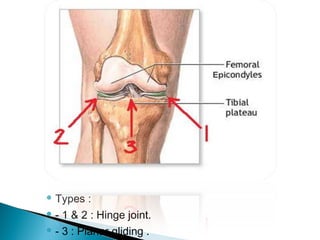
- It consists of 3 Joints within a single synovial cavity :
1) Medial Condylar Joint : Between the medial condyle
“of the femur” & the medial condyle “of the tibia” .
2) Lateral Condylar Joint : Between the lateral condyle
“of the femur” & the lateral condyle “of the tibia” .
3) Patellofemoral Joint : Between the patella & the
patellar surface of the femur .
- The fibula is NOT directly involved in the joint .
 Types :
 - 1 & 2 : Hinge joint.
 - 3 : Planar gliding .
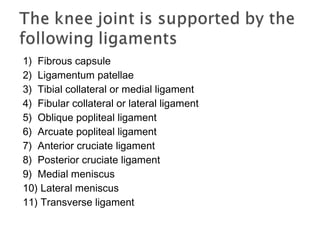
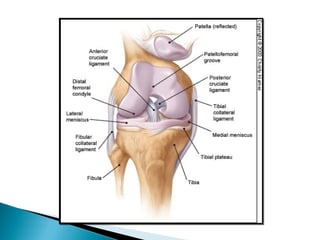
1) Fibrous capsule
2) Ligamentum patellae
3) Tibial collateral or medial ligament
4) Fibular collateral or lateral ligament
5) Oblique popliteal ligament
6) Arcuate popliteal ligament
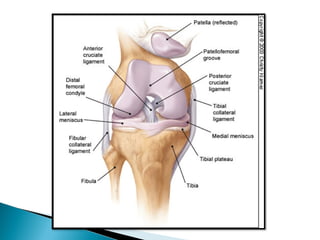
7) Anterior cruciate ligament
8) Posterior cruciate ligament
9) Medial meniscus
10) Lateral meniscus
11) Transverse ligament
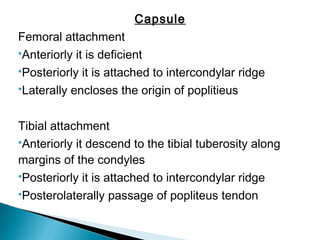
Capsule
Femoral attachment
Anteriorly it is deficient
Posteriorly it is attached to intercondylar ridge
Laterally encloses the origin of poplitieus
Tibial attachment
Anteriorly it descend to the tibial tuberosity along
margins of the condyles
Posteriorly it is attached to intercondylar ridge
Posterolaterally passage of popliteus tendon
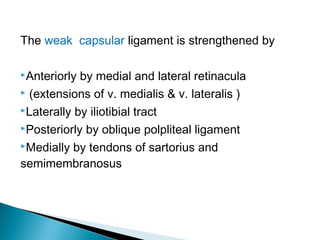
The weak capsular ligament is strengthened by
Anteriorly by medial and lateral retinacula
 (extensions of v. medialis & v. lateralis )
Laterally by iliotibial tract
Posteriorly by oblique polpliteal ligament
Medially by tendons of sartorius and
semimembranosus
Ligamentum patellae
Attachment
Above – margins and rough posterior margins of
patellar retinacular
Below- smooth upper part of tibial tuberosity
Related to deep and superficial infrapatella bursa ,
infrapatella pad of fat
Tibial collateral or medial ligament
This is a long band of great strength
Attachments
Superioly –medial epicondyle of femur
Inferioly -anterior part & posterior part
Anterior part- below to medial border of medial surface
of shaft of tibia
(covers inferior medial genicular vessels and nerve
,anterior part of semimembranosus tendon)
Posterior part – medial condyl of tibia above groove for
semetendinosus
(blends with medail meniscus and capsule)
 Fibular collateral or lateral ligament
 Strong and code like ligament
 Attachments
 Superiorly –lateral epicondyle of femur below to
popliteal groove
 Inferiorly head of fibula in front of its apex
 (it is separated from lateral meniscus from capsule
and tendon of popliteus)
 Oblique popliteal ligament
 This is an expansion of semimembranosus tendon
which runs upwards and laterally
 Attached to intracondylar line and lateral condyle
of femur
 Have a close relation with popliteal artery
Arcuate popliteal ligament
Posterior expansion of short lateral ligament
It expands backwards from head of the fibula ,
arches over tendon of poplitieus and attached to
the posterior border of intracondylar region of tibia
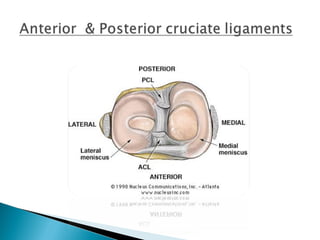
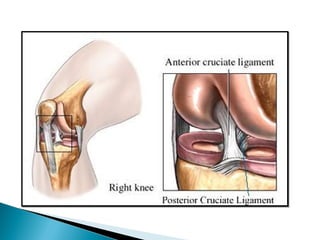
Anterior & Posterior cruciate ligaments
Both are very strong and thick fibrous bands they
act directly to maintain anteroposterior stability of
knee joint
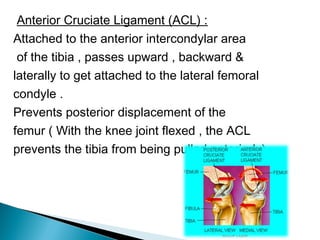
Anterior Cruciate Ligament (ACL) :
Attached to the anterior intercondylar area
of the tibia , passes upward , backward &
laterally to get attached to the lateral femoral
condyle .
Prevents posterior displacement of the
femur ( With the knee joint flexed , the ACL
prevents the tibia from being pulled anteriorly)
~ Posterior Cruciate Ligament (PCL)
 Attached to the posterior intercondylar area of
the tibia , passes upward , forward , & medially
to get attached to the medial femoral condyle.
 Prevents anterior displacement of the femur
( With the knee joint flexed , the PCL prevents
the tibia from being pulled posteriorly ).
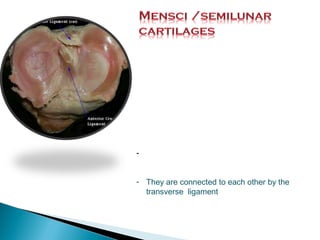
- The medial and lateral menisci are 2 C-
shaped sheets of fibrocartilage between the
tibial & femoral condyles
- Their peripheral border is thick & attached to
the capsule and vascular
their inner border is thin & forms a free edge
and avascular
- Each meniscus is attached to the upper
surface of the tibia by anterior & posteriorly
- They are connected to each other by the
transverse ligament and to the margins of
the head of the tibia by coronary ligaments.
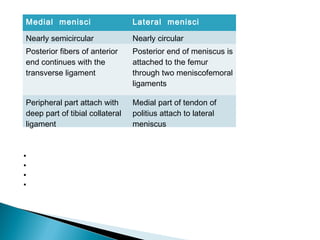
Medial menisci Lateral menisci
Nearly semicircular Nearly circular
Posterior fibers of anterior
end continues with the
transverse ligament
Posterior end of meniscus is
attached to the femur
through two meniscofemoral
ligaments
Peripheral part attach with
deep part of tibial collateral
ligament
Medial part of tendon of
politius attach to lateral
meniscus
Functions
•Make articular surfaces more congruent
•Act as shock absorbers
•Lubricate joint cavity
•Give rise to proprioceptive impulses due to their nerve supply
 Synovial membrane lines the capsule except
posteriorly where it is forwards by cruciate
ligaments
 In front it is absent from patella
 Below it covers the deep surface of infrapatellar
fatty pad
 Medially the infrapatellar synovial fold extend
backwards from fatty pad to intercondylar fossa of
femur
 There are 13 bursae around knee joint
 4 anteriorly
 4 laterally
 5 medially
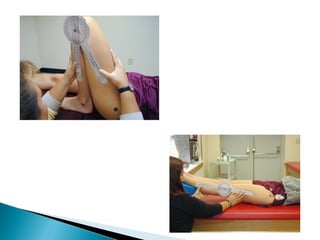
 Flexion and extension are take place in upper
compartment of the joint
 Flexion : these muscles produce flexion :
 Biceps femoris , Semitendinosus ,
Semimembranosus , Gracilis, Sartorius , Popliteus .
 Flexion is limited by the contact of the back of the leg
with the thigh .
 Extension : by the Quadriceps femoris , tensor
fasciae latae
 Extension is limited by the tension of all the ligaments
of the joint .
Flexion
Extension
 Raotatry movements at the knee take place in
lower compartment around a vertical axis
- Medial Rotation : by the Semtendinosus ,
Semimembranosus, Popliteus Sartorius ,
Gracilis
 - Lateral Rotation : by the Biceps femoris .
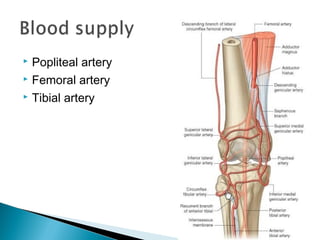
 Popliteal artery
 Femoral artery
 Tibial artery
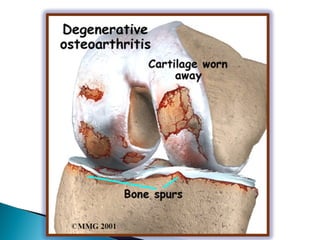
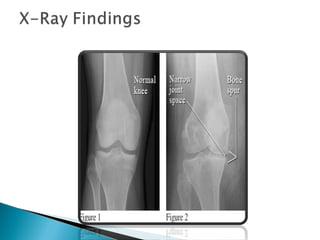
 Osteoarthritis (OA) : a chronic inflammatory joint
disorder in which there’s progressive softening &
destruction of the articular cartilage , accompanied
by new growth of cartilage and bone at the joint
margins (osteophytes) and capsular fibrosis...
leading to bone exposure & severe pain .
 OA is the most common joint disease.
 The knee is the most common site.
 Risk factors:
 age .
 obesity.
 Family
 Predisposing factors :
 Articular surface injury .
 Torn meniscus .
 Ligament instability .
 Preexisting deformity .
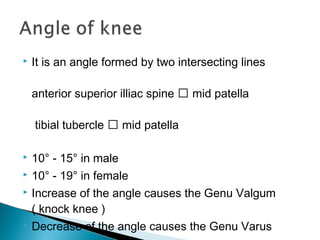
 It is an angle formed by two intersecting lines
anterior superior illiac spine  mid patella
tibial tubercle  mid patella
 10° - 15° in male
 10° - 19° in female
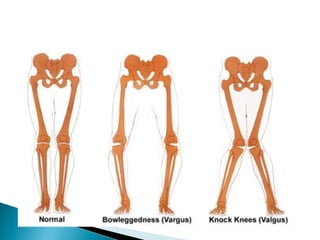
 Increase of the angle causes the Genu Valgum
( knock knee )
 Decrease of the angle causes the Genu Varus
 Injuries to menisci
 Injuries to crucial ligaments
 Injuries to collateral ligaments
knee joint anatomy and clinical

knee joint anatomy and clinical

  • 1.
  • 2.
    Content Type of joint Articularsurfaces Ligaments Synovial membrane Mobility of the joint
  • 3.
    - The KneeJoint is the largest & most complicated joint in the body . - It consists of 3 Joints within a single synovial cavity : 1) Medial Condylar Joint : Between the medial condyle “of the femur” & the medial condyle “of the tibia” . 2) Lateral Condylar Joint : Between the lateral condyle “of the femur” & the lateral condyle “of the tibia” . 3) Patellofemoral Joint : Between the patella & the patellar surface of the femur . - The fibula is NOT directly involved in the joint .
  • 4.
     Types : - 1 & 2 : Hinge joint.  - 3 : Planar gliding .
  • 5.
    1) Fibrous capsule 2)Ligamentum patellae 3) Tibial collateral or medial ligament 4) Fibular collateral or lateral ligament 5) Oblique popliteal ligament 6) Arcuate popliteal ligament 7) Anterior cruciate ligament 8) Posterior cruciate ligament 9) Medial meniscus 10) Lateral meniscus 11) Transverse ligament
  • 7.
    Capsule Femoral attachment Anteriorly itis deficient Posteriorly it is attached to intercondylar ridge Laterally encloses the origin of poplitieus Tibial attachment Anteriorly it descend to the tibial tuberosity along margins of the condyles Posteriorly it is attached to intercondylar ridge Posterolaterally passage of popliteus tendon
  • 8.
    The weak capsularligament is strengthened by Anteriorly by medial and lateral retinacula  (extensions of v. medialis & v. lateralis ) Laterally by iliotibial tract Posteriorly by oblique polpliteal ligament Medially by tendons of sartorius and semimembranosus
  • 9.
    Ligamentum patellae Attachment Above –margins and rough posterior margins of patellar retinacular Below- smooth upper part of tibial tuberosity Related to deep and superficial infrapatella bursa , infrapatella pad of fat
  • 10.
    Tibial collateral ormedial ligament This is a long band of great strength Attachments Superioly –medial epicondyle of femur Inferioly -anterior part & posterior part Anterior part- below to medial border of medial surface of shaft of tibia (covers inferior medial genicular vessels and nerve ,anterior part of semimembranosus tendon) Posterior part – medial condyl of tibia above groove for semetendinosus (blends with medail meniscus and capsule)
  • 11.
     Fibular collateralor lateral ligament  Strong and code like ligament  Attachments  Superiorly –lateral epicondyle of femur below to popliteal groove  Inferiorly head of fibula in front of its apex  (it is separated from lateral meniscus from capsule and tendon of popliteus)
  • 12.
     Oblique poplitealligament  This is an expansion of semimembranosus tendon which runs upwards and laterally  Attached to intracondylar line and lateral condyle of femur  Have a close relation with popliteal artery
  • 13.
    Arcuate popliteal ligament Posteriorexpansion of short lateral ligament It expands backwards from head of the fibula , arches over tendon of poplitieus and attached to the posterior border of intracondylar region of tibia Anterior & Posterior cruciate ligaments Both are very strong and thick fibrous bands they act directly to maintain anteroposterior stability of knee joint
  • 17.
    Anterior Cruciate Ligament(ACL) : Attached to the anterior intercondylar area of the tibia , passes upward , backward & laterally to get attached to the lateral femoral condyle . Prevents posterior displacement of the femur ( With the knee joint flexed , the ACL prevents the tibia from being pulled anteriorly)
  • 18.
    ~ Posterior CruciateLigament (PCL)  Attached to the posterior intercondylar area of the tibia , passes upward , forward , & medially to get attached to the medial femoral condyle.  Prevents anterior displacement of the femur ( With the knee joint flexed , the PCL prevents the tibia from being pulled posteriorly ).
  • 19.
    - The medialand lateral menisci are 2 C- shaped sheets of fibrocartilage between the tibial & femoral condyles - Their peripheral border is thick & attached to the capsule and vascular their inner border is thin & forms a free edge and avascular - Each meniscus is attached to the upper surface of the tibia by anterior & posteriorly - They are connected to each other by the transverse ligament and to the margins of the head of the tibia by coronary ligaments.
  • 20.
    Medial menisci Lateralmenisci Nearly semicircular Nearly circular Posterior fibers of anterior end continues with the transverse ligament Posterior end of meniscus is attached to the femur through two meniscofemoral ligaments Peripheral part attach with deep part of tibial collateral ligament Medial part of tendon of politius attach to lateral meniscus Functions •Make articular surfaces more congruent •Act as shock absorbers •Lubricate joint cavity •Give rise to proprioceptive impulses due to their nerve supply
  • 21.
     Synovial membranelines the capsule except posteriorly where it is forwards by cruciate ligaments  In front it is absent from patella  Below it covers the deep surface of infrapatellar fatty pad  Medially the infrapatellar synovial fold extend backwards from fatty pad to intercondylar fossa of femur
  • 22.
     There are13 bursae around knee joint  4 anteriorly  4 laterally  5 medially
  • 23.
     Flexion andextension are take place in upper compartment of the joint  Flexion : these muscles produce flexion :  Biceps femoris , Semitendinosus , Semimembranosus , Gracilis, Sartorius , Popliteus .  Flexion is limited by the contact of the back of the leg with the thigh .  Extension : by the Quadriceps femoris , tensor fasciae latae  Extension is limited by the tension of all the ligaments of the joint .
  • 24.
  • 25.
     Raotatry movementsat the knee take place in lower compartment around a vertical axis - Medial Rotation : by the Semtendinosus , Semimembranosus, Popliteus Sartorius , Gracilis  - Lateral Rotation : by the Biceps femoris .
  • 27.
     Popliteal artery Femoral artery  Tibial artery
  • 28.
     Osteoarthritis (OA): a chronic inflammatory joint disorder in which there’s progressive softening & destruction of the articular cartilage , accompanied by new growth of cartilage and bone at the joint margins (osteophytes) and capsular fibrosis... leading to bone exposure & severe pain .  OA is the most common joint disease.  The knee is the most common site.
  • 30.
     Risk factors: age .  obesity.  Family  Predisposing factors :  Articular surface injury .  Torn meniscus .  Ligament instability .  Preexisting deformity .
  • 32.
     It isan angle formed by two intersecting lines anterior superior illiac spine  mid patella tibial tubercle  mid patella  10° - 15° in male  10° - 19° in female  Increase of the angle causes the Genu Valgum ( knock knee )  Decrease of the angle causes the Genu Varus
  • 34.
     Injuries tomenisci  Injuries to crucial ligaments  Injuries to collateral ligaments