PRESENTOR- UMESH YADAV
SURGICAL APPROACHES TO HIP JOINT
UMY
BACK TO BASICS- ANATOMY REVISION
UMY
UMY
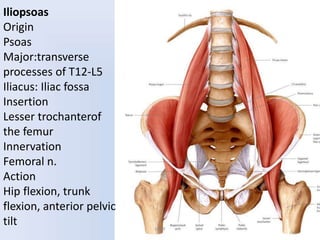
Iliopsoas
Origin
Psoas
Major:transverse
processes of T12-L5
Iliacus: Iliac fossa
Insertion
Lesser trochanterof
the femur
Innervation
Femoral n.
Action
Hip flexion, trunk
flexion, anterior pelvic
tilt UMY
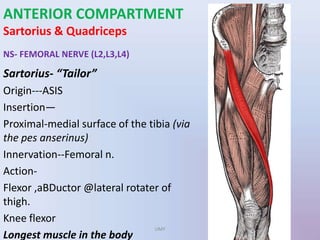
ANTERIOR COMPARTMENT
Sartorius & Quadriceps
NS- FEMORAL NERVE (L2,L3,L4)
Sartorius- “Tailor”
Origin---ASIS
Insertion—
Proximal-medial surface of the tibia (via
the pes anserinus)
Innervation--Femoral n.
Action-
Flexor ,aBDuctor @lateral rotater of
thigh.
Knee flexor
Longest muscle in the body
UMY
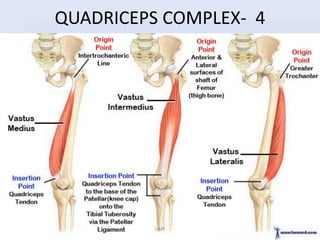
QUADRICEPS COMPLEX- 4
UMY
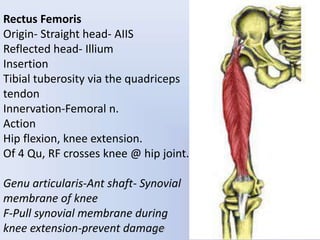
Rectus Femoris

Origin- Straight head- AIIS
Reflected head- Illium
Insertion
Tibial tuberosity via the quadriceps
tendon
Innervation-Femoral n.
Action
Hip flexion, knee extension.
Of 4 Qu, RF crosses knee @ hip joint.
Genu articularis-Ant shaft- Synovial
membrane of knee
F-Pull synovial membrane during
knee extension-prevent damageUMY
MEDIAL COMPARTMENT
(ADDUCTOR COMPARTMENT)
• Adductor Longus
• Adductor brevis
• Adductor magnus
• Gracilis
• Pectineus
• Nerve supply- Obturator Nerve
UMY
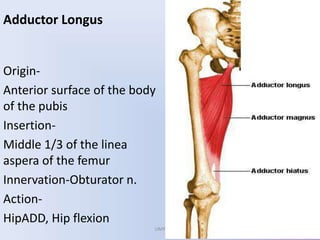
Adductor Longus
Origin-
Anterior surface of the body
of the pubis
Insertion-
Middle 1/3 of the linea
aspera of the femur
Innervation-Obturator n.
Action-
HipADD, Hip flexion
UMY
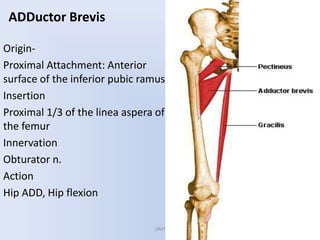
ADDuctor Brevis
Origin-
Proximal Attachment: Anterior
surface of the inferior pubic ramus
Insertion
Proximal 1/3 of the linea aspera of
the femur
Innervation
Obturator n.
Action
Hip ADD, Hip flexion
UMY
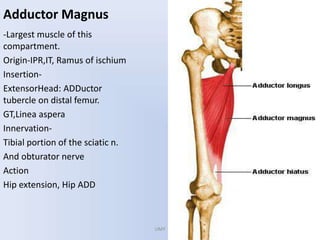
Adductor Magnus
-Largest muscle of this
compartment.
Origin-IPR,IT, Ramus of ischium
Insertion-
ExtensorHead: ADDuctor
tubercle on distal femur.
GT,Linea aspera
Innervation-
Tibial portion of the sciatic n.
And obturator nerve
Action
Hip extension, Hip ADD
UMY
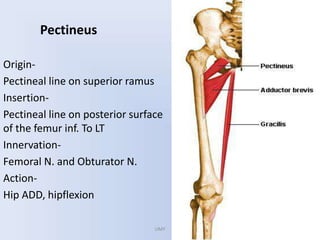
Pectineus
Origin-
Pectineal line on superior ramus
Insertion-
Pectineal line on posterior surface
of the femur inf. To LT
Innervation-
Femoral N. and Obturator N.
Action-
Hip ADD, hipflexion
UMY
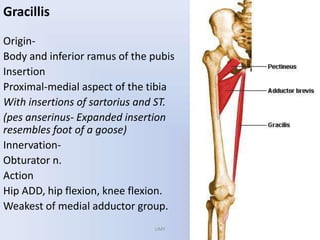
Gracillis
Origin-
Body and inferior ramus of the pubis
Insertion
Proximal-medial aspect of the tibia
With insertions of sartorius and ST.
(pes anserinus- Expanded insertion
resembles foot of a goose)
Innervation-
Obturator n.
Action
Hip ADD, hip flexion, knee flexion.
Weakest of medial adductor group.
UMY
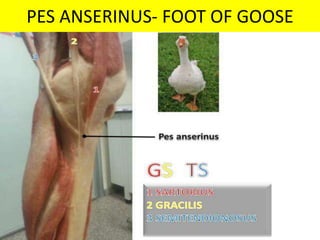
PES ANSERINUS- FOOT OF GOOSE
UMY
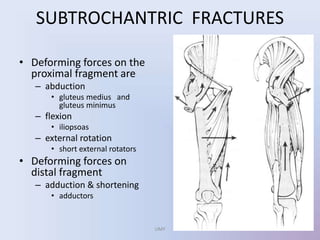
SUBTROCHANTRIC FRACTURES
• Deforming forces on the
proximal fragment are
– abduction
• gluteus medius and
gluteus minimus
– flexion
• iliopsoas
– external rotation
• short external rotators
• Deforming forces on
distal fragment
– adduction & shortening
• adductors
UMY
POSTERIOR ASPECT
HAMSTRINGS
NS- TIBIAL PART OF SCIATIC NERVE
UMY
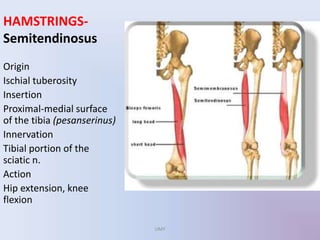
HAMSTRINGS-
Semitendinosus
Origin
Ischial tuberosity
Insertion
Proximal-medial surface
of the tibia (pesanserinus)
Innervation
Tibial portion of the
sciatic n.
Action
Hip extension, knee
flexion
UMY
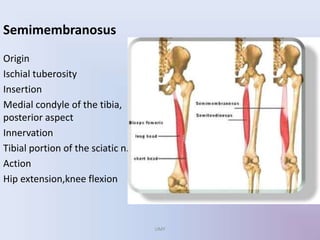
Semimembranosus
Origin
Ischial tuberosity
Insertion
Medial condyle of the tibia,
posterior aspect
Innervation
Tibial portion of the sciatic n.
Action
Hip extension,knee flexion
UMY
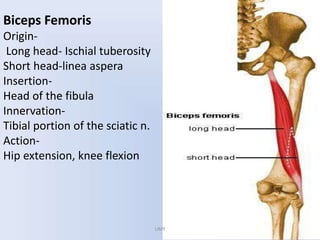
Biceps Femoris
Origin-
Long head- Ischial tuberosity
Short head-linea aspera
Insertion-
Head of the fibula
Innervation-
Tibial portion of the sciatic n.
Action-
Hip extension, knee flexion
UMY
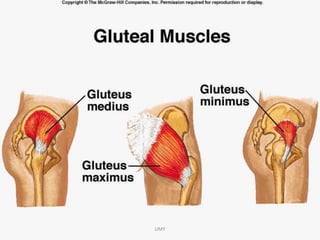
GLUTEAL REGION
UMY
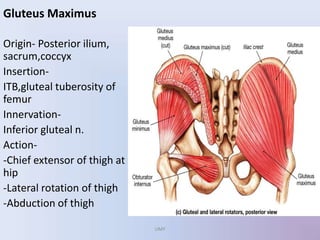
Gluteus Maximus
Origin- Posterior ilium,
sacrum,coccyx
Insertion-
ITB,gluteal tuberosity of
femur
Innervation-
Inferior gluteal n.
Action-
-Chief extensor of thigh at
hip
-Lateral rotation of thigh
-Abduction of thigh
UMY
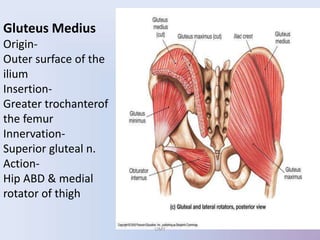
Gluteus Medius
Origin-
Outer surface of the
ilium
Insertion-
Greater trochanterof
the femur
Innervation-
Superior gluteal n.
Action-
Hip ABD & medial
rotator of thigh
UMY
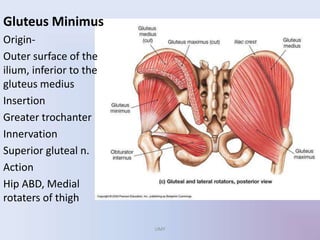
Gluteus Minimus
Origin-
Outer surface of the
ilium, inferior to the
gluteus medius
Insertion
Greater trochanter
Innervation
Superior gluteal n.
Action
Hip ABD, Medial
rotaters of thigh
UMY
UMY
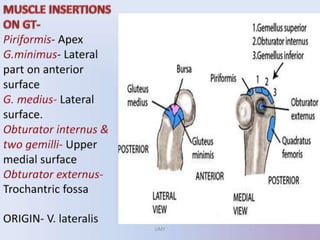
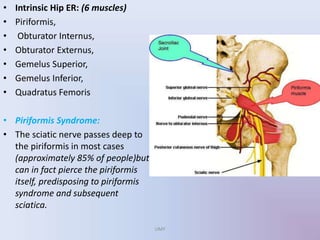
• Intrinsic Hip ER: (6 muscles)
• Piriformis,
• Obturator Internus,
• Obturator Externus,
• Gemelus Superior,
• Gemelus Inferior,
• Quadratus Femoris
• Piriformis Syndrome:
• The sciatic nerve passes deep to
the piriformis in most cases
(approximately 85% of people)but
can in fact pierce the piriformis
itself, predisposing to piriformis
syndrome and subsequent
sciatica.
UMY
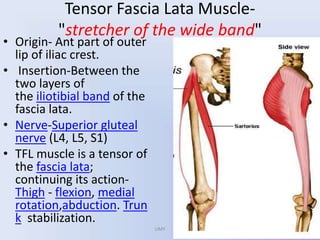
Tensor Fascia Lata Muscle-
"stretcher of the wide band"
• Origin- Ant part of outer
lip of iliac crest.
• Insertion-Between the
two layers of
the iliotibial band of the
fascia lata.
• Nerve-Superior gluteal
nerve (L4, L5, S1)
• TFL muscle is a tensor of
the fascia lata;
continuing its action-
Thigh - flexion, medial
rotation,abduction. Trun
k stabilization.
UMY
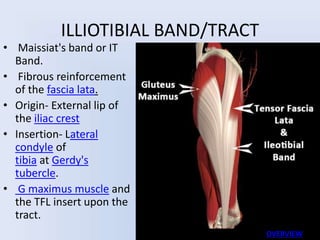
ILLIOTIBIAL BAND/TRACT
• Maissiat's band or IT
Band.
• Fibrous reinforcement
of the fascia lata.
• Origin- External lip of
the iliac crest
• Insertion- Lateral
condyle of
tibia at Gerdy's
tubercle.
• G maximus muscle and
the TFL insert upon the
tract.
UMY
OVERVIEW
UMY
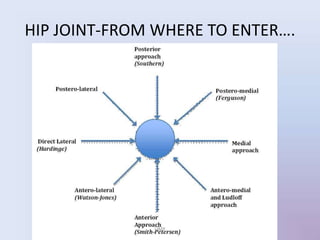
HIP JOINT-FROM WHERE TO ENTER….
UMY
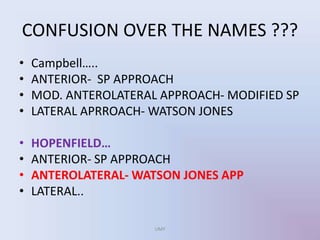
CONFUSION OVER THE NAMES ???
• Campbell…..
• ANTERIOR- SP APPROACH
• MOD. ANTEROLATERAL APPROACH- MODIFIED SP
• LATERAL APRROACH- WATSON JONES
• HOPENFIELD…
• ANTERIOR- SP APPROACH
• ANTEROLATERAL- WATSON JONES APP
• LATERAL..
UMY
ANTERIOR ILIOFEMORAL APPROACH:
(SMITH PETERSON APPROACH)
Gives safe access to hip & ilLium
INDICATIONS:
• Open reduction of congenital dislocations of hip when dislocated
femoral head is anterosup. to the true acetabulum
• Synovial biopsies
• Intra articular fusions
• THR
• Hemiarthroplasty
• Excision of tumors
• Pelvic osteotomies using upper part of approach
UMY
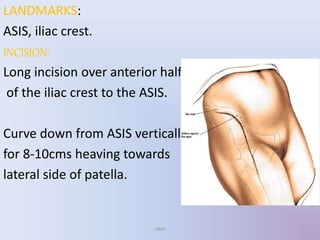
LANDMARKS:
ASIS, iliac crest.
INCISION:
Long incision over anterior half
of the iliac crest to the ASIS.
Curve down from ASIS vertically
for 8-10cms heaving towards
lateral side of patella.
UMY
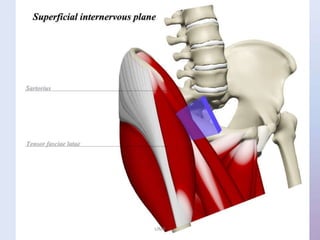
INTERNERVOUS PLANE:
Superficial plane b/w Sartorius (innervated by
femoral N.) & TFL(innervated by Sup.glut.N)
Deep plane lies b/w RF (by femoral N.) &
G.medius ( by Sup.glut.N.)
UMY
UMY
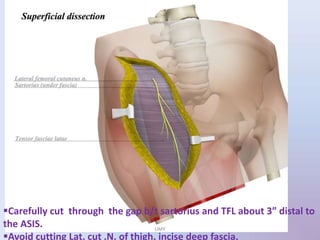
Carefully cut through the gap b/t sartorius and TFL about 3” distal to
the ASIS.
Avoid cutting Lat. cut .N. of thigh, incise deep fascia.
UMY
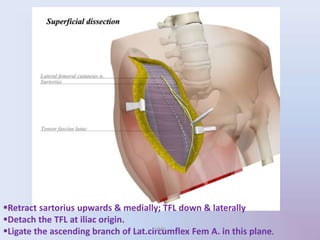
Retract sartorius upwards & medially; TFL down & laterally
Detach the TFL at iliac origin.
Ligate the ascending branch of Lat.circumflex Fem A. in this plane.UMY
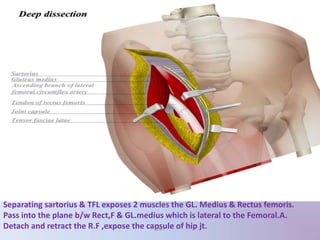
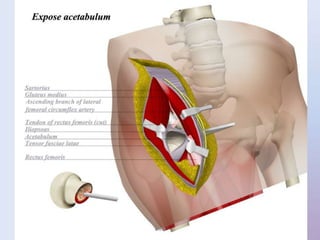
Separating sartorius & TFL exposes 2 muscles the GL. Medius & Rectus femoris.
Pass into the plane b/w Rect,F & GL.medius which is lateral to the Femoral.A.
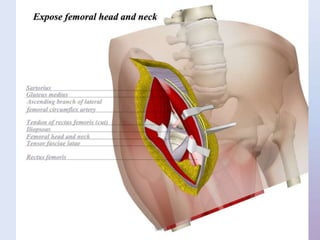
Detach and retract the R.F ,expose the capsule of hip jt.UMY
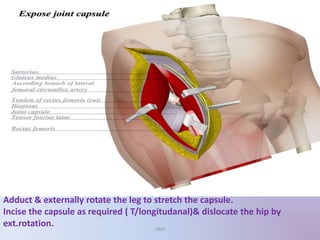
Adduct & externally rotate the leg to stretch the capsule.
Incise the capsule as required ( T/longitudanal)& dislocate the hip by
ext.rotation. UMY
UMY
UMY
DANGERS:
NERVES:
LFCN. of thigh- may be injured b/w sartorius & TFL.
Femoral N. – may be injured if plane is missed during deep dissection as
it lies anterior to hip , medial to RF, lateral to the femoralA.
VESSELS:
Ascending branch of Lat.Circumflex F.A.- May be injured in the plane
b/t TFL & Sartorius.
ENLARGING THE APPROACH:
PROXIMAL EXTENSION- For bone graft harvesting
DISTAL EXTENSION- For intraoperative fracture of distal femur
In superficial dissection - by detaching sartorius at the origin.
In deep dissection- Stay in plane b/w vastus lateralis & rectus femoris.
UMY
• Reattachment of fascia lata to iliac crest difficult
• Osteotomy of overhang of iliac crest is performed
b/w Ext. Oblique medially & fascia lata to as far as
origin of g.maximus.
• TFL, G.medius & G.minimus dissected
subperiosteally to expose hip joint capsule.
• Closure – Iliac osteotomy fragment reattached with
non-absorbable sutures through holes drilled.
SCHAUBEL MODIFICATION OF SP
ANTERIOR APPROACH
UMY
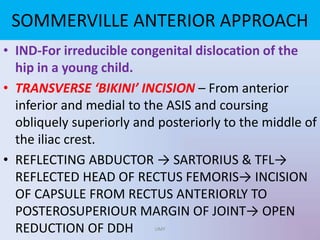
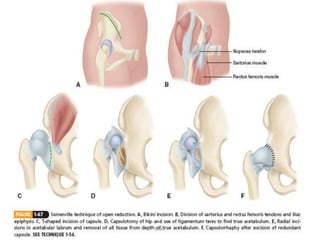
• IND-For irreducible congenital dislocation of the
hip in a young child.
• TRANSVERSE ‘BIKINI’ INCISION – From anterior
inferior and medial to the ASIS and coursing
obliquely superiorly and posteriorly to the middle of
the iliac crest.
• REFLECTING ABDUCTOR → SARTORIUS & TFL→
REFLECTED HEAD OF RECTUS FEMORIS→ INCISION
OF CAPSULE FROM RECTUS ANTERIORLY TO
POSTEROSUPERIOUR MARGIN OF JOINT→ OPEN
REDUCTION OF DDH
SOMMERVILLE ANTERIOR APPROACH
UMY
UMY
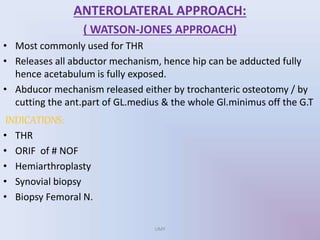
ANTEROLATERAL APPROACH:
( WATSON-JONES APPROACH)
• Most commonly used for THR
• Releases all abductor mechanism, hence hip can be adducted fully
hence acetabulum is fully exposed.
• Abducor mechanism released either by trochanteric osteotomy / by
cutting the ant.part of GL.medius & the whole Gl.minimus off the G.T
INDICATIONS:
• THR
• ORIF of # NOF
• Hemiarthroplasty
• Synovial biopsy
• Biopsy Femoral N.
UMY
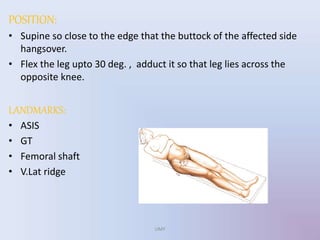
POSITION:
• Supine so close to the edge that the buttock of the affected side
hangsover.
• Flex the leg upto 30 deg. , adduct it so that leg lies across the
opposite knee.
LANDMARKS:
• ASIS
• GT
• Femoral shaft
• V.Lat ridge
UMY
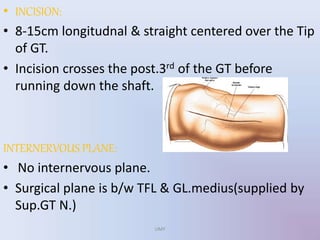
• INCISION:
• 8-15cm longitudnal & straight centered over the Tip
of GT.
• Incision crosses the post.3rd of the GT before
running down the shaft.
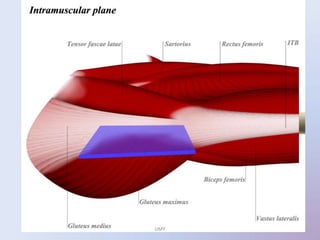
INTERNERVOUS PLANE:
• No internervous plane.
• Surgical plane is b/w TFL & GL.medius(supplied by
Sup.GT N.)
UMY
UMY
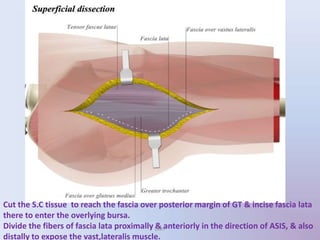
Cut the S.C tissue to reach the fascia over posterior margin of GT & incise fascia lata
there to enter the overlying bursa.
Divide the fibers of fascia lata proximally & anteriorly in the direction of ASIS, & also
distally to expose the vast,lateralis muscle.
UMY
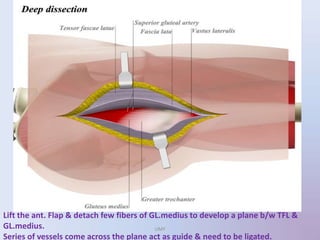
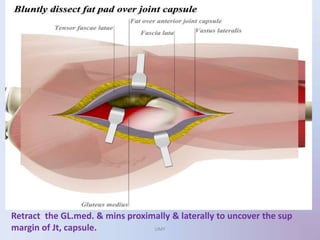
Lift the ant. Flap & detach few fibers of GL.medius to develop a plane b/w TFL &
GL.medius.
Series of vessels come across the plane act as guide & need to be ligated.
UMY
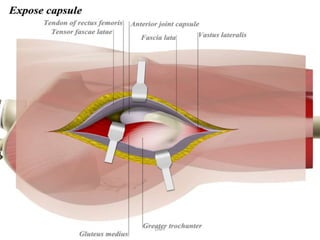
Retract the GL.med. & mins proximally & laterally to uncover the sup
margin of Jt, capsule. UMY
UMY
UMY
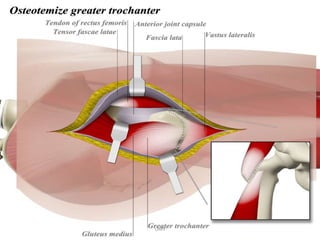
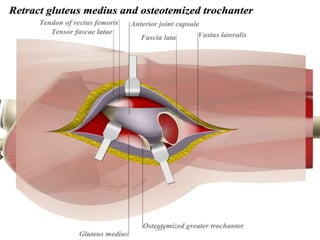
• 1)TROCHANTERIC OSTEOTOMY –ALLOWS
COMPLETE MOBILISATION OF G.MEDIUS AND
G.MINIMUS
• BASE OF OSTEOTMY IS AT BASE OF VASTUS
LATERALIS RIDGE
• 2)PARTIAL DETACHMENT OF ABDUCTOR
MECHANISM – A STAY SUTURE IN ANTERIOR
PORTION OF G.MEDIUS AND CUTTING THIS
PORTION OFF GT
• G.MINIMUS TENDON BELOW IS INCISED
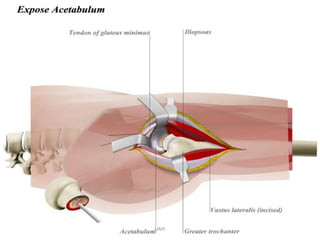
EXPOSURE OF ACETABULUM – NEUTRALISING ABDUCTOR
MECHANISM
UMY
UMY
UMY
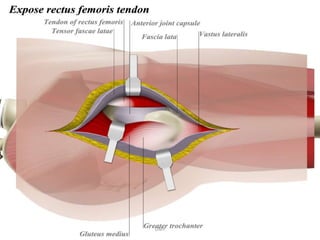
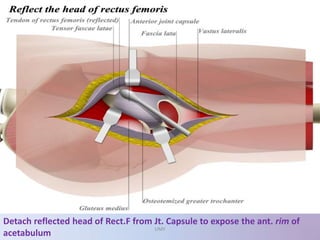
Detach reflected head of Rect.F from Jt. Capsule to expose the ant. rim of
acetabulum
UMY
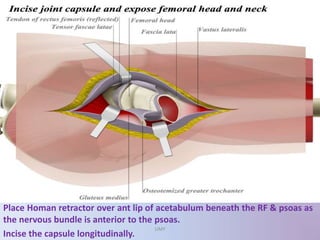
Place Homan retractor over ant lip of acetabulum beneath the RF & psoas as
the nervous bundle is anterior to the psoas.
Incise the capsule longitudinally.
UMY
• FEMORAL N-Not flexing the hip after dissecting
upto anterior rim of acetabulum
Placing retractors into substance of iliopsoas
Or overexuberant retraction can damage it..
• VESSELS – FEMORAL ARTERY & VEIN – damaged by
acetabular retractors that penetrate iliopsoas
substance.
Anterior retractors (R) – 1-o` clock position
(L) – 11-o` clock position.
• PROFUNDA FEMORIS ARTERY
• FEMORAL SHAFT# - while hip dislocation esp if
inadequate capsular release
DANGERS
UMY
LATERAL APPROACHTO HIP:
• Exellent approach to hip replacement.
• No need for trochanteric osteotomy.
• Early mobilisation of pt possible as the Gl.medius is
preserved.
• But not a wider approach as anterolateral approach.
POSITION:
Supine with GT at the edge of the table.
LANDMARKS:
ASIS
G.T
Shaft of femur UMY
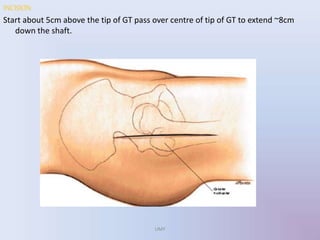
INCISION:
Start about 5cm above the tip of GT pass over centre of tip of GT to extend ~8cm
down the shaft.
UMY
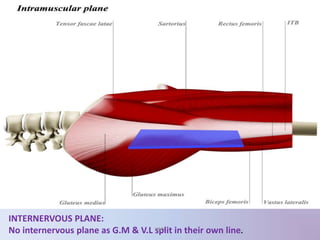
INTERNERVOUS PLANE:
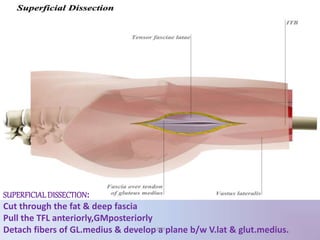
No internervous plane as G.M & V.L split in their own line.UMY
SUPERFICIALDISSECTION:
Cut through the fat & deep fascia
Pull the TFL anteriorly,GMposteriorly
Detach fibers of GL.medius & develop a plane b/w V.lat & glut.medius.UMY
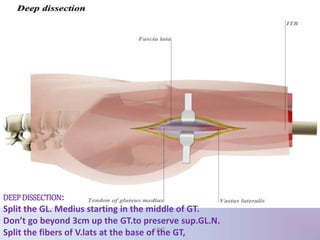
DEEPDISSECTION:
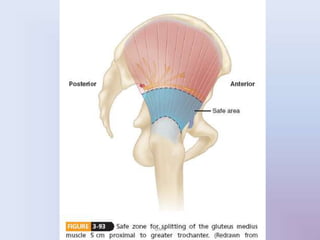
Split the GL. Medius starting in the middle of GT.
Don’t go beyond 3cm up the GT.to preserve sup.GL.N.
Split the fibers of V.lats at the base of the GT,UMY
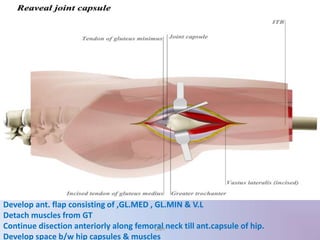
UMY
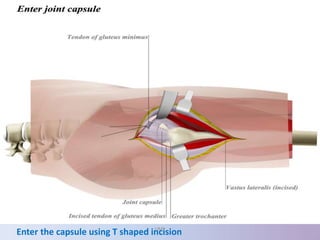
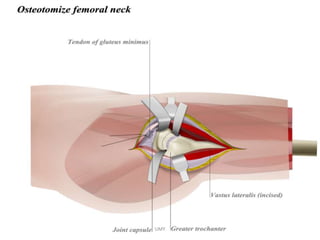
Develop ant. flap consisting of ,GL.MED , GL.MIN & V.L
Detach muscles from GT
Continue disection anteriorly along femoral neck till ant.capsule of hip.
Develop space b/w hip capsules & muscles
UMY
Enter the capsule using T shaped incisionUMY
UMY
UMY
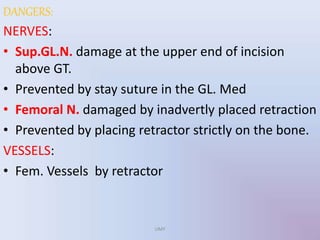
DANGERS:
NERVES:
• Sup.GL.N. damage at the upper end of incision
above GT.
• Prevented by stay suture in the GL. Med
• Femoral N. damaged by inadvertly placed retraction
• Prevented by placing retractor strictly on the bone.
VESSELS:
• Fem. Vessels by retractor
UMY
HARRIS APPROACH
• LATERAL APPROACH FOR EXTENSIVE EXPOSURE
OF THE HIP.
• Permits hip dislocation ant & post.
But requires GT osteotomy.
So risks are Trochanteric non-union,
Trochanteric bursitis,
Heterotopic ossification
UMY
SOME OTHER MODIFICATIONS
McFarland & Osborne lateral
approach
• Preserves the integrity of the
gluteus medius muscle.
• Combined mass of g.medius
& vastus lateralis with their
tendinous junction is elevated
& retracted anteriorly.
Hardinge lateral
Transgluteal approach
• Strong mobile tendon of
gluteus medius is incised
obliquely across GT leaving
posterior half still attached
to GT.
• GT Osteotomy is avoided.
UMY
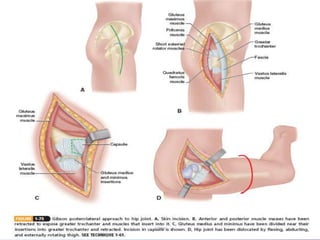
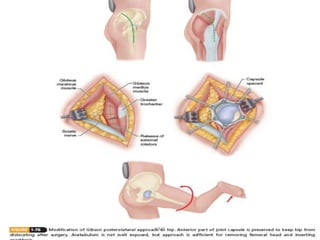
GIBSON MODIFIED KL incision making it more
anterior but still angled.
• Iliotibial band is incised along with its fibres,
gluteus medius & minimus are divided at their
insertions leaving enough tendon attached so
that closure is easy & post-op rehabilitation is
rapid
Gibson’s Posterolateral approach
UMY
UMY
Gibson Approach Modified
By Marcy and Fletcher
• For insertion of a prosthesis in which the hip is
dislocated by internal rotation .
• Anterior part of the joint capsule is preserved
to keep the hip from dislocating anteriorly
after surgery.
UMY
UMY
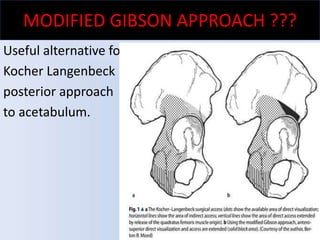
MODIFIED GIBSON APPROACH ???
Useful alternative for
Kocher Langenbeck
posterior approach
to acetabulum.
UMY
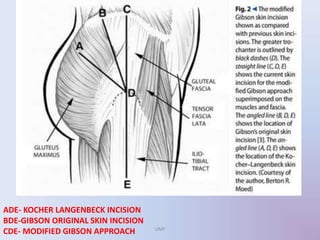
C
ADE- KOCHER LANGENBECK INCISION
BDE-GIBSON ORIGINAL SKIN INCISION
CDE- MODIFIED GIBSON APPROACH UMY
What are the modifications ???
• Making vertical skin incision.- More cosmetic in
obese female dec risk of postop “saddlebag” soft
tissue deformity.
• Limiting extent of hip joint capsultomy.
• Rather G Max splitting, interval between G max &
TFL is developed.So, vascular supply of ant portion
of G max is not at risk.
• Better anterosuperior visualization & access.
UMY
POSTERIOR APPROACH:
(MOORES APPROACH- SOUTHERN EXPOSURE)
• Most commonly used approach & practical
• Easy ,safe, quick
INDICATIONS:
Hemiarthroplasty
THR including revision
ORIF of post. Acetabular #
Dependent drainage in hip sepsis
Removal loose bodies
Pedicle bone grafting
Open reduction of posterior dislocation
UMY
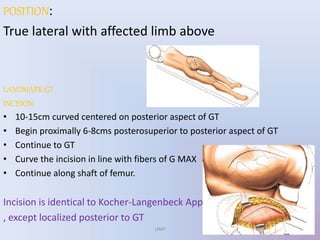
POSITION:
True lateral with affected limb above
LANDMARK:GT
INCISION:
• 10-15cm curved centered on posterior aspect of GT
• Begin proximally 6-8cms posterosuperior to posterior aspect of GT
• Continue to GT
• Curve the incision in line with fibers of G MAX
• Continue along shaft of femur.
Incision is identical to Kocher-Langenbeck App
, except localized posterior to GT
UMY
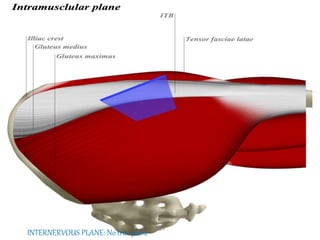
INTERNERVOUS PLANE: No true plane UMY
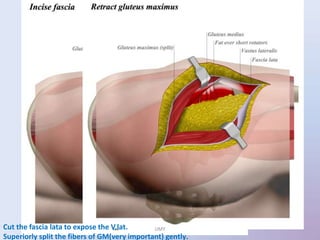
Cut the fascia lata to expose the V.lat.
Superiorly split the fibers of GM(very important) gently.
UMY
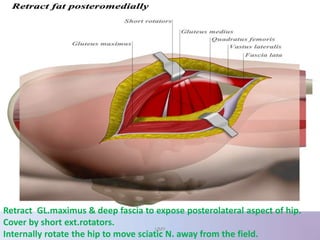
Retract GL.maximus & deep fascia to expose posterolateral aspect of hip.
Cover by short ext.rotators.
Internally rotate the hip to move sciatic N. away from the field.
UMY
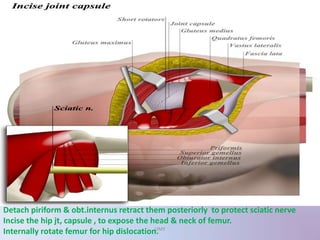
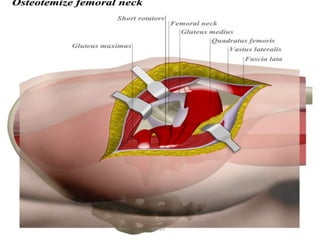
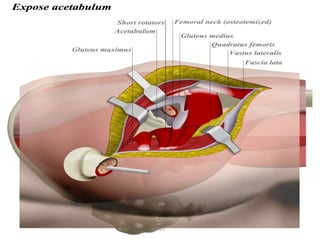
Detach piriform & obt.internus retract them posteriorly to protect sciatic nerve
Incise the hip jt, capsule , to expose the head & neck of femur.
Internally rotate femur for hip dislocation.UMY
UMY
UMY
DANGERS:
Sciatic Nerve-
PREVENTION- Extend hip & flex knee to prevent
-Gentle retraction & release short ext rotators.
VESSELS-
Inferior Gluteal A- Leaves below piriformis
Femoral vessels
UMY
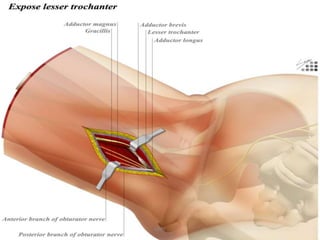
MEDIAL APPROACH
(LUDOLFFS APPROACH)
INDICATIONS:
• Open reduction of congenital dislocation of hip.
• Biopsy & RX of tumors of the inf.portion of femoral
neck & medial aspect of proximal shaft.
• Psoas release
• Obturator neurectomy.
• By making short transverse/longitudinal incision-
used for adductor release
UMY
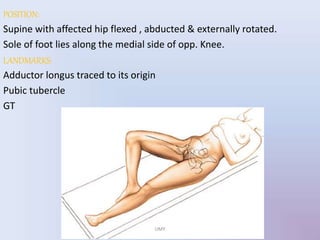
POSITION:
Supine with affected hip flexed , abducted & externally rotated.
Sole of foot lies along the medial side of opp. Knee.
LANDMARKS:
Adductor longus traced to its origin
Pubic tubercle
GT
UMY
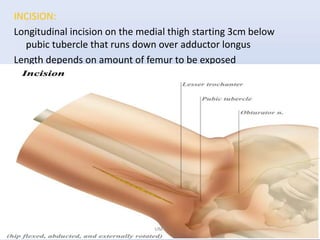
INCISION:
Longitudinal incision on the medial thigh starting 3cm below
pubic tubercle that runs down over adductor longus
Length depends on amount of femur to be exposed
UMY
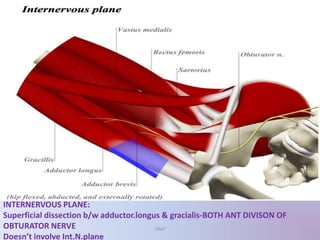
INTERNERVOUS PLANE:
Superficial dissection b/w adductor.longus & gracialis-BOTH ANT DIVISON OF
OBTURATOR NERVE
Doesn’t involve Int.N.plane
UMY
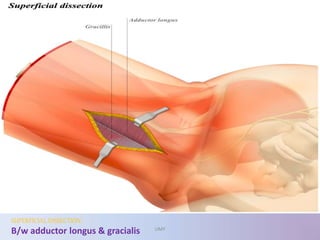
SUPERFICIAL DISSECTION:
B/w adductor longus & gracialis UMY
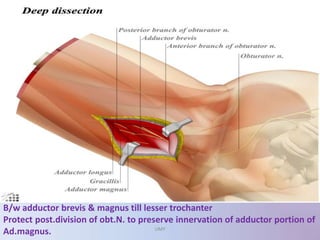
B/w adductor brevis & magnus till lesser trochanter
Protect post.division of obt.N. to preserve innervation of adductor portion of
Ad.magnus. UMY
UMY
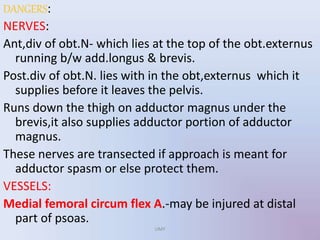
DANGERS:
NERVES:
Ant,div of obt.N- which lies at the top of the obt.externus
running b/w add.longus & brevis.
Post.div of obt.N. lies with in the obt,externus which it
supplies before it leaves the pelvis.
Runs down the thigh on adductor magnus under the
brevis,it also supplies adductor portion of adductor
magnus.
These nerves are transected if approach is meant for
adductor spasm or else protect them.
VESSELS:
Medial femoral circum flex A.-may be injured at distal
part of psoas.
UMY
QUESTION?????
• Which of the following approaches for total hip
arthroplasty is reported to have the lowest
prosthetic dislocation rate?
• 1. Posterior approach with posterior soft tissue
repair
• 2. Anterolateral (Watson Jones)
• 3. Direct lateral (Hardinge)
• 4. Transtrochanteric
• 5. Posterior approach without posterior soft
tissue repair
UMY
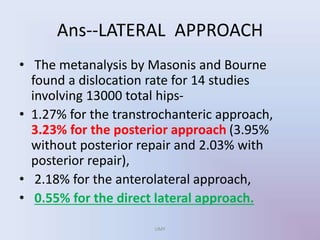
Ans--LATERAL APPROACH
• The metanalysis by Masonis and Bourne
found a dislocation rate for 14 studies
involving 13000 total hips-
• 1.27% for the transtrochanteric approach,
3.23% for the posterior approach (3.95%
without posterior repair and 2.03% with
posterior repair),
• 2.18% for the anterolateral approach,
• 0.55% for the direct lateral approach.
UMY
UMY
UMY

Approach to hip joint

  • 1.
    PRESENTOR- UMESH YADAV SURGICALAPPROACHES TO HIP JOINT UMY
  • 2.
    BACK TO BASICS-ANATOMY REVISION UMY
  • 3.
  • 4.
    Iliopsoas Origin Psoas Major:transverse processes of T12-L5 Iliacus:Iliac fossa Insertion Lesser trochanterof the femur Innervation Femoral n. Action Hip flexion, trunk flexion, anterior pelvic tilt UMY
  • 5.
    ANTERIOR COMPARTMENT Sartorius &Quadriceps NS- FEMORAL NERVE (L2,L3,L4) Sartorius- “Tailor” Origin---ASIS Insertion— Proximal-medial surface of the tibia (via the pes anserinus) Innervation--Femoral n. Action- Flexor ,aBDuctor @lateral rotater of thigh. Knee flexor Longest muscle in the body UMY
  • 6.
  • 7.
    Rectus Femoris Origin- Straighthead- AIIS Reflected head- Illium Insertion Tibial tuberosity via the quadriceps tendon Innervation-Femoral n. Action Hip flexion, knee extension. Of 4 Qu, RF crosses knee @ hip joint. Genu articularis-Ant shaft- Synovial membrane of knee F-Pull synovial membrane during knee extension-prevent damageUMY
  • 8.
    MEDIAL COMPARTMENT (ADDUCTOR COMPARTMENT) •Adductor Longus • Adductor brevis • Adductor magnus • Gracilis • Pectineus • Nerve supply- Obturator Nerve UMY
  • 9.
    Adductor Longus Origin- Anterior surfaceof the body of the pubis Insertion- Middle 1/3 of the linea aspera of the femur Innervation-Obturator n. Action- HipADD, Hip flexion UMY
  • 10.
    ADDuctor Brevis Origin- Proximal Attachment:Anterior surface of the inferior pubic ramus Insertion Proximal 1/3 of the linea aspera of the femur Innervation Obturator n. Action Hip ADD, Hip flexion UMY
  • 11.
    Adductor Magnus -Largest muscleof this compartment. Origin-IPR,IT, Ramus of ischium Insertion- ExtensorHead: ADDuctor tubercle on distal femur. GT,Linea aspera Innervation- Tibial portion of the sciatic n. And obturator nerve Action Hip extension, Hip ADD UMY
  • 12.
    Pectineus Origin- Pectineal line onsuperior ramus Insertion- Pectineal line on posterior surface of the femur inf. To LT Innervation- Femoral N. and Obturator N. Action- Hip ADD, hipflexion UMY
  • 13.
    Gracillis Origin- Body and inferiorramus of the pubis Insertion Proximal-medial aspect of the tibia With insertions of sartorius and ST. (pes anserinus- Expanded insertion resembles foot of a goose) Innervation- Obturator n. Action Hip ADD, hip flexion, knee flexion. Weakest of medial adductor group. UMY
  • 14.
    PES ANSERINUS- FOOTOF GOOSE UMY
  • 15.
    SUBTROCHANTRIC FRACTURES • Deformingforces on the proximal fragment are – abduction • gluteus medius and gluteus minimus – flexion • iliopsoas – external rotation • short external rotators • Deforming forces on distal fragment – adduction & shortening • adductors UMY
  • 16.
    POSTERIOR ASPECT HAMSTRINGS NS- TIBIALPART OF SCIATIC NERVE UMY
  • 17.
    HAMSTRINGS- Semitendinosus Origin Ischial tuberosity Insertion Proximal-medial surface ofthe tibia (pesanserinus) Innervation Tibial portion of the sciatic n. Action Hip extension, knee flexion UMY
  • 18.
    Semimembranosus Origin Ischial tuberosity Insertion Medial condyleof the tibia, posterior aspect Innervation Tibial portion of the sciatic n. Action Hip extension,knee flexion UMY
  • 19.
    Biceps Femoris Origin- Long head-Ischial tuberosity Short head-linea aspera Insertion- Head of the fibula Innervation- Tibial portion of the sciatic n. Action- Hip extension, knee flexion UMY
  • 20.
  • 21.
    Gluteus Maximus Origin- Posteriorilium, sacrum,coccyx Insertion- ITB,gluteal tuberosity of femur Innervation- Inferior gluteal n. Action- -Chief extensor of thigh at hip -Lateral rotation of thigh -Abduction of thigh UMY
  • 22.
    Gluteus Medius Origin- Outer surfaceof the ilium Insertion- Greater trochanterof the femur Innervation- Superior gluteal n. Action- Hip ABD & medial rotator of thigh UMY
  • 23.
    Gluteus Minimus Origin- Outer surfaceof the ilium, inferior to the gluteus medius Insertion Greater trochanter Innervation Superior gluteal n. Action Hip ABD, Medial rotaters of thigh UMY
  • 24.
  • 25.
    • Intrinsic HipER: (6 muscles) • Piriformis, • Obturator Internus, • Obturator Externus, • Gemelus Superior, • Gemelus Inferior, • Quadratus Femoris • Piriformis Syndrome: • The sciatic nerve passes deep to the piriformis in most cases (approximately 85% of people)but can in fact pierce the piriformis itself, predisposing to piriformis syndrome and subsequent sciatica. UMY
  • 26.
    Tensor Fascia LataMuscle- "stretcher of the wide band" • Origin- Ant part of outer lip of iliac crest. • Insertion-Between the two layers of the iliotibial band of the fascia lata. • Nerve-Superior gluteal nerve (L4, L5, S1) • TFL muscle is a tensor of the fascia lata; continuing its action- Thigh - flexion, medial rotation,abduction. Trun k stabilization. UMY
  • 27.
    ILLIOTIBIAL BAND/TRACT • Maissiat'sband or IT Band. • Fibrous reinforcement of the fascia lata. • Origin- External lip of the iliac crest • Insertion- Lateral condyle of tibia at Gerdy's tubercle. • G maximus muscle and the TFL insert upon the tract. UMY OVERVIEW
  • 28.
  • 29.
    HIP JOINT-FROM WHERETO ENTER…. UMY
  • 30.
    CONFUSION OVER THENAMES ??? • Campbell….. • ANTERIOR- SP APPROACH • MOD. ANTEROLATERAL APPROACH- MODIFIED SP • LATERAL APRROACH- WATSON JONES • HOPENFIELD… • ANTERIOR- SP APPROACH • ANTEROLATERAL- WATSON JONES APP • LATERAL.. UMY
  • 31.
    ANTERIOR ILIOFEMORAL APPROACH: (SMITHPETERSON APPROACH) Gives safe access to hip & ilLium INDICATIONS: • Open reduction of congenital dislocations of hip when dislocated femoral head is anterosup. to the true acetabulum • Synovial biopsies • Intra articular fusions • THR • Hemiarthroplasty • Excision of tumors • Pelvic osteotomies using upper part of approach UMY
  • 32.
    LANDMARKS: ASIS, iliac crest. INCISION: Longincision over anterior half of the iliac crest to the ASIS. Curve down from ASIS vertically for 8-10cms heaving towards lateral side of patella. UMY
  • 33.
    INTERNERVOUS PLANE: Superficial planeb/w Sartorius (innervated by femoral N.) & TFL(innervated by Sup.glut.N) Deep plane lies b/w RF (by femoral N.) & G.medius ( by Sup.glut.N.) UMY
  • 34.
  • 35.
    Carefully cut throughthe gap b/t sartorius and TFL about 3” distal to the ASIS. Avoid cutting Lat. cut .N. of thigh, incise deep fascia. UMY
  • 36.
    Retract sartorius upwards& medially; TFL down & laterally Detach the TFL at iliac origin. Ligate the ascending branch of Lat.circumflex Fem A. in this plane.UMY
  • 37.
    Separating sartorius &TFL exposes 2 muscles the GL. Medius & Rectus femoris. Pass into the plane b/w Rect,F & GL.medius which is lateral to the Femoral.A. Detach and retract the R.F ,expose the capsule of hip jt.UMY
  • 38.
    Adduct & externallyrotate the leg to stretch the capsule. Incise the capsule as required ( T/longitudanal)& dislocate the hip by ext.rotation. UMY
  • 39.
  • 40.
  • 41.
    DANGERS: NERVES: LFCN. of thigh-may be injured b/w sartorius & TFL. Femoral N. – may be injured if plane is missed during deep dissection as it lies anterior to hip , medial to RF, lateral to the femoralA. VESSELS: Ascending branch of Lat.Circumflex F.A.- May be injured in the plane b/t TFL & Sartorius. ENLARGING THE APPROACH: PROXIMAL EXTENSION- For bone graft harvesting DISTAL EXTENSION- For intraoperative fracture of distal femur In superficial dissection - by detaching sartorius at the origin. In deep dissection- Stay in plane b/w vastus lateralis & rectus femoris. UMY
  • 42.
    • Reattachment offascia lata to iliac crest difficult • Osteotomy of overhang of iliac crest is performed b/w Ext. Oblique medially & fascia lata to as far as origin of g.maximus. • TFL, G.medius & G.minimus dissected subperiosteally to expose hip joint capsule. • Closure – Iliac osteotomy fragment reattached with non-absorbable sutures through holes drilled. SCHAUBEL MODIFICATION OF SP ANTERIOR APPROACH UMY
  • 43.
    • IND-For irreduciblecongenital dislocation of the hip in a young child. • TRANSVERSE ‘BIKINI’ INCISION – From anterior inferior and medial to the ASIS and coursing obliquely superiorly and posteriorly to the middle of the iliac crest. • REFLECTING ABDUCTOR → SARTORIUS & TFL→ REFLECTED HEAD OF RECTUS FEMORIS→ INCISION OF CAPSULE FROM RECTUS ANTERIORLY TO POSTEROSUPERIOUR MARGIN OF JOINT→ OPEN REDUCTION OF DDH SOMMERVILLE ANTERIOR APPROACH UMY
  • 44.
  • 45.
    ANTEROLATERAL APPROACH: ( WATSON-JONESAPPROACH) • Most commonly used for THR • Releases all abductor mechanism, hence hip can be adducted fully hence acetabulum is fully exposed. • Abducor mechanism released either by trochanteric osteotomy / by cutting the ant.part of GL.medius & the whole Gl.minimus off the G.T INDICATIONS: • THR • ORIF of # NOF • Hemiarthroplasty • Synovial biopsy • Biopsy Femoral N. UMY
  • 46.
    POSITION: • Supine soclose to the edge that the buttock of the affected side hangsover. • Flex the leg upto 30 deg. , adduct it so that leg lies across the opposite knee. LANDMARKS: • ASIS • GT • Femoral shaft • V.Lat ridge UMY
  • 47.
    • INCISION: • 8-15cmlongitudnal & straight centered over the Tip of GT. • Incision crosses the post.3rd of the GT before running down the shaft. INTERNERVOUS PLANE: • No internervous plane. • Surgical plane is b/w TFL & GL.medius(supplied by Sup.GT N.) UMY
  • 48.
  • 49.
    Cut the S.Ctissue to reach the fascia over posterior margin of GT & incise fascia lata there to enter the overlying bursa. Divide the fibers of fascia lata proximally & anteriorly in the direction of ASIS, & also distally to expose the vast,lateralis muscle. UMY
  • 50.
    Lift the ant.Flap & detach few fibers of GL.medius to develop a plane b/w TFL & GL.medius. Series of vessels come across the plane act as guide & need to be ligated. UMY
  • 51.
    Retract the GL.med.& mins proximally & laterally to uncover the sup margin of Jt, capsule. UMY
  • 52.
  • 53.
  • 54.
    • 1)TROCHANTERIC OSTEOTOMY–ALLOWS COMPLETE MOBILISATION OF G.MEDIUS AND G.MINIMUS • BASE OF OSTEOTMY IS AT BASE OF VASTUS LATERALIS RIDGE • 2)PARTIAL DETACHMENT OF ABDUCTOR MECHANISM – A STAY SUTURE IN ANTERIOR PORTION OF G.MEDIUS AND CUTTING THIS PORTION OFF GT • G.MINIMUS TENDON BELOW IS INCISED EXPOSURE OF ACETABULUM – NEUTRALISING ABDUCTOR MECHANISM UMY
  • 55.
  • 56.
  • 57.
    Detach reflected headof Rect.F from Jt. Capsule to expose the ant. rim of acetabulum UMY
  • 58.
    Place Homan retractorover ant lip of acetabulum beneath the RF & psoas as the nervous bundle is anterior to the psoas. Incise the capsule longitudinally. UMY
  • 59.
    • FEMORAL N-Notflexing the hip after dissecting upto anterior rim of acetabulum Placing retractors into substance of iliopsoas Or overexuberant retraction can damage it.. • VESSELS – FEMORAL ARTERY & VEIN – damaged by acetabular retractors that penetrate iliopsoas substance. Anterior retractors (R) – 1-o` clock position (L) – 11-o` clock position. • PROFUNDA FEMORIS ARTERY • FEMORAL SHAFT# - while hip dislocation esp if inadequate capsular release DANGERS UMY
  • 60.
    LATERAL APPROACHTO HIP: •Exellent approach to hip replacement. • No need for trochanteric osteotomy. • Early mobilisation of pt possible as the Gl.medius is preserved. • But not a wider approach as anterolateral approach. POSITION: Supine with GT at the edge of the table. LANDMARKS: ASIS G.T Shaft of femur UMY
  • 61.
    INCISION: Start about 5cmabove the tip of GT pass over centre of tip of GT to extend ~8cm down the shaft. UMY
  • 62.
    INTERNERVOUS PLANE: No internervousplane as G.M & V.L split in their own line.UMY
  • 63.
    SUPERFICIALDISSECTION: Cut through thefat & deep fascia Pull the TFL anteriorly,GMposteriorly Detach fibers of GL.medius & develop a plane b/w V.lat & glut.medius.UMY
  • 64.
    DEEPDISSECTION: Split the GL.Medius starting in the middle of GT. Don’t go beyond 3cm up the GT.to preserve sup.GL.N. Split the fibers of V.lats at the base of the GT,UMY
  • 65.
  • 66.
    Develop ant. flapconsisting of ,GL.MED , GL.MIN & V.L Detach muscles from GT Continue disection anteriorly along femoral neck till ant.capsule of hip. Develop space b/w hip capsules & muscles UMY
  • 67.
    Enter the capsuleusing T shaped incisionUMY
  • 68.
  • 69.
  • 70.
    DANGERS: NERVES: • Sup.GL.N. damageat the upper end of incision above GT. • Prevented by stay suture in the GL. Med • Femoral N. damaged by inadvertly placed retraction • Prevented by placing retractor strictly on the bone. VESSELS: • Fem. Vessels by retractor UMY
  • 71.
    HARRIS APPROACH • LATERALAPPROACH FOR EXTENSIVE EXPOSURE OF THE HIP. • Permits hip dislocation ant & post. But requires GT osteotomy. So risks are Trochanteric non-union, Trochanteric bursitis, Heterotopic ossification UMY
  • 72.
    SOME OTHER MODIFICATIONS McFarland& Osborne lateral approach • Preserves the integrity of the gluteus medius muscle. • Combined mass of g.medius & vastus lateralis with their tendinous junction is elevated & retracted anteriorly. Hardinge lateral Transgluteal approach • Strong mobile tendon of gluteus medius is incised obliquely across GT leaving posterior half still attached to GT. • GT Osteotomy is avoided. UMY
  • 73.
    GIBSON MODIFIED KLincision making it more anterior but still angled. • Iliotibial band is incised along with its fibres, gluteus medius & minimus are divided at their insertions leaving enough tendon attached so that closure is easy & post-op rehabilitation is rapid Gibson’s Posterolateral approach UMY
  • 74.
  • 75.
    Gibson Approach Modified ByMarcy and Fletcher • For insertion of a prosthesis in which the hip is dislocated by internal rotation . • Anterior part of the joint capsule is preserved to keep the hip from dislocating anteriorly after surgery. UMY
  • 76.
  • 77.
    MODIFIED GIBSON APPROACH??? Useful alternative for Kocher Langenbeck posterior approach to acetabulum. UMY
  • 78.
    C ADE- KOCHER LANGENBECKINCISION BDE-GIBSON ORIGINAL SKIN INCISION CDE- MODIFIED GIBSON APPROACH UMY
  • 79.
    What are themodifications ??? • Making vertical skin incision.- More cosmetic in obese female dec risk of postop “saddlebag” soft tissue deformity. • Limiting extent of hip joint capsultomy. • Rather G Max splitting, interval between G max & TFL is developed.So, vascular supply of ant portion of G max is not at risk. • Better anterosuperior visualization & access. UMY
  • 80.
    POSTERIOR APPROACH: (MOORES APPROACH-SOUTHERN EXPOSURE) • Most commonly used approach & practical • Easy ,safe, quick INDICATIONS: Hemiarthroplasty THR including revision ORIF of post. Acetabular # Dependent drainage in hip sepsis Removal loose bodies Pedicle bone grafting Open reduction of posterior dislocation UMY
  • 81.
    POSITION: True lateral withaffected limb above LANDMARK:GT INCISION: • 10-15cm curved centered on posterior aspect of GT • Begin proximally 6-8cms posterosuperior to posterior aspect of GT • Continue to GT • Curve the incision in line with fibers of G MAX • Continue along shaft of femur. Incision is identical to Kocher-Langenbeck App , except localized posterior to GT UMY
  • 82.
    INTERNERVOUS PLANE: Notrue plane UMY
  • 83.
    Cut the fascialata to expose the V.lat. Superiorly split the fibers of GM(very important) gently. UMY
  • 84.
    Retract GL.maximus &deep fascia to expose posterolateral aspect of hip. Cover by short ext.rotators. Internally rotate the hip to move sciatic N. away from the field. UMY
  • 85.
    Detach piriform &obt.internus retract them posteriorly to protect sciatic nerve Incise the hip jt, capsule , to expose the head & neck of femur. Internally rotate femur for hip dislocation.UMY
  • 86.
  • 87.
  • 88.
    DANGERS: Sciatic Nerve- PREVENTION- Extendhip & flex knee to prevent -Gentle retraction & release short ext rotators. VESSELS- Inferior Gluteal A- Leaves below piriformis Femoral vessels UMY
  • 89.
    MEDIAL APPROACH (LUDOLFFS APPROACH) INDICATIONS: •Open reduction of congenital dislocation of hip. • Biopsy & RX of tumors of the inf.portion of femoral neck & medial aspect of proximal shaft. • Psoas release • Obturator neurectomy. • By making short transverse/longitudinal incision- used for adductor release UMY
  • 90.
    POSITION: Supine with affectedhip flexed , abducted & externally rotated. Sole of foot lies along the medial side of opp. Knee. LANDMARKS: Adductor longus traced to its origin Pubic tubercle GT UMY
  • 91.
    INCISION: Longitudinal incision onthe medial thigh starting 3cm below pubic tubercle that runs down over adductor longus Length depends on amount of femur to be exposed UMY
  • 92.
    INTERNERVOUS PLANE: Superficial dissectionb/w adductor.longus & gracialis-BOTH ANT DIVISON OF OBTURATOR NERVE Doesn’t involve Int.N.plane UMY
  • 93.
  • 94.
    B/w adductor brevis& magnus till lesser trochanter Protect post.division of obt.N. to preserve innervation of adductor portion of Ad.magnus. UMY
  • 95.
  • 96.
    DANGERS: NERVES: Ant,div of obt.N-which lies at the top of the obt.externus running b/w add.longus & brevis. Post.div of obt.N. lies with in the obt,externus which it supplies before it leaves the pelvis. Runs down the thigh on adductor magnus under the brevis,it also supplies adductor portion of adductor magnus. These nerves are transected if approach is meant for adductor spasm or else protect them. VESSELS: Medial femoral circum flex A.-may be injured at distal part of psoas. UMY
  • 97.
    QUESTION????? • Which ofthe following approaches for total hip arthroplasty is reported to have the lowest prosthetic dislocation rate? • 1. Posterior approach with posterior soft tissue repair • 2. Anterolateral (Watson Jones) • 3. Direct lateral (Hardinge) • 4. Transtrochanteric • 5. Posterior approach without posterior soft tissue repair UMY
  • 98.
    Ans--LATERAL APPROACH • Themetanalysis by Masonis and Bourne found a dislocation rate for 14 studies involving 13000 total hips- • 1.27% for the transtrochanteric approach, 3.23% for the posterior approach (3.95% without posterior repair and 2.03% with posterior repair), • 2.18% for the anterolateral approach, • 0.55% for the direct lateral approach. UMY
  • 99.
  • 100.