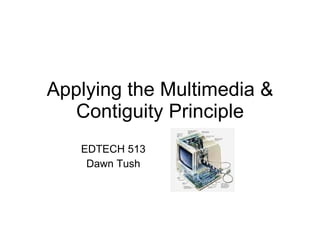
Applying the Multimedia & Contiguity Principle EDTECH 513 Dawn Tush
Instructional Objectives The learner will demonstrate types of graphics that illustrate the Contiguity Principle 90% of the time.  The learner will provide an example of when an organizational graphic is used to show relationships among ideas, lesson topics, or where the parts are located within a whole structure 90% of the time. The learner will provide and explain one quantitative graphic and one qualitative graphic 90% of the time. The learner will define the principle of continuity 100% of the time. The learner will explain why cognitive load is an important consideration in lesson planning 100% of the time.
What is the Multimedia Principal? Use words and graphics rather than words alone Words - printed or spoken text Multimedia Presentation - contains both words and graphics
Multimedia Rationale Engage active learning Engage in relevant cognitive processing Mentally organizing material into a coherent cognitive representation with existing knowledge Mentally making connections between the pictorial and verbal representations
Graphic Types Decorative  - added for aesthetic appeal Representational  - illustrate the appearance of an object Organizational  - show qualitative relationships among content Relational  - summarize quantitative relationships Transformational  - illustrate changes in time or over space Interpretive  - make intangible phenomena visible and concrete
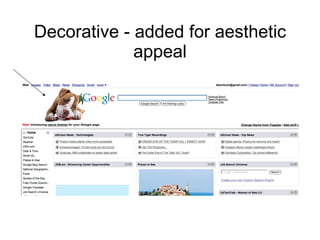
Decorative - added for aesthetic appeal
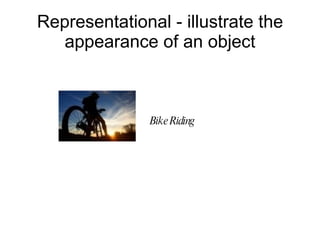
Representational - illustrate the appearance of an object Bike Riding
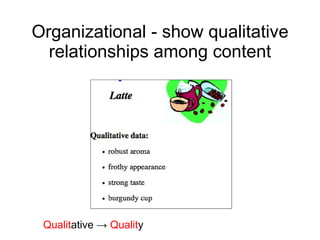
Organizational - show qualitative relationships among content Qualit ative ->  Qualit y
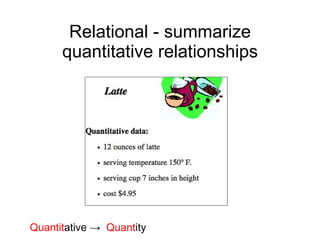
Relational - summarize quantitative relationships Quantit ative ->  Quant ity
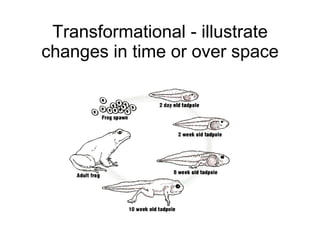
Transformational - illustrate changes in time or over space
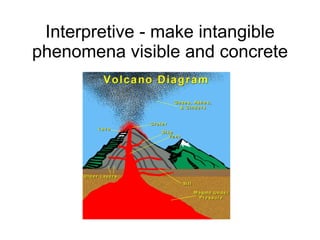
Interpretive - make intangible phenomena visible and concrete
Learning is facilitated when the graphics and text work together to communicate the instructional message.
Graphics Teach Content Types Clark (2007) has identified five different kinds of content:  Fact Concept Process Procedure Principal
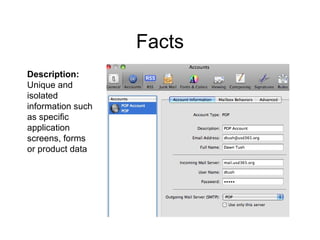
Facts Description:  Unique and isolated information such as specific application screens, forms or product data
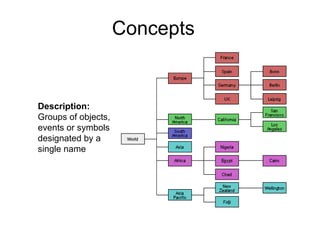
Concepts Description:  Groups of objects, events or symbols designated by a single name
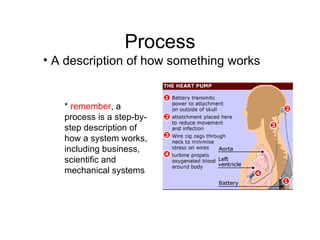
Process *  remember , a process is a step-by-step description of how a system works, including business, scientific and mechanical systems A description of how something works
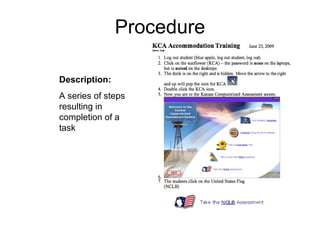
Procedure Description:   A series of steps resulting in completion of a task
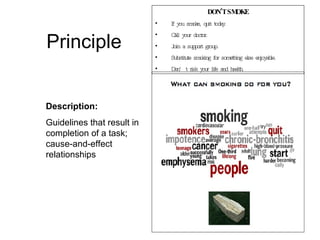
Principle Description:   Guidelines that result in completion of a task; cause-and-effect relationships DON’T SMOKE If you smoke, quit today. Call your doctor. Join a support group. Substitute smoking for something else enjoyable. Don’t risk your life and health.
Psychological Reasons for the Multimedia Principle According to the knowledge construction theory, learning is seen as a process of active sense-making and teaching to foster cognitive processing in the learner. Using words and graphics is particularly important for learners having low knowledge of the domain.
Animation Vs. Static Illustrations Animations can cost more to develop than static diagrams. Use static illustrations unless there is a compelling rationale for animation.
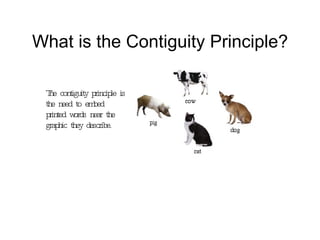
What is the Contiguity Principle? The contiguity principle is the need to embed printed words near the graphic they describe.
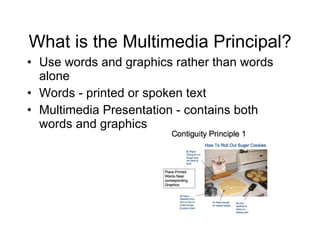
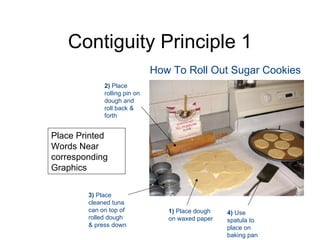
Contiguity Principle 1 Place Printed Words Near corresponding Graphics How To Roll Out Sugar Cookies 1)  Place dough on waxed paper 2)  Place rolling pin on dough and roll back & forth 3)  Place cleaned tuna can on top of rolled dough & press down 4)  Use spatula to place on baking pan
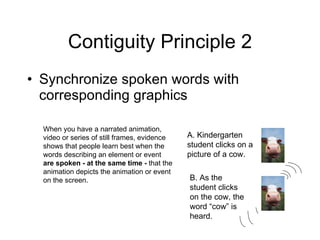
Contiguity Principle 2 Synchronize spoken words with corresponding graphics When you have a narrated animation, video or series of still frames, evidence shows that people learn best when the words describing an element or event  are spoken - at the same time -  that the animation depicts the animation or event on the screen.  A. Kindergarten student clicks on a picture of a cow. B. As the student clicks on the cow, the word “cow” is heard.
Today, you learned that… Use words and graphics rather than words alone Place printed words near the graphic they describe
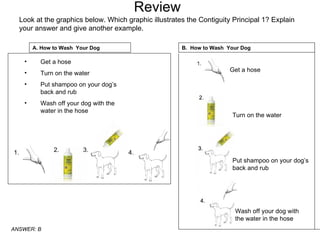
Review Look at the graphics below. Which graphic illustrates the Contiguity Principal 1? Explain your answer and give another example. Get a hose Turn on the water Put shampoo on your dog’s back and rub Wash off your dog with the water in the hose 1. 2. 3. 4.  A. How to Wash  Your Dog B.  How to Wash  Your Dog Get a hose Turn on the water Put shampoo on your dog’s back and rub Wash off your dog with the water in the hose ANSWER: B
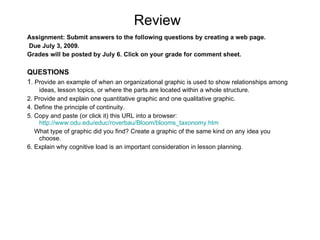
Review Assignment: Submit answers to the following questions by creating a web page. Due July 3, 2009 .   Grades will be posted by July 6. Click on your grade for comment sheet. QUESTIONS 1 . Provide an example of when an organizational graphic is used to show relationships among ideas, lesson topics, or where the parts are located within a whole structure.   2. Provide and explain one quantitative graphic and one qualitative graphic.  4. Define the principle of continuity. 5. Copy and paste (or click it) this URL into a browser:  http://www.odu.edu/educ/roverbau/Bloom/blooms_taxonomy.htm What type of graphic did you find? Create a graphic of the same kind on any idea you choose. 6. Explain why cognitive load is an important consideration in lesson planning.
Credits Book Sources Clark, R. C., R. E. Mayer (2008). e-Learning and the science of  instruction: Proven Guidelines for Consumers and Designers of  Multimedia Learning. San Francisco, CA: Pfeiffer. Image Sources   Free Images  http://www.techsoup.org/learningcenter/internet/page5977.cfm?rss =1%20- http://fotogenika.net/ http://www.freeimages.co.uk/ Web 2.0 Resources http://wordle.net http://www. slideshare .net Applications Fireworks Kidspiration Microsoft Office

Applying the Multimedia & Contiguity Principle

  • 1.
    Applying the Multimedia& Contiguity Principle EDTECH 513 Dawn Tush
  • 2.
    Instructional Objectives Thelearner will demonstrate types of graphics that illustrate the Contiguity Principle 90% of the time. The learner will provide an example of when an organizational graphic is used to show relationships among ideas, lesson topics, or where the parts are located within a whole structure 90% of the time. The learner will provide and explain one quantitative graphic and one qualitative graphic 90% of the time. The learner will define the principle of continuity 100% of the time. The learner will explain why cognitive load is an important consideration in lesson planning 100% of the time.
  • 3.
    What is theMultimedia Principal? Use words and graphics rather than words alone Words - printed or spoken text Multimedia Presentation - contains both words and graphics
  • 4.
    Multimedia Rationale Engageactive learning Engage in relevant cognitive processing Mentally organizing material into a coherent cognitive representation with existing knowledge Mentally making connections between the pictorial and verbal representations
  • 5.
    Graphic Types Decorative - added for aesthetic appeal Representational - illustrate the appearance of an object Organizational - show qualitative relationships among content Relational - summarize quantitative relationships Transformational - illustrate changes in time or over space Interpretive - make intangible phenomena visible and concrete
  • 6.
    Decorative - addedfor aesthetic appeal
  • 7.
    Representational - illustratethe appearance of an object Bike Riding
  • 8.
    Organizational - showqualitative relationships among content Qualit ative -> Qualit y
  • 9.
    Relational - summarizequantitative relationships Quantit ative -> Quant ity
  • 10.
    Transformational - illustratechanges in time or over space
  • 11.
    Interpretive - makeintangible phenomena visible and concrete
  • 12.
    Learning is facilitatedwhen the graphics and text work together to communicate the instructional message.
  • 13.
    Graphics Teach ContentTypes Clark (2007) has identified five different kinds of content: Fact Concept Process Procedure Principal
  • 14.
    Facts Description: Unique and isolated information such as specific application screens, forms or product data
  • 15.
    Concepts Description: Groups of objects, events or symbols designated by a single name
  • 16.
    Process * remember , a process is a step-by-step description of how a system works, including business, scientific and mechanical systems A description of how something works
  • 17.
    Procedure Description: A series of steps resulting in completion of a task
  • 18.
    Principle Description: Guidelines that result in completion of a task; cause-and-effect relationships DON’T SMOKE If you smoke, quit today. Call your doctor. Join a support group. Substitute smoking for something else enjoyable. Don’t risk your life and health.
  • 19.
    Psychological Reasons forthe Multimedia Principle According to the knowledge construction theory, learning is seen as a process of active sense-making and teaching to foster cognitive processing in the learner. Using words and graphics is particularly important for learners having low knowledge of the domain.
  • 20.
    Animation Vs. StaticIllustrations Animations can cost more to develop than static diagrams. Use static illustrations unless there is a compelling rationale for animation.
  • 21.
    What is theContiguity Principle? The contiguity principle is the need to embed printed words near the graphic they describe.
  • 22.
    Contiguity Principle 1Place Printed Words Near corresponding Graphics How To Roll Out Sugar Cookies 1) Place dough on waxed paper 2) Place rolling pin on dough and roll back & forth 3) Place cleaned tuna can on top of rolled dough & press down 4) Use spatula to place on baking pan
  • 23.
    Contiguity Principle 2Synchronize spoken words with corresponding graphics When you have a narrated animation, video or series of still frames, evidence shows that people learn best when the words describing an element or event are spoken - at the same time - that the animation depicts the animation or event on the screen. A. Kindergarten student clicks on a picture of a cow. B. As the student clicks on the cow, the word “cow” is heard.
  • 24.
    Today, you learnedthat… Use words and graphics rather than words alone Place printed words near the graphic they describe
  • 25.
    Review Look atthe graphics below. Which graphic illustrates the Contiguity Principal 1? Explain your answer and give another example. Get a hose Turn on the water Put shampoo on your dog’s back and rub Wash off your dog with the water in the hose 1. 2. 3. 4. A. How to Wash Your Dog B. How to Wash Your Dog Get a hose Turn on the water Put shampoo on your dog’s back and rub Wash off your dog with the water in the hose ANSWER: B
  • 26.
    Review Assignment: Submitanswers to the following questions by creating a web page. Due July 3, 2009 . Grades will be posted by July 6. Click on your grade for comment sheet. QUESTIONS 1 . Provide an example of when an organizational graphic is used to show relationships among ideas, lesson topics, or where the parts are located within a whole structure. 2. Provide and explain one quantitative graphic and one qualitative graphic. 4. Define the principle of continuity. 5. Copy and paste (or click it) this URL into a browser: http://www.odu.edu/educ/roverbau/Bloom/blooms_taxonomy.htm What type of graphic did you find? Create a graphic of the same kind on any idea you choose. 6. Explain why cognitive load is an important consideration in lesson planning.
  • 27.
    Credits Book SourcesClark, R. C., R. E. Mayer (2008). e-Learning and the science of instruction: Proven Guidelines for Consumers and Designers of Multimedia Learning. San Francisco, CA: Pfeiffer. Image Sources Free Images http://www.techsoup.org/learningcenter/internet/page5977.cfm?rss =1%20- http://fotogenika.net/ http://www.freeimages.co.uk/ Web 2.0 Resources http://wordle.net http://www. slideshare .net Applications Fireworks Kidspiration Microsoft Office