Darren Entwistle Curriculum Manager K-12 Curriculum Resources effective eLearning design Julie Bettenay Manager  K-12 Curriculum Resources Jonathan Bromage Deputy Principal  Schools of Isolated and  Distance Education
introduce
Darren Entwistle Curriculum Manager K-12 Curriculum Resources effective eLearning design Julie Bettenay Manager  K-12 Curriculum Resources Jonathan Bromage Deputy Principal  Schools of Isolated and  Distance Education
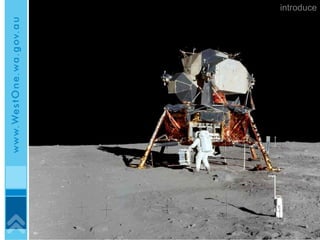
1969 introduce
Darren B Entwistle  2 February 1969 - introduce
introduce
introduce
introduce
introduce
introduce
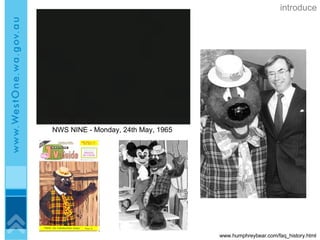
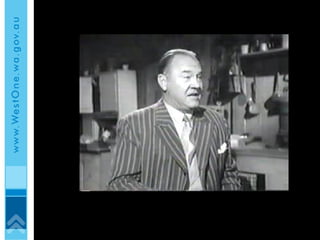
NWS NINE - Monday, 24th May, 1965   www.humphreybear.com/faq_history.html introduce
Times have changed discover
introduce
Darren Entwistle Curriculum Manager K-12 Curriculum Resources effective eLearning design Julie Bettenay Manager  K-12 Curriculum Resources Jonathan Bromage Deputy Principal  Schools of Isolated and  Distance Education
introduce
eLearning  is not new discover
discover
But we’re  not quite here yet discover
discover
effective online learning design?
a framework  for content discover
 
Robin Smith “Conquering the content”
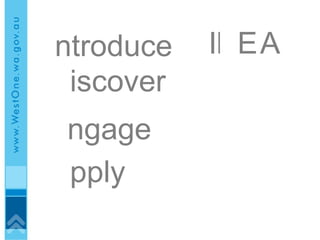
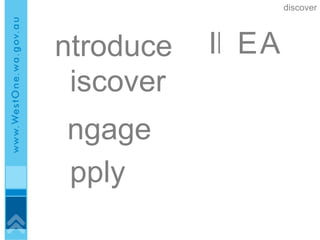
I D E A ntroduce iscover ngage pply
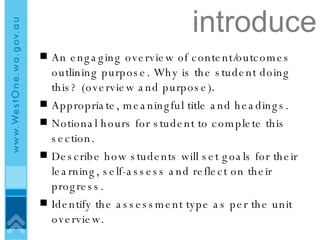
introduce An engaging overview of content/outcomes outlining purpose. Why is the student doing this? (overview and purpose) . Appropriate, meaningful title and headings.   Notional hours for student to complete this section.  Describe how students will set goals for their learning, self-assess and reflect on their progress. Identify the assessment type as per the unit overview.

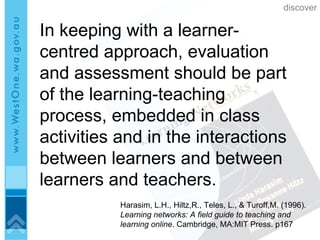
In keeping with a learner-centred approach, evaluation and assessment should be part of the learning-teaching process, embedded in class activities and in the interactions between learners and between learners and teachers. Harasim, L.H., Hiltz,R., Teles, L., & Turoff,M. (1996).  Learning networks:   A field guide to teaching and learning online . Cambridge, MA:MIT Press. p167 discover
 
 
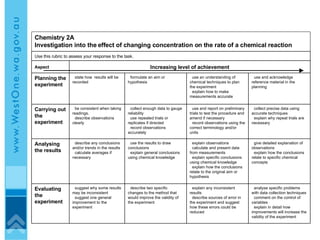
analyse specific problems with data collection techniques  comment on the control of variables explain in detail how improvements will increase the validity of the experiment explain any inconsistent results describe sources of error in the experiment and suggest how these errors could be reduced describe two specific changes to the method that would improve the validity of the experiment suggest why some results may be inconsistent suggest one general improvement to the experiment Evaluating the experiment give detailed explanation of observations explain how the conclusions relate to specific chemical concepts  explain observations calculate and present data from measurements explain specific conclusions using chemical knowledge explain how the conclusions relate to the original aim or hypothesis use the results to draw conclusions explain general conclusions using chemical knowledge describe any conclusions and/or trends in the results calculate averages if necessary Analysing the results collect precise data using accurate techniques explain why repeat trials are necessary use and report on preliminary trials to test the procedure and amend if necessary record observations using the correct terminology and/or units collect enough data to gauge reliability  use repeated trials or replicates if directed record observations accurately be consistent when taking readings. describe observations clearly Carrying out the experiment use and acknowledge reference material in the planning use an understanding of chemical techniques to plan the experiment explain how to make measurements accurate formulate an aim or hypothesis state how  results will be recorded Planning the experiment  Increasing level of achievement Aspect Use this rubric to assess your response to the task. Chemistry 2A  Investigation into the effect of changing concentration on the rate of a chemical reaction


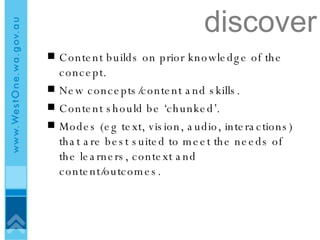
discover Content builds on prior knowledge of the concept.  New concepts/content and skills. Content should be ‘chunked’. Modes (eg text, vision, audio, interactions) that are best suited to meet the needs of the learners, context and content/outcomes.


engage A direct relationship between the Discover and Engage activities.  Explicit explanation of strategies for guiding student interaction with content. Opportunities for students to engage with the content to develop the skills, knowledge and understandings or the outcomes. Activities are scaffolded and sequenced appropriately.  Opportunities for meta-cognition.


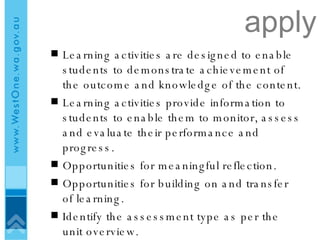
apply Learning activities are designed to enable students to demonstrate achievement of the outcome and knowledge of the content.  Learning activities provide information to students to enable them to monitor, assess and evaluate their performance and progress.  Opportunities for meaningful reflection.  Opportunities for building on and transfer of learning.  Identify the assessment type as per the unit overview.


I D E A ntroduce iscover ngage pply discover
how do teachers use these? Jonathan Bromage Deputy Principal Curriculum Schools of Isolated and Distance Education discover
effective online learning design?
Discover  new learning solutions
 
Darren Entwistle Curriculum Manager K-12 Curriculum Resources effective eLearning design Julie Bettenay Manager  K-12 Curriculum Resources Jonathan Bromage Deputy Principal  Schools of Isolated and  Distance Education
 
 
There are thousands of buildings in this country where millions of people in them have no telephones, no cable television, and no reasonable prospects of broadband services.  They’re called schools. Reed Hundt Chairman of US Federal Communications Commission Quoted by Bill Gates in  The Road Ahead  1996 discover


WA Westone SIDE

  • 1.
    Darren Entwistle CurriculumManager K-12 Curriculum Resources effective eLearning design Julie Bettenay Manager K-12 Curriculum Resources Jonathan Bromage Deputy Principal Schools of Isolated and Distance Education
  • 2.
  • 3.
    Darren Entwistle CurriculumManager K-12 Curriculum Resources effective eLearning design Julie Bettenay Manager K-12 Curriculum Resources Jonathan Bromage Deputy Principal Schools of Isolated and Distance Education
  • 4.
  • 5.
    Darren B Entwistle 2 February 1969 - introduce
  • 6.
  • 7.
  • 8.
  • 9.
  • 10.
  • 11.
    NWS NINE -Monday, 24th May, 1965 www.humphreybear.com/faq_history.html introduce
  • 12.
  • 13.
  • 14.
    Darren Entwistle CurriculumManager K-12 Curriculum Resources effective eLearning design Julie Bettenay Manager K-12 Curriculum Resources Jonathan Bromage Deputy Principal Schools of Isolated and Distance Education
  • 15.
  • 16.
    eLearning isnot new discover
  • 17.
  • 18.
    But we’re not quite here yet discover
  • 19.
  • 20.
  • 21.
    a framework for content discover
  • 22.
  • 23.
  • 24.
    I D EA ntroduce iscover ngage pply
  • 25.
    introduce An engagingoverview of content/outcomes outlining purpose. Why is the student doing this? (overview and purpose) . Appropriate, meaningful title and headings. Notional hours for student to complete this section. Describe how students will set goals for their learning, self-assess and reflect on their progress. Identify the assessment type as per the unit overview.
  • 26.
    In keeping witha learner-centred approach, evaluation and assessment should be part of the learning-teaching process, embedded in class activities and in the interactions between learners and between learners and teachers. Harasim, L.H., Hiltz,R., Teles, L., & Turoff,M. (1996). Learning networks: A field guide to teaching and learning online . Cambridge, MA:MIT Press. p167 discover
  • 27.
  • 28.
  • 29.
    analyse specific problemswith data collection techniques comment on the control of variables explain in detail how improvements will increase the validity of the experiment explain any inconsistent results describe sources of error in the experiment and suggest how these errors could be reduced describe two specific changes to the method that would improve the validity of the experiment suggest why some results may be inconsistent suggest one general improvement to the experiment Evaluating the experiment give detailed explanation of observations explain how the conclusions relate to specific chemical concepts explain observations calculate and present data from measurements explain specific conclusions using chemical knowledge explain how the conclusions relate to the original aim or hypothesis use the results to draw conclusions explain general conclusions using chemical knowledge describe any conclusions and/or trends in the results calculate averages if necessary Analysing the results collect precise data using accurate techniques explain why repeat trials are necessary use and report on preliminary trials to test the procedure and amend if necessary record observations using the correct terminology and/or units collect enough data to gauge reliability use repeated trials or replicates if directed record observations accurately be consistent when taking readings. describe observations clearly Carrying out the experiment use and acknowledge reference material in the planning use an understanding of chemical techniques to plan the experiment explain how to make measurements accurate formulate an aim or hypothesis state how results will be recorded Planning the experiment Increasing level of achievement Aspect Use this rubric to assess your response to the task. Chemistry 2A Investigation into the effect of changing concentration on the rate of a chemical reaction
  • 30.
  • 31.
  • 32.
  • 33.
    discover Content buildson prior knowledge of the concept. New concepts/content and skills. Content should be ‘chunked’. Modes (eg text, vision, audio, interactions) that are best suited to meet the needs of the learners, context and content/outcomes.
  • 34.
  • 35.
  • 36.
  • 37.
    engage A directrelationship between the Discover and Engage activities. Explicit explanation of strategies for guiding student interaction with content. Opportunities for students to engage with the content to develop the skills, knowledge and understandings or the outcomes. Activities are scaffolded and sequenced appropriately. Opportunities for meta-cognition.
  • 38.
  • 39.
  • 40.
  • 41.
  • 42.
  • 43.
    apply Learning activitiesare designed to enable students to demonstrate achievement of the outcome and knowledge of the content. Learning activities provide information to students to enable them to monitor, assess and evaluate their performance and progress. Opportunities for meaningful reflection. Opportunities for building on and transfer of learning. Identify the assessment type as per the unit overview.
  • 44.
  • 45.
  • 46.
  • 47.
  • 48.
  • 49.
  • 50.
    I D EA ntroduce iscover ngage pply discover
  • 51.
    how do teachersuse these? Jonathan Bromage Deputy Principal Curriculum Schools of Isolated and Distance Education discover
  • 52.
  • 53.
    Discover newlearning solutions
  • 54.
  • 55.
    Darren Entwistle CurriculumManager K-12 Curriculum Resources effective eLearning design Julie Bettenay Manager K-12 Curriculum Resources Jonathan Bromage Deputy Principal Schools of Isolated and Distance Education
  • 56.
  • 57.
  • 58.
    There are thousandsof buildings in this country where millions of people in them have no telephones, no cable television, and no reasonable prospects of broadband services. They’re called schools. Reed Hundt Chairman of US Federal Communications Commission Quoted by Bill Gates in The Road Ahead 1996 discover
  • 59.
  • 60.
  • 61.
  • 62.