Alicia Mueller EdTech 513:  Multimedia Module 3 Multimedia and Contiguity Principles
Instructional Objectives After watching this presentation: Learners will be able to define the multimedia principle. Learners will be able to define multimedia presentation and identify the elements that comprise it. Learners will be able to identify how graphics support learning. Learners will be able to define the contiguity principle. Learners will be able to recognize how the contiguity principle can be violated and how to avoid it.
Words can be  printed  or  spoken . “ People learn more deeply from words and graphics than from words alone.”  (Colvin Clark and Mayer, 2008, p.  437 ) Graphics include  static drawings photographs charts or  dynamic animation video Multimedia Principle
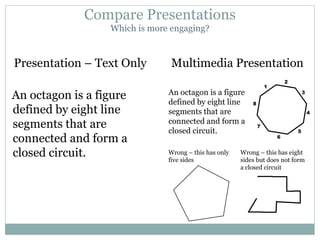
Multimedia Presentation and Learning Learning  is more  meaningful  when a combination of printed or spoken  words , and static or dynamic  graphics , are used. A presentation that uses such a combination is called a  multimedia presentation . The graphic media must  support  the text media. A multimedia presentation is more  engaging  for the learner.
Presentation – Text Only An octagon is a figure defined by eight line segments that are connected and form a closed circuit. Multimedia Presentation Compare Presentations Which is more engaging? An octagon is a figure defined by eight line segments that are connected and form a closed circuit. Wrong – this has only five sides Wrong – this has eight sides but does not form a closed circuit
There are different purposes for graphics.  Those that support learning are: Transformational  – depict changes over time Animations and video Time-lapses, procedures, demonstrations Interpretive  – illustrate relationships to make them concrete Drawings and diagrams Organizational  – Show relationships among elements Tables, concept maps, diagrams How Do Graphics Support Learning?
"People learn more deeply when corresponding printed words and graphics are placed close to one another on the screen or when spoken words and graphics are presented at the same time."   (Colvin Clark and Mayer, 2008, p.  429 ) Place text close to the corresponding graphic OR play the sound while the corresponding graphic is being shown. Contiguity Principle
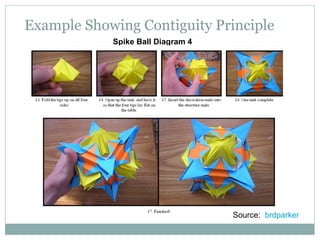
Example Showing Contiguity Principle Spike Ball Diagram 4 Source:  brdparker
Common Violations of Contiguity Principle Related to printed words Text is placed too far from its corresponding graphic.  (It also negates the multimedia principle – what’s the points of using text and graphics if they aren’t combined properly?) Scrolling windows separate text and graphics (e.g., the graphic is at the top of the page, but you scroll down to read the text and cannot see the graphic anymore.) When answering questions, the feedback occurs on a separate page.  (It makes it difficult to relate the two).
Rollovers How to Avoid Violations  of the Contiguity Principle Rollovers are popups that occur when you roll your mouse over specific text and/or graphics. They allow the designer to fit more text on page without having to scroll down and leave the graphic behind.
Common Violations of Contiguity Principle Related to spoken words Links to audio and video are separate icons.  Do not make it easy for learners to listen to audio and watch related video separately. The audio occurs  before  the video is shown.  Do not introduce the video; show it while speaking about it.
Assessment Questions What does the multimedia principle state about text and graphics?  Are they more effective when presented together, or is text only a better alternative? What is a multimedia presentation?  What does it mean to be “multimedia”? What are three types of graphics that support learning?  How do they support the text? What is the contiguity principle?  How does it relate to both the printed word and the spoken word? How is the contiguity principle commonly violated, and what is one way to prevent it?
References Colvin Clark, Ruth and Mayer, Richard E. (2008).  e-Learning and the Science of Instruction:  Proven Guidelines for Consumers and Designers of Multimedia Learning.  San Francisco, CA:  John Wiley & Sons, Inc. Spike Ball Diagram 4. (2009).  flickr.  Retrieved February 16, 2009, from  http://flickr.com/photos/brdparker/2308545851/

Mueller Module3

  • 1.
    Alicia Mueller EdTech513: Multimedia Module 3 Multimedia and Contiguity Principles
  • 2.
    Instructional Objectives Afterwatching this presentation: Learners will be able to define the multimedia principle. Learners will be able to define multimedia presentation and identify the elements that comprise it. Learners will be able to identify how graphics support learning. Learners will be able to define the contiguity principle. Learners will be able to recognize how the contiguity principle can be violated and how to avoid it.
  • 3.
    Words can be printed or spoken . “ People learn more deeply from words and graphics than from words alone.” (Colvin Clark and Mayer, 2008, p. 437 ) Graphics include static drawings photographs charts or dynamic animation video Multimedia Principle
  • 4.
    Multimedia Presentation andLearning Learning is more meaningful when a combination of printed or spoken words , and static or dynamic graphics , are used. A presentation that uses such a combination is called a multimedia presentation . The graphic media must support the text media. A multimedia presentation is more engaging for the learner.
  • 5.
    Presentation – TextOnly An octagon is a figure defined by eight line segments that are connected and form a closed circuit. Multimedia Presentation Compare Presentations Which is more engaging? An octagon is a figure defined by eight line segments that are connected and form a closed circuit. Wrong – this has only five sides Wrong – this has eight sides but does not form a closed circuit
  • 6.
    There are differentpurposes for graphics. Those that support learning are: Transformational – depict changes over time Animations and video Time-lapses, procedures, demonstrations Interpretive – illustrate relationships to make them concrete Drawings and diagrams Organizational – Show relationships among elements Tables, concept maps, diagrams How Do Graphics Support Learning?
  • 7.
    "People learn moredeeply when corresponding printed words and graphics are placed close to one another on the screen or when spoken words and graphics are presented at the same time." (Colvin Clark and Mayer, 2008, p. 429 ) Place text close to the corresponding graphic OR play the sound while the corresponding graphic is being shown. Contiguity Principle
  • 8.
    Example Showing ContiguityPrinciple Spike Ball Diagram 4 Source: brdparker
  • 9.
    Common Violations ofContiguity Principle Related to printed words Text is placed too far from its corresponding graphic. (It also negates the multimedia principle – what’s the points of using text and graphics if they aren’t combined properly?) Scrolling windows separate text and graphics (e.g., the graphic is at the top of the page, but you scroll down to read the text and cannot see the graphic anymore.) When answering questions, the feedback occurs on a separate page. (It makes it difficult to relate the two).
  • 10.
    Rollovers How toAvoid Violations of the Contiguity Principle Rollovers are popups that occur when you roll your mouse over specific text and/or graphics. They allow the designer to fit more text on page without having to scroll down and leave the graphic behind.
  • 11.
    Common Violations ofContiguity Principle Related to spoken words Links to audio and video are separate icons. Do not make it easy for learners to listen to audio and watch related video separately. The audio occurs before the video is shown. Do not introduce the video; show it while speaking about it.
  • 12.
    Assessment Questions Whatdoes the multimedia principle state about text and graphics? Are they more effective when presented together, or is text only a better alternative? What is a multimedia presentation? What does it mean to be “multimedia”? What are three types of graphics that support learning? How do they support the text? What is the contiguity principle? How does it relate to both the printed word and the spoken word? How is the contiguity principle commonly violated, and what is one way to prevent it?
  • 13.
    References Colvin Clark,Ruth and Mayer, Richard E. (2008). e-Learning and the Science of Instruction: Proven Guidelines for Consumers and Designers of Multimedia Learning. San Francisco, CA: John Wiley & Sons, Inc. Spike Ball Diagram 4. (2009). flickr. Retrieved February 16, 2009, from http://flickr.com/photos/brdparker/2308545851/