BEHAVIOUR MODIFICATION
PRESENTER: Hafsath Nisha
M.Phil Rehabilitation Psychology (Part 1)
JSSMCH
CHAIRPERSON: Mr. Dheeraj
Rehabilitation Psychologist
JSSMCH
MAJOR CATEGORIES OF DEVELOPMENTAL
DISABILITY
(Board on Global Health & Committee on Nervous System Disorders in Developing Countries,
2
Common Triggers for Behavioral
Issues:
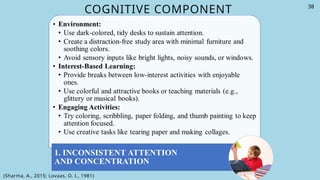
• Fear or confusion from
unfamiliar situations, people or
events
• Disruption or interference in
routines
• Difficulty understanding
instructions or explanations
• Inability to communicate needs
and feelings
• Fear of certain situations or
objects
• Pressure to perform tasks that
are too difficult
• Sensory overload
(Sharma, A.,
3
BEHAVIOUR MODIFICATION
Behavior modification is a field of psychology focused on analyzing and modifying human
behavior.
• Analyzing Behavior: Identify the functional relationship between environmental
events and a particular behavior to understand it.
• Modifying Behavior: Develop and implement strategies to alter environmental
events, thus influencing the behavior (Gambrill, 1977; Kazdin, 1994).
• Behavioral Targets:
⚬ Excess: Unwanted behaviors to decrease (e.g., tantrums).
⚬ Deficit: Desired behaviors to increase (e.g., exercise).
• Emphasizes changing behavior, not labeling individuals.
• Based on behavioral principles (like reinforcement and punishment), applied to
change socially significant behaviors in a range of settings (e.g., education,
developmental disabilities).
BEHAVIOUR MODIFICATION FOR DEVELOPMENTALLY
DISABLED CHILDREN
(Miltenberger, R. G., 2012).
5
ASSESSMENT AND IDENTIFICATION OF
TARGET BEHAVIORS
Purpose of FBA
• Identifies the functions of problem behaviors.
• Guides intervention strategies to reduce undesirable behaviors.
• Determines what reinforces the behavior to inform interventions.
Benefits of FBA:
• Leads to effective reinforcement-based interventions.
• Reduces reliance on punishment-based strategies.
FUNCTIONAL BEHAVIOR ASSESSMENT
(FBA)
FBA is a process of identifying the purpose (function) a behavior serves for an
individual. The goal is to understand why a behavior occurs to design
effective interventions.
(Cooper, et al., 2007; Miltenberger, R. G., 2012)
7
FUNCTIONAL BEHAVIOR ASSESSMENT (FBA)
METHODS
(Cooper, et al., 2007; Miltenberger, R. G., 2012)
8
FUNCTIONAL BEHAVIOR ASSESSMENT (FBA)
(Cooper, et al., 2007)
9
FUNCTIONAL BEHAVIOR ASSESSMENT (FBA)
STEPS
(Cooper, et al., 2007)
10
FUNCTIONAL ANALYSIS AND STAR CHART
STAR CHART
Developed by The National Autistic Society (UK) to assess behavior.
1.Behavior and Personality: Consider the child’s personality and pace before making
demands.
2.Changing Behaviors: Focus on one behavior at a time.
3.Constructive Punishment:
⚬ Punishment for a behavior need not necessarily be harmful always. Use constructive
punishment to increase awareness of acceptable and unacceptable behaviors.
(Sharma, A., 2015)
11
Target Behaviors:
• Behaviors that are chosen for modification due to their social
importance and potential positive impact on the individual's life.
• Focus on socially significant behaviors that lead to meaningful change.
Steps to Identify Target Behaviors:
a. Assessment:
i. Use direct observation, interviews, checklists, and tests to
identify behaviors that need change.
b. Defining Behaviors:
i. Ensure definitions are clear, objective, and measurable.
SELECTING AND DEFINING TARGET
BEHAVIORS
(Cooper, et al., 2007; Miltenberger, R. G., 2012)
12
SELECTING AND DEFINING TARGET BEHAVIORS
DEFINING BEHAVIORS:
(Cooper, et al., 2007; Miltenberger, R. G., 2012)
13
SELECTING AND DEFINING TARGET BEHAVIORS
(Cooper, et al., 2007)
14
• Measurement involves assigning quantitative labels to behavior, providing a basis for analysis and evaluatio
• Accurate measurement ensures that behavior modification programs are effective and that progress can be
documented.
MEASURING BEHAVIOR
(Cooper, et al., 2007; Miltenberger, R. G., 2012)
Methods of Measurement
15
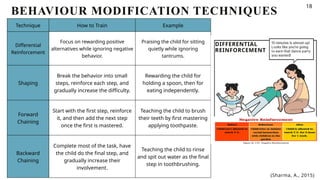
BEHAVIOUR MODIFICATION TECHNIQUES
(Sharma, A., 2015)
1
7
Technique How to Train Example
Differential
Reinforcement
Focus on rewarding positive
alternatives while ignoring negative
behavior.
Praising the child for sitting
quietly while ignoring
tantrums.
Shaping
Break the behavior into small
steps, reinforce each step, and
gradually increase the difficulty.
Rewarding the child for
holding a spoon, then for
eating independently.
Forward
Chaining
Start with the first step, reinforce
it, and then add the next step
once the first is mastered.
Teaching the child to brush
their teeth by first mastering
applying toothpaste.
Backward
Chaining
Complete most of the task, have
the child do the final step, and
gradually increase their
involvement.
Teaching the child to rinse
and spit out water as the final
step in toothbrushing.
BEHAVIOUR MODIFICATION TECHNIQUES
DIFFERENTIAL
REINFORCEMENT
(Sharma, A., 2015)
18
• REWARDS
⚬ Getting positives (positive rewards) is rewarding.
⚬ Rewards must be delivered immediately.
⚬ Reward schedules; Start with continuous reinforcement, then gradually
shift to a partial schedule ('thinning').
BEHAVIOR MODIFICATION TECHNIQUES
TYPES
(Lovaas, O. I., 1981)
1
9
Physical Punishment
• Used to stop or decrease undesirable behavior in children.
• Punishment should be evident and effective quickly, ideally within minutes.
• Use only as much force as necessary to cause apprehension, and always monitor the impact.
• Keep records of the behavior and the effectiveness of the punishment for future reference.
BEHAVIOR MODIFICATION TECHNIQUES
TYPES
(Lovaas, O. I., 1981)
20
APPLIED BEHAVIOUR
ANALYSIS
Applied behavior analysis is the science in which tactics derived from
the principles of behavior are applied systematically to improve socially
significant behavior and experimentation is used to identify the variables
responsible for behavior change (Cooper, et. al., 2007)
Characteristics:
• Applied: Focuses on socially significant behaviors.
• Behavioral: Involves precise measurement of actual behavior.
• Analytic: Demonstrates experimental control over behavior.
• Technological: Procedures are detailed for replication.
• Conceptually Systematic: Interventions derived from behavior
principles.
• Effective: Produces practical results for participants.
• Generality: Behavior changes last over time and across environments.
APPLIED BEHAVIOUR ANALYSIS
(Cooper, et al., 2007; Sharma, A., 2015)
22
Basic Principles of Behavior
Change:
• Immediate consequences are
most effective.
• Behavior can be shaped through
reinforcement and punishment.
• A reinforcer increases the
likelihood of a response, while a
punisher decreases it.
Three-Term Contingency:
• Antecedent Behavior
→ →
Consequence
(Cooper, et al., 2007; Sharma, A., 2015)
23
APPLIED BEHAVIOUR ANALYSIS
Term Behavior Modification Applied Behavior Analysis (ABA)
Defintion
Uses behavioral principles to
change behavior.
A scientific approach that applies behavioral
principles to socially significant behaviors.
Focus
Applying behavioral principles
to change behavior.
Focuses on socially important behaviors.
Key
Characteristics
Identifies similar principles to
ABA.
- Uses behavioral principles.
- Targets behavior change.
Defined by Baer et al. with several key
characteristics:
- Demonstrates functional relationships
between environment and behavior.
- Clear descriptions of procedures.
- Connected to basic behavioral principles.
- Produces meaningful, long-lasting changes.
ABA and Behavioral Modification
(Miltenberger, R. G., 2012).
24
STRATEGIES OF APPLIED
BEHAVIOURAL ANALYSIS
Discrete Trial Training (DTT)
• Breaking down a skill into small “discrete” steps and teaching it through repeated lessons (one by one).
• E.g. present a clear discriminative stimulus (e.g., "point to red"), prompt the child's response (e.g., child
points to red), and immediately provide a reinforcer (e.g., verbal praise or a reward) to strengthen the
correct behavior
26
Pivotal Response Therapy (PRT)
• Play-based and initiated by the child. Focuses
on key pivotal areas like
⚬ Motivation
⚬ Response to multiple cues
⚬ Self-management
⚬ Initiation of social interactions
• Which lead to improvements in
⚬ social skills
⚬ communication
⚬ behavior,
⚬ learning.
• Example: if a child makes a meaningful
attempt to request a stuffed animal, the
reward is the stuffed animal for making a good
attempt, even if it is not perfect 27
Reciprocal Imitation Training
• Teaching imitation skills by mutually
imitating play actions between the therapist
and child.
• If the child rolls a car, roll a car too, and then
encourage them copy your actions.
• Once the child learns to imitate, they can
observe the environment and learn new
things.
• This skill improves social-communication
skills.
28
Technique Definition Example
Self-Management Training
Teaching the child to monitor their
performance, track progress and reinforce
their own behavior independently.
Having a child record their appropriate play
behavior and give themselves a reward.
Video Modeling
Using videos to demonstrate and teach target
behaviors encourage the child to replicate
what they see.
Teaching conversational skills by showing a
video of appropriate verbal exchanges.
Prompting and Fading
Providing assistance (verbally or physically) to
encourage correct responses and gradually
removing prompts when the skill is mastered
Pointing to a toothbrush to prompt
brushing, then fading to verbal cues only.
Generalization
Applying mastered skills in various real-life
settings and contexts.
After learning color recognition, ask the
child to identify colors during daily tasks.
Time-Out (Positive
Punishment)
Removing the child from a reinforcing
environment to reduce inappropriate
behaviors, explaining the reason and
expected behavior.
After hitting, placing the child in a time-out
corner for a few minutes to calm down.
(Sharma, A.,
29
SYMPTOMATIC MANAGEMENT
FOR COMMON BEHAVIOR
PROBLEMS
BEHAVIOUR PATTERNS
BEHAVIOUR PATTERNS
1.PROPER SITTING
By learning to sit properly the child gain a sense of control and discipline
Generalization:
• Practice sitting in different settings (living room, kitchen) and with different people.
• Be firm and consistent when enforcing commands, despite any tantrums
(Lovaas, O. I., 1981)
32
BEHAVIOR PATTERNS
(Sharma, A.,
33
BEHAVIOUR PATTERNS
(Sharma, A.,
34
BEHAVIOUR PATTERNS
(Sharma, A.,
35
BEHAVOUR PATTERNS
(Sharma, A.,
36
COGNITIVE COMPONENT
COGNITIVE COMPONENT
(Sharma, A., 2015; Lovaas, O. I., 1981)
38
COGNITIVE COMPONENT
(Sharma, A.,
39
SPEECH, LANGUAGE, AND
COMMUNICATION
SPEECH, LANGUAGE AND COMMUNICATION
TECHNIQUES FOR IMPROVING COMMUNICATION, DIFFICULTY
WITH USING NON-VERBAL LANGUAGE OR GESTURES
(Sharma, A.,
41
SOCIAL RELATIONSHIPS AND
RECIPROCITY
SOCIAL RELATIONSHIPS AND RECIPROCITY
(Sharma, A.,
43
EMOTIONAL
RESPONSIVENESS
EMOTIONAL RESPONSIVENESS
(Sharma, A.,
45
EMOTIONAL RESPONSIVENESS
(Sharma, A.,
46
• Medications:
⚬ Prescription: SSRIs (e.g.,
fluvoxamine, fluoxetine),
venlafaxine, acetylcholinesterase
inhibitors (e.g., rivastigmine,
donepezil).
⚬ Non-prescription:
Multivitamin/mineral supplements,
Omega-3. Consult a doctor for
suitability.
ADJUNCT THERAPIES AND MEDICATIONS FOR
BEHAVIORAL IMPROVEMENT
THERAPIES:
(Sharma, A.,
47
• Board on Global Health, & Committee on Nervous System Disorders in Developing Countries. (2001).
Neurological, psychiatric, and developmental disorders: Meeting the challenge in the developing world. National
Academies Press.
• Cooper, J. O., Heron, T. E., & Heward, W. L. (2007). Applied Behavior Analysis (2nd ed.). Pearson.
• Gambrill, E. D. (1977). Behavior modification: Handbook of assessment, intervention and evaluation. San
Francisco: Jossey-Bass.
• Kazdin, A. E. (1982). The token economy: A decade later. Journal of Applied Behavior Analysis, 15, 431–445.
• Miltenberger, R. G. (2012). Behavior Modification: Principles and Procedures (5th ed.). Wadsworth, Cengage
Learning.
• Sharma, A. (2015). Parent and Teacher Guidebook for Autism: Practical Strategies for Managing Challenging
Behaviors. Sterling Publishers.
• Lovaas, O. I. (1981). Teaching Developmentally Disabled Children: The ME Book. University Park Press.
REFERENCES
49
THANK YOU
48

Behaviour Modification- techniques for common behavioral problems.

  • 1.
    BEHAVIOUR MODIFICATION PRESENTER: HafsathNisha M.Phil Rehabilitation Psychology (Part 1) JSSMCH CHAIRPERSON: Mr. Dheeraj Rehabilitation Psychologist JSSMCH
  • 2.
    MAJOR CATEGORIES OFDEVELOPMENTAL DISABILITY (Board on Global Health & Committee on Nervous System Disorders in Developing Countries, 2
  • 3.
    Common Triggers forBehavioral Issues: • Fear or confusion from unfamiliar situations, people or events • Disruption or interference in routines • Difficulty understanding instructions or explanations • Inability to communicate needs and feelings • Fear of certain situations or objects • Pressure to perform tasks that are too difficult • Sensory overload (Sharma, A., 3
  • 4.
  • 5.
    Behavior modification isa field of psychology focused on analyzing and modifying human behavior. • Analyzing Behavior: Identify the functional relationship between environmental events and a particular behavior to understand it. • Modifying Behavior: Develop and implement strategies to alter environmental events, thus influencing the behavior (Gambrill, 1977; Kazdin, 1994). • Behavioral Targets: ⚬ Excess: Unwanted behaviors to decrease (e.g., tantrums). ⚬ Deficit: Desired behaviors to increase (e.g., exercise). • Emphasizes changing behavior, not labeling individuals. • Based on behavioral principles (like reinforcement and punishment), applied to change socially significant behaviors in a range of settings (e.g., education, developmental disabilities). BEHAVIOUR MODIFICATION FOR DEVELOPMENTALLY DISABLED CHILDREN (Miltenberger, R. G., 2012). 5
  • 6.
    ASSESSMENT AND IDENTIFICATIONOF TARGET BEHAVIORS
  • 7.
    Purpose of FBA •Identifies the functions of problem behaviors. • Guides intervention strategies to reduce undesirable behaviors. • Determines what reinforces the behavior to inform interventions. Benefits of FBA: • Leads to effective reinforcement-based interventions. • Reduces reliance on punishment-based strategies. FUNCTIONAL BEHAVIOR ASSESSMENT (FBA) FBA is a process of identifying the purpose (function) a behavior serves for an individual. The goal is to understand why a behavior occurs to design effective interventions. (Cooper, et al., 2007; Miltenberger, R. G., 2012) 7
  • 8.
    FUNCTIONAL BEHAVIOR ASSESSMENT(FBA) METHODS (Cooper, et al., 2007; Miltenberger, R. G., 2012) 8
  • 9.
    FUNCTIONAL BEHAVIOR ASSESSMENT(FBA) (Cooper, et al., 2007) 9
  • 10.
    FUNCTIONAL BEHAVIOR ASSESSMENT(FBA) STEPS (Cooper, et al., 2007) 10
  • 11.
    FUNCTIONAL ANALYSIS ANDSTAR CHART STAR CHART Developed by The National Autistic Society (UK) to assess behavior. 1.Behavior and Personality: Consider the child’s personality and pace before making demands. 2.Changing Behaviors: Focus on one behavior at a time. 3.Constructive Punishment: ⚬ Punishment for a behavior need not necessarily be harmful always. Use constructive punishment to increase awareness of acceptable and unacceptable behaviors. (Sharma, A., 2015) 11
  • 12.
    Target Behaviors: • Behaviorsthat are chosen for modification due to their social importance and potential positive impact on the individual's life. • Focus on socially significant behaviors that lead to meaningful change. Steps to Identify Target Behaviors: a. Assessment: i. Use direct observation, interviews, checklists, and tests to identify behaviors that need change. b. Defining Behaviors: i. Ensure definitions are clear, objective, and measurable. SELECTING AND DEFINING TARGET BEHAVIORS (Cooper, et al., 2007; Miltenberger, R. G., 2012) 12
  • 13.
    SELECTING AND DEFININGTARGET BEHAVIORS DEFINING BEHAVIORS: (Cooper, et al., 2007; Miltenberger, R. G., 2012) 13
  • 14.
    SELECTING AND DEFININGTARGET BEHAVIORS (Cooper, et al., 2007) 14
  • 15.
    • Measurement involvesassigning quantitative labels to behavior, providing a basis for analysis and evaluatio • Accurate measurement ensures that behavior modification programs are effective and that progress can be documented. MEASURING BEHAVIOR (Cooper, et al., 2007; Miltenberger, R. G., 2012) Methods of Measurement 15
  • 16.
  • 17.
  • 18.
    Technique How toTrain Example Differential Reinforcement Focus on rewarding positive alternatives while ignoring negative behavior. Praising the child for sitting quietly while ignoring tantrums. Shaping Break the behavior into small steps, reinforce each step, and gradually increase the difficulty. Rewarding the child for holding a spoon, then for eating independently. Forward Chaining Start with the first step, reinforce it, and then add the next step once the first is mastered. Teaching the child to brush their teeth by first mastering applying toothpaste. Backward Chaining Complete most of the task, have the child do the final step, and gradually increase their involvement. Teaching the child to rinse and spit out water as the final step in toothbrushing. BEHAVIOUR MODIFICATION TECHNIQUES DIFFERENTIAL REINFORCEMENT (Sharma, A., 2015) 18
  • 19.
    • REWARDS ⚬ Gettingpositives (positive rewards) is rewarding. ⚬ Rewards must be delivered immediately. ⚬ Reward schedules; Start with continuous reinforcement, then gradually shift to a partial schedule ('thinning'). BEHAVIOR MODIFICATION TECHNIQUES TYPES (Lovaas, O. I., 1981) 1 9
  • 20.
    Physical Punishment • Usedto stop or decrease undesirable behavior in children. • Punishment should be evident and effective quickly, ideally within minutes. • Use only as much force as necessary to cause apprehension, and always monitor the impact. • Keep records of the behavior and the effectiveness of the punishment for future reference. BEHAVIOR MODIFICATION TECHNIQUES TYPES (Lovaas, O. I., 1981) 20
  • 21.
  • 22.
    Applied behavior analysisis the science in which tactics derived from the principles of behavior are applied systematically to improve socially significant behavior and experimentation is used to identify the variables responsible for behavior change (Cooper, et. al., 2007) Characteristics: • Applied: Focuses on socially significant behaviors. • Behavioral: Involves precise measurement of actual behavior. • Analytic: Demonstrates experimental control over behavior. • Technological: Procedures are detailed for replication. • Conceptually Systematic: Interventions derived from behavior principles. • Effective: Produces practical results for participants. • Generality: Behavior changes last over time and across environments. APPLIED BEHAVIOUR ANALYSIS (Cooper, et al., 2007; Sharma, A., 2015) 22
  • 23.
    Basic Principles ofBehavior Change: • Immediate consequences are most effective. • Behavior can be shaped through reinforcement and punishment. • A reinforcer increases the likelihood of a response, while a punisher decreases it. Three-Term Contingency: • Antecedent Behavior → → Consequence (Cooper, et al., 2007; Sharma, A., 2015) 23 APPLIED BEHAVIOUR ANALYSIS
  • 24.
    Term Behavior ModificationApplied Behavior Analysis (ABA) Defintion Uses behavioral principles to change behavior. A scientific approach that applies behavioral principles to socially significant behaviors. Focus Applying behavioral principles to change behavior. Focuses on socially important behaviors. Key Characteristics Identifies similar principles to ABA. - Uses behavioral principles. - Targets behavior change. Defined by Baer et al. with several key characteristics: - Demonstrates functional relationships between environment and behavior. - Clear descriptions of procedures. - Connected to basic behavioral principles. - Produces meaningful, long-lasting changes. ABA and Behavioral Modification (Miltenberger, R. G., 2012). 24
  • 25.
  • 26.
    Discrete Trial Training(DTT) • Breaking down a skill into small “discrete” steps and teaching it through repeated lessons (one by one). • E.g. present a clear discriminative stimulus (e.g., "point to red"), prompt the child's response (e.g., child points to red), and immediately provide a reinforcer (e.g., verbal praise or a reward) to strengthen the correct behavior 26
  • 27.
    Pivotal Response Therapy(PRT) • Play-based and initiated by the child. Focuses on key pivotal areas like ⚬ Motivation ⚬ Response to multiple cues ⚬ Self-management ⚬ Initiation of social interactions • Which lead to improvements in ⚬ social skills ⚬ communication ⚬ behavior, ⚬ learning. • Example: if a child makes a meaningful attempt to request a stuffed animal, the reward is the stuffed animal for making a good attempt, even if it is not perfect 27
  • 28.
    Reciprocal Imitation Training •Teaching imitation skills by mutually imitating play actions between the therapist and child. • If the child rolls a car, roll a car too, and then encourage them copy your actions. • Once the child learns to imitate, they can observe the environment and learn new things. • This skill improves social-communication skills. 28
  • 29.
    Technique Definition Example Self-ManagementTraining Teaching the child to monitor their performance, track progress and reinforce their own behavior independently. Having a child record their appropriate play behavior and give themselves a reward. Video Modeling Using videos to demonstrate and teach target behaviors encourage the child to replicate what they see. Teaching conversational skills by showing a video of appropriate verbal exchanges. Prompting and Fading Providing assistance (verbally or physically) to encourage correct responses and gradually removing prompts when the skill is mastered Pointing to a toothbrush to prompt brushing, then fading to verbal cues only. Generalization Applying mastered skills in various real-life settings and contexts. After learning color recognition, ask the child to identify colors during daily tasks. Time-Out (Positive Punishment) Removing the child from a reinforcing environment to reduce inappropriate behaviors, explaining the reason and expected behavior. After hitting, placing the child in a time-out corner for a few minutes to calm down. (Sharma, A., 29
  • 30.
  • 31.
  • 32.
    BEHAVIOUR PATTERNS 1.PROPER SITTING Bylearning to sit properly the child gain a sense of control and discipline Generalization: • Practice sitting in different settings (living room, kitchen) and with different people. • Be firm and consistent when enforcing commands, despite any tantrums (Lovaas, O. I., 1981) 32
  • 33.
  • 34.
  • 35.
  • 36.
  • 37.
  • 38.
    COGNITIVE COMPONENT (Sharma, A.,2015; Lovaas, O. I., 1981) 38
  • 39.
  • 40.
  • 41.
    SPEECH, LANGUAGE ANDCOMMUNICATION TECHNIQUES FOR IMPROVING COMMUNICATION, DIFFICULTY WITH USING NON-VERBAL LANGUAGE OR GESTURES (Sharma, A., 41
  • 42.
  • 43.
    SOCIAL RELATIONSHIPS ANDRECIPROCITY (Sharma, A., 43
  • 44.
  • 45.
  • 46.
  • 47.
    • Medications: ⚬ Prescription:SSRIs (e.g., fluvoxamine, fluoxetine), venlafaxine, acetylcholinesterase inhibitors (e.g., rivastigmine, donepezil). ⚬ Non-prescription: Multivitamin/mineral supplements, Omega-3. Consult a doctor for suitability. ADJUNCT THERAPIES AND MEDICATIONS FOR BEHAVIORAL IMPROVEMENT THERAPIES: (Sharma, A., 47
  • 48.
    • Board onGlobal Health, & Committee on Nervous System Disorders in Developing Countries. (2001). Neurological, psychiatric, and developmental disorders: Meeting the challenge in the developing world. National Academies Press. • Cooper, J. O., Heron, T. E., & Heward, W. L. (2007). Applied Behavior Analysis (2nd ed.). Pearson. • Gambrill, E. D. (1977). Behavior modification: Handbook of assessment, intervention and evaluation. San Francisco: Jossey-Bass. • Kazdin, A. E. (1982). The token economy: A decade later. Journal of Applied Behavior Analysis, 15, 431–445. • Miltenberger, R. G. (2012). Behavior Modification: Principles and Procedures (5th ed.). Wadsworth, Cengage Learning. • Sharma, A. (2015). Parent and Teacher Guidebook for Autism: Practical Strategies for Managing Challenging Behaviors. Sterling Publishers. • Lovaas, O. I. (1981). Teaching Developmentally Disabled Children: The ME Book. University Park Press. REFERENCES 49
  • 49.

Editor's Notes

  • #5  > Analysing means identifying the functional relationship between environ- mental events and a particular behavior to understand the reasons for behavior or to determine why a person behaved as he or she did. > Modifying means developing and implementing procedures to help people change their behavior. It involves altering environmental events so as to influence behavior. Behavior modification procedures are developed by professionals and used to change socially significant behaviors, with the goal of improving some aspect of a person’s life. Following are some characteristics that define behavior modification (Gambrill, 1977; Kazdin, 1994). Example: If a child with autism is screaming during class, behavior modification would focus on the behavior (screaming) and modify environmental variables to reduce it.
  • #7 Functional Behavior Assessment (FBA) Purpose of FBA: Identifies the functions of problem behaviors. Guides intervention strategies to reduce undesirable behaviors. Determines the purpose (function) of a behavior and identifies what reinforces it to inform interventions. Methods of FBA: Functional Analysis: Systematically manipulates conditions to observe effects on behavior. Descriptive Assessment: Observes behavior in natural settings (ABC recording). Indirect Assessment: Collects information through interviews and questionnaires. Benefits of FBA: Leads to effective reinforcement-based interventions. Reduces reliance on punishment-based strategies. Key Takeaway: Understanding the function of behavior is crucial for developing effective and individualized interventions. Case Examples: Multiple Functions: A person can display one problem behavior for more than one reason, requiring multiple components in the intervention. Tailored Functional Analyses: Can be used to test specific and idiosyncratic hypotheses. Automatic Reinforcement: If behavior is undifferentiated during functional analysis, it may indicate an automatic reinforcement function. Multiple Topographies: Different behaviors (e.g., self-injury, aggression) may each serve a different function, requiring distinct interventions.
  • #10  Contingent Escape: In a functional behavior assessment, contingent escape refers to when a child is allowed to avoid or escape a task after displaying challenging behavior. This tests whether the behavior is happening to escape a demand. For example, if the child throws a tantrum and is allowed to leave the task, this shows the behavior may serve as an escape mechanism. Control Condition: The control condition is a situation where the child is not given any demands or challenging tasks, and reinforcement is not tied to their behavior. This serves as a baseline to compare with other test conditions. The goal is to see if the behavior still occurs when no task or demand is present.
  • #11  Behavior and Personality Example: If your child is slow-paced, give them extra time to get ready. Changing Behaviors Example: Tackling headbanging before minor issues like clothing preferences. Constructive Punishment- PUNISHMENT FOR A BEHAVIOUR NEED NOT NECESSARILY BE HARMFUL ALWAYS. Example: "Please sit here" rather than "Don’t jump around."
  • #12 Target behaviors are crucial for improving the individual's life.
  • #18 >Differential Reinforcement: This involves reinforcing a desired behavior while withholding reinforcement for an undesirable behavior. *the focus is on reducing negative behavior by promoting positive alternatives.* Differential Reinforcement of Alternative Behavior (DRA) _______________________Reinforcing a behavior that serves as a viable alternative to the problem behavior, but not necessarily incompatible with it. Example: Reinforcing a child for asking for help verbally instead of crying when frustrated. Both behaviors (asking for help and crying) can potentially occur together, but the focus is on reinforcing the more appropriate alternative. Differential Reinforcement of Incompatible Behavior (DRI): ________________________Reinforces a behavior that is physically incompatible with the problem behavior, meaning both cannot occur at the same time. Example: Reinforcing a child for sitting quietly, which is incompatible with running around the classroom. (Cooper, Heron, & Heward, Applied Behavior Analysis, p. 487) Differential Reinforcement of Low Rates of Behavior (DRL): _____________________Reinforcing a behavior only if it occurs at a reduced frequency. Example: Praising a student who raises their hand no more than three times per lesson, to reduce excessive interruptions. (Miltenberger, Behavior Modification: Principles and Procedures, p. 350) Differential Reinforcement of Other Behavior (DRO): ____________________________Reinforcing the absence of the problem behavior during specific time periods. Example: Providing a reward when a child does not engage in hand-flapping for a set duration. (Cooper, Heron, & Heward, Applied Behavior Analysis, p. 489)
  • #19 Individual differences; Rewards must be tailored to individual preferences. Some children respond to food, others to social approval or sensory experiences
  • #20 Aversive Punishment Definition: "Punishment is used to stop or decrease behavior." Methods: "A swat on the behind, or a loud, sharp 'No!'" Guideline: "If verbal reprimand does not work, a swat is almost always effective, if it is hard enough so it 'smarts.'" Caution: "If escalation happens, immediately back off and try something else." Time-Out Definition: "Punish a child by taking something away from him... called time-out (from positive rewards)." Duration: "3 to 5 minutes, with the last 30 seconds of quiet." Guideline: "Do not exceed 5 minutes, and do not remove the child from time-out when tantruming." Overcorrection Definition: "A procedure developed... to reduce aggressive, disruptive, and inappropriate behaviors." Example: "If a child spills milk, they clean the mess and mop the entire floor." Key Components: "Restitution and positive practice."
  • #22 > ABA applies the science of “behaviorism,” to bring about meaningful change in an individual’s actions. Applied behavior analysis is the science in which tactics derived from the principles of behavior are applied systematically to improve socially signifi- cant behavior and experimentation is used to iden- tify the variables responsible for behavior change. This definition includes six key components. First, the practice of applied behavior analysis is guided by the attitudes and methods of scientific inquiry. Second, all behavior change procedures are described and imple- mented in a systematic, technological manner. Third, not any means of changing behavior qualifies as applied behavior analysis: Only those procedures conceptually derived from the basic principles of behavior are cir- cumscribed by the field. Fourth, the focus of applied be- havior analysis is socially significant behavior. The fifth and sixth parts of the definition specify the twin goals of applied behavior analysis: improvement and under- standing. Applied behavior analysis seeks to make mean- ingful improvement in important behavior and to produce an analysis of the factors responsible for that improve- ment.
  • #23  > It looks at behavior as a three step process: the antecedent (a cue or instruction), the behavior and the consequence. > For example, when you’re hungry (antecedent), you eat something (behavior) and then you feel better (consequence). You enjoyed a positive consequence for your behavior, and this increases the likelihood that you’ll again eat when hungry in the future! >it’s widely used to help individuals develop positive behaviors
  • #26 **DTT > DTT was one of the very first interventions developed for autism and has extensive research supporting it. > For example, a trainer teaching colors to a child might begin by teaching red. She would ask the child to point to red and then reward the behavior. She would then move on to teaching yellow by itself, reinforce that skill, and then ask about both colors. After the child learns all his colors, the trainer might teach the child to say each color’s name.
  • #27 **PRT > The PRT delivered in a more natural and less structured way than DDT pivotal behavior- A behavior that, when learned, produces corresponding modifications or covariation in other un- trained behaviors. (Compare to behavioral cusp.) > What is a typical PRT therapy program like? * Each program is tailored to meet the goals and needs of the individual person and his or her everyday routines. * A session typically involves six segments. * PRT programs usually involve 25 or more hours per week. * Language, play and social skills are targeted with both structured and unstructured interactions. * The focus of each session changes as the person makes progress, to accommodate more advanced goals and needs. * Everyone involved in the child’s life is encouraged to use PRT methods consistently in every part of his or her life. * PRT has been described as a lifestyle adopted by the whole family. __________________________________
  • #28 *RIT >teaching spontaneous imitation. this intervention technique increases pretend play action. >once the child learns to imitate, they can observe the environment and learn new things. ASD kids lacks this skills. this skill improves social-communication skills. EXAMPLES: imitate play with toys, play through gestures (running-walk in fast pace), imitate vocalization, DO NOT IMITATE AGGRESSIVE BEHAVIOURS. ******All these types of ABA types of teaching include an instruction (antecedent), a response from the child (behavior), and a reward (consequence). ******
  • #29 * SELF-MANAGEMENT TRAINING: > useful for school-age children with autism to engage in increased level of independent play > to increase independence and generalization without increased reliance on parents. > includes: 1. self-evaluation of performance 2. self monitoring 3. self-delivery of reinforcement __________________________________ * VIDEO MODELLING: >improve 1. conversational speech 2. verbal responding 3. helping behvaior 4. purchasing skills 5. vocabulary 6. emotional understanding 7. attribute acquistion 8. daily living skills
  • #32 "SIT DOWN" select chair >command > sit > reward > stand up > repeat > reward only while sitting > reduce help and prompts until they sit on their own> rewards . increase distance bw child and the chair. (same for stand up afterwards) "STRAIGHT" Command > correct posture, physically help > reward > give time for corrections > fails- forcefully assist > reward sitting straight mildly discourage slouching "HANDS QUIET" command when fidgets > position hand (either by their sides, palms down legs, folded in lap) > reward > decrease assistance and do independently> thin out rewards until they sit properly
  • #34 4. SAMENESS: > ASD children prefers routines and sameness. Routines gives order, structure and predictability and help manage anxiety. Due which it's distressing for them to disrupt the routine. Unexpected changes are often most difficult to deal with. 5. HYPERACTIVITY- > Stay Calm: If we are upset, frustrated or angry, the hyperactivity levels increases. React calmly to prevent your child's hyperactivity from escalating. Take a break if needed to remain composed.
  • #35 6. AGGRESSION >Children with ASD finds it difficult manage their feelings- develop skill to monitor and manage their emotions & behaviors- which help to identify, respond appropriately to situations & increase independence and confidence.
  • #36 8. MILD DIRUPTIVE BEHAVIOURS: > Straight extinction: best suited for mild behaviors, not appropriate for aggressive or dangerous actions (biting) time-out: not effective if the child is self-stimulates or enjoys being isolated >corner behavior: only for aggressive children who pose a danger to others or themsleves. 7. Lacks Fear of Danger Children with autism may have issues with their proprioceptive (body position) and vestibular (balance) systems. Signs of dysfunction include clumsiness, frequent falls, and a poor sense of body position. In hypersensitivity, children may be overly fearful of movement activities like climbing or descending stairs. In hyposensitivity, they may seek intense sensory experiences like spinning or jumping and may lack awareness of danger. Techniques to Improve Proprioception and Balance: >Ice skating, sledding, skiing, or using a Bungee Jumper. >Play with heavy sand in a sandbox. >Build forts using cardboard boxes, blankets, and pillows. >Ride bikes, scooters, or skateboards. ?Engage in activities like amusement park rides or swimming. >Push a grocery cart or stroller. >Perform Brain Gym and yoga exercises. >Climb stairs, ramps, ladders, or use monkey bars. >Jump on a mini-trampoline or play with spinning toys (e.g., Sit n’ Spin).
  • #41 You can also make your child look at mobiles, lava lamps, bubble lamps, disco globes, colored rotating discs and colored light bulbs. Avoid fluorescent bulbs (visual flicker, noise, and mercury content in compact fluorescents). SAFE SPACE If the child had a preference of any specific type of clothing, color, interior decorations, keep them in mind and respect them, as it will make your child more comfortable in his environment. To avoid confusion and preventing visual overload, try to keep minimal amount of toys in the room at one point of time.
  • #45 2. shows exaggerated emotions- some things in their environment can act as severe irritants, it can be easier to remove the things that might be irritating rather than changing the pattern.
  • #46 METLDOWN: sheer loss of control over one's behavior, its exhausting, frustrating, loud, scary, and at times risky. its the ultimate cry for help. the child needs help to regain their composure