WHAT IS APPLIEDBEHAVIOR ANALYSIS?
Applied Behavior Analysis (ABA) is a therapy based on the
science of learning and behavior.
Behavior analysis helps us to understand:
How behavior works
How behavior is affected by the environment
How learning takes place
ABA therapy applies our understanding of how behavior works
to real situations. The goal is to increase behaviors that are
helpful and decrease behaviors that are harmful or affect
learning.
ABA therapy programs can help:
Increase language and communication skills
Improve attention, focus, social skills, memory, and academics
Decrease problem behaviors
3.
HOW DOES ABATHERAPY WORK?
Applied Behavior Analysis involves many
techniques for understanding and changing
behavior. ABA is a flexible treatment:
Can be adapted to meet the needs of each unique
person
Provided in many different locations – at home,
at school, and in the community
Teaches skills that are useful in everyday life
Can involve one-to-one teaching or group
instruction
4.
“Applied BehaviorAnalysis is the process of
systematically applying interventions based upon
the principles of learning theory to improve
socially significant behaviors to a meaningful
degree, and to demonstrate that the interventions
employed are responsible for the improvement in
behavior.”
Baer, Wolf & Risley, 1968
5.
ABA
Applied BehaviorAnalysis (ABA) is the only
scientifically validated treatment for autism and
is recommended by the U.S. Surgeon General.
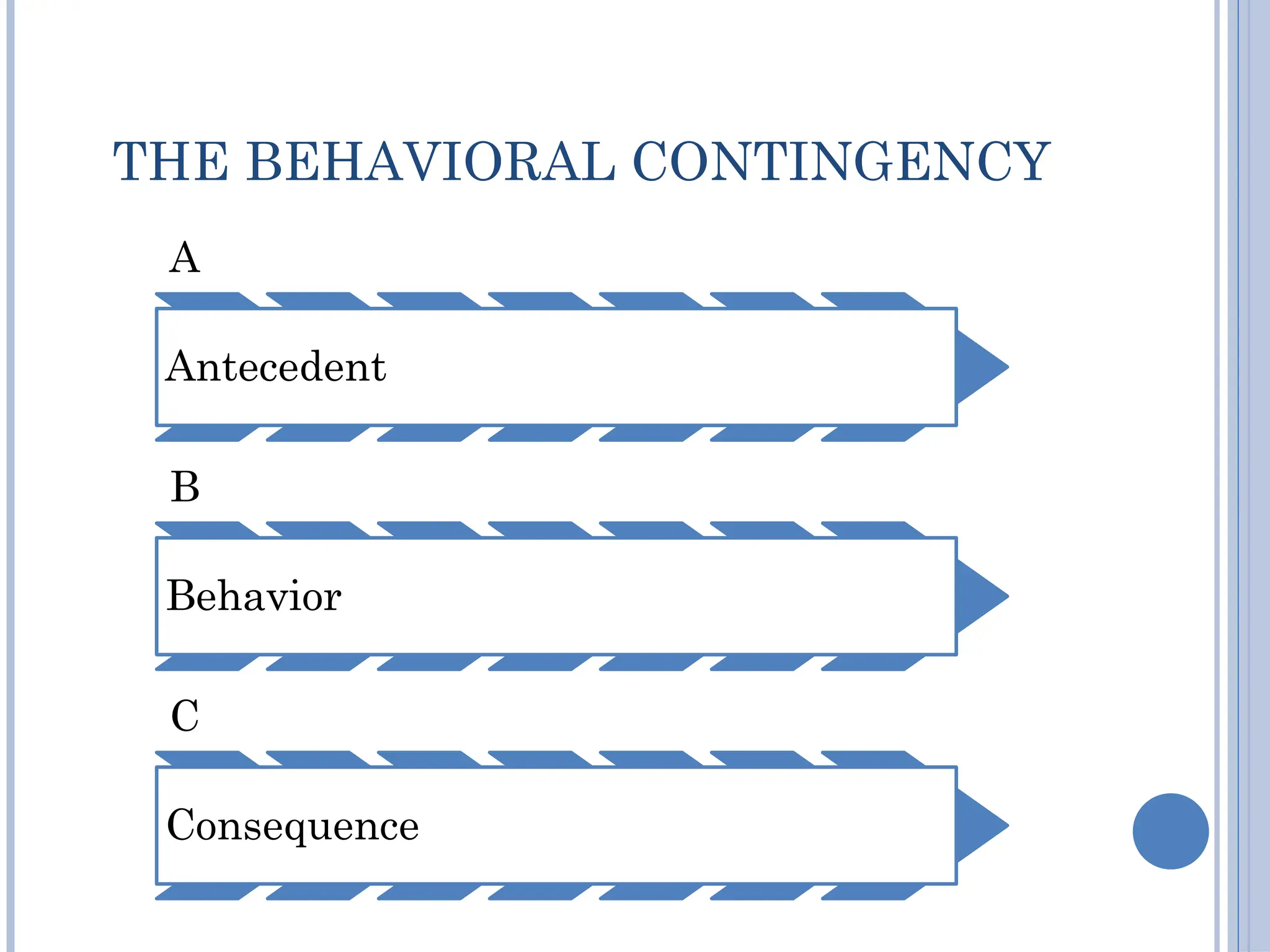
Antecedent--Behavior--Consequences
A—B—C
Applied Behavior Analysis (ABA) given in early
then it is called Early intensive behavior analysis
(EIBI)
6.
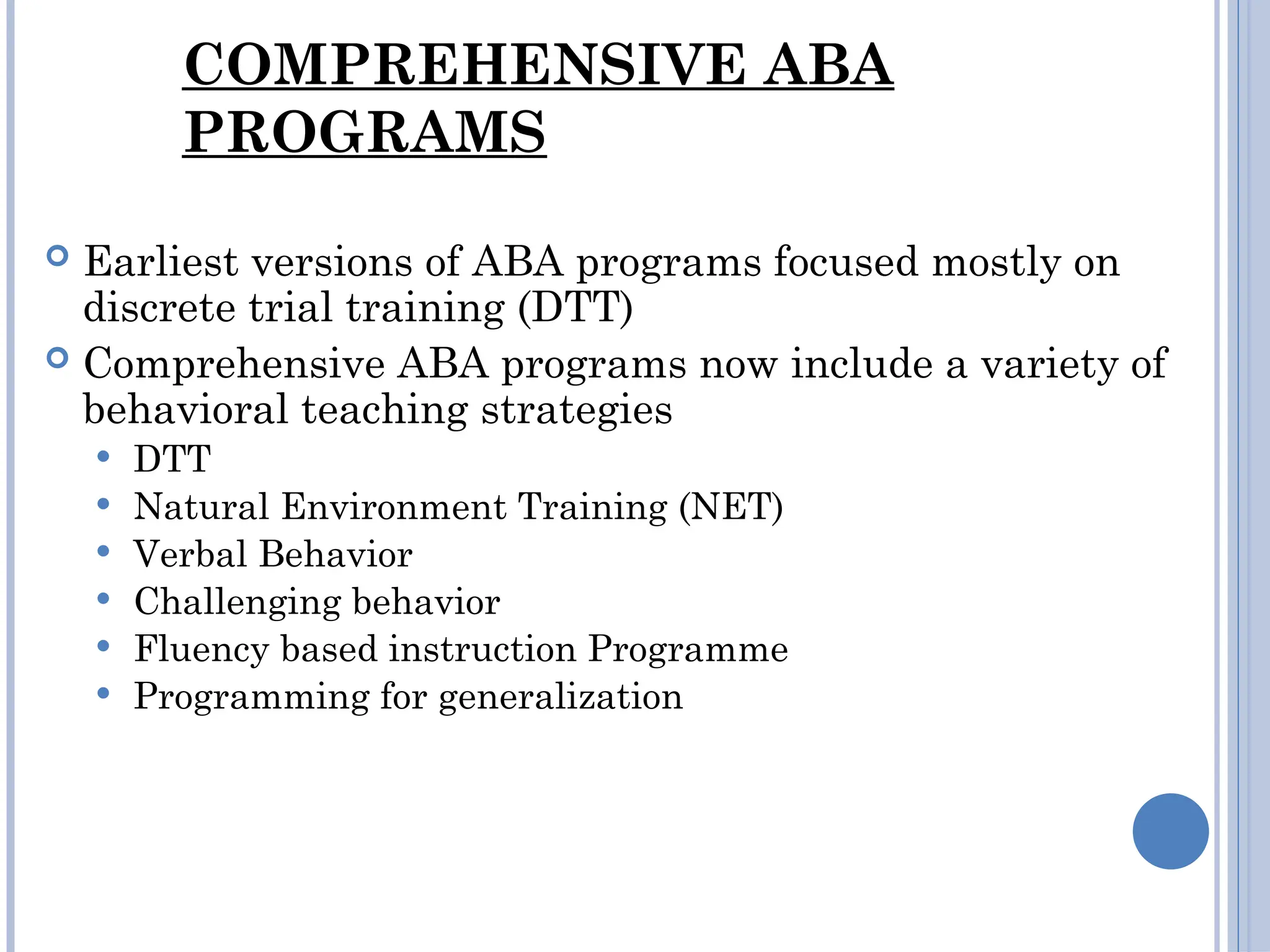
COMPREHENSIVE ABA
PROGRAMS
Earliestversions of ABA programs focused mostly on
discrete trial training (DTT)
Comprehensive ABA programs now include a variety of
behavioral teaching strategies
DTT
Natural Environment Training (NET)
Verbal Behavior
Challenging behavior
Fluency based instruction Programme
Programming for generalization
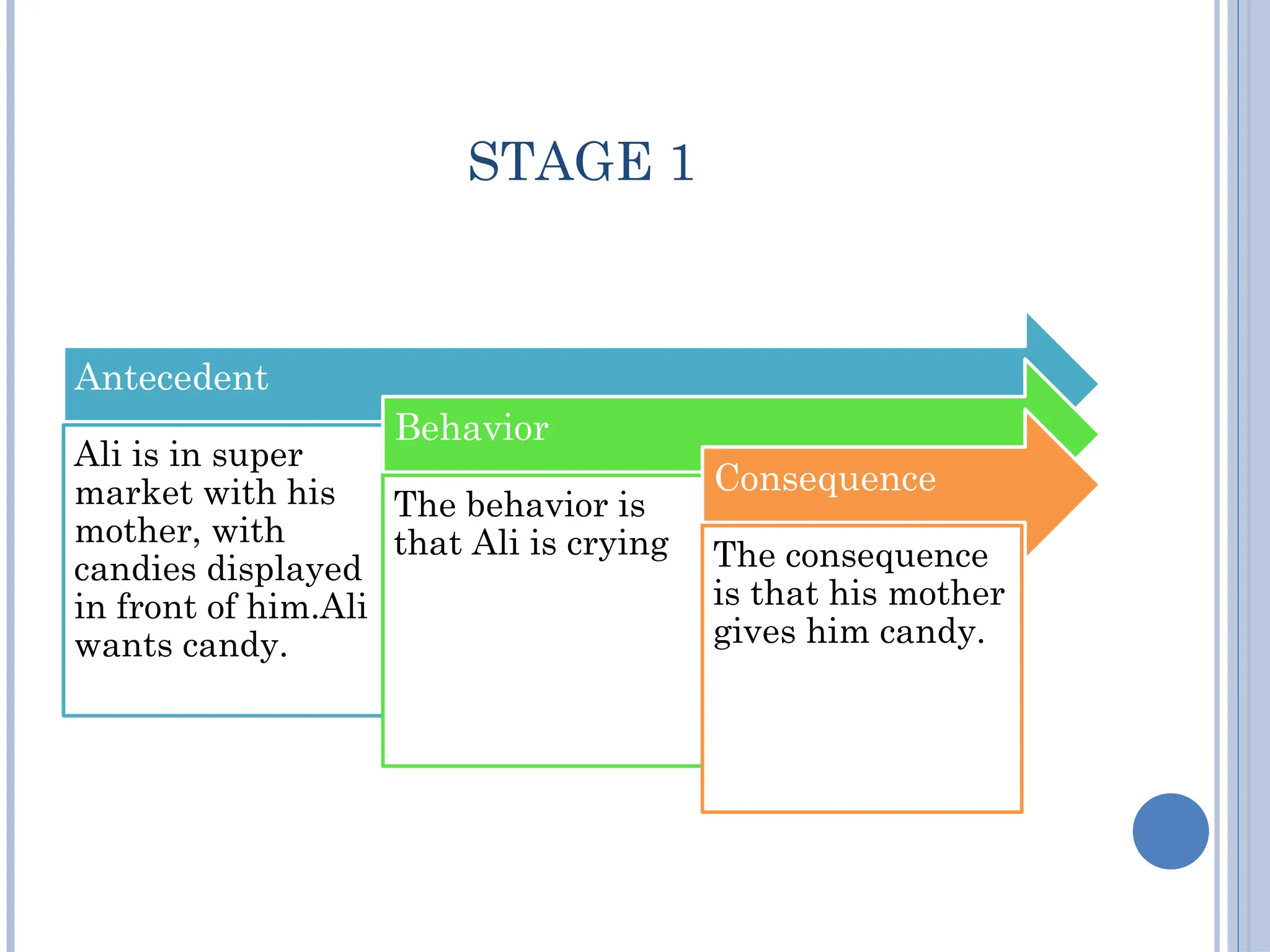
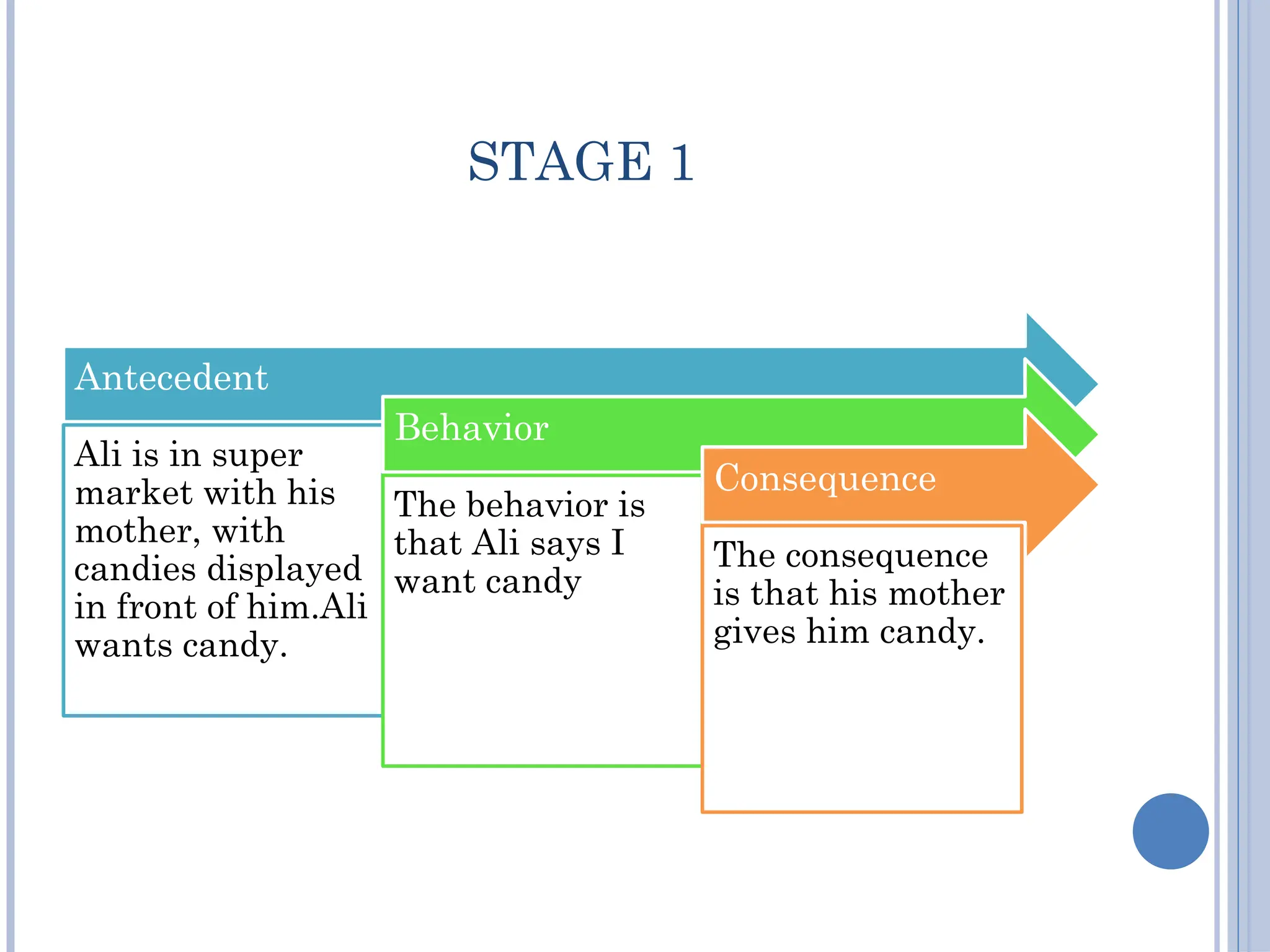
STAGE 1
Antecedent
Ali isin super
market with his
mother, with
candies displayed
in front of him.Ali
wants candy.
Behavior
The behavior is
that Ali is crying
Consequence
The consequence
is that his mother
gives him candy.
10.
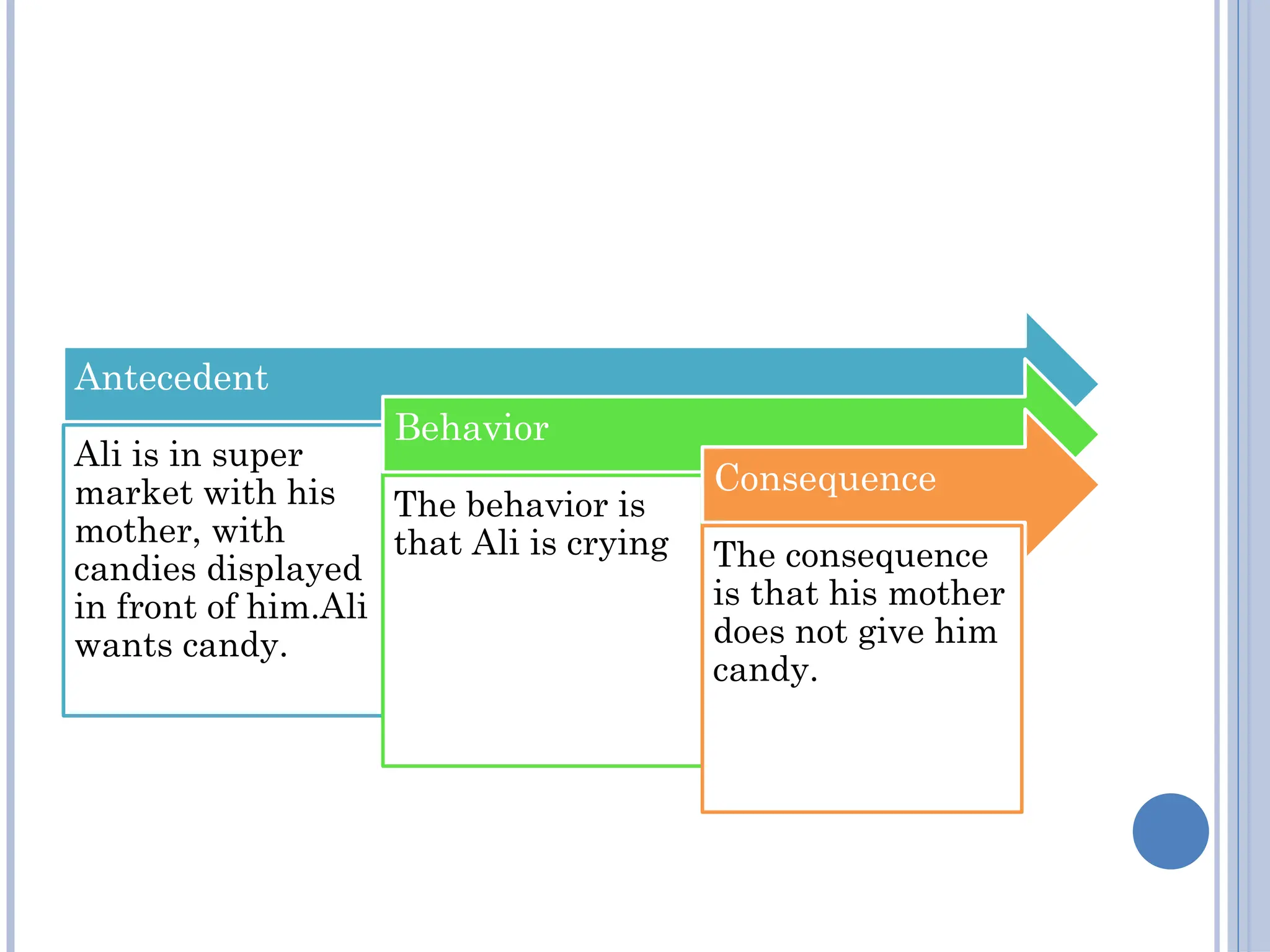
STAGE 1
Antecedent
Ali isin super
market with his
mother, with
candies displayed
in front of him.Ali
wants candy.
Behavior
The behavior is
that Ali says I
want candy
Consequence
The consequence
is that his mother
gives him candy.
11.
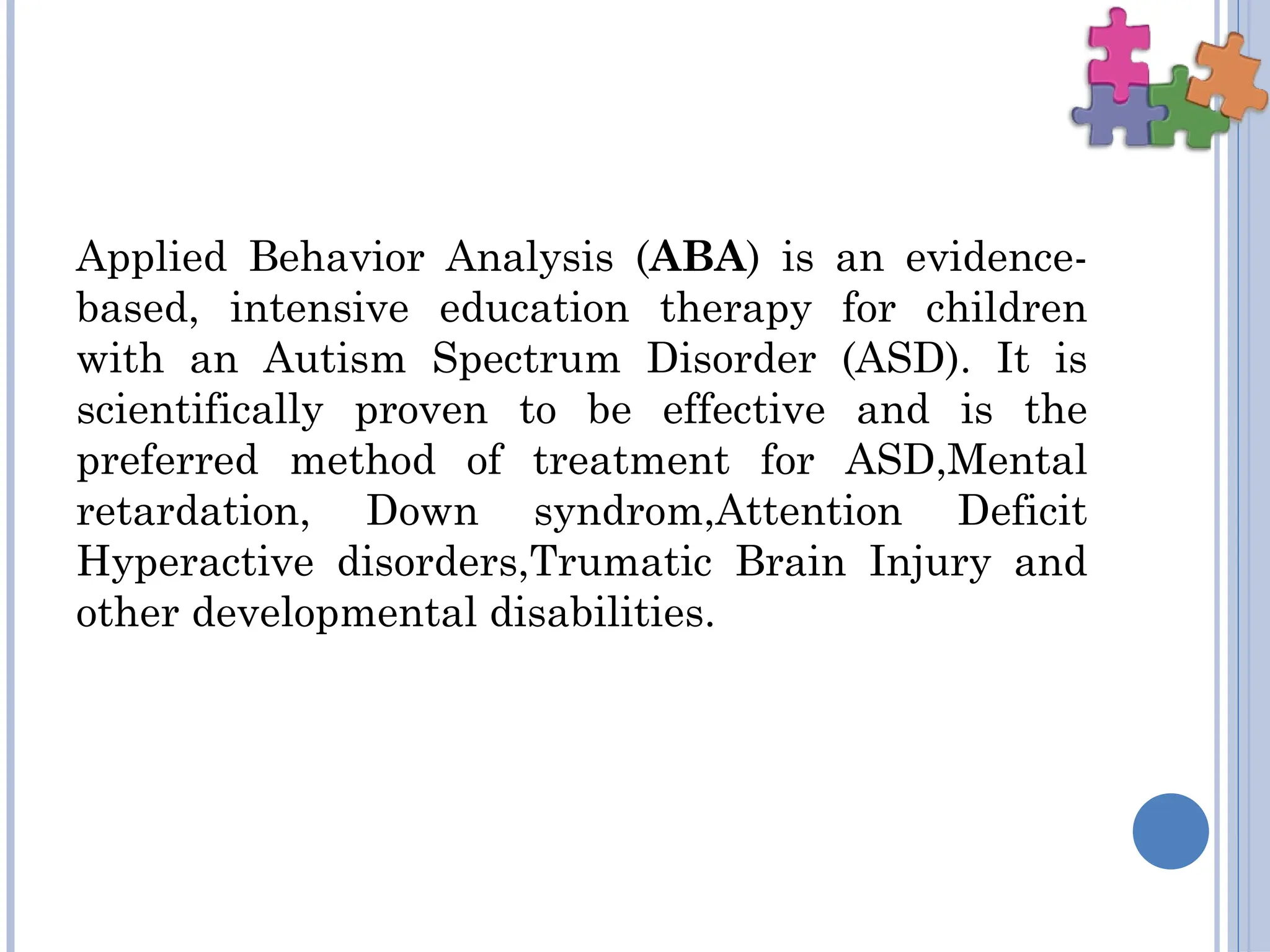
Antecedent
Ali is insuper
market with his
mother, with
candies displayed
in front of him.Ali
wants candy.
Behavior
The behavior is
that Ali is crying
Consequence
The consequence
is that his mother
does not give him
candy.
12.
Applied Behavior Analysis(ABA) is an evidence-
based, intensive education therapy for children
with an Autism Spectrum Disorder (ASD). It is
scientifically proven to be effective and is the
preferred method of treatment for ASD,Mental
retardation, Down syndrom,Attention Deficit
Hyperactive disorders,Trumatic Brain Injury and
other developmental disabilities.
13.
COMPONENTS PROGRAMME
OF EFFECTIVEABA
1. Antecedent Package
2. Behavioral Package
3. Comprehensive Behavioral Treatment for
Young Children
4. Joint Attention Intervention
5. Modeling
6. Naturalistic Teaching Strategies
7. Peer Training Package
8. Pivotal Response Treatment
9. Schedules
10. Self-management
11. Story-based Intervention Package
14.
ANTECEDENT PACKAGE
Antecedent manipulation- modification of
situational events that precede the target
behavior. These alterations are designed to
increase the likelihood of success of the targeted
behavior. Examples include:
Prompt/fading procedures
Behavioral momentum
Contrived motivational operations (EO-AO)
Inter-trial intervals
Incorporation special interests etc.
15.
PROMPT/FADING PROCEDURES
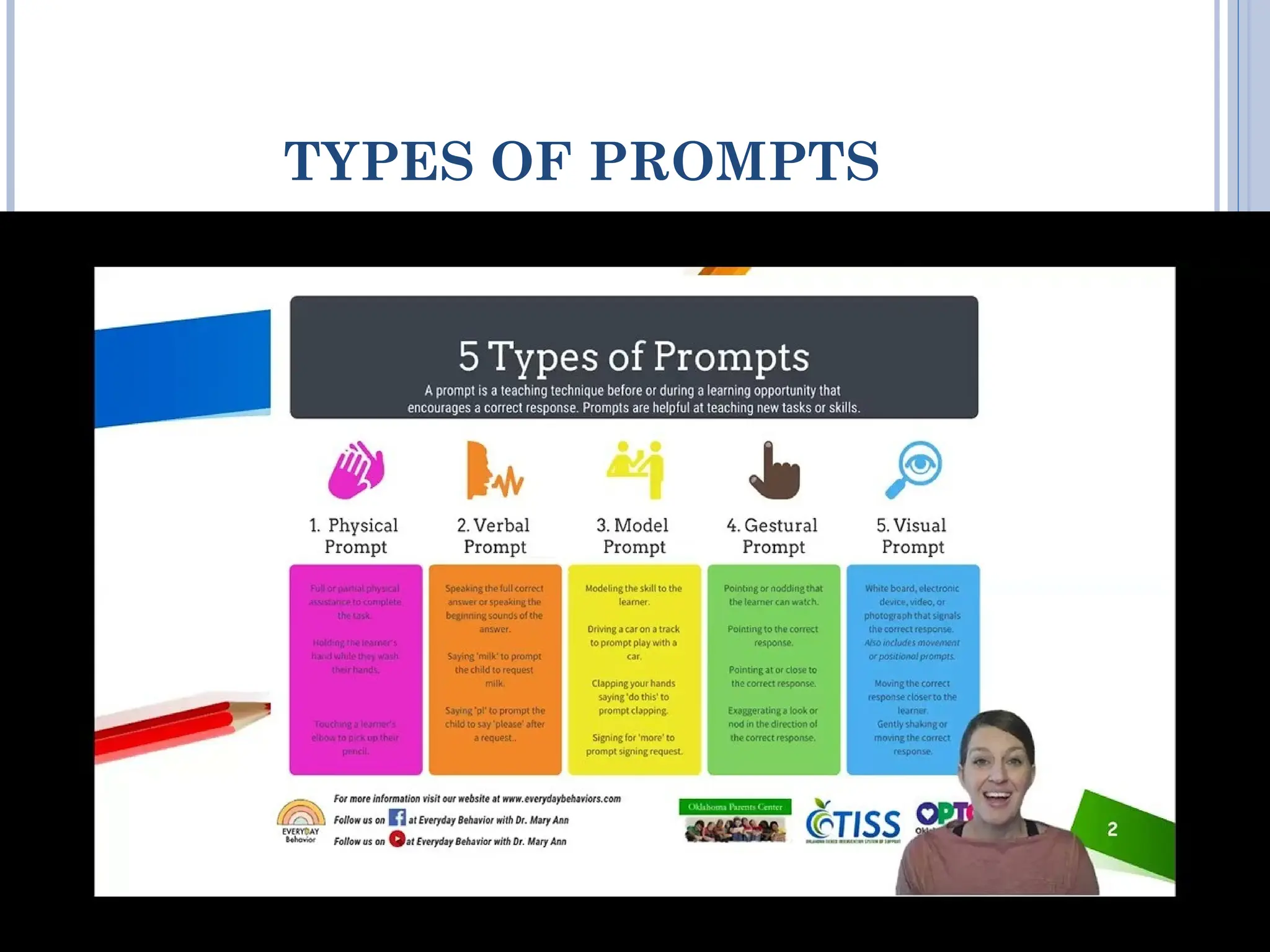
Promptsare instructions, gestures,
demonstrations, touches, or other things that we
arrange or do to increase the likelihood that
children will make correct responses. In other
words, it is a specific form of assistance given by
an adult before or as the learner attempts to use a
skill.
Prompting procedures provide a systematic way
of providing and removing prompts so that the
learner begins to perform skills independently.
These procedures rely on reinforcing correct
responses that are both prompted and not
prompted.
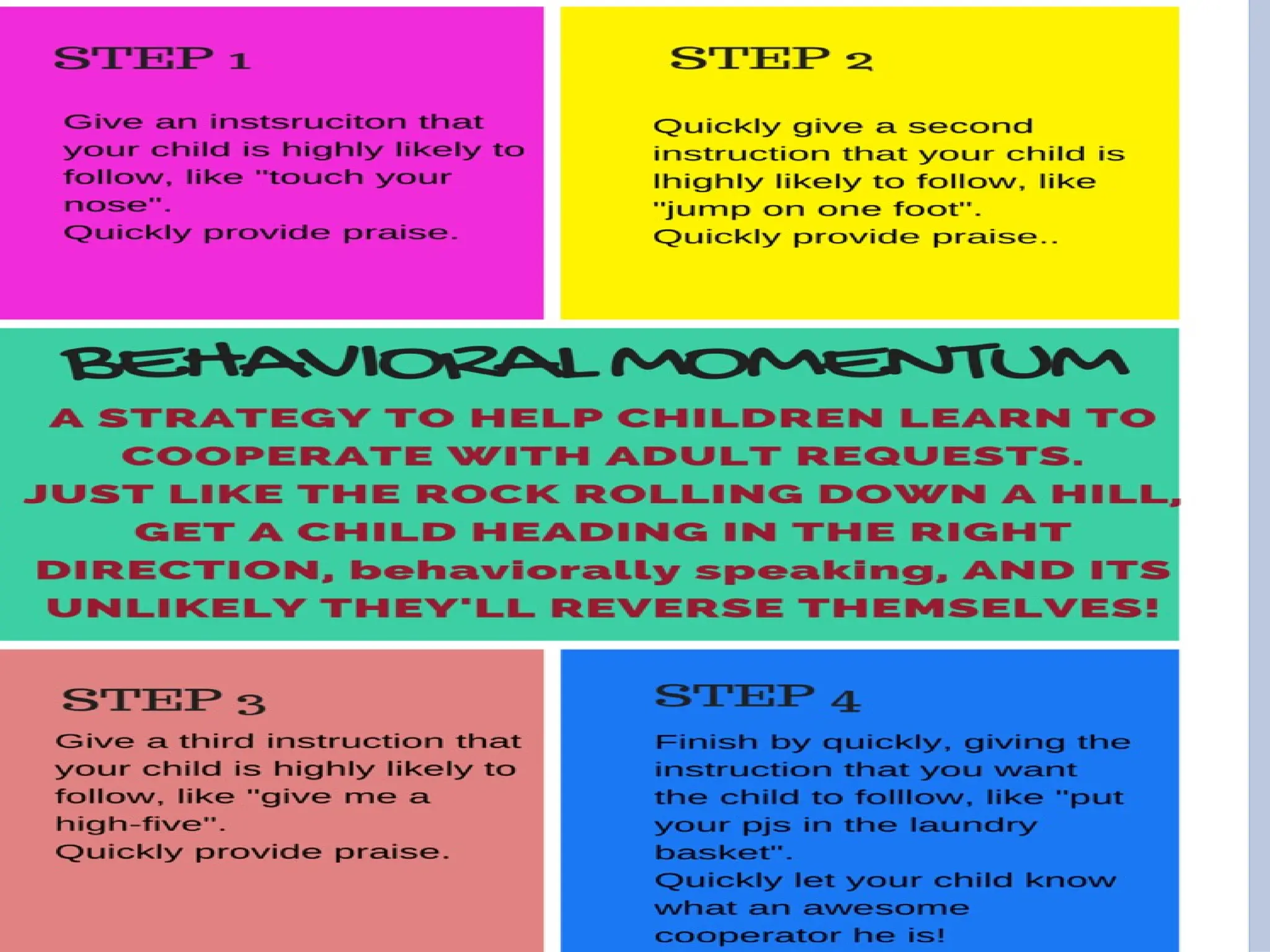
BEHAVIORAL MOMENTUM
Alsoknown as, High-Probability Command
Sequence (HPCS) is an
effective antecedent strategy that increases
compliant behaviors.
Can be used for behavior compliance, the child is
likely to follow directions because they are
getting reinforced for easy behaviors. Reduces
frustration levels, because students are having
success on easy tasks, increasing the likelihood
that they will try harder behaviors.
18.
In workingwith a young student start with
presenting three high-
p behaviors prior to one
low-
p behavior. Teacher should be in close
proximity to model and reinforce high-
p and low-
p behaviors.
1. “Clap hands”…(model if needed) “Wonderful
clapping hands!”
2. “Touch nose”…. (model if needed) “Super job
touching nose! Tickle attack!” Give tickles.
3. “High five”…(extend hand as a model) “Thanks
buddy!”
4. “Sit down” (low-
p behavior), walk with student
to desk, once seated, “You are sitting so nicely!”
20.
SUMMARY
Behavioral Momentumessentially means to
build up momentum to what you really want the
child to do, by giving them easy tasks or
demands, that they are highly likely to do first
before presenting them with more difficult tasks.
Instead of approaching the child with what you
want them to do, you start with what they are
most likely to want to do.
21.
CONTRIVED MOTIVATIONAL OPERATIONS
(EO-AO)
What is AO and EO in ABA?
MO's are environmental factors that impact how
effective a reinforce is. MO's can either be
Establishing Operations (EO's)
Abolishing Operations (AO's)
An EO is that increases how reinforcing something
is, and an AO is that decreases how reinforcing
something is.
22.
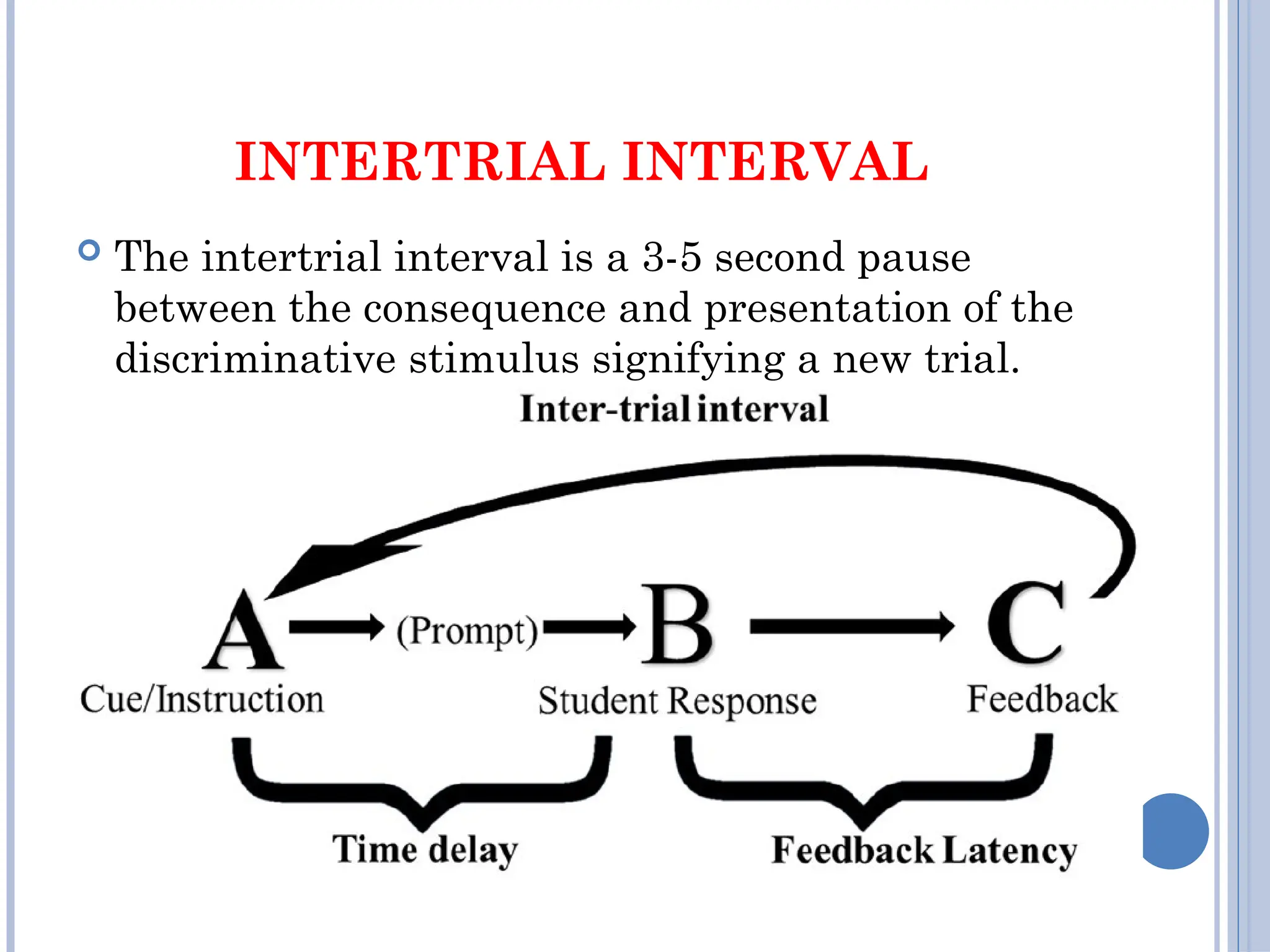
INTERTRIAL INTERVAL
Theintertrial interval is a 3-5 second pause
between the consequence and presentation of the
discriminative stimulus signifying a new trial.
23.
INCORPORATION SPECIAL
INTERESTS
Many autisticpeople have intense and highly-
focused interests, often from a fairly young age.
These can change over time or be lifelong. It can
be art, music, gardening, animals, postcodes or
numbers. For many younger children it's Thomas
the Tank Engine, dinosaurs or particular cartoon
character.
24.
BEHAVIORAL PACKAGE
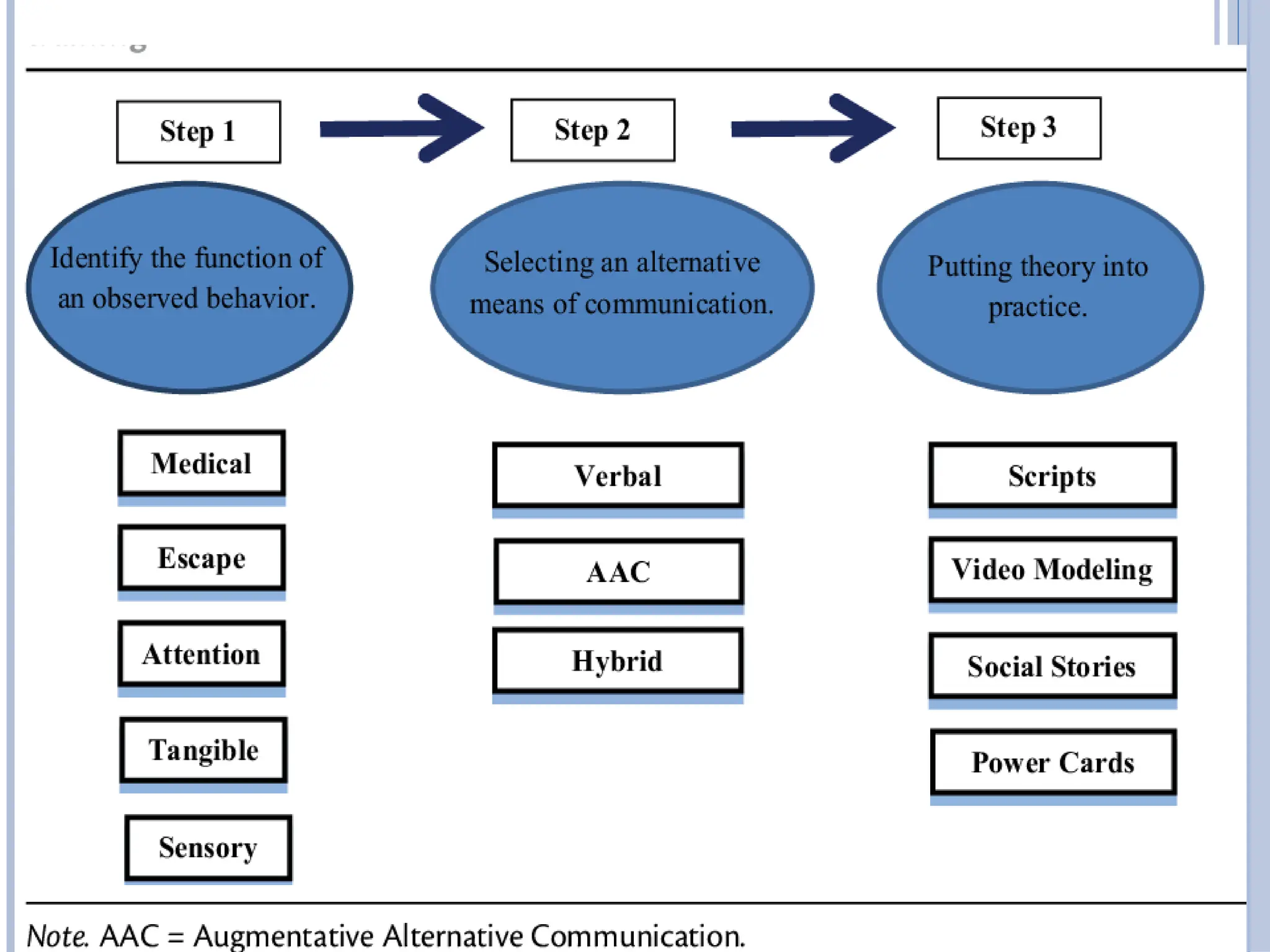
Behavioral treatment-programs designed to
decrease problem behaviors and to increase
functional alternative behaviors. Examples include:
Functional communication training
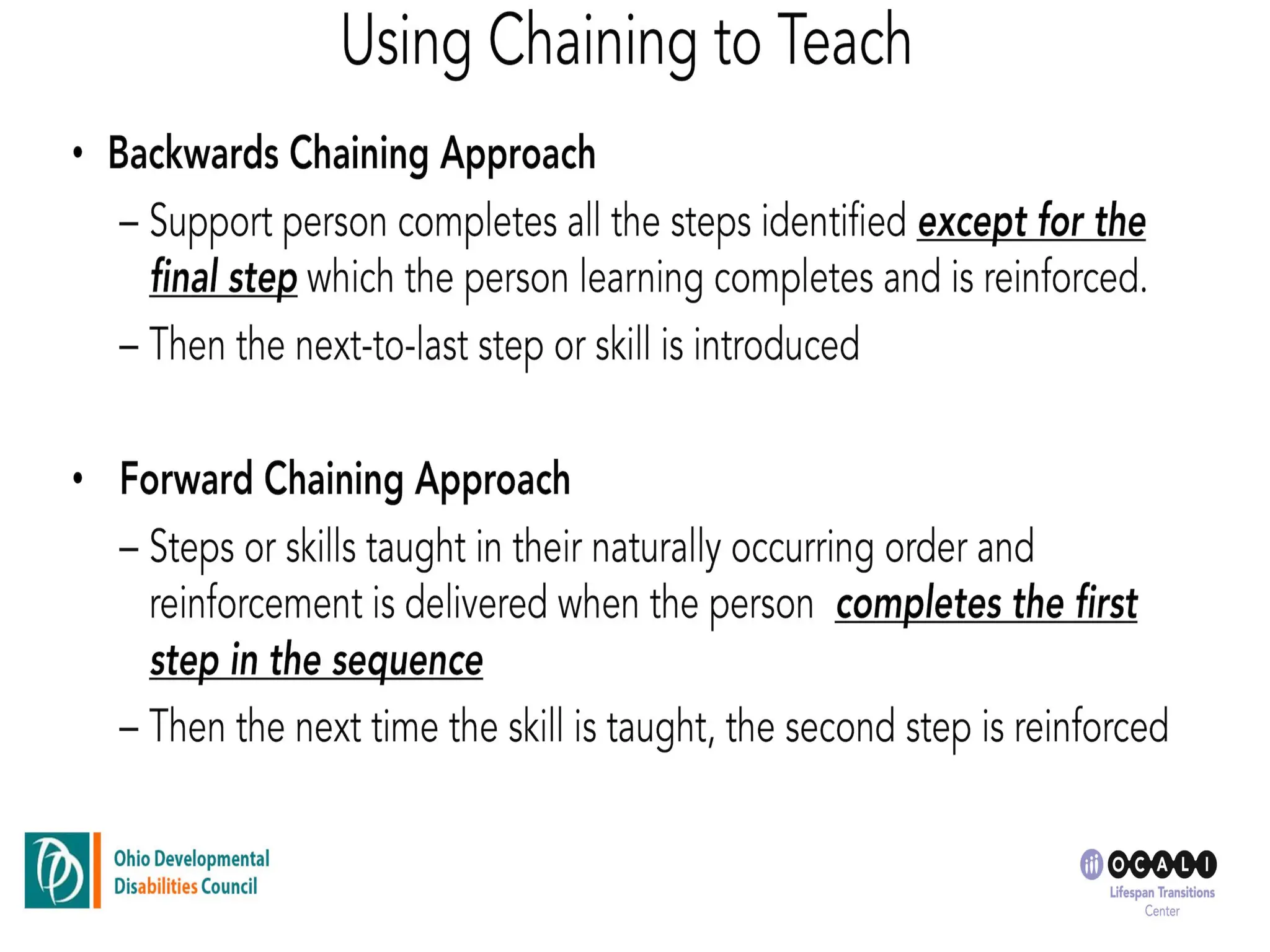
chaining
discrete trial training
mand training
generalization training
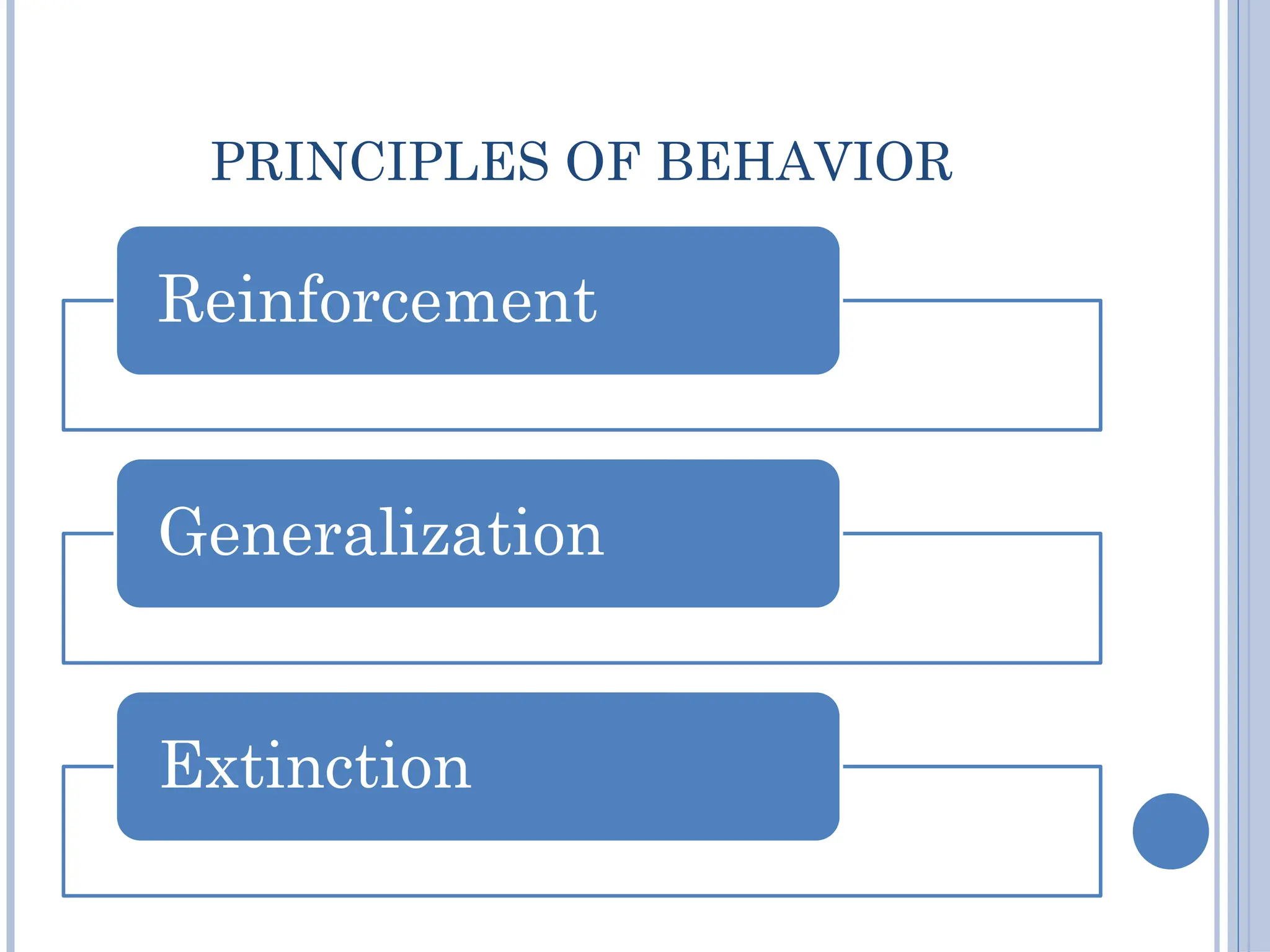
reinforcement
shaping etc.
27.
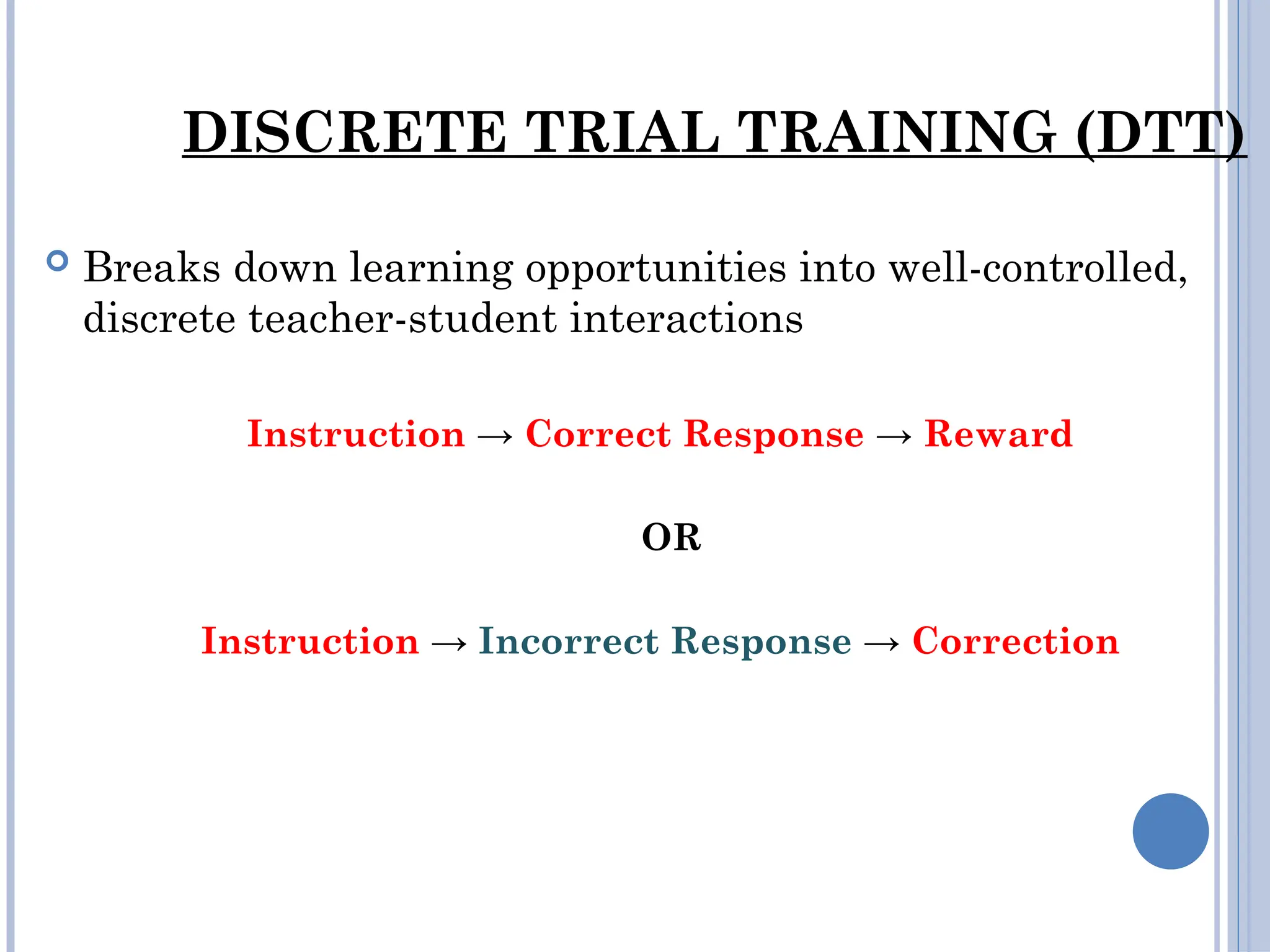
DISCRETE TRIAL TRAINING(DTT)
Breaks down learning opportunities into well-controlled,
discrete teacher-student interactions
Instruction → Correct Response → Reward
OR
Instruction → Incorrect Response → Correction
28.
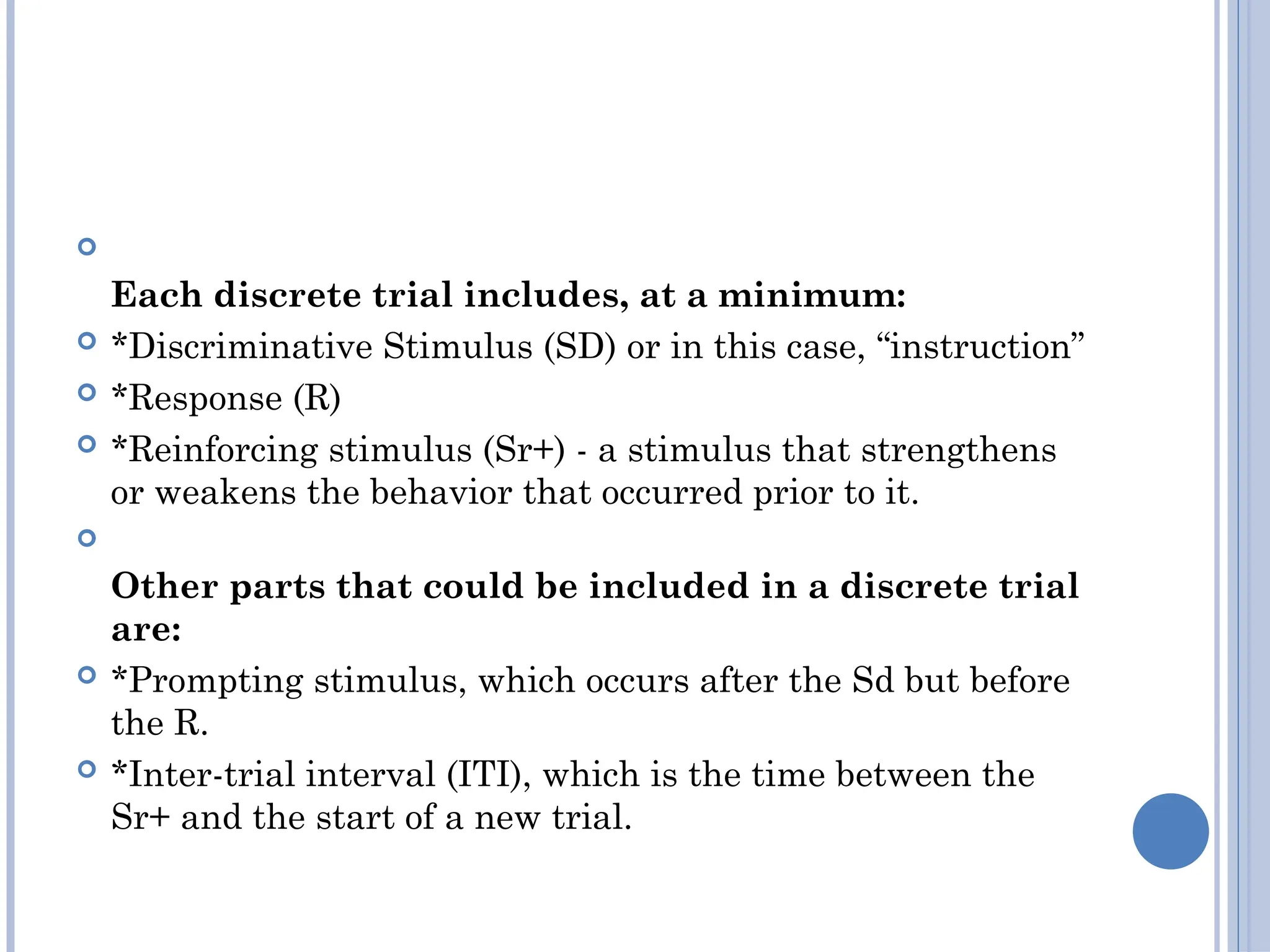
Each discrete trialincludes, at a minimum:
*Discriminative Stimulus (SD) or in this case, “instruction”
*Response (R)
*Reinforcing stimulus (Sr+) - a stimulus that strengthens
or weakens the behavior that occurred prior to it.
Other parts that could be included in a discrete trial
are:
*Prompting stimulus, which occurs after the Sd but before
the R.
*Inter-trial interval (ITI), which is the time between the
Sr+ and the start of a new trial.
29.
A typical exampleof a teaching trial follows:
Suppose the target is to teach the child to imitate touching
his/her toes.
*The Sd will be “Do this/Copy me”.
*The target response will be that he/she touches his/her toes
within 2 seconds of being given the Sd.
*Teacher: “Do this”, while touching her own toes. [This is
the Sd.]
*Teacher and Student: at the same time as giving the Sd the
teacher is physically prompting (assisting) the child to also
touch his/her toes. [The prompt is the Sp.]
*Student: The student touches his/her toes. [This is the R.]
*Teacher: Gives verbal praise and maybe some tickles
immediately following the response (R). [This is the Sr+.]
30.
COMPREHENSIVE BEHAVIORAL
TREATMENT
Comprehensive intervention- low student to
teacher ratio (1:1, or low as appropriate) in a
variety of settings, including home school and
community. Effective programs are based on a
treatment manual, provide intensive treatment
(25hrs/wk), and include data-driven decision-
making.
31.
JOINT ATTENTION INTERVENTION
Jointattention intervention - programs designed to
teach a child to respond to the social bids of
another, or to initiate joint attention interactions.
Examples include:
pointing to objects
showing items
activities to another
following eye gaze.
32.
MODELING
Modeling - adultsor peers provide a demonstration
of the target behavior; the student is expected to
imitate. Thus, imitation skills are a necessary
prerequisite to this type intervention. Modeling is
often combined with prompting and reinforcement
strategies which can assist the student to acquire
imitation skills.
33.
NATURALISTIC TEACHING
STRATEGIES
Naturalistic teachingstrategies - use of child-
initiated interactions to teach functional skills in
the natural environment. This intervention
requires providing a
stimulating environment,
modeling play,
providing choices,
encouraging conversation
and rewarding reasonable attempts
34.
PEER TRAINING PACKAGE
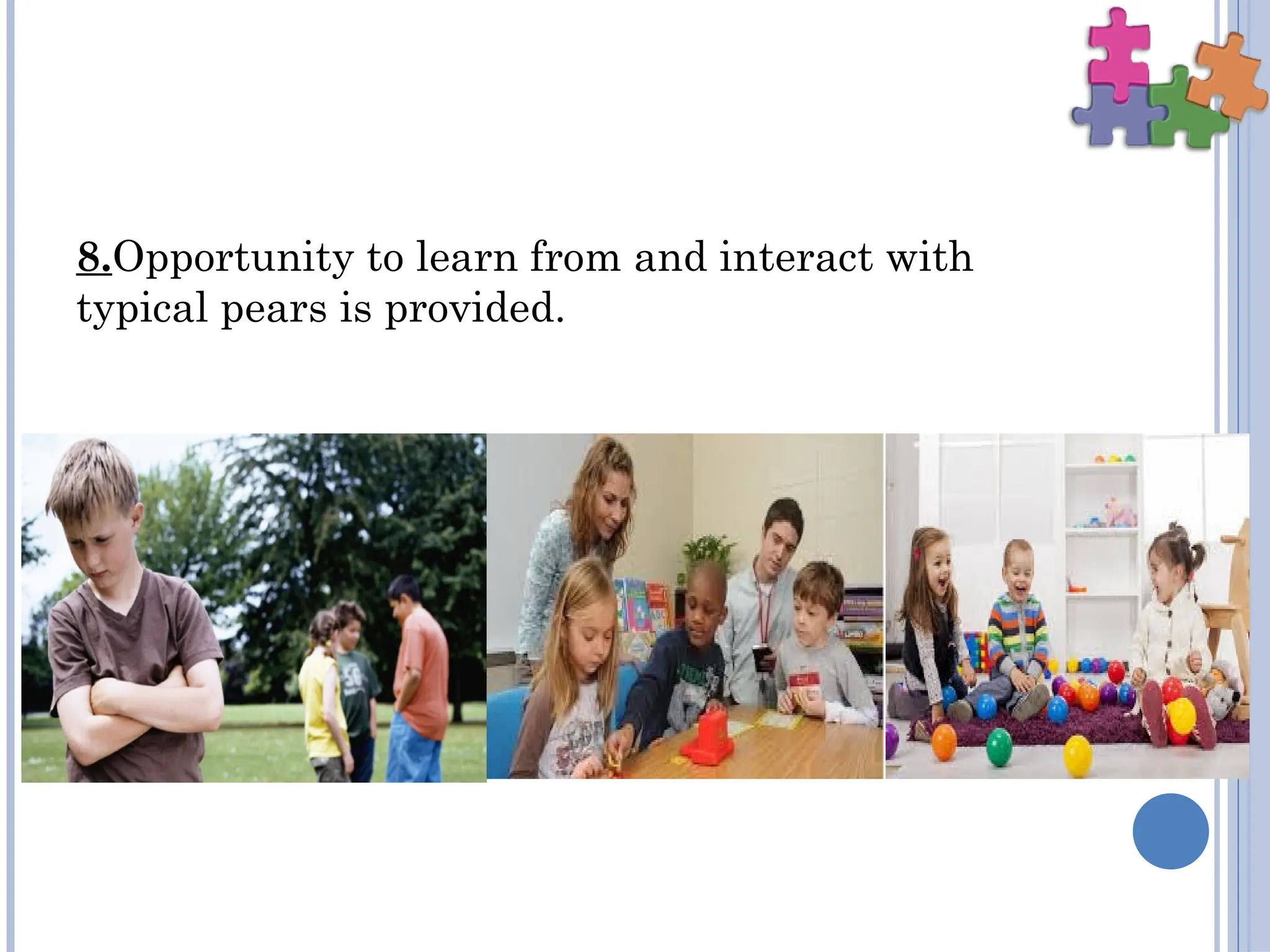
Peertraining - involves training peers without
disabilities strategies for interacting (play and
social) with children with autism. Some commonly
known peer-training programs include:
circle of friends
buddy skills
peer networks etc.
35.
PIVOTAL RESPONSE TREATMENT
Pivotalresponse training - program designed to
target specific, “pivotal,” behaviors that lead to
improvement across a broad range of behaviors.
These pivotal behaviors include: motivation to
engage in
social communication
self-initiation
self-management
responsiveness to multiple cues etc.
36.
SCHEDULES
Schedules - teachinga student to follow a task list
(picture- or word-based) through a series of
activities or steps in order to complete a specific
activity. Schedules are accompanied by other
behavioral interventions, including reinforcement.
37.
SELF-MANAGEMENT
Self-management - thistreatment intervention
teaches a student to regulate his or her behavior by
recording the occurrence or non-occurrence of the
target behavior, and secure reinforcement for doing
so.
38.
STORY-BASED INTERVENTION
PACKAGE
Story-based interventions- involves a written
description of the situations under which specific
behaviors are expected to occur. The stories seek to
teach the: who, what, when, where and why of
social interactions to improve perspective taking.
The most well-known of these interventions is
Carol Gray’s “Social Stories.”
EARLY INTENSIVE BEHAVIOR
INTERVENTION(EIBI)
Early and Intensive Behavioral Intervention (EIBI)
is an evidence-based intervention using principles
and procedures from Applied Behavior Analysis to
teach adaptive behaviors to young children with
autism spectrum disorders. Several outcome
studies have indicated that the best outcome is
achieved when treatment is started as early as
possible (before the age of 5) and with a high
intensity (30–40 h per week).
41.
The treatment iscarried out by parents and teachers
under supervision by a professional and consists of
identifying the skills that the child lacks, breaking
these tasks into components and teaching those
component behaviors separately. This enables the child
to succeed more easily. The child is provided with
guidance to learn novel behaviors, and this help is then
phased out until the child can perform the target skills
independently. The complexity of tasks is gradually
increased as the child progresses, so that the child can
master each consecutive step. Much emphasis is placed
on generalization of taught skills, meaning that skills
taught in an EIBI program must be functional for the
child in everyday life.
42.
EIBI consistsof both one-to-one discrete trial
teaching for basic skills such as imitation (verbal
and motor), expressive and receptive language,
and matching, and less structured teaching such
as naturalistic and incidental teaching working
on all areas of functioning, such as
communication, self-help skills, and independent
functioning. From a behavior analytic view,
autism can be seen as a biologically based
disorder related to innate social and sensory
motivation.
43.
10 COMPONENTS OFEIBI
PROGRAMS
1.
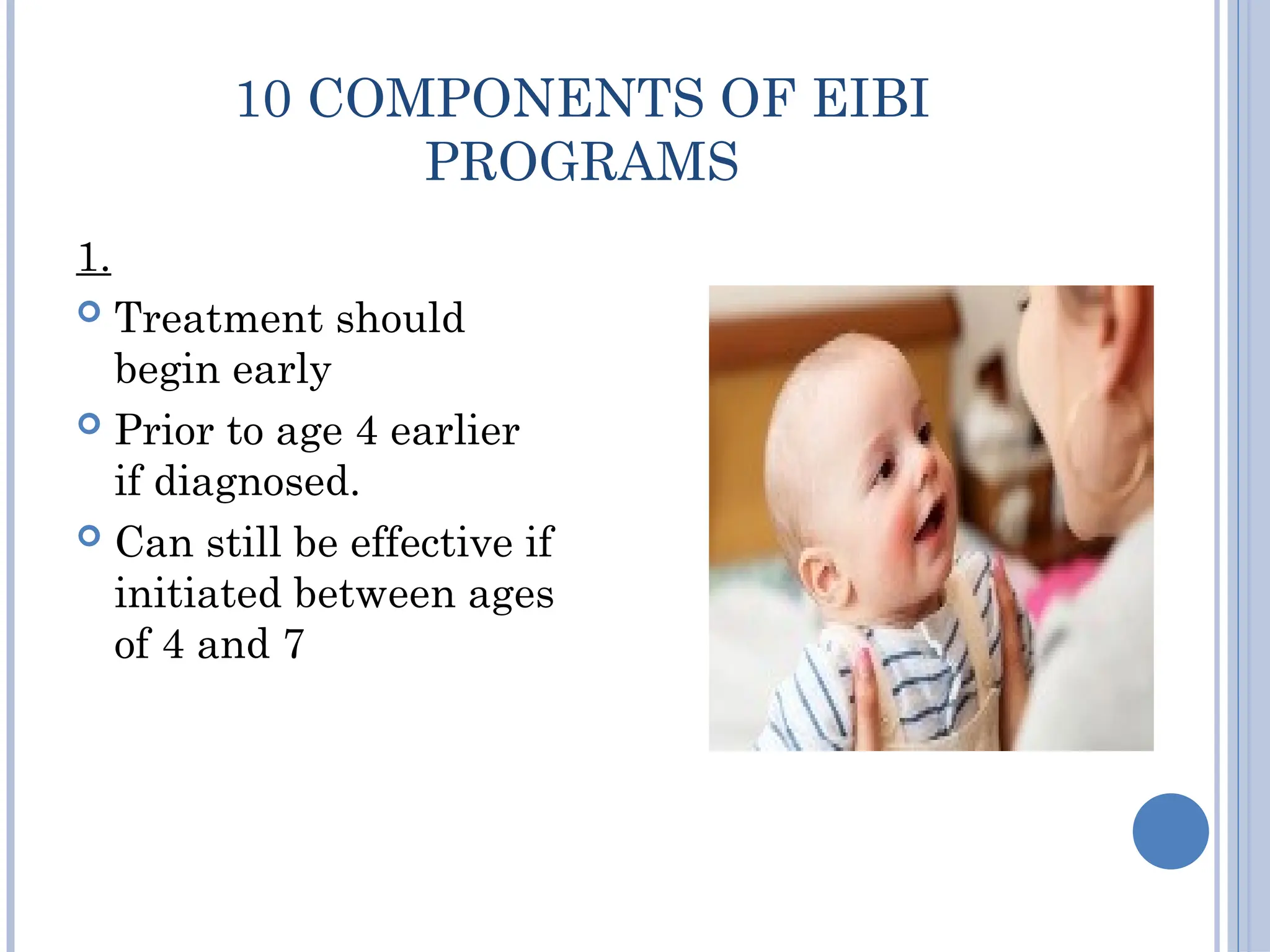
Treatment should
begin early
Prior to age 4 earlier
if diagnosed.
Can still be effective if
initiated between ages
of 4 and 7
3.
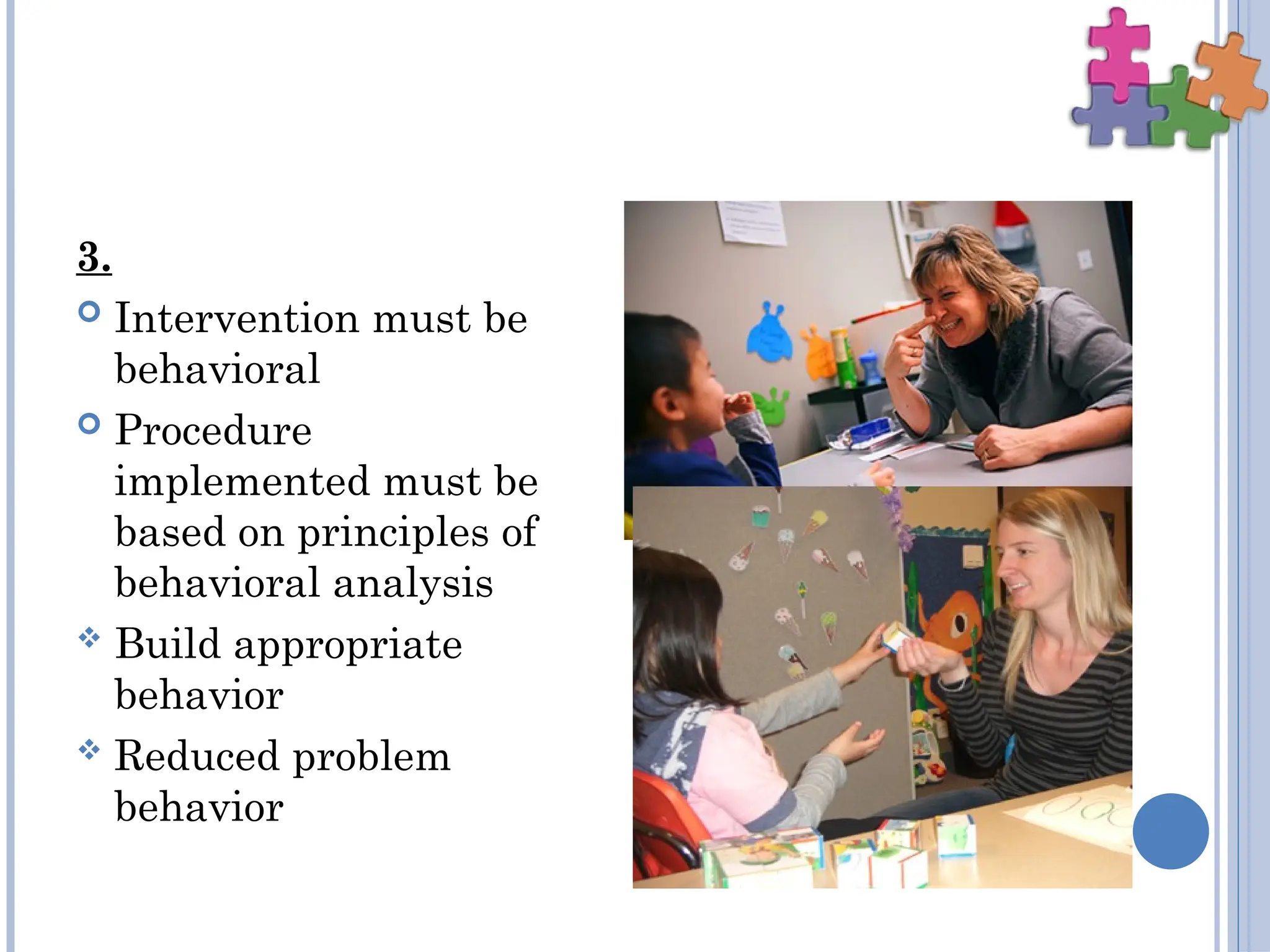
Intervention mustbe
behavioral
Procedure
implemented must be
based on principles of
behavioral analysis
Build appropriate
behavior
Reduced problem
behavior
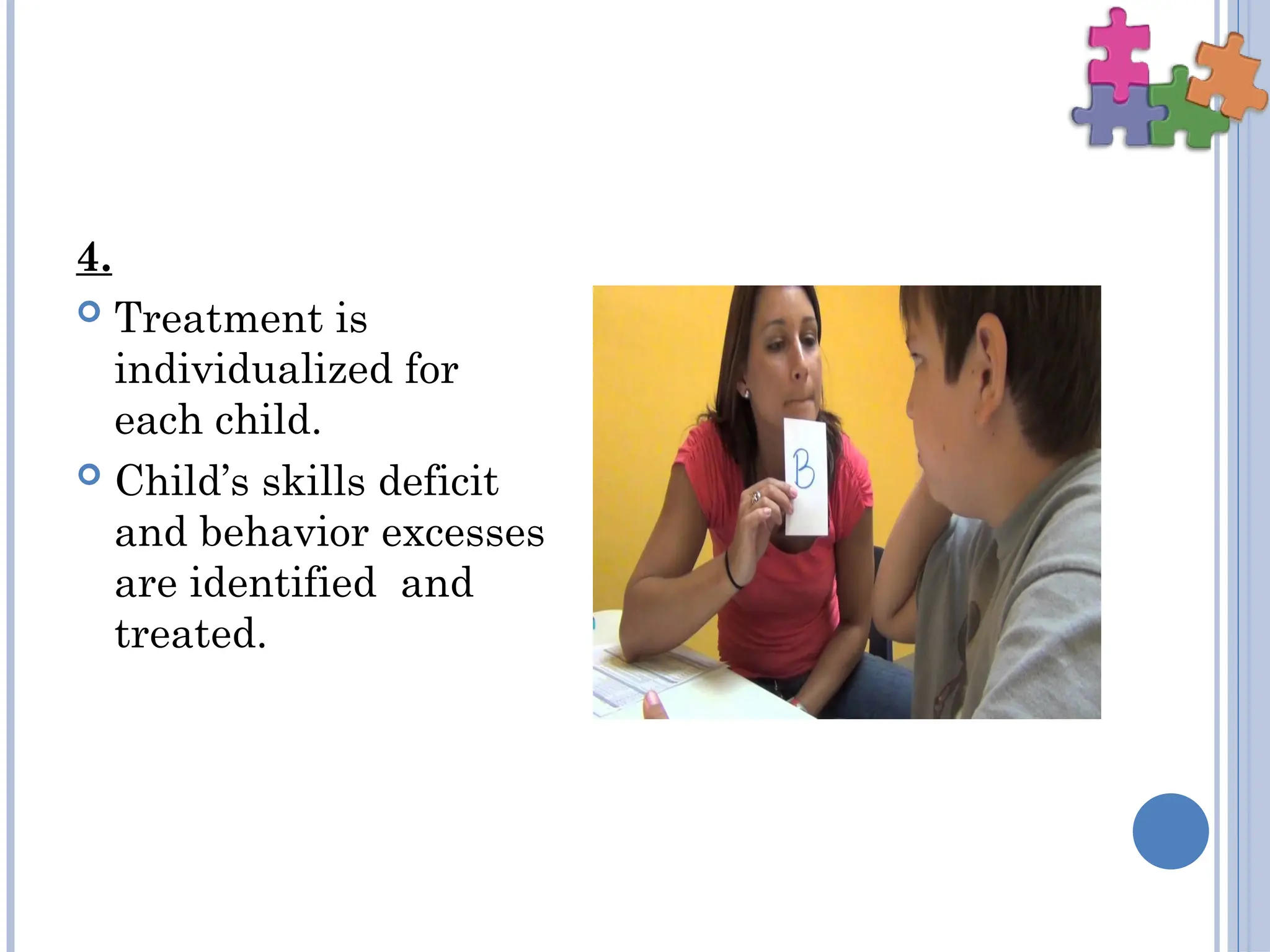
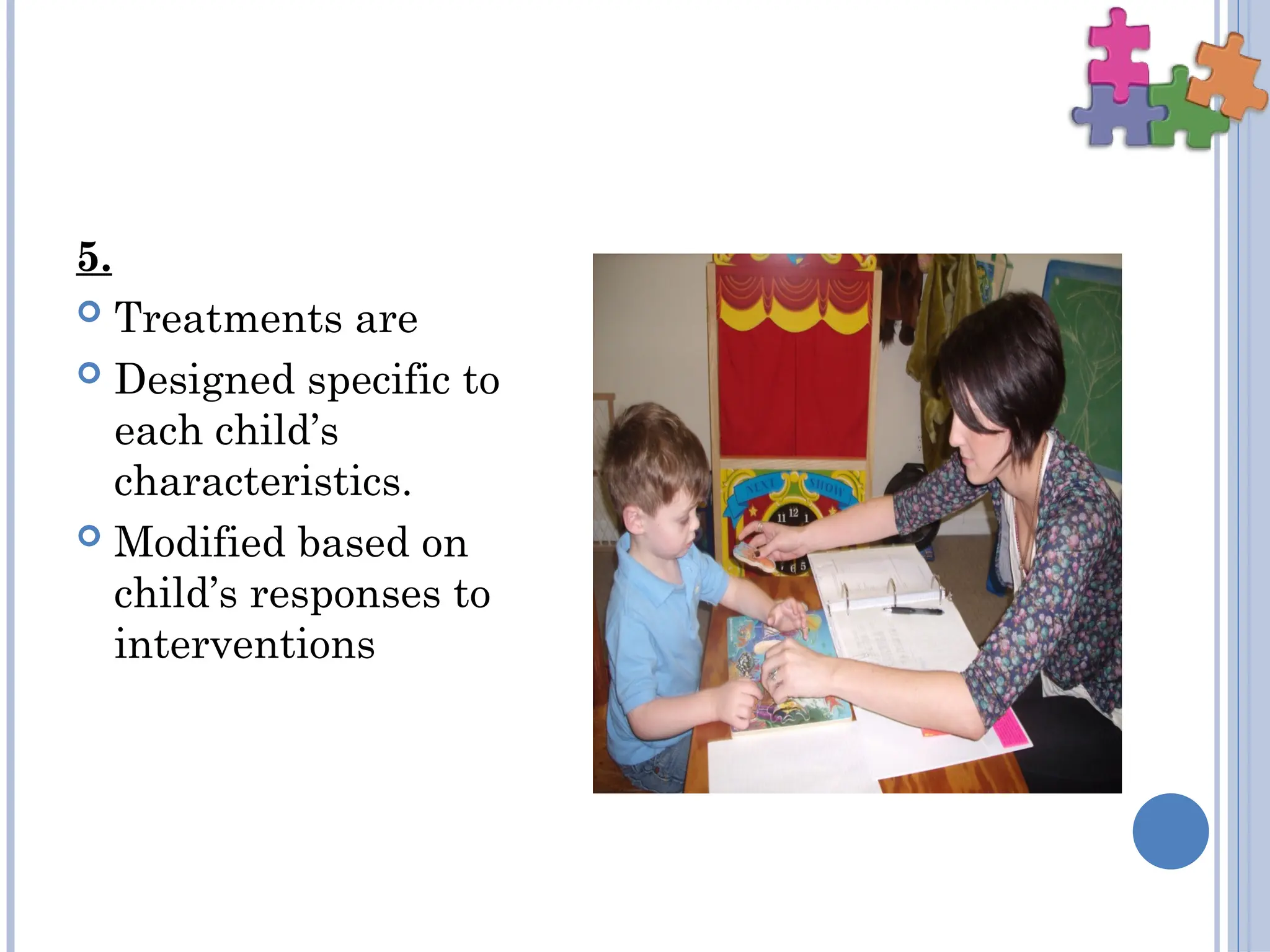
5.
Treatments are
Designed specific to
each child’s
characteristics.
Modified based on
child’s responses to
interventions
48.
5.Treatment must becomprehensive
All skill domain must be assessed and treated.
Language/communication
Play
Social
Perspective taking
Motor
Adaptive
Academics
Planning/Self management
All problems behavior should be assessed.
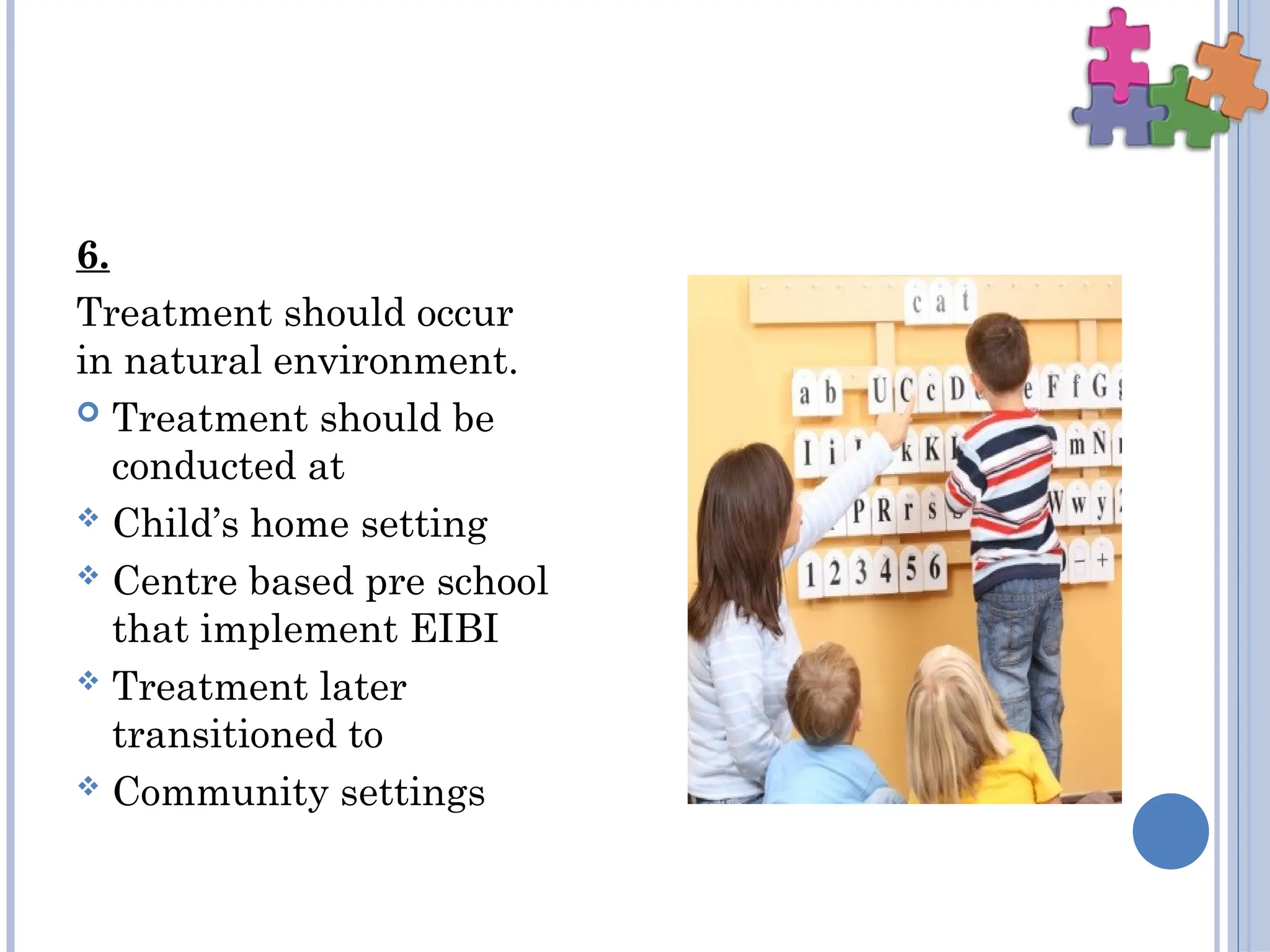
49.
6.
Treatment should occur
innatural environment.
Treatment should be
conducted at
Child’s home setting
Centre based pre school
that implement EIBI
Treatment later
transitioned to
Community settings
50.
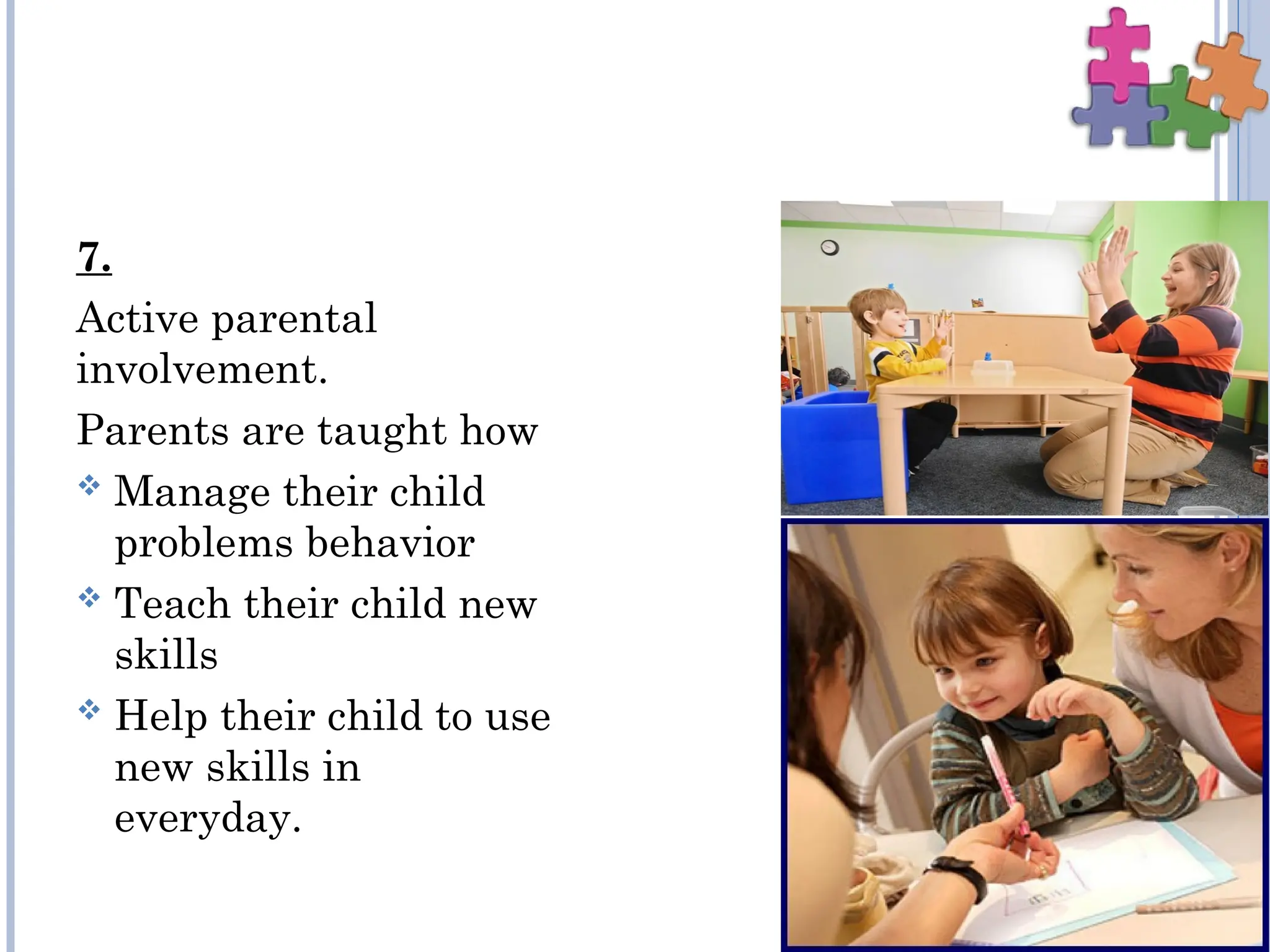
7.
Active parental
involvement.
Parents aretaught how
Manage their child
problems behavior
Teach their child new
skills
Help their child to use
new skills in
everyday.
9.Duration of treatment
Two or more years are necessary to achieve
optimal outcomes.
10.
Treatment supervision is only provided by
individuals experiences in autism.
![A typical example of a teaching trial follows:
Suppose the target is to teach the child to imitate touching
his/her toes.
*The Sd will be “Do this/Copy me”.
*The target response will be that he/she touches his/her toes
within 2 seconds of being given the Sd.
*Teacher: “Do this”, while touching her own toes. [This is
the Sd.]
*Teacher and Student: at the same time as giving the Sd the
teacher is physically prompting (assisting) the child to also
touch his/her toes. [The prompt is the Sp.]
*Student: The student touches his/her toes. [This is the R.]
*Teacher: Gives verbal praise and maybe some tickles
immediately following the response (R). [This is the Sr+.]](https://image.slidesharecdn.com/appliedbehavioranalysis-250524112654-1c1c3efb/75/Applied-Behavior-Analysis-Applied-Behavior-Analysis-29-2048.jpg)