Applications of Markov Decision Processes (MDPs)
in the Internet of Things (IoT) and Sensor Networks
Mohammad Abu Alsheikh
https://sites.google.com/site/mohabualsheikh
School of Computer Engineering
Nanyang Technological University
April 2016
1 / 26
Survey and summary of the field
See our comprehensive survey article:
Abu Alsheikh, M.; Hoang, D.T.; Niyato, D.; Tan, H.; Lin, S., "Markov Decision Processes
With Applications in Wireless Sensor Networks: A Survey," IEEE Communications
Surveys & Tutorials, vol.17, no.3, pp.1239,1267, thirdquarter 2015
2 / 26
Outline
Outline
1 Introduction and Motivation
2 Markov Decision Processes (MDPs): Overview
3 Applications of MDPs in the IoT and Sensor Networks
4 Future Trends and Open Issues
5 Summary and Conclusions
3 / 26
Introduction and Motivation
4 / 26
Introduction and Motivation Motivation
Motivation
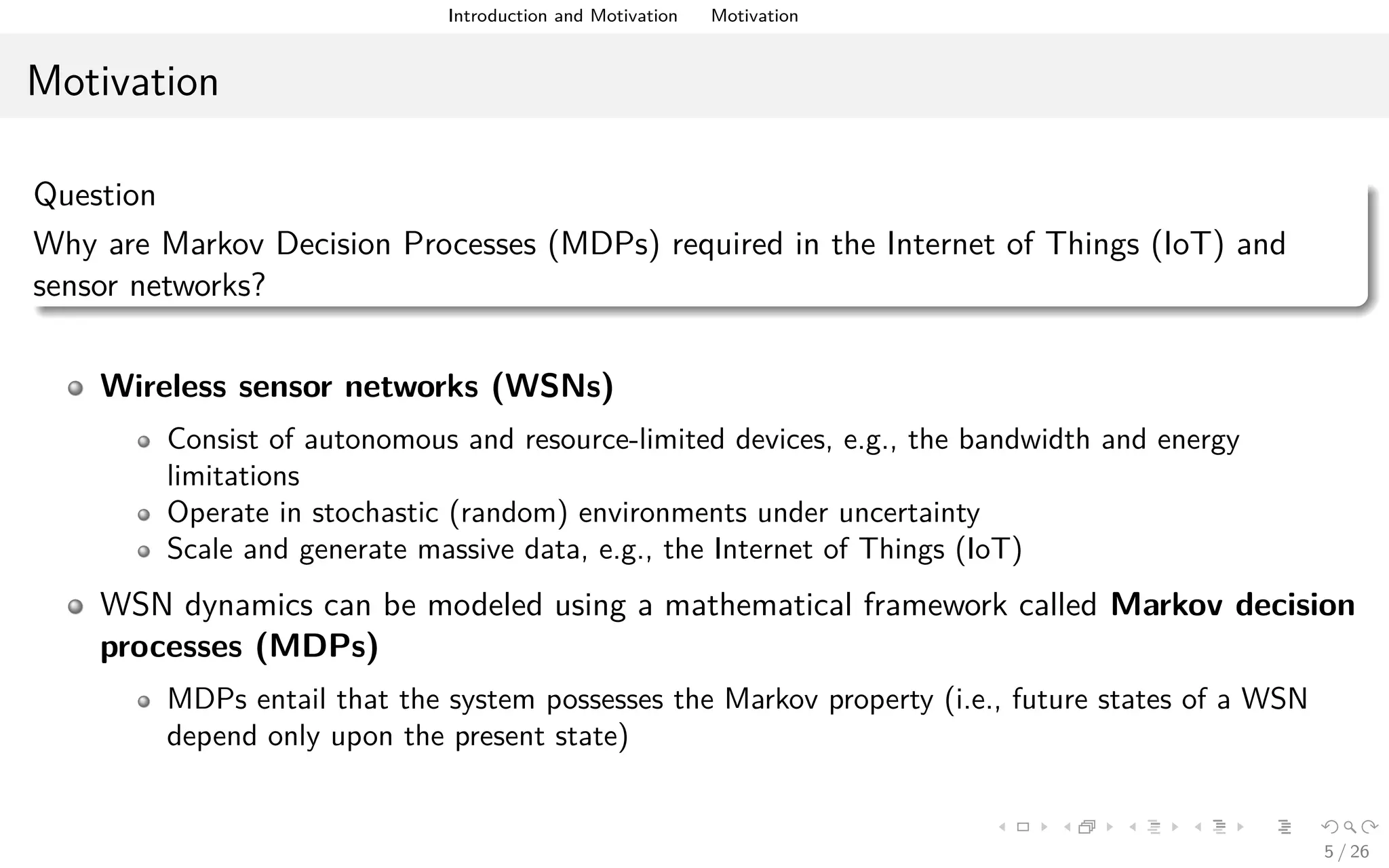
Question
Why are Markov Decision Processes (MDPs) required in the Internet of Things (IoT) and
sensor networks?
Wireless sensor networks (WSNs)
Consist of autonomous and resource-limited devices, e.g., the bandwidth and energy
limitations
Operate in stochastic (random) environments under uncertainty
Scale and generate massive data, e.g., the Internet of Things (IoT)
WSN dynamics can be modeled using a mathematical framework called Markov decision
processes (MDPs)
MDPs entail that the system possesses the Markov property (i.e., future states of a WSN
depend only upon the present state)
5 / 26
Introduction and Motivation Motivation
Taxonomy
Question
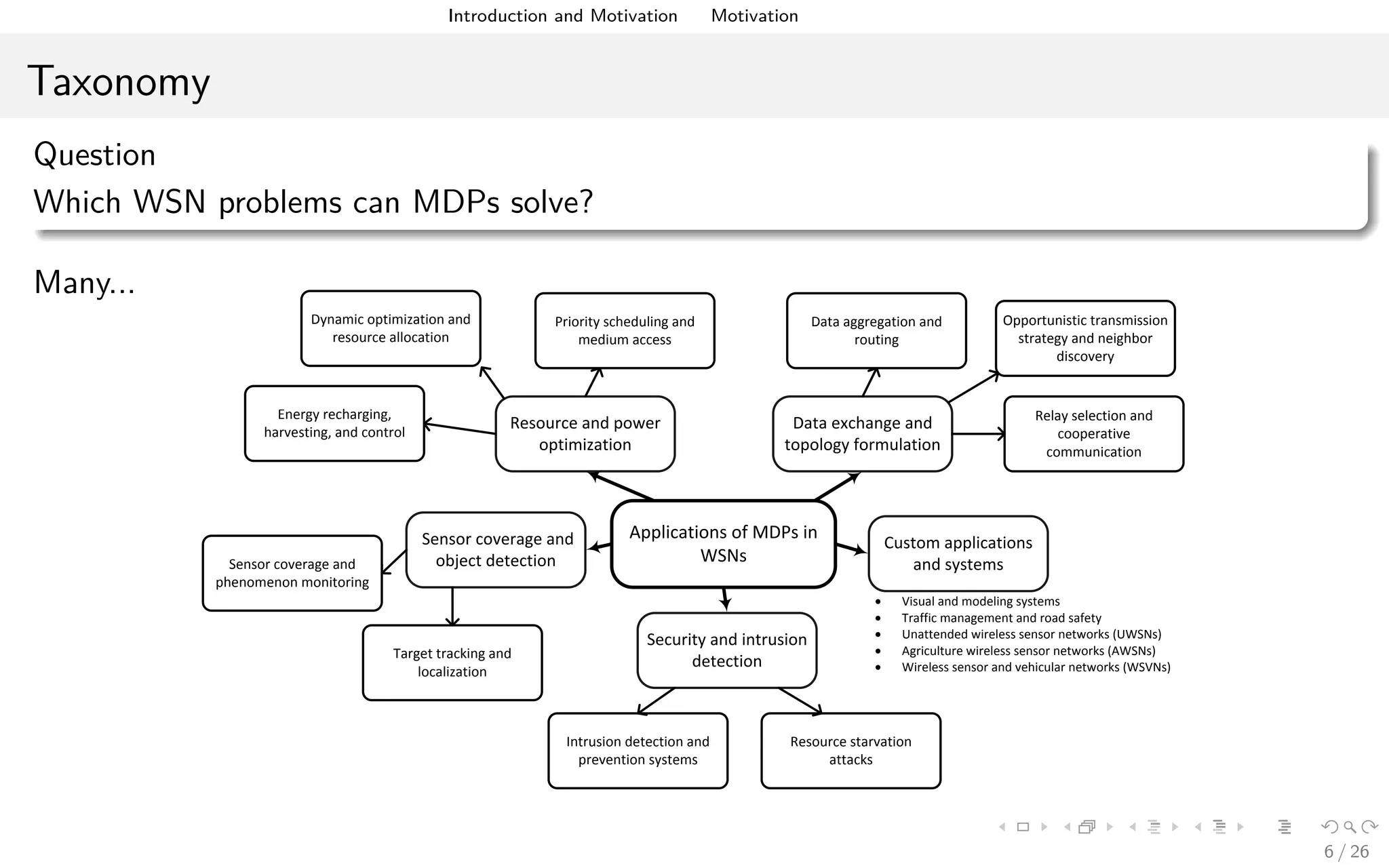
Which WSN problems can MDPs solve?
Many...
Applications of MDPs in
WSNs
Data exchange and
topology formulation
Resource and power
optimization
Security and intrusion
detection
Sensor coverage and
object detection
Custom applications
and systems
Data aggregation and
routing
Opportunistic transmission
strategy and neighbor
discovery
Relay selection and
cooperative
communication
Energy recharging,
harvesting, and control
Dynamic optimization and
resource allocation
Priority scheduling and
medium access
Sensor coverage and
phenomenon monitoring
Target tracking and
localization
· Visual and modeling systems
· Traffic management and road safety
· Unattended wireless sensor networks (UWSNs)
· Agriculture wireless sensor networks (AWSNs)
· Wireless sensor and vehicular networks (WSVNs)
Intrusion detection and
prevention systems
Resource starvation
attacks
6 / 26
Introduction and Motivation Motivation
Summary of Benefits
MDP modeling provides the following general benefits to WSNs’ operations:
Using MDPs for dynamically optimizing the network operations to fit the physical
conditions results in significantly improved resource utilization
The MDP model allows a balanced design of different objectives (optimization problems
with multiple objectives)
The solution of an MDP model, referred to as a policy, can be implemented based on a
look-up table with low computation requirements
MDPs are flexible with many variants that can fit the distinct conditions in WSN
applications
7 / 26
Markov Decision Processes (MDPs): Overview
8 / 26
Markov Decision Processes (MDPs): Overview The Markov Decision Process Framework
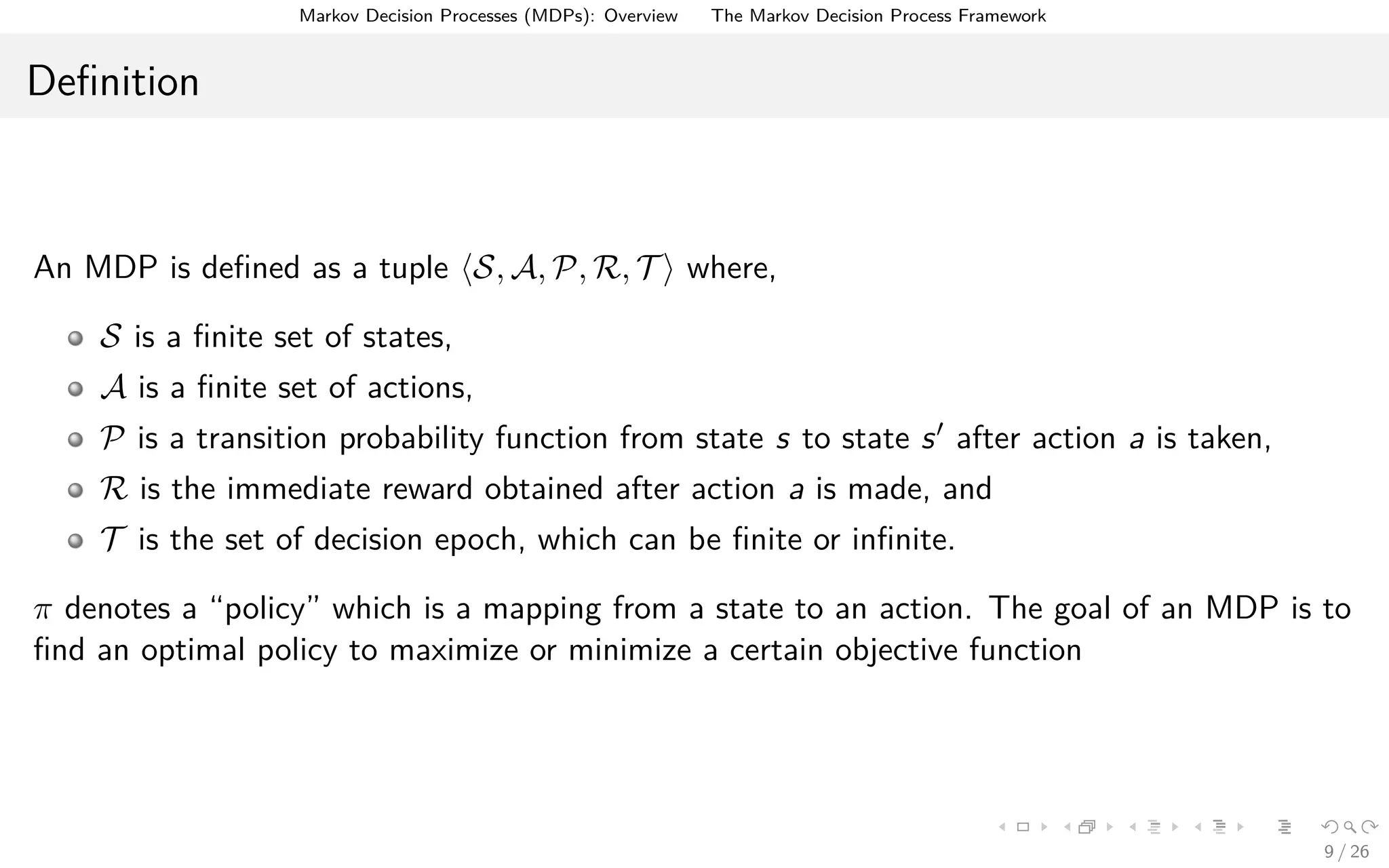
Definition
An MDP is defined as a tuple S, A, P, R, T where,
S is a finite set of states,
A is a finite set of actions,
P is a transition probability function from state s to state s after action a is taken,
R is the immediate reward obtained after action a is made, and
T is the set of decision epoch, which can be finite or infinite.
π denotes a “policy” which is a mapping from a state to an action. The goal of an MDP is to
find an optimal policy to maximize or minimize a certain objective function
9 / 26
Markov Decision Processes (MDPs): Overview The Markov Decision Process Framework
MDP Types (Time Horizon)
For the finite time horizon MDP, an optimal policy π∗ to maximize the expected total
reward is defined as follows:
max Vπ(s) = Eπ,s
T
t=1
R st|st, π(at) (1)
where st and at are the state and action at time t, respectively.
For the infinite time horizon MDP, the objective can be to maximize the expected
discounted total reward or to maximize the average reward. The former is defined as
follows:
max Vπ(s) = Eπ,s
T
t=1
γt
R st|st, π(at) , (2)
while the latter is expressed as follows:
max Vπ(s) = lim inf
T→∞
1
T
Eπ,s
T
t=1
R st|st, π(at) . (3)
Here, γ is the discounting factor and E[·] is the expectation function.
10 / 26
Markov Decision Processes (MDPs): Overview Solutions of MDPs
Solutions for Finite Time Horizon MDPs
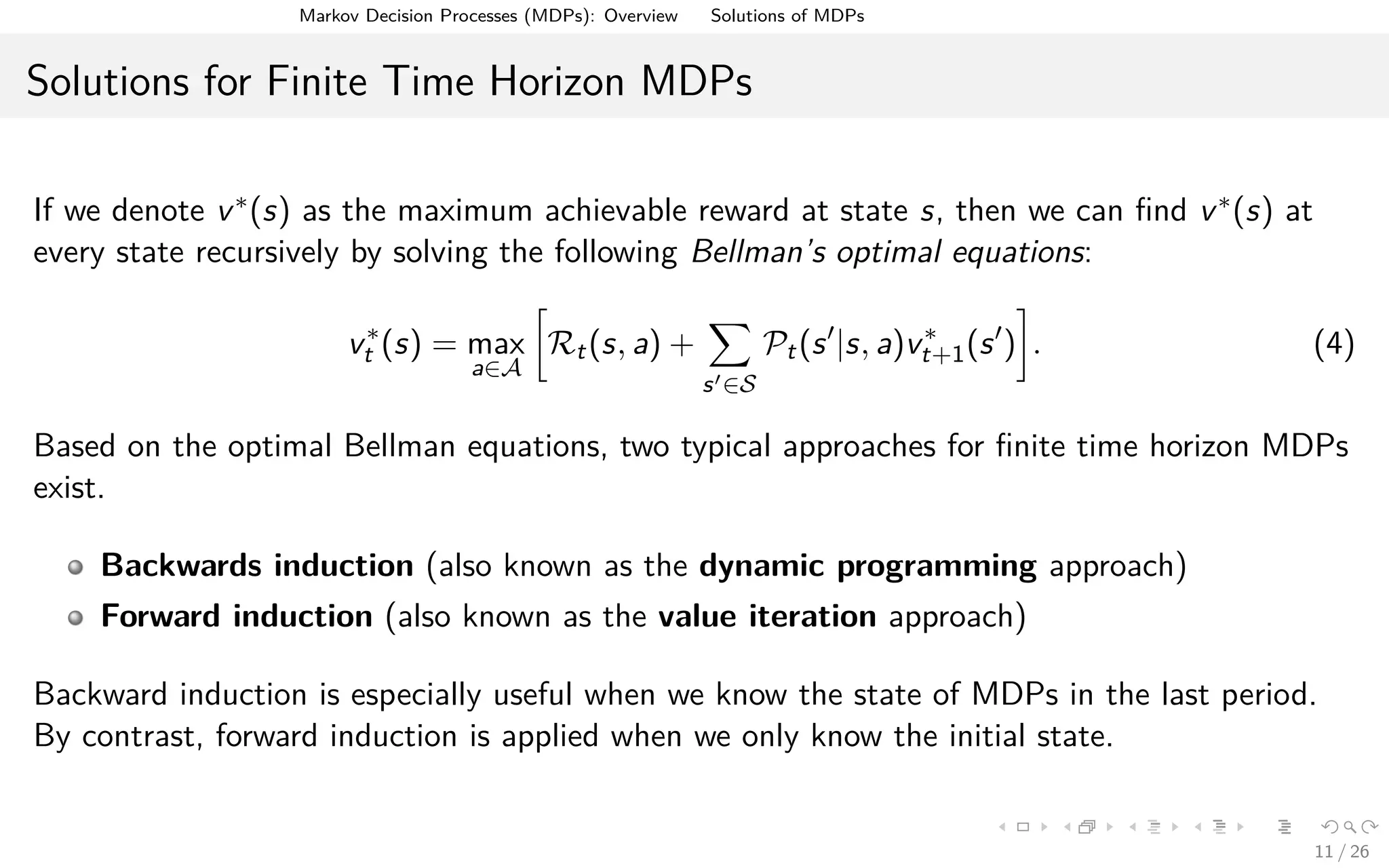
If we denote v∗(s) as the maximum achievable reward at state s, then we can find v∗(s) at
every state recursively by solving the following Bellman’s optimal equations:
v∗
t (s) = max
a∈A
Rt(s, a) +
s ∈S
Pt(s |s, a)v∗
t+1(s ) . (4)
Based on the optimal Bellman equations, two typical approaches for finite time horizon MDPs
exist.
Backwards induction (also known as the dynamic programming approach)
Forward induction (also known as the value iteration approach)
Backward induction is especially useful when we know the state of MDPs in the last period.
By contrast, forward induction is applied when we only know the initial state.
11 / 26
Markov Decision Processes (MDPs): Overview Solutions of MDPs
Solutions for Finite Time Horizon MDPs: Forward Induction
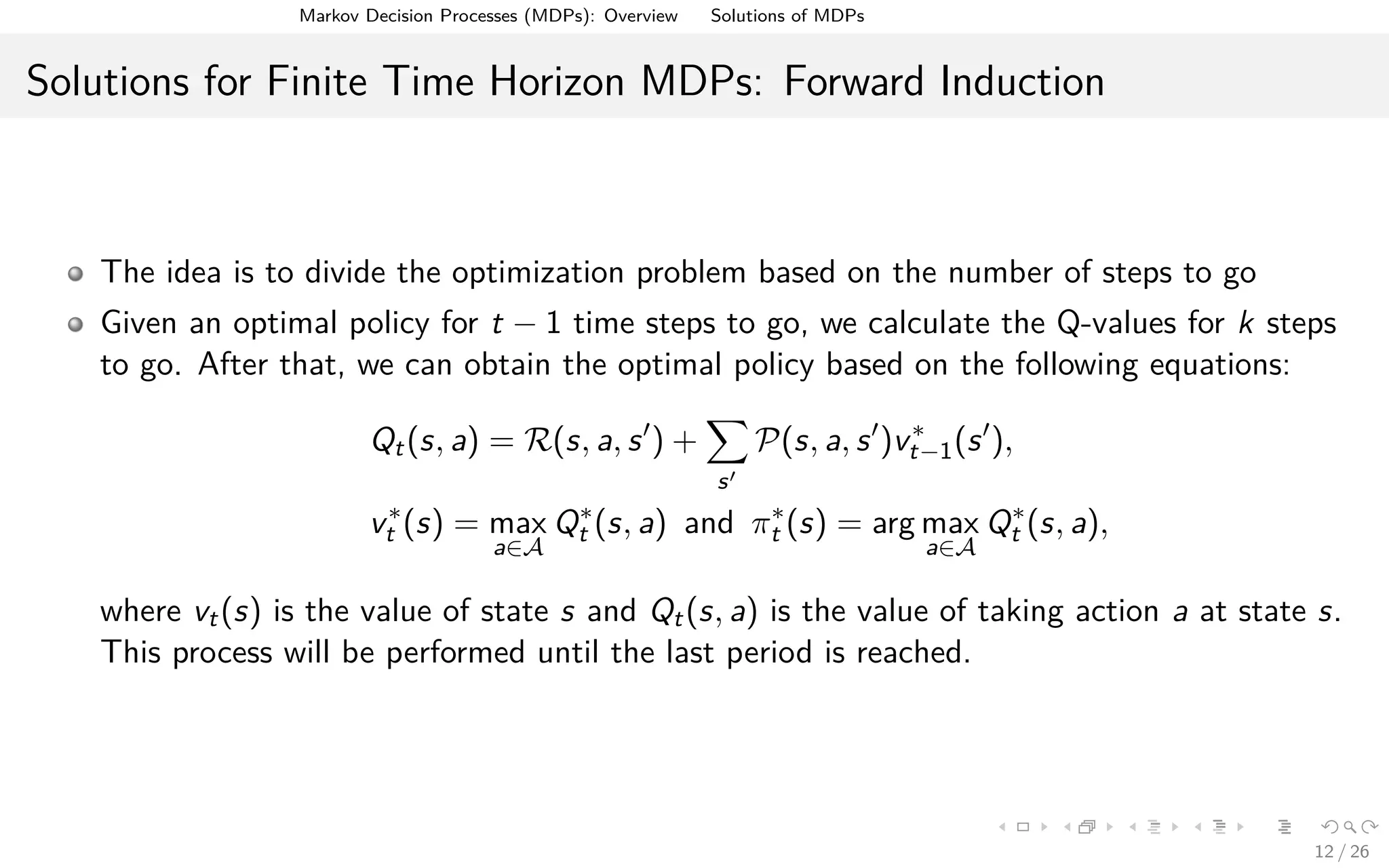
The idea is to divide the optimization problem based on the number of steps to go
Given an optimal policy for t − 1 time steps to go, we calculate the Q-values for k steps
to go. After that, we can obtain the optimal policy based on the following equations:
Qt(s, a) = R(s, a, s ) +
s
P(s, a, s )v∗
t−1(s ),
v∗
t (s) = max
a∈A
Q∗
t (s, a) and π∗
t (s) = arg max
a∈A
Q∗
t (s, a),
where vt(s) is the value of state s and Qt(s, a) is the value of taking action a at state s.
This process will be performed until the last period is reached.
12 / 26
Markov Decision Processes (MDPs): Overview Solutions of MDPs
Solutions for Infinite Time Horizon MDPs
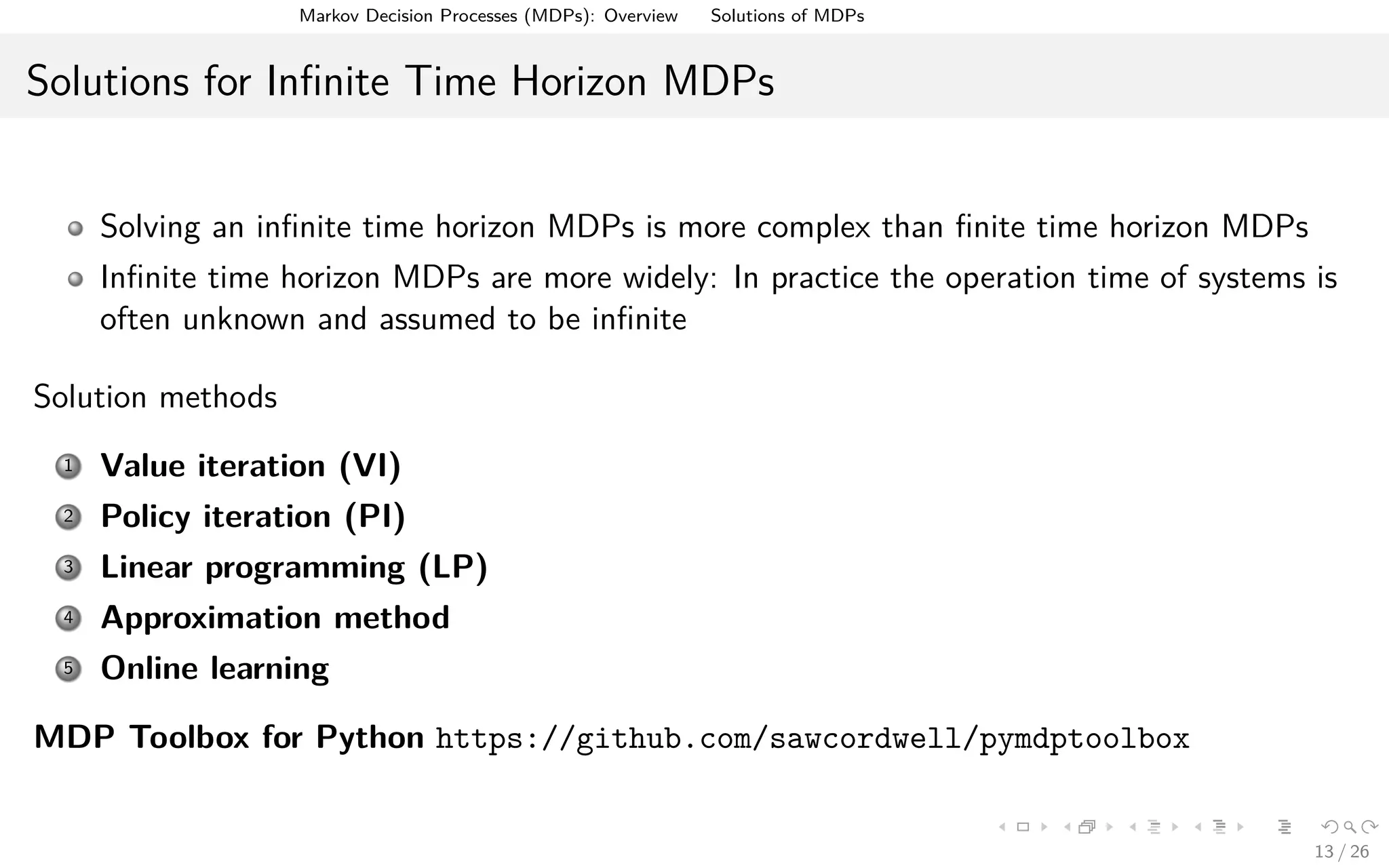
Solving an infinite time horizon MDPs is more complex than finite time horizon MDPs
Infinite time horizon MDPs are more widely: In practice the operation time of systems is
often unknown and assumed to be infinite
Solution methods
1 Value iteration (VI)
2 Policy iteration (PI)
3 Linear programming (LP)
4 Approximation method
5 Online learning
MDP Toolbox for Python https://github.com/sawcordwell/pymdptoolbox
13 / 26
Markov Decision Processes (MDPs): Overview Extensions of MDPs and Complexity
Extensions of MDPs: Summary
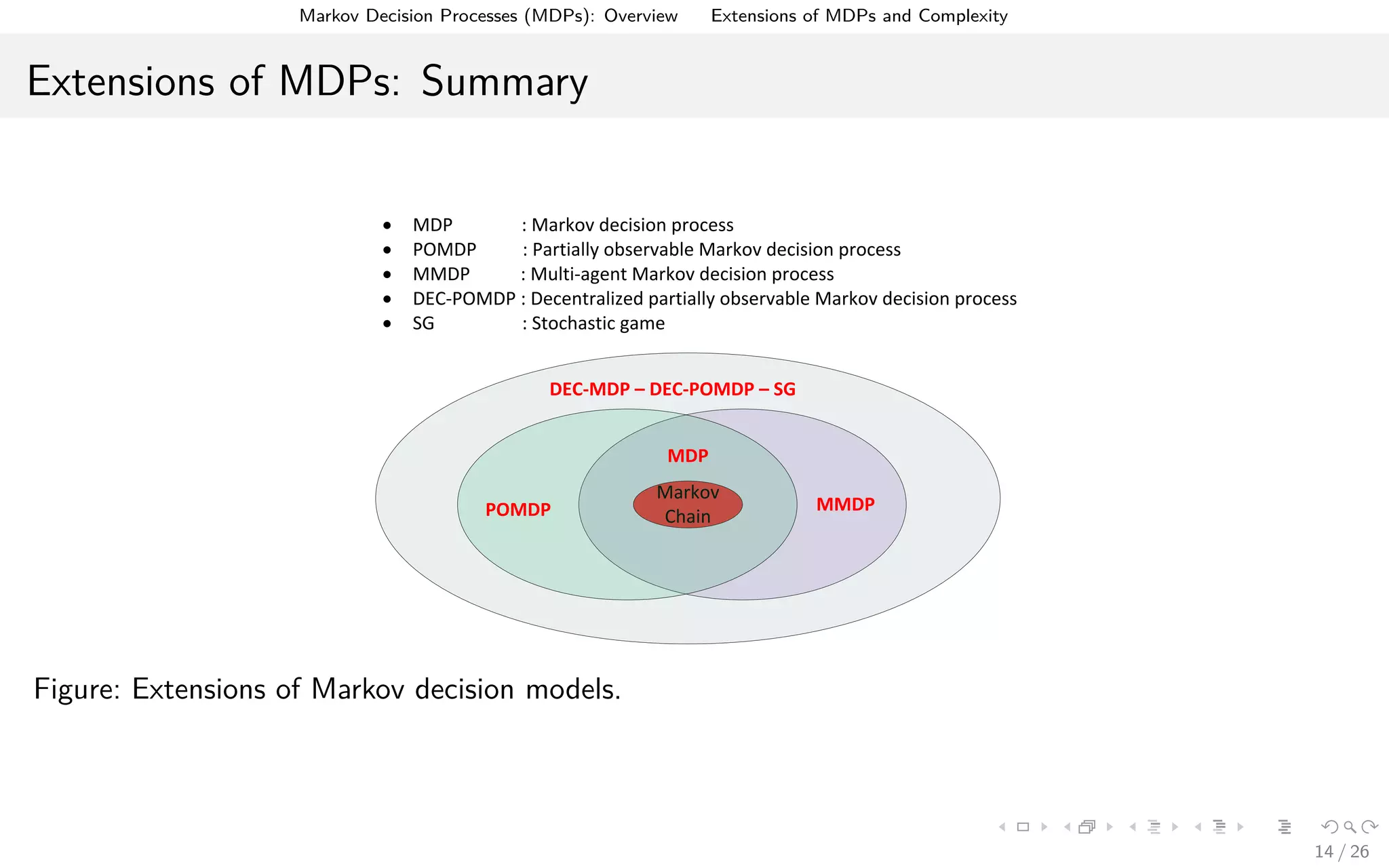
· MDP : Markov decision process
· POMDP : Partially observable Markov decision process
· MMDP : Multi-agent Markov decision process
· DEC-POMDP : Decentralized partially observable Markov decision process
· SG : Stochastic game
Markov
Chain
MDP
MMDPPOMDP
DEC-MDP – DEC-POMDP – SG
Figure: Extensions of Markov decision models.
14 / 26
Applications of MDPs in the IoT and Sensor Networks
15 / 26
Applications of MDPs in the IoT and Sensor Networks Summary
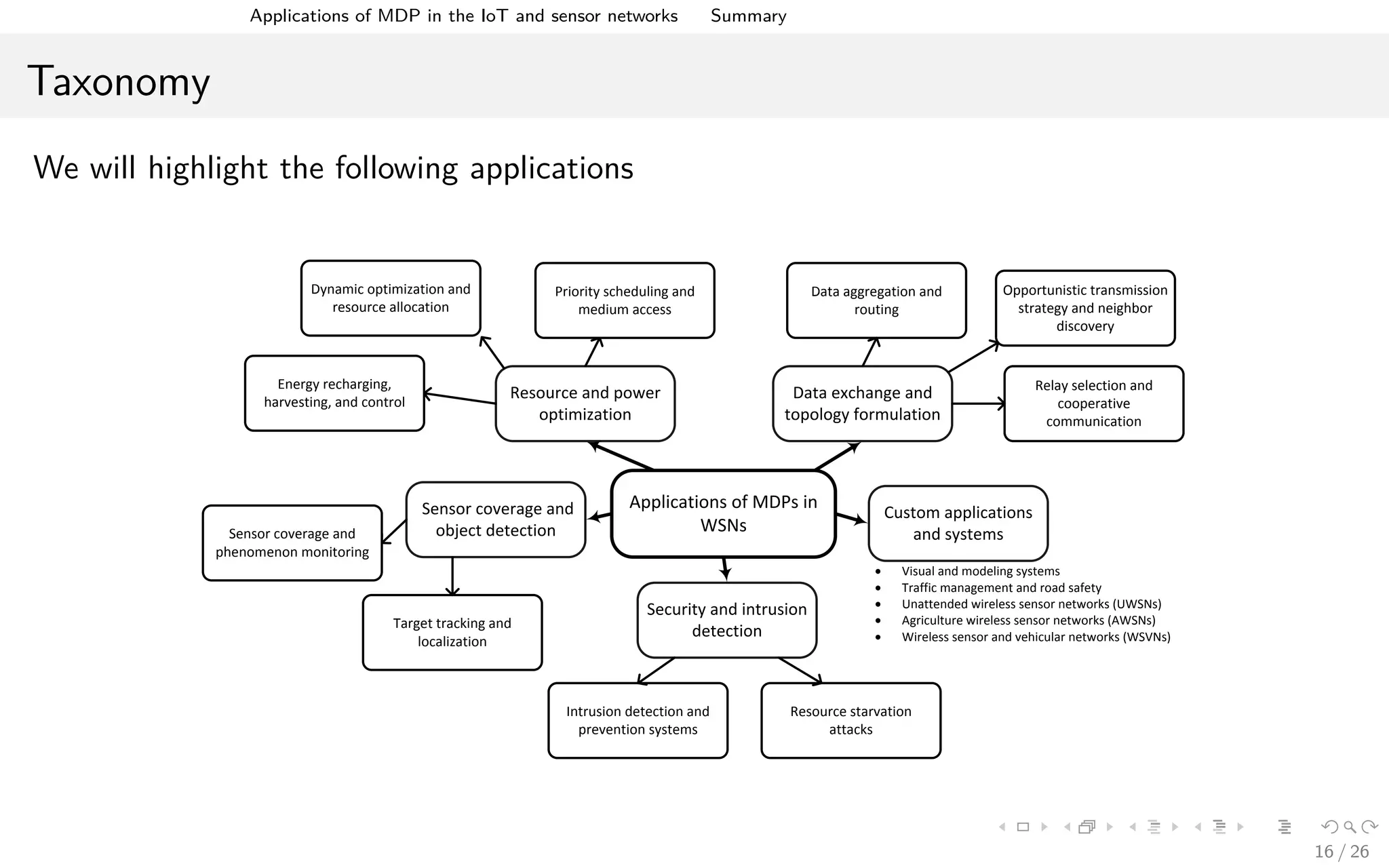
Taxonomy
We will highlight the following applications
Applications of MDPs in
WSNs
Data exchange and
topology formulation
Resource and power
optimization
Security and intrusion
detection
Sensor coverage and
object detection
Custom applications
and systems
Data aggregation and
routing
Opportunistic transmission
strategy and neighbor
discovery
Relay selection and
cooperative
communication
Energy recharging,
harvesting, and control
Dynamic optimization and
resource allocation
Priority scheduling and
medium access
Sensor coverage and
phenomenon monitoring
Target tracking and
localization
· Visual and modeling systems
· Traffic management and road safety
· Unattended wireless sensor networks (UWSNs)
· Agriculture wireless sensor networks (AWSNs)
· Wireless sensor and vehicular networks (WSVNs)
Intrusion detection and
prevention systems
Resource starvation
attacks
16 / 26
Applications of MDPs in the IoT and Sensor Networks Highlights
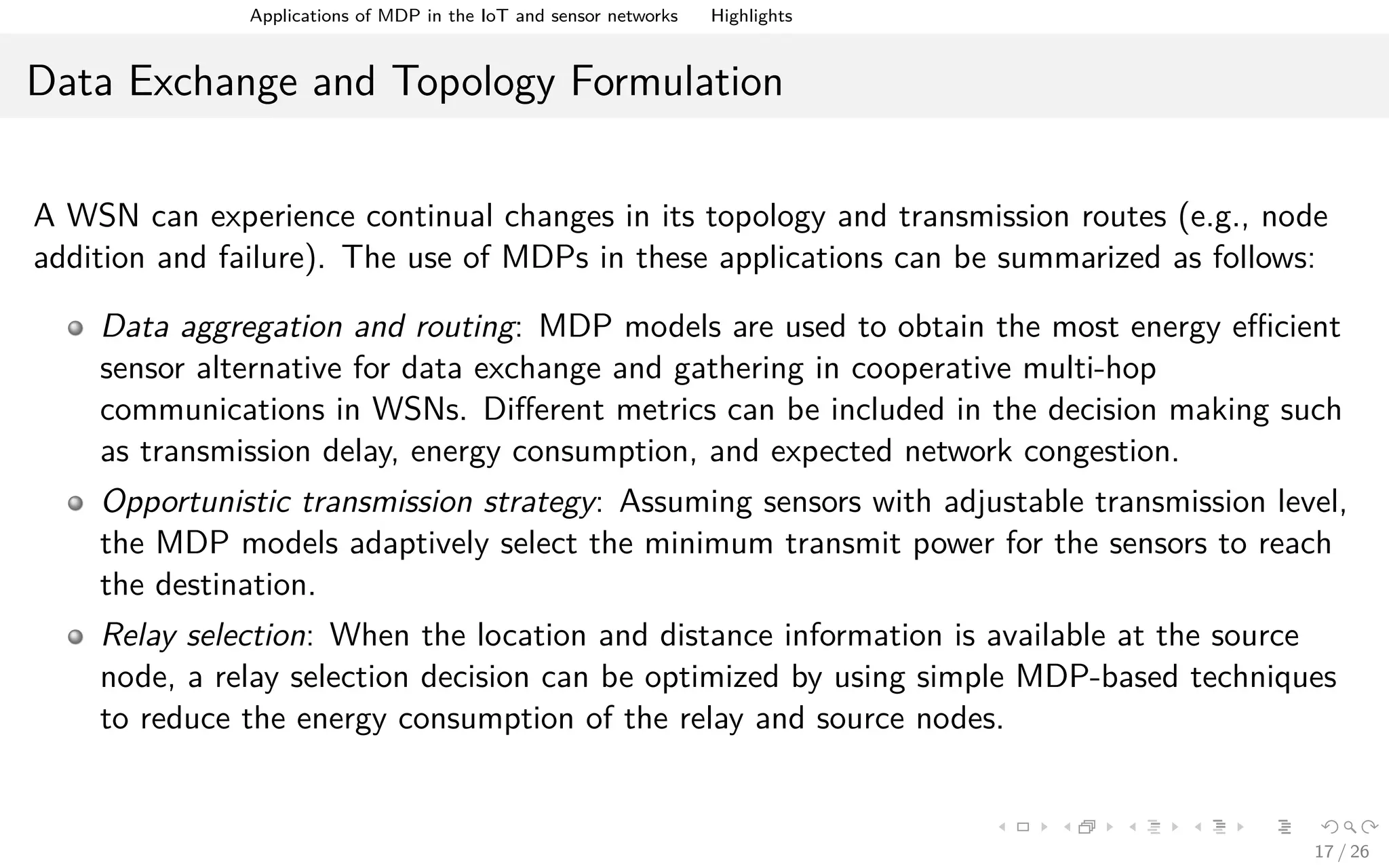
Data Exchange and Topology Formulation
A WSN can experience continual changes in its topology and transmission routes (e.g., node
addition and failure). The use of MDPs in these applications can be summarized as follows:
Data aggregation and routing: MDP models are used to obtain the most energy efficient
sensor alternative for data exchange and gathering in cooperative multi-hop
communications in WSNs. Different metrics can be included in the decision making such
as transmission delay, energy consumption, and expected network congestion.
Opportunistic transmission strategy: Assuming sensors with adjustable transmission level,
the MDP models adaptively select the minimum transmit power for the sensors to reach
the destination.
Relay selection: When the location and distance information is available at the source
node, a relay selection decision can be optimized by using simple MDP-based techniques
to reduce the energy consumption of the relay and source nodes.
17 / 26
Applications of MDPs in the IoT and Sensor Networks Highlights
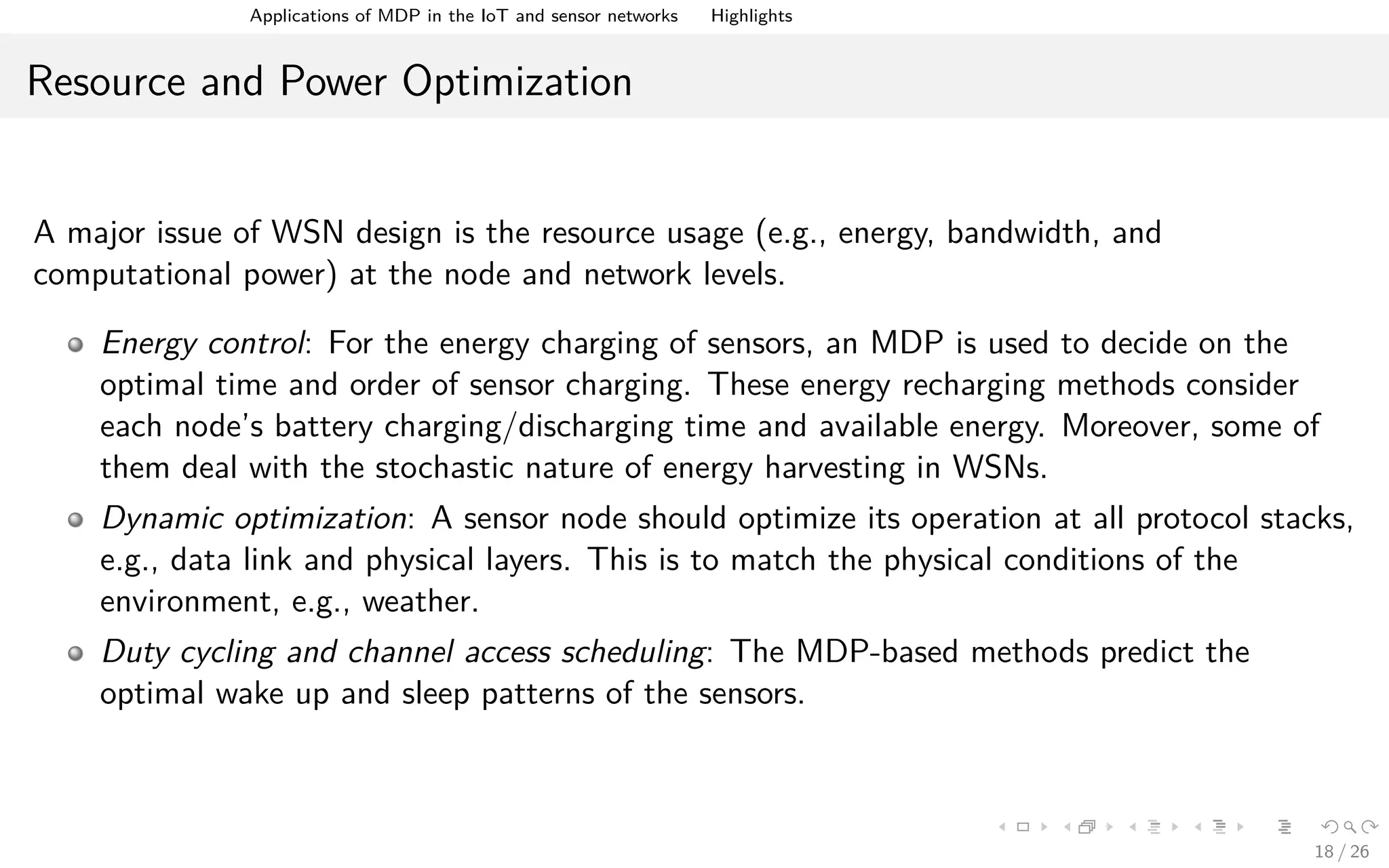
Resource and Power Optimization
A major issue of WSN design is the resource usage (e.g., energy, bandwidth, and
computational power) at the node and network levels.
Energy control: For the energy charging of sensors, an MDP is used to decide on the
optimal time and order of sensor charging. These energy recharging methods consider
each node’s battery charging/discharging time and available energy. Moreover, some of
them deal with the stochastic nature of energy harvesting in WSNs.
Dynamic optimization: A sensor node should optimize its operation at all protocol stacks,
e.g., data link and physical layers. This is to match the physical conditions of the
environment, e.g., weather.
Duty cycling and channel access scheduling: The MDP-based methods predict the
optimal wake up and sleep patterns of the sensors.
18 / 26
Applications of MDPs in the IoT and Sensor Networks Highlights
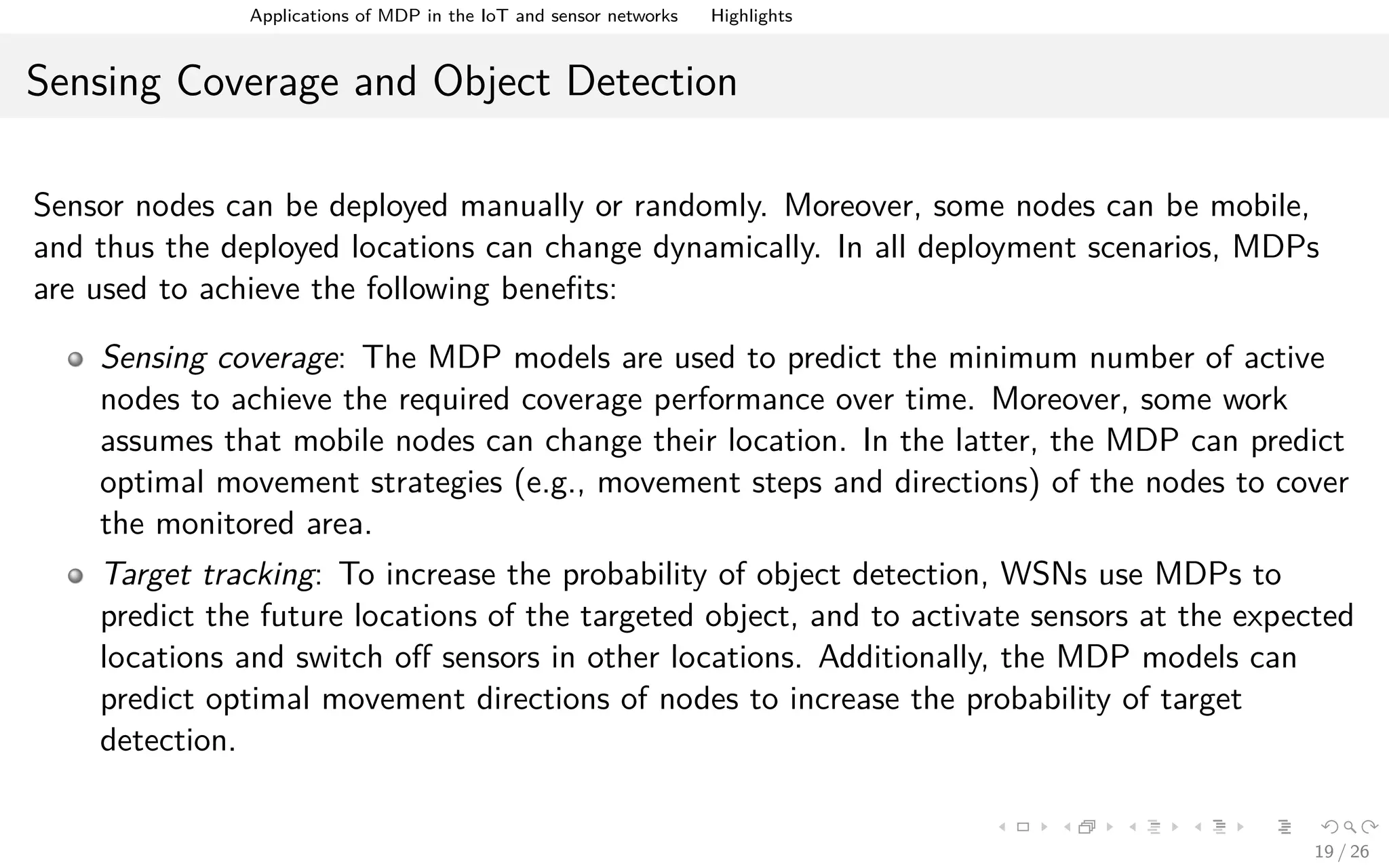
Sensing Coverage and Object Detection
Sensor nodes can be deployed manually or randomly. Moreover, some nodes can be mobile,
and thus the deployed locations can change dynamically. In all deployment scenarios, MDPs
are used to achieve the following benefits:
Sensing coverage: The MDP models are used to predict the minimum number of active
nodes to achieve the required coverage performance over time. Moreover, some work
assumes that mobile nodes can change their location. In the latter, the MDP can predict
optimal movement strategies (e.g., movement steps and directions) of the nodes to cover
the monitored area.
Target tracking: To increase the probability of object detection, WSNs use MDPs to
predict the future locations of the targeted object, and to activate sensors at the expected
locations and switch off sensors in other locations. Additionally, the MDP models can
predict optimal movement directions of nodes to increase the probability of target
detection.
19 / 26
Applications of MDPs in the IoT and Sensor Networks Highlights
Security and Intrusion Detection
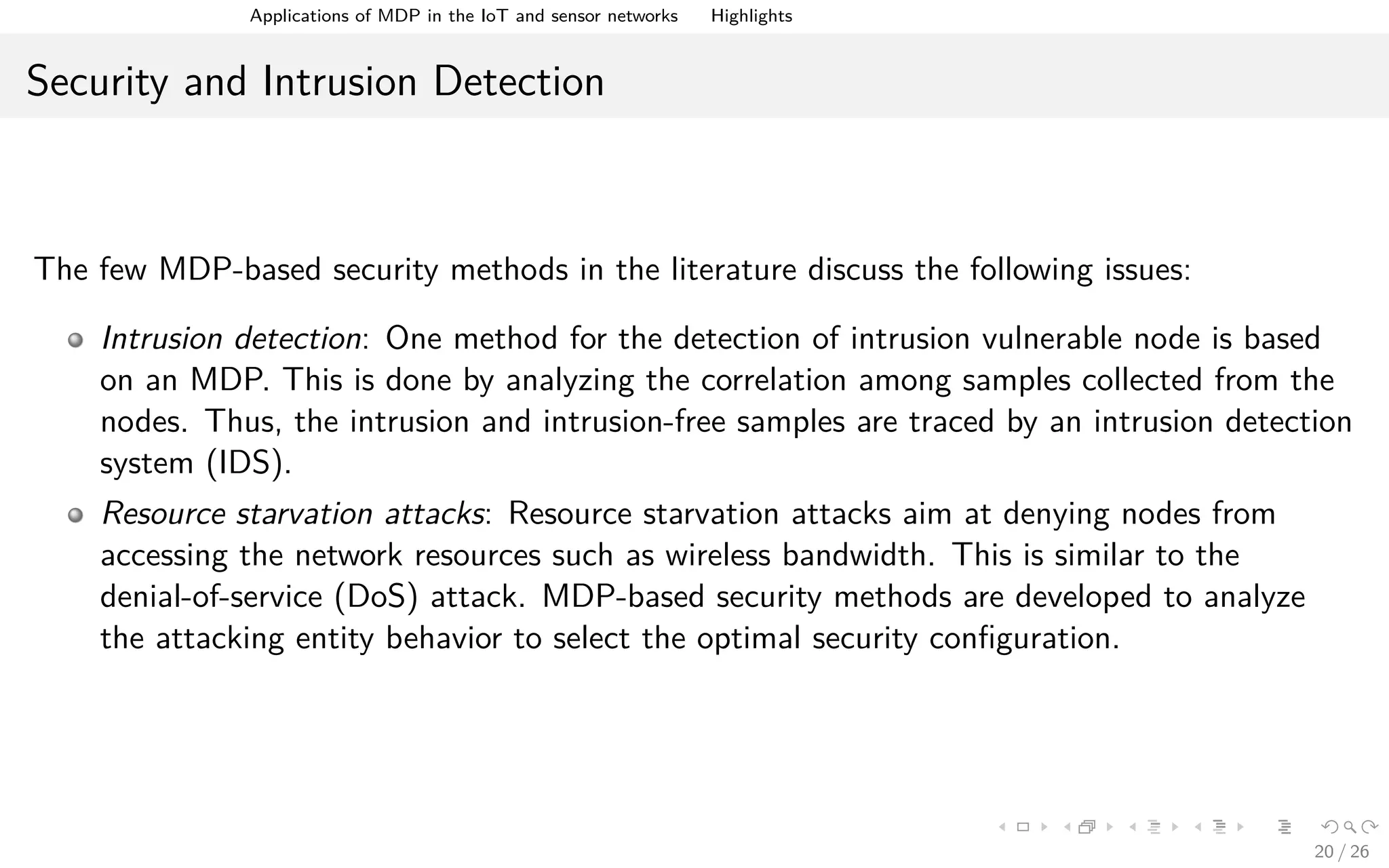
The few MDP-based security methods in the literature discuss the following issues:
Intrusion detection: One method for the detection of intrusion vulnerable node is based
on an MDP. This is done by analyzing the correlation among samples collected from the
nodes. Thus, the intrusion and intrusion-free samples are traced by an intrusion detection
system (IDS).
Resource starvation attacks: Resource starvation attacks aim at denying nodes from
accessing the network resources such as wireless bandwidth. This is similar to the
denial-of-service (DoS) attack. MDP-based security methods are developed to analyze
the attacking entity behavior to select the optimal security configuration.
20 / 26
Future Trends and Open Issues
21 / 26
Future Trends and Open Issues
Challenges of Applying MDPs to WSNs
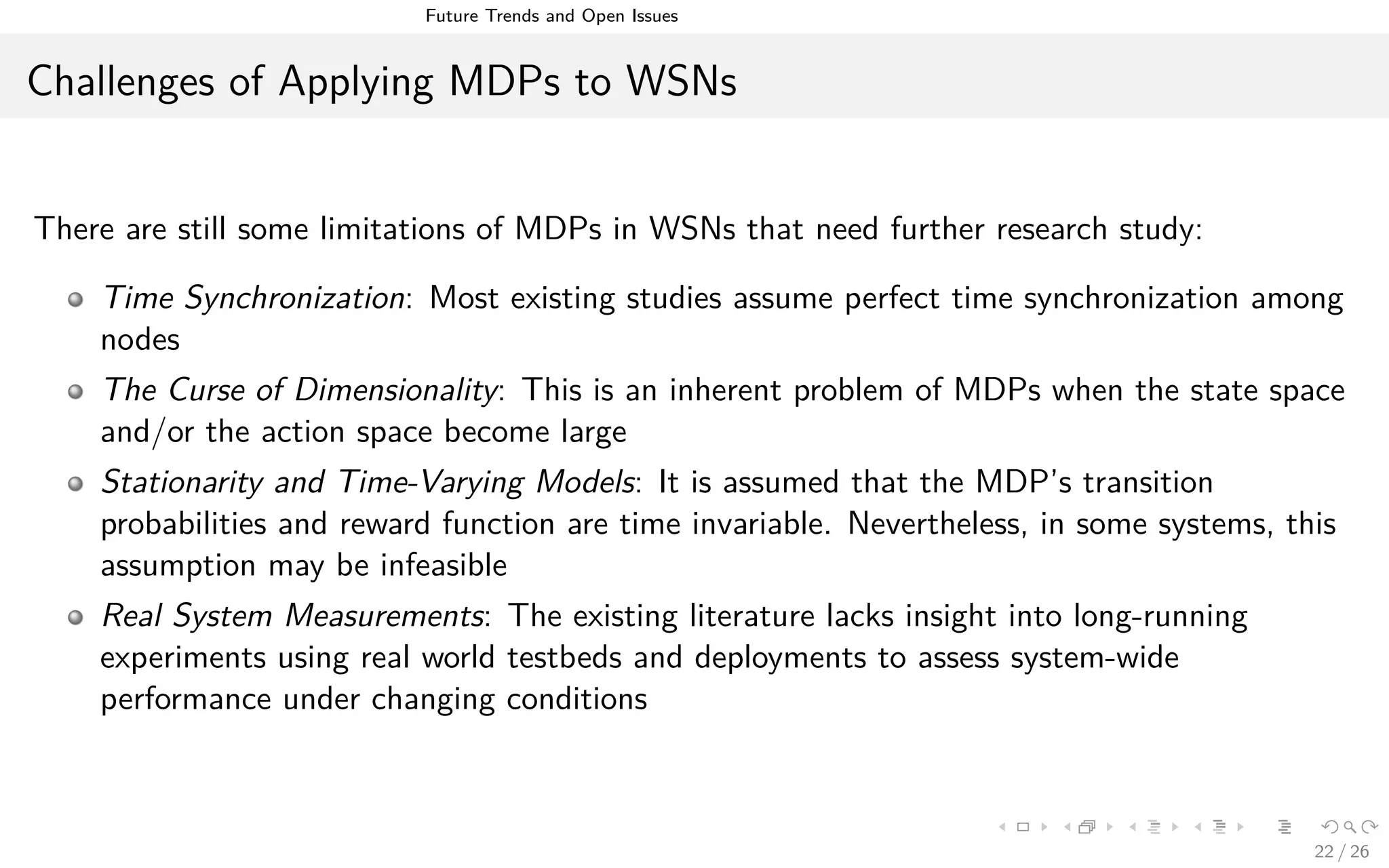
There are still some limitations of MDPs in WSNs that need further research study:
Time Synchronization: Most existing studies assume perfect time synchronization among
nodes
The Curse of Dimensionality: This is an inherent problem of MDPs when the state space
and/or the action space become large
Stationarity and Time-Varying Models: It is assumed that the MDP’s transition
probabilities and reward function are time invariable. Nevertheless, in some systems, this
assumption may be infeasible
Real System Measurements: The existing literature lacks insight into long-running
experiments using real world testbeds and deployments to assess system-wide
performance under changing conditions
22 / 26
Future Trends and Open Issues
Emerging MDP Models
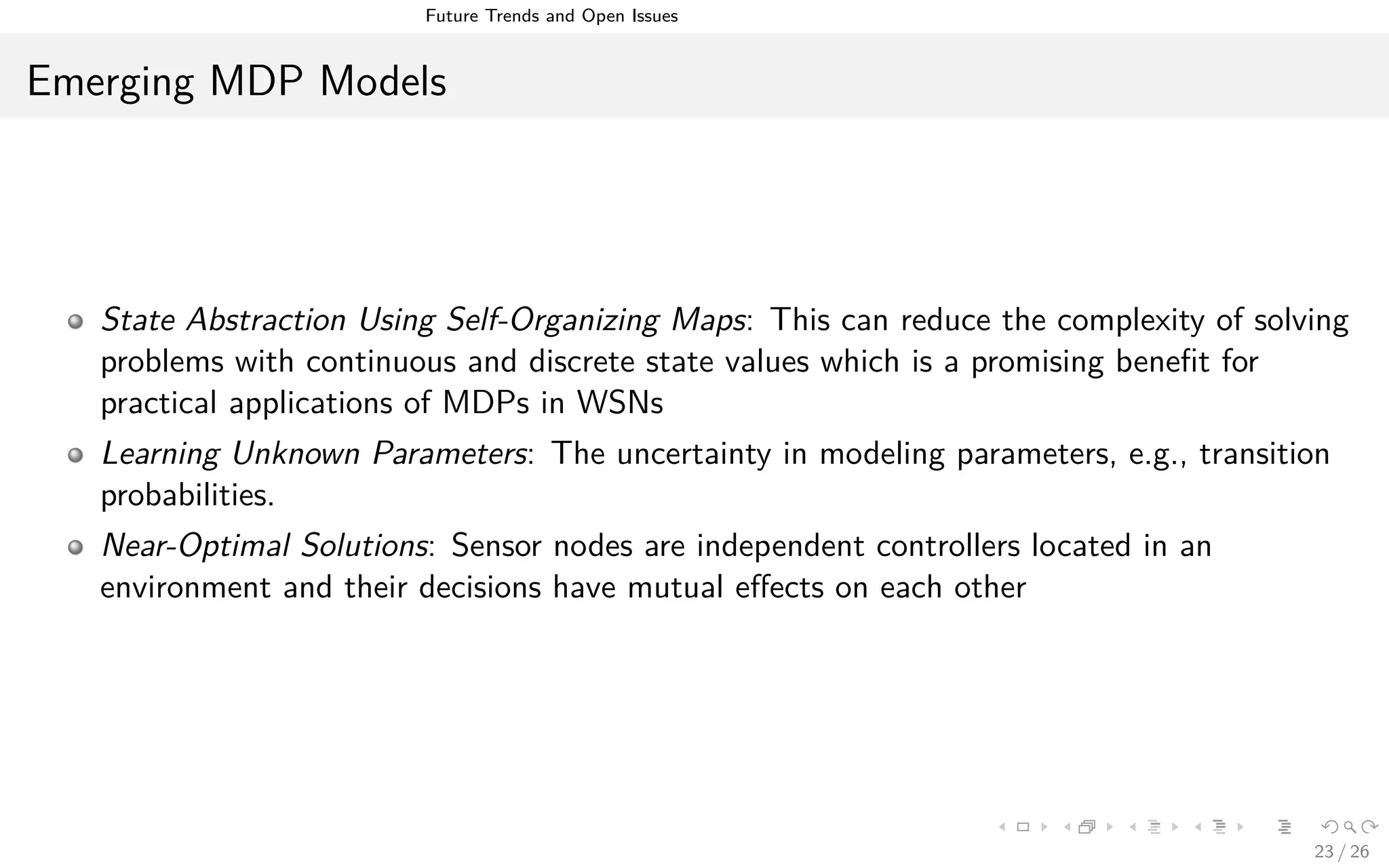
State Abstraction Using Self-Organizing Maps: This can reduce the complexity of solving
problems with continuous and discrete state values which is a promising benefit for
practical applications of MDPs in WSNs
Learning Unknown Parameters: The uncertainty in modeling parameters, e.g., transition
probabilities.
Near-Optimal Solutions: Sensor nodes are independent controllers located in an
environment and their decisions have mutual effects on each other
23 / 26
Future Trends and Open Issues
Emerging Topics in WSNs
WSNs find new applications and serves as a key platform in many smart technologies and
Internet of Things (IoT)
Cross-Layer Optimized Sensor Networks
Cognitive Radio Sensor Networks
Privacy Models
Internet-of-Things (IoT)
24 / 26
Summary and Conclusions
25 / 26
Summary and Conclusions
Conclusions
WSNs operate as stochastic systems because of randomness in the monitored
environments
WSNs require adaptive and robust methods to address data exchange, topology
formulation, resource and power optimization, sensing coverage and object detection, and
security challenges
The MDP framework is a powerful decision-making tool to develop adaptive algorithms
and protocols for WSNs and IoT
26 / 26

Applications of Markov Decision Processes (MDPs) in the Internet of Things (IoT) and Sensor Networks

  • 1.
    Applications of MarkovDecision Processes (MDPs) in the Internet of Things (IoT) and Sensor Networks Mohammad Abu Alsheikh https://sites.google.com/site/mohabualsheikh School of Computer Engineering Nanyang Technological University April 2016 1 / 26
  • 2.
    Survey and summaryof the field See our comprehensive survey article: Abu Alsheikh, M.; Hoang, D.T.; Niyato, D.; Tan, H.; Lin, S., "Markov Decision Processes With Applications in Wireless Sensor Networks: A Survey," IEEE Communications Surveys & Tutorials, vol.17, no.3, pp.1239,1267, thirdquarter 2015 2 / 26
  • 3.
    Outline Outline 1 Introduction andMotivation 2 Markov Decision Processes (MDPs): Overview 3 Applications of MDPs in the IoT and Sensor Networks 4 Future Trends and Open Issues 5 Summary and Conclusions 3 / 26
  • 4.
  • 5.
    Introduction and MotivationMotivation Motivation Question Why are Markov Decision Processes (MDPs) required in the Internet of Things (IoT) and sensor networks? Wireless sensor networks (WSNs) Consist of autonomous and resource-limited devices, e.g., the bandwidth and energy limitations Operate in stochastic (random) environments under uncertainty Scale and generate massive data, e.g., the Internet of Things (IoT) WSN dynamics can be modeled using a mathematical framework called Markov decision processes (MDPs) MDPs entail that the system possesses the Markov property (i.e., future states of a WSN depend only upon the present state) 5 / 26
  • 6.
    Introduction and MotivationMotivation Taxonomy Question Which WSN problems can MDPs solve? Many... Applications of MDPs in WSNs Data exchange and topology formulation Resource and power optimization Security and intrusion detection Sensor coverage and object detection Custom applications and systems Data aggregation and routing Opportunistic transmission strategy and neighbor discovery Relay selection and cooperative communication Energy recharging, harvesting, and control Dynamic optimization and resource allocation Priority scheduling and medium access Sensor coverage and phenomenon monitoring Target tracking and localization · Visual and modeling systems · Traffic management and road safety · Unattended wireless sensor networks (UWSNs) · Agriculture wireless sensor networks (AWSNs) · Wireless sensor and vehicular networks (WSVNs) Intrusion detection and prevention systems Resource starvation attacks 6 / 26
  • 7.
    Introduction and MotivationMotivation Summary of Benefits MDP modeling provides the following general benefits to WSNs’ operations: Using MDPs for dynamically optimizing the network operations to fit the physical conditions results in significantly improved resource utilization The MDP model allows a balanced design of different objectives (optimization problems with multiple objectives) The solution of an MDP model, referred to as a policy, can be implemented based on a look-up table with low computation requirements MDPs are flexible with many variants that can fit the distinct conditions in WSN applications 7 / 26
  • 8.
    Markov Decision Processes(MDPs): Overview Markov Decision Processes (MDPs): Overview 8 / 26
  • 9.
    Markov Decision Processes(MDPs): Overview The Markov Decision Process Framework Definition An MDP is defined as a tuple S, A, P, R, T where, S is a finite set of states, A is a finite set of actions, P is a transition probability function from state s to state s after action a is taken, R is the immediate reward obtained after action a is made, and T is the set of decision epoch, which can be finite or infinite. π denotes a “policy” which is a mapping from a state to an action. The goal of an MDP is to find an optimal policy to maximize or minimize a certain objective function 9 / 26
  • 10.
    Markov Decision Processes(MDPs): Overview The Markov Decision Process Framework MDP Types (Time Horizon) For the finite time horizon MDP, an optimal policy π∗ to maximize the expected total reward is defined as follows: max Vπ(s) = Eπ,s T t=1 R st|st, π(at) (1) where st and at are the state and action at time t, respectively. For the infinite time horizon MDP, the objective can be to maximize the expected discounted total reward or to maximize the average reward. The former is defined as follows: max Vπ(s) = Eπ,s T t=1 γt R st|st, π(at) , (2) while the latter is expressed as follows: max Vπ(s) = lim inf T→∞ 1 T Eπ,s T t=1 R st|st, π(at) . (3) Here, γ is the discounting factor and E[·] is the expectation function. 10 / 26
  • 11.
    Markov Decision Processes(MDPs): Overview Solutions of MDPs Solutions for Finite Time Horizon MDPs If we denote v∗(s) as the maximum achievable reward at state s, then we can find v∗(s) at every state recursively by solving the following Bellman’s optimal equations: v∗ t (s) = max a∈A Rt(s, a) + s ∈S Pt(s |s, a)v∗ t+1(s ) . (4) Based on the optimal Bellman equations, two typical approaches for finite time horizon MDPs exist. Backwards induction (also known as the dynamic programming approach) Forward induction (also known as the value iteration approach) Backward induction is especially useful when we know the state of MDPs in the last period. By contrast, forward induction is applied when we only know the initial state. 11 / 26
  • 12.
    Markov Decision Processes(MDPs): Overview Solutions of MDPs Solutions for Finite Time Horizon MDPs: Forward Induction The idea is to divide the optimization problem based on the number of steps to go Given an optimal policy for t − 1 time steps to go, we calculate the Q-values for k steps to go. After that, we can obtain the optimal policy based on the following equations: Qt(s, a) = R(s, a, s ) + s P(s, a, s )v∗ t−1(s ), v∗ t (s) = max a∈A Q∗ t (s, a) and π∗ t (s) = arg max a∈A Q∗ t (s, a), where vt(s) is the value of state s and Qt(s, a) is the value of taking action a at state s. This process will be performed until the last period is reached. 12 / 26
  • 13.
    Markov Decision Processes(MDPs): Overview Solutions of MDPs Solutions for Infinite Time Horizon MDPs Solving an infinite time horizon MDPs is more complex than finite time horizon MDPs Infinite time horizon MDPs are more widely: In practice the operation time of systems is often unknown and assumed to be infinite Solution methods 1 Value iteration (VI) 2 Policy iteration (PI) 3 Linear programming (LP) 4 Approximation method 5 Online learning MDP Toolbox for Python https://github.com/sawcordwell/pymdptoolbox 13 / 26
  • 14.
    Markov Decision Processes(MDPs): Overview Extensions of MDPs and Complexity Extensions of MDPs: Summary · MDP : Markov decision process · POMDP : Partially observable Markov decision process · MMDP : Multi-agent Markov decision process · DEC-POMDP : Decentralized partially observable Markov decision process · SG : Stochastic game Markov Chain MDP MMDPPOMDP DEC-MDP – DEC-POMDP – SG Figure: Extensions of Markov decision models. 14 / 26
  • 15.
    Applications of MDPsin the IoT and Sensor Networks Applications of MDPs in the IoT and Sensor Networks 15 / 26
  • 16.
    Applications of MDPsin the IoT and Sensor Networks Summary Taxonomy We will highlight the following applications Applications of MDPs in WSNs Data exchange and topology formulation Resource and power optimization Security and intrusion detection Sensor coverage and object detection Custom applications and systems Data aggregation and routing Opportunistic transmission strategy and neighbor discovery Relay selection and cooperative communication Energy recharging, harvesting, and control Dynamic optimization and resource allocation Priority scheduling and medium access Sensor coverage and phenomenon monitoring Target tracking and localization · Visual and modeling systems · Traffic management and road safety · Unattended wireless sensor networks (UWSNs) · Agriculture wireless sensor networks (AWSNs) · Wireless sensor and vehicular networks (WSVNs) Intrusion detection and prevention systems Resource starvation attacks 16 / 26
  • 17.
    Applications of MDPsin the IoT and Sensor Networks Highlights Data Exchange and Topology Formulation A WSN can experience continual changes in its topology and transmission routes (e.g., node addition and failure). The use of MDPs in these applications can be summarized as follows: Data aggregation and routing: MDP models are used to obtain the most energy efficient sensor alternative for data exchange and gathering in cooperative multi-hop communications in WSNs. Different metrics can be included in the decision making such as transmission delay, energy consumption, and expected network congestion. Opportunistic transmission strategy: Assuming sensors with adjustable transmission level, the MDP models adaptively select the minimum transmit power for the sensors to reach the destination. Relay selection: When the location and distance information is available at the source node, a relay selection decision can be optimized by using simple MDP-based techniques to reduce the energy consumption of the relay and source nodes. 17 / 26
  • 18.
    Applications of MDPsin the IoT and Sensor Networks Highlights Resource and Power Optimization A major issue of WSN design is the resource usage (e.g., energy, bandwidth, and computational power) at the node and network levels. Energy control: For the energy charging of sensors, an MDP is used to decide on the optimal time and order of sensor charging. These energy recharging methods consider each node’s battery charging/discharging time and available energy. Moreover, some of them deal with the stochastic nature of energy harvesting in WSNs. Dynamic optimization: A sensor node should optimize its operation at all protocol stacks, e.g., data link and physical layers. This is to match the physical conditions of the environment, e.g., weather. Duty cycling and channel access scheduling: The MDP-based methods predict the optimal wake up and sleep patterns of the sensors. 18 / 26
  • 19.
    Applications of MDPsin the IoT and Sensor Networks Highlights Sensing Coverage and Object Detection Sensor nodes can be deployed manually or randomly. Moreover, some nodes can be mobile, and thus the deployed locations can change dynamically. In all deployment scenarios, MDPs are used to achieve the following benefits: Sensing coverage: The MDP models are used to predict the minimum number of active nodes to achieve the required coverage performance over time. Moreover, some work assumes that mobile nodes can change their location. In the latter, the MDP can predict optimal movement strategies (e.g., movement steps and directions) of the nodes to cover the monitored area. Target tracking: To increase the probability of object detection, WSNs use MDPs to predict the future locations of the targeted object, and to activate sensors at the expected locations and switch off sensors in other locations. Additionally, the MDP models can predict optimal movement directions of nodes to increase the probability of target detection. 19 / 26
  • 20.
    Applications of MDPsin the IoT and Sensor Networks Highlights Security and Intrusion Detection The few MDP-based security methods in the literature discuss the following issues: Intrusion detection: One method for the detection of intrusion vulnerable node is based on an MDP. This is done by analyzing the correlation among samples collected from the nodes. Thus, the intrusion and intrusion-free samples are traced by an intrusion detection system (IDS). Resource starvation attacks: Resource starvation attacks aim at denying nodes from accessing the network resources such as wireless bandwidth. This is similar to the denial-of-service (DoS) attack. MDP-based security methods are developed to analyze the attacking entity behavior to select the optimal security configuration. 20 / 26
  • 21.
    Future Trends andOpen Issues Future Trends and Open Issues 21 / 26
  • 22.
    Future Trends andOpen Issues Challenges of Applying MDPs to WSNs There are still some limitations of MDPs in WSNs that need further research study: Time Synchronization: Most existing studies assume perfect time synchronization among nodes The Curse of Dimensionality: This is an inherent problem of MDPs when the state space and/or the action space become large Stationarity and Time-Varying Models: It is assumed that the MDP’s transition probabilities and reward function are time invariable. Nevertheless, in some systems, this assumption may be infeasible Real System Measurements: The existing literature lacks insight into long-running experiments using real world testbeds and deployments to assess system-wide performance under changing conditions 22 / 26
  • 23.
    Future Trends andOpen Issues Emerging MDP Models State Abstraction Using Self-Organizing Maps: This can reduce the complexity of solving problems with continuous and discrete state values which is a promising benefit for practical applications of MDPs in WSNs Learning Unknown Parameters: The uncertainty in modeling parameters, e.g., transition probabilities. Near-Optimal Solutions: Sensor nodes are independent controllers located in an environment and their decisions have mutual effects on each other 23 / 26
  • 24.
    Future Trends andOpen Issues Emerging Topics in WSNs WSNs find new applications and serves as a key platform in many smart technologies and Internet of Things (IoT) Cross-Layer Optimized Sensor Networks Cognitive Radio Sensor Networks Privacy Models Internet-of-Things (IoT) 24 / 26
  • 25.
    Summary and Conclusions Summaryand Conclusions 25 / 26
  • 26.
    Summary and Conclusions Conclusions WSNsoperate as stochastic systems because of randomness in the monitored environments WSNs require adaptive and robust methods to address data exchange, topology formulation, resource and power optimization, sensing coverage and object detection, and security challenges The MDP framework is a powerful decision-making tool to develop adaptive algorithms and protocols for WSNs and IoT 26 / 26