MDP Presentation
CS594
Automated Optimal Decision Making
Sohail M Yousof
Advanced Artificial Intelligence
Topic
Planning and Control in
Stochastic Domains
With
Imperfect Information
Objective
 Markov Decision Processes (Sequences of decisions)
– Introduction to MDPs
– Computing optimal policies for MDPs
Markov Decision Process (MDP)
 Sequential decision problems under uncertainty
– Not just the immediate utility, but the longer-term utility
as well
– Uncertainty in outcomes
 Roots in operations research
 Also used in economics, communications engineering,
ecology, performance modeling and of course, AI!
– Also referred to as stochastic dynamic programs
Markov Decision Process (MDP)
 Defined as a tuple: <S, A, P, R>
– S: State
– A: Action
– P: Transition function
 Table P(s’| s, a), prob of s’ given action “a” in state “s”
– R: Reward
 R(s, a) = cost or reward of taking action a in state s
 Choose a sequence of actions (not just one decision or one action)
– Utility based on a sequence of decisions
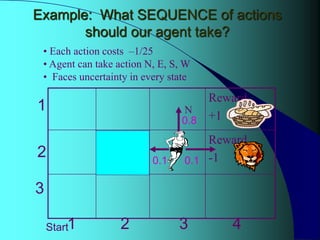
Example: What SEQUENCE of actions
should our agent take?
Reward
-1
Blocked
CELL
Reward
+1
Start1 2 3 4
1
2
3
0.8
0.1
0.1
• Each action costs –1/25
• Agent can take action N, E, S, W
• Faces uncertainty in every state
N
MDP Tuple: <S, A, P, R>
 S: State of the agent on the grid (4,3)
– Note that cell denoted by (x,y)
 A: Actions of the agent, i.e., N, E, S, W
 P: Transition function
– Table P(s’| s, a), prob of s’ given action “a” in state “s”
– E.g., P( (4,3) | (3,3), N) = 0.1
– E.g., P((3, 2) | (3,3), N) = 0.8
– (Robot movement, uncertainty of another agent’s actions,…)
 R: Reward (more comments on the reward function later)
– R( (3, 3), N) = -1/25
– R (4,1) = +1
??Terminology
• Before describing policies, lets go through some terminology
• Terminology useful throughout this set of lectures
•Policy: Complete mapping from states to actions
MDP Basics and Terminology
An agent must make a decision or control a probabilistic
system
 Goal is to choose a sequence of actions for optimality
 Defined as <S, A, P, R>
 MDP models:
– Finite horizon: Maximize the expected reward for the
next n steps
– Infinite horizon: Maximize the expected discounted
reward.
– Transition model: Maximize average expected reward
per transition.
– Goal state: maximize expected reward (minimize expected
cost) to some target state G.
???Reward Function
 According to chapter2, directly associated with state
– Denoted R(I)
– Simplifies computations seen later in algorithms presented
 Sometimes, reward is assumed associated with state,action
– R(S, A)
– We could also assume a mix of R(S,A) and R(S)
 Sometimes, reward associated with state,action,destination-state
– R(S,A,J)
– R(S,A) = S R(S,A,J) * P(J | S, A)
J
Markov Assumption
 Markov Assumption: Transition probabilities (and rewards) from
any given state depend only on the state and not on previous
history
 Where you end up after action depends only on current state
– After Russian Mathematician A. A. Markov (1856-1922)
– (He did not come up with markov decision processes
however)
– Transitions in state (1,2) do not depend on prior state (1,1)
or (1,2)
???MDP vs POMDPs
 Accessibility: Agent’s percept in any given state identify the
state that it is in, e.g., state (4,3) vs (3,3)
– Given observations, uniquely determine the state
– Hence, we will not explicitly consider observations, only states
 Inaccessibility: Agent’s percepts in any given state DO NOT
identify the state that it is in, e.g., may be (4,3) or (3,3)
– Given observations, not uniquely determine the state
– POMDP: Partially observable MDP for inaccessible environments
 We will focus on MDPs in this presentation.
MDP vs POMDP
Agent
World
States
Actions
MDP
Agent
World
Observations
Actions
SE
P
b
Stationary and Deterministic Policies
 Policy denoted by symbol 
Policy
 Policy is like a plan, but not quite
– Certainly, generated ahead of time, like a plan
 Unlike traditional plans, it is not a sequence of
actions that an agent must execute
– If there are failures in execution, agent can continue to
execute a policy
 Prescribes an action for all the states
 Maximizes expected reward, rather than just
reaching a goal state
MDP problem
 The MDP problem consists of:
– Finding the optimal control policy for all possible states;
– Finding the sequence of optimal control functions for a specific
initial state
– Finding the best control action(decision) for a specific state.
Non-Optimal Vs Optimal Policy
-1
+1
Start
1 2 3 4
1
2
3
• Choose Red policy or Yellow policy?
• Choose Red policy or Blue policy?
Which is optimal (if any)?
• Value iteration: One popular algorithm to determine optimal policy
Value Iteration: Key Idea
• Iterate: update utility of state “I” using old utility of
neighbor states “J”; given actions “A”
– U t+1 (I) = max [R(I,A) + S P(J|I,A)* U t (J)]
A J
– P(J|I,A): Probability of J if A is taken in state I
– max F(A) returns highest F(A)
– Immediate reward & longer term reward taken into
account
Value Iteration: Algorithm
• Initialize: U0 (I) = 0
• Iterate:
U t+1 (I) = max [ R(I,A) + S P(J|I,A)* U t (J) ]
A J
– Until close-enough (U t+1, Ut)
 At the end of iteration, calculate optimal policy:
Policy(I) = argmax [R(I,A) + S P(J|I,A)* U t+1 (J) ]
A J
Forward Method
for Solving MDP
Decision Tree
??Markov Chain
 Given fixed policy, you get a markov chain from the MDP
– Markov chain: Next state is dependent only on previous state
– Next state: Not dependent on action (there is only one action)
– Next state: History dependency only via the previous state
– P(S t+1 | St, S t-1, S t-2 …..) = P(S t+1 | St)
 How to evaluate the markov chain?
• Could we try simulations?
• Are there other sophisticated methods around?
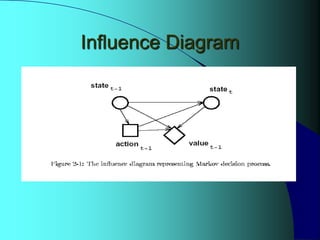
Influence Diagram
Expanded Influence Diagram
Relation between
time & steps-to-go
Decision Tree
Dynamic Construction
of the Decision Tree
 Incrémental expansion(MDP,γ, sI, є, VL, VU)
Initialize tree T with sI and ubound (sI), lbound (sI) using VL, VU;
repeat until(single action remains for sI or ubound (sI) - lbound (sI) <= є
call Improve-tree(T,MDP,γ, VL, VU)
return action with greatest lover bound as a result;
Improve-tree (T,MDP,γ, VL, VU)
if root(T) is a leaf
then expand root(T)
set bouds lbound, ubound of new leaves using VL, VU;
else for all decision subtrees T’ of T
do call Improve-tree (T,MDP,γ, VL, VU)
recompute bounds lbound(root(T)), ubound(root(T))for root(T);
when root(T) is a decision node
prune suboptimal action branches from T;
return;
Incremental expansion function:
Basic Method for the Dynamic Construction of the Decision Tree
start
MDP, γ, SI, ε, VL,
VU
OR SI)-bound(SI)
initialize leaf node of the partially
built decision tree
return
call Improve-tree(T,MDP, γ, ε, VL, VU)
Terminate
Computer Decisions
using Bound Iteration
 Incrémental expansion(MDP,γ, sI, є, VL, VU)
Initialize tree T with sI and ubound (sI), lbound (sI) using VL, VU;
repeat until(single action remains for sI or ubound (sI) - lbound (sI) <= є
call Improve-tree(T,MDP,γ, VL, VU)
return action with greatest lover bound as a result;
Improve-tree (T,MDP,γ, VL, VU)
if root(T) is a leaf
then expand root(T)
set bouds lbound, ubound of new leaves using VL, VU;
else for all decision subtrees T’ of T
do call Improve-tree (T,MDP,γ, VL, VU)
recompute bounds lbound(root(T)), ubound(root(T))for root(T);
when root(T) is a decision node
prune suboptimal action branches from T;
return;
Incremental expansion function:
Basic Method for the Dynamic Construction of the Decision Tree
start
MDP, γ, SI, ε, VL,
VU
OR (SI)-bound(SI)
initialize leaf node of the partially
built decision tree
return
call Improve-tree(T,MDP, γ, ε, VL, VU)
Terminate
Solving Large MDP problmes
If You Want to Read More
on MDPs
If You Want to Read More
on MDPs
 Book:
– Martin L. Puterman
 Markov Decision Processes
 Wiley Series in Probability
– Available on Amazon.com

RL intro

  • 1.
    MDP Presentation CS594 Automated OptimalDecision Making Sohail M Yousof Advanced Artificial Intelligence
  • 2.
    Topic Planning and Controlin Stochastic Domains With Imperfect Information
  • 3.
    Objective  Markov DecisionProcesses (Sequences of decisions) – Introduction to MDPs – Computing optimal policies for MDPs
  • 4.
    Markov Decision Process(MDP)  Sequential decision problems under uncertainty – Not just the immediate utility, but the longer-term utility as well – Uncertainty in outcomes  Roots in operations research  Also used in economics, communications engineering, ecology, performance modeling and of course, AI! – Also referred to as stochastic dynamic programs
  • 5.
    Markov Decision Process(MDP)  Defined as a tuple: <S, A, P, R> – S: State – A: Action – P: Transition function  Table P(s’| s, a), prob of s’ given action “a” in state “s” – R: Reward  R(s, a) = cost or reward of taking action a in state s  Choose a sequence of actions (not just one decision or one action) – Utility based on a sequence of decisions
  • 6.
    Example: What SEQUENCEof actions should our agent take? Reward -1 Blocked CELL Reward +1 Start1 2 3 4 1 2 3 0.8 0.1 0.1 • Each action costs –1/25 • Agent can take action N, E, S, W • Faces uncertainty in every state N
  • 7.
    MDP Tuple: <S,A, P, R>  S: State of the agent on the grid (4,3) – Note that cell denoted by (x,y)  A: Actions of the agent, i.e., N, E, S, W  P: Transition function – Table P(s’| s, a), prob of s’ given action “a” in state “s” – E.g., P( (4,3) | (3,3), N) = 0.1 – E.g., P((3, 2) | (3,3), N) = 0.8 – (Robot movement, uncertainty of another agent’s actions,…)  R: Reward (more comments on the reward function later) – R( (3, 3), N) = -1/25 – R (4,1) = +1
  • 8.
    ??Terminology • Before describingpolicies, lets go through some terminology • Terminology useful throughout this set of lectures •Policy: Complete mapping from states to actions
  • 9.
    MDP Basics andTerminology An agent must make a decision or control a probabilistic system  Goal is to choose a sequence of actions for optimality  Defined as <S, A, P, R>  MDP models: – Finite horizon: Maximize the expected reward for the next n steps – Infinite horizon: Maximize the expected discounted reward. – Transition model: Maximize average expected reward per transition. – Goal state: maximize expected reward (minimize expected cost) to some target state G.
  • 10.
    ???Reward Function  Accordingto chapter2, directly associated with state – Denoted R(I) – Simplifies computations seen later in algorithms presented  Sometimes, reward is assumed associated with state,action – R(S, A) – We could also assume a mix of R(S,A) and R(S)  Sometimes, reward associated with state,action,destination-state – R(S,A,J) – R(S,A) = S R(S,A,J) * P(J | S, A) J
  • 11.
    Markov Assumption  MarkovAssumption: Transition probabilities (and rewards) from any given state depend only on the state and not on previous history  Where you end up after action depends only on current state – After Russian Mathematician A. A. Markov (1856-1922) – (He did not come up with markov decision processes however) – Transitions in state (1,2) do not depend on prior state (1,1) or (1,2)
  • 12.
    ???MDP vs POMDPs Accessibility: Agent’s percept in any given state identify the state that it is in, e.g., state (4,3) vs (3,3) – Given observations, uniquely determine the state – Hence, we will not explicitly consider observations, only states  Inaccessibility: Agent’s percepts in any given state DO NOT identify the state that it is in, e.g., may be (4,3) or (3,3) – Given observations, not uniquely determine the state – POMDP: Partially observable MDP for inaccessible environments  We will focus on MDPs in this presentation.
  • 13.
  • 14.
    Stationary and DeterministicPolicies  Policy denoted by symbol 
  • 15.
    Policy  Policy islike a plan, but not quite – Certainly, generated ahead of time, like a plan  Unlike traditional plans, it is not a sequence of actions that an agent must execute – If there are failures in execution, agent can continue to execute a policy  Prescribes an action for all the states  Maximizes expected reward, rather than just reaching a goal state
  • 16.
    MDP problem  TheMDP problem consists of: – Finding the optimal control policy for all possible states; – Finding the sequence of optimal control functions for a specific initial state – Finding the best control action(decision) for a specific state.
  • 17.
    Non-Optimal Vs OptimalPolicy -1 +1 Start 1 2 3 4 1 2 3 • Choose Red policy or Yellow policy? • Choose Red policy or Blue policy? Which is optimal (if any)? • Value iteration: One popular algorithm to determine optimal policy
  • 18.
    Value Iteration: KeyIdea • Iterate: update utility of state “I” using old utility of neighbor states “J”; given actions “A” – U t+1 (I) = max [R(I,A) + S P(J|I,A)* U t (J)] A J – P(J|I,A): Probability of J if A is taken in state I – max F(A) returns highest F(A) – Immediate reward & longer term reward taken into account
  • 19.
    Value Iteration: Algorithm •Initialize: U0 (I) = 0 • Iterate: U t+1 (I) = max [ R(I,A) + S P(J|I,A)* U t (J) ] A J – Until close-enough (U t+1, Ut)  At the end of iteration, calculate optimal policy: Policy(I) = argmax [R(I,A) + S P(J|I,A)* U t+1 (J) ] A J
  • 20.
    Forward Method for SolvingMDP Decision Tree
  • 21.
    ??Markov Chain  Givenfixed policy, you get a markov chain from the MDP – Markov chain: Next state is dependent only on previous state – Next state: Not dependent on action (there is only one action) – Next state: History dependency only via the previous state – P(S t+1 | St, S t-1, S t-2 …..) = P(S t+1 | St)  How to evaluate the markov chain? • Could we try simulations? • Are there other sophisticated methods around?
  • 22.
  • 23.
  • 24.
  • 25.
  • 26.
    Dynamic Construction of theDecision Tree  Incrémental expansion(MDP,γ, sI, є, VL, VU) Initialize tree T with sI and ubound (sI), lbound (sI) using VL, VU; repeat until(single action remains for sI or ubound (sI) - lbound (sI) <= є call Improve-tree(T,MDP,γ, VL, VU) return action with greatest lover bound as a result; Improve-tree (T,MDP,γ, VL, VU) if root(T) is a leaf then expand root(T) set bouds lbound, ubound of new leaves using VL, VU; else for all decision subtrees T’ of T do call Improve-tree (T,MDP,γ, VL, VU) recompute bounds lbound(root(T)), ubound(root(T))for root(T); when root(T) is a decision node prune suboptimal action branches from T; return;
  • 27.
    Incremental expansion function: BasicMethod for the Dynamic Construction of the Decision Tree start MDP, γ, SI, ε, VL, VU OR SI)-bound(SI) initialize leaf node of the partially built decision tree return call Improve-tree(T,MDP, γ, ε, VL, VU) Terminate
  • 28.
    Computer Decisions using BoundIteration  Incrémental expansion(MDP,γ, sI, є, VL, VU) Initialize tree T with sI and ubound (sI), lbound (sI) using VL, VU; repeat until(single action remains for sI or ubound (sI) - lbound (sI) <= є call Improve-tree(T,MDP,γ, VL, VU) return action with greatest lover bound as a result; Improve-tree (T,MDP,γ, VL, VU) if root(T) is a leaf then expand root(T) set bouds lbound, ubound of new leaves using VL, VU; else for all decision subtrees T’ of T do call Improve-tree (T,MDP,γ, VL, VU) recompute bounds lbound(root(T)), ubound(root(T))for root(T); when root(T) is a decision node prune suboptimal action branches from T; return;
  • 29.
    Incremental expansion function: BasicMethod for the Dynamic Construction of the Decision Tree start MDP, γ, SI, ε, VL, VU OR (SI)-bound(SI) initialize leaf node of the partially built decision tree return call Improve-tree(T,MDP, γ, ε, VL, VU) Terminate
  • 30.
  • 31.
    If You Wantto Read More on MDPs If You Want to Read More on MDPs  Book: – Martin L. Puterman  Markov Decision Processes  Wiley Series in Probability – Available on Amazon.com