Prepositional Logic and
First order Predicate Logic
Name :- Ashish Duggal
Qualification :- M.C.A.
Prepositional Logic
Propositional logic (PL) is the simplest form of logic where all the statements are
made by propositions. A proposition is a declarative statement which is either
true or false. It is a technique of knowledge representation in logical and
mathematical form.
Example:
a) It is Sunday.
b) The Sun rises from West (False proposition)
c) 3+3= 7(False proposition)
d) 5 is a prime number.
Following are some basic facts about
propositional logic:
 Propositional logic is also called Boolean logic as it works on 0 and 1.
 Propositions can be either true or false, but it cannot be both.
 A proposition formula which is always true is called tautology, and it is also called a valid
sentence.
 A proposition formula which is always false is called Contradiction or Unsatisfiable .
 A statement is satisfiable if there is some interpretation for which it is true.
 Statements which are questions, commands, or opinions are not propositions such as
"Where is Rohini", "How are you", "What is your name", are not propositions.
Syntax of propositional logic:
There are two types of Propositions:
 Atomic Propositions - :
Atomic propositions are the simple propositions. It consists of a single proposition
symbol. These are the sentences which must be either true or false.
Example:
a) 2+2 is 4, it is an atomic proposition as it is a true fact.
b) "The Sun is cold" is also a proposition as it is a false fact.
 Compound proposition -:
Compound propositions are constructed by combining simpler or atomic propositions,
using parenthesis and logical connectives.
Example:
a) "It is raining today, and street is wet."
b) "Ankit is a doctor, and his clinic is in Mumbai."
Logical Connectives:
 Negation: A sentence such as ¬ P is called negation of P. A literal can be either Positive literal or
negative literal.
 Conjunction: A sentence which has ∧ connective such as, P ∧ Q is called a conjunction.
Example: Rohan is intelligent and hardworking.
P= Rohan is intelligent, Q= Rohan is hardworking. → P∧ Q.
 Disjunction: A sentence which has ∨ connective, such as P ∨ Q. is called disjunction, where P and Q
are the propositions.
Example: "Ritika is a doctor or Engineer",
P= Ritika is Doctor. Q= Ritika is Engineer, so we can write it as P ∨ Q.
 Implication: A sentence such as P → Q, is called an implication. Implications are also known as if-then
rules. It can be represented as
If it is raining, then the street is wet.
Let P= It is raining, and Q= Street is wet, so it is represented as P → Q
 Biconditional: A sentence such as P⇔ Q is a Biconditional sentence, example If I am breathing, then I
am alive
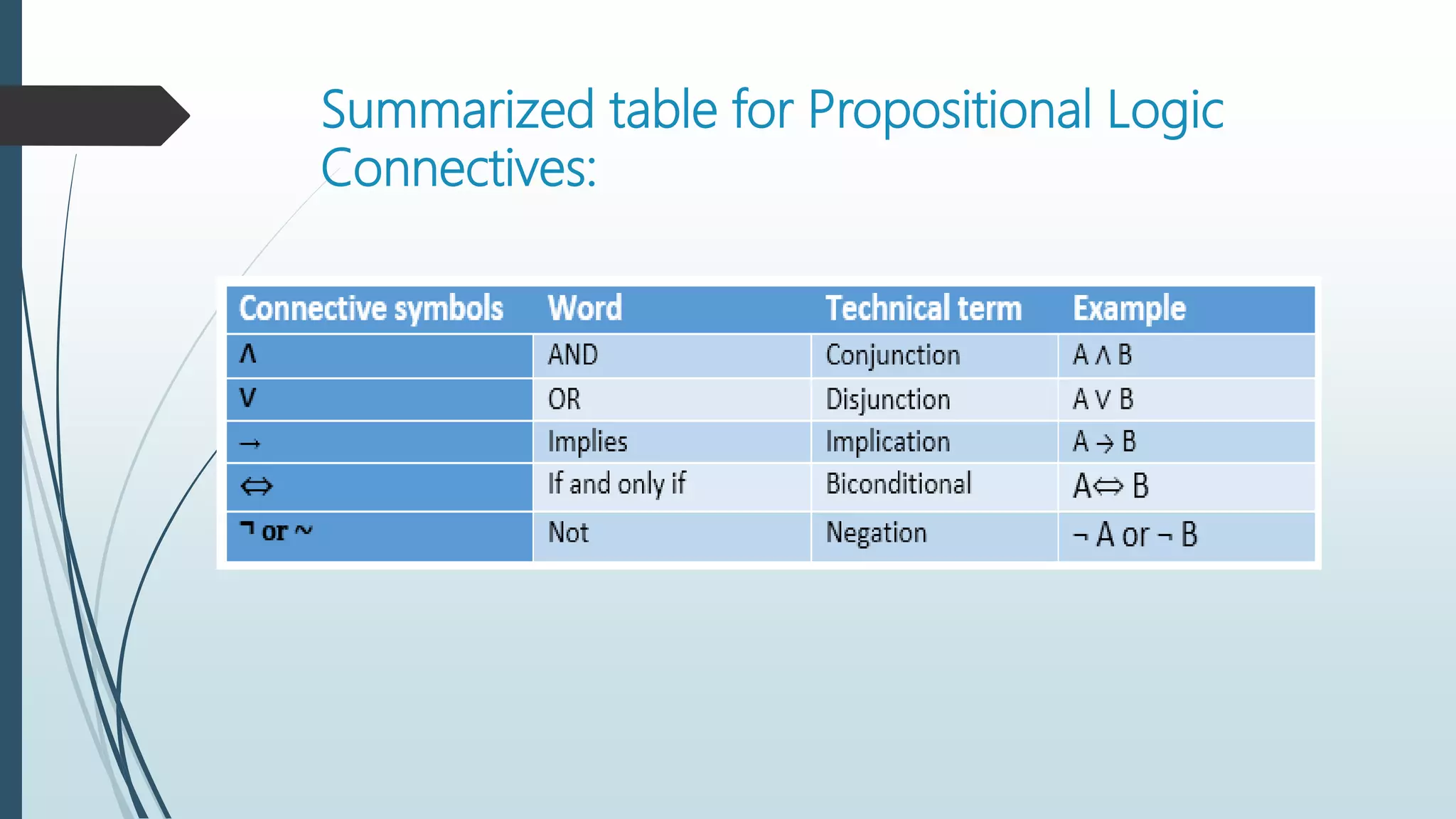
Summarized table for Propositional Logic
Connectives:
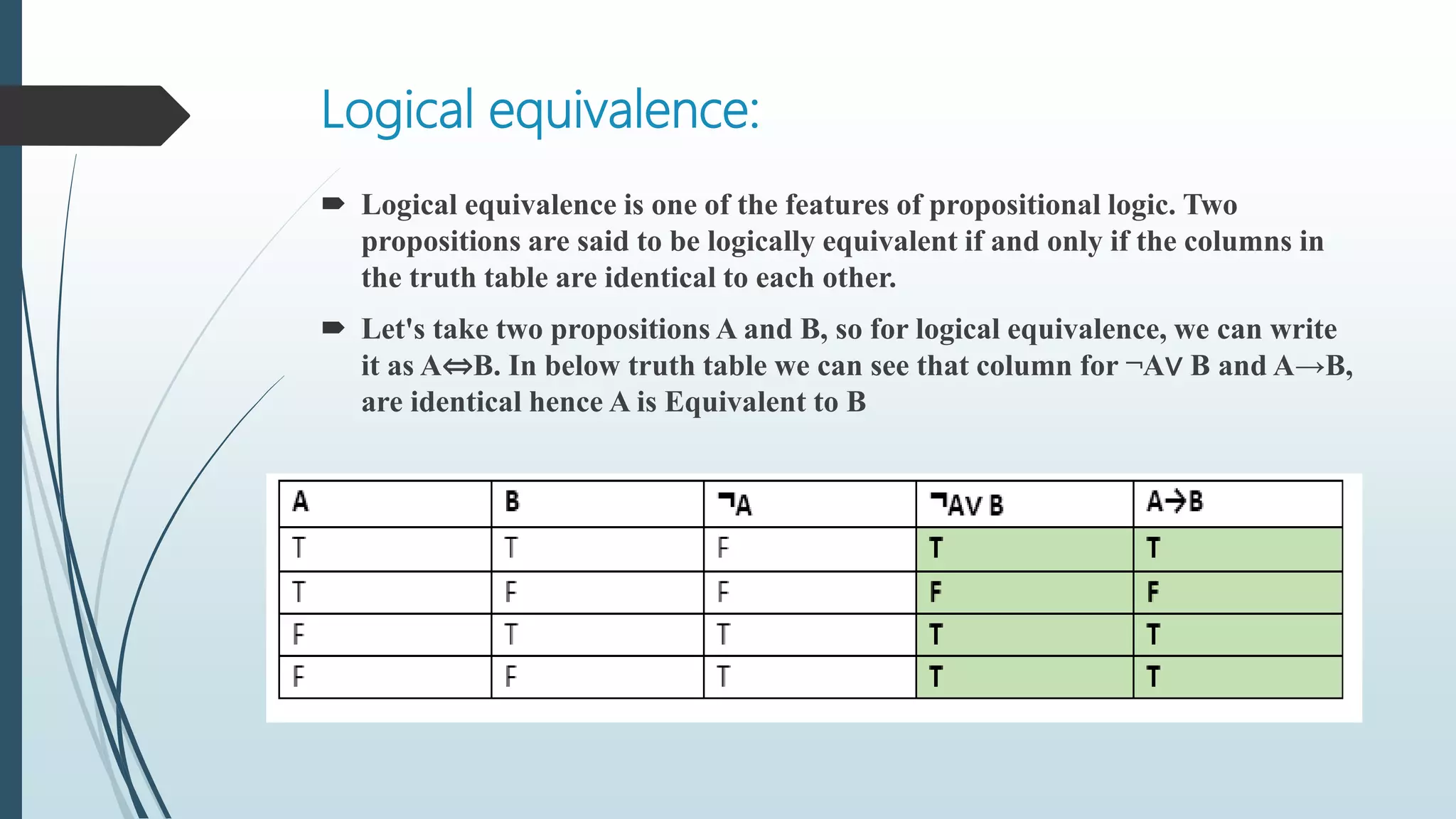
Logical equivalence:
 Logical equivalence is one of the features of propositional logic. Two
propositions are said to be logically equivalent if and only if the columns in
the truth table are identical to each other.
 Let's take two propositions A and B, so for logical equivalence, we can write
it as A⇔B. In below truth table we can see that column for ¬A∨ B and A→B,
are identical hence A is Equivalent to B
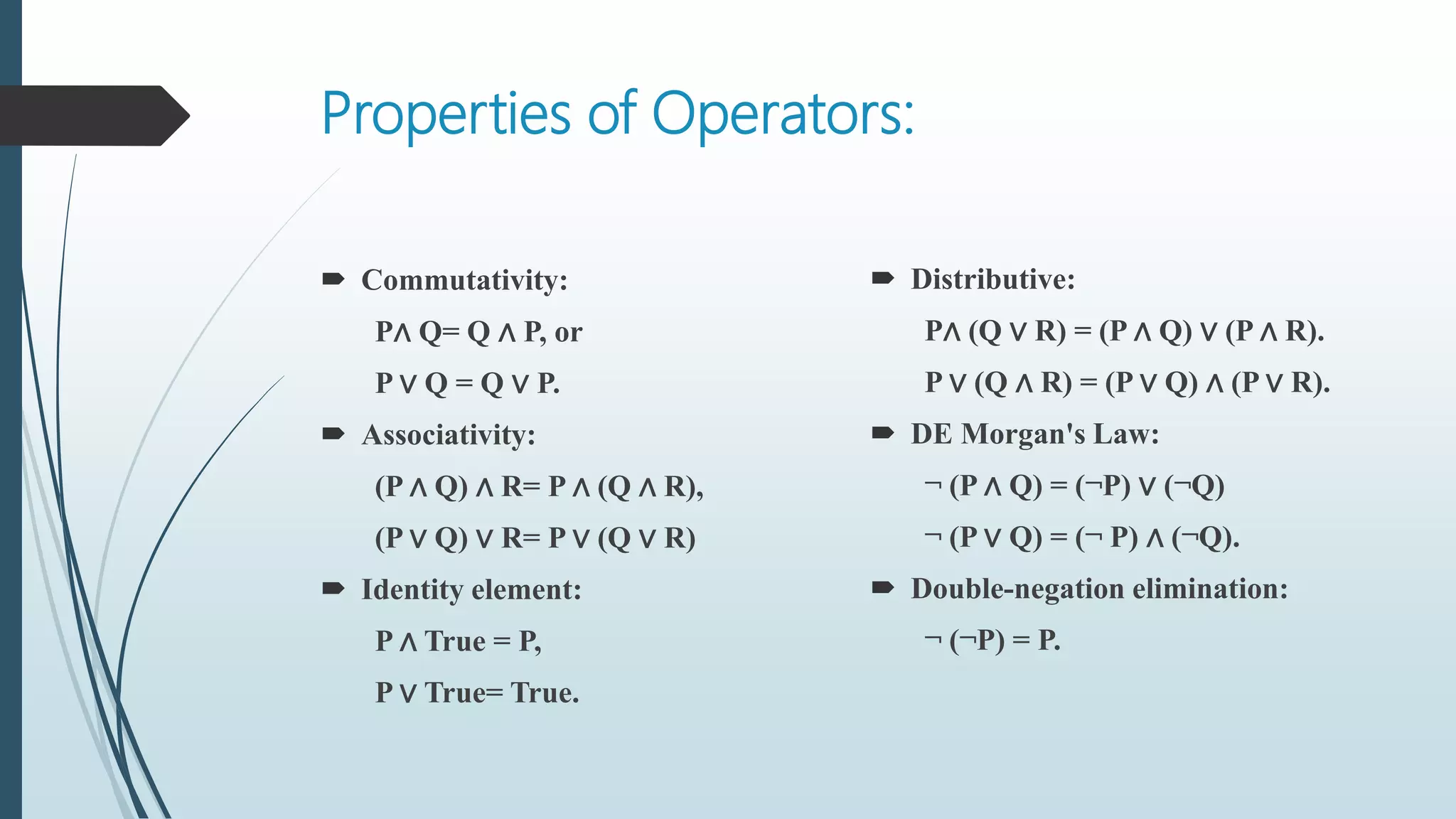
Properties of Operators:
 Commutativity:
P∧ Q= Q ∧ P, or
P ∨ Q = Q ∨ P.
 Associativity:
(P ∧ Q) ∧ R= P ∧ (Q ∧ R),
(P ∨ Q) ∨ R= P ∨ (Q ∨ R)
 Identity element:
P ∧ True = P,
P ∨ True= True.
 Distributive:
P∧ (Q ∨ R) = (P ∧ Q) ∨ (P ∧ R).
P ∨ (Q ∧ R) = (P ∨ Q) ∧ (P ∨ R).
 DE Morgan's Law:
¬ (P ∧ Q) = (¬P) ∨ (¬Q)
¬ (P ∨ Q) = (¬ P) ∧ (¬Q).
 Double-negation elimination:
¬ (¬P) = P.
Limitations of Propositional logic:
 We cannot represent relations like ALL, some, or none with
propositional logic. Example:
All the girls are intelligent.
Some apples are sweet.
 Propositional logic has limited expressive power.
First order Predicate Logic
 First-order logic is another way of knowledge representation in AI. It is an extension to
propositional logic.
 FOPL is sufficiently expressive to represent the natural language statements in a concise way.
 First-order logic is also known as Predicate logic or First-order predicate logic. First-order
logic is a powerful language that develops information about the objects in a more easy way
and can also express the relationship between those objects.
 First-order logic (like natural language) does not only assume that the world contains facts like
propositional logic but also assumes the following things in the world:
Objects: A, B, people, numbers, colors, wars, theories, squares, pits, wumpus, ......
Relations: It can be unary relation such as: red, round, is adjacent, or n-any relation such
as: the sister of, brother of, has color, comes between
Function: Father of, best friend, third inning of, end of, ......
 As a natural language, first-order logic also has two main parts:
Syntax
Semantics
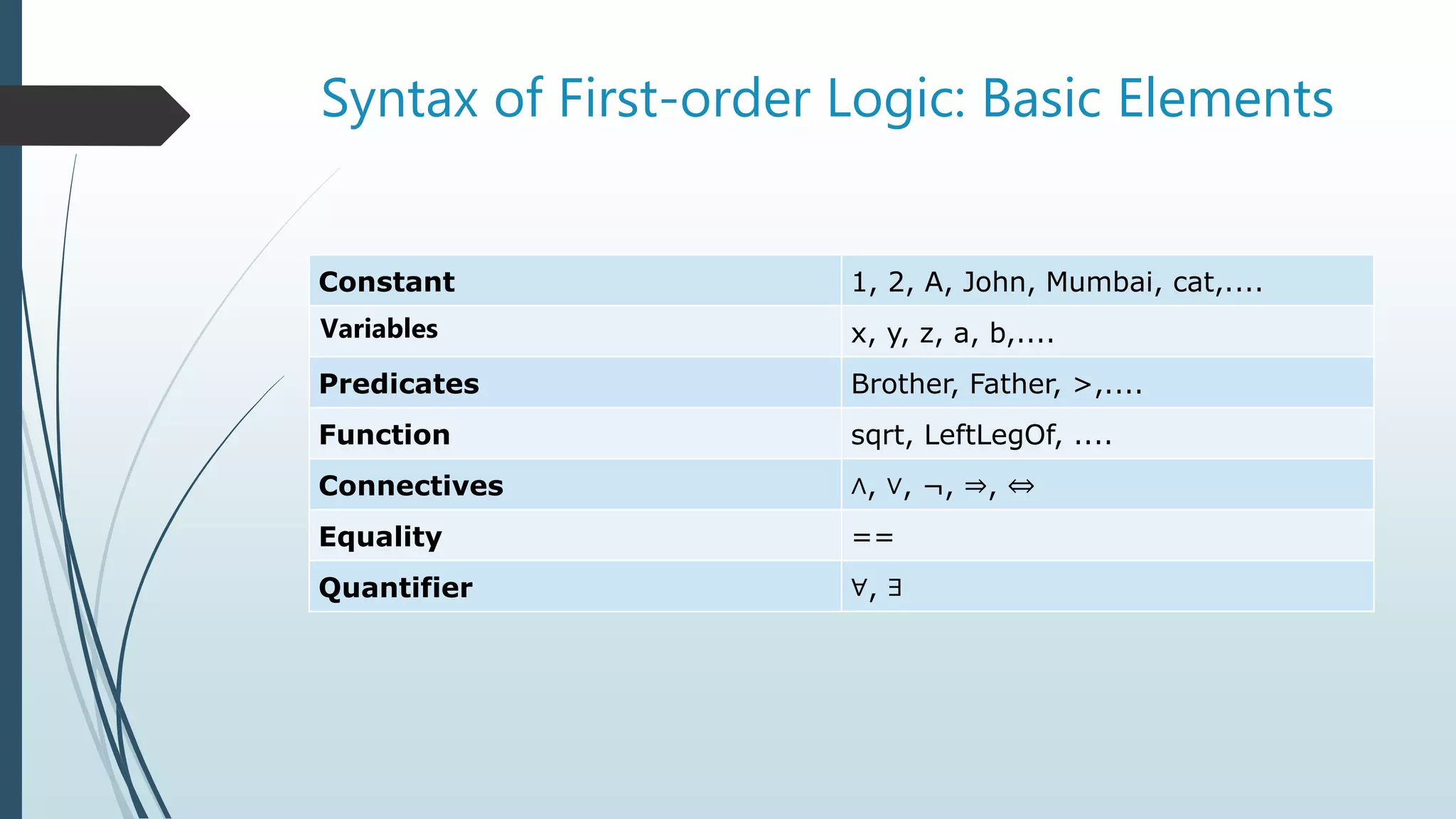
Syntax of First-order Logic: Basic Elements
Constant 1, 2, A, John, Mumbai, cat,....
Variables x, y, z, a, b,....
Predicates Brother, Father, >,....
Function sqrt, LeftLegOf, ....
Connectives ∧, ∨, ¬, ⇒, ⇔
Equality ==
Quantifier ∀, ∃
Atomic sentences:
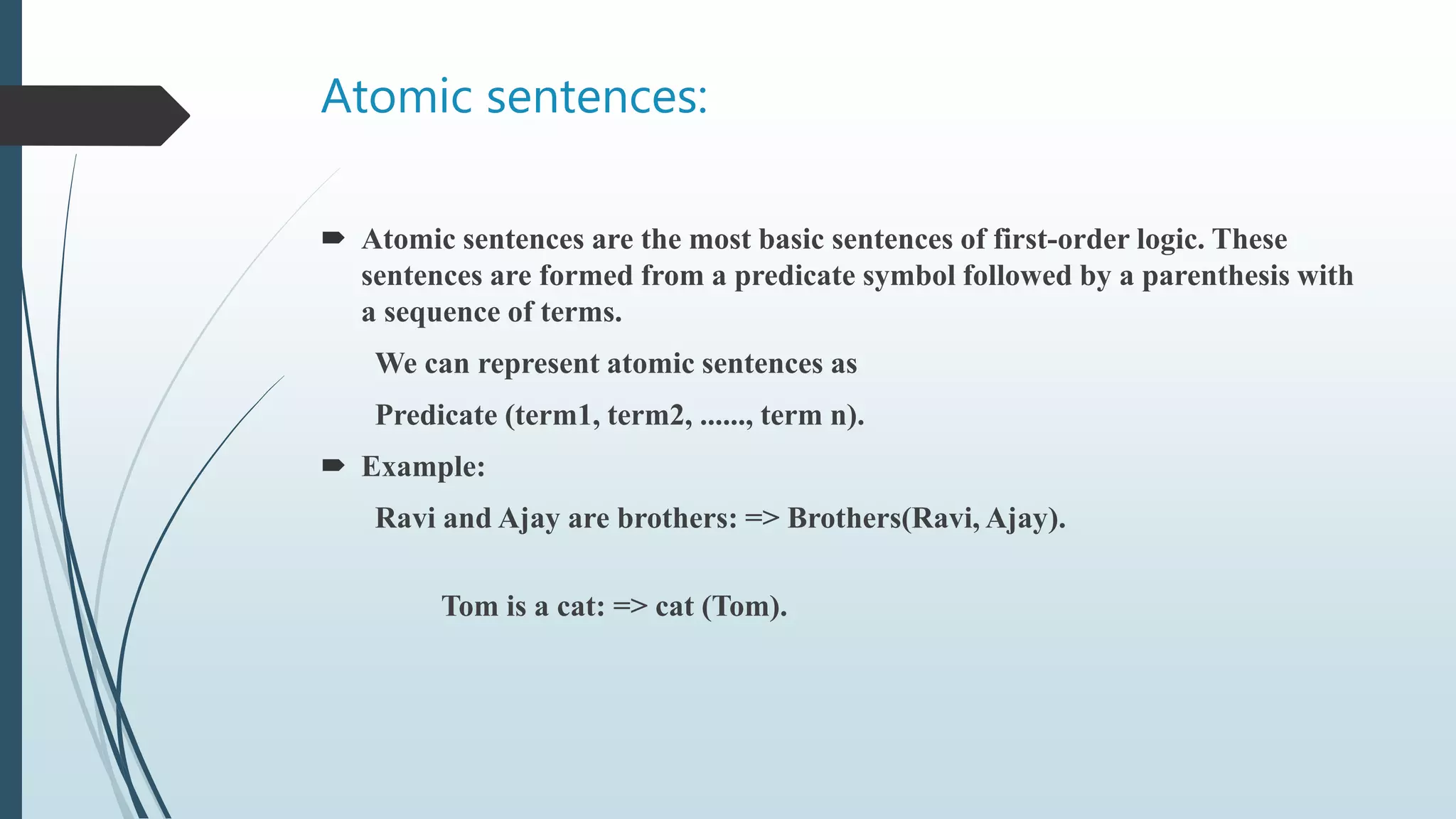
 Atomic sentences are the most basic sentences of first-order logic. These
sentences are formed from a predicate symbol followed by a parenthesis with
a sequence of terms.
We can represent atomic sentences as
Predicate (term1, term2, ......, term n).
 Example:
Ravi and Ajay are brothers: => Brothers(Ravi, Ajay).
Tom is a cat: => cat (Tom).
Complex Sentences:
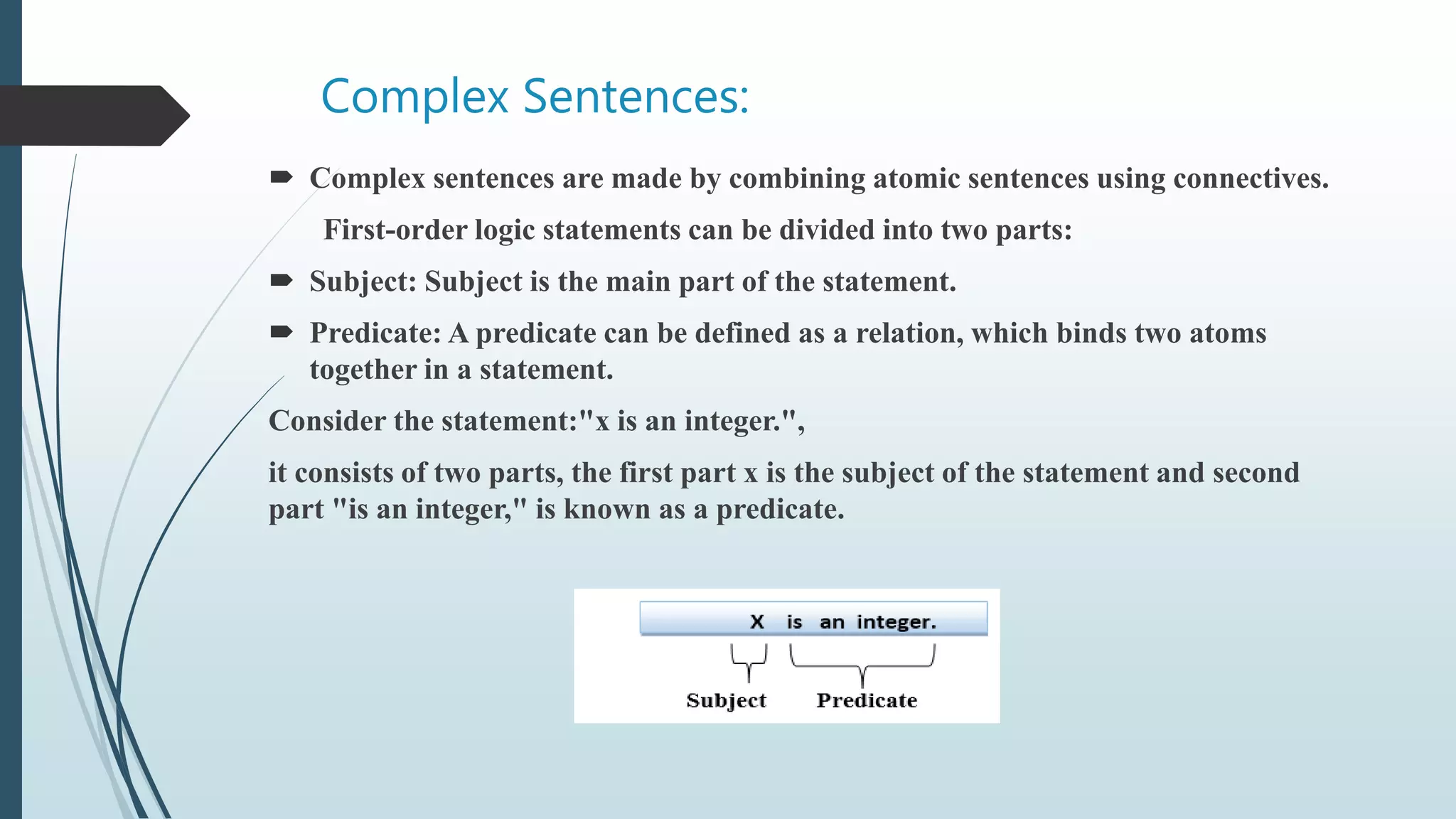
 Complex sentences are made by combining atomic sentences using connectives.
First-order logic statements can be divided into two parts:
 Subject: Subject is the main part of the statement.
 Predicate: A predicate can be defined as a relation, which binds two atoms
together in a statement.
Consider the statement:"x is an integer.",
it consists of two parts, the first part x is the subject of the statement and second
part "is an integer," is known as a predicate.
Quantifiers in First-order logic:
There are two types of quantifier:
 Universal Quantifier(∀), (for all, everyone, everything)
Universal quantifier is a symbol of logical representation, which specifies that the
statement within its range is true for everything or every instance of a particular thing.
The Universal quantifier is represented by a symbol ∀ .
In universal quantifier we use implication "→".
 Existential quantifier(∃), (for some, at least one)
Existential quantifiers are the type of quantifiers, which express that the statement within
its scope is true for at least one instance of something.
It is denoted by the logical operator ∃.
In Existential quantifier we always use AND or Conjunction symbol (∧)
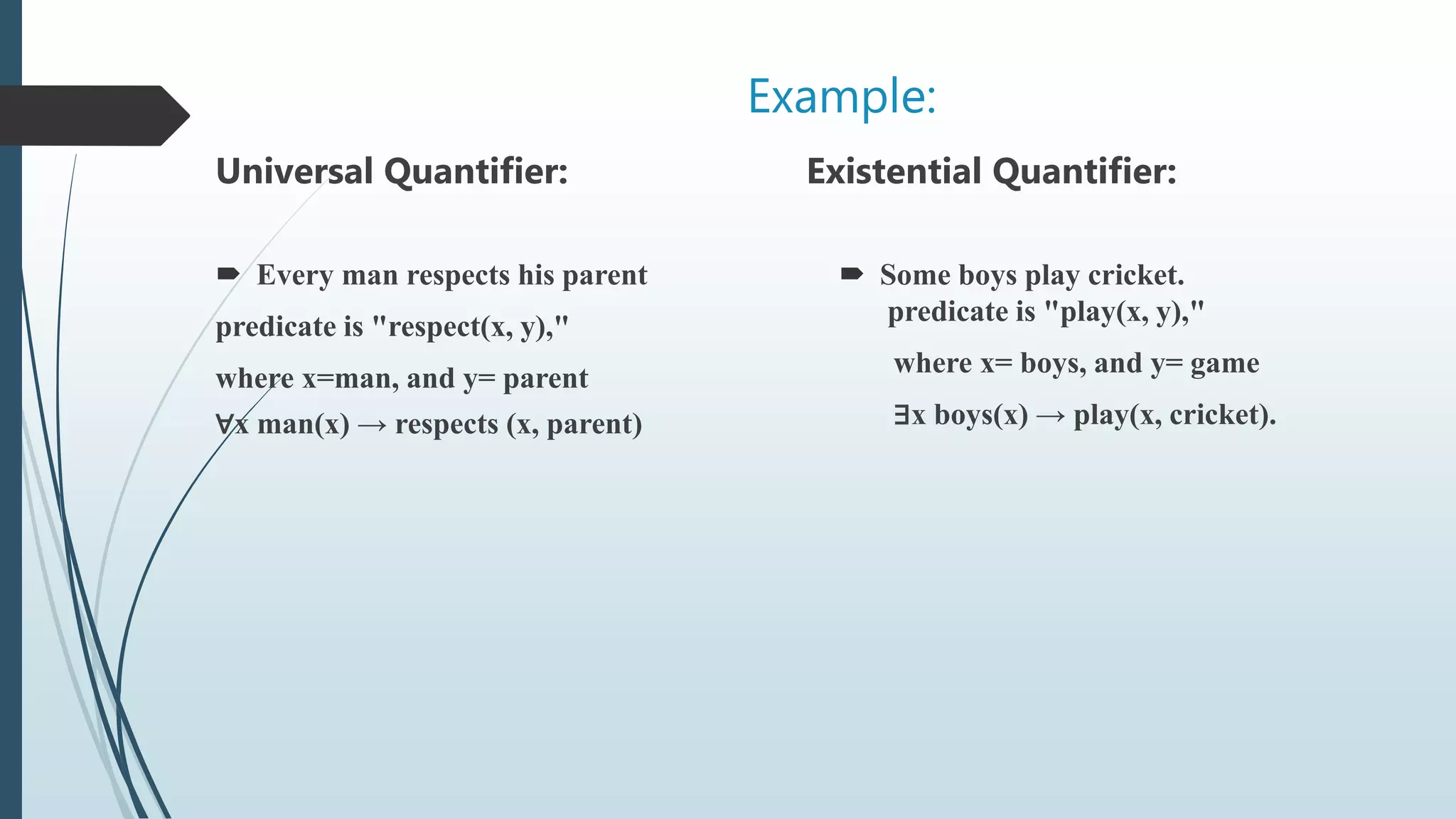
Example:
Universal Quantifier:
 Every man respects his parent
predicate is "respect(x, y),"
where x=man, and y= parent
∀x man(x) → respects (x, parent)
Existential Quantifier:
 Some boys play cricket.
predicate is "play(x, y),"
where x= boys, and y= game
∃x boys(x) → play(x, cricket).
Thank You

Artificial Intelligence (AI) | Prepositional logic (PL)and first order predicate logic (FOPL) | Knowledge Representation

  • 1.
    Prepositional Logic and Firstorder Predicate Logic Name :- Ashish Duggal Qualification :- M.C.A.
  • 2.
    Prepositional Logic Propositional logic(PL) is the simplest form of logic where all the statements are made by propositions. A proposition is a declarative statement which is either true or false. It is a technique of knowledge representation in logical and mathematical form. Example: a) It is Sunday. b) The Sun rises from West (False proposition) c) 3+3= 7(False proposition) d) 5 is a prime number.
  • 3.
    Following are somebasic facts about propositional logic:  Propositional logic is also called Boolean logic as it works on 0 and 1.  Propositions can be either true or false, but it cannot be both.  A proposition formula which is always true is called tautology, and it is also called a valid sentence.  A proposition formula which is always false is called Contradiction or Unsatisfiable .  A statement is satisfiable if there is some interpretation for which it is true.  Statements which are questions, commands, or opinions are not propositions such as "Where is Rohini", "How are you", "What is your name", are not propositions.
  • 4.
    Syntax of propositionallogic: There are two types of Propositions:  Atomic Propositions - : Atomic propositions are the simple propositions. It consists of a single proposition symbol. These are the sentences which must be either true or false. Example: a) 2+2 is 4, it is an atomic proposition as it is a true fact. b) "The Sun is cold" is also a proposition as it is a false fact.  Compound proposition -: Compound propositions are constructed by combining simpler or atomic propositions, using parenthesis and logical connectives. Example: a) "It is raining today, and street is wet." b) "Ankit is a doctor, and his clinic is in Mumbai."
  • 5.
    Logical Connectives:  Negation:A sentence such as ¬ P is called negation of P. A literal can be either Positive literal or negative literal.  Conjunction: A sentence which has ∧ connective such as, P ∧ Q is called a conjunction. Example: Rohan is intelligent and hardworking. P= Rohan is intelligent, Q= Rohan is hardworking. → P∧ Q.  Disjunction: A sentence which has ∨ connective, such as P ∨ Q. is called disjunction, where P and Q are the propositions. Example: "Ritika is a doctor or Engineer", P= Ritika is Doctor. Q= Ritika is Engineer, so we can write it as P ∨ Q.  Implication: A sentence such as P → Q, is called an implication. Implications are also known as if-then rules. It can be represented as If it is raining, then the street is wet. Let P= It is raining, and Q= Street is wet, so it is represented as P → Q  Biconditional: A sentence such as P⇔ Q is a Biconditional sentence, example If I am breathing, then I am alive
  • 6.
    Summarized table forPropositional Logic Connectives:
  • 7.
    Logical equivalence:  Logicalequivalence is one of the features of propositional logic. Two propositions are said to be logically equivalent if and only if the columns in the truth table are identical to each other.  Let's take two propositions A and B, so for logical equivalence, we can write it as A⇔B. In below truth table we can see that column for ¬A∨ B and A→B, are identical hence A is Equivalent to B
  • 8.
    Properties of Operators: Commutativity: P∧ Q= Q ∧ P, or P ∨ Q = Q ∨ P.  Associativity: (P ∧ Q) ∧ R= P ∧ (Q ∧ R), (P ∨ Q) ∨ R= P ∨ (Q ∨ R)  Identity element: P ∧ True = P, P ∨ True= True.  Distributive: P∧ (Q ∨ R) = (P ∧ Q) ∨ (P ∧ R). P ∨ (Q ∧ R) = (P ∨ Q) ∧ (P ∨ R).  DE Morgan's Law: ¬ (P ∧ Q) = (¬P) ∨ (¬Q) ¬ (P ∨ Q) = (¬ P) ∧ (¬Q).  Double-negation elimination: ¬ (¬P) = P.
  • 9.
    Limitations of Propositionallogic:  We cannot represent relations like ALL, some, or none with propositional logic. Example: All the girls are intelligent. Some apples are sweet.  Propositional logic has limited expressive power.
  • 10.
    First order PredicateLogic  First-order logic is another way of knowledge representation in AI. It is an extension to propositional logic.  FOPL is sufficiently expressive to represent the natural language statements in a concise way.  First-order logic is also known as Predicate logic or First-order predicate logic. First-order logic is a powerful language that develops information about the objects in a more easy way and can also express the relationship between those objects.  First-order logic (like natural language) does not only assume that the world contains facts like propositional logic but also assumes the following things in the world: Objects: A, B, people, numbers, colors, wars, theories, squares, pits, wumpus, ...... Relations: It can be unary relation such as: red, round, is adjacent, or n-any relation such as: the sister of, brother of, has color, comes between Function: Father of, best friend, third inning of, end of, ......  As a natural language, first-order logic also has two main parts: Syntax Semantics
  • 11.
    Syntax of First-orderLogic: Basic Elements Constant 1, 2, A, John, Mumbai, cat,.... Variables x, y, z, a, b,.... Predicates Brother, Father, >,.... Function sqrt, LeftLegOf, .... Connectives ∧, ∨, ¬, ⇒, ⇔ Equality == Quantifier ∀, ∃
  • 12.
    Atomic sentences:  Atomicsentences are the most basic sentences of first-order logic. These sentences are formed from a predicate symbol followed by a parenthesis with a sequence of terms. We can represent atomic sentences as Predicate (term1, term2, ......, term n).  Example: Ravi and Ajay are brothers: => Brothers(Ravi, Ajay). Tom is a cat: => cat (Tom).
  • 13.
    Complex Sentences:  Complexsentences are made by combining atomic sentences using connectives. First-order logic statements can be divided into two parts:  Subject: Subject is the main part of the statement.  Predicate: A predicate can be defined as a relation, which binds two atoms together in a statement. Consider the statement:"x is an integer.", it consists of two parts, the first part x is the subject of the statement and second part "is an integer," is known as a predicate.
  • 14.
    Quantifiers in First-orderlogic: There are two types of quantifier:  Universal Quantifier(∀), (for all, everyone, everything) Universal quantifier is a symbol of logical representation, which specifies that the statement within its range is true for everything or every instance of a particular thing. The Universal quantifier is represented by a symbol ∀ . In universal quantifier we use implication "→".  Existential quantifier(∃), (for some, at least one) Existential quantifiers are the type of quantifiers, which express that the statement within its scope is true for at least one instance of something. It is denoted by the logical operator ∃. In Existential quantifier we always use AND or Conjunction symbol (∧)
  • 15.
    Example: Universal Quantifier:  Everyman respects his parent predicate is "respect(x, y)," where x=man, and y= parent ∀x man(x) → respects (x, parent) Existential Quantifier:  Some boys play cricket. predicate is "play(x, y)," where x= boys, and y= game ∃x boys(x) → play(x, cricket).
  • 16.