Food flavors: Types, Biosynthesis of
flavor compounds, off – flavor in foods
Jasmine Juliet .R
Biotechnology Department
Agricultural college and
Research & Institute
Madurai.
Food Flavors - Definition
• Flavor is the sensory impression of a food or other substance, and
is determined mainly by the chemical senses of taste and smell.
• Food flavourings are ingredients added to food to intensify or
improve its flavor.
• They are usually represented by a mixture of spices, herbs, taste
components, and colors.
• Some of the most commonly used seasonings include herbs (e.g.
oregano) spices (e.g. cinnamon), condiments (e.g. mustard), and
a variety of vinegars.
What Are Flavours Made Of?
• Flavour Chemicals – Aroma Compounds
• Over 7,000 volatile compounds have been identified in foods
• Approximately 1,500 of these volatile compounds are used in the
creation of flavourings – Nature Identical or Natural
• Approximately 400 materials not identified in foods are also used in
flavourings – Artificial
• There are many different flavour categories that cover the range of foods
and beverages, e.g. fruit flavours, sweet brown flavours, spice/herbs,
Types of Food Flavors
• To-date, 10,000 flavouring substances have been identified in nature however,
the food flavouring industry only uses about 2,500 of substances.
• The most often used substances include citral which tastes of lemon or menthol
which gives a peppermint taste.
• Depending on the manufacturing process flavourings are divided into two
major groups:
Natural flavouring substances
Synthetically produced flavouring substances which includes Nature-
identical flavouring substances and Artificial flavouring substances.
Types of Food Flavors
• There are three major classification of food favourings which are
based on their origin:
(I) Natural flavoring substances: These are substances that are
obtained from plant or animal raw materials, by physical,
microbiological or enzymatic processes.
• They can be either used in their natural form or processed form
for consumption.
• spices, fruit juices, eggs, herbs, edible yeast, vegetable juice.
Types of Food Flavors
(II) Nature-identical flavoring substances: Nature-identical substances are
the flavoring substances that are obtained by synthesis or are isolated
through chemical processes in a lab but their chemical structures are
identical to the substances present in natural products.
 These flavorings do not contain any artificial flavouring substances.
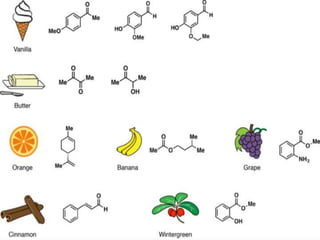
 Example: Vanillin, the main component of vanilla beans which can be
produced as a natural or a nature-identical flavouring substance.
Types of Food Flavors
(III) Artificial flavoring substances: These are substances that have no
equivalent in nature.
• These food flavorings are typically produced by fractional distillation
and additional chemical manipulation of naturally sourced chemicals
or from crude oil or coal tar.
• Example: Ethyl vanillin, which is artificial and smells and tastes like
vanillin yet is roughly three times more taste-intensive when added to
ice cream, confectionery and baked goods.
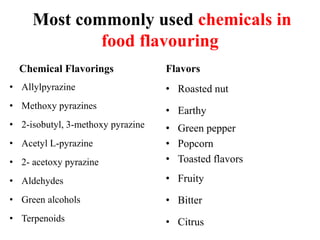
Most commonly used chemicals in
food flavouring
Chemical Flavorings
• Allylpyrazine
• Methoxy pyrazines
• 2-isobutyl, 3-methoxy pyrazine
• Acetyl L-pyrazine
• 2- acetoxy pyrazine
• Aldehydes
• Green alcohols
• Terpenoids
Flavors
• Roasted nut
• Earthy
• Green pepper
• Popcorn
• Toasted flavors
• Fruity
• Bitter
• Citrus
Biosynthesis of Vanilla Food Flavors
 Vanilla is the most popular flavor worldwide. It is used in favorites like
ice cream, candies, cakes, and cookies.
 Natural vanilla extract is obtained by steeping vanilla beans in alcohol
to afford a solution of vanillin and other minor components that may be
used in cooking and baking.
 While as many as 250 taste and aroma components have been detected
in vanilla extract, most of these are destroyed upon exposure to elevated
temperature, causing the complexity of the vanilla flavor to diminish upon
baking.
Biosynthesis of Vanilla Food Flavors
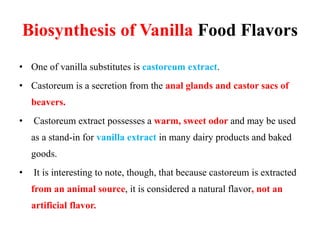
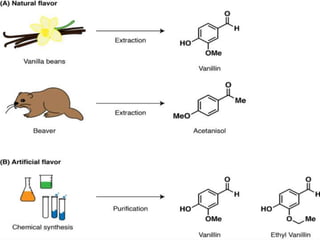
• One of vanilla substitutes is castoreum extract.
• Castoreum is a secretion from the anal glands and castor sacs of
beavers.
• Castoreum extract possesses a warm, sweet odor and may be used
as a stand-in for vanilla extract in many dairy products and baked
goods.
• It is interesting to note, though, that because castoreum is extracted
from an animal source, it is considered a natural flavor, not an
artificial flavor.
Biosynthesis of Vanilla Food Flavors
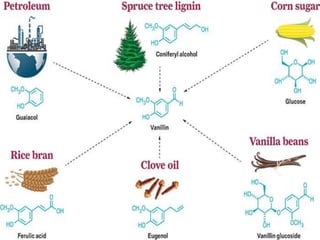
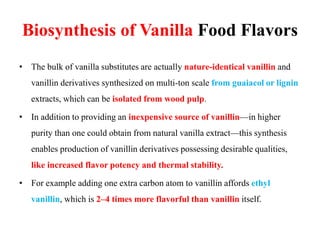
• The bulk of vanilla substitutes are actually nature-identical vanillin and
vanillin derivatives synthesized on multi-ton scale from guaiacol or lignin
extracts, which can be isolated from wood pulp.
• In addition to providing an inexpensive source of vanillin—in higher
purity than one could obtain from natural vanilla extract—this synthesis
enables production of vanillin derivatives possessing desirable qualities,
like increased flavor potency and thermal stability.
• For example adding one extra carbon atom to vanillin affords ethyl
vanillin, which is 2–4 times more flavorful than vanillin itself.
Biosynthesis of Butter Food Flavors
• Butter Me Up
• The rich, smooth flavor of butter is another consumer
favorite, adding body and depth to cooking sprays, sauces,
baked goods, and (of course) popcorn.
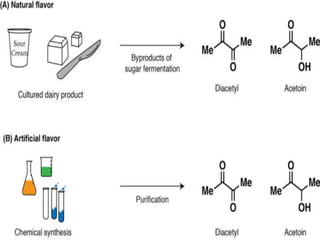
• This flavor arises from the production of diacetyl and
acetoin as byproducts of sugar fermentation in the
production of cultured dairy products like cultured butter,
buttermilk, and sour cream (natural butter flavoring).
Biosynthesis of Butter Food Flavors
• Butter flavorings compounds can be isolated from dairy products, the very
low efficiency of the extraction limits its practicality.
• Instead, these flavor additives are generally produced through chemical
synthesis or industrial fermentation on specialized culture, which is
optimized for flavor production.
• When produced through this culturing technique, diacetyl and acetoin are
listed as “natural butter flavoring,” but when they are produced through
controlled laboratory synthesis, the very same components are listed as
“artificial butter flavoring”
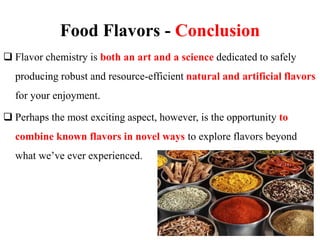
Food Flavors - Conclusion
 Flavor chemistry is both an art and a science dedicated to safely
producing robust and resource-efficient natural and artificial flavors
for your enjoyment.
 Perhaps the most exciting aspect, however, is the opportunity to
combine known flavors in novel ways to explore flavors beyond
what we’ve ever experienced.

Food flavors

  • 1.
    Food flavors: Types,Biosynthesis of flavor compounds, off – flavor in foods Jasmine Juliet .R Biotechnology Department Agricultural college and Research & Institute Madurai.
  • 2.
    Food Flavors -Definition • Flavor is the sensory impression of a food or other substance, and is determined mainly by the chemical senses of taste and smell. • Food flavourings are ingredients added to food to intensify or improve its flavor. • They are usually represented by a mixture of spices, herbs, taste components, and colors. • Some of the most commonly used seasonings include herbs (e.g. oregano) spices (e.g. cinnamon), condiments (e.g. mustard), and a variety of vinegars.
  • 4.
    What Are FlavoursMade Of? • Flavour Chemicals – Aroma Compounds • Over 7,000 volatile compounds have been identified in foods • Approximately 1,500 of these volatile compounds are used in the creation of flavourings – Nature Identical or Natural • Approximately 400 materials not identified in foods are also used in flavourings – Artificial • There are many different flavour categories that cover the range of foods and beverages, e.g. fruit flavours, sweet brown flavours, spice/herbs,
  • 6.
    Types of FoodFlavors • To-date, 10,000 flavouring substances have been identified in nature however, the food flavouring industry only uses about 2,500 of substances. • The most often used substances include citral which tastes of lemon or menthol which gives a peppermint taste. • Depending on the manufacturing process flavourings are divided into two major groups: Natural flavouring substances Synthetically produced flavouring substances which includes Nature- identical flavouring substances and Artificial flavouring substances.
  • 8.
    Types of FoodFlavors • There are three major classification of food favourings which are based on their origin: (I) Natural flavoring substances: These are substances that are obtained from plant or animal raw materials, by physical, microbiological or enzymatic processes. • They can be either used in their natural form or processed form for consumption. • spices, fruit juices, eggs, herbs, edible yeast, vegetable juice.
  • 11.
    Types of FoodFlavors (II) Nature-identical flavoring substances: Nature-identical substances are the flavoring substances that are obtained by synthesis or are isolated through chemical processes in a lab but their chemical structures are identical to the substances present in natural products.  These flavorings do not contain any artificial flavouring substances.  Example: Vanillin, the main component of vanilla beans which can be produced as a natural or a nature-identical flavouring substance.
  • 13.
    Types of FoodFlavors (III) Artificial flavoring substances: These are substances that have no equivalent in nature. • These food flavorings are typically produced by fractional distillation and additional chemical manipulation of naturally sourced chemicals or from crude oil or coal tar. • Example: Ethyl vanillin, which is artificial and smells and tastes like vanillin yet is roughly three times more taste-intensive when added to ice cream, confectionery and baked goods.
  • 15.
    Most commonly usedchemicals in food flavouring Chemical Flavorings • Allylpyrazine • Methoxy pyrazines • 2-isobutyl, 3-methoxy pyrazine • Acetyl L-pyrazine • 2- acetoxy pyrazine • Aldehydes • Green alcohols • Terpenoids Flavors • Roasted nut • Earthy • Green pepper • Popcorn • Toasted flavors • Fruity • Bitter • Citrus
  • 17.
    Biosynthesis of VanillaFood Flavors  Vanilla is the most popular flavor worldwide. It is used in favorites like ice cream, candies, cakes, and cookies.  Natural vanilla extract is obtained by steeping vanilla beans in alcohol to afford a solution of vanillin and other minor components that may be used in cooking and baking.  While as many as 250 taste and aroma components have been detected in vanilla extract, most of these are destroyed upon exposure to elevated temperature, causing the complexity of the vanilla flavor to diminish upon baking.
  • 19.
    Biosynthesis of VanillaFood Flavors • One of vanilla substitutes is castoreum extract. • Castoreum is a secretion from the anal glands and castor sacs of beavers. • Castoreum extract possesses a warm, sweet odor and may be used as a stand-in for vanilla extract in many dairy products and baked goods. • It is interesting to note, though, that because castoreum is extracted from an animal source, it is considered a natural flavor, not an artificial flavor.
  • 20.
    Biosynthesis of VanillaFood Flavors • The bulk of vanilla substitutes are actually nature-identical vanillin and vanillin derivatives synthesized on multi-ton scale from guaiacol or lignin extracts, which can be isolated from wood pulp. • In addition to providing an inexpensive source of vanillin—in higher purity than one could obtain from natural vanilla extract—this synthesis enables production of vanillin derivatives possessing desirable qualities, like increased flavor potency and thermal stability. • For example adding one extra carbon atom to vanillin affords ethyl vanillin, which is 2–4 times more flavorful than vanillin itself.
  • 22.
    Biosynthesis of ButterFood Flavors • Butter Me Up • The rich, smooth flavor of butter is another consumer favorite, adding body and depth to cooking sprays, sauces, baked goods, and (of course) popcorn. • This flavor arises from the production of diacetyl and acetoin as byproducts of sugar fermentation in the production of cultured dairy products like cultured butter, buttermilk, and sour cream (natural butter flavoring).
  • 23.
    Biosynthesis of ButterFood Flavors • Butter flavorings compounds can be isolated from dairy products, the very low efficiency of the extraction limits its practicality. • Instead, these flavor additives are generally produced through chemical synthesis or industrial fermentation on specialized culture, which is optimized for flavor production. • When produced through this culturing technique, diacetyl and acetoin are listed as “natural butter flavoring,” but when they are produced through controlled laboratory synthesis, the very same components are listed as “artificial butter flavoring”
  • 25.
    Food Flavors -Conclusion  Flavor chemistry is both an art and a science dedicated to safely producing robust and resource-efficient natural and artificial flavors for your enjoyment.  Perhaps the most exciting aspect, however, is the opportunity to combine known flavors in novel ways to explore flavors beyond what we’ve ever experienced.