Ritabrata Sarkar; B.Sc Ag. 3rd year, Siksha “O” Anusandhan University
Contents
 Introduction
 Role of IT
 Initiators of E-agriculture in India
 Advantages of IT in Agriculture
 Agricultural Tool
 Weather Forecasting
 Digital Mandi, mKrishi, Kisan call centres, E-choupal
 Technology used in Green House
 Weed Control
 Use of GIS in Agriculture
 Use of GPS in Agriculture
 Uses of Drones in Agriculture
 List of Agri Advisory Services in India
 IT Vision 2020
 Challenges
Introduction
 IT is the branch of engineering that deals with the use of computers and
telecommunication to retrieve, store and transmit information.
 Information technology is potential tool for improving decision making
in agriculture.
 IT can improve farm management and farming technologies by efficient
farm management.
 The widespread use of IT to make a direct contribution to agricultural
productivity.
 Satellite technology, geographic information systems using the techniques
of agronomy and soil science is to increase agricultural production.
Role of IT in Agriculture in India
 Farmers in India must use Information and Communication Technology
(ICT) for agricultural purposes.
 India’s food production and productivity can be increased by an effective
use of IT for agricultural purposes.
 The developed nations are using laser technology instead of tractors to
plough lands. This helps in optimizing the use of various inputs such as
water, seeds, fertilizers, etc.
INITIATOR OF E-AGRICULTURE IN INDIA
 The Association For People of Haryana (AFPOH) has taken many steps
and initiatives at national and international level in the fields of
agriculture, rural development etc.
 As far as initiatives for e-agriculture in India are concerned, they have
shared their research works and suggestions with national and
international community.
 They have also started an initiative titled e-agriculture in India that would
endeavour to amalgamate ICT with agriculture in India.
ADVANTAGES OF IT IN AGRICULTURE
 The benefits of IT for the improvement and strengthening of agriculture
sector in India include timely information on weather forecasts and
calamities.
 Better and spontaneous agricultural practices.
 Better marketing exposure and pricing and reduction of agricultural risks
and enhanced incomes.
 Facility of online trading.
 E-agriculture can play a major role in the increased food production and
productivity in India.
WEATHER FORCASTING
Weather forecasting find out the
 Weather
 Climate
 Water Stresses
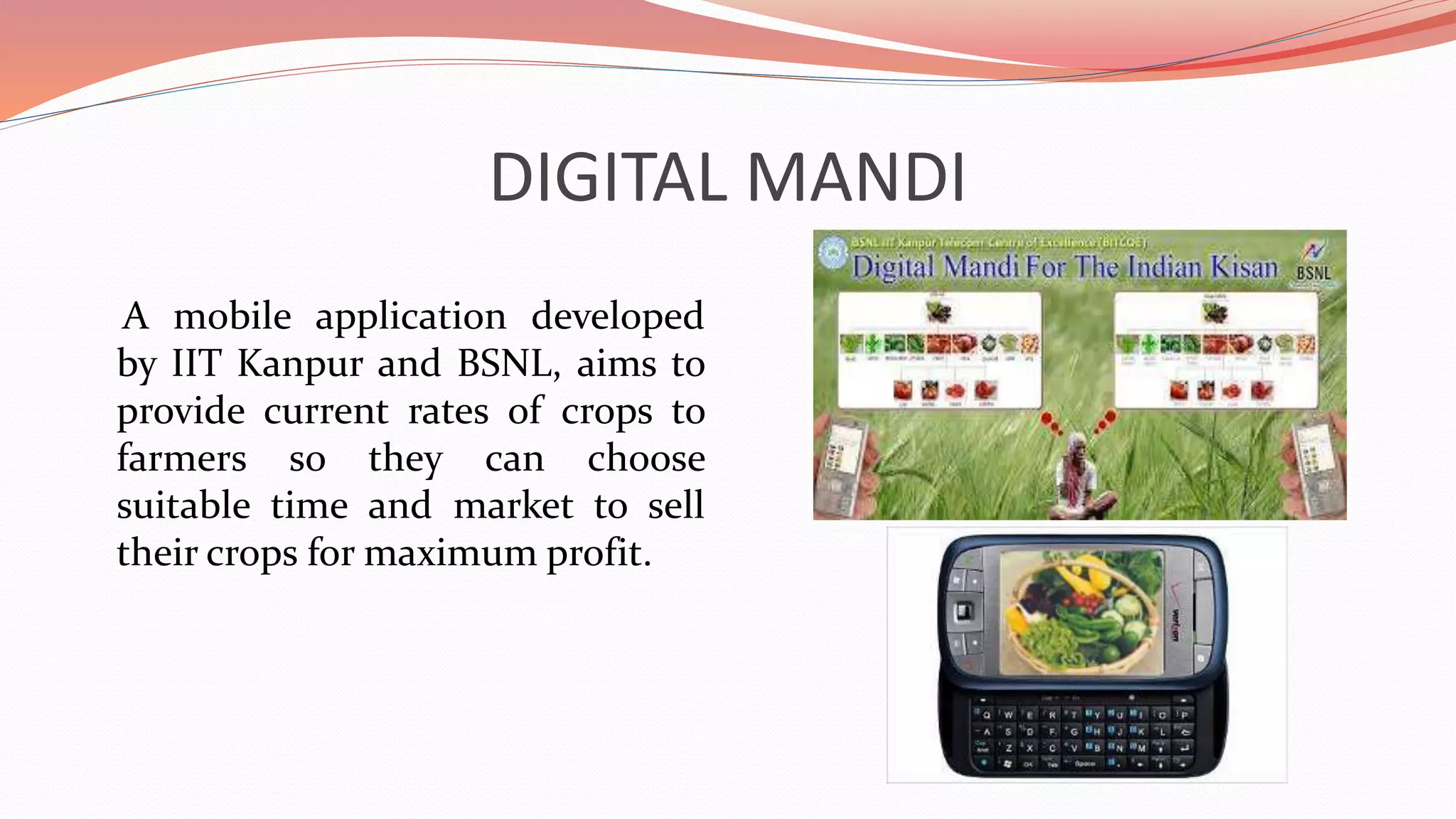
DIGITAL MANDI
A mobile application developed
by IIT Kanpur and BSNL, aims to
provide current rates of crops to
farmers so they can choose
suitable time and market to sell
their crops for maximum profit.
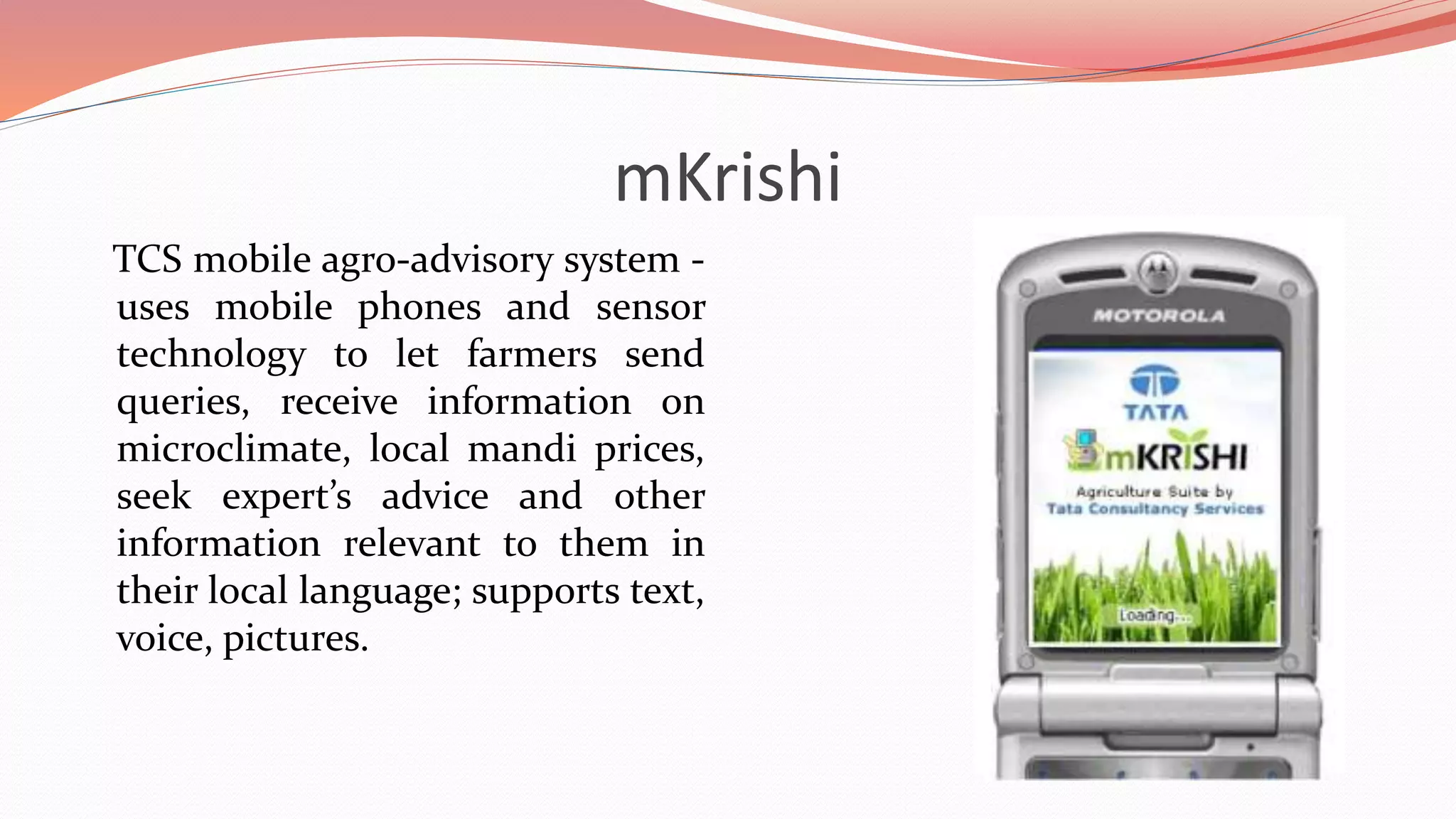
mKrishi
TCS mobile agro-advisory system -
uses mobile phones and sensor
technology to let farmers send
queries, receive information on
microclimate, local mandi prices,
seek expert’s advice and other
information relevant to them in
their local language; supports text,
voice, pictures.
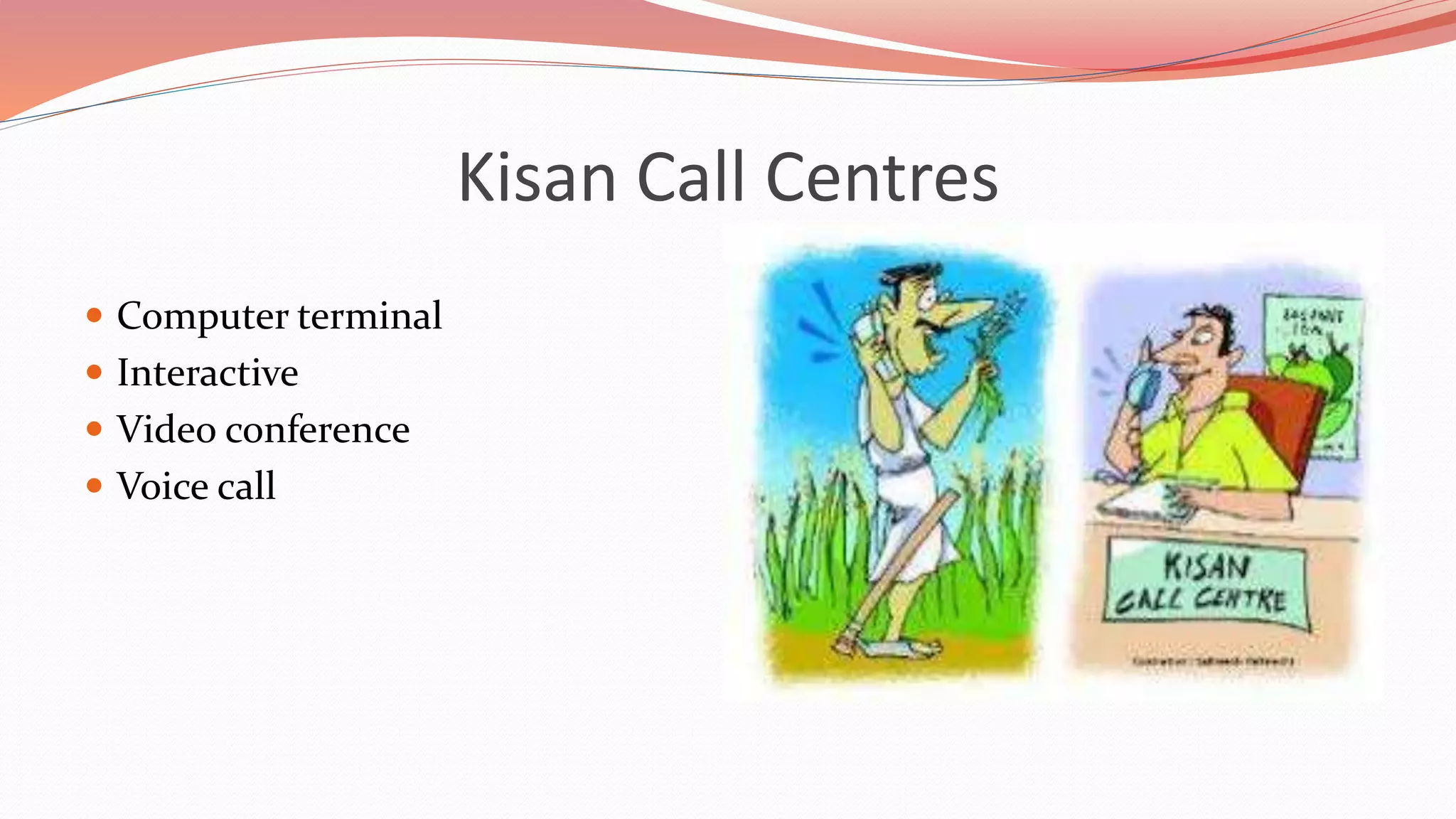
Kisan Call Centres
 Computer terminal
 Interactive
 Video conference
 Voice call
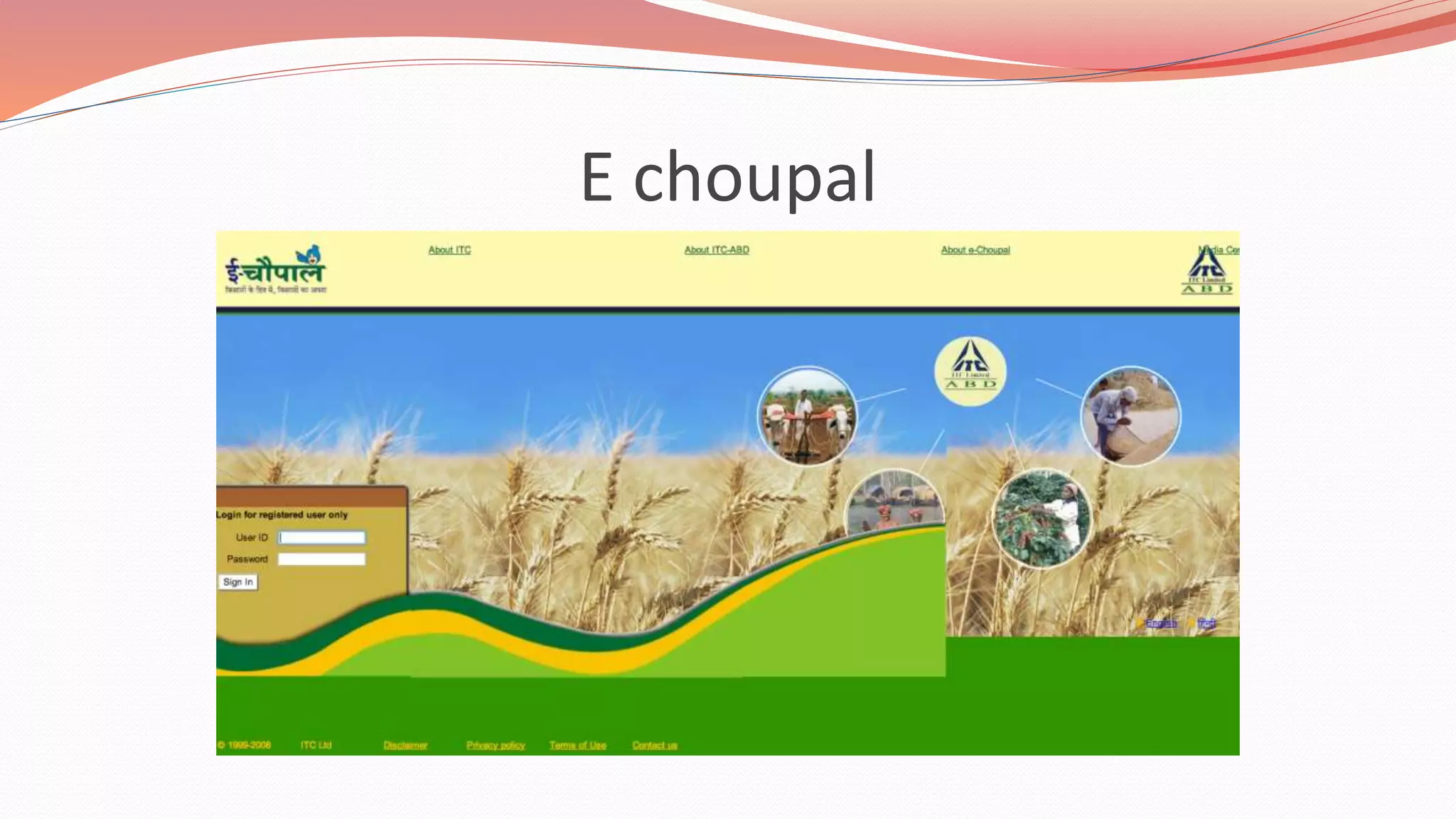
E choupal
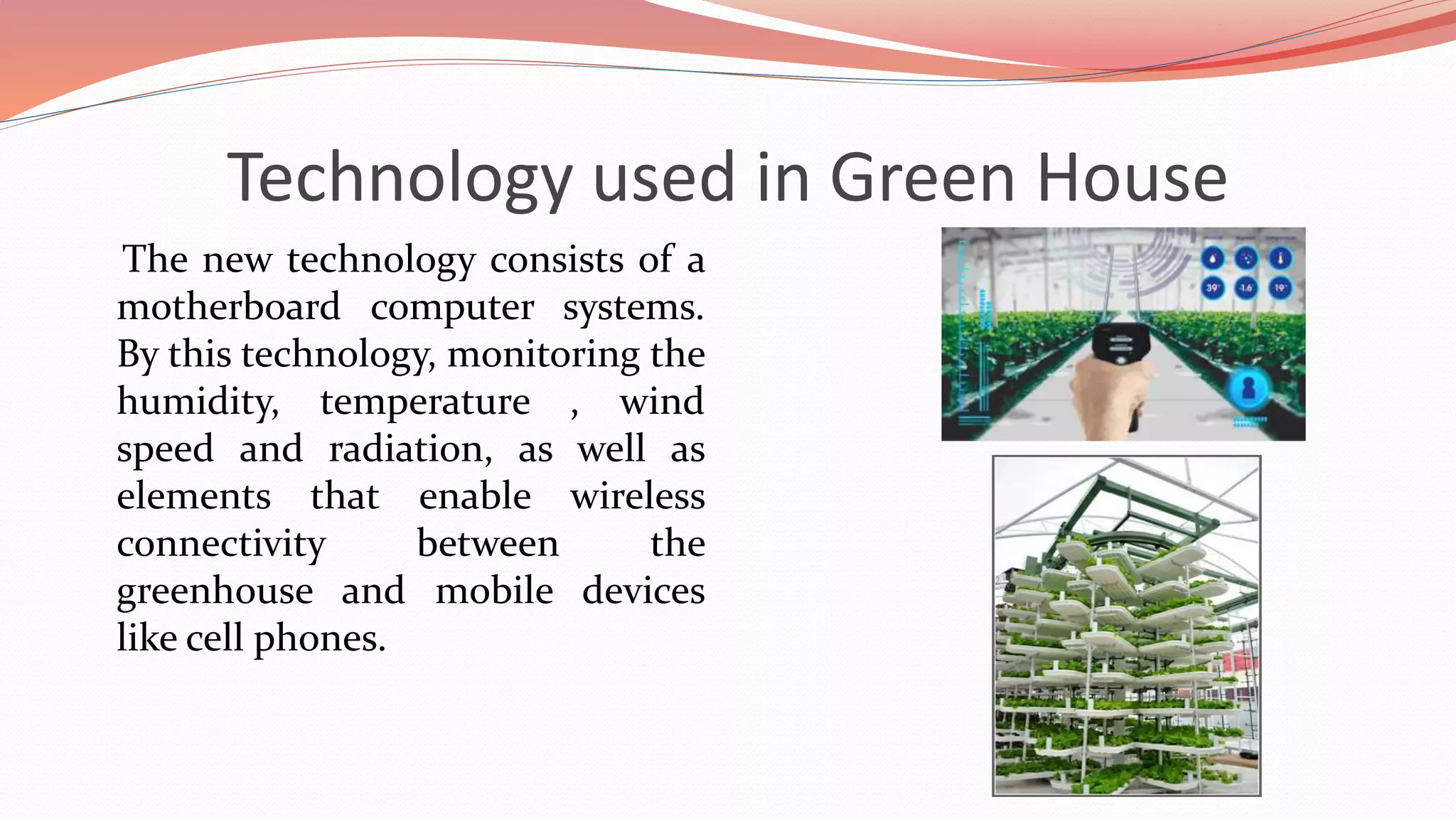
Technology used in Green House
The new technology consists of a
motherboard computer systems.
By this technology, monitoring the
humidity, temperature , wind
speed and radiation, as well as
elements that enable wireless
connectivity between the
greenhouse and mobile devices
like cell phones.
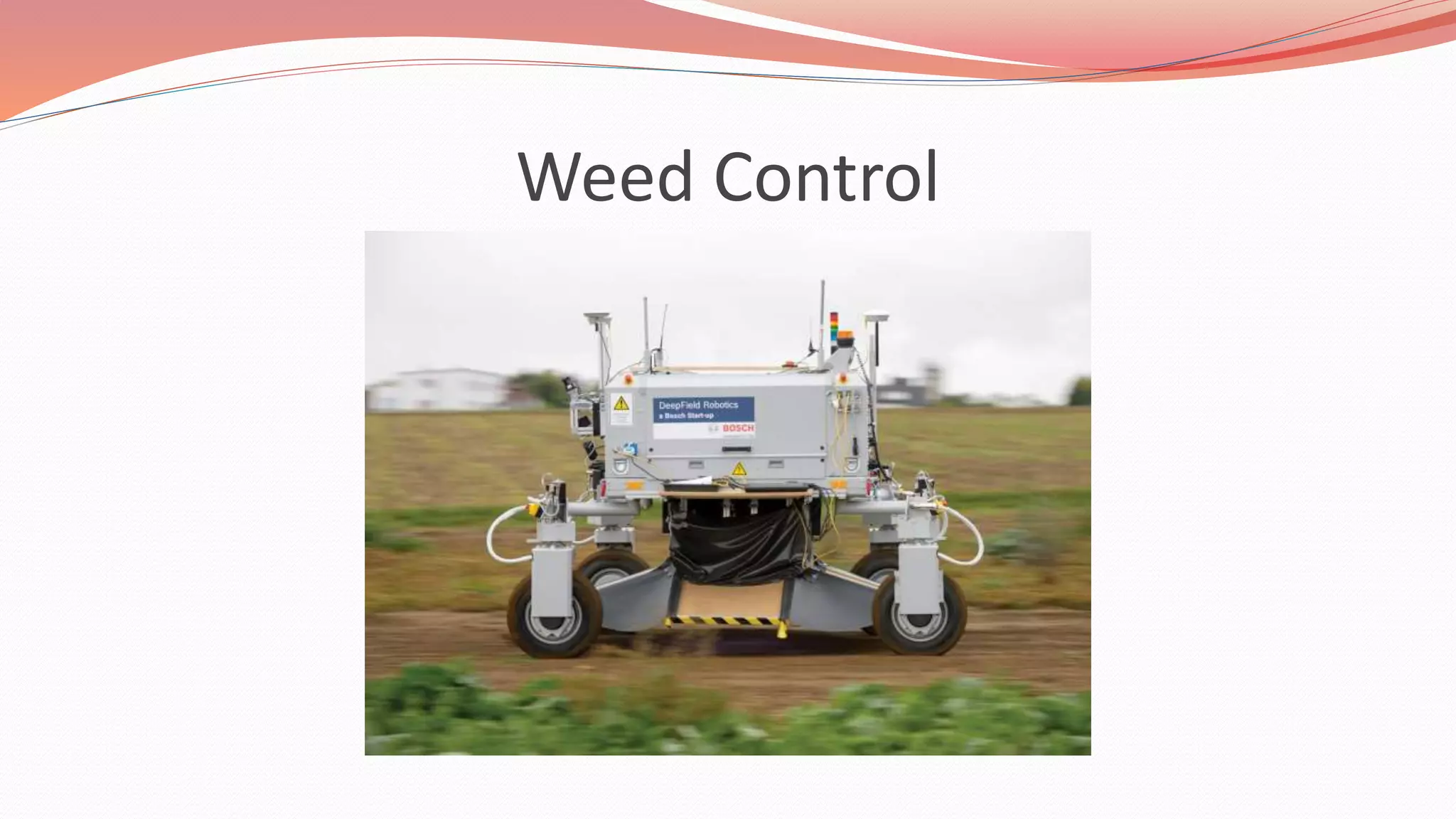
Weed Control
Use of GIS in Agriculture
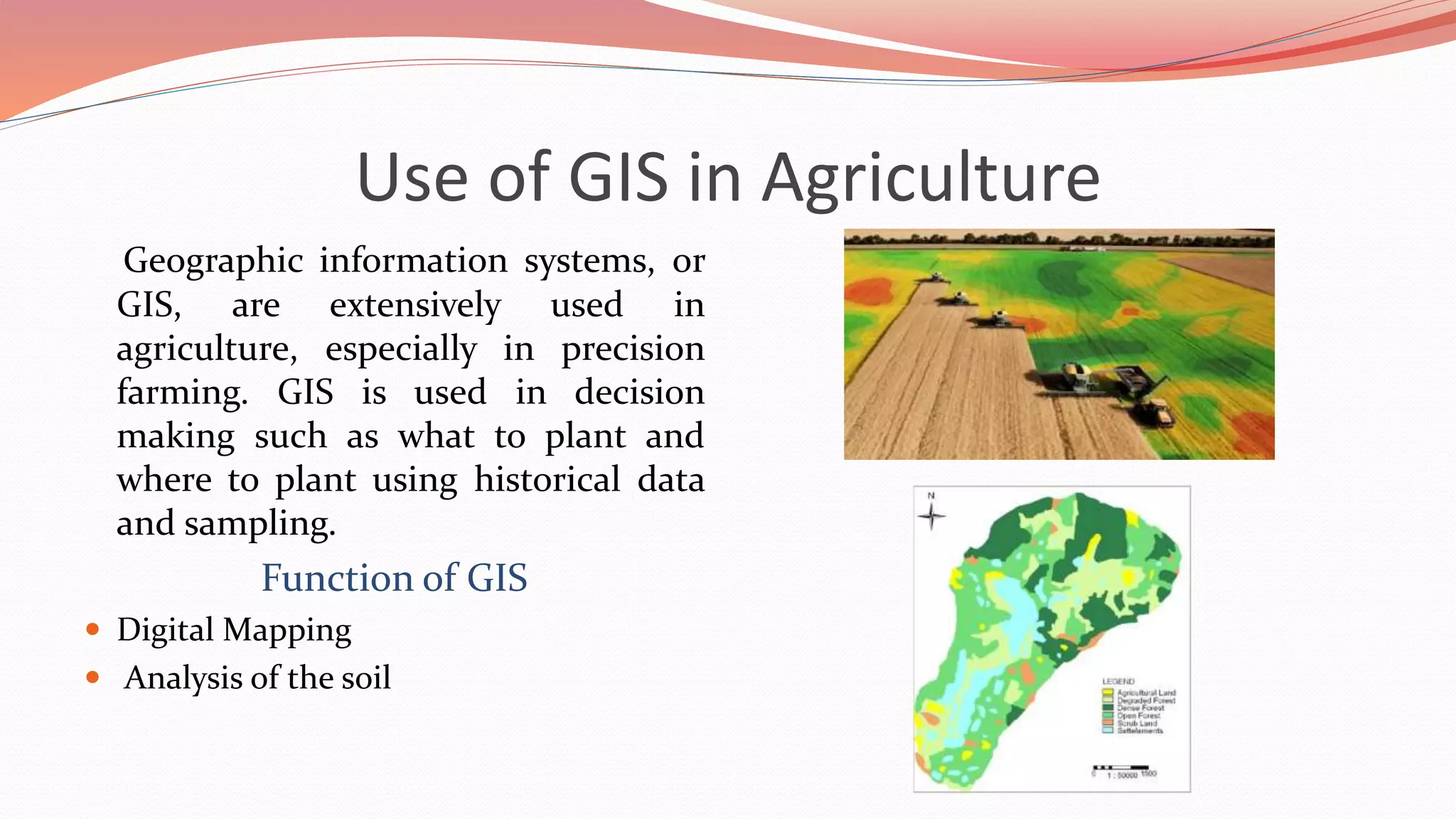
Geographic information systems, or
GIS, are extensively used in
agriculture, especially in precision
farming. GIS is used in decision
making such as what to plant and
where to plant using historical data
and sampling.
Function of GIS
 Digital Mapping
 Analysis of the soil
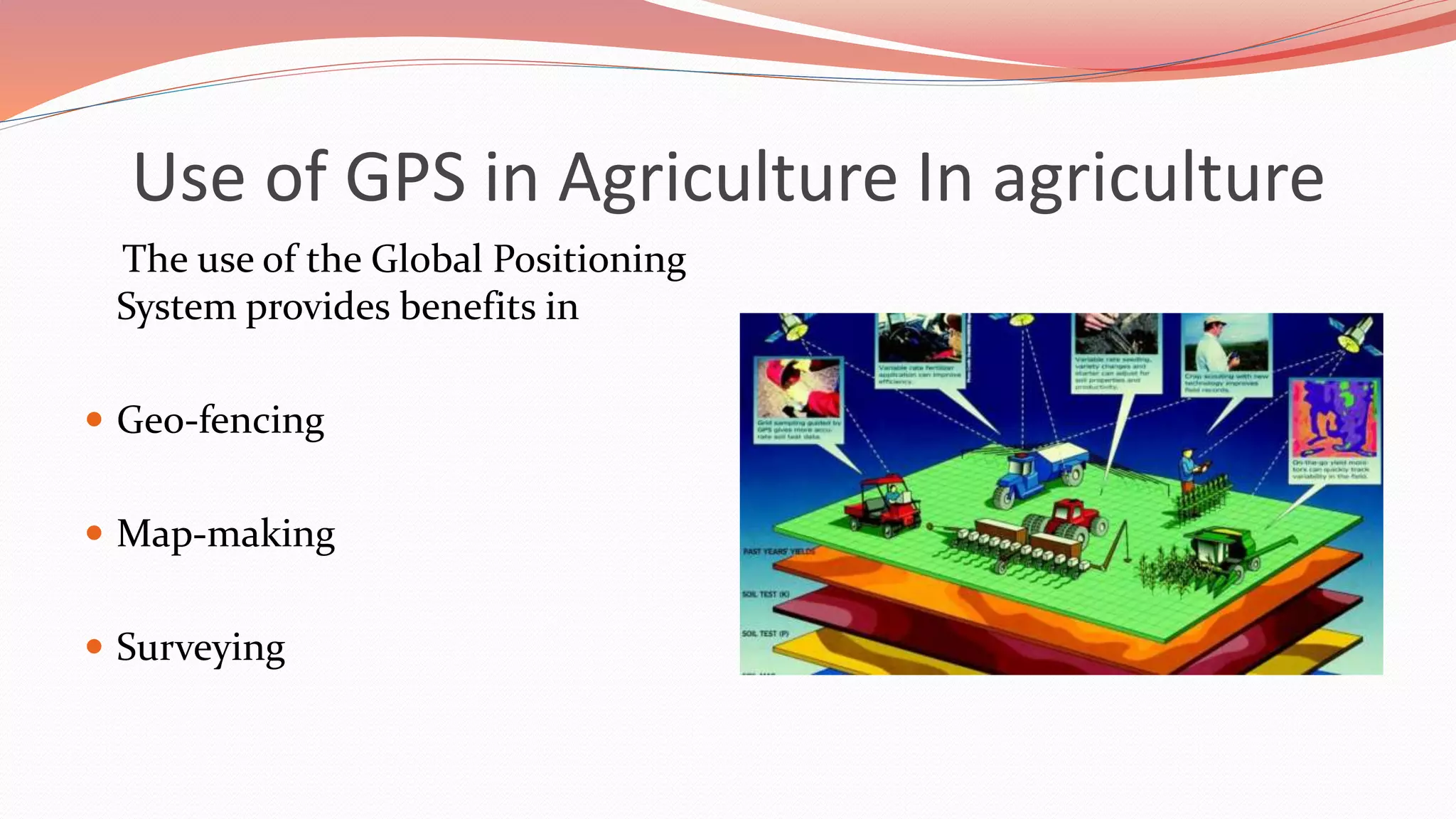
Use of GPS in Agriculture In agriculture
The use of the Global Positioning
System provides benefits in
 Geo-fencing
 Map-making
 Surveying
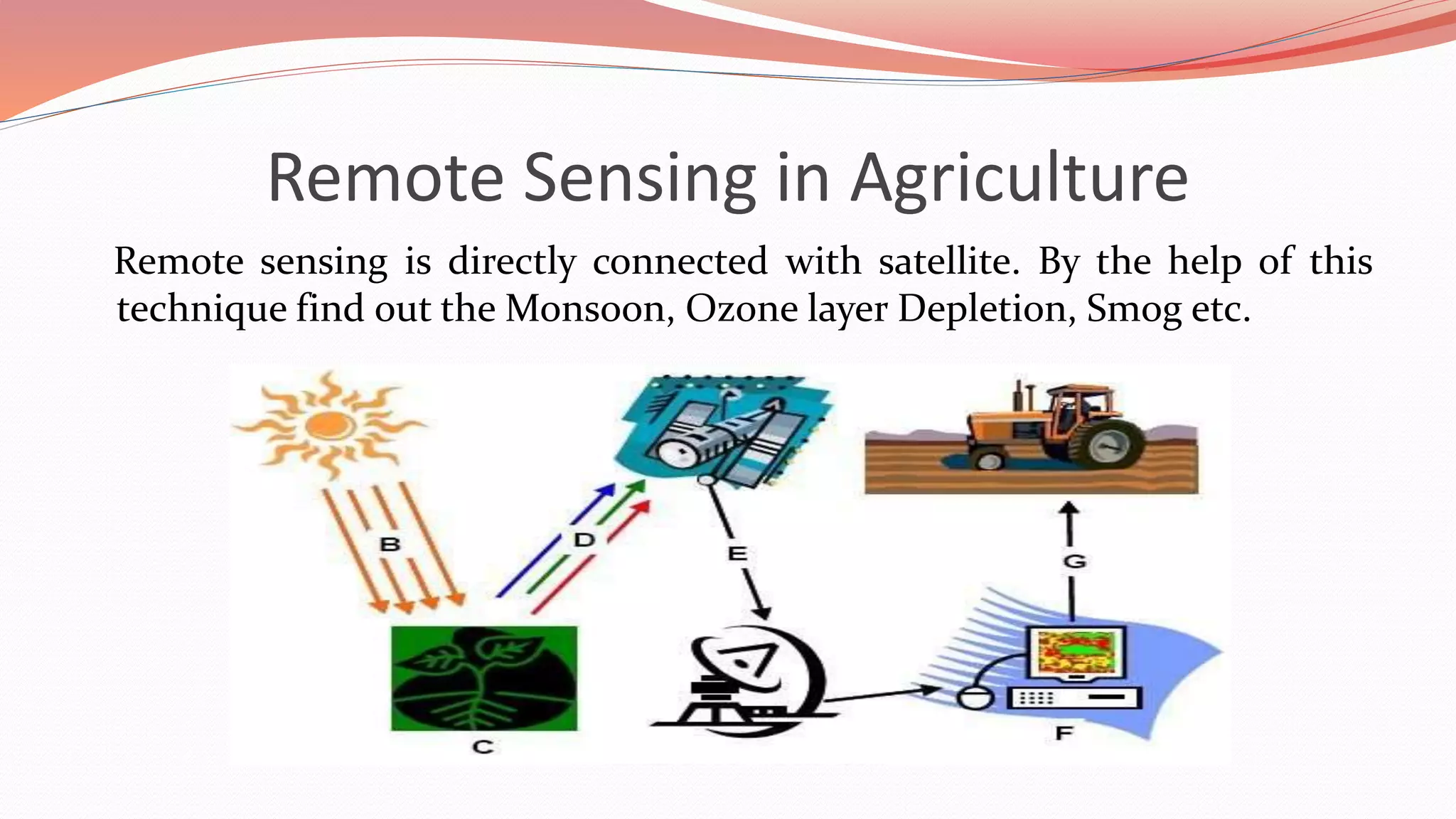
Remote Sensing in Agriculture
Remote sensing is directly connected with satellite. By the help of this
technique find out the Monsoon, Ozone layer Depletion, Smog etc.
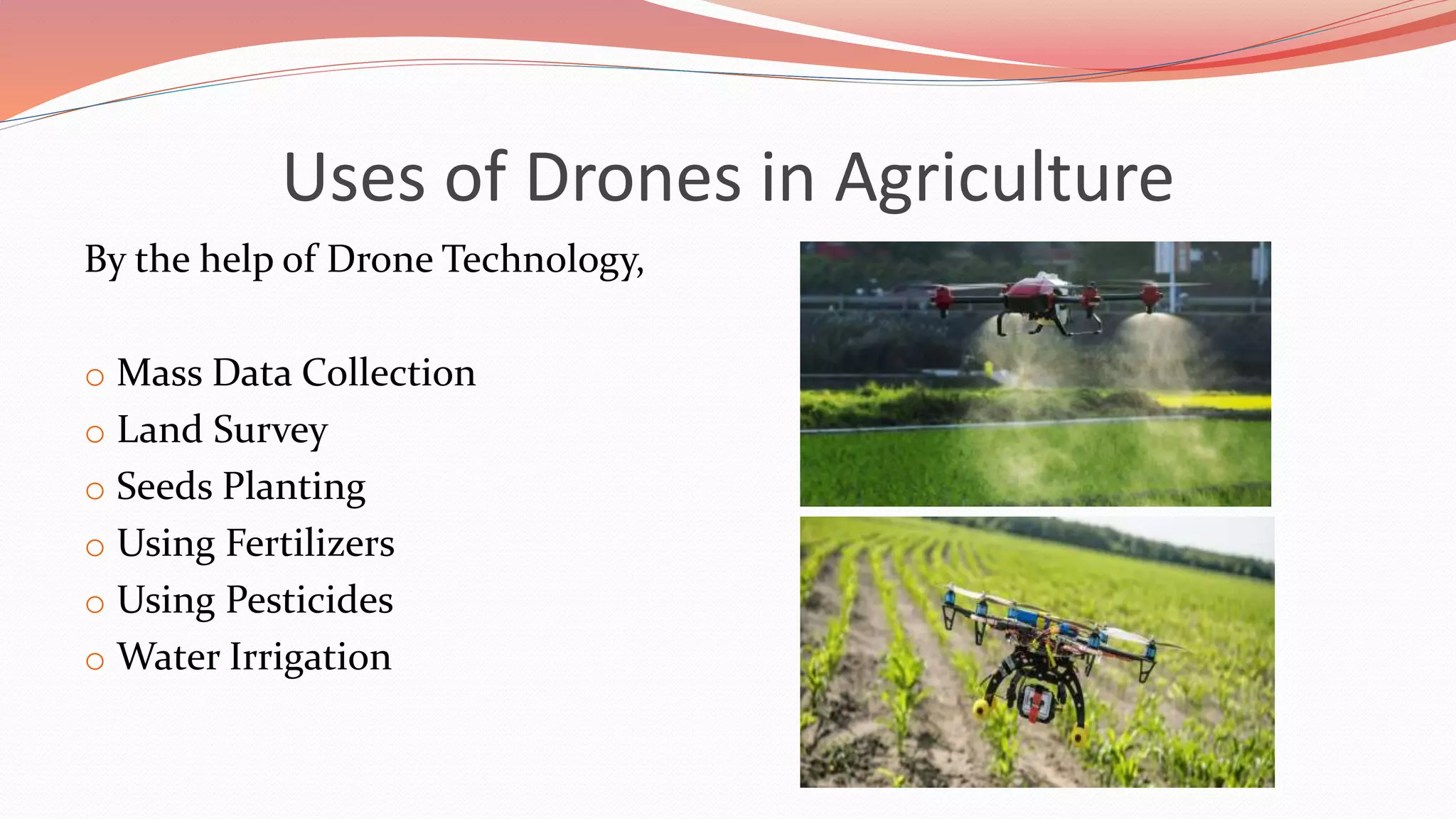
Uses of Drones in Agriculture
By the help of Drone Technology,
o Mass Data Collection
o Land Survey
o Seeds Planting
o Using Fertilizers
o Using Pesticides
o Water Irrigation
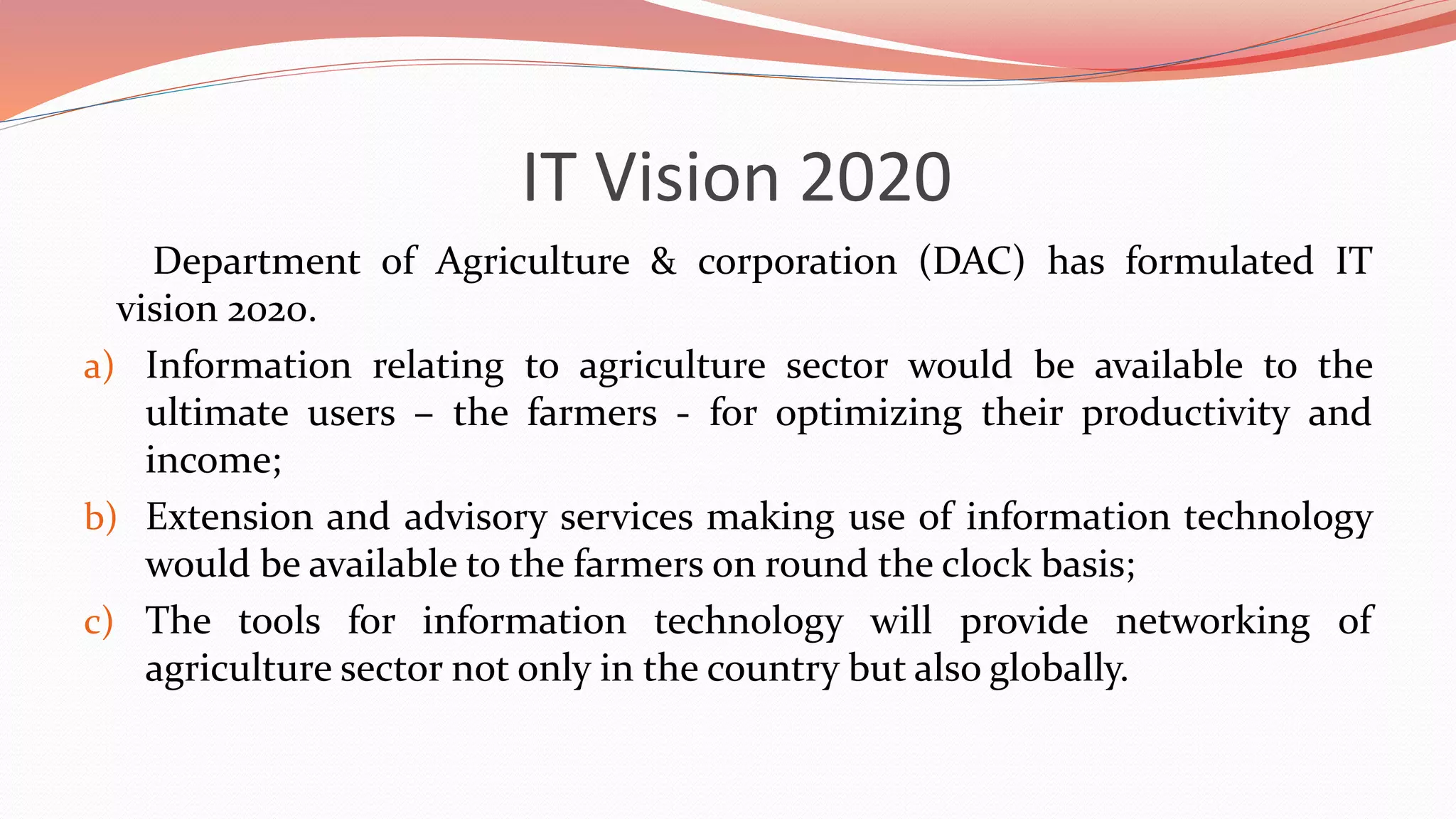
IT Vision 2020
Department of Agriculture & corporation (DAC) has formulated IT
vision 2020.
a) Information relating to agriculture sector would be available to the
ultimate users – the farmers - for optimizing their productivity and
income;
b) Extension and advisory services making use of information technology
would be available to the farmers on round the clock basis;
c) The tools for information technology will provide networking of
agriculture sector not only in the country but also globally.
Agri Advisory Services in India
 Ikisan
 E-Chopal
 Kisan Mitra
 Nokia Life Tools
 MRC, India
 Airtel
 TCS
 ICAR-KMAS
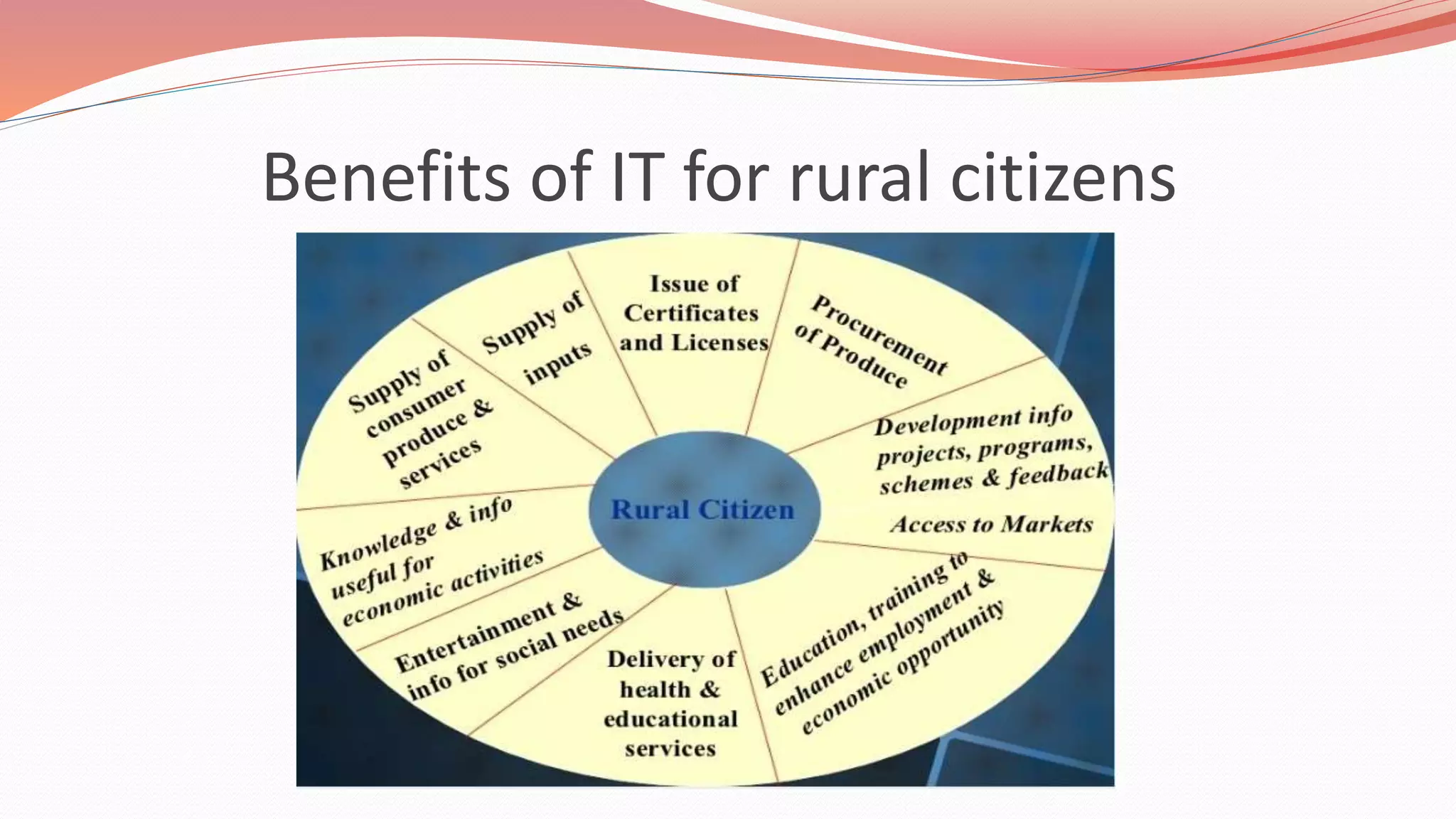
Benefits of IT for rural citizens
Impact of IT on education
 Projected growth in education : 24.4% today to 55.6%by 2020.
 Affordable, high quality education in rural areas.
 Confident, English speaking, computer literate students.
 Increased educational awareness in rural societies.
Impact of IT on healthcare
 Projected growth in healthcare : 24.2% today to 55.6% by 2020.
 Health care facilities was not good between the early 1950s and early
1980s.
 But now IT has improved health care through more timely diagnosis and
reduction of medical errors.
Case studies
 Case study 1 - Drishti BPO
 Case study 2 - NREGA
 Case study 3 – E- Seva
Drishti BPO
 Drishti is present in 5 states and is currently available in six districts.
 It is a private company which has the main work of developing the
modules for the poor section of the society.
 Currently, Drishti has over 100 rural internet kiosks in several states, run
by franchises according to a revenue sharing arrangement.
NREGA
 NREGA is an Indian job guarantee scheme enacted by legislation on
august 25, 2005.
 It promises work with minimum wages for all BPL individuals for a
minimum of 100 days a year.
 This project saw the rollout of new technologies like biometric
identification and handheld data devices.
E-Seva(Governance)
 It was initially implemented in West Godavari to deliver e-governance
facility.
 These are designed to provide better government services to rural people.
Challenges
 It lack relatable connectivity in rural areas.
 Poor literacy level.
 Farmers benefit more from simple technology, which communicates
information, which is relevant and easy to understand.
 Door delivery of information is limited by the fact that there are a very
large number of farm households and many families may not own radios
or television sets and may not have access to a daily newspaper.
CONCLUSION
 IT can improve farm management and farming technologies by efficient
farm management.
 IT helps in better marketing exposure and pricing and reduction of
agricultural risks and enhanced incomes.
Information Technology in Rural Development

Information Technology in Rural Development

  • 1.
    Ritabrata Sarkar; B.ScAg. 3rd year, Siksha “O” Anusandhan University
  • 2.
    Contents  Introduction  Roleof IT  Initiators of E-agriculture in India  Advantages of IT in Agriculture  Agricultural Tool  Weather Forecasting  Digital Mandi, mKrishi, Kisan call centres, E-choupal  Technology used in Green House  Weed Control  Use of GIS in Agriculture  Use of GPS in Agriculture  Uses of Drones in Agriculture  List of Agri Advisory Services in India  IT Vision 2020  Challenges
  • 3.
    Introduction  IT isthe branch of engineering that deals with the use of computers and telecommunication to retrieve, store and transmit information.  Information technology is potential tool for improving decision making in agriculture.  IT can improve farm management and farming technologies by efficient farm management.  The widespread use of IT to make a direct contribution to agricultural productivity.  Satellite technology, geographic information systems using the techniques of agronomy and soil science is to increase agricultural production.
  • 4.
    Role of ITin Agriculture in India  Farmers in India must use Information and Communication Technology (ICT) for agricultural purposes.  India’s food production and productivity can be increased by an effective use of IT for agricultural purposes.  The developed nations are using laser technology instead of tractors to plough lands. This helps in optimizing the use of various inputs such as water, seeds, fertilizers, etc.
  • 5.
    INITIATOR OF E-AGRICULTUREIN INDIA  The Association For People of Haryana (AFPOH) has taken many steps and initiatives at national and international level in the fields of agriculture, rural development etc.  As far as initiatives for e-agriculture in India are concerned, they have shared their research works and suggestions with national and international community.  They have also started an initiative titled e-agriculture in India that would endeavour to amalgamate ICT with agriculture in India.
  • 6.
    ADVANTAGES OF ITIN AGRICULTURE  The benefits of IT for the improvement and strengthening of agriculture sector in India include timely information on weather forecasts and calamities.  Better and spontaneous agricultural practices.  Better marketing exposure and pricing and reduction of agricultural risks and enhanced incomes.  Facility of online trading.  E-agriculture can play a major role in the increased food production and productivity in India.
  • 7.
    WEATHER FORCASTING Weather forecastingfind out the  Weather  Climate  Water Stresses
  • 8.
    DIGITAL MANDI A mobileapplication developed by IIT Kanpur and BSNL, aims to provide current rates of crops to farmers so they can choose suitable time and market to sell their crops for maximum profit.
  • 9.
    mKrishi TCS mobile agro-advisorysystem - uses mobile phones and sensor technology to let farmers send queries, receive information on microclimate, local mandi prices, seek expert’s advice and other information relevant to them in their local language; supports text, voice, pictures.
  • 10.
    Kisan Call Centres Computer terminal  Interactive  Video conference  Voice call
  • 11.
  • 12.
    Technology used inGreen House The new technology consists of a motherboard computer systems. By this technology, monitoring the humidity, temperature , wind speed and radiation, as well as elements that enable wireless connectivity between the greenhouse and mobile devices like cell phones.
  • 13.
  • 14.
    Use of GISin Agriculture Geographic information systems, or GIS, are extensively used in agriculture, especially in precision farming. GIS is used in decision making such as what to plant and where to plant using historical data and sampling. Function of GIS  Digital Mapping  Analysis of the soil
  • 15.
    Use of GPSin Agriculture In agriculture The use of the Global Positioning System provides benefits in  Geo-fencing  Map-making  Surveying
  • 16.
    Remote Sensing inAgriculture Remote sensing is directly connected with satellite. By the help of this technique find out the Monsoon, Ozone layer Depletion, Smog etc.
  • 17.
    Uses of Dronesin Agriculture By the help of Drone Technology, o Mass Data Collection o Land Survey o Seeds Planting o Using Fertilizers o Using Pesticides o Water Irrigation
  • 18.
    IT Vision 2020 Departmentof Agriculture & corporation (DAC) has formulated IT vision 2020. a) Information relating to agriculture sector would be available to the ultimate users – the farmers - for optimizing their productivity and income; b) Extension and advisory services making use of information technology would be available to the farmers on round the clock basis; c) The tools for information technology will provide networking of agriculture sector not only in the country but also globally.
  • 19.
    Agri Advisory Servicesin India  Ikisan  E-Chopal  Kisan Mitra  Nokia Life Tools  MRC, India  Airtel  TCS  ICAR-KMAS
  • 20.
    Benefits of ITfor rural citizens
  • 21.
    Impact of ITon education  Projected growth in education : 24.4% today to 55.6%by 2020.  Affordable, high quality education in rural areas.  Confident, English speaking, computer literate students.  Increased educational awareness in rural societies.
  • 22.
    Impact of ITon healthcare  Projected growth in healthcare : 24.2% today to 55.6% by 2020.  Health care facilities was not good between the early 1950s and early 1980s.  But now IT has improved health care through more timely diagnosis and reduction of medical errors.
  • 23.
    Case studies  Casestudy 1 - Drishti BPO  Case study 2 - NREGA  Case study 3 – E- Seva
  • 24.
    Drishti BPO  Drishtiis present in 5 states and is currently available in six districts.  It is a private company which has the main work of developing the modules for the poor section of the society.  Currently, Drishti has over 100 rural internet kiosks in several states, run by franchises according to a revenue sharing arrangement.
  • 25.
    NREGA  NREGA isan Indian job guarantee scheme enacted by legislation on august 25, 2005.  It promises work with minimum wages for all BPL individuals for a minimum of 100 days a year.  This project saw the rollout of new technologies like biometric identification and handheld data devices.
  • 26.
    E-Seva(Governance)  It wasinitially implemented in West Godavari to deliver e-governance facility.  These are designed to provide better government services to rural people.
  • 27.
    Challenges  It lackrelatable connectivity in rural areas.  Poor literacy level.  Farmers benefit more from simple technology, which communicates information, which is relevant and easy to understand.  Door delivery of information is limited by the fact that there are a very large number of farm households and many families may not own radios or television sets and may not have access to a daily newspaper.
  • 28.
    CONCLUSION  IT canimprove farm management and farming technologies by efficient farm management.  IT helps in better marketing exposure and pricing and reduction of agricultural risks and enhanced incomes.