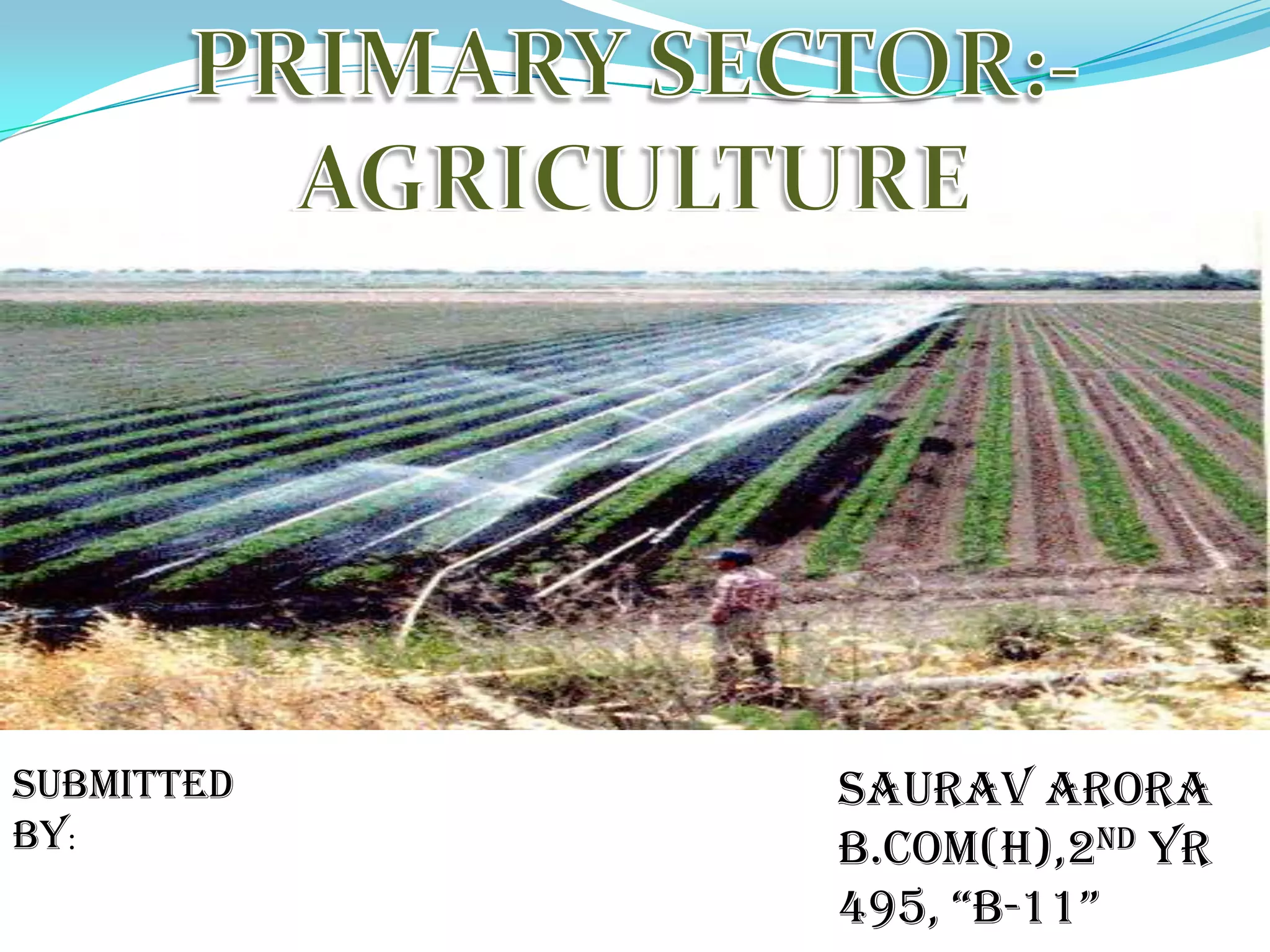
PRIMARY SECTOR:-AGRICULTURESubmitted by:SAURAV ARORAB.COM(H),2ND YR495, “B-11”
INTRODUCTION :-The Primary sector of the economy is the change of natural resources into primary products.
Most products from this sector provides raw materials for other industries.
 Major businesses in this sector are agriculture, agribusiness, fishing, forestry, all mining and quarrying industries. AGRICULTURE :-Agriculture in India is the major sector of its economy.
 These sectors provide employment to 60% of the country’s total population.
 About 43% of the country’s total geographical area is used for agricultural purposes.
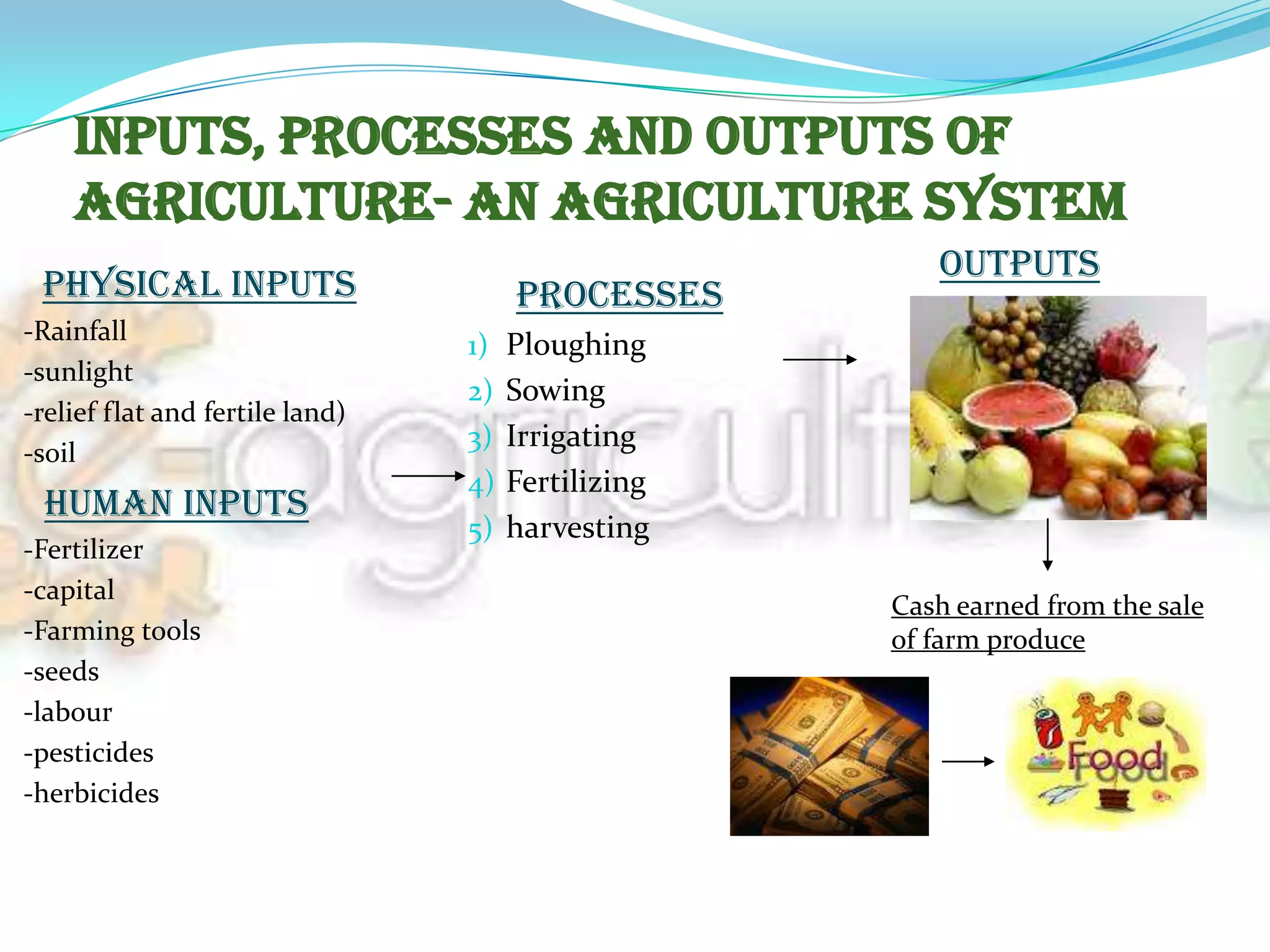
 Almost two-thirds of the total work-force earns their livelihood though farming and other allied sectors like forestry, logging and fishing which account 18% of the GDP.Inputs, processes and outputs of Agriculture- an agriculture systemOUTPUTSPHYSICAL INPUTS-Rainfall-sunlight-relief flat and fertile land)-soilHUMAN INPUTS-Fertilizer-capital-Farming tools-seeds-labour-pesticides-herbicidesPROCESSESPloughingSowingIrrigatingFertilizingharvestingCash earned from the sale of farm produce
Thepresent state of AGRICULTURE IN INDIAThe agricultural sector in India is currently passing through a difficult phase. India is moving towards an agricultural emergency due to lack of attention, insufficient land reforms, defective land management, non-providing of fair prices to farmers for their crops, inadequate investment in irrigational and agricultural infrastructure in India, etc. India’s food production and productivity is declining while its food consumption is increasing.
IT/E-AGRICULTURE IN INDIA :-Farmers in India must use Information and Information Technology (ICT) for agricultural purposes.
India’s food production and productivity can be increased by an effective use of IT for agricultural purposes.
The developed nations are using laser technology instead of tractors to plough lands. This helps in optimising the use of various inputs such as water, seeds, fertilisers, etc POTENTIAL OF IT IN AGRICULTUREThe agriculture scenario all over the world is undergoing a rapid change particularly after WTO agreements came into existence. In the context of agriculture, the potential of IT can be assessed broadly under two heads:As a tool for direct contribution to agriculture productivity, As an indirect tool for empowering farmers  to take informed and quality decisions which will have positive impact on the way agriculture and allied activities are conducted.
contd…IT can initiate new agriculture and rural business such as e-commerce, real estate business for satellite offices, rural tourism, etc. IT can improve farm management and farming technologies by efficient farm management.	Hence, IT can take an important and key role for industrialization of farming or farm business enterprises, combining the above role.
IT for Agriculture production and Marketing:	IT is playing an important and vital role in agricultural production and marketing. In order to take the real status of agricultural production and marketing, there is an urgent need to develop the following items:Farmers’ crop database should be managed. The database includes the kinds of crops, the size of cultivated area, time of harvest and yield.Crops information service should be created.Production techniques and information inquiry system should be created.
IT Vision 2020:Department of Agriculture & corporation (DAC) has formulated IT vision 2020. This vision inter-alia envisages that:a) Information relating to agriculture sector would be available to the ultimate users – the farmers - for optimizing their productivity and income;b) Extension and advisory services making use of information technology would be available to the farmers on round the clock basis;c) The tools for information technology will provide networking of agriculture sector not only in the country but also globally
Hurdles in IT-use :-The problem is that Indian farmers cannot afford latest technology and unless government comes in support for agricultural infrastructure, the same remains a dream only.
Further, power and electricity also remains a major problem for Indian farmers and alternative means of power like solar energy panels, regulated and optimised by ICT, can be a blessing for them.
 Thus, e-agriculture in India can put India on the higher pedestal of Green Revolution making India self-sufficient in the matters of food grains. INITIATERS OF E-AGRICULTURE IN INDIA The Association For People of Haryana (AFPOH) has taken many steps and initiatives at national and international level in the fields of agriculture, health, rural infrastructure development, revitalizing financial access to rural farmers, etc.
 As far as initiatives for e-agriculture in India are concerned, they have shared their research works and suggestions with national and international community.

AGRICULTURE & IT (e-commerce)

  • 1.
    PRIMARY SECTOR:-AGRICULTURESubmitted by:SAURAVARORAB.COM(H),2ND YR495, “B-11”
  • 2.
    INTRODUCTION :-The Primarysector of the economy is the change of natural resources into primary products.
  • 3.
    Most products fromthis sector provides raw materials for other industries.
  • 4.
    Major businessesin this sector are agriculture, agribusiness, fishing, forestry, all mining and quarrying industries. AGRICULTURE :-Agriculture in India is the major sector of its economy.
  • 5.
    These sectorsprovide employment to 60% of the country’s total population.
  • 6.
    About 43%of the country’s total geographical area is used for agricultural purposes.
  • 7.
    Almost two-thirdsof the total work-force earns their livelihood though farming and other allied sectors like forestry, logging and fishing which account 18% of the GDP.Inputs, processes and outputs of Agriculture- an agriculture systemOUTPUTSPHYSICAL INPUTS-Rainfall-sunlight-relief flat and fertile land)-soilHUMAN INPUTS-Fertilizer-capital-Farming tools-seeds-labour-pesticides-herbicidesPROCESSESPloughingSowingIrrigatingFertilizingharvestingCash earned from the sale of farm produce
  • 8.
    Thepresent state ofAGRICULTURE IN INDIAThe agricultural sector in India is currently passing through a difficult phase. India is moving towards an agricultural emergency due to lack of attention, insufficient land reforms, defective land management, non-providing of fair prices to farmers for their crops, inadequate investment in irrigational and agricultural infrastructure in India, etc. India’s food production and productivity is declining while its food consumption is increasing.
  • 9.
    IT/E-AGRICULTURE IN INDIA:-Farmers in India must use Information and Information Technology (ICT) for agricultural purposes.
  • 10.
    India’s food productionand productivity can be increased by an effective use of IT for agricultural purposes.
  • 11.
    The developed nationsare using laser technology instead of tractors to plough lands. This helps in optimising the use of various inputs such as water, seeds, fertilisers, etc POTENTIAL OF IT IN AGRICULTUREThe agriculture scenario all over the world is undergoing a rapid change particularly after WTO agreements came into existence. In the context of agriculture, the potential of IT can be assessed broadly under two heads:As a tool for direct contribution to agriculture productivity, As an indirect tool for empowering farmers to take informed and quality decisions which will have positive impact on the way agriculture and allied activities are conducted.
  • 12.
    contd…IT can initiatenew agriculture and rural business such as e-commerce, real estate business for satellite offices, rural tourism, etc. IT can improve farm management and farming technologies by efficient farm management. Hence, IT can take an important and key role for industrialization of farming or farm business enterprises, combining the above role.
  • 13.
    IT for Agricultureproduction and Marketing: IT is playing an important and vital role in agricultural production and marketing. In order to take the real status of agricultural production and marketing, there is an urgent need to develop the following items:Farmers’ crop database should be managed. The database includes the kinds of crops, the size of cultivated area, time of harvest and yield.Crops information service should be created.Production techniques and information inquiry system should be created.
  • 14.
    IT Vision 2020:Departmentof Agriculture & corporation (DAC) has formulated IT vision 2020. This vision inter-alia envisages that:a) Information relating to agriculture sector would be available to the ultimate users – the farmers - for optimizing their productivity and income;b) Extension and advisory services making use of information technology would be available to the farmers on round the clock basis;c) The tools for information technology will provide networking of agriculture sector not only in the country but also globally
  • 15.
    Hurdles in IT-use:-The problem is that Indian farmers cannot afford latest technology and unless government comes in support for agricultural infrastructure, the same remains a dream only.
  • 16.
    Further, power andelectricity also remains a major problem for Indian farmers and alternative means of power like solar energy panels, regulated and optimised by ICT, can be a blessing for them.
  • 17.
    Thus, e-agriculturein India can put India on the higher pedestal of Green Revolution making India self-sufficient in the matters of food grains. INITIATERS OF E-AGRICULTURE IN INDIA The Association For People of Haryana (AFPOH) has taken many steps and initiatives at national and international level in the fields of agriculture, health, rural infrastructure development, revitalizing financial access to rural farmers, etc.
  • 18.
    As faras initiatives for e-agriculture in India are concerned, they have shared their research works and suggestions with national and international community.
  • 19.
    They have alsostarted an initiative titled e-agriculture in India that would endeavor to amalgamate ICT with agriculture in India. About AFPOH :- AFPOH is a social initiative by an association of people who are working in the direction of empowering the marginalized and deprived people in rural and other areas.
  • 20.
    The area ofoperation of AFPOH covers segments like agriculture, health, banking, finance and insurance, education, rural infrastructure development, power, etc.
  • 21.
    AFPOH has strengthenedthe use of IT in agriculture by extending support for legal and regulatory measure that farmers and other people may face in various situations. AFPOH using ICT for its mission and objectivesAFPOH is working in the direction of use of ICT for communication and sharing of views, expertise, suggestions, problems, etc at national and international level.
  • 22.
    AFPOH intends toprovide a ‘voice’ to the marginalised and deprived segment so that national and international communities can coordinate and collaborate their empowerment initiatives.
  • 23.
    Concepts like e-agriculture,e-health, e-learning, e-commerce, e-banking, etc are also some of the initiatives that are in the process of implementation by AFPOH.ADVANTAGES OF IT/ E-AGRICULTURE:- The benefits of IT for the improvement and strengthening of agriculture sector in India include timely information on weather forecasts and calamities.
  • 24.
    Better and spontaneousagricultural practices,
  • 25.
  • 26.
    Reduction of agriculturalrisks and enhanced incomes.
  • 27.
  • 28.
  • 29.
    Facility of onlinetrading and e-commerce.
  • 30.
    Better representation atvarious forums, authorities and platform.
  • 31.
    E-agriculture canplay a major role in the increased food production and productivity in India. IT and Indian Agriculture in the Future:User friendly systems, particularly with content in local languages, can generate interest in the farmers and others working at the grassroots. It is possible to create dedicated networks or harness the power of Internet to make these services are available to all parts of the country.Our country has the advantage of having a large number of specialized institutions in place catering to various aspects of Indian agriculture. These institutions can play a crucial role in designing the aspects of Indian agriculture. These institutions can play a crucial role in designing the necessary applications & databases and services.
  • 32.
    Cond…In the postWTO regime, it is suggested that it is useful to focus more on some agricultural products to maintain an unquestionable competitive advantage for exports.This will call for urgent measures to introduce state of the art technologies such as remote sensing, geographical information systems (GIS), bio-engineering, etc. India has made rapid strides in satellite technologies.
  • 33.