Cloud Computing In Agriculture
Presented By: Ankita Solanki
Reg. No. : 06-0025-2015
Sem:3rd
Guide By: Dharmesh K. Vyas
College of Agricultural Information Technology,AAU,ANAND
Introduction
 Cloud computing is a kind of Internet-based computing
that provides shared processing resources and data to
computers and other devices on demand.
 In recent years, new ICT technologies are being
implemented in every sector of the developing nations
and development of focused on the Indian agricultural
sector. That new application domain of ICT is Cloud
Computing.
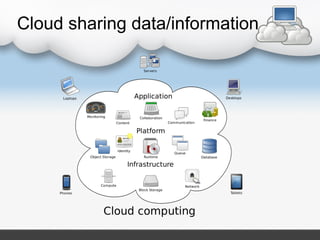
Cloud sharing data/information
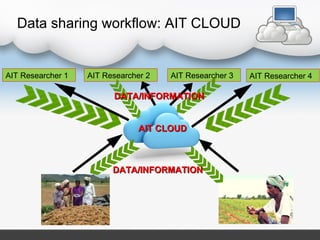
Data sharing workflow: AIT CLOUD
AIT Researcher 1 AIT Researcher 2 AIT Researcher 3 AIT Researcher 4
DATA/INFORMATIONDATA/INFORMATION
AIT CLOUDAIT CLOUD
Types Of Clouds
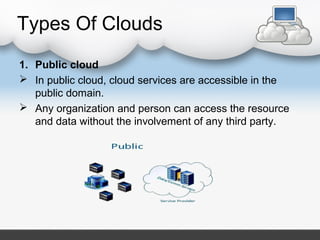
1. Public cloud
 In public cloud, cloud services are accessible in the
public domain.
 Any organization and person can access the resource
and data without the involvement of any third party.
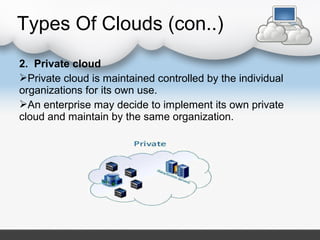
2. Private cloud
Private cloud is maintained controlled by the individual
organizations for its own use.
An enterprise may decide to implement its own private
cloud and maintain by the same organization.
Types Of Clouds (con..)
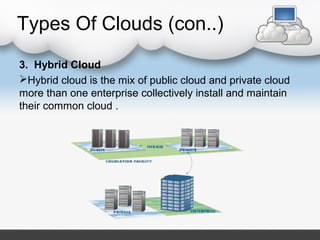
3. Hybrid Cloud
Hybrid cloud is the mix of public cloud and private cloud
more than one enterprise collectively install and maintain
their common cloud .
Types Of Clouds (con..)
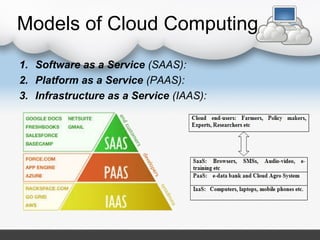
1. Software as a Service (SAAS):
2. Platform as a Service (PAAS):
3. Infrastructure as a Service (IAAS):
Models of Cloud Computing
 On demand self-provisioning of resources
 Reduce costs
 Green Technology
 High performance
 Users not concerned with upgrading and maintenance
 Fast deployment
 Pool of service providers
Significant Features
Case Study
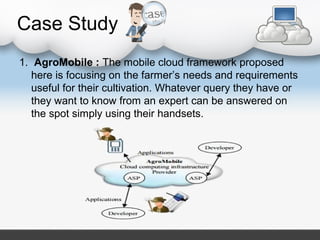
1. AgroMobile : The mobile cloud framework proposed
here is focusing on the farmer’s needs and requirements
useful for their cultivation. Whatever query they have or
they want to know from an expert can be answered on
the spot simply using their handsets.
Case Study (con..)
 Features of Agro Mobile
 Multi-functional software to serve farmers to get the detailed information about
crops and their diseases and causes.
 Interactive learning service to put there question and get reply spontaneously
whatever wherever on time. And there is no limitation of language(s).
 A multi-lingual services.
 All forms of learning such as audio and video lectures for illiterate farmers of
India.
• It can act as a real-time question answering service too.
 Functionalities provided:
 Crop advice and analysis
 Weather forecasting
 Simulations for disease analysis etc.
Case Study (con..)
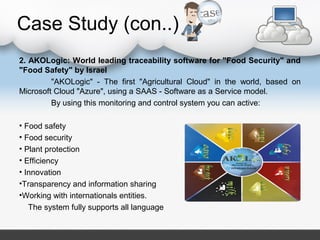
2. AKOLogic: World leading traceability software for "Food Security" and
"Food Safety" by Israel
"AKOLogic" - The first "Agricultural Cloud" in the world, based on
Microsoft Cloud "Azure", using a SAAS - Software as a Service model.
By using this monitoring and control system you can active:
• Food safety
• Food security
• Plant protection
• Efficiency
• Innovation
•Transparency and information sharing
•Working with internationals entities.
The system fully supports all language
Case Study (con..)
3. Cloud Computing to Control Automatic Irrigation Systems
This system uses an ethernet module to provide
the microcontroller an interface for internet
connection. The Ethernet module has been
mapped with a cloud connector Near-Bus
[an open source cloud connector] which allows
us to integrate our MCU [microcontroller unit]
platform with cloud.
4. Land record automation:
Cloud computing storage facility store the record of land with the
description related to that particular land like soil analysis result and production
history etc.
Cloud computing ?
 Easy Data Management
 Easy and anytime data readiness
 Local and global communication
 Motivation to farmers and researchers
 Secure and reliable
 Reduction of technical issues like man power,
infrastructures etc.
Cloud computing’s pitfalls
 Requires a Constant Internet Connection
 Doesn’t Work Well with Low-Speed Connections
 Can Be Slow
 If the Cloud Loses Your Data, You’re screwed.
Future Scope
 Store and maintain a database for the information
generated in daily farming activities.
 Weather forecasting and related information.
 Database for crop specific all the information with
different parameters.
 Database for market related information like Price,
Season, market surplus etc.
 Database for production related data.
 Database for various agricultural tools related
information.
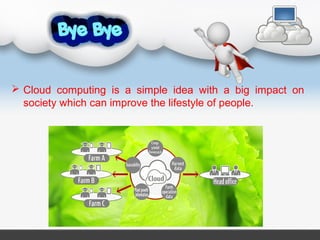
 Cloud computing is a simple idea with a big impact on
society which can improve the lifestyle of people.
Working of Cloud Computing
Reference: https://www.youtube.com/watch?v=gu4FYSFeWqg
Cloud computing in Agriculture

Cloud computing in Agriculture

  • 1.
    Cloud Computing InAgriculture Presented By: Ankita Solanki Reg. No. : 06-0025-2015 Sem:3rd Guide By: Dharmesh K. Vyas College of Agricultural Information Technology,AAU,ANAND
  • 2.
    Introduction  Cloud computingis a kind of Internet-based computing that provides shared processing resources and data to computers and other devices on demand.  In recent years, new ICT technologies are being implemented in every sector of the developing nations and development of focused on the Indian agricultural sector. That new application domain of ICT is Cloud Computing.
  • 3.
  • 4.
    Data sharing workflow:AIT CLOUD AIT Researcher 1 AIT Researcher 2 AIT Researcher 3 AIT Researcher 4 DATA/INFORMATIONDATA/INFORMATION DATA/INFORMATIONDATA/INFORMATION AIT CLOUDAIT CLOUD
  • 5.
    Types Of Clouds 1.Public cloud  In public cloud, cloud services are accessible in the public domain.  Any organization and person can access the resource and data without the involvement of any third party.
  • 6.
    2. Private cloud Privatecloud is maintained controlled by the individual organizations for its own use. An enterprise may decide to implement its own private cloud and maintain by the same organization. Types Of Clouds (con..)
  • 7.
    3. Hybrid Cloud Hybridcloud is the mix of public cloud and private cloud more than one enterprise collectively install and maintain their common cloud . Types Of Clouds (con..)
  • 8.
    1. Software asa Service (SAAS): 2. Platform as a Service (PAAS): 3. Infrastructure as a Service (IAAS): Models of Cloud Computing
  • 9.
     On demandself-provisioning of resources  Reduce costs  Green Technology  High performance  Users not concerned with upgrading and maintenance  Fast deployment  Pool of service providers Significant Features
  • 10.
    Case Study 1. AgroMobile: The mobile cloud framework proposed here is focusing on the farmer’s needs and requirements useful for their cultivation. Whatever query they have or they want to know from an expert can be answered on the spot simply using their handsets.
  • 11.
    Case Study (con..) Features of Agro Mobile  Multi-functional software to serve farmers to get the detailed information about crops and their diseases and causes.  Interactive learning service to put there question and get reply spontaneously whatever wherever on time. And there is no limitation of language(s).  A multi-lingual services.  All forms of learning such as audio and video lectures for illiterate farmers of India. • It can act as a real-time question answering service too.  Functionalities provided:  Crop advice and analysis  Weather forecasting  Simulations for disease analysis etc.
  • 12.
    Case Study (con..) 2.AKOLogic: World leading traceability software for "Food Security" and "Food Safety" by Israel "AKOLogic" - The first "Agricultural Cloud" in the world, based on Microsoft Cloud "Azure", using a SAAS - Software as a Service model. By using this monitoring and control system you can active: • Food safety • Food security • Plant protection • Efficiency • Innovation •Transparency and information sharing •Working with internationals entities. The system fully supports all language
  • 13.
    Case Study (con..) 3.Cloud Computing to Control Automatic Irrigation Systems This system uses an ethernet module to provide the microcontroller an interface for internet connection. The Ethernet module has been mapped with a cloud connector Near-Bus [an open source cloud connector] which allows us to integrate our MCU [microcontroller unit] platform with cloud. 4. Land record automation: Cloud computing storage facility store the record of land with the description related to that particular land like soil analysis result and production history etc.
  • 14.
    Cloud computing ? Easy Data Management  Easy and anytime data readiness  Local and global communication  Motivation to farmers and researchers  Secure and reliable  Reduction of technical issues like man power, infrastructures etc.
  • 15.
    Cloud computing’s pitfalls Requires a Constant Internet Connection  Doesn’t Work Well with Low-Speed Connections  Can Be Slow  If the Cloud Loses Your Data, You’re screwed.
  • 16.
    Future Scope  Storeand maintain a database for the information generated in daily farming activities.  Weather forecasting and related information.  Database for crop specific all the information with different parameters.  Database for market related information like Price, Season, market surplus etc.  Database for production related data.  Database for various agricultural tools related information.
  • 17.
     Cloud computingis a simple idea with a big impact on society which can improve the lifestyle of people.
  • 18.
    Working of CloudComputing Reference: https://www.youtube.com/watch?v=gu4FYSFeWqg