The French Newton
Pierre-SimonLaplace
Developed mathematics in
astronomy, physics, and statistics
Began work in calculus which led
to the Laplace Transform
Focused later on celestial
mechanics
One of the first scientists to
suggest the existence of black
holes
3.
History of theTransform
Euler began looking at integrals as solutions to differential equations
in the mid 1700’s:
Lagrange took this a step further while working on probability
density functions and looked at forms of the following equation:
Finally, in 1785, Laplace began using a transformation to solve
equations of finite differences which eventually lead to the current
transform
4.
Definition
Transforms --a mathematical conversion from
one way of thinking to another to make a problem
easier to solve
transform
solution
in transform
way of
thinking
inverse
transform
solution
in original
way of
thinking
problem
in original
way of
thinking
2. Transforms
Basic Tool ForContinuous Time:
Laplace Transform
Convert time-domain functions and operations into
frequency-domain
f(t) F(s) (tR, sC
Linear differential equations (LDE) algebraic expression
in Complex plane
Graphical solution for key LDE characteristics
Discrete systems use the analogous z-transform
0
)
(
)
(
)]
(
[ dt
e
t
f
s
F
t
f st
L
8.
The Complex Plane(review)
Imaginary axis (j)
Real axis
jy
x
u
x
y
r
r
jy
x
u
(complex) conjugate
y
2
2
1
|
|
|
|
tan
y
x
u
r
u
x
y
u
9.
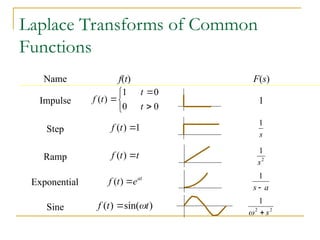
Laplace Transforms ofCommon
Functions
Name f(t) F(s)
Impulse
Step
Ramp
Exponential
Sine
1
s
1
2
1
s
a
s
1
2
2
1
s
1
)
(
t
f
t
t
f
)
(
at
e
t
f
)
(
)
sin(
)
( t
t
f
0
0
0
1
)
(
t
t
t
f
10.
Laplace Transform Properties
)
(
lim
)
(
lim
)
(
lim
)
0
(
)
(
)
(
)
)
(
1
)
(
)
(
)
0
(
)
(
)
(
)
(
)
(
)]
(
)
(
[
0
0
2
1
2
1
0
2
1
2
1
s
sF
t
f
-
s
sF
f
-
s
F
s
F
dτ
(τ
τ)f
(t
f
dt
t
f
s
s
s
F
dt
t
f
L
f
s
sF
t
f
dt
d
L
s
bF
s
aF
t
bf
t
af
L
s
t
s
t
t
theorem
value
Final
theorem
value
Initial
n
Convolutio
n
Integratio
ation
Differenti
caling
Addition/S
Definition
Definition --Partial fractions are several
fractions whose sum equals a given fraction
Purpose -- Working with transforms requires
breaking complex fractions into simpler
fractions to allow use of tables of transforms
19.
Partial Fraction Expansions
3
2
)
3
(
)
2
(
1
s
B
s
A
s
s
s Expand into a term for each
factor in the denominator.
Recombine RHS
Equate terms in s and
constant terms. Solve.
Each term is in a form so
that inverse Laplace
transforms can be applied.
)
3
(
)
2
(
2
)
3
(
)
3
(
)
2
(
1
s
s
s
B
s
A
s
s
s
3
2
2
1
)
3
(
)
2
(
1
s
s
s
s
s
1
B
A 1
2
3
B
A
20.
Example of Solutionof an ODE
0
)
0
(
'
)
0
(
2
8
6
2
2
y
y
y
dt
dy
dt
y
d ODE w/initial conditions
Apply Laplace transform to
each term
Solve for Y(s)
Apply partial fraction
expansion
Apply inverse Laplace
transform to each term
s
s
Y
s
Y
s
s
Y
s /
2
)
(
8
)
(
6
)
(
2
)
4
(
)
2
(
2
)
(
s
s
s
s
Y
)
4
(
4
1
)
2
(
2
1
4
1
)
(
s
s
s
s
Y
4
2
4
1
)
(
4
2 t
t
e
e
t
y
21.
Different terms of1st degree
To separate a fraction into partial fractions
when its denominator can be divided into
different terms of first degree, assume an
unknown numerator for each fraction
Example --
(11x-1)/(X2
- 1) = A/(x+1) + B/(x-1)
= [A(x-1) +B(x+1)]/[(x+1)(x-1))]
A+B=11
-A+B=-1
A=6, B=5
22.
Repeated terms of1st degree (1 of 2)
When the factors of the denominator are of
the first degree but some are repeated,
assume unknown numerators for each
factor
If a term is present twice, make the fractions
the corresponding term and its second power
If a term is present three times, make the
fractions the term and its second and third
powers
3. Partial fractions
Solution process (1of 8)
Any nonhomogeneous linear differential
equation with constant coefficients can be
solved with the following procedure, which
reduces the solution to algebra
4. Laplace transforms
29.
Solution process (2of 8)
Step 1: Put differential equation into
standard form
D2
y + 2D y + 2y = cos t
y(0) = 1
D y(0) = 0
30.
Solution process (3of 8)
Step 2: Take the Laplace transform of both
sides
L{D2
y} + L{2D y} + L{2y} = L{cos t}
31.
Solution process (4of 8)
Step 3: Use table of transforms to express
equation in s-domain
L{D2
y} + L{2D y} + L{2y} = L{cos t}
L{D2
y} = s2
Y(s) - sy(0) - D y(0)
L{2D y} = 2[ s Y(s) - y(0)]
L{2y} = 2 Y(s)
L{cos t} = s/(s2
+ 1)
s2
Y(s) - s + 2s Y(s) - 2 + 2 Y(s) = s /(s2
+ 1)
Solution process (8of 8)
Step 6: Use table to convert s-domain to
time domain
0.2 s/ (s2
+ 1) becomes 0.2 cos t
0.4 / (s2
+ 1) becomes 0.4 sin t
0.8 (s+1)/[(s+1)2
+ 1] becomes 0.8 e-t
cos t
0.4/ [(s+1)2
+ 1] becomes 0.4 e-t
sin t
y(t) = 0.2 cos t + 0.4 sin t + 0.8 e-t
cos t + 0.4 e-
t
sin t
Introduction
Definition --a transfer function is an
expression that relates the output to the
input in the s-domain
differential
equation
r(t) y(t)
transfer
function
r(s) y(s)
5. Transfer functions
38.
Transfer Function
Definition
H(s) = Y(s) / X(s)
Relates the output of a linear system (or
component) to its input
Describes how a linear system responds to
an impulse
All linear operations allowed
Scaling, addition, multiplication
H(s)
X(s) Y(s)
39.
Block Diagrams
Pictoriallyexpresses flows and relationships
between elements in system
Blocks may recursively be systems
Rules
Cascaded (non-loading) elements: convolution
Summation and difference elements
Can simplify
Example
v(t)
R
C
L
v(t) = RI(t) + 1/C I(t) dt + L di(t)/dt
V(s) = [R I(s) + 1/(C s) I(s) + s L I(s)]
Note: Ignore initial conditions
5. Transfer functions
42.
Block diagram andtransfer function
V(s)
= (R + 1/(C s) + s L ) I(s)
= (C L s2
+ C R s + 1 )/(C s) I(s)
I(s)/V(s) = C s / (C L s2
+ C R s + 1 )
C s / (C L s2
+ C R s + 1 )
V(s) I(s)
5. Transfer functions
43.
Block diagram reductionrules
G1 G2 G1 G2
U Y U Y
G1
G2
U Y
+
+ G1 + G2
U Y
G1
G2
U Y
+
- G1 /(1+G1 G2)
U Y
Series
Parallel
Feedback
5. Transfer functions
Second Order System:Parameters
n
oscillatio
the
of
frequency
the
gives
frequency
natural
undamped
of
tion
Interpreta
0)
Im
0,
(Re
Overdamped
1
Im)
(Re
d
Underdampe
0)
Im
0,
(Re
n
oscillatio
Undamped
ratio
damping
of
tion
Interpreta
N
:
0
:
1
0
:
0
Transient Response
Estimatesthe shape of the curve based on
the foregoing points on the x and y axis
Typically applied to the following inputs
Impulse
Step
Ramp
Quadratic (Parabola)
Basic Control Actions:u(t)
:
control
al
Differenti
:
control
Integral
:
control
al
Proportion
s
K
s
E
s
U
t
e
dt
d
K
t
u
s
K
s
E
s
U
dt
t
e
K
t
u
K
s
E
s
U
t
e
K
t
u
d
d
i
t
i
p
p
)
(
)
(
)
(
)
(
)
(
)
(
)
(
)
(
)
(
)
(
)
(
)
(
0
53.
Effect of ControlActions
Proportional Action
Adjustable gain (amplifier)
Integral Action
Eliminates bias (steady-state error)
Can cause oscillations
Derivative Action (“rate control”)
Effective in transient periods
Provides faster response (higher sensitivity)
Never used alone
54.
Basic Controllers
Proportionalcontrol is often used by itself
Integral and differential control are typically
used in combination with at least proportional
control
eg, Proportional Integral (PI) controller:
s
T
K
s
K
K
s
E
s
U
s
G
i
p
I
p
1
1
)
(
)
(
)
(
55.
Summary of BasicControl
Proportional control
Multiply e(t) by a constant
PI control
Multiply e(t) and its integral by separate constants
Avoids bias for step
PD control
Multiply e(t) and its derivative by separate constants
Adjust more rapidly to changes
PID control
Multiply e(t), its derivative and its integral by separate constants
Reduce bias and react quickly
56.
Root-locus Analysis
Basedon characteristic eqn of closed-loop transfer
function
Plot location of roots of this eqn
Same as poles of closed-loop transfer function
Parameter (gain) varied from 0 to
Multiple parameters are ok
Vary one-by-one
Plot a root “contour” (usually for 2-3 params)
Quickly get approximate results
Range of parameters that gives desired response
Initial value
Inthe initial value of f(t) as t approaches 0
is given by
f(0 ) = Lim s F(s)
s
f(t) = e -t
F(s) = 1/(s+1)
f(0 ) = Lim s /(s+1) = 1
s
Example
6. Laplace applications
59.
Final value
Inthe final value of f(t) as t approaches
is given by
f(0 ) = Lim s F(s)
s 0
f(t) = e -t
F(s) = 1/(s+1)
f(0 ) = Lim s /(s+1) = 0
s 0
Example
6. Laplace applications
60.
Apply Initial- andFinal-Value
Theorems to this Example
Laplace
transform of the
function.
Apply final-value
theorem
Apply initial-
value theorem
)
4
(
)
2
(
2
)
(
s
s
s
s
Y
4
1
)
4
0
(
)
2
0
(
)
0
(
)
0
(
2
)
(
lim
t
f
t
0
)
4
(
)
2
(
)
(
)
(
2
)
(
lim 0
t
f
t
61.
Poles
The polesof a Laplace function are the
values of s that make the Laplace function
evaluate to infinity. They are therefore the
roots of the denominator polynomial
10 (s + 2)/[(s + 1)(s + 3)] has a pole at s = -
1 and a pole at s = -3
Complex poles always appear in complex-
conjugate pairs
The transient response of system is
determined by the location of poles
6. Laplace applications
62.
Zeros
The zerosof a Laplace function are the
values of s that make the Laplace function
evaluate to zero. They are therefore the
zeros of the numerator polynomial
10 (s + 2)/[(s + 1)(s + 3)] has a zero at s =
-2
Complex zeros always appear in complex-
conjugate pairs
6. Laplace applications
63.
Stability
A systemis stable if bounded inputs produce bounded
outputs
The complex s-plane is divided into two regions: the stable
region, which is the left half of the plane, and the unstable
region, which is the right half of the s-plane
s-plane
stable unstable
x
x
x
x x
x
x
j
Introduction
Many problemscan be thought of in the
time domain, and solutions can be
developed accordingly.
Other problems are more easily thought of
in the frequency domain.
A technique for thinking in the frequency
domain is to express the system in terms
of a frequency response
7. Frequency response
66.
Definition
The responseof the system to a sinusoidal
signal. The output of the system at each
frequency is the result of driving the system
with a sinusoid of unit amplitude at that
frequency.
The frequency response has both amplitude
and phase
7. Frequency response
67.
Process
The frequencyresponse is computed by
replacing s with j in the transfer function
f(t) = e -t
F(s) = 1/(s+1)
Example
F(j ) = 1/(j +1)
Magnitude = 1/SQRT(1 + 2
)
Magnitude in dB = 20 log10 (magnitude)
Phase = argument = ATAN2(- , 1)
magnitude in dB
7. Frequency response
68.
Graphical methods
Frequencyresponse is a graphical method
Polar plot -- difficult to construct
Corner plot -- easy to construct
7. Frequency response
Simple pole orzero at origin, 1/ (j)n
+180o
+90o
0o
-270o
-180o
-90o
60 dB
40 dB
20 dB
0 dB
-20 dB
-40 dB
-60 dB
magnitude
phase
0.1 1 10 100
, radians/sec
1/
1/ 2
1/ 3
1/
1/ 2
1/ 3
G(s) = n
2
/(s2
+ 2 ns + n
2
)
71.
Simple pole orzero, 1/(1+j)
+180o
+90o
0o
-270o
-180o
-90o
60 dB
40 dB
20 dB
0 dB
-20 dB
-40 dB
-60 dB
magnitude
phase
0.1 1 10 100
T
7. Frequency response
Quadratic pole orzero
+180o
+90o
0o
-270o
-180o
-90o
60 dB
40 dB
20 dB
0 dB
-20 dB
-40 dB
-60 dB
magnitude
phase
0.1 1 10 100
T
7. Frequency response
74.
Transfer Functions
Definedas G(s) = Y(s)/U(s)
Represents a normalized model of a process,
i.e., can be used with any input.
Y(s) and U(s) are both written in deviation
variable form.
The form of the transfer function indicates the
dynamic behavior of the process.
75.
Derivation of aTransfer Function
T
F
F
T
F
T
F
dt
dT
M )
( 2
1
2
2
1
1
Dynamic model of
CST thermal mixer
Apply deviation
variables
Equation in terms
of deviation
variables.
0
2
2
0
1
1
0 T
T
T
T
T
T
T
T
T
T
F
F
T
F
T
F
dt
T
d
M
)
( 2
1
2
2
1
1
76.
Derivation of aTransfer Function
2
1
1
1 )
(
)
(
)
(
F
F
s
M
F
s
T
s
T
s
G
Apply Laplace transform
to each term considering
that only inlet and outlet
temperatures change.
Determine the transfer
function for the effect of
inlet temperature changes
on the outlet temperature.
Note that the response is
first order.
2
1
2
2
1
1 )
(
)
(
)
(
F
F
s
M
s
T
F
s
T
F
s
T
77.
Poles of theTransfer Function
Indicate the Dynamic Response
For a, b, c, and d positive constants, transfer
function indicates exponential decay, oscillatory
response, and exponential growth, respectively.
)
(
)
(
)
(
)
( 2
d
s
C
c
bs
s
B
a
s
A
s
Y
dt
pt
at
e
C
t
e
B
e
A
t
y
)
sin(
)
(
)
(
)
(
)
(
1
)
( 2
d
s
c
bs
s
a
s
s
G
Unstable Behavior
Ifthe output of a process grows without bound
for a bounded input, the process is referred to
a unstable.
If the real portion of any pole of a transfer
function is positive, the process corresponding
to the transfer function is unstable.
If any pole is located in the right half plane,
the process is unstable.
#2 A French mathematician and astronomer from the late 1700’s. His early published work started with calculus and differential equations. He spent many of his later years developing ideas about the movements of planets and stability of the solar system in addition to working on probability theory and Bayesian inference. Some of the math he worked on included: the general theory of determinants, proof that every equation of an even degree must have at least one real quadratic factor, provided a solution to the linear partial differential equation of the second order, and solved many definite integrals.
He is one of only 72 people to have his name engraved on the Eiffel tower.
#3 Laplace also recognized that Joseph Fourier's method of Fourier series for solving the diffusion equation could only apply to a limited region of space as the solutions were periodic. In 1809, Laplace applied his transform to find solutions that diffused indefinitely in space
#44 Jlh: Need to give insights into why poles and zeroes are important. Otherwise, the audience will be overwhelmed.
#45 Examples of transducers in computer systems are mainly surrogate variables. For example, we may not be able to measure end-user response times. However, we can measure internal system queueing. So we use the latter as a surrogate for the former and sometimes use simple equations (e.g., Little’s result) to convert between the two.
Use the approximation to simplify the following analysis
Another aspect of the transducer are the delays it introduces. Typically, measurements are sampled. The sample rate cannot be too fast if the performance of the plant (e.g., database server) is
#46 Jlh: Haven’t explained the relationship between poles and oscillations
#47 Get oscillatory response if have poles that have non-zero Im values.
#48 Get oscillatory response if have poles that have non-zero Im values.
#52 Jlh: Can we give more intuition on control actions. This seems real brief considering its importance.


![Basic Tool For Continuous Time:
Laplace Transform
Convert time-domain functions and operations into
frequency-domain
f(t) F(s) (tR, sC
Linear differential equations (LDE) algebraic expression
in Complex plane
Graphical solution for key LDE characteristics
Discrete systems use the analogous z-transform
0
)
(
)
(
)]
(
[ dt
e
t
f
s
F
t
f st
L](https://image.slidesharecdn.com/unit7laplacetransforms1-250625154319-f6b98ab7/85/unit7-LAPLACE-TRANSFORMS-power-point-presentation-7-320.jpg)

![Laplace Transform Properties
)
(
lim
)
(
lim
)
(
lim
)
0
(
)
(
)
(
)
)
(
1
)
(
)
(
)
0
(
)
(
)
(
)
(
)
(
)]
(
)
(
[
0
0
2
1
2
1
0
2
1
2
1
s
sF
t
f
-
s
sF
f
-
s
F
s
F
dτ
(τ
τ)f
(t
f
dt
t
f
s
s
s
F
dt
t
f
L
f
s
sF
t
f
dt
d
L
s
bF
s
aF
t
bf
t
af
L
s
t
s
t
t
theorem
value
Final
theorem
value
Initial
n
Convolutio
n
Integratio
ation
Differenti
caling
Addition/S](https://image.slidesharecdn.com/unit7laplacetransforms1-250625154319-f6b98ab7/85/unit7-LAPLACE-TRANSFORMS-power-point-presentation-10-320.jpg)


![Different terms of 1st degree
To separate a fraction into partial fractions
when its denominator can be divided into
different terms of first degree, assume an
unknown numerator for each fraction
Example --
(11x-1)/(X2
- 1) = A/(x+1) + B/(x-1)
= [A(x-1) +B(x+1)]/[(x+1)(x-1))]
A+B=11
-A+B=-1
A=6, B=5](https://image.slidesharecdn.com/unit7laplacetransforms1-250625154319-f6b98ab7/85/unit7-LAPLACE-TRANSFORMS-power-point-presentation-21-320.jpg)


![Different quadratic terms
When there is a quadratic term, assume a
numerator of the form Ax + B
Example --
1/[(x+1) (x2
+ x + 2)] = A/(x+1) + (Bx +C)/ (x2
+
x + 2)
1 = A (x2
+ x + 2) + Bx(x+1) + C(x+1)
1 = (A+B) x2
+ (A+B+C)x +(2A+C)
A+B=0
A+B+C=0
2A+C=1
A=0.5, B=-0.5, C=0
3. Partial fractions](https://image.slidesharecdn.com/unit7laplacetransforms1-250625154319-f6b98ab7/85/unit7-LAPLACE-TRANSFORMS-power-point-presentation-24-320.jpg)
![Repeated quadratic terms
Example --
1/[(x+1) (x2
+ x + 2)2
] = A/(x+1) + (Bx +C)/ (x2
+
x + 2) + (Dx +E)/ (x2
+ x + 2)2
1 = A(x2
+ x + 2)2
+ Bx(x+1) (x2
+ x + 2) +
C(x+1) (x2
+ x + 2) + Dx(x+1) + E(x+1)
A+B=0
2A+2B+C=0
5A+3B+2C+D=0
4A+2B+3C+D+E=0
4A+2C+E=1
A=0.25, B=-0.25, C=0, D=-0.5, E=0
3. Partial fractions](https://image.slidesharecdn.com/unit7laplacetransforms1-250625154319-f6b98ab7/85/unit7-LAPLACE-TRANSFORMS-power-point-presentation-25-320.jpg)


![Solution process (4 of 8)
Step 3: Use table of transforms to express
equation in s-domain
L{D2
y} + L{2D y} + L{2y} = L{cos t}
L{D2
y} = s2
Y(s) - sy(0) - D y(0)
L{2D y} = 2[ s Y(s) - y(0)]
L{2y} = 2 Y(s)
L{cos t} = s/(s2
+ 1)
s2
Y(s) - s + 2s Y(s) - 2 + 2 Y(s) = s /(s2
+ 1)](https://image.slidesharecdn.com/unit7laplacetransforms1-250625154319-f6b98ab7/85/unit7-LAPLACE-TRANSFORMS-power-point-presentation-31-320.jpg)
![Solution process (5 of 8)
Step 4: Solve for Y(s)
s2
Y(s) - s + 2s Y(s) - 2 + 2 Y(s) = s/(s2
+ 1)
(s2
+ 2s + 2) Y(s) = s/(s2
+ 1) + s + 2
Y(s) = [s/(s2
+ 1) + s + 2]/ (s2
+ 2s + 2)
= (s3
+ 2 s2
+ 2s + 2)/[(s2
+ 1) (s2
+ 2s + 2)]](https://image.slidesharecdn.com/unit7laplacetransforms1-250625154319-f6b98ab7/85/unit7-LAPLACE-TRANSFORMS-power-point-presentation-32-320.jpg)
![Solution process (6 of 8)
Step 5: Expand equation into format covered by
table
Y(s) = (s3
+ 2 s2
+ 2s + 2)/[(s2
+ 1) (s2
+ 2s + 2)]
= (As + B)/ (s2
+ 1) + (Cs + E)/ (s2
+ 2s + 2)
(A+C)s3
+ (2A + B + E) s2
+ (2A + 2B + C)s + (2B
+E)
1 = A + C
2 = 2A + B + E
2 = 2A + 2B + C
2 = 2B + E
A = 0.2, B = 0.4, C = 0.8, E = 1.2](https://image.slidesharecdn.com/unit7laplacetransforms1-250625154319-f6b98ab7/85/unit7-LAPLACE-TRANSFORMS-power-point-presentation-33-320.jpg)
![Solution process (7 of 8)
(0.2s + 0.4)/ (s2
+ 1)
= 0.2 s/ (s2
+ 1) + 0.4 / (s2
+ 1)
(0.8s + 1.2)/ (s2
+ 2s + 2)
= 0.8 (s+1)/[(s+1)2
+ 1] + 0.4/ [(s+1)2
+ 1]](https://image.slidesharecdn.com/unit7laplacetransforms1-250625154319-f6b98ab7/85/unit7-LAPLACE-TRANSFORMS-power-point-presentation-34-320.jpg)
![Solution process (8 of 8)
Step 6: Use table to convert s-domain to
time domain
0.2 s/ (s2
+ 1) becomes 0.2 cos t
0.4 / (s2
+ 1) becomes 0.4 sin t
0.8 (s+1)/[(s+1)2
+ 1] becomes 0.8 e-t
cos t
0.4/ [(s+1)2
+ 1] becomes 0.4 e-t
sin t
y(t) = 0.2 cos t + 0.4 sin t + 0.8 e-t
cos t + 0.4 e-
t
sin t](https://image.slidesharecdn.com/unit7laplacetransforms1-250625154319-f6b98ab7/85/unit7-LAPLACE-TRANSFORMS-power-point-presentation-35-320.jpg)


![Example
v(t)
R
C
L
v(t) = R I(t) + 1/C I(t) dt + L di(t)/dt
V(s) = [R I(s) + 1/(C s) I(s) + s L I(s)]
Note: Ignore initial conditions
5. Transfer functions](https://image.slidesharecdn.com/unit7laplacetransforms1-250625154319-f6b98ab7/85/unit7-LAPLACE-TRANSFORMS-power-point-presentation-41-320.jpg)


![Poles
The poles of a Laplace function are the
values of s that make the Laplace function
evaluate to infinity. They are therefore the
roots of the denominator polynomial
10 (s + 2)/[(s + 1)(s + 3)] has a pole at s = -
1 and a pole at s = -3
Complex poles always appear in complex-
conjugate pairs
The transient response of system is
determined by the location of poles
6. Laplace applications](https://image.slidesharecdn.com/unit7laplacetransforms1-250625154319-f6b98ab7/85/unit7-LAPLACE-TRANSFORMS-power-point-presentation-61-320.jpg)
![Zeros
The zeros of a Laplace function are the
values of s that make the Laplace function
evaluate to zero. They are therefore the
zeros of the numerator polynomial
10 (s + 2)/[(s + 1)(s + 3)] has a zero at s =
-2
Complex zeros always appear in complex-
conjugate pairs
6. Laplace applications](https://image.slidesharecdn.com/unit7laplacetransforms1-250625154319-f6b98ab7/85/unit7-LAPLACE-TRANSFORMS-power-point-presentation-62-320.jpg)


