Dr. Kevin Burden:
The University of Hull
Designing Meaningful
Pedagogies for Mobile
Learning
Apple Meeting:
Regents Street, London
28th June 2013
“There is very little evidence that kids learn
more, faster or better by using these
machines...iPads are marvellous tools to engage
kids, but then the novelty wears off and you get
into hard-core issues of teaching and learning.”
Larry Cuban, professor emeritus of education at
Stanford University New York Times, 2011
(
http://www.nytimes.com/2011/01/05/education/05tablets.html?_
)
• what pedagogies work well with
mobile devices?
• why is this important but not
sufficient?
• how can practitioners and
researchers design more effective
learning episodes using mobiles?
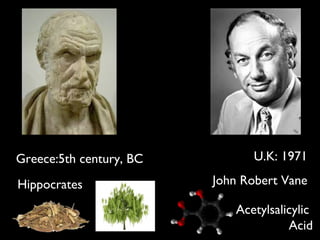
Greece:5th century, BC U.K: 1971
Hippocrates John Robert Vane
Acetylsalicylic
Acid
acetylsalicylic acid
1861
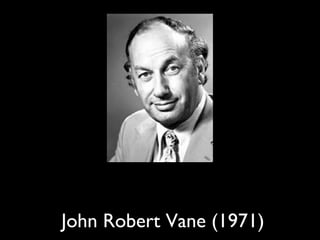
John Robert Vane (1971)
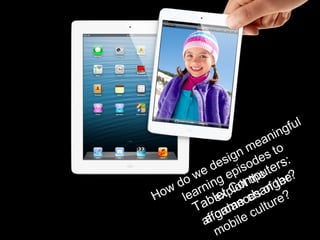
Tablet Computers:
a game changer?
How do we design meaningful
learning episodes to
exploit the
affordances of the
mobile culture?
http://www2.hull.ac.uk/ifl/ipadresearchinschools.aspx
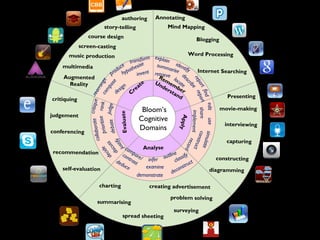
BBloom’s
Cognitive
Domains
Remember
Understand
Apply
Analyse
Evaluate
C
reate
edit
share
implement
usesimulate
construct
record
classify
compare/
contrastdeduce
infer outline

examine
demonstrate deconstruct
critique
rank
judgedebate
prioritise
collaborate
justify
decide
discuss
transform
hypothesise
rearrange
produce
invent
compose
design
explain
identify
summarise
describereport
retrieve
reportfind
locate
Mind Mapping
Blogging
Word Processing
Internet Searching
Annotating
Presenting
movie-making
interviewing
capturing
constructing
diagramming
problem solving
surveying
spread sheeting
summarising
charting creating advertisement
recommendation
judgement
self-evaluation
conferencing
critiquing
authoring
story-telling
course design
screen-casting
music production
multimedia
Augmented
Reality
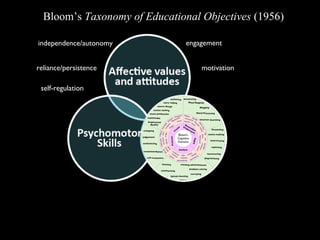
Bloom’s Taxonomy of Educational Objectives (1956)
engagement
motivationreliance/persistence
independence/autonomy
self-regulation
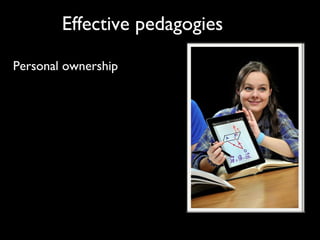
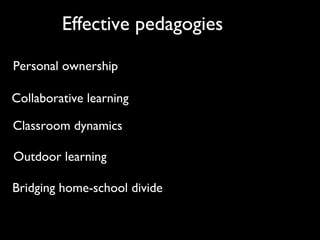
Effective pedagogies
Personal ownership
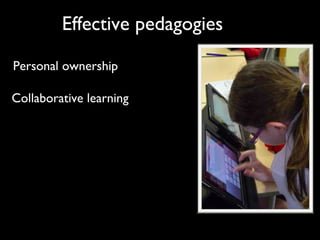
Effective pedagogies
Personal ownership
Collaborative learning
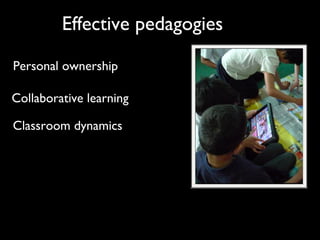
Effective pedagogies
Classroom dynamics
Personal ownership
Collaborative learning
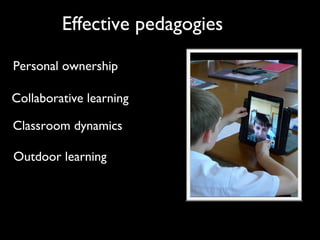
Effective pedagogies
Outdoor learning
Classroom dynamics
Personal ownership
Collaborative learning
Effective pedagogies
Outdoor learning
Classroom dynamics
Personal ownership
Bridging home-school divide
Collaborative learning
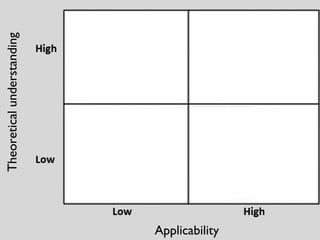
Pasteur’s Quadrant
?
Applicability
Theoreticalunderstanding
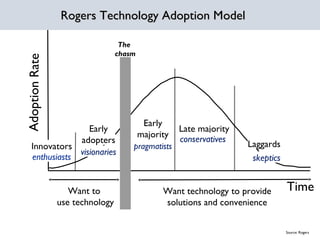
The
chasm
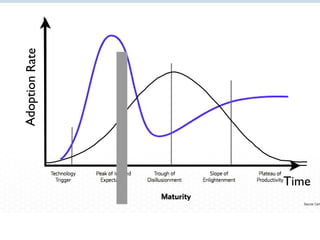
AdoptionRate
Time
Innovators
Early
adopters
Early
majority
Late majority
Laggards
enthusiasts
visionaries
pragmatists
conservatives
skeptics
Want to
use technology
Want technology to provide
solutions and convenience
Source: Rogers
Rogers Technology Adoption MRogers Technology Adoption Modelodel
AdoptionRate
Time
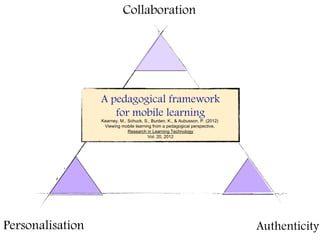
Collaboration
Datasharing
Conversation
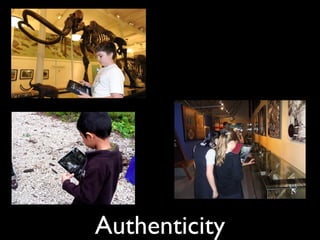
Authenticity
Contextualised
Situated
Personalisation
Agency
Customisation
A pedagogical framework
for mobile learning
Kearney, M., Schuck, S., Burden, K., & Aubusson, P. (2012)
Viewing mobile learning from a pedagogical perspective,
Research in Learning Technology
Vol. 20, 2012
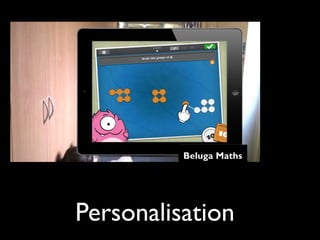
Personalisation
Beluga MathsBeluga Maths
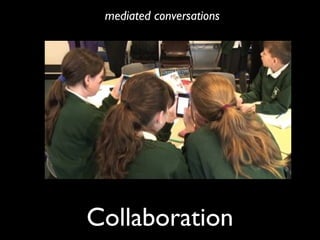
Collaboration
mediated conversations
Authenticity
Authenticity
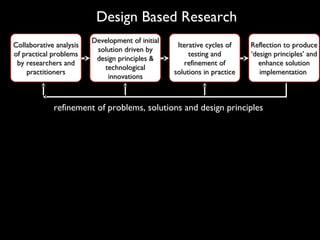
Collaborative analysisCollaborative analysis
of practical problemsof practical problems
by researchers andby researchers and
practitionerspractitioners
Reflection to produceReflection to produce
‘design principles’ and‘design principles’ and
enhance solutionenhance solution
implementationimplementation
Design Based Research
Development of initialDevelopment of initial
solution driven bysolution driven by
design principles &design principles &
technologicaltechnological
innovationsinnovations
Iterative cycles ofIterative cycles of
testing andtesting and
refinement ofrefinement of
solutions in practicesolutions in practice
refinement of problems, solutions and design principles
Educational Design
Research
Explain Everything
QuickTime™ and a
decompressor
are needed to see this picture.
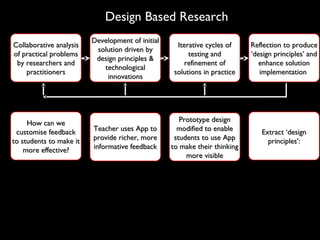
Collaborative analysisCollaborative analysis
of practical problemsof practical problems
by researchers andby researchers and
practitionerspractitioners
Development of initialDevelopment of initial
solution driven bysolution driven by
design principles &design principles &
technologicaltechnological
innovationsinnovations
Iterative cycles ofIterative cycles of
testing andtesting and
refinement ofrefinement of
solutions in practicesolutions in practice
Reflection to produceReflection to produce
‘design principles’ and‘design principles’ and
enhance solutionenhance solution
implementationimplementation
Design Based Research
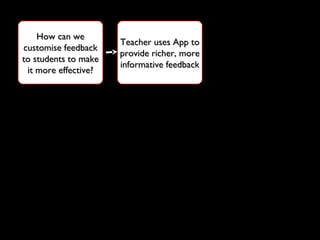
How can weHow can we
customise feedbackcustomise feedback
to students to make itto students to make it
more effective?more effective?
Teacher uses App toTeacher uses App to
provide richer, moreprovide richer, more
informative feedbackinformative feedback
Prototype designPrototype design
modified to enablemodified to enable
students to use Appstudents to use App
to make their thinkingto make their thinking
more visiblemore visible
Extract ‘designExtract ‘design
principles’:principles’:
How can weHow can we
customise feedbackcustomise feedback
to students to maketo students to make
it more effective?it more effective?
Teacher uses App toTeacher uses App to
provide richer, moreprovide richer, more
informative feedbackinformative feedback
QuickTime™ and a
H.264 decompressor
are needed to see this picture.
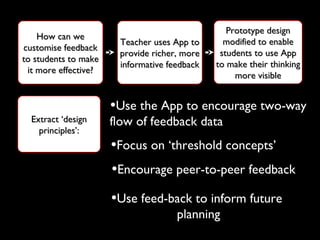
How can weHow can we
customise feedbackcustomise feedback
to students to maketo students to make
it more effective?it more effective?
Teacher uses App toTeacher uses App to
provide richer, moreprovide richer, more
informative feedbackinformative feedback
Prototype designPrototype design
modified to enablemodified to enable
students to use Appstudents to use App
to make their thinkingto make their thinking
more visiblemore visible
Extract ‘designExtract ‘design
principles’:principles’:
•Use the App to encourage two-way
flow of feedback data
•Focus on ‘threshold concepts’
•Encourage peer-to-peer feedback
•Use feed-back to inform future
planning
49
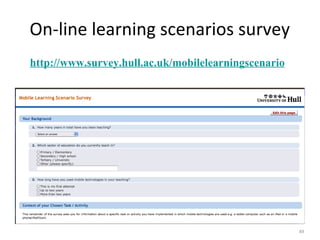
On-line learning scenarios survey
http://www.survey.hull.ac.uk/mobilelearningscenario
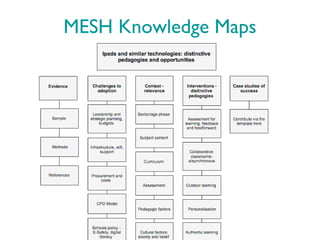
MESH Knowledge Maps

51
http://www.educationcommunities.org/c/162117/
home.do
53
Dr. Kevin Burden
The Centre for
Educational Studies
The Faculty of Education
The University of Hull
k.j.burden@hull.ac.uk
07815184477

Apple ledership event london 2013

Editor's Notes

  • #3 Could be called: Three Models and a Challenge - Distinctive Pedagogies for Tablet Computers
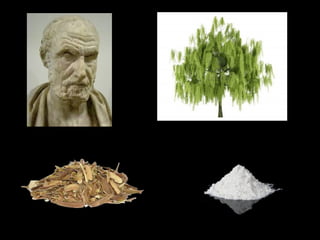
  • #8 As long back as ancient times physicians and doctors like Hippocrates knew that the bark of this tree (the willow) when ground down (powder) produced a compound with great analgesic powers to reliev a wide variety of minor aliment and pains including inflammation and headaches. It continued to be used as a remedy for hundreds of years until in the 1860s it was identified as acetylsalicylic acid’ In 1899 Bayer (the US pharmaceutical company) patented this chemical as Aspirin but it was not until 1971 that John Robert Vane actually discovered the mechanism behind this drug. Since John Vane made his discovery numerous other applications have been developed moving far beyond the original purpose which was simple pain relief - it is now used extensively to prevent heart attacks and strokes
  • #13 The use of technology in general, and mobile computers and tablets devices like the ipad, in particular follows a similar pattern to that I have just described. Given the recency of these devices (2008 for mobiles and 2010 for iPads) we have already collected considerable amounts of evidence about what works and does not work. But we are still struggling to explain the precise mechansims - the why and the how - that make these activities work. That is the real challenge for researchers and practitioners and this is where my research lies But firstly lets consider what we do know about what works and does not work when iPads are used in classrooms For example, even from the relatively small number of genuine studies which have been undertaken in the use of mobile devices and tablet devices in particular we know the following activities or pedagogical patterns appear to work very well:
  • #15 Where is this evidence located ? A growing number of studies led by this one in Scotland - NEED OTHER STUDIES HERE - 2008, MELBOURNE STUDY, ETC
  • #24 But despite all of this evidence to indicate what works and what works less well, we are still unclear about why or how these particular technologies achieve these outcomes. We do not yet undertsand the DNA code which would enable us to extend and generalise what works to new settings and indeed into new, as yet unexplored, pedagogical patterns. Partly because our research tends to be descriptive rather than explanatory or even prescriptive (as in medicine). We need to adopt a new research paradigm to achieve this. What some researchers as calling, working in Pasteur’s Quadrant. Doing this using a research approach called Educational Design Research
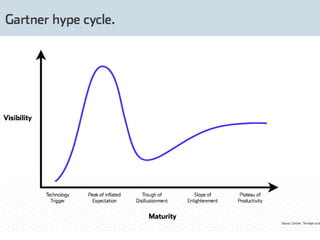
  • #25 Stage 1 - Technology Triggers (touch screen) * characterised by proof of concept and media stories (Need image from papers here) * seldom a usable product exists - therefore viability is unproven Stage 2: Peak - early publicity fuels triggers of success stories - some companies take action (most do not) Stage 3: Trough - interest wanes as implementations and experiments fail * producers fail or move on *investment limited to those providers who improve their offering in the light of what early adopter wants Stage 4: slope of enlightenment * more successful examples begin to emerge to show real benefits * 2nd and 3rd generation products emerge * more funding for pilots *conservative enterprises remain cautious (is this where we are now?) Stage 5: Plauteau: *mainstream adoption begins * criteria for assessing and measuring viability and effectiveness are well established *broad market applicability paying off
  • #30 The juxtaposing of both models suggest different groups and individuals will be further along the Hype cycle than others 1. innovators have alrerady scaled the Peak experienced the trough - through the first wave of tablet PCs (i.e. pen driven) 2. they have now moved on with the next generation of devices to the slope (2nd and 3rd wave generations - e.g. iPods and iPads) and the plateu, followed now by the early adopters who are the trend setters: 3. approaching the plateau - seeking ways top meausure their success (more of this later) This phase is characteristed by BUT important to remember the early majority (34%) are now following them - some points to make about their adoption patterns 1. Do they need to follow the same route - i.e. false expectations dahsed: probably not (can learn from others - in school this may be through champions and sharing - e.g. TeachMeets) 2. Note this group will follow but are not natural innovators - they will do so when they see it how it fits in with their current lives and ways of working (in practice this may mean becoming familiar with the technology at home - comon in many studies now - 3. BUT - they are unlikely to want to use this technology to change the current way things are done (i.e. to be transfromational) - this needs to be driven elesewhere
  • #31 By the time innovators and early adopters reach Roger’s plateau they are well versed in the technology itself and are looking to establish tools and criteria to measure or evaluate the value of these initiatives. This is where we are approaching with some individuals and schools now. How do they do this?
  • #32 One way - SAMR good to measure where you or your school are in relation to technolgy use generally Little value as a formmative tool, however, to help you or your organisation progress
  • #33 To support this form of research we are using a largely theoretical framework for mobile learning developed between myself and colleagues at the University of Technology, Sydney. It identifies three broad areas to investigate and within this six strands or designs
  • #44 Stages in DBR 1. Stage 1: Identify the problem/puzzle (real world) - e.g. How can I get students to take more notice of the feedback I provide to them when I assess their work? 2. Stage 2: what does the literature say about this? (e.g. Hattie: Visible Learning - summarise findings) 3. Stage 3: develop the prototype activity with practitoners - introduce Explain Everything app (illustrate example from Sally giving feedback on writing - report effect) 4. Stage 4: collect feedback from stakeholders and modify the design - report here on Reshan Richard’s feedback in NY - how teachers started to discover more effective ways of using Explain Everything - get students to use it to explain their thinking 5. Stage 5: implement new iteration - e.g. student led (insight into their thinking) - collect feedback 6. Stage 6: develop theoretical understanding (Pasteur’s use-inspired basic theory) -e.g. the most effective feedback is not from the teacher to the student (i.e. iteration 1) but from the student to the teacher and using a multimodal format like EE enables the teacher to understand this better and modify their teaching accordingly. NB. This is just an example - porbably fits into Customisation
  • #53 1. Teachers are generally very capable and fluent in their pedagogical content knowledge (PCK) – i.e. they understand how different pedagogical patterns will be more/or less effective in helping students to understand particular bodies of subject knowledge. The difficulties lies in understanding how, when and under what circumstances technology is part of this equation (TPCK- Mishra and Koeller) – the personal ownership of a device like the iPad brings this equation into play in a big way and teachers have probably not been equipped or prepared for this in their training