Learning in a Mobile Age: 
Translational Research That Makes a Difference 
Doha College Mobile Learning Conference, 
2014 
Dr. Kevin Burden: 
Reader in Educational Technology 
The Faculty of Education 
The University of Hull
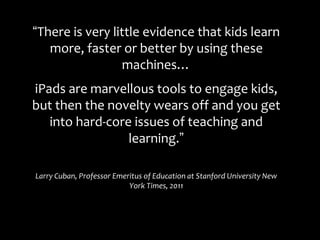
“There is very little evidence that kids learn 
more, faster or better by using these 
machines… 
iPads are marvellous tools to engage kids, 
but then the novelty wears off and you get 
into hard-core issues of teaching and 
learning.” 
Larry Cuban, Professor Emeritus of Education at Stanford University New 
York Times, 2011
What does the 
research tell us?
Mobile learning is not 
just? 
Delivering more content!
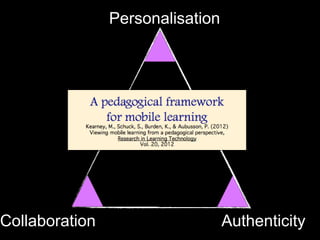
Personalisation 
Collaboration Authenticity
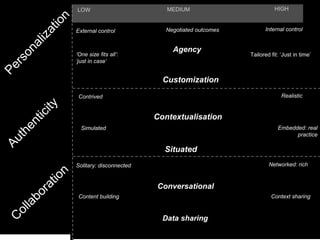
LOW MEDIUM HIGH 
External control Negotiated outcomes 
Agency 
Customization 
Contextualisation 
Situated 
Conversational 
Data sharing 
‘One size fits all’: 
‘just in case’ 
Internal control 
Tailored fit: ‘Just in time’ 
Contrived Realistic 
Simulated Embedded: real 
practice 
Solitary: disconnected Networked: rich 
Content building Context sharing
Mobile technologies 
dramatically increase 
personal access to 
technology in the 
classroom
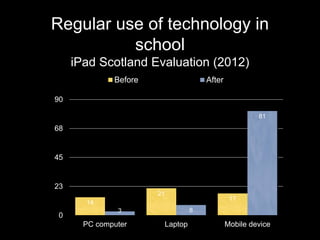
Regular use of technology in 
school 
iPad Scotland Evaluation (2012) 
14 
Before After 
21 
17 
3 8 
81 
90 
68 
45 
23 
0 
PC computer Laptop Mobile device
Personalisation 
increases when mobile 
devices are deployed 
effectively
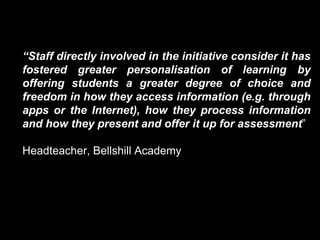
“Staff directly involved in the initiative consider it has 
fostered greater personalisation of learning by 
offering students a greater degree of choice and 
freedom in how they access information (e.g. through 
apps or the Internet), how they process information 
and how they present and offer it up for assessment” 
Headteacher, Bellshill Academy
Greater levels of 
collaboration and 
cooperation are evident
• through conversations - ‘dialogical 
talk’ 
through sharing artefacts
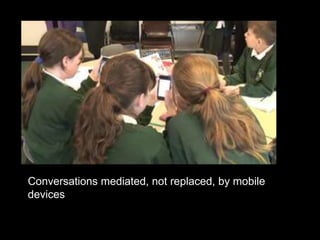
Conversations mediated, not replaced, by mobile 
devices
Learning can be more 
authentic 
• Task authenticity 
• Tool authenticity 
• Situated learning
Shifts from consumption 
(content delivery) to 
production (content creation)
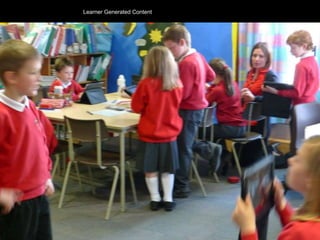
Learner Generated Content
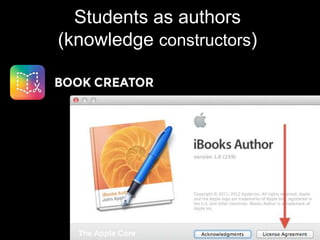
Students as authors 
(knowledge constructors)
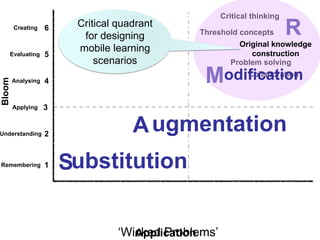
What Next...?
ugmentation 
ubstitution 
Application 
Creating 6 
Evaluating 5 
Analysing 4 
Applying 3 
Understanding 2 
Remembering 1 
1 
Acquire 
knowledge 
in one discipline 
2 
Apply 
knowledge 
in one discipline 
3 
Apply 
Threshold concepts 
knowledge 
across disciplines 
4 
Apply 
knowledge 
to real-world 
predictable 
situations 
5 
Apply 
knowledge 
in real-world 
unpredictable 
situations 
Critical thinking 
Problem solving 
Collaboration 
S 
A 
M 
R 
‘Wicked Problems’ 
odification 
Critical quadrant 
for designing 
mobile learning 
scenarios 
Original knowledge 
construction
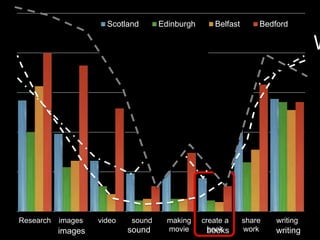
125 
Scotland Edinburgh Belfast Bedford 
What 0 
100 
75 
50 
25 
Research images video sound making 
movie 
create a 
book 
share 
work 
writing 
images sound books writing
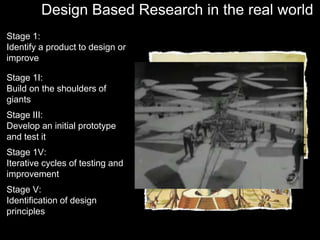
Design Based Research in the real world 
Stage 1: 
Identify a product to design or 
improve 
Stage 1I: 
Build on the shoulders of 
giants 
Stage III: 
Develop an initial prototype 
and test it 
Stage 1V: 
Iterative cycles of testing and 
improvement 
Stage V: 
Identification of design 
principles
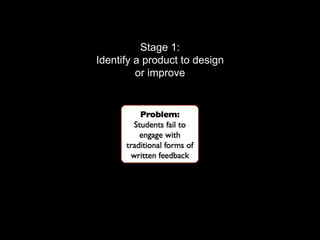
Stage 1: 
Identify a product to design 
or improve
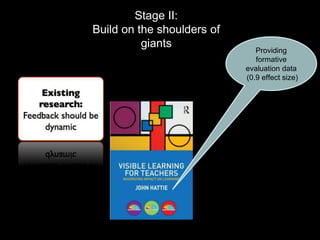
Stage II: 
Build on the shoulders of 
giants 
Providing 
formative 
evaluation data 
(0.9 effect size)
Stage III: 
Develop an initial prototype 
and test it
Stage IV: 
Iterative cycles of testing 
and improvement
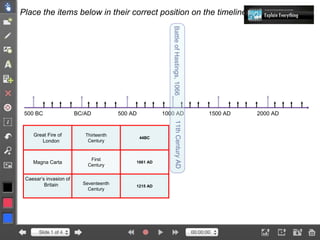
Place the items below in their correct position on the timeline 
500 BC BC/AD 500 AD 1000 AD 1500 AD 2000 AD 
Great Fire of 

London 
Thirteenth 
Century 
44BC 
Magna Carta 
First 
Century 
1661 AD 
Caesar’s invasion of 
Britain Seventeenth 
Century 
1215 AD
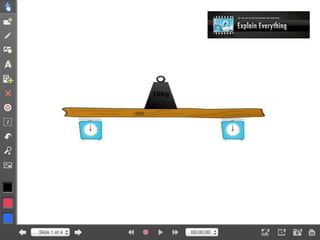
‘Making Thinking Visible’
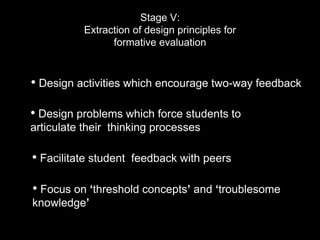
Stage V: 
Extraction of design principles for 
formative evaluation 
• Design activities which encourage two-way feedback 
• Design problems which force students to 
articulate their thinking processes 
• Facilitate student feedback with peers 
• Focus on ‘threshold concepts’ and ‘troublesome 
knowledge’
Mobilising & Transforming 
Teacher Educators’s 
Pwewdwa.gmotgteieps.eu
Outputs 
European Mobile Learning Network for Teacher Educators
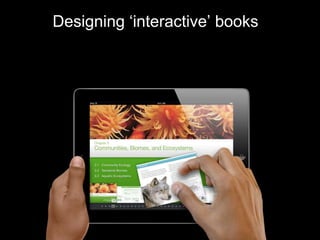
Designing ‘interactive’ books
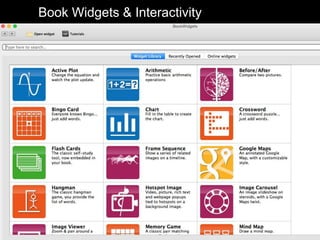
Book Widgets & Interactivity
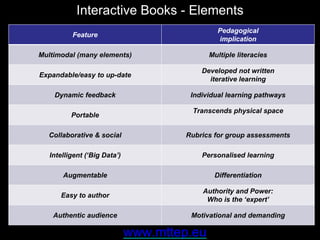
Interactive Books - Elements 
Feature 
Pedagogical 
implication 
Multimodal (many elements) Multiple literacies 
Expandable/easy to up-date 
Developed not written 
iterative learning 
Dynamic feedback Individual learning pathways 
Portable 
Transcends physical space 
Collaborative & social Rubrics for group assessments 
Intelligent (‘Big Data’) Personalised learning 
Augmentable Differentiation 
Easy to author 
Authority and Power: 
Who is the ‘expert’ 
Authentic audience Motivational and demanding 
www.mttep.eu
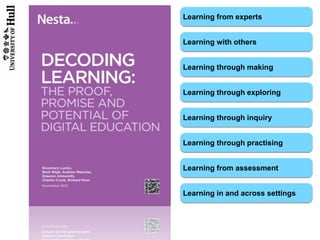
Learning from experts 
Learning with others 
Learning through making 
Learning through exploring 
Learning through inquiry 
Learning through practising 
Learning from assessment 
Learning in and across settings
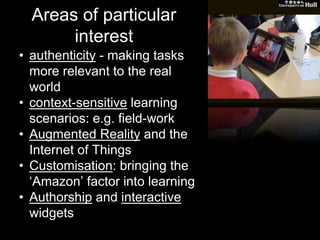
Areas of particular 
interest 
• authenticity - making tasks 
more relevant to the real 
world 
• context-sensitive learning 
scenarios: e.g. field-work 
• Augmented Reality and the 
Internet of Things 
• Customisation: bringing the 
‘Amazon’ factor into learning 
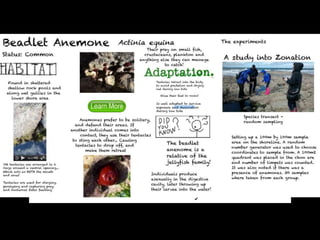
• Authorship and interactive 
widgets
• We know what works but not why it works 
• We need to better understand the unique 
‘affordances’ of mobile technologies in 
order to leverage higher order thinking 
skills 
• Thinking of teaching as a design based 
science may help to identify how these 
affordances are translated into learning 
scenarios
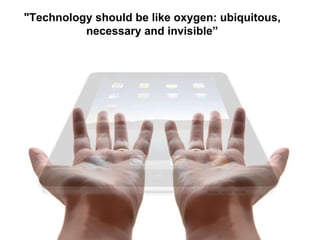
"Technology should be like oxygen: ubiquitous, 
necessary and invisible”
Contact Details 
Dr. Kevin Burden 
Reader in Educational Technology 
The Faculty of Education 
The University of Hull 
k.j.burden@hull.ac.uk 
Twitter: @edskjb 
www.mttep.eu

Doha College Mobile Learning Conference 2014: Learning from Research

  • 1.
    Learning in aMobile Age: Translational Research That Makes a Difference Doha College Mobile Learning Conference, 2014 Dr. Kevin Burden: Reader in Educational Technology The Faculty of Education The University of Hull
  • 3.
    “There is verylittle evidence that kids learn more, faster or better by using these machines… iPads are marvellous tools to engage kids, but then the novelty wears off and you get into hard-core issues of teaching and learning.” Larry Cuban, Professor Emeritus of Education at Stanford University New York Times, 2011
  • 10.
    What does the research tell us?
  • 11.
    Mobile learning isnot just? Delivering more content!
  • 12.
  • 13.
    LOW MEDIUM HIGH External control Negotiated outcomes Agency Customization Contextualisation Situated Conversational Data sharing ‘One size fits all’: ‘just in case’ Internal control Tailored fit: ‘Just in time’ Contrived Realistic Simulated Embedded: real practice Solitary: disconnected Networked: rich Content building Context sharing
  • 14.
    Mobile technologies dramaticallyincrease personal access to technology in the classroom
  • 15.
    Regular use oftechnology in school iPad Scotland Evaluation (2012) 14 Before After 21 17 3 8 81 90 68 45 23 0 PC computer Laptop Mobile device
  • 16.
    Personalisation increases whenmobile devices are deployed effectively
  • 17.
    “Staff directly involvedin the initiative consider it has fostered greater personalisation of learning by offering students a greater degree of choice and freedom in how they access information (e.g. through apps or the Internet), how they process information and how they present and offer it up for assessment” Headteacher, Bellshill Academy
  • 18.
    Greater levels of collaboration and cooperation are evident
  • 19.
    • through conversations- ‘dialogical talk’ through sharing artefacts
  • 20.
    Conversations mediated, notreplaced, by mobile devices
  • 22.
    Learning can bemore authentic • Task authenticity • Tool authenticity • Situated learning
  • 23.
    Shifts from consumption (content delivery) to production (content creation)
  • 24.
  • 25.
    Students as authors (knowledge constructors)
  • 26.
  • 27.
    ugmentation ubstitution Application Creating 6 Evaluating 5 Analysing 4 Applying 3 Understanding 2 Remembering 1 1 Acquire knowledge in one discipline 2 Apply knowledge in one discipline 3 Apply Threshold concepts knowledge across disciplines 4 Apply knowledge to real-world predictable situations 5 Apply knowledge in real-world unpredictable situations Critical thinking Problem solving Collaboration S A M R ‘Wicked Problems’ odification Critical quadrant for designing mobile learning scenarios Original knowledge construction
  • 28.
    125 Scotland EdinburghBelfast Bedford What 0 100 75 50 25 Research images video sound making movie create a book share work writing images sound books writing
  • 29.
    Design Based Researchin the real world Stage 1: Identify a product to design or improve Stage 1I: Build on the shoulders of giants Stage III: Develop an initial prototype and test it Stage 1V: Iterative cycles of testing and improvement Stage V: Identification of design principles
  • 30.
    Stage 1: Identifya product to design or improve
  • 31.
    Stage II: Buildon the shoulders of giants Providing formative evaluation data (0.9 effect size)
  • 32.
    Stage III: Developan initial prototype and test it
  • 33.
    Stage IV: Iterativecycles of testing and improvement
  • 34.
    Place the itemsbelow in their correct position on the timeline 500 BC BC/AD 500 AD 1000 AD 1500 AD 2000 AD Great Fire of London Thirteenth Century 44BC Magna Carta First Century 1661 AD Caesar’s invasion of Britain Seventeenth Century 1215 AD
  • 36.
  • 37.
    Stage V: Extractionof design principles for formative evaluation • Design activities which encourage two-way feedback • Design problems which force students to articulate their thinking processes • Facilitate student feedback with peers • Focus on ‘threshold concepts’ and ‘troublesome knowledge’
  • 39.
    Mobilising & Transforming Teacher Educators’s Pwewdwa.gmotgteieps.eu
  • 40.
    Outputs European MobileLearning Network for Teacher Educators
  • 42.
  • 43.
    Book Widgets &Interactivity
  • 44.
    Interactive Books -Elements Feature Pedagogical implication Multimodal (many elements) Multiple literacies Expandable/easy to up-date Developed not written iterative learning Dynamic feedback Individual learning pathways Portable Transcends physical space Collaborative & social Rubrics for group assessments Intelligent (‘Big Data’) Personalised learning Augmentable Differentiation Easy to author Authority and Power: Who is the ‘expert’ Authentic audience Motivational and demanding www.mttep.eu
  • 45.
    Learning from experts Learning with others Learning through making Learning through exploring Learning through inquiry Learning through practising Learning from assessment Learning in and across settings
  • 46.
    Areas of particular interest • authenticity - making tasks more relevant to the real world • context-sensitive learning scenarios: e.g. field-work • Augmented Reality and the Internet of Things • Customisation: bringing the ‘Amazon’ factor into learning • Authorship and interactive widgets
  • 47.
    • We knowwhat works but not why it works • We need to better understand the unique ‘affordances’ of mobile technologies in order to leverage higher order thinking skills • Thinking of teaching as a design based science may help to identify how these affordances are translated into learning scenarios
  • 48.
    "Technology should belike oxygen: ubiquitous, necessary and invisible”
  • 49.
    Contact Details Dr.Kevin Burden Reader in Educational Technology The Faculty of Education The University of Hull k.j.burden@hull.ac.uk Twitter: @edskjb www.mttep.eu

Editor's Notes

  • #4 The other end of the spectrum - techno-dystopia
  • #5 So whats stops us tackling these issues - we know what works (by observing) but we know far less about why or how they work and therefore how to replicate them at scale - use analogy What next - we need to understand more about what makes good learning with mobile technologies so good, in order that we can replicate this and better understand when and when not to use mobile devices
  • #9 Current growth in interest around mobile learning - evidenced by the interest of the international Agencies Fill in with other pictures from the UNESCO studies across the world
  • #11 Authority: 1. Where mobile technologies are sanctioned within the institution, especially in depolyments which are highly personal (e.g. 1:1) they alter the relationship between learners and teachers/educators 2. Current model of learning is unsymmetrical in many ways: the teacher owns and controls most of the knowledge or ‘stuff’ which is mandated to be understood/known - Freire’s Banking Analogy (Knowledge is deposited) restricting the ability to think critically knowledge (or stuff) is consumed by the learner in large volumes but relatively little is produced, particularly with any lasting value (most is ephemeral and quickly lost) 3. Ubiquitous connectivity (which is what mobile learning promises) - challenges this in many respects: knowledge cannot be ‘controlled’ or rationed in the same way it was when it belonged exclusively to the teachers - scarcity has dissappeared (much as it did with the monks who were previous guardians of knowledge and therefore learning) not necessary to teach as much content any longer - most of it can be located by students it is also less necessary to memorise everything any longer - freeing up cognitive space and energy for other things learners become more independent and less needy of the teacher they are able to make more choices - agency (where they work; how they work and undertake a task; when they work) they
  • #12 List from previous conference - ??? 2012 delivering more content
  • #13 My colleagues and I have captured all of these opportunities/affordances in a framework as shown
  • #14 Low = exchange of content High = creation and sharing of contexts
  • #16 Need to define regular - is this daily or weekly? all of our research demonstrates very clearly how students get considerable more access to technology in school when mobile devices are introduced than they ever did before (see graph) the access to technology is significantly more unmediated than is normally the case
  • #18 not just about providing equipment - its about providing flexible provision (giving students more choice)
  • #22 The risks associated with individualisations - lack of social contact But our data does not support this conclusion - at least not yet 1. we were surprised to find higher levels of conversation and collaboration in the classroom than we expected - teachers report it has increased
  • #23 Important that teachers still design lessons which encourage collaboration and cooperation between learners - when they do the technology actually supports this kind of learning - (e.g. see these apps_)
  • #26 Examples of production - student generated content (contexts) - find examples For almost as long as we have had schools the relationship between the learner and the teacher has been unsymmetrical in the sense that most of what occurs is about consumption (i.e. of knowledge) not production: why technical reasons - hard for students to produce anything that would last technical - hard to share or disseminate to a wider audience lack of real audience diminishes the drive to publish - who reads a typical essay
  • #27 Whole host of apps and software which enable students to create their own books smart books - customised t your likes and interests - sharing content with other readers/their notes on the same book - knows where you are and who is near you insert images of Apple books here ..
  • #29 Note: vertical dotted line designates shift from artificial to more authentic learning (i.e. in terms of the contexts, setting, place, tasks) Real interest is to use technologies to support learners in applying their knowledge to real world predictable and unpredictable problems
  • #30 To undertake research and to support writing (fairly traditional - on the surface at least - this needs unpacking) So what do students use this access and technology for? 1. All of our evidence show two principal uses at this point in time: research/internet writing - productivity 2. Interesting - for later - also considerable sharing (look at this later) Research is interesting - demonstrates a different model of learning - not a banking model (deposits) Ubiquitous connectivity (which is what mobile learning promises) - challenges this in many respects: knowledge cannot be ‘controlled’ or rationed in the same way it was when it belonged exclusively to the teachers - scarcity has dissappeared (much as it did with the monks who were previous guardians of knowledge and therefore learning) not necessary to teach as much content any longer - most of it can be located by students it is also less necessary to memorise everything any longer - freeing up cognitive space and energy for other things learners become more independent and less needy of the teacher they are able to make more choices - agency (where they work; how they work and undertake a task; when they work) they
  • #31 Example of DBR in non educational context - traffic flow and calming
  • #44 Start with a problem: how do we use mobile technologies to act deep learning/applied learning, etc (show model ffrom Doug here)
  • #47 Slide 34: Return to work of Luckin, et al and start to think about the types of learning we might want students to engage with in the future and then how the iPad might support this? (ask participants to take this away and think about it) learning from experts - example of artist in residence in Sciennes who could not attend school but supported students through Skype and virtual exhibitions learning through making: production of animations and videos to convey complex understanding and ideas (e.g. learning through inquiry - flipped classroom example with FIPS classes learning across settings: i.e. taking learning from one context (classroom) and applying it another (e.g. the home) - seen often with the iPad in Scotland (acts as a mediating object) - life logs also an examples (captures moments in a day usin mobile phone - images; writing notes and locations) - allow users to review these later and
  • #50 Conclusion We are not yet at the stage where learning with the iPad is ‘invisible’ in the sense that users do not even consider themselves to be using a technology, but we have already passed this phase in non-formal contexts outside of school. Young people do not even consider their mobile devices to be technologies and in one sense this is the goal we have to seek in schools to the extent that learners don’t even see the technology, they just see the learning. We are still some way from this and over the next five years or so it will be important for researchers like myself and educators like you to work more closely together not only to identify what works (we know a lot of the answers for that already) but why it works (i.e. the mechanisms) and under what circumstances it works most effectively. This will enable us scale and sustain these wonderful case studies we have seen today in sun a way that we promote genuine and meaningful transformation of pedagogies rather than simply replicating and sustaining what is increasingly look like an outdated and out of tune model of education .