Leading Kids Through a
Successful Engineering
Experience

An online workshop for volunteers.
DiscoverE Training
Are you looking for the formula for
leading kids through a successful
engineering outreach experience?
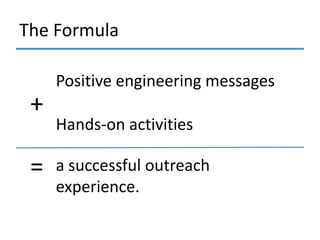
The Formula
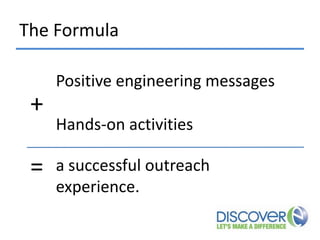
Positive engineering messages

+

=

Hands-on activities

a successful outreach
experience.
The Messages
Research has shown that effective and
positive messages about engineering can
increase a student’s understanding and
interest in engineering.
The Messages

Find opportunities to share the following
effective and positive messages with
students during your visit.
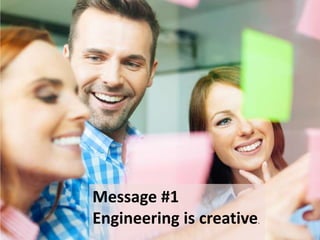
Message #1
Engineering is creative

.
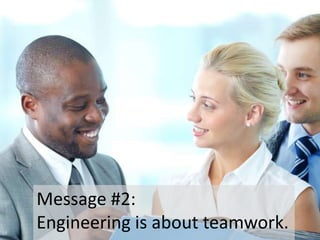
Message #2:
Engineering is about teamwork.
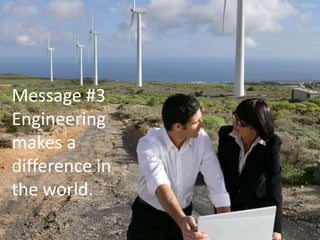
Message #3
Engineering
makes a
difference in
the world.
The Messages
Incorporate these messages when you
introduce yourself to the kids and briefly
explain your job.
The Activity
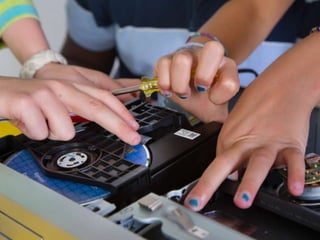
The second part of the formula is
combining the messages with a
hands-on activity.
The Activity: Selecting the Best
One
Go to DiscoverE.org and check out “Cool
Content and Activities.”
The Activity: Selecting the Best
One
Choose an activity that fits your criteria.
Sort by:

Time
Engineering discipline
Age range
The Activity: Selecting the Best
One
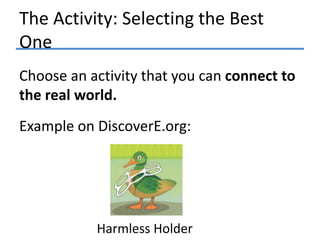
Choose an activity that you can connect to
the real world.
Example on DiscoverE.org:

Harmless Holder
The Activity: Selecting the Best
One
Find more activities at:
www.pbs.org/designsquad
www.pbs.org/buildingbig
www.pbskids.org/zoom
The Activity: Testing It Out
Do the activity before your visit!
The Activity: Testing It Out
Identify the learning goals you want kids to
walk away understanding.
The Activity: Testing It Out
Anticipate where kids may need extra
help. Where might they get stuck?
The Activity: Testing It Out
Make modifications to the activity as
necessary – such as adding or taking away
materials.
The Activity: Testing It Out
Think of ways to extend the challenge for
kids who finish early.
The Activity: Getting Ready to Lead
How does the activity reinforce the
messages of teamwork, making a
difference, or creativity?
Look for opportunities to weave these
messages into your presentation.
The Activity: Getting Ready to Lead
What connections can you make from the
activity to the real world or your area of
engineering? Use photos or real life
examples.
This is a great place to insert the “engineers
make a difference in the world” message.
The Activity: Getting Ready to Lead
Write down some open-ended questions to
ask kids during the activity – starting with
“where” or “why?”
The Activity: Getting Ready to Lead
Plan your time.
Come up with a schedule to help keep the
activity on track.
Be sure to leave time for wrap-up: time to
summarize, reflect on results, and clean
up.
The Activity: Getting Ready to Lead
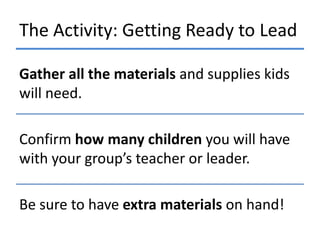
Gather all the materials and supplies kids
will need.
Confirm how many children you will have
with your group’s teacher or leader.

Be sure to have extra materials on hand!
The Activity: Getting Ready to Lead
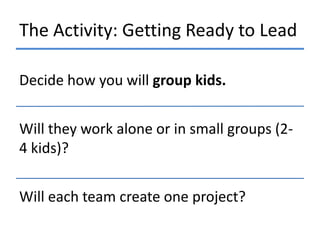
Decide how you will group kids.
Will they work alone or in small groups (24 kids)?
Will each team create one project?
The Activity: Setting the Tone
When you arrive…

Introduce yourself and talk briefly about
your job. Weave in the 3 messages!
The Activity: Setting the Tone
Establish a signal–such as ringing a bell
or quickly flashing the lights–that tells
kids to stop working and listen.

If kids are talking while you are, stop
and wait. They will tend to quiet down
in response to your silence.
The Activity: Setting the Tone
Introduce the engineering design process…
brainstorm, design, build, test, redesign
…and emphasize the value of brainstorming
and exploration, rather than right and wrong.
The Activity: Setting the Tone
Share your enthusiasm for the subject—it
will be contagious.
Have a sense of humor and be patient!
The Activity: Introducing It
Make your activity intro enticing and
short.
You can choose to connect the activity to
real-life examples now or during the wrapup.
The Activity: Introducing It
Give clear instructions.
Fully explain what the activity is and what
kids will be exploring.
Give directions in multiple ways (e.g.,
verbally, written on the board).
The Activity: Introducing It
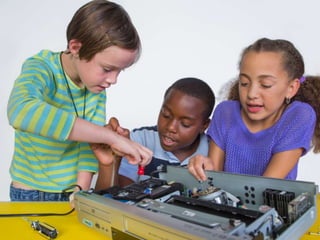
Break kids into teams. This a great time to
tell them how engineers work in teams.
Describe a project that you’ve worked on
that has been a success because of
teamwork.
The Activity: Introducing It
Pass out materials only when you are
ready for the kids to use them.
The Activity: Keeping Kids Engaged
During the activity…
Walk around and ask kids to describe what
they’re doing.
Kids are sensitive about having the "right"
answer, so emphasize the design process
again.
The Activity: Keeping Kids Engaged
Point out things that different teams are doing to
the whole group.
This lets kids know that the activity is do-able and
that they can make a contribution.
Explain that this isn't "copying," but rather
collaborating and building on new information as
engineers do.
The Activity: Keeping Kids Engaged
If a group is not progressing, ask a leading
question to put them back on track,
rather than telling them what to do.
Use open-ended questions starting with:
where, why, or how might you…
The Activity: Keeping Kids Engaged
Have extension ideas ready for those kids
who race through an activity ahead of the
rest of the group.
The Activity: Wrapping It Up
Be sure to leave time to clean up,
summarize and reflect on results.
And give kids a 5-minute warning first!
The Activity: Wrapping It Up
For the discussion, consider changing
locations to capture kids attention (e.g. sit
on floor – away from work stations)
The Activity: Wrapping It Up
If you haven’t already, connect the big idea
of the activity back to the "real world.”
The Activity: Wrapping It Up
Ask: What do you know now that you
didn't know before the activity?
The Activity: Wrapping It Up
Record kids' reflections and explanations in
writing (on flip chart or dry erase board).
The Activity: Wrapping It Up
Keep conversation moving. Have only a few
kids share their designs but ask all kids
“does anyone have a similar design?”
The Activity: Wrapping It Up
If kids worked individually, allow them to
take their products home to share with
their families!
The Formula
Positive engineering messages

+

=

Hands-on activities

a successful outreach
experience.
The Results

You did it!

DiscoverE Leading Kids Through A Successful Engineering Experience

  • 1.
    Leading Kids Througha Successful Engineering Experience An online workshop for volunteers.
  • 2.
    DiscoverE Training Are youlooking for the formula for leading kids through a successful engineering outreach experience?
  • 3.
    The Formula Positive engineeringmessages + = Hands-on activities a successful outreach experience.
  • 4.
    The Messages Research hasshown that effective and positive messages about engineering can increase a student’s understanding and interest in engineering.
  • 5.
    The Messages Find opportunitiesto share the following effective and positive messages with students during your visit.
  • 6.
  • 7.
  • 8.
  • 9.
    The Messages Incorporate thesemessages when you introduce yourself to the kids and briefly explain your job.
  • 11.
    The Activity The secondpart of the formula is combining the messages with a hands-on activity.
  • 12.
    The Activity: Selectingthe Best One Go to DiscoverE.org and check out “Cool Content and Activities.”
  • 13.
    The Activity: Selectingthe Best One Choose an activity that fits your criteria. Sort by: Time Engineering discipline Age range
  • 14.
    The Activity: Selectingthe Best One Choose an activity that you can connect to the real world. Example on DiscoverE.org: Harmless Holder
  • 15.
    The Activity: Selectingthe Best One Find more activities at: www.pbs.org/designsquad www.pbs.org/buildingbig www.pbskids.org/zoom
  • 17.
    The Activity: TestingIt Out Do the activity before your visit!
  • 18.
    The Activity: TestingIt Out Identify the learning goals you want kids to walk away understanding.
  • 19.
    The Activity: TestingIt Out Anticipate where kids may need extra help. Where might they get stuck?
  • 20.
    The Activity: TestingIt Out Make modifications to the activity as necessary – such as adding or taking away materials.
  • 21.
    The Activity: TestingIt Out Think of ways to extend the challenge for kids who finish early.
  • 23.
    The Activity: GettingReady to Lead How does the activity reinforce the messages of teamwork, making a difference, or creativity? Look for opportunities to weave these messages into your presentation.
  • 24.
    The Activity: GettingReady to Lead What connections can you make from the activity to the real world or your area of engineering? Use photos or real life examples. This is a great place to insert the “engineers make a difference in the world” message.
  • 25.
    The Activity: GettingReady to Lead Write down some open-ended questions to ask kids during the activity – starting with “where” or “why?”
  • 26.
    The Activity: GettingReady to Lead Plan your time. Come up with a schedule to help keep the activity on track. Be sure to leave time for wrap-up: time to summarize, reflect on results, and clean up.
  • 27.
    The Activity: GettingReady to Lead Gather all the materials and supplies kids will need. Confirm how many children you will have with your group’s teacher or leader. Be sure to have extra materials on hand!
  • 28.
    The Activity: GettingReady to Lead Decide how you will group kids. Will they work alone or in small groups (24 kids)? Will each team create one project?
  • 30.
    The Activity: Settingthe Tone When you arrive… Introduce yourself and talk briefly about your job. Weave in the 3 messages!
  • 31.
    The Activity: Settingthe Tone Establish a signal–such as ringing a bell or quickly flashing the lights–that tells kids to stop working and listen. If kids are talking while you are, stop and wait. They will tend to quiet down in response to your silence.
  • 32.
    The Activity: Settingthe Tone Introduce the engineering design process… brainstorm, design, build, test, redesign …and emphasize the value of brainstorming and exploration, rather than right and wrong.
  • 33.
    The Activity: Settingthe Tone Share your enthusiasm for the subject—it will be contagious. Have a sense of humor and be patient!
  • 35.
    The Activity: IntroducingIt Make your activity intro enticing and short. You can choose to connect the activity to real-life examples now or during the wrapup.
  • 36.
    The Activity: IntroducingIt Give clear instructions. Fully explain what the activity is and what kids will be exploring. Give directions in multiple ways (e.g., verbally, written on the board).
  • 37.
    The Activity: IntroducingIt Break kids into teams. This a great time to tell them how engineers work in teams. Describe a project that you’ve worked on that has been a success because of teamwork.
  • 38.
    The Activity: IntroducingIt Pass out materials only when you are ready for the kids to use them.
  • 40.
    The Activity: KeepingKids Engaged During the activity… Walk around and ask kids to describe what they’re doing. Kids are sensitive about having the "right" answer, so emphasize the design process again.
  • 41.
    The Activity: KeepingKids Engaged Point out things that different teams are doing to the whole group. This lets kids know that the activity is do-able and that they can make a contribution. Explain that this isn't "copying," but rather collaborating and building on new information as engineers do.
  • 42.
    The Activity: KeepingKids Engaged If a group is not progressing, ask a leading question to put them back on track, rather than telling them what to do. Use open-ended questions starting with: where, why, or how might you…
  • 43.
    The Activity: KeepingKids Engaged Have extension ideas ready for those kids who race through an activity ahead of the rest of the group.
  • 45.
    The Activity: WrappingIt Up Be sure to leave time to clean up, summarize and reflect on results. And give kids a 5-minute warning first!
  • 46.
    The Activity: WrappingIt Up For the discussion, consider changing locations to capture kids attention (e.g. sit on floor – away from work stations)
  • 47.
    The Activity: WrappingIt Up If you haven’t already, connect the big idea of the activity back to the "real world.”
  • 48.
    The Activity: WrappingIt Up Ask: What do you know now that you didn't know before the activity?
  • 49.
    The Activity: WrappingIt Up Record kids' reflections and explanations in writing (on flip chart or dry erase board).
  • 50.
    The Activity: WrappingIt Up Keep conversation moving. Have only a few kids share their designs but ask all kids “does anyone have a similar design?”
  • 51.
    The Activity: WrappingIt Up If kids worked individually, allow them to take their products home to share with their families!
  • 52.
    The Formula Positive engineeringmessages + = Hands-on activities a successful outreach experience.
  • 53.