Learning in a Mobile Age:
a pedagogical framework
FacultyofEducation
Dr. Kevin Burden:
Reader in Digital Education
Faculty of Education,
The University of Hull
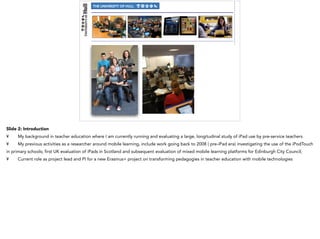
Slide 2: Introduction
¥ My background in teacher education where I am currently running and evaluating a large, longitudinal study of iPad use by pre-service teachers
¥ My previous activities as a researcher around mobile learning, include work going back to 2008 ( pre-iPad era) investigating the use of the iPodTouch
in primary schools; first UK evaluation of iPads in Scotland and subsequent evaluation of mixed mobile learning platforms for Edinburgh City Council;
¥ Current role as project lead and PI for a new Erasmus+ project on transforming pedagogies in teacher education with mobile technologies
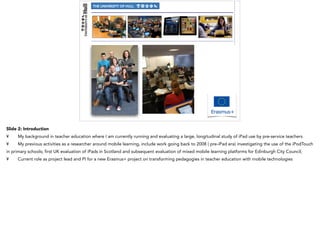
Slide 2: Introduction
¥ My background in teacher education where I am currently running and evaluating a large, longitudinal study of iPad use by pre-service teachers
¥ My previous activities as a researcher around mobile learning, include work going back to 2008 ( pre-iPad era) investigating the use of the iPodTouch
in primary schools; first UK evaluation of iPads in Scotland and subsequent evaluation of mixed mobile learning platforms for Edinburgh City Council;
¥ Current role as project lead and PI for a new Erasmus+ project on transforming pedagogies in teacher education with mobile technologies
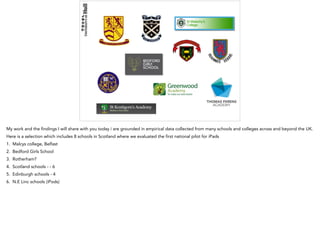
My work and the findings I will share with you today i are grounded in empirical data collected from many schools and colleges across and beyond the UK.
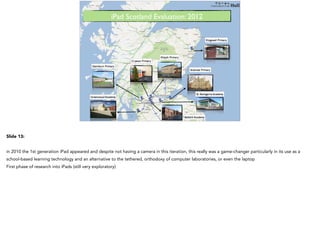
Here is a selection which includes 8 schools in Scotland where we evaluated the first national pilot for iPads
1. Malcys college, Belfast
2. Bedford Girls School
3. Rotherham?
4. Scotland schools - - 6
5. Edinburgh schools - 4
6. N.E Linc schools (iPods)
Outline of presentation:
Part I: Evidence for mobile technology use in
education
Outline of presentation:
Part I: Evidence for mobile technology use in
education
Part II: Frameworks to conceptualise the use of
mobile technologies in Education
Outline of presentation:
Part I: Evidence for mobile technology use in
education
Part II: Frameworks to conceptualise the use of
mobile technologies in Education
Part III: Future developments, research &
opportunities with mobile technologies
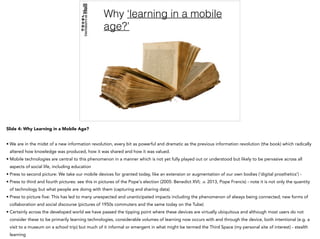
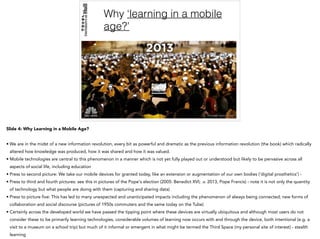
Why ‘learning in a mobile
age?’
Slide 4: Why Learning in a Mobile Age?
• We are in the midst of a new information revolution, every bit as powerful and dramatic as the previous information revolution (the book) which radically
altered how knowledge was produced, how it was shared and how it was valued.
• Mobile technologies are central to this phenomenon in a manner which is not yet fully played out or understood but likely to be pervasive across all
aspects of social life, including education
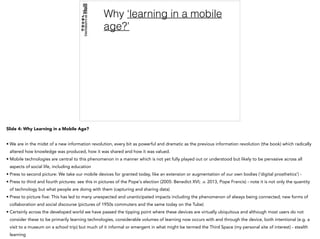
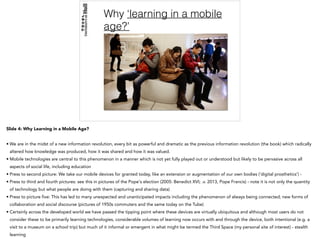
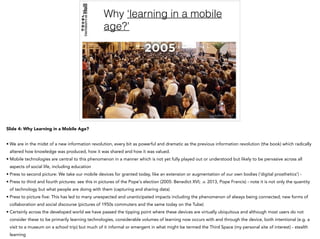
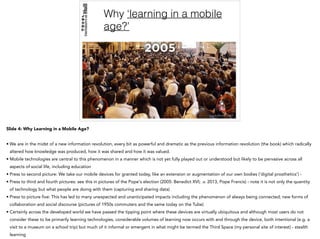
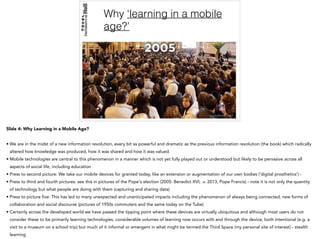
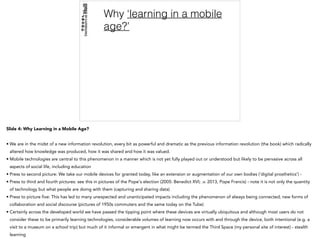
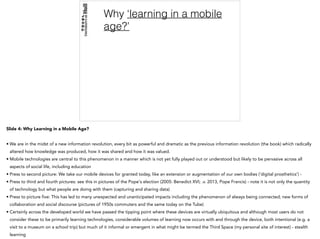
• Press to second picture: We take our mobile devices for granted today, like an extension or augmentation of our own bodies (‘digital prosthetics’) -
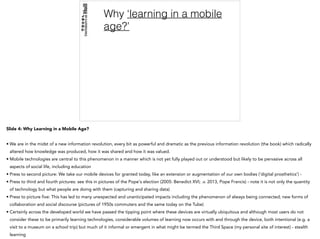
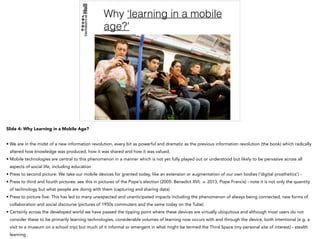
• Press to third and fourth pictures: see this in pictures of the Pope's election (2005: Benedict XVI; .v. 2013, Pope Francis) - note it is not only the quantity
of technology but what people are doing with them (capturing and sharing data)
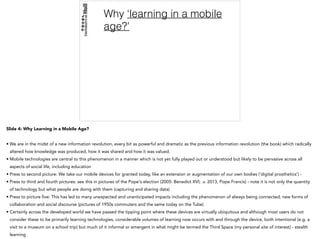
• Press to picture five: This has led to many unexpected and unanticipated impacts including the phenomenon of always being connected; new forms of
collaboration and social discourse (pictures of 1950s commuters and the same today on the Tube)
• Certainly across the developed world we have passed the tipping point where these devices are virtually ubiquitous and although most users do not
consider these to be primarily learning technologies, considerable volumes of learning now occurs with and through the device, both intentional (e.g. a
visit to a museum on a school trip) but much of it informal or emergent in what might be termed the Third Space (my personal site of interest) - stealth
learning
Why ‘learning in a mobile
age?’
Slide 4: Why Learning in a Mobile Age?
• We are in the midst of a new information revolution, every bit as powerful and dramatic as the previous information revolution (the book) which radically
altered how knowledge was produced, how it was shared and how it was valued.
• Mobile technologies are central to this phenomenon in a manner which is not yet fully played out or understood but likely to be pervasive across all
aspects of social life, including education
• Press to second picture: We take our mobile devices for granted today, like an extension or augmentation of our own bodies (‘digital prosthetics’) -
• Press to third and fourth pictures: see this in pictures of the Pope's election (2005: Benedict XVI; .v. 2013, Pope Francis) - note it is not only the quantity
of technology but what people are doing with them (capturing and sharing data)
• Press to picture five: This has led to many unexpected and unanticipated impacts including the phenomenon of always being connected; new forms of
collaboration and social discourse (pictures of 1950s commuters and the same today on the Tube)
• Certainly across the developed world we have passed the tipping point where these devices are virtually ubiquitous and although most users do not
consider these to be primarily learning technologies, considerable volumes of learning now occurs with and through the device, both intentional (e.g. a
visit to a museum on a school trip) but much of it informal or emergent in what might be termed the Third Space (my personal site of interest) - stealth
learning
Why ‘learning in a mobile
age?’
Slide 4: Why Learning in a Mobile Age?
• We are in the midst of a new information revolution, every bit as powerful and dramatic as the previous information revolution (the book) which radically
altered how knowledge was produced, how it was shared and how it was valued.
• Mobile technologies are central to this phenomenon in a manner which is not yet fully played out or understood but likely to be pervasive across all
aspects of social life, including education
• Press to second picture: We take our mobile devices for granted today, like an extension or augmentation of our own bodies (‘digital prosthetics’) -
• Press to third and fourth pictures: see this in pictures of the Pope's election (2005: Benedict XVI; .v. 2013, Pope Francis) - note it is not only the quantity
of technology but what people are doing with them (capturing and sharing data)
• Press to picture five: This has led to many unexpected and unanticipated impacts including the phenomenon of always being connected; new forms of
collaboration and social discourse (pictures of 1950s commuters and the same today on the Tube)
• Certainly across the developed world we have passed the tipping point where these devices are virtually ubiquitous and although most users do not
consider these to be primarily learning technologies, considerable volumes of learning now occurs with and through the device, both intentional (e.g. a
visit to a museum on a school trip) but much of it informal or emergent in what might be termed the Third Space (my personal site of interest) - stealth
learning
Why ‘learning in a mobile
age?’
Slide 4: Why Learning in a Mobile Age?
• We are in the midst of a new information revolution, every bit as powerful and dramatic as the previous information revolution (the book) which radically
altered how knowledge was produced, how it was shared and how it was valued.
• Mobile technologies are central to this phenomenon in a manner which is not yet fully played out or understood but likely to be pervasive across all
aspects of social life, including education
• Press to second picture: We take our mobile devices for granted today, like an extension or augmentation of our own bodies (‘digital prosthetics’) -
• Press to third and fourth pictures: see this in pictures of the Pope's election (2005: Benedict XVI; .v. 2013, Pope Francis) - note it is not only the quantity
of technology but what people are doing with them (capturing and sharing data)
• Press to picture five: This has led to many unexpected and unanticipated impacts including the phenomenon of always being connected; new forms of
collaboration and social discourse (pictures of 1950s commuters and the same today on the Tube)
• Certainly across the developed world we have passed the tipping point where these devices are virtually ubiquitous and although most users do not
consider these to be primarily learning technologies, considerable volumes of learning now occurs with and through the device, both intentional (e.g. a
visit to a museum on a school trip) but much of it informal or emergent in what might be termed the Third Space (my personal site of interest) - stealth
learning
Why ‘learning in a mobile
age?’
Slide 4: Why Learning in a Mobile Age?
• We are in the midst of a new information revolution, every bit as powerful and dramatic as the previous information revolution (the book) which radically
altered how knowledge was produced, how it was shared and how it was valued.
• Mobile technologies are central to this phenomenon in a manner which is not yet fully played out or understood but likely to be pervasive across all
aspects of social life, including education
• Press to second picture: We take our mobile devices for granted today, like an extension or augmentation of our own bodies (‘digital prosthetics’) -
• Press to third and fourth pictures: see this in pictures of the Pope's election (2005: Benedict XVI; .v. 2013, Pope Francis) - note it is not only the quantity
of technology but what people are doing with them (capturing and sharing data)
• Press to picture five: This has led to many unexpected and unanticipated impacts including the phenomenon of always being connected; new forms of
collaboration and social discourse (pictures of 1950s commuters and the same today on the Tube)
• Certainly across the developed world we have passed the tipping point where these devices are virtually ubiquitous and although most users do not
consider these to be primarily learning technologies, considerable volumes of learning now occurs with and through the device, both intentional (e.g. a
visit to a museum on a school trip) but much of it informal or emergent in what might be termed the Third Space (my personal site of interest) - stealth
learning
Why ‘learning in a mobile
age?’
Slide 4: Why Learning in a Mobile Age?
• We are in the midst of a new information revolution, every bit as powerful and dramatic as the previous information revolution (the book) which radically
altered how knowledge was produced, how it was shared and how it was valued.
• Mobile technologies are central to this phenomenon in a manner which is not yet fully played out or understood but likely to be pervasive across all
aspects of social life, including education
• Press to second picture: We take our mobile devices for granted today, like an extension or augmentation of our own bodies (‘digital prosthetics’) -
• Press to third and fourth pictures: see this in pictures of the Pope's election (2005: Benedict XVI; .v. 2013, Pope Francis) - note it is not only the quantity
of technology but what people are doing with them (capturing and sharing data)
• Press to picture five: This has led to many unexpected and unanticipated impacts including the phenomenon of always being connected; new forms of
collaboration and social discourse (pictures of 1950s commuters and the same today on the Tube)
• Certainly across the developed world we have passed the tipping point where these devices are virtually ubiquitous and although most users do not
consider these to be primarily learning technologies, considerable volumes of learning now occurs with and through the device, both intentional (e.g. a
visit to a museum on a school trip) but much of it informal or emergent in what might be termed the Third Space (my personal site of interest) - stealth
learning
Why ‘learning in a mobile
age?’
Slide 4: Why Learning in a Mobile Age?
• We are in the midst of a new information revolution, every bit as powerful and dramatic as the previous information revolution (the book) which radically
altered how knowledge was produced, how it was shared and how it was valued.
• Mobile technologies are central to this phenomenon in a manner which is not yet fully played out or understood but likely to be pervasive across all
aspects of social life, including education
• Press to second picture: We take our mobile devices for granted today, like an extension or augmentation of our own bodies (‘digital prosthetics’) -
• Press to third and fourth pictures: see this in pictures of the Pope's election (2005: Benedict XVI; .v. 2013, Pope Francis) - note it is not only the quantity
of technology but what people are doing with them (capturing and sharing data)
• Press to picture five: This has led to many unexpected and unanticipated impacts including the phenomenon of always being connected; new forms of
collaboration and social discourse (pictures of 1950s commuters and the same today on the Tube)
• Certainly across the developed world we have passed the tipping point where these devices are virtually ubiquitous and although most users do not
consider these to be primarily learning technologies, considerable volumes of learning now occurs with and through the device, both intentional (e.g. a
visit to a museum on a school trip) but much of it informal or emergent in what might be termed the Third Space (my personal site of interest) - stealth
learning
Why ‘learning in a mobile
age?’
Slide 4: Why Learning in a Mobile Age?
• We are in the midst of a new information revolution, every bit as powerful and dramatic as the previous information revolution (the book) which radically
altered how knowledge was produced, how it was shared and how it was valued.
• Mobile technologies are central to this phenomenon in a manner which is not yet fully played out or understood but likely to be pervasive across all
aspects of social life, including education
• Press to second picture: We take our mobile devices for granted today, like an extension or augmentation of our own bodies (‘digital prosthetics’) -
• Press to third and fourth pictures: see this in pictures of the Pope's election (2005: Benedict XVI; .v. 2013, Pope Francis) - note it is not only the quantity
of technology but what people are doing with them (capturing and sharing data)
• Press to picture five: This has led to many unexpected and unanticipated impacts including the phenomenon of always being connected; new forms of
collaboration and social discourse (pictures of 1950s commuters and the same today on the Tube)
• Certainly across the developed world we have passed the tipping point where these devices are virtually ubiquitous and although most users do not
consider these to be primarily learning technologies, considerable volumes of learning now occurs with and through the device, both intentional (e.g. a
visit to a museum on a school trip) but much of it informal or emergent in what might be termed the Third Space (my personal site of interest) - stealth
learning
Why ‘learning in a mobile
age?’
Slide 4: Why Learning in a Mobile Age?
• We are in the midst of a new information revolution, every bit as powerful and dramatic as the previous information revolution (the book) which radically
altered how knowledge was produced, how it was shared and how it was valued.
• Mobile technologies are central to this phenomenon in a manner which is not yet fully played out or understood but likely to be pervasive across all
aspects of social life, including education
• Press to second picture: We take our mobile devices for granted today, like an extension or augmentation of our own bodies (‘digital prosthetics’) -
• Press to third and fourth pictures: see this in pictures of the Pope's election (2005: Benedict XVI; .v. 2013, Pope Francis) - note it is not only the quantity
of technology but what people are doing with them (capturing and sharing data)
• Press to picture five: This has led to many unexpected and unanticipated impacts including the phenomenon of always being connected; new forms of
collaboration and social discourse (pictures of 1950s commuters and the same today on the Tube)
• Certainly across the developed world we have passed the tipping point where these devices are virtually ubiquitous and although most users do not
consider these to be primarily learning technologies, considerable volumes of learning now occurs with and through the device, both intentional (e.g. a
visit to a museum on a school trip) but much of it informal or emergent in what might be termed the Third Space (my personal site of interest) - stealth
learning
Why ‘learning in a mobile
age?’
Slide 4: Why Learning in a Mobile Age?
• We are in the midst of a new information revolution, every bit as powerful and dramatic as the previous information revolution (the book) which radically
altered how knowledge was produced, how it was shared and how it was valued.
• Mobile technologies are central to this phenomenon in a manner which is not yet fully played out or understood but likely to be pervasive across all
aspects of social life, including education
• Press to second picture: We take our mobile devices for granted today, like an extension or augmentation of our own bodies (‘digital prosthetics’) -
• Press to third and fourth pictures: see this in pictures of the Pope's election (2005: Benedict XVI; .v. 2013, Pope Francis) - note it is not only the quantity
of technology but what people are doing with them (capturing and sharing data)
• Press to picture five: This has led to many unexpected and unanticipated impacts including the phenomenon of always being connected; new forms of
collaboration and social discourse (pictures of 1950s commuters and the same today on the Tube)
• Certainly across the developed world we have passed the tipping point where these devices are virtually ubiquitous and although most users do not
consider these to be primarily learning technologies, considerable volumes of learning now occurs with and through the device, both intentional (e.g. a
visit to a museum on a school trip) but much of it informal or emergent in what might be termed the Third Space (my personal site of interest) - stealth
learning
Why ‘learning in a mobile
age?’
Slide 4: Why Learning in a Mobile Age?
• We are in the midst of a new information revolution, every bit as powerful and dramatic as the previous information revolution (the book) which radically
altered how knowledge was produced, how it was shared and how it was valued.
• Mobile technologies are central to this phenomenon in a manner which is not yet fully played out or understood but likely to be pervasive across all
aspects of social life, including education
• Press to second picture: We take our mobile devices for granted today, like an extension or augmentation of our own bodies (‘digital prosthetics’) -
• Press to third and fourth pictures: see this in pictures of the Pope's election (2005: Benedict XVI; .v. 2013, Pope Francis) - note it is not only the quantity
of technology but what people are doing with them (capturing and sharing data)
• Press to picture five: This has led to many unexpected and unanticipated impacts including the phenomenon of always being connected; new forms of
collaboration and social discourse (pictures of 1950s commuters and the same today on the Tube)
• Certainly across the developed world we have passed the tipping point where these devices are virtually ubiquitous and although most users do not
consider these to be primarily learning technologies, considerable volumes of learning now occurs with and through the device, both intentional (e.g. a
visit to a museum on a school trip) but much of it informal or emergent in what might be termed the Third Space (my personal site of interest) - stealth
learning
Why ‘learning in a mobile
age?’
Slide 4: Why Learning in a Mobile Age?
• We are in the midst of a new information revolution, every bit as powerful and dramatic as the previous information revolution (the book) which radically
altered how knowledge was produced, how it was shared and how it was valued.
• Mobile technologies are central to this phenomenon in a manner which is not yet fully played out or understood but likely to be pervasive across all
aspects of social life, including education
• Press to second picture: We take our mobile devices for granted today, like an extension or augmentation of our own bodies (‘digital prosthetics’) -
• Press to third and fourth pictures: see this in pictures of the Pope's election (2005: Benedict XVI; .v. 2013, Pope Francis) - note it is not only the quantity
of technology but what people are doing with them (capturing and sharing data)
• Press to picture five: This has led to many unexpected and unanticipated impacts including the phenomenon of always being connected; new forms of
collaboration and social discourse (pictures of 1950s commuters and the same today on the Tube)
• Certainly across the developed world we have passed the tipping point where these devices are virtually ubiquitous and although most users do not
consider these to be primarily learning technologies, considerable volumes of learning now occurs with and through the device, both intentional (e.g. a
visit to a museum on a school trip) but much of it informal or emergent in what might be termed the Third Space (my personal site of interest) - stealth
learning
Why ‘learning in a mobile
age?’
Slide 4: Why Learning in a Mobile Age?
• We are in the midst of a new information revolution, every bit as powerful and dramatic as the previous information revolution (the book) which radically
altered how knowledge was produced, how it was shared and how it was valued.
• Mobile technologies are central to this phenomenon in a manner which is not yet fully played out or understood but likely to be pervasive across all
aspects of social life, including education
• Press to second picture: We take our mobile devices for granted today, like an extension or augmentation of our own bodies (‘digital prosthetics’) -
• Press to third and fourth pictures: see this in pictures of the Pope's election (2005: Benedict XVI; .v. 2013, Pope Francis) - note it is not only the quantity
of technology but what people are doing with them (capturing and sharing data)
• Press to picture five: This has led to many unexpected and unanticipated impacts including the phenomenon of always being connected; new forms of
collaboration and social discourse (pictures of 1950s commuters and the same today on the Tube)
• Certainly across the developed world we have passed the tipping point where these devices are virtually ubiquitous and although most users do not
consider these to be primarily learning technologies, considerable volumes of learning now occurs with and through the device, both intentional (e.g. a
visit to a museum on a school trip) but much of it informal or emergent in what might be termed the Third Space (my personal site of interest) - stealth
learning
Why ‘learning in a mobile
age?’
Slide 4: Why Learning in a Mobile Age?
• We are in the midst of a new information revolution, every bit as powerful and dramatic as the previous information revolution (the book) which radically
altered how knowledge was produced, how it was shared and how it was valued.
• Mobile technologies are central to this phenomenon in a manner which is not yet fully played out or understood but likely to be pervasive across all
aspects of social life, including education
• Press to second picture: We take our mobile devices for granted today, like an extension or augmentation of our own bodies (‘digital prosthetics’) -
• Press to third and fourth pictures: see this in pictures of the Pope's election (2005: Benedict XVI; .v. 2013, Pope Francis) - note it is not only the quantity
of technology but what people are doing with them (capturing and sharing data)
• Press to picture five: This has led to many unexpected and unanticipated impacts including the phenomenon of always being connected; new forms of
collaboration and social discourse (pictures of 1950s commuters and the same today on the Tube)
• Certainly across the developed world we have passed the tipping point where these devices are virtually ubiquitous and although most users do not
consider these to be primarily learning technologies, considerable volumes of learning now occurs with and through the device, both intentional (e.g. a
visit to a museum on a school trip) but much of it informal or emergent in what might be termed the Third Space (my personal site of interest) - stealth
learning
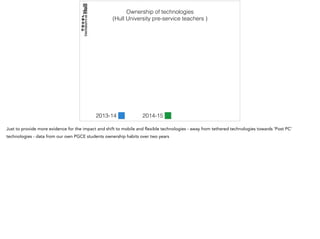
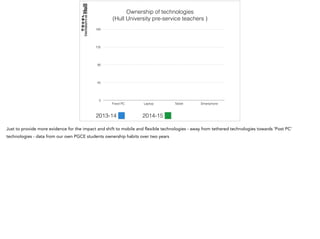
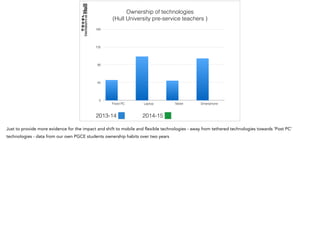
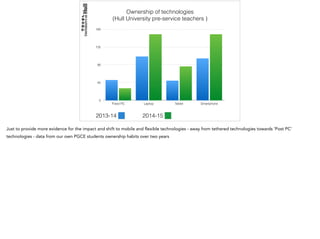
Ownership of technologies
(Hull University pre-service teachers )
2013-14 2014-15
Just to provide more evidence for the impact and shift to mobile and flexible technologies - away from tethered technologies towards ‘Post PC’
technologies - data from our own PGCE students ownership habits over two years
0
45
90
135
180
Fixed PC Laptop Tablet Smartphone
Ownership of technologies
(Hull University pre-service teachers )
2013-14 2014-15
Just to provide more evidence for the impact and shift to mobile and flexible technologies - away from tethered technologies towards ‘Post PC’
technologies - data from our own PGCE students ownership habits over two years
0
45
90
135
180
Fixed PC Laptop Tablet Smartphone
Ownership of technologies
(Hull University pre-service teachers )
2013-14 2014-15
Just to provide more evidence for the impact and shift to mobile and flexible technologies - away from tethered technologies towards ‘Post PC’
technologies - data from our own PGCE students ownership habits over two years
0
45
90
135
180
Fixed PC Laptop Tablet Smartphone
Ownership of technologies
(Hull University pre-service teachers )
2013-14 2014-15
Just to provide more evidence for the impact and shift to mobile and flexible technologies - away from tethered technologies towards ‘Post PC’
technologies - data from our own PGCE students ownership habits over two years
Part I:
The evidence base for
mobile technologies
Slide 6:
So what has research discovered about this phenomenon to date ( remembering the iPad only appeared in 2010 - less than five years of evidence
available)
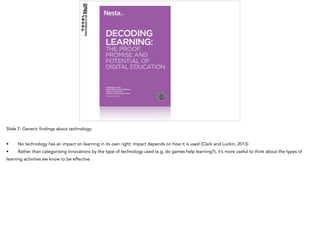
Slide 7: Generic findings about technology:
• No technology has an impact on learning in its own right; impact depends on how it is used (Clark and Luckin, 2013)
• Rather than categorising innovations by the type of technology used (e.g, do games help learning?), it’s more useful to think about the types of
learning activities we know to be effective
Phase I: Exploratory
Studies
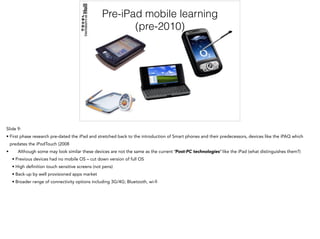
Pre-iPad mobile learning
(pre-2010)
Slide 9:
• First phase research pre-dated the iPad and stretched back to the introduction of Smart phones and their predecessors, devices like the iPAQ which
predates the iPodTouch (2008
• Although some may look similar these devices are not the same as the current ‘Post-PC technologies’ like the iPad (what distinguishes them?)
• Previous devices had no mobile OS – cut down version of full OS
• High definition touch sensitive screens (not pens)
• Back-up by well provisioned apps market
• Broader range of connectivity options including 3G/4G; Bluetooth, wi-fi
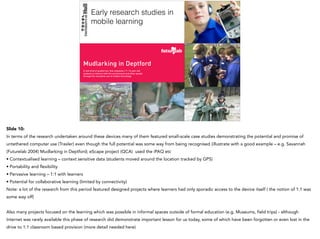
Mudlarking in Deptford
A new kind of guided tour that empowers 11-14 year-old
students to interact with the environment and other people
through the innovative use of mobile technology
Early research studies in
mobile learning
Slide 10:
In terms of the research undertaken around these devices many of them featured small-scale case studies demonstrating the potential and promise of
untethered computer use (Traxler) even though the full potential was some way from being recognised (illustrate with a good example – e.g. Savannah
(Futurelab 2004) Mudlarking in Deptford; eScape project (QCA) used the iPAQ etc
• Contextualised learning – context sensitive data (students moved around the location tracked by GPS)
• Portability and flexibility
• Pervasive learning – 1:1 with learners
• Potential for collaborative learning (limited by connectivity)
Note: a lot of the research from this period featured designed projects where learners had only sporadic access to the device itself ( the notion of 1:1 was
some way off)
Also many projects focused on the learning which was possible in informal spaces outside of formal education (e.g. Museums, field trips) - although
Internet was rarely available this phase of research did demonstrate important lesson for us today, some of which have been forgotten or even lost in the
drive to 1:1 classroom based provision (more detail needed here)
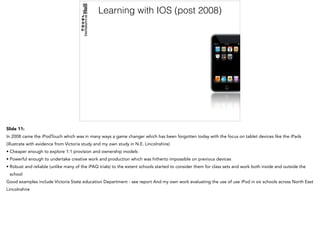
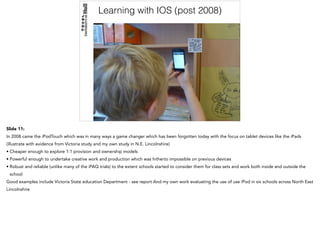
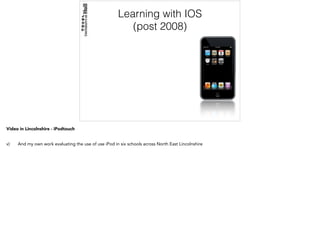
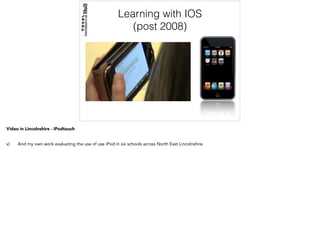
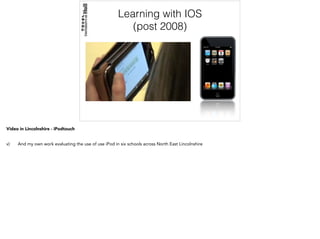
Learning with IOS (post 2008)
Slide 11:
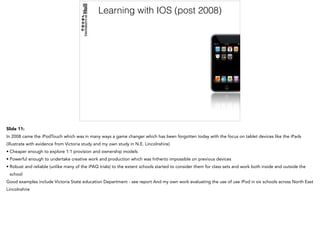
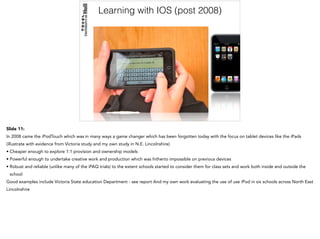
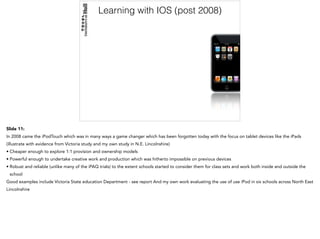
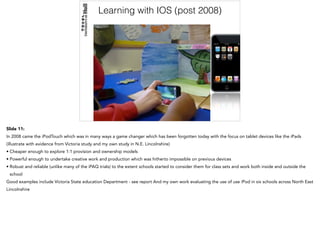
In 2008 came the iPodTouch which was in many ways a game changer which has been forgotten today with the focus on tablet devices like the iPads
(illustrate with evidence from Victoria study and my own study in N.E. Lincolnshire)
• Cheaper enough to explore 1:1 provision and ownership models
• Powerful enough to undertake creative work and production which was hitherto impossible on previous devices
• Robust and reliable (unlike many of the iPAQ trials) to the extent schools started to consider them for class sets and work both inside and outside the
school
Good examples include Victoria State education Department - see report And my own work evaluating the use of use iPod in six schools across North East
Lincolnshire
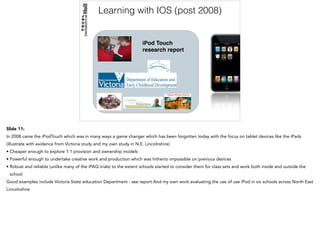
Learning with IOS (post 2008)
!
!
iPod Touch
research report
!
! !
Slide 11:
In 2008 came the iPodTouch which was in many ways a game changer which has been forgotten today with the focus on tablet devices like the iPads
(illustrate with evidence from Victoria study and my own study in N.E. Lincolnshire)
• Cheaper enough to explore 1:1 provision and ownership models
• Powerful enough to undertake creative work and production which was hitherto impossible on previous devices
• Robust and reliable (unlike many of the iPAQ trials) to the extent schools started to consider them for class sets and work both inside and outside the
school
Good examples include Victoria State education Department - see report And my own work evaluating the use of use iPod in six schools across North East
Lincolnshire
Learning with IOS (post 2008)
Slide 11:
In 2008 came the iPodTouch which was in many ways a game changer which has been forgotten today with the focus on tablet devices like the iPads
(illustrate with evidence from Victoria study and my own study in N.E. Lincolnshire)
• Cheaper enough to explore 1:1 provision and ownership models
• Powerful enough to undertake creative work and production which was hitherto impossible on previous devices
• Robust and reliable (unlike many of the iPAQ trials) to the extent schools started to consider them for class sets and work both inside and outside the
school
Good examples include Victoria State education Department - see report And my own work evaluating the use of use iPod in six schools across North East
Lincolnshire
Learning with IOS (post 2008)
Slide 11:
In 2008 came the iPodTouch which was in many ways a game changer which has been forgotten today with the focus on tablet devices like the iPads
(illustrate with evidence from Victoria study and my own study in N.E. Lincolnshire)
• Cheaper enough to explore 1:1 provision and ownership models
• Powerful enough to undertake creative work and production which was hitherto impossible on previous devices
• Robust and reliable (unlike many of the iPAQ trials) to the extent schools started to consider them for class sets and work both inside and outside the
school
Good examples include Victoria State education Department - see report And my own work evaluating the use of use iPod in six schools across North East
Lincolnshire
Learning with IOS (post 2008)
Slide 11:
In 2008 came the iPodTouch which was in many ways a game changer which has been forgotten today with the focus on tablet devices like the iPads
(illustrate with evidence from Victoria study and my own study in N.E. Lincolnshire)
• Cheaper enough to explore 1:1 provision and ownership models
• Powerful enough to undertake creative work and production which was hitherto impossible on previous devices
• Robust and reliable (unlike many of the iPAQ trials) to the extent schools started to consider them for class sets and work both inside and outside the
school
Good examples include Victoria State education Department - see report And my own work evaluating the use of use iPod in six schools across North East
Lincolnshire
Learning with IOS (post 2008)
Slide 11:
In 2008 came the iPodTouch which was in many ways a game changer which has been forgotten today with the focus on tablet devices like the iPads
(illustrate with evidence from Victoria study and my own study in N.E. Lincolnshire)
• Cheaper enough to explore 1:1 provision and ownership models
• Powerful enough to undertake creative work and production which was hitherto impossible on previous devices
• Robust and reliable (unlike many of the iPAQ trials) to the extent schools started to consider them for class sets and work both inside and outside the
school
Good examples include Victoria State education Department - see report And my own work evaluating the use of use iPod in six schools across North East
Lincolnshire
Learning with IOS (post 2008)
Slide 11:
In 2008 came the iPodTouch which was in many ways a game changer which has been forgotten today with the focus on tablet devices like the iPads
(illustrate with evidence from Victoria study and my own study in N.E. Lincolnshire)
• Cheaper enough to explore 1:1 provision and ownership models
• Powerful enough to undertake creative work and production which was hitherto impossible on previous devices
• Robust and reliable (unlike many of the iPAQ trials) to the extent schools started to consider them for class sets and work both inside and outside the
school
Good examples include Victoria State education Department - see report And my own work evaluating the use of use iPod in six schools across North East
Lincolnshire
Learning with IOS (post 2008)
Slide 11:
In 2008 came the iPodTouch which was in many ways a game changer which has been forgotten today with the focus on tablet devices like the iPads
(illustrate with evidence from Victoria study and my own study in N.E. Lincolnshire)
• Cheaper enough to explore 1:1 provision and ownership models
• Powerful enough to undertake creative work and production which was hitherto impossible on previous devices
• Robust and reliable (unlike many of the iPAQ trials) to the extent schools started to consider them for class sets and work both inside and outside the
school
Good examples include Victoria State education Department - see report And my own work evaluating the use of use iPod in six schools across North East
Lincolnshire
Learning with IOS (post 2008)
Slide 11:
In 2008 came the iPodTouch which was in many ways a game changer which has been forgotten today with the focus on tablet devices like the iPads
(illustrate with evidence from Victoria study and my own study in N.E. Lincolnshire)
• Cheaper enough to explore 1:1 provision and ownership models
• Powerful enough to undertake creative work and production which was hitherto impossible on previous devices
• Robust and reliable (unlike many of the iPAQ trials) to the extent schools started to consider them for class sets and work both inside and outside the
school
Good examples include Victoria State education Department - see report And my own work evaluating the use of use iPod in six schools across North East
Lincolnshire
Learning with IOS (post 2008)
Slide 11:
In 2008 came the iPodTouch which was in many ways a game changer which has been forgotten today with the focus on tablet devices like the iPads
(illustrate with evidence from Victoria study and my own study in N.E. Lincolnshire)
• Cheaper enough to explore 1:1 provision and ownership models
• Powerful enough to undertake creative work and production which was hitherto impossible on previous devices
• Robust and reliable (unlike many of the iPAQ trials) to the extent schools started to consider them for class sets and work both inside and outside the
school
Good examples include Victoria State education Department - see report And my own work evaluating the use of use iPod in six schools across North East
Lincolnshire
Learning with IOS
(post 2008)
Video in Lincolnshire - iPodtouch
v) And my own work evaluating the use of use iPod in six schools across North East Lincolnshire
Learning with IOS
(post 2008)
Video in Lincolnshire - iPodtouch
v) And my own work evaluating the use of use iPod in six schools across North East Lincolnshire
Learning with IOS
(post 2008)
Video in Lincolnshire - iPodtouch
v) And my own work evaluating the use of use iPod in six schools across North East Lincolnshire
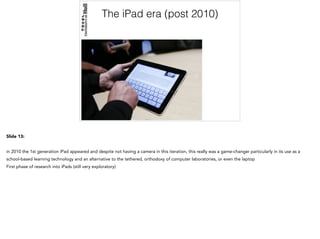
The iPad era (post 2010)
Slide 13:
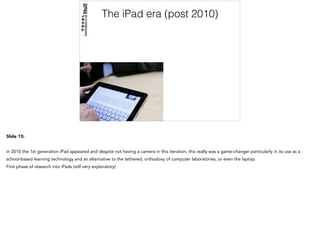
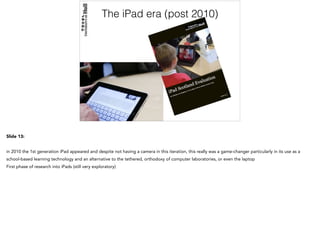
in 2010 the 1st generation iPad appeared and despite not having a camera in this iteration, this really was a game-changer particularly in its use as a
school-based learning technology and an alternative to the tethered, orthodoxy of computer laboratories, or even the laptop
First phase of research into iPads (still very exploratory)
The iPad era (post 2010)
Slide 13:
in 2010 the 1st generation iPad appeared and despite not having a camera in this iteration, this really was a game-changer particularly in its use as a
school-based learning technology and an alternative to the tethered, orthodoxy of computer laboratories, or even the laptop
First phase of research into iPads (still very exploratory)
The iPad era (post 2010)
Slide 13:
in 2010 the 1st generation iPad appeared and despite not having a camera in this iteration, this really was a game-changer particularly in its use as a
school-based learning technology and an alternative to the tethered, orthodoxy of computer laboratories, or even the laptop
First phase of research into iPads (still very exploratory)
The iPad era (post 2010)
Slide 13:
in 2010 the 1st generation iPad appeared and despite not having a camera in this iteration, this really was a game-changer particularly in its use as a
school-based learning technology and an alternative to the tethered, orthodoxy of computer laboratories, or even the laptop
First phase of research into iPads (still very exploratory)
The iPad era (post 2010)iPad Scotland Evaluation: 2012!
Slide 13:
in 2010 the 1st generation iPad appeared and despite not having a camera in this iteration, this really was a game-changer particularly in its use as a
school-based learning technology and an alternative to the tethered, orthodoxy of computer laboratories, or even the laptop
First phase of research into iPads (still very exploratory)
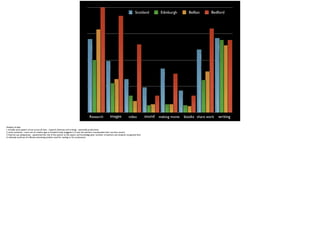
What do students u
regularly in scho
0
25
50
75
100
Research video making movie share work
Scotland Edinburgh Belfast Bedford
images sound books writing
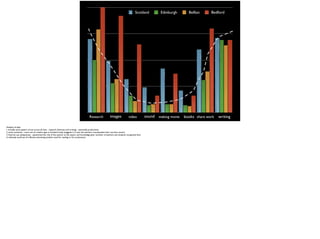
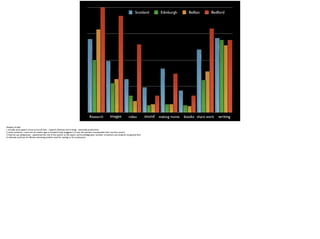
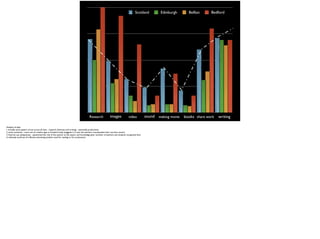
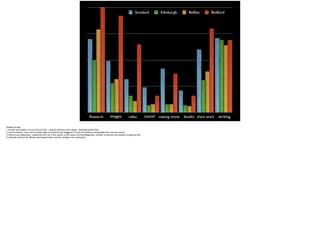
Analysis of data:
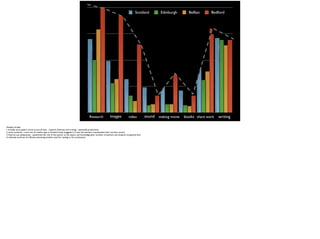
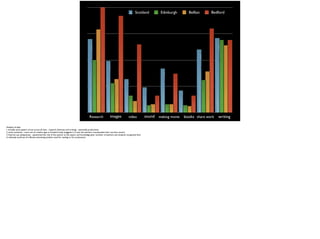
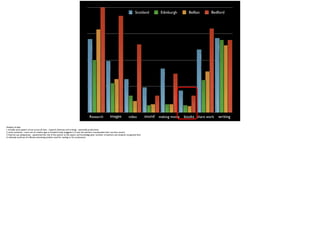
1. broadly same pattern of use across all sites - research (Internet and writing) - essentially productivity
2. some variations - more use of creative apps in Scotland study (suggests it is how the teachers conceptualise their use that counts)
3. Internet use (ubiquitous) - questioned the role of the teacher as the expert and knowledge giver (number of teachers and students recognised this)
4. relatively small use of e-Books interesting (neither used for reading or for production)
What do students u
regularly in scho
0
25
50
75
100
Research video making movie share work
Scotland Edinburgh Belfast Bedford
images sound books writing
Analysis of data:
1. broadly same pattern of use across all sites - research (Internet and writing) - essentially productivity
2. some variations - more use of creative apps in Scotland study (suggests it is how the teachers conceptualise their use that counts)
3. Internet use (ubiquitous) - questioned the role of the teacher as the expert and knowledge giver (number of teachers and students recognised this)
4. relatively small use of e-Books interesting (neither used for reading or for production)
What do students u
regularly in scho
0
25
50
75
100
Research video making movie share work
Scotland Edinburgh Belfast Bedford
images sound books writing
Analysis of data:
1. broadly same pattern of use across all sites - research (Internet and writing) - essentially productivity
2. some variations - more use of creative apps in Scotland study (suggests it is how the teachers conceptualise their use that counts)
3. Internet use (ubiquitous) - questioned the role of the teacher as the expert and knowledge giver (number of teachers and students recognised this)
4. relatively small use of e-Books interesting (neither used for reading or for production)
What do students u
regularly in scho
0
25
50
75
100
Research video making movie share work
Scotland Edinburgh Belfast Bedford
images sound books writing
Analysis of data:
1. broadly same pattern of use across all sites - research (Internet and writing) - essentially productivity
2. some variations - more use of creative apps in Scotland study (suggests it is how the teachers conceptualise their use that counts)
3. Internet use (ubiquitous) - questioned the role of the teacher as the expert and knowledge giver (number of teachers and students recognised this)
4. relatively small use of e-Books interesting (neither used for reading or for production)
What do students u
regularly in scho
0
25
50
75
100
Research video making movie share work
Scotland Edinburgh Belfast Bedford
images sound books writing
Analysis of data:
1. broadly same pattern of use across all sites - research (Internet and writing) - essentially productivity
2. some variations - more use of creative apps in Scotland study (suggests it is how the teachers conceptualise their use that counts)
3. Internet use (ubiquitous) - questioned the role of the teacher as the expert and knowledge giver (number of teachers and students recognised this)
4. relatively small use of e-Books interesting (neither used for reading or for production)
What do students u
regularly in scho
0
25
50
75
100
Research video making movie share work
Scotland Edinburgh Belfast Bedford
images sound books writing
Analysis of data:
1. broadly same pattern of use across all sites - research (Internet and writing) - essentially productivity
2. some variations - more use of creative apps in Scotland study (suggests it is how the teachers conceptualise their use that counts)
3. Internet use (ubiquitous) - questioned the role of the teacher as the expert and knowledge giver (number of teachers and students recognised this)
4. relatively small use of e-Books interesting (neither used for reading or for production)
What do students u
regularly in scho
0
25
50
75
100
Research video making movie share work
Scotland Edinburgh Belfast Bedford
images sound books writing
Analysis of data:
1. broadly same pattern of use across all sites - research (Internet and writing) - essentially productivity
2. some variations - more use of creative apps in Scotland study (suggests it is how the teachers conceptualise their use that counts)
3. Internet use (ubiquitous) - questioned the role of the teacher as the expert and knowledge giver (number of teachers and students recognised this)
4. relatively small use of e-Books interesting (neither used for reading or for production)
What do students u
regularly in scho
0
25
50
75
100
Research video making movie share work
Scotland Edinburgh Belfast Bedford
images sound books writing
Analysis of data:
1. broadly same pattern of use across all sites - research (Internet and writing) - essentially productivity
2. some variations - more use of creative apps in Scotland study (suggests it is how the teachers conceptualise their use that counts)
3. Internet use (ubiquitous) - questioned the role of the teacher as the expert and knowledge giver (number of teachers and students recognised this)
4. relatively small use of e-Books interesting (neither used for reading or for production)
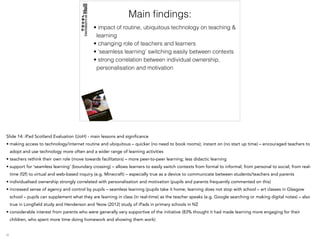
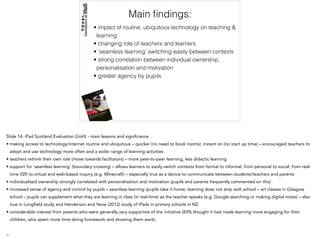
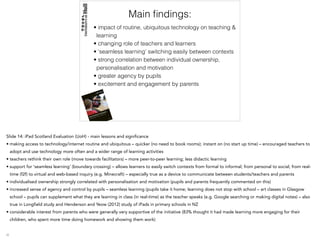
Main findings:
Slide 14: iPad Scotland Evaluation (UoH) - main lessons and significance
• making access to technology/internet routine and ubiquitous – quicker (no need to book rooms); instant on (no start up time) – encouraged teachers to
adopt and use technology more often and a wider range of learning activities
• teachers rethink their own role (move towards facilitators) – more peer-to-peer learning; less didactic learning
• support for ‘seamless learning’ (boundary crossing) – allows learners to easily switch contexts from formal to informal; from personal to social; from real-
time (f2f) to virtual and web-based inquiry (e.g. Minecraft) – especially true as a device to communicate between students/teachers and parents
• individualised ownership strongly correlated with personalisation and motivation (pupils and parents frequently commented on this)
• increased sense of agency and control by pupils – seamless learning (pupils take it home; learning does not stop with school – art classes in Glasgow
school – pupils can supplement what they are learning in class (in real-time) as the teacher speaks (e.g. Google searching or making digital notes) – also
true in Longfield study and Henderson and Yeow (2012) study of iPads in primary schools in NZ
• considerable interest from parents who were generally very supportive of the initiative (83% thought it had made learning more engaging for their
children, who spent more time doing homework and showing them work)
Main findings:
• impact of routine, ubiquitous technology on teaching &
learning
Slide 14: iPad Scotland Evaluation (UoH) - main lessons and significance
• making access to technology/internet routine and ubiquitous – quicker (no need to book rooms); instant on (no start up time) – encouraged teachers to
adopt and use technology more often and a wider range of learning activities
• teachers rethink their own role (move towards facilitators) – more peer-to-peer learning; less didactic learning
• support for ‘seamless learning’ (boundary crossing) – allows learners to easily switch contexts from formal to informal; from personal to social; from real-
time (f2f) to virtual and web-based inquiry (e.g. Minecraft) – especially true as a device to communicate between students/teachers and parents
• individualised ownership strongly correlated with personalisation and motivation (pupils and parents frequently commented on this)
• increased sense of agency and control by pupils – seamless learning (pupils take it home; learning does not stop with school – art classes in Glasgow
school – pupils can supplement what they are learning in class (in real-time) as the teacher speaks (e.g. Google searching or making digital notes) – also
true in Longfield study and Henderson and Yeow (2012) study of iPads in primary schools in NZ
• considerable interest from parents who were generally very supportive of the initiative (83% thought it had made learning more engaging for their
children, who spent more time doing homework and showing them work)
Main findings:
• impact of routine, ubiquitous technology on teaching &
learning
• changing role of teachers and learners
Slide 14: iPad Scotland Evaluation (UoH) - main lessons and significance
• making access to technology/internet routine and ubiquitous – quicker (no need to book rooms); instant on (no start up time) – encouraged teachers to
adopt and use technology more often and a wider range of learning activities
• teachers rethink their own role (move towards facilitators) – more peer-to-peer learning; less didactic learning
• support for ‘seamless learning’ (boundary crossing) – allows learners to easily switch contexts from formal to informal; from personal to social; from real-
time (f2f) to virtual and web-based inquiry (e.g. Minecraft) – especially true as a device to communicate between students/teachers and parents
• individualised ownership strongly correlated with personalisation and motivation (pupils and parents frequently commented on this)
• increased sense of agency and control by pupils – seamless learning (pupils take it home; learning does not stop with school – art classes in Glasgow
school – pupils can supplement what they are learning in class (in real-time) as the teacher speaks (e.g. Google searching or making digital notes) – also
true in Longfield study and Henderson and Yeow (2012) study of iPads in primary schools in NZ
• considerable interest from parents who were generally very supportive of the initiative (83% thought it had made learning more engaging for their
children, who spent more time doing homework and showing them work)
Main findings:
• impact of routine, ubiquitous technology on teaching &
learning
• changing role of teachers and learners
• ‘seamless learning’ switching easily between contexts
Slide 14: iPad Scotland Evaluation (UoH) - main lessons and significance
• making access to technology/internet routine and ubiquitous – quicker (no need to book rooms); instant on (no start up time) – encouraged teachers to
adopt and use technology more often and a wider range of learning activities
• teachers rethink their own role (move towards facilitators) – more peer-to-peer learning; less didactic learning
• support for ‘seamless learning’ (boundary crossing) – allows learners to easily switch contexts from formal to informal; from personal to social; from real-
time (f2f) to virtual and web-based inquiry (e.g. Minecraft) – especially true as a device to communicate between students/teachers and parents
• individualised ownership strongly correlated with personalisation and motivation (pupils and parents frequently commented on this)
• increased sense of agency and control by pupils – seamless learning (pupils take it home; learning does not stop with school – art classes in Glasgow
school – pupils can supplement what they are learning in class (in real-time) as the teacher speaks (e.g. Google searching or making digital notes) – also
true in Longfield study and Henderson and Yeow (2012) study of iPads in primary schools in NZ
• considerable interest from parents who were generally very supportive of the initiative (83% thought it had made learning more engaging for their
children, who spent more time doing homework and showing them work)
Main findings:
• impact of routine, ubiquitous technology on teaching &
learning
• changing role of teachers and learners
• ‘seamless learning’ switching easily between contexts
• strong correlation between individual ownership,
personalisation and motivation
Slide 14: iPad Scotland Evaluation (UoH) - main lessons and significance
• making access to technology/internet routine and ubiquitous – quicker (no need to book rooms); instant on (no start up time) – encouraged teachers to
adopt and use technology more often and a wider range of learning activities
• teachers rethink their own role (move towards facilitators) – more peer-to-peer learning; less didactic learning
• support for ‘seamless learning’ (boundary crossing) – allows learners to easily switch contexts from formal to informal; from personal to social; from real-
time (f2f) to virtual and web-based inquiry (e.g. Minecraft) – especially true as a device to communicate between students/teachers and parents
• individualised ownership strongly correlated with personalisation and motivation (pupils and parents frequently commented on this)
• increased sense of agency and control by pupils – seamless learning (pupils take it home; learning does not stop with school – art classes in Glasgow
school – pupils can supplement what they are learning in class (in real-time) as the teacher speaks (e.g. Google searching or making digital notes) – also
true in Longfield study and Henderson and Yeow (2012) study of iPads in primary schools in NZ
• considerable interest from parents who were generally very supportive of the initiative (83% thought it had made learning more engaging for their
children, who spent more time doing homework and showing them work)
Main findings:
• impact of routine, ubiquitous technology on teaching &
learning
• changing role of teachers and learners
• ‘seamless learning’ switching easily between contexts
• strong correlation between individual ownership,
personalisation and motivation
• greater agency by pupils
Slide 14: iPad Scotland Evaluation (UoH) - main lessons and significance
• making access to technology/internet routine and ubiquitous – quicker (no need to book rooms); instant on (no start up time) – encouraged teachers to
adopt and use technology more often and a wider range of learning activities
• teachers rethink their own role (move towards facilitators) – more peer-to-peer learning; less didactic learning
• support for ‘seamless learning’ (boundary crossing) – allows learners to easily switch contexts from formal to informal; from personal to social; from real-
time (f2f) to virtual and web-based inquiry (e.g. Minecraft) – especially true as a device to communicate between students/teachers and parents
• individualised ownership strongly correlated with personalisation and motivation (pupils and parents frequently commented on this)
• increased sense of agency and control by pupils – seamless learning (pupils take it home; learning does not stop with school – art classes in Glasgow
school – pupils can supplement what they are learning in class (in real-time) as the teacher speaks (e.g. Google searching or making digital notes) – also
true in Longfield study and Henderson and Yeow (2012) study of iPads in primary schools in NZ
• considerable interest from parents who were generally very supportive of the initiative (83% thought it had made learning more engaging for their
children, who spent more time doing homework and showing them work)
Main findings:
• impact of routine, ubiquitous technology on teaching &
learning
• changing role of teachers and learners
• ‘seamless learning’ switching easily between contexts
• strong correlation between individual ownership,
personalisation and motivation
• greater agency by pupils
• excitement and engagement by parents
Slide 14: iPad Scotland Evaluation (UoH) - main lessons and significance
• making access to technology/internet routine and ubiquitous – quicker (no need to book rooms); instant on (no start up time) – encouraged teachers to
adopt and use technology more often and a wider range of learning activities
• teachers rethink their own role (move towards facilitators) – more peer-to-peer learning; less didactic learning
• support for ‘seamless learning’ (boundary crossing) – allows learners to easily switch contexts from formal to informal; from personal to social; from real-
time (f2f) to virtual and web-based inquiry (e.g. Minecraft) – especially true as a device to communicate between students/teachers and parents
• individualised ownership strongly correlated with personalisation and motivation (pupils and parents frequently commented on this)
• increased sense of agency and control by pupils – seamless learning (pupils take it home; learning does not stop with school – art classes in Glasgow
school – pupils can supplement what they are learning in class (in real-time) as the teacher speaks (e.g. Google searching or making digital notes) – also
true in Longfield study and Henderson and Yeow (2012) study of iPads in primary schools in NZ
• considerable interest from parents who were generally very supportive of the initiative (83% thought it had made learning more engaging for their
children, who spent more time doing homework and showing them work)
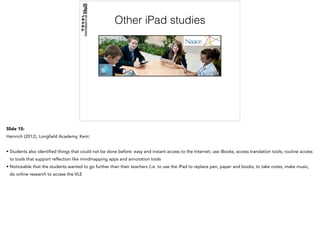
Other iPad studies
Slide 15:
Heinrich (2012), Longfield Academy, Kent:
• Students also identified things that could not be done before: easy and instant access to the Internet; use iBooks; access translation tools; routine access
to tools that support reflection like mindmapping apps and annotation tools
• Noticeable that the students wanted to go further than their teachers (i.e. to use the iPad to replace pen, paper and books; to take notes, make music,
do online research to access the VLE
Part II:
Frameworks to conceptualise
the pedagogical impact of
mobile technologies
S.A.M.R
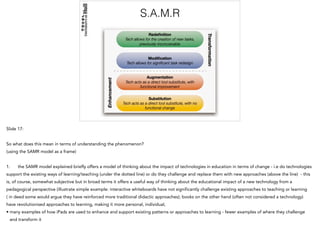
Slide 17:
So what does this mean in terms of understanding the phenomenon?
(using the SAMR model as a frame)
1. the SAMR model explained briefly offers a model of thinking about the impact of technologies in education in terms of change - i.e do technologies
support the existing ways of learning/teaching (under the dotted line) or do they challenge and replace them with new approaches (above the line) - this
is, of course, somewhat subjective but in broad terms it offers a useful way of thinking about the educational impact of a new technology from a
pedagogical perspective (illustrate simple example: interactive whiteboards have not significantly challenge existing approaches to teaching or learning
( in deed some would argue they have reinforced more traditional didactic approaches); books on the other hand (often not considered a technology)
have revolutionised approaches to learning, making it more personal, individual,
• many examples of how iPads are used to enhance and support existing patterns or approaches to learning - fewer examples of where they challenge
and transform it
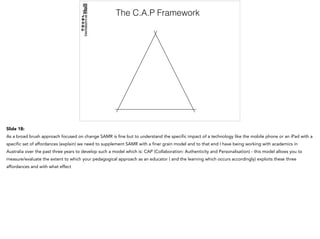
The C.A.P Framework
A pedagogical framework
for mobile learning
Kearney, M., Schuck, S., Burden, K., & Aubusson, P. (2012) 
Viewing mobile learning from a pedagogical perspective, 
Research in Learning Technology
Vol. 20, 2012
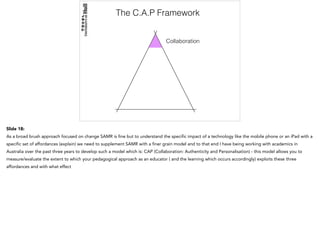
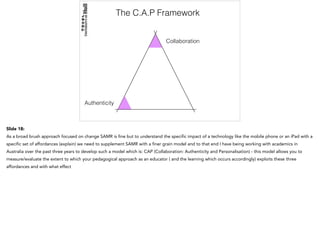
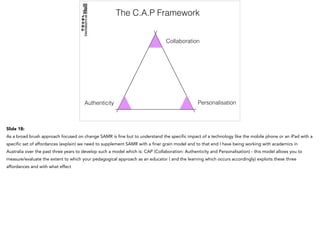
Slide 18:
As a broad brush approach focused on change SAMR is fine but to understand the specific impact of a technology like the mobile phone or an iPad with a
specific set of affordances (explain) we need to supplement SAMR with a finer grain model and to that end I have being working with academics in
Australia over the past three years to develop such a model which is: CAP (Collaboration: Authenticity and Personalisation) - this model allows you to
measure/evaluate the extent to which your pedagogical approach as an educator ( and the learning which occurs accordingly) exploits these three
affordances and with what effect
The C.A.P Framework
Slide 18:
As a broad brush approach focused on change SAMR is fine but to understand the specific impact of a technology like the mobile phone or an iPad with a
specific set of affordances (explain) we need to supplement SAMR with a finer grain model and to that end I have being working with academics in
Australia over the past three years to develop such a model which is: CAP (Collaboration: Authenticity and Personalisation) - this model allows you to
measure/evaluate the extent to which your pedagogical approach as an educator ( and the learning which occurs accordingly) exploits these three
affordances and with what effect
The C.A.P Framework
Slide 18:
As a broad brush approach focused on change SAMR is fine but to understand the specific impact of a technology like the mobile phone or an iPad with a
specific set of affordances (explain) we need to supplement SAMR with a finer grain model and to that end I have being working with academics in
Australia over the past three years to develop such a model which is: CAP (Collaboration: Authenticity and Personalisation) - this model allows you to
measure/evaluate the extent to which your pedagogical approach as an educator ( and the learning which occurs accordingly) exploits these three
affordances and with what effect
The C.A.P Framework
Collaboration
Slide 18:
As a broad brush approach focused on change SAMR is fine but to understand the specific impact of a technology like the mobile phone or an iPad with a
specific set of affordances (explain) we need to supplement SAMR with a finer grain model and to that end I have being working with academics in
Australia over the past three years to develop such a model which is: CAP (Collaboration: Authenticity and Personalisation) - this model allows you to
measure/evaluate the extent to which your pedagogical approach as an educator ( and the learning which occurs accordingly) exploits these three
affordances and with what effect
The C.A.P Framework
Collaboration
Authenticity
Slide 18:
As a broad brush approach focused on change SAMR is fine but to understand the specific impact of a technology like the mobile phone or an iPad with a
specific set of affordances (explain) we need to supplement SAMR with a finer grain model and to that end I have being working with academics in
Australia over the past three years to develop such a model which is: CAP (Collaboration: Authenticity and Personalisation) - this model allows you to
measure/evaluate the extent to which your pedagogical approach as an educator ( and the learning which occurs accordingly) exploits these three
affordances and with what effect
The C.A.P Framework
Collaboration
Authenticity Personalisation
Slide 18:
As a broad brush approach focused on change SAMR is fine but to understand the specific impact of a technology like the mobile phone or an iPad with a
specific set of affordances (explain) we need to supplement SAMR with a finer grain model and to that end I have being working with academics in
Australia over the past three years to develop such a model which is: CAP (Collaboration: Authenticity and Personalisation) - this model allows you to
measure/evaluate the extent to which your pedagogical approach as an educator ( and the learning which occurs accordingly) exploits these three
affordances and with what effect
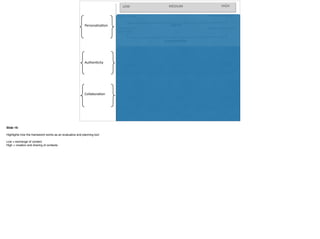
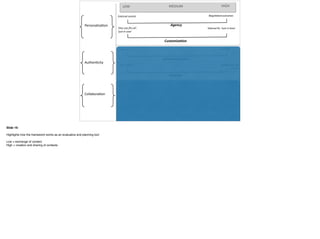
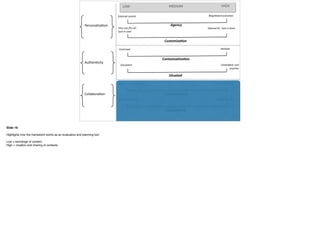
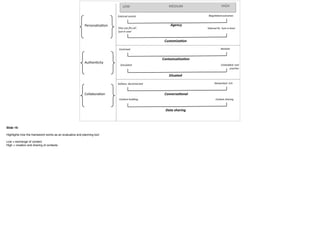
Agency
LOW MEDIUM HIGH
Customiza0on
Contextualiza0on
Situated
Conversa0onal
Data	
  sharing
External	
  control Nego.ated	
  outcomes
‘One	
  size	
  fits	
  all’:	
  
‘just	
  in	
  case’
Tailored	
  fit:	
  ‘Just	
  in	
  <me’
Personaliza<on
Contrived Realis.c
Simulated Embedded:	
  real	
  
prac.ce
Authen<city
Collabora<on
Solitary:	
  disconnected Networked:	
  rich
Content	
  building Context	
  sharing
Slide 19:
Highlights how the framework works as an evaluative and planning tool
Low = exchange of content
High = creation and sharing of contexts
Agency
LOW MEDIUM HIGH
Customiza0on
Contextualiza0on
Situated
Conversa0onal
Data	
  sharing
External	
  control Nego.ated	
  outcomes
‘One	
  size	
  fits	
  all’:	
  
‘just	
  in	
  case’
Tailored	
  fit:	
  ‘Just	
  in	
  <me’
Personaliza<on
Contrived Realis.c
Simulated Embedded:	
  real	
  
prac.ce
Authen<city
Collabora<on
Solitary:	
  disconnected Networked:	
  rich
Content	
  building Context	
  sharing
Slide 19:
Highlights how the framework works as an evaluative and planning tool
Low = exchange of content
High = creation and sharing of contexts
Agency
LOW MEDIUM HIGH
Customiza0on
Contextualiza0on
Situated
Conversa0onal
Data	
  sharing
External	
  control Nego.ated	
  outcomes
‘One	
  size	
  fits	
  all’:	
  
‘just	
  in	
  case’
Tailored	
  fit:	
  ‘Just	
  in	
  <me’
Personaliza<on
Contrived Realis.c
Simulated Embedded:	
  real	
  
prac.ce
Authen<city
Collabora<on
Solitary:	
  disconnected Networked:	
  rich
Content	
  building Context	
  sharing
Slide 19:
Highlights how the framework works as an evaluative and planning tool
Low = exchange of content
High = creation and sharing of contexts
Agency
LOW MEDIUM HIGH
Customiza0on
Contextualiza0on
Situated
Conversa0onal
Data	
  sharing
External	
  control Nego.ated	
  outcomes
‘One	
  size	
  fits	
  all’:	
  
‘just	
  in	
  case’
Tailored	
  fit:	
  ‘Just	
  in	
  <me’
Personaliza<on
Contrived Realis.c
Simulated Embedded:	
  real	
  
prac.ce
Authen<city
Collabora<on
Solitary:	
  disconnected Networked:	
  rich
Content	
  building Context	
  sharing
Slide 19:
Highlights how the framework works as an evaluative and planning tool
Low = exchange of content
High = creation and sharing of contexts
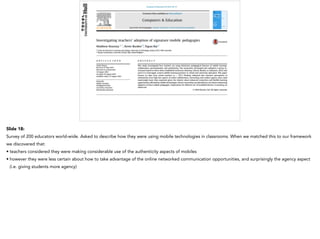
Slide 18:
Survey of 200 educators world-wide. Asked to describe how they were using mobile technologies in classrooms. When we matched this to our framework
we discovered that:
• teachers considered they were making considerable use of the authenticity aspects of mobiles
• however they were less certain about how to take advantage of the online networked communication opportunities, and surprisingly the agency aspect
(i.e. giving students more agency)
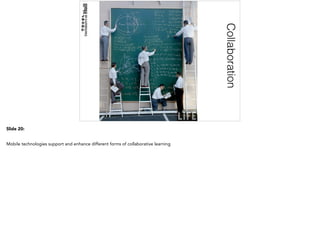
Collaboration
Slide 20:
Mobile technologies support and enhance different forms of collaborative learning
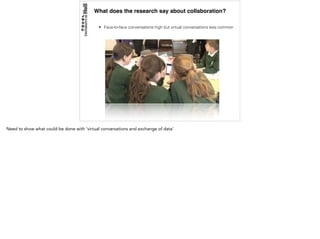
What does the research say about collaboration?
• Face-to-face conversations high but virtual conversations less common
Need to show what could be done with ‘virtual conversations and exchange of data’
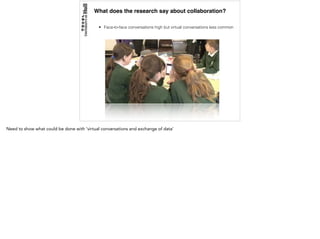
What does the research say about collaboration?
• Face-to-face conversations high but virtual conversations less common
Need to show what could be done with ‘virtual conversations and exchange of data’
What does the research say about collaboration?
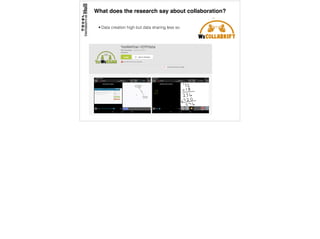
• Data creation high but data sharing less so
What does the research say about collaboration?
• Data creation high but data sharing less so
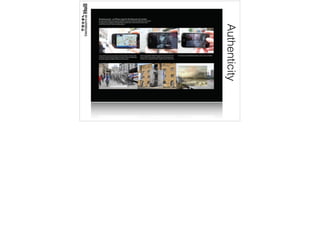
Authenticity
What does the research say about authenticity?
Slide 24:
Authenticity
1. Use of tools like professional use in real-life
2. Use of live and dynamic data in the classroom
3. Ability to situate learning outside of formal contexts – field trips; etc
What does the research say about authenticity?
•mobile technologies enable students to use tools like
those used by professionals in real-life contexts
Slide 24:
Authenticity
1. Use of tools like professional use in real-life
2. Use of live and dynamic data in the classroom
3. Ability to situate learning outside of formal contexts – field trips; etc
What does the research say about authenticity?
•mobile technologies enable students to use tools like
those used by professionals in real-life contexts
•mobile technologies act as a portal for teachers to
stream real-time data into their classrooms
Slide 24:
Authenticity
1. Use of tools like professional use in real-life
2. Use of live and dynamic data in the classroom
3. Ability to situate learning outside of formal contexts – field trips; etc
What does the research say about authenticity?
•mobile technologies enable students to use tools like
those used by professionals in real-life contexts
•mobile technologies act as a portal for teachers to
stream real-time data into their classrooms
•mobile technologies facilitate more situated
learning in non-formal contexts (e.g. field
trips)
Slide 24:
Authenticity
1. Use of tools like professional use in real-life
2. Use of live and dynamic data in the classroom
3. Ability to situate learning outside of formal contexts – field trips; etc
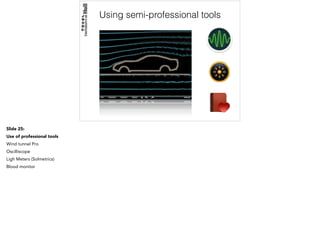
Using semi-professional tools
Slide 25:
Use of professional tools
Wind tunnel Pro
Oscilliscope
Ligh Meters (Solmetrics)
Blood monitor
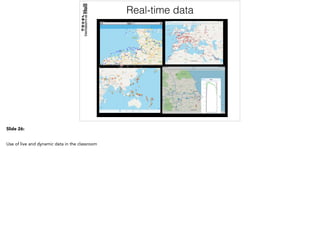
Real-time data
Slide 26:
Use of live and dynamic data in the classroom
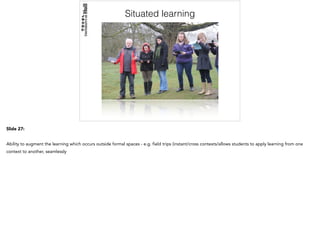
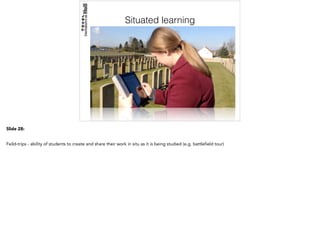
Situated learning
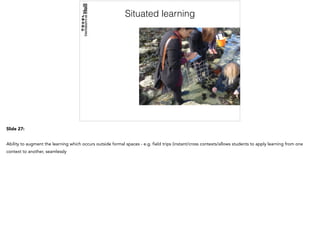
Slide 27:
Ability to augment the learning which occurs outside formal spaces - e.g. field trips (instant/cross contexts/allows students to apply learning from one
context to another, seamlessly
Situated learning
Slide 27:
Ability to augment the learning which occurs outside formal spaces - e.g. field trips (instant/cross contexts/allows students to apply learning from one
context to another, seamlessly
Situated learning
Slide 27:
Ability to augment the learning which occurs outside formal spaces - e.g. field trips (instant/cross contexts/allows students to apply learning from one
context to another, seamlessly
Situated learning
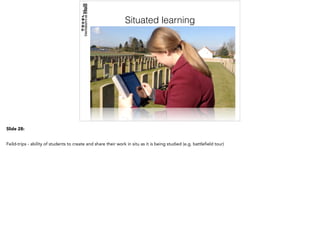
Slide 28:
Feild-trips - ability of students to create and share their work in situ as it is being studied (e.g. battlefield tour)
Situated learning
Slide 28:
Feild-trips - ability of students to create and share their work in situ as it is being studied (e.g. battlefield tour)
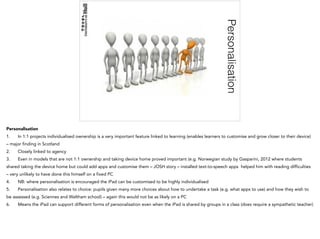
Personalisation
Personalisation
1. In 1:1 projects individualised ownership is a very important feature linked to learning (enables learners to customise and grow closer to their device)
– major finding in Scotland
2. Closely linked to agency
3. Even in models that are not 1:1 ownership and taking device home proved important (e.g. Norwegian study by Gasparini, 2012 where students
shared taking the device home but could add apps and customise them – JOSH story – installed text-to-speech apps helped him with reading difficulties
– very unlikely to have done this himself on a fixed PC
4. NB: where personalisation is encouraged the iPad can be customised to be highly individualised
5. Personalisation also relates to choice: pupils given many more choices about how to undertake a task (e.g. what apps to use) and how they wish to
be assessed (e.g. Sciennes and Waltham school) – again this would not be as likely on a PC
6. Means the iPad can support different forms of personalisation even when the iPad is shared by groups in a class (does require a sympathetic teacher)
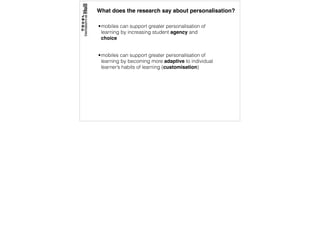
What does the research say about personalisation?
•mobiles can support greater personalisation of
learning by increasing student agency and
choice
•mobiles can support greater personalisation of
learning by becoming more adaptive to individual
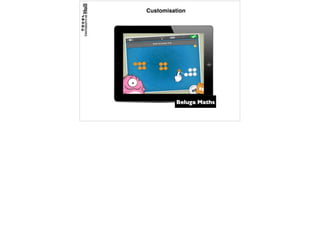
learner’s habits of learning (customisation)
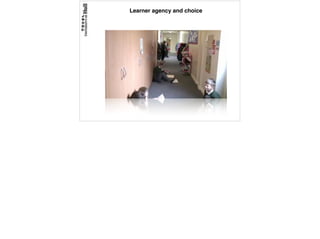
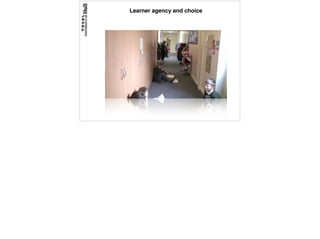
Learner agency and choice
Customisation
Beluga Maths!
Part III:
Future developments and
research
Part 3: Looking forwards: further research and development
1. Need to think about new approaches to research and development as a process between researchers, practitioners and software developers (e.g.
Design Based Research) - not just exploratory or small case studies
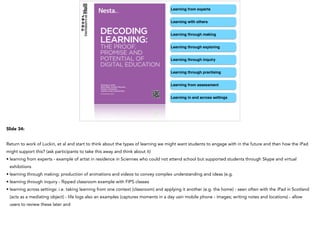
Learning from experts
Learning with others
Learning through making
Learning through exploring
Learning through inquiry
Learning through practising
Learning from assessment
Learning in and across settings
Slide 34:
Return to work of Luckin, et al and start to think about the types of learning we might want students to engage with in the future and then how the iPad
might support this? (ask participants to take this away and think about it)
• learning from experts - example of artist in residence in Sciennes who could not attend school but supported students through Skype and virtual
exhibitions
• learning through making: production of animations and videos to convey complex understanding and ideas (e.g.
• learning through inquiry - flipped classroom example with FIPS classes
• learning across settings: i.e. taking learning from one context (classroom) and applying it another (e.g. the home) - seen often with the iPad in Scotland
(acts as a mediating object) - life logs also an examples (captures moments in a day usin mobile phone - images; writing notes and locations) - allow
users to review these later and
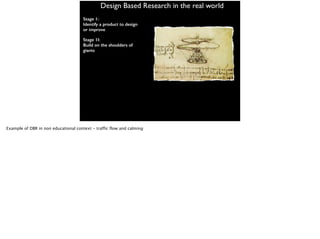
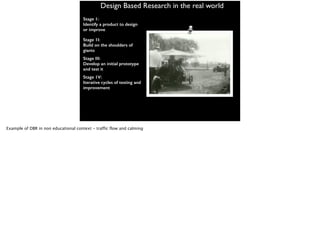
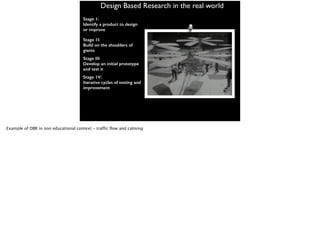
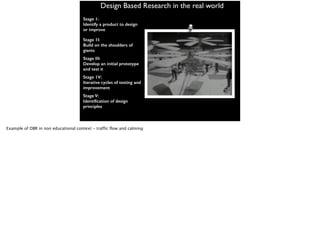
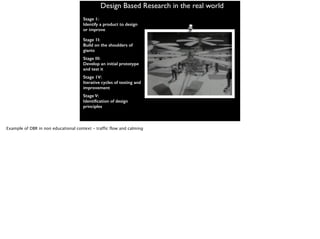
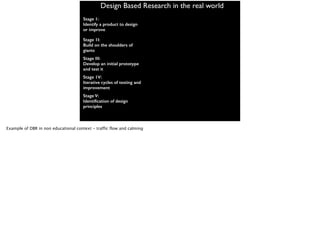
Design Based Research in the real world
Example of DBR in non educational context - traffic flow and calming
Design Based Research in the real world
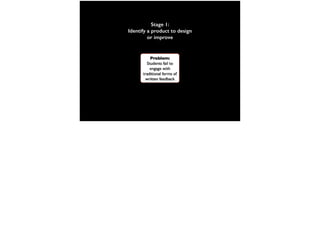
Stage 1:
Identify a product to design
or improve
Example of DBR in non educational context - traffic flow and calming
Design Based Research in the real world
Stage 1:
Identify a product to design
or improve
Example of DBR in non educational context - traffic flow and calming
Design Based Research in the real world
Stage 1:
Identify a product to design
or improve
Example of DBR in non educational context - traffic flow and calming
Design Based Research in the real world
Stage 1:
Identify a product to design
or improve
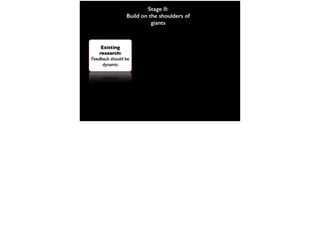
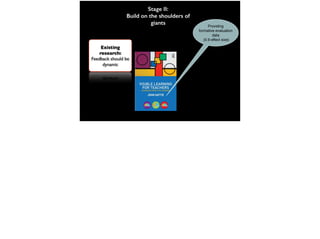
Stage 1I:
Build on the shoulders of
giants
Example of DBR in non educational context - traffic flow and calming
Design Based Research in the real world
Stage 1:
Identify a product to design
or improve
Stage 1I:
Build on the shoulders of
giants
Example of DBR in non educational context - traffic flow and calming
Design Based Research in the real world
Stage 1:
Identify a product to design
or improve
Stage 1I:
Build on the shoulders of
giants
Example of DBR in non educational context - traffic flow and calming
Design Based Research in the real world
Stage 1:
Identify a product to design
or improve
Stage 1I:
Build on the shoulders of
giants
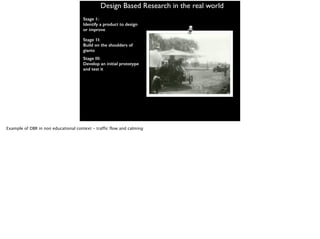
Stage III:
Develop an initial prototype
and test it
Example of DBR in non educational context - traffic flow and calming
Design Based Research in the real world
Stage 1:
Identify a product to design
or improve
Stage 1I:
Build on the shoulders of
giants
Stage III:
Develop an initial prototype
and test it
Example of DBR in non educational context - traffic flow and calming
Design Based Research in the real world
Stage 1:
Identify a product to design
or improve
Stage 1I:
Build on the shoulders of
giants
Stage III:
Develop an initial prototype
and test it
Stage 1V:
Iterative cycles of testing and
improvement
Example of DBR in non educational context - traffic flow and calming
Design Based Research in the real world
Stage 1:
Identify a product to design
or improve
Stage 1I:
Build on the shoulders of
giants
Stage III:
Develop an initial prototype
and test it
Stage 1V:
Iterative cycles of testing and
improvement
Example of DBR in non educational context - traffic flow and calming
Design Based Research in the real world
Stage 1:
Identify a product to design
or improve
Stage 1I:
Build on the shoulders of
giants
Stage III:
Develop an initial prototype
and test it
Stage 1V:
Iterative cycles of testing and
improvement
Stage V:
Identification of design
principles
Example of DBR in non educational context - traffic flow and calming
Design Based Research in the real world
Stage 1:
Identify a product to design
or improve
Stage 1I:
Build on the shoulders of
giants
Stage III:
Develop an initial prototype
and test it
Stage 1V:
Iterative cycles of testing and
improvement
Stage V:
Identification of design
principles
Example of DBR in non educational context - traffic flow and calming
Design Based Research in the real world
Stage 1:
Identify a product to design
or improve
Stage 1I:
Build on the shoulders of
giants
Stage III:
Develop an initial prototype
and test it
Stage 1V:
Iterative cycles of testing and
improvement
Stage V:
Identification of design
principles
Example of DBR in non educational context - traffic flow and calming
Stage 1:
Identify a product to design
or improve
Stage II:
Build on the shoulders of
giants
Stage II:
Build on the shoulders of
giants
Stage II:
Build on the shoulders of
giants Providing
formative evaluation
data
(0.9 effect size)
Stage III:
Develop an initial
prototype and test it
Stage III:
Develop an initial
prototype and test it
Stage IV:
Iterative cycles of testing
and improvement
Place the items below in their correct position on the timeline
1000 ADBC/AD500 BC 1500 AD 2000 AD500 AD
BattleofHastings,106611thCenturyAD
Great Fire of London
Thirteenth
Century
44BC
Magna Carta
First
Century
1661 AD
Caesar’s invasion of
Britain Seventeenth
Century
1215 AD
‘Making ThinkingVisible’
Stage V:
Extraction of design principles for
formative evaluation
Stage V:
Extraction of design principles for
formative evaluation
• Design activities which encourage two-way feedback
Stage V:
Extraction of design principles for
formative evaluation
• Design activities which encourage two-way feedback
• Design problems which force students to
articulate their thinking processes
Stage V:
Extraction of design principles for
formative evaluation
• Design activities which encourage two-way feedback
• Design problems which force students to
articulate their thinking processes
• Facilitate student feedback with peers
Stage V:
Extraction of design principles for
formative evaluation
• Design activities which encourage two-way feedback
• Design problems which force students to
articulate their thinking processes
• Facilitate student feedback with peers
• Focus on ‘threshold concepts’ and ‘troublesome
knowledge’
Translational Research
Focus on participatory and design based approaches (DBR) - use Explain Everything here
Translational Research
Focus on participatory and design based approaches (DBR) - use Explain Everything here
Translational Research
Focus on participatory and design based approaches (DBR) - use Explain Everything here
Translational Research
Focus on participatory and design based approaches (DBR) - use Explain Everything here
Translational Research
Focus on participatory and design based approaches (DBR) - use Explain Everything here
Translational Research
Focus on participatory and design based approaches (DBR) - use Explain Everything here
Translational Research
Focus on participatory and design based approaches (DBR) - use Explain Everything here
Translational Research
Focus on participatory and design based approaches (DBR) - use Explain Everything here
Mobilising and Transforming
Teacher Education Pedagogies
€450,000 (2014-2017)
Last year we provided half of our pre-service trainee teachers with iPads (this year the other half). If we are to achieve any of this we need to consider
carefully the CPD opportunities we provide for existing teachers and, critically, how we inculcate and educate the next generation of teachers into this
mobile learning culture so they are in the vanguard of change.
• At my own university we have done this over the past two years by providing students with an iPad for their 1 year course (over 300 now)
• interesting that when we surveyed them at the start of the course how few already used a PC device compared to a portable one
• this European funded project is an attempt to build a network and set of resources to help teacher educators introduce and support their students in the
use of mobile technology
• increasingly in the UK this is a function of schools and universities since ITE is increasingly a shared responsibility
• therefore we are looking at schools and other partners involved in the process of ITE or CPD in joining the network, acting as pilots to test the resources
and attend the workshops/training events
Mobilising and Transforming
Teacher Education Pedagogies
€450,000 (2014-2017)
Last year we provided half of our pre-service trainee teachers with iPads (this year the other half). If we are to achieve any of this we need to consider
carefully the CPD opportunities we provide for existing teachers and, critically, how we inculcate and educate the next generation of teachers into this
mobile learning culture so they are in the vanguard of change.
• At my own university we have done this over the past two years by providing students with an iPad for their 1 year course (over 300 now)
• interesting that when we surveyed them at the start of the course how few already used a PC device compared to a portable one
• this European funded project is an attempt to build a network and set of resources to help teacher educators introduce and support their students in the
use of mobile technology
• increasingly in the UK this is a function of schools and universities since ITE is increasingly a shared responsibility
• therefore we are looking at schools and other partners involved in the process of ITE or CPD in joining the network, acting as pilots to test the resources
and attend the workshops/training events
European Mobile Learning
Network for Educators
We aim to establish a European wide mobile learning network for teacher educators
Mobile Learning Toolkit
Toolkit =
• evaluation tool or app to help you gauge the extent to which teachers and students are using the affordances of mobile devices (based on the CAP
survey)
• a tool for teachers to identify and share pedagogical value of apps
• a series of video case studies and vignettes explain how to support teacher educators
Reconceptualising the textbook
One of our ambitions is to demonstrate how students and teachers can make their own ‘textbooks’ and how this alters the dynamics and relationships
between students and teachers as students become co-constructors and authors of knowledge
This is one of the main ideas we want to explore since we have already found this to be a significant lever for pedagogical change (e.g. the science and
english department project with students in Norway)
Reconceptualising the textbook
One of our ambitions is to demonstrate how students and teachers can make their own ‘textbooks’ and how this alters the dynamics and relationships
between students and teachers as students become co-constructors and authors of knowledge
This is one of the main ideas we want to explore since we have already found this to be a significant lever for pedagogical change (e.g. the science and
english department project with students in Norway)
Conclusions
Conclusion
We are not yet at the stage where learning with the iPad is ‘invisible’ in the sense that users do not even consider themselves to be using a technology,
but we have already passed this phase in non-formal contexts outside of school. Young people do not even consider their mobile devices to be
technologies and in one sense this is the goal we have to seek in schools to the extent that learners don’t even see the technology, they just see the
learning. We are still some way from this and over the next five years or so it will be important for researchers like myself and educators like you to work
more closely together not only to identify what works (we know a lot of the answers for that already) but why it works (i.e. the mechanisms) and under
what circumstances it works most effectively. This will enable us scale and sustain these wonderful case studies we have seen today in sun a way that we
promote genuine and meaningful transformation of pedagogies rather than simply replicating and sustaining what is increasingly look like an outdated
and out of tune model of education .
• We know what works but not why it works
• We need to better understand the unique
‘affordances’ of mobile technologies in order
to leverage higher order thinking skills
• We know what works but not why it works
• We need to better understand the unique
‘affordances’ of mobile technologies in order
to leverage higher order thinking skills
• Thinking of teaching as a design based science
may help to identify how these affordances are
translated into learning scenarios
Contact Details
Dr. Kevin Burden
Reader in Educational Technology
The Faculty of Education
The University of Hull
Twitter: @edskjb
www.mttep.eu
References and further resources
•iPad Scotland Evaluation Report (Burden, et al,
2012):
•Decoding Learning: the proof, promise and
potential of digital education (Luckin, et al, 2011)
•MESH maps for iPads: http:www.richprocter.co.uk/
cgi-bin/pathways/pad.pl

Lecture presentation week1

  • 1.
    Learning in aMobile Age: a pedagogical framework FacultyofEducation Dr. Kevin Burden: Reader in Digital Education Faculty of Education, The University of Hull
  • 2.
    Slide 2: Introduction ¥My background in teacher education where I am currently running and evaluating a large, longitudinal study of iPad use by pre-service teachers ¥ My previous activities as a researcher around mobile learning, include work going back to 2008 ( pre-iPad era) investigating the use of the iPodTouch in primary schools; first UK evaluation of iPads in Scotland and subsequent evaluation of mixed mobile learning platforms for Edinburgh City Council; ¥ Current role as project lead and PI for a new Erasmus+ project on transforming pedagogies in teacher education with mobile technologies
  • 3.
    Slide 2: Introduction ¥My background in teacher education where I am currently running and evaluating a large, longitudinal study of iPad use by pre-service teachers ¥ My previous activities as a researcher around mobile learning, include work going back to 2008 ( pre-iPad era) investigating the use of the iPodTouch in primary schools; first UK evaluation of iPads in Scotland and subsequent evaluation of mixed mobile learning platforms for Edinburgh City Council; ¥ Current role as project lead and PI for a new Erasmus+ project on transforming pedagogies in teacher education with mobile technologies
  • 4.
    My work andthe findings I will share with you today i are grounded in empirical data collected from many schools and colleges across and beyond the UK. Here is a selection which includes 8 schools in Scotland where we evaluated the first national pilot for iPads 1. Malcys college, Belfast 2. Bedford Girls School 3. Rotherham? 4. Scotland schools - - 6 5. Edinburgh schools - 4 6. N.E Linc schools (iPods)
  • 5.
  • 6.
    Outline of presentation: PartI: Evidence for mobile technology use in education
  • 7.
    Outline of presentation: PartI: Evidence for mobile technology use in education Part II: Frameworks to conceptualise the use of mobile technologies in Education
  • 8.
    Outline of presentation: PartI: Evidence for mobile technology use in education Part II: Frameworks to conceptualise the use of mobile technologies in Education Part III: Future developments, research & opportunities with mobile technologies
  • 9.
    Why ‘learning ina mobile age?’ Slide 4: Why Learning in a Mobile Age? • We are in the midst of a new information revolution, every bit as powerful and dramatic as the previous information revolution (the book) which radically altered how knowledge was produced, how it was shared and how it was valued. • Mobile technologies are central to this phenomenon in a manner which is not yet fully played out or understood but likely to be pervasive across all aspects of social life, including education • Press to second picture: We take our mobile devices for granted today, like an extension or augmentation of our own bodies (‘digital prosthetics’) - • Press to third and fourth pictures: see this in pictures of the Pope's election (2005: Benedict XVI; .v. 2013, Pope Francis) - note it is not only the quantity of technology but what people are doing with them (capturing and sharing data) • Press to picture five: This has led to many unexpected and unanticipated impacts including the phenomenon of always being connected; new forms of collaboration and social discourse (pictures of 1950s commuters and the same today on the Tube) • Certainly across the developed world we have passed the tipping point where these devices are virtually ubiquitous and although most users do not consider these to be primarily learning technologies, considerable volumes of learning now occurs with and through the device, both intentional (e.g. a visit to a museum on a school trip) but much of it informal or emergent in what might be termed the Third Space (my personal site of interest) - stealth learning
  • 10.
    Why ‘learning ina mobile age?’ Slide 4: Why Learning in a Mobile Age? • We are in the midst of a new information revolution, every bit as powerful and dramatic as the previous information revolution (the book) which radically altered how knowledge was produced, how it was shared and how it was valued. • Mobile technologies are central to this phenomenon in a manner which is not yet fully played out or understood but likely to be pervasive across all aspects of social life, including education • Press to second picture: We take our mobile devices for granted today, like an extension or augmentation of our own bodies (‘digital prosthetics’) - • Press to third and fourth pictures: see this in pictures of the Pope's election (2005: Benedict XVI; .v. 2013, Pope Francis) - note it is not only the quantity of technology but what people are doing with them (capturing and sharing data) • Press to picture five: This has led to many unexpected and unanticipated impacts including the phenomenon of always being connected; new forms of collaboration and social discourse (pictures of 1950s commuters and the same today on the Tube) • Certainly across the developed world we have passed the tipping point where these devices are virtually ubiquitous and although most users do not consider these to be primarily learning technologies, considerable volumes of learning now occurs with and through the device, both intentional (e.g. a visit to a museum on a school trip) but much of it informal or emergent in what might be termed the Third Space (my personal site of interest) - stealth learning
  • 11.
    Why ‘learning ina mobile age?’ Slide 4: Why Learning in a Mobile Age? • We are in the midst of a new information revolution, every bit as powerful and dramatic as the previous information revolution (the book) which radically altered how knowledge was produced, how it was shared and how it was valued. • Mobile technologies are central to this phenomenon in a manner which is not yet fully played out or understood but likely to be pervasive across all aspects of social life, including education • Press to second picture: We take our mobile devices for granted today, like an extension or augmentation of our own bodies (‘digital prosthetics’) - • Press to third and fourth pictures: see this in pictures of the Pope's election (2005: Benedict XVI; .v. 2013, Pope Francis) - note it is not only the quantity of technology but what people are doing with them (capturing and sharing data) • Press to picture five: This has led to many unexpected and unanticipated impacts including the phenomenon of always being connected; new forms of collaboration and social discourse (pictures of 1950s commuters and the same today on the Tube) • Certainly across the developed world we have passed the tipping point where these devices are virtually ubiquitous and although most users do not consider these to be primarily learning technologies, considerable volumes of learning now occurs with and through the device, both intentional (e.g. a visit to a museum on a school trip) but much of it informal or emergent in what might be termed the Third Space (my personal site of interest) - stealth learning
  • 12.
    Why ‘learning ina mobile age?’ Slide 4: Why Learning in a Mobile Age? • We are in the midst of a new information revolution, every bit as powerful and dramatic as the previous information revolution (the book) which radically altered how knowledge was produced, how it was shared and how it was valued. • Mobile technologies are central to this phenomenon in a manner which is not yet fully played out or understood but likely to be pervasive across all aspects of social life, including education • Press to second picture: We take our mobile devices for granted today, like an extension or augmentation of our own bodies (‘digital prosthetics’) - • Press to third and fourth pictures: see this in pictures of the Pope's election (2005: Benedict XVI; .v. 2013, Pope Francis) - note it is not only the quantity of technology but what people are doing with them (capturing and sharing data) • Press to picture five: This has led to many unexpected and unanticipated impacts including the phenomenon of always being connected; new forms of collaboration and social discourse (pictures of 1950s commuters and the same today on the Tube) • Certainly across the developed world we have passed the tipping point where these devices are virtually ubiquitous and although most users do not consider these to be primarily learning technologies, considerable volumes of learning now occurs with and through the device, both intentional (e.g. a visit to a museum on a school trip) but much of it informal or emergent in what might be termed the Third Space (my personal site of interest) - stealth learning
  • 13.
    Why ‘learning ina mobile age?’ Slide 4: Why Learning in a Mobile Age? • We are in the midst of a new information revolution, every bit as powerful and dramatic as the previous information revolution (the book) which radically altered how knowledge was produced, how it was shared and how it was valued. • Mobile technologies are central to this phenomenon in a manner which is not yet fully played out or understood but likely to be pervasive across all aspects of social life, including education • Press to second picture: We take our mobile devices for granted today, like an extension or augmentation of our own bodies (‘digital prosthetics’) - • Press to third and fourth pictures: see this in pictures of the Pope's election (2005: Benedict XVI; .v. 2013, Pope Francis) - note it is not only the quantity of technology but what people are doing with them (capturing and sharing data) • Press to picture five: This has led to many unexpected and unanticipated impacts including the phenomenon of always being connected; new forms of collaboration and social discourse (pictures of 1950s commuters and the same today on the Tube) • Certainly across the developed world we have passed the tipping point where these devices are virtually ubiquitous and although most users do not consider these to be primarily learning technologies, considerable volumes of learning now occurs with and through the device, both intentional (e.g. a visit to a museum on a school trip) but much of it informal or emergent in what might be termed the Third Space (my personal site of interest) - stealth learning
  • 14.
    Why ‘learning ina mobile age?’ Slide 4: Why Learning in a Mobile Age? • We are in the midst of a new information revolution, every bit as powerful and dramatic as the previous information revolution (the book) which radically altered how knowledge was produced, how it was shared and how it was valued. • Mobile technologies are central to this phenomenon in a manner which is not yet fully played out or understood but likely to be pervasive across all aspects of social life, including education • Press to second picture: We take our mobile devices for granted today, like an extension or augmentation of our own bodies (‘digital prosthetics’) - • Press to third and fourth pictures: see this in pictures of the Pope's election (2005: Benedict XVI; .v. 2013, Pope Francis) - note it is not only the quantity of technology but what people are doing with them (capturing and sharing data) • Press to picture five: This has led to many unexpected and unanticipated impacts including the phenomenon of always being connected; new forms of collaboration and social discourse (pictures of 1950s commuters and the same today on the Tube) • Certainly across the developed world we have passed the tipping point where these devices are virtually ubiquitous and although most users do not consider these to be primarily learning technologies, considerable volumes of learning now occurs with and through the device, both intentional (e.g. a visit to a museum on a school trip) but much of it informal or emergent in what might be termed the Third Space (my personal site of interest) - stealth learning
  • 15.
    Why ‘learning ina mobile age?’ Slide 4: Why Learning in a Mobile Age? • We are in the midst of a new information revolution, every bit as powerful and dramatic as the previous information revolution (the book) which radically altered how knowledge was produced, how it was shared and how it was valued. • Mobile technologies are central to this phenomenon in a manner which is not yet fully played out or understood but likely to be pervasive across all aspects of social life, including education • Press to second picture: We take our mobile devices for granted today, like an extension or augmentation of our own bodies (‘digital prosthetics’) - • Press to third and fourth pictures: see this in pictures of the Pope's election (2005: Benedict XVI; .v. 2013, Pope Francis) - note it is not only the quantity of technology but what people are doing with them (capturing and sharing data) • Press to picture five: This has led to many unexpected and unanticipated impacts including the phenomenon of always being connected; new forms of collaboration and social discourse (pictures of 1950s commuters and the same today on the Tube) • Certainly across the developed world we have passed the tipping point where these devices are virtually ubiquitous and although most users do not consider these to be primarily learning technologies, considerable volumes of learning now occurs with and through the device, both intentional (e.g. a visit to a museum on a school trip) but much of it informal or emergent in what might be termed the Third Space (my personal site of interest) - stealth learning
  • 16.
    Why ‘learning ina mobile age?’ Slide 4: Why Learning in a Mobile Age? • We are in the midst of a new information revolution, every bit as powerful and dramatic as the previous information revolution (the book) which radically altered how knowledge was produced, how it was shared and how it was valued. • Mobile technologies are central to this phenomenon in a manner which is not yet fully played out or understood but likely to be pervasive across all aspects of social life, including education • Press to second picture: We take our mobile devices for granted today, like an extension or augmentation of our own bodies (‘digital prosthetics’) - • Press to third and fourth pictures: see this in pictures of the Pope's election (2005: Benedict XVI; .v. 2013, Pope Francis) - note it is not only the quantity of technology but what people are doing with them (capturing and sharing data) • Press to picture five: This has led to many unexpected and unanticipated impacts including the phenomenon of always being connected; new forms of collaboration and social discourse (pictures of 1950s commuters and the same today on the Tube) • Certainly across the developed world we have passed the tipping point where these devices are virtually ubiquitous and although most users do not consider these to be primarily learning technologies, considerable volumes of learning now occurs with and through the device, both intentional (e.g. a visit to a museum on a school trip) but much of it informal or emergent in what might be termed the Third Space (my personal site of interest) - stealth learning
  • 17.
    Why ‘learning ina mobile age?’ Slide 4: Why Learning in a Mobile Age? • We are in the midst of a new information revolution, every bit as powerful and dramatic as the previous information revolution (the book) which radically altered how knowledge was produced, how it was shared and how it was valued. • Mobile technologies are central to this phenomenon in a manner which is not yet fully played out or understood but likely to be pervasive across all aspects of social life, including education • Press to second picture: We take our mobile devices for granted today, like an extension or augmentation of our own bodies (‘digital prosthetics’) - • Press to third and fourth pictures: see this in pictures of the Pope's election (2005: Benedict XVI; .v. 2013, Pope Francis) - note it is not only the quantity of technology but what people are doing with them (capturing and sharing data) • Press to picture five: This has led to many unexpected and unanticipated impacts including the phenomenon of always being connected; new forms of collaboration and social discourse (pictures of 1950s commuters and the same today on the Tube) • Certainly across the developed world we have passed the tipping point where these devices are virtually ubiquitous and although most users do not consider these to be primarily learning technologies, considerable volumes of learning now occurs with and through the device, both intentional (e.g. a visit to a museum on a school trip) but much of it informal or emergent in what might be termed the Third Space (my personal site of interest) - stealth learning
  • 18.
    Why ‘learning ina mobile age?’ Slide 4: Why Learning in a Mobile Age? • We are in the midst of a new information revolution, every bit as powerful and dramatic as the previous information revolution (the book) which radically altered how knowledge was produced, how it was shared and how it was valued. • Mobile technologies are central to this phenomenon in a manner which is not yet fully played out or understood but likely to be pervasive across all aspects of social life, including education • Press to second picture: We take our mobile devices for granted today, like an extension or augmentation of our own bodies (‘digital prosthetics’) - • Press to third and fourth pictures: see this in pictures of the Pope's election (2005: Benedict XVI; .v. 2013, Pope Francis) - note it is not only the quantity of technology but what people are doing with them (capturing and sharing data) • Press to picture five: This has led to many unexpected and unanticipated impacts including the phenomenon of always being connected; new forms of collaboration and social discourse (pictures of 1950s commuters and the same today on the Tube) • Certainly across the developed world we have passed the tipping point where these devices are virtually ubiquitous and although most users do not consider these to be primarily learning technologies, considerable volumes of learning now occurs with and through the device, both intentional (e.g. a visit to a museum on a school trip) but much of it informal or emergent in what might be termed the Third Space (my personal site of interest) - stealth learning
  • 19.
    Why ‘learning ina mobile age?’ Slide 4: Why Learning in a Mobile Age? • We are in the midst of a new information revolution, every bit as powerful and dramatic as the previous information revolution (the book) which radically altered how knowledge was produced, how it was shared and how it was valued. • Mobile technologies are central to this phenomenon in a manner which is not yet fully played out or understood but likely to be pervasive across all aspects of social life, including education • Press to second picture: We take our mobile devices for granted today, like an extension or augmentation of our own bodies (‘digital prosthetics’) - • Press to third and fourth pictures: see this in pictures of the Pope's election (2005: Benedict XVI; .v. 2013, Pope Francis) - note it is not only the quantity of technology but what people are doing with them (capturing and sharing data) • Press to picture five: This has led to many unexpected and unanticipated impacts including the phenomenon of always being connected; new forms of collaboration and social discourse (pictures of 1950s commuters and the same today on the Tube) • Certainly across the developed world we have passed the tipping point where these devices are virtually ubiquitous and although most users do not consider these to be primarily learning technologies, considerable volumes of learning now occurs with and through the device, both intentional (e.g. a visit to a museum on a school trip) but much of it informal or emergent in what might be termed the Third Space (my personal site of interest) - stealth learning
  • 20.
    Why ‘learning ina mobile age?’ Slide 4: Why Learning in a Mobile Age? • We are in the midst of a new information revolution, every bit as powerful and dramatic as the previous information revolution (the book) which radically altered how knowledge was produced, how it was shared and how it was valued. • Mobile technologies are central to this phenomenon in a manner which is not yet fully played out or understood but likely to be pervasive across all aspects of social life, including education • Press to second picture: We take our mobile devices for granted today, like an extension or augmentation of our own bodies (‘digital prosthetics’) - • Press to third and fourth pictures: see this in pictures of the Pope's election (2005: Benedict XVI; .v. 2013, Pope Francis) - note it is not only the quantity of technology but what people are doing with them (capturing and sharing data) • Press to picture five: This has led to many unexpected and unanticipated impacts including the phenomenon of always being connected; new forms of collaboration and social discourse (pictures of 1950s commuters and the same today on the Tube) • Certainly across the developed world we have passed the tipping point where these devices are virtually ubiquitous and although most users do not consider these to be primarily learning technologies, considerable volumes of learning now occurs with and through the device, both intentional (e.g. a visit to a museum on a school trip) but much of it informal or emergent in what might be termed the Third Space (my personal site of interest) - stealth learning
  • 21.
    Why ‘learning ina mobile age?’ Slide 4: Why Learning in a Mobile Age? • We are in the midst of a new information revolution, every bit as powerful and dramatic as the previous information revolution (the book) which radically altered how knowledge was produced, how it was shared and how it was valued. • Mobile technologies are central to this phenomenon in a manner which is not yet fully played out or understood but likely to be pervasive across all aspects of social life, including education • Press to second picture: We take our mobile devices for granted today, like an extension or augmentation of our own bodies (‘digital prosthetics’) - • Press to third and fourth pictures: see this in pictures of the Pope's election (2005: Benedict XVI; .v. 2013, Pope Francis) - note it is not only the quantity of technology but what people are doing with them (capturing and sharing data) • Press to picture five: This has led to many unexpected and unanticipated impacts including the phenomenon of always being connected; new forms of collaboration and social discourse (pictures of 1950s commuters and the same today on the Tube) • Certainly across the developed world we have passed the tipping point where these devices are virtually ubiquitous and although most users do not consider these to be primarily learning technologies, considerable volumes of learning now occurs with and through the device, both intentional (e.g. a visit to a museum on a school trip) but much of it informal or emergent in what might be termed the Third Space (my personal site of interest) - stealth learning
  • 22.
    Why ‘learning ina mobile age?’ Slide 4: Why Learning in a Mobile Age? • We are in the midst of a new information revolution, every bit as powerful and dramatic as the previous information revolution (the book) which radically altered how knowledge was produced, how it was shared and how it was valued. • Mobile technologies are central to this phenomenon in a manner which is not yet fully played out or understood but likely to be pervasive across all aspects of social life, including education • Press to second picture: We take our mobile devices for granted today, like an extension or augmentation of our own bodies (‘digital prosthetics’) - • Press to third and fourth pictures: see this in pictures of the Pope's election (2005: Benedict XVI; .v. 2013, Pope Francis) - note it is not only the quantity of technology but what people are doing with them (capturing and sharing data) • Press to picture five: This has led to many unexpected and unanticipated impacts including the phenomenon of always being connected; new forms of collaboration and social discourse (pictures of 1950s commuters and the same today on the Tube) • Certainly across the developed world we have passed the tipping point where these devices are virtually ubiquitous and although most users do not consider these to be primarily learning technologies, considerable volumes of learning now occurs with and through the device, both intentional (e.g. a visit to a museum on a school trip) but much of it informal or emergent in what might be termed the Third Space (my personal site of interest) - stealth learning
  • 23.
    Ownership of technologies (HullUniversity pre-service teachers ) 2013-14 2014-15 Just to provide more evidence for the impact and shift to mobile and flexible technologies - away from tethered technologies towards ‘Post PC’ technologies - data from our own PGCE students ownership habits over two years
  • 24.
    0 45 90 135 180 Fixed PC LaptopTablet Smartphone Ownership of technologies (Hull University pre-service teachers ) 2013-14 2014-15 Just to provide more evidence for the impact and shift to mobile and flexible technologies - away from tethered technologies towards ‘Post PC’ technologies - data from our own PGCE students ownership habits over two years
  • 25.
    0 45 90 135 180 Fixed PC LaptopTablet Smartphone Ownership of technologies (Hull University pre-service teachers ) 2013-14 2014-15 Just to provide more evidence for the impact and shift to mobile and flexible technologies - away from tethered technologies towards ‘Post PC’ technologies - data from our own PGCE students ownership habits over two years
  • 26.
    0 45 90 135 180 Fixed PC LaptopTablet Smartphone Ownership of technologies (Hull University pre-service teachers ) 2013-14 2014-15 Just to provide more evidence for the impact and shift to mobile and flexible technologies - away from tethered technologies towards ‘Post PC’ technologies - data from our own PGCE students ownership habits over two years
  • 27.
    Part I: The evidencebase for mobile technologies Slide 6: So what has research discovered about this phenomenon to date ( remembering the iPad only appeared in 2010 - less than five years of evidence available)
  • 28.
    Slide 7: Genericfindings about technology: • No technology has an impact on learning in its own right; impact depends on how it is used (Clark and Luckin, 2013) • Rather than categorising innovations by the type of technology used (e.g, do games help learning?), it’s more useful to think about the types of learning activities we know to be effective
  • 29.
  • 30.
    Pre-iPad mobile learning (pre-2010) Slide9: • First phase research pre-dated the iPad and stretched back to the introduction of Smart phones and their predecessors, devices like the iPAQ which predates the iPodTouch (2008 • Although some may look similar these devices are not the same as the current ‘Post-PC technologies’ like the iPad (what distinguishes them?) • Previous devices had no mobile OS – cut down version of full OS • High definition touch sensitive screens (not pens) • Back-up by well provisioned apps market • Broader range of connectivity options including 3G/4G; Bluetooth, wi-fi
  • 31.
    Mudlarking in Deptford Anew kind of guided tour that empowers 11-14 year-old students to interact with the environment and other people through the innovative use of mobile technology Early research studies in mobile learning Slide 10: In terms of the research undertaken around these devices many of them featured small-scale case studies demonstrating the potential and promise of untethered computer use (Traxler) even though the full potential was some way from being recognised (illustrate with a good example – e.g. Savannah (Futurelab 2004) Mudlarking in Deptford; eScape project (QCA) used the iPAQ etc • Contextualised learning – context sensitive data (students moved around the location tracked by GPS) • Portability and flexibility • Pervasive learning – 1:1 with learners • Potential for collaborative learning (limited by connectivity) Note: a lot of the research from this period featured designed projects where learners had only sporadic access to the device itself ( the notion of 1:1 was some way off) Also many projects focused on the learning which was possible in informal spaces outside of formal education (e.g. Museums, field trips) - although Internet was rarely available this phase of research did demonstrate important lesson for us today, some of which have been forgotten or even lost in the drive to 1:1 classroom based provision (more detail needed here)
  • 32.
    Learning with IOS(post 2008) Slide 11: In 2008 came the iPodTouch which was in many ways a game changer which has been forgotten today with the focus on tablet devices like the iPads (illustrate with evidence from Victoria study and my own study in N.E. Lincolnshire) • Cheaper enough to explore 1:1 provision and ownership models • Powerful enough to undertake creative work and production which was hitherto impossible on previous devices • Robust and reliable (unlike many of the iPAQ trials) to the extent schools started to consider them for class sets and work both inside and outside the school Good examples include Victoria State education Department - see report And my own work evaluating the use of use iPod in six schools across North East Lincolnshire
  • 33.
    Learning with IOS(post 2008) ! ! iPod Touch research report ! ! ! Slide 11: In 2008 came the iPodTouch which was in many ways a game changer which has been forgotten today with the focus on tablet devices like the iPads (illustrate with evidence from Victoria study and my own study in N.E. Lincolnshire) • Cheaper enough to explore 1:1 provision and ownership models • Powerful enough to undertake creative work and production which was hitherto impossible on previous devices • Robust and reliable (unlike many of the iPAQ trials) to the extent schools started to consider them for class sets and work both inside and outside the school Good examples include Victoria State education Department - see report And my own work evaluating the use of use iPod in six schools across North East Lincolnshire
  • 34.
    Learning with IOS(post 2008) Slide 11: In 2008 came the iPodTouch which was in many ways a game changer which has been forgotten today with the focus on tablet devices like the iPads (illustrate with evidence from Victoria study and my own study in N.E. Lincolnshire) • Cheaper enough to explore 1:1 provision and ownership models • Powerful enough to undertake creative work and production which was hitherto impossible on previous devices • Robust and reliable (unlike many of the iPAQ trials) to the extent schools started to consider them for class sets and work both inside and outside the school Good examples include Victoria State education Department - see report And my own work evaluating the use of use iPod in six schools across North East Lincolnshire
  • 35.
    Learning with IOS(post 2008) Slide 11: In 2008 came the iPodTouch which was in many ways a game changer which has been forgotten today with the focus on tablet devices like the iPads (illustrate with evidence from Victoria study and my own study in N.E. Lincolnshire) • Cheaper enough to explore 1:1 provision and ownership models • Powerful enough to undertake creative work and production which was hitherto impossible on previous devices • Robust and reliable (unlike many of the iPAQ trials) to the extent schools started to consider them for class sets and work both inside and outside the school Good examples include Victoria State education Department - see report And my own work evaluating the use of use iPod in six schools across North East Lincolnshire
  • 36.
    Learning with IOS(post 2008) Slide 11: In 2008 came the iPodTouch which was in many ways a game changer which has been forgotten today with the focus on tablet devices like the iPads (illustrate with evidence from Victoria study and my own study in N.E. Lincolnshire) • Cheaper enough to explore 1:1 provision and ownership models • Powerful enough to undertake creative work and production which was hitherto impossible on previous devices • Robust and reliable (unlike many of the iPAQ trials) to the extent schools started to consider them for class sets and work both inside and outside the school Good examples include Victoria State education Department - see report And my own work evaluating the use of use iPod in six schools across North East Lincolnshire
  • 37.
    Learning with IOS(post 2008) Slide 11: In 2008 came the iPodTouch which was in many ways a game changer which has been forgotten today with the focus on tablet devices like the iPads (illustrate with evidence from Victoria study and my own study in N.E. Lincolnshire) • Cheaper enough to explore 1:1 provision and ownership models • Powerful enough to undertake creative work and production which was hitherto impossible on previous devices • Robust and reliable (unlike many of the iPAQ trials) to the extent schools started to consider them for class sets and work both inside and outside the school Good examples include Victoria State education Department - see report And my own work evaluating the use of use iPod in six schools across North East Lincolnshire
  • 38.
    Learning with IOS(post 2008) Slide 11: In 2008 came the iPodTouch which was in many ways a game changer which has been forgotten today with the focus on tablet devices like the iPads (illustrate with evidence from Victoria study and my own study in N.E. Lincolnshire) • Cheaper enough to explore 1:1 provision and ownership models • Powerful enough to undertake creative work and production which was hitherto impossible on previous devices • Robust and reliable (unlike many of the iPAQ trials) to the extent schools started to consider them for class sets and work both inside and outside the school Good examples include Victoria State education Department - see report And my own work evaluating the use of use iPod in six schools across North East Lincolnshire
  • 39.
    Learning with IOS(post 2008) Slide 11: In 2008 came the iPodTouch which was in many ways a game changer which has been forgotten today with the focus on tablet devices like the iPads (illustrate with evidence from Victoria study and my own study in N.E. Lincolnshire) • Cheaper enough to explore 1:1 provision and ownership models • Powerful enough to undertake creative work and production which was hitherto impossible on previous devices • Robust and reliable (unlike many of the iPAQ trials) to the extent schools started to consider them for class sets and work both inside and outside the school Good examples include Victoria State education Department - see report And my own work evaluating the use of use iPod in six schools across North East Lincolnshire
  • 40.
    Learning with IOS(post 2008) Slide 11: In 2008 came the iPodTouch which was in many ways a game changer which has been forgotten today with the focus on tablet devices like the iPads (illustrate with evidence from Victoria study and my own study in N.E. Lincolnshire) • Cheaper enough to explore 1:1 provision and ownership models • Powerful enough to undertake creative work and production which was hitherto impossible on previous devices • Robust and reliable (unlike many of the iPAQ trials) to the extent schools started to consider them for class sets and work both inside and outside the school Good examples include Victoria State education Department - see report And my own work evaluating the use of use iPod in six schools across North East Lincolnshire
  • 41.
    Learning with IOS(post 2008) Slide 11: In 2008 came the iPodTouch which was in many ways a game changer which has been forgotten today with the focus on tablet devices like the iPads (illustrate with evidence from Victoria study and my own study in N.E. Lincolnshire) • Cheaper enough to explore 1:1 provision and ownership models • Powerful enough to undertake creative work and production which was hitherto impossible on previous devices • Robust and reliable (unlike many of the iPAQ trials) to the extent schools started to consider them for class sets and work both inside and outside the school Good examples include Victoria State education Department - see report And my own work evaluating the use of use iPod in six schools across North East Lincolnshire
  • 42.
    Learning with IOS (post2008) Video in Lincolnshire - iPodtouch v) And my own work evaluating the use of use iPod in six schools across North East Lincolnshire
  • 43.
    Learning with IOS (post2008) Video in Lincolnshire - iPodtouch v) And my own work evaluating the use of use iPod in six schools across North East Lincolnshire
  • 44.
    Learning with IOS (post2008) Video in Lincolnshire - iPodtouch v) And my own work evaluating the use of use iPod in six schools across North East Lincolnshire
  • 45.
    The iPad era(post 2010) Slide 13: in 2010 the 1st generation iPad appeared and despite not having a camera in this iteration, this really was a game-changer particularly in its use as a school-based learning technology and an alternative to the tethered, orthodoxy of computer laboratories, or even the laptop First phase of research into iPads (still very exploratory)
  • 46.
    The iPad era(post 2010) Slide 13: in 2010 the 1st generation iPad appeared and despite not having a camera in this iteration, this really was a game-changer particularly in its use as a school-based learning technology and an alternative to the tethered, orthodoxy of computer laboratories, or even the laptop First phase of research into iPads (still very exploratory)
  • 47.
    The iPad era(post 2010) Slide 13: in 2010 the 1st generation iPad appeared and despite not having a camera in this iteration, this really was a game-changer particularly in its use as a school-based learning technology and an alternative to the tethered, orthodoxy of computer laboratories, or even the laptop First phase of research into iPads (still very exploratory)
  • 48.
    The iPad era(post 2010) Slide 13: in 2010 the 1st generation iPad appeared and despite not having a camera in this iteration, this really was a game-changer particularly in its use as a school-based learning technology and an alternative to the tethered, orthodoxy of computer laboratories, or even the laptop First phase of research into iPads (still very exploratory)
  • 49.
    The iPad era(post 2010)iPad Scotland Evaluation: 2012! Slide 13: in 2010 the 1st generation iPad appeared and despite not having a camera in this iteration, this really was a game-changer particularly in its use as a school-based learning technology and an alternative to the tethered, orthodoxy of computer laboratories, or even the laptop First phase of research into iPads (still very exploratory)
  • 50.
    What do studentsu regularly in scho 0 25 50 75 100 Research video making movie share work Scotland Edinburgh Belfast Bedford images sound books writing Analysis of data: 1. broadly same pattern of use across all sites - research (Internet and writing) - essentially productivity 2. some variations - more use of creative apps in Scotland study (suggests it is how the teachers conceptualise their use that counts) 3. Internet use (ubiquitous) - questioned the role of the teacher as the expert and knowledge giver (number of teachers and students recognised this) 4. relatively small use of e-Books interesting (neither used for reading or for production)
  • 51.
    What do studentsu regularly in scho 0 25 50 75 100 Research video making movie share work Scotland Edinburgh Belfast Bedford images sound books writing Analysis of data: 1. broadly same pattern of use across all sites - research (Internet and writing) - essentially productivity 2. some variations - more use of creative apps in Scotland study (suggests it is how the teachers conceptualise their use that counts) 3. Internet use (ubiquitous) - questioned the role of the teacher as the expert and knowledge giver (number of teachers and students recognised this) 4. relatively small use of e-Books interesting (neither used for reading or for production)
  • 52.
    What do studentsu regularly in scho 0 25 50 75 100 Research video making movie share work Scotland Edinburgh Belfast Bedford images sound books writing Analysis of data: 1. broadly same pattern of use across all sites - research (Internet and writing) - essentially productivity 2. some variations - more use of creative apps in Scotland study (suggests it is how the teachers conceptualise their use that counts) 3. Internet use (ubiquitous) - questioned the role of the teacher as the expert and knowledge giver (number of teachers and students recognised this) 4. relatively small use of e-Books interesting (neither used for reading or for production)
  • 53.
    What do studentsu regularly in scho 0 25 50 75 100 Research video making movie share work Scotland Edinburgh Belfast Bedford images sound books writing Analysis of data: 1. broadly same pattern of use across all sites - research (Internet and writing) - essentially productivity 2. some variations - more use of creative apps in Scotland study (suggests it is how the teachers conceptualise their use that counts) 3. Internet use (ubiquitous) - questioned the role of the teacher as the expert and knowledge giver (number of teachers and students recognised this) 4. relatively small use of e-Books interesting (neither used for reading or for production)
  • 54.
    What do studentsu regularly in scho 0 25 50 75 100 Research video making movie share work Scotland Edinburgh Belfast Bedford images sound books writing Analysis of data: 1. broadly same pattern of use across all sites - research (Internet and writing) - essentially productivity 2. some variations - more use of creative apps in Scotland study (suggests it is how the teachers conceptualise their use that counts) 3. Internet use (ubiquitous) - questioned the role of the teacher as the expert and knowledge giver (number of teachers and students recognised this) 4. relatively small use of e-Books interesting (neither used for reading or for production)
  • 55.
    What do studentsu regularly in scho 0 25 50 75 100 Research video making movie share work Scotland Edinburgh Belfast Bedford images sound books writing Analysis of data: 1. broadly same pattern of use across all sites - research (Internet and writing) - essentially productivity 2. some variations - more use of creative apps in Scotland study (suggests it is how the teachers conceptualise their use that counts) 3. Internet use (ubiquitous) - questioned the role of the teacher as the expert and knowledge giver (number of teachers and students recognised this) 4. relatively small use of e-Books interesting (neither used for reading or for production)
  • 56.
    What do studentsu regularly in scho 0 25 50 75 100 Research video making movie share work Scotland Edinburgh Belfast Bedford images sound books writing Analysis of data: 1. broadly same pattern of use across all sites - research (Internet and writing) - essentially productivity 2. some variations - more use of creative apps in Scotland study (suggests it is how the teachers conceptualise their use that counts) 3. Internet use (ubiquitous) - questioned the role of the teacher as the expert and knowledge giver (number of teachers and students recognised this) 4. relatively small use of e-Books interesting (neither used for reading or for production)
  • 57.
    What do studentsu regularly in scho 0 25 50 75 100 Research video making movie share work Scotland Edinburgh Belfast Bedford images sound books writing Analysis of data: 1. broadly same pattern of use across all sites - research (Internet and writing) - essentially productivity 2. some variations - more use of creative apps in Scotland study (suggests it is how the teachers conceptualise their use that counts) 3. Internet use (ubiquitous) - questioned the role of the teacher as the expert and knowledge giver (number of teachers and students recognised this) 4. relatively small use of e-Books interesting (neither used for reading or for production)
  • 58.
    Main findings: Slide 14:iPad Scotland Evaluation (UoH) - main lessons and significance • making access to technology/internet routine and ubiquitous – quicker (no need to book rooms); instant on (no start up time) – encouraged teachers to adopt and use technology more often and a wider range of learning activities • teachers rethink their own role (move towards facilitators) – more peer-to-peer learning; less didactic learning • support for ‘seamless learning’ (boundary crossing) – allows learners to easily switch contexts from formal to informal; from personal to social; from real- time (f2f) to virtual and web-based inquiry (e.g. Minecraft) – especially true as a device to communicate between students/teachers and parents • individualised ownership strongly correlated with personalisation and motivation (pupils and parents frequently commented on this) • increased sense of agency and control by pupils – seamless learning (pupils take it home; learning does not stop with school – art classes in Glasgow school – pupils can supplement what they are learning in class (in real-time) as the teacher speaks (e.g. Google searching or making digital notes) – also true in Longfield study and Henderson and Yeow (2012) study of iPads in primary schools in NZ • considerable interest from parents who were generally very supportive of the initiative (83% thought it had made learning more engaging for their children, who spent more time doing homework and showing them work)
  • 59.
    Main findings: • impactof routine, ubiquitous technology on teaching & learning Slide 14: iPad Scotland Evaluation (UoH) - main lessons and significance • making access to technology/internet routine and ubiquitous – quicker (no need to book rooms); instant on (no start up time) – encouraged teachers to adopt and use technology more often and a wider range of learning activities • teachers rethink their own role (move towards facilitators) – more peer-to-peer learning; less didactic learning • support for ‘seamless learning’ (boundary crossing) – allows learners to easily switch contexts from formal to informal; from personal to social; from real- time (f2f) to virtual and web-based inquiry (e.g. Minecraft) – especially true as a device to communicate between students/teachers and parents • individualised ownership strongly correlated with personalisation and motivation (pupils and parents frequently commented on this) • increased sense of agency and control by pupils – seamless learning (pupils take it home; learning does not stop with school – art classes in Glasgow school – pupils can supplement what they are learning in class (in real-time) as the teacher speaks (e.g. Google searching or making digital notes) – also true in Longfield study and Henderson and Yeow (2012) study of iPads in primary schools in NZ • considerable interest from parents who were generally very supportive of the initiative (83% thought it had made learning more engaging for their children, who spent more time doing homework and showing them work)
  • 60.
    Main findings: • impactof routine, ubiquitous technology on teaching & learning • changing role of teachers and learners Slide 14: iPad Scotland Evaluation (UoH) - main lessons and significance • making access to technology/internet routine and ubiquitous – quicker (no need to book rooms); instant on (no start up time) – encouraged teachers to adopt and use technology more often and a wider range of learning activities • teachers rethink their own role (move towards facilitators) – more peer-to-peer learning; less didactic learning • support for ‘seamless learning’ (boundary crossing) – allows learners to easily switch contexts from formal to informal; from personal to social; from real- time (f2f) to virtual and web-based inquiry (e.g. Minecraft) – especially true as a device to communicate between students/teachers and parents • individualised ownership strongly correlated with personalisation and motivation (pupils and parents frequently commented on this) • increased sense of agency and control by pupils – seamless learning (pupils take it home; learning does not stop with school – art classes in Glasgow school – pupils can supplement what they are learning in class (in real-time) as the teacher speaks (e.g. Google searching or making digital notes) – also true in Longfield study and Henderson and Yeow (2012) study of iPads in primary schools in NZ • considerable interest from parents who were generally very supportive of the initiative (83% thought it had made learning more engaging for their children, who spent more time doing homework and showing them work)
  • 61.
    Main findings: • impactof routine, ubiquitous technology on teaching & learning • changing role of teachers and learners • ‘seamless learning’ switching easily between contexts Slide 14: iPad Scotland Evaluation (UoH) - main lessons and significance • making access to technology/internet routine and ubiquitous – quicker (no need to book rooms); instant on (no start up time) – encouraged teachers to adopt and use technology more often and a wider range of learning activities • teachers rethink their own role (move towards facilitators) – more peer-to-peer learning; less didactic learning • support for ‘seamless learning’ (boundary crossing) – allows learners to easily switch contexts from formal to informal; from personal to social; from real- time (f2f) to virtual and web-based inquiry (e.g. Minecraft) – especially true as a device to communicate between students/teachers and parents • individualised ownership strongly correlated with personalisation and motivation (pupils and parents frequently commented on this) • increased sense of agency and control by pupils – seamless learning (pupils take it home; learning does not stop with school – art classes in Glasgow school – pupils can supplement what they are learning in class (in real-time) as the teacher speaks (e.g. Google searching or making digital notes) – also true in Longfield study and Henderson and Yeow (2012) study of iPads in primary schools in NZ • considerable interest from parents who were generally very supportive of the initiative (83% thought it had made learning more engaging for their children, who spent more time doing homework and showing them work)
  • 62.
    Main findings: • impactof routine, ubiquitous technology on teaching & learning • changing role of teachers and learners • ‘seamless learning’ switching easily between contexts • strong correlation between individual ownership, personalisation and motivation Slide 14: iPad Scotland Evaluation (UoH) - main lessons and significance • making access to technology/internet routine and ubiquitous – quicker (no need to book rooms); instant on (no start up time) – encouraged teachers to adopt and use technology more often and a wider range of learning activities • teachers rethink their own role (move towards facilitators) – more peer-to-peer learning; less didactic learning • support for ‘seamless learning’ (boundary crossing) – allows learners to easily switch contexts from formal to informal; from personal to social; from real- time (f2f) to virtual and web-based inquiry (e.g. Minecraft) – especially true as a device to communicate between students/teachers and parents • individualised ownership strongly correlated with personalisation and motivation (pupils and parents frequently commented on this) • increased sense of agency and control by pupils – seamless learning (pupils take it home; learning does not stop with school – art classes in Glasgow school – pupils can supplement what they are learning in class (in real-time) as the teacher speaks (e.g. Google searching or making digital notes) – also true in Longfield study and Henderson and Yeow (2012) study of iPads in primary schools in NZ • considerable interest from parents who were generally very supportive of the initiative (83% thought it had made learning more engaging for their children, who spent more time doing homework and showing them work)
  • 63.
    Main findings: • impactof routine, ubiquitous technology on teaching & learning • changing role of teachers and learners • ‘seamless learning’ switching easily between contexts • strong correlation between individual ownership, personalisation and motivation • greater agency by pupils Slide 14: iPad Scotland Evaluation (UoH) - main lessons and significance • making access to technology/internet routine and ubiquitous – quicker (no need to book rooms); instant on (no start up time) – encouraged teachers to adopt and use technology more often and a wider range of learning activities • teachers rethink their own role (move towards facilitators) – more peer-to-peer learning; less didactic learning • support for ‘seamless learning’ (boundary crossing) – allows learners to easily switch contexts from formal to informal; from personal to social; from real- time (f2f) to virtual and web-based inquiry (e.g. Minecraft) – especially true as a device to communicate between students/teachers and parents • individualised ownership strongly correlated with personalisation and motivation (pupils and parents frequently commented on this) • increased sense of agency and control by pupils – seamless learning (pupils take it home; learning does not stop with school – art classes in Glasgow school – pupils can supplement what they are learning in class (in real-time) as the teacher speaks (e.g. Google searching or making digital notes) – also true in Longfield study and Henderson and Yeow (2012) study of iPads in primary schools in NZ • considerable interest from parents who were generally very supportive of the initiative (83% thought it had made learning more engaging for their children, who spent more time doing homework and showing them work)
  • 64.
    Main findings: • impactof routine, ubiquitous technology on teaching & learning • changing role of teachers and learners • ‘seamless learning’ switching easily between contexts • strong correlation between individual ownership, personalisation and motivation • greater agency by pupils • excitement and engagement by parents Slide 14: iPad Scotland Evaluation (UoH) - main lessons and significance • making access to technology/internet routine and ubiquitous – quicker (no need to book rooms); instant on (no start up time) – encouraged teachers to adopt and use technology more often and a wider range of learning activities • teachers rethink their own role (move towards facilitators) – more peer-to-peer learning; less didactic learning • support for ‘seamless learning’ (boundary crossing) – allows learners to easily switch contexts from formal to informal; from personal to social; from real- time (f2f) to virtual and web-based inquiry (e.g. Minecraft) – especially true as a device to communicate between students/teachers and parents • individualised ownership strongly correlated with personalisation and motivation (pupils and parents frequently commented on this) • increased sense of agency and control by pupils – seamless learning (pupils take it home; learning does not stop with school – art classes in Glasgow school – pupils can supplement what they are learning in class (in real-time) as the teacher speaks (e.g. Google searching or making digital notes) – also true in Longfield study and Henderson and Yeow (2012) study of iPads in primary schools in NZ • considerable interest from parents who were generally very supportive of the initiative (83% thought it had made learning more engaging for their children, who spent more time doing homework and showing them work)
  • 65.
    Other iPad studies Slide15: Heinrich (2012), Longfield Academy, Kent: • Students also identified things that could not be done before: easy and instant access to the Internet; use iBooks; access translation tools; routine access to tools that support reflection like mindmapping apps and annotation tools • Noticeable that the students wanted to go further than their teachers (i.e. to use the iPad to replace pen, paper and books; to take notes, make music, do online research to access the VLE
  • 66.
    Part II: Frameworks toconceptualise the pedagogical impact of mobile technologies
  • 67.
    S.A.M.R Slide 17: So whatdoes this mean in terms of understanding the phenomenon? (using the SAMR model as a frame) 1. the SAMR model explained briefly offers a model of thinking about the impact of technologies in education in terms of change - i.e do technologies support the existing ways of learning/teaching (under the dotted line) or do they challenge and replace them with new approaches (above the line) - this is, of course, somewhat subjective but in broad terms it offers a useful way of thinking about the educational impact of a new technology from a pedagogical perspective (illustrate simple example: interactive whiteboards have not significantly challenge existing approaches to teaching or learning ( in deed some would argue they have reinforced more traditional didactic approaches); books on the other hand (often not considered a technology) have revolutionised approaches to learning, making it more personal, individual, • many examples of how iPads are used to enhance and support existing patterns or approaches to learning - fewer examples of where they challenge and transform it
  • 68.
    The C.A.P Framework Apedagogical framework for mobile learning Kearney, M., Schuck, S., Burden, K., & Aubusson, P. (2012) Viewing mobile learning from a pedagogical perspective, Research in Learning Technology Vol. 20, 2012 Slide 18: As a broad brush approach focused on change SAMR is fine but to understand the specific impact of a technology like the mobile phone or an iPad with a specific set of affordances (explain) we need to supplement SAMR with a finer grain model and to that end I have being working with academics in Australia over the past three years to develop such a model which is: CAP (Collaboration: Authenticity and Personalisation) - this model allows you to measure/evaluate the extent to which your pedagogical approach as an educator ( and the learning which occurs accordingly) exploits these three affordances and with what effect
  • 69.
    The C.A.P Framework Slide18: As a broad brush approach focused on change SAMR is fine but to understand the specific impact of a technology like the mobile phone or an iPad with a specific set of affordances (explain) we need to supplement SAMR with a finer grain model and to that end I have being working with academics in Australia over the past three years to develop such a model which is: CAP (Collaboration: Authenticity and Personalisation) - this model allows you to measure/evaluate the extent to which your pedagogical approach as an educator ( and the learning which occurs accordingly) exploits these three affordances and with what effect
  • 70.
    The C.A.P Framework Slide18: As a broad brush approach focused on change SAMR is fine but to understand the specific impact of a technology like the mobile phone or an iPad with a specific set of affordances (explain) we need to supplement SAMR with a finer grain model and to that end I have being working with academics in Australia over the past three years to develop such a model which is: CAP (Collaboration: Authenticity and Personalisation) - this model allows you to measure/evaluate the extent to which your pedagogical approach as an educator ( and the learning which occurs accordingly) exploits these three affordances and with what effect
  • 71.
    The C.A.P Framework Collaboration Slide18: As a broad brush approach focused on change SAMR is fine but to understand the specific impact of a technology like the mobile phone or an iPad with a specific set of affordances (explain) we need to supplement SAMR with a finer grain model and to that end I have being working with academics in Australia over the past three years to develop such a model which is: CAP (Collaboration: Authenticity and Personalisation) - this model allows you to measure/evaluate the extent to which your pedagogical approach as an educator ( and the learning which occurs accordingly) exploits these three affordances and with what effect
  • 72.
    The C.A.P Framework Collaboration Authenticity Slide18: As a broad brush approach focused on change SAMR is fine but to understand the specific impact of a technology like the mobile phone or an iPad with a specific set of affordances (explain) we need to supplement SAMR with a finer grain model and to that end I have being working with academics in Australia over the past three years to develop such a model which is: CAP (Collaboration: Authenticity and Personalisation) - this model allows you to measure/evaluate the extent to which your pedagogical approach as an educator ( and the learning which occurs accordingly) exploits these three affordances and with what effect
  • 73.
    The C.A.P Framework Collaboration AuthenticityPersonalisation Slide 18: As a broad brush approach focused on change SAMR is fine but to understand the specific impact of a technology like the mobile phone or an iPad with a specific set of affordances (explain) we need to supplement SAMR with a finer grain model and to that end I have being working with academics in Australia over the past three years to develop such a model which is: CAP (Collaboration: Authenticity and Personalisation) - this model allows you to measure/evaluate the extent to which your pedagogical approach as an educator ( and the learning which occurs accordingly) exploits these three affordances and with what effect
  • 74.
    Agency LOW MEDIUM HIGH Customiza0on Contextualiza0on Situated Conversa0onal Data  sharing External  control Nego.ated  outcomes ‘One  size  fits  all’:   ‘just  in  case’ Tailored  fit:  ‘Just  in  <me’ Personaliza<on Contrived Realis.c Simulated Embedded:  real   prac.ce Authen<city Collabora<on Solitary:  disconnected Networked:  rich Content  building Context  sharing Slide 19: Highlights how the framework works as an evaluative and planning tool Low = exchange of content High = creation and sharing of contexts
  • 75.
    Agency LOW MEDIUM HIGH Customiza0on Contextualiza0on Situated Conversa0onal Data  sharing External  control Nego.ated  outcomes ‘One  size  fits  all’:   ‘just  in  case’ Tailored  fit:  ‘Just  in  <me’ Personaliza<on Contrived Realis.c Simulated Embedded:  real   prac.ce Authen<city Collabora<on Solitary:  disconnected Networked:  rich Content  building Context  sharing Slide 19: Highlights how the framework works as an evaluative and planning tool Low = exchange of content High = creation and sharing of contexts
  • 76.
    Agency LOW MEDIUM HIGH Customiza0on Contextualiza0on Situated Conversa0onal Data  sharing External  control Nego.ated  outcomes ‘One  size  fits  all’:   ‘just  in  case’ Tailored  fit:  ‘Just  in  <me’ Personaliza<on Contrived Realis.c Simulated Embedded:  real   prac.ce Authen<city Collabora<on Solitary:  disconnected Networked:  rich Content  building Context  sharing Slide 19: Highlights how the framework works as an evaluative and planning tool Low = exchange of content High = creation and sharing of contexts
  • 77.
    Agency LOW MEDIUM HIGH Customiza0on Contextualiza0on Situated Conversa0onal Data  sharing External  control Nego.ated  outcomes ‘One  size  fits  all’:   ‘just  in  case’ Tailored  fit:  ‘Just  in  <me’ Personaliza<on Contrived Realis.c Simulated Embedded:  real   prac.ce Authen<city Collabora<on Solitary:  disconnected Networked:  rich Content  building Context  sharing Slide 19: Highlights how the framework works as an evaluative and planning tool Low = exchange of content High = creation and sharing of contexts
  • 78.
    Slide 18: Survey of200 educators world-wide. Asked to describe how they were using mobile technologies in classrooms. When we matched this to our framework we discovered that: • teachers considered they were making considerable use of the authenticity aspects of mobiles • however they were less certain about how to take advantage of the online networked communication opportunities, and surprisingly the agency aspect (i.e. giving students more agency)
  • 79.
    Collaboration Slide 20: Mobile technologiessupport and enhance different forms of collaborative learning
  • 80.
    What does theresearch say about collaboration? • Face-to-face conversations high but virtual conversations less common Need to show what could be done with ‘virtual conversations and exchange of data’
  • 81.
    What does theresearch say about collaboration? • Face-to-face conversations high but virtual conversations less common Need to show what could be done with ‘virtual conversations and exchange of data’
  • 82.
    What does theresearch say about collaboration? • Data creation high but data sharing less so
  • 83.
    What does theresearch say about collaboration? • Data creation high but data sharing less so
  • 84.
  • 85.
    What does theresearch say about authenticity? Slide 24: Authenticity 1. Use of tools like professional use in real-life 2. Use of live and dynamic data in the classroom 3. Ability to situate learning outside of formal contexts – field trips; etc
  • 86.
    What does theresearch say about authenticity? •mobile technologies enable students to use tools like those used by professionals in real-life contexts Slide 24: Authenticity 1. Use of tools like professional use in real-life 2. Use of live and dynamic data in the classroom 3. Ability to situate learning outside of formal contexts – field trips; etc
  • 87.
    What does theresearch say about authenticity? •mobile technologies enable students to use tools like those used by professionals in real-life contexts •mobile technologies act as a portal for teachers to stream real-time data into their classrooms Slide 24: Authenticity 1. Use of tools like professional use in real-life 2. Use of live and dynamic data in the classroom 3. Ability to situate learning outside of formal contexts – field trips; etc
  • 88.
    What does theresearch say about authenticity? •mobile technologies enable students to use tools like those used by professionals in real-life contexts •mobile technologies act as a portal for teachers to stream real-time data into their classrooms •mobile technologies facilitate more situated learning in non-formal contexts (e.g. field trips) Slide 24: Authenticity 1. Use of tools like professional use in real-life 2. Use of live and dynamic data in the classroom 3. Ability to situate learning outside of formal contexts – field trips; etc
  • 89.
    Using semi-professional tools Slide25: Use of professional tools Wind tunnel Pro Oscilliscope Ligh Meters (Solmetrics) Blood monitor
  • 90.
    Real-time data Slide 26: Useof live and dynamic data in the classroom
  • 91.
    Situated learning Slide 27: Abilityto augment the learning which occurs outside formal spaces - e.g. field trips (instant/cross contexts/allows students to apply learning from one context to another, seamlessly
  • 92.
    Situated learning Slide 27: Abilityto augment the learning which occurs outside formal spaces - e.g. field trips (instant/cross contexts/allows students to apply learning from one context to another, seamlessly
  • 93.
    Situated learning Slide 27: Abilityto augment the learning which occurs outside formal spaces - e.g. field trips (instant/cross contexts/allows students to apply learning from one context to another, seamlessly
  • 94.
    Situated learning Slide 28: Feild-trips- ability of students to create and share their work in situ as it is being studied (e.g. battlefield tour)
  • 95.
    Situated learning Slide 28: Feild-trips- ability of students to create and share their work in situ as it is being studied (e.g. battlefield tour)
  • 96.
    Personalisation Personalisation 1. In 1:1projects individualised ownership is a very important feature linked to learning (enables learners to customise and grow closer to their device) – major finding in Scotland 2. Closely linked to agency 3. Even in models that are not 1:1 ownership and taking device home proved important (e.g. Norwegian study by Gasparini, 2012 where students shared taking the device home but could add apps and customise them – JOSH story – installed text-to-speech apps helped him with reading difficulties – very unlikely to have done this himself on a fixed PC 4. NB: where personalisation is encouraged the iPad can be customised to be highly individualised 5. Personalisation also relates to choice: pupils given many more choices about how to undertake a task (e.g. what apps to use) and how they wish to be assessed (e.g. Sciennes and Waltham school) – again this would not be as likely on a PC 6. Means the iPad can support different forms of personalisation even when the iPad is shared by groups in a class (does require a sympathetic teacher)
  • 97.
    What does theresearch say about personalisation? •mobiles can support greater personalisation of learning by increasing student agency and choice •mobiles can support greater personalisation of learning by becoming more adaptive to individual learner’s habits of learning (customisation)
  • 98.
  • 99.
  • 100.
  • 101.
    Part III: Future developmentsand research Part 3: Looking forwards: further research and development 1. Need to think about new approaches to research and development as a process between researchers, practitioners and software developers (e.g. Design Based Research) - not just exploratory or small case studies
  • 102.
    Learning from experts Learningwith others Learning through making Learning through exploring Learning through inquiry Learning through practising Learning from assessment Learning in and across settings Slide 34: Return to work of Luckin, et al and start to think about the types of learning we might want students to engage with in the future and then how the iPad might support this? (ask participants to take this away and think about it) • learning from experts - example of artist in residence in Sciennes who could not attend school but supported students through Skype and virtual exhibitions • learning through making: production of animations and videos to convey complex understanding and ideas (e.g. • learning through inquiry - flipped classroom example with FIPS classes • learning across settings: i.e. taking learning from one context (classroom) and applying it another (e.g. the home) - seen often with the iPad in Scotland (acts as a mediating object) - life logs also an examples (captures moments in a day usin mobile phone - images; writing notes and locations) - allow users to review these later and
  • 109.
    Design Based Researchin the real world Example of DBR in non educational context - traffic flow and calming
  • 110.
    Design Based Researchin the real world Stage 1: Identify a product to design or improve Example of DBR in non educational context - traffic flow and calming
  • 111.
    Design Based Researchin the real world Stage 1: Identify a product to design or improve Example of DBR in non educational context - traffic flow and calming
  • 112.
    Design Based Researchin the real world Stage 1: Identify a product to design or improve Example of DBR in non educational context - traffic flow and calming
  • 113.
    Design Based Researchin the real world Stage 1: Identify a product to design or improve Stage 1I: Build on the shoulders of giants Example of DBR in non educational context - traffic flow and calming
  • 114.
    Design Based Researchin the real world Stage 1: Identify a product to design or improve Stage 1I: Build on the shoulders of giants Example of DBR in non educational context - traffic flow and calming
  • 115.
    Design Based Researchin the real world Stage 1: Identify a product to design or improve Stage 1I: Build on the shoulders of giants Example of DBR in non educational context - traffic flow and calming
  • 116.
    Design Based Researchin the real world Stage 1: Identify a product to design or improve Stage 1I: Build on the shoulders of giants Stage III: Develop an initial prototype and test it Example of DBR in non educational context - traffic flow and calming
  • 117.
    Design Based Researchin the real world Stage 1: Identify a product to design or improve Stage 1I: Build on the shoulders of giants Stage III: Develop an initial prototype and test it Example of DBR in non educational context - traffic flow and calming
  • 118.
    Design Based Researchin the real world Stage 1: Identify a product to design or improve Stage 1I: Build on the shoulders of giants Stage III: Develop an initial prototype and test it Stage 1V: Iterative cycles of testing and improvement Example of DBR in non educational context - traffic flow and calming
  • 119.
    Design Based Researchin the real world Stage 1: Identify a product to design or improve Stage 1I: Build on the shoulders of giants Stage III: Develop an initial prototype and test it Stage 1V: Iterative cycles of testing and improvement Example of DBR in non educational context - traffic flow and calming
  • 120.
    Design Based Researchin the real world Stage 1: Identify a product to design or improve Stage 1I: Build on the shoulders of giants Stage III: Develop an initial prototype and test it Stage 1V: Iterative cycles of testing and improvement Stage V: Identification of design principles Example of DBR in non educational context - traffic flow and calming
  • 121.
    Design Based Researchin the real world Stage 1: Identify a product to design or improve Stage 1I: Build on the shoulders of giants Stage III: Develop an initial prototype and test it Stage 1V: Iterative cycles of testing and improvement Stage V: Identification of design principles Example of DBR in non educational context - traffic flow and calming
  • 122.
    Design Based Researchin the real world Stage 1: Identify a product to design or improve Stage 1I: Build on the shoulders of giants Stage III: Develop an initial prototype and test it Stage 1V: Iterative cycles of testing and improvement Stage V: Identification of design principles Example of DBR in non educational context - traffic flow and calming
  • 123.
    Stage 1: Identify aproduct to design or improve
  • 124.
    Stage II: Build onthe shoulders of giants
  • 125.
    Stage II: Build onthe shoulders of giants
  • 126.
    Stage II: Build onthe shoulders of giants Providing formative evaluation data (0.9 effect size)
  • 127.
    Stage III: Develop aninitial prototype and test it
  • 128.
    Stage III: Develop aninitial prototype and test it
  • 129.
    Stage IV: Iterative cyclesof testing and improvement
  • 130.
    Place the itemsbelow in their correct position on the timeline 1000 ADBC/AD500 BC 1500 AD 2000 AD500 AD BattleofHastings,106611thCenturyAD Great Fire of London Thirteenth Century 44BC Magna Carta First Century 1661 AD Caesar’s invasion of Britain Seventeenth Century 1215 AD
  • 132.
  • 133.
    Stage V: Extraction ofdesign principles for formative evaluation
  • 134.
    Stage V: Extraction ofdesign principles for formative evaluation • Design activities which encourage two-way feedback
  • 135.
    Stage V: Extraction ofdesign principles for formative evaluation • Design activities which encourage two-way feedback • Design problems which force students to articulate their thinking processes
  • 136.
    Stage V: Extraction ofdesign principles for formative evaluation • Design activities which encourage two-way feedback • Design problems which force students to articulate their thinking processes • Facilitate student feedback with peers
  • 137.
    Stage V: Extraction ofdesign principles for formative evaluation • Design activities which encourage two-way feedback • Design problems which force students to articulate their thinking processes • Facilitate student feedback with peers • Focus on ‘threshold concepts’ and ‘troublesome knowledge’
  • 138.
    Translational Research Focus onparticipatory and design based approaches (DBR) - use Explain Everything here
  • 139.
    Translational Research Focus onparticipatory and design based approaches (DBR) - use Explain Everything here
  • 140.
    Translational Research Focus onparticipatory and design based approaches (DBR) - use Explain Everything here
  • 141.
    Translational Research Focus onparticipatory and design based approaches (DBR) - use Explain Everything here
  • 142.
    Translational Research Focus onparticipatory and design based approaches (DBR) - use Explain Everything here
  • 143.
    Translational Research Focus onparticipatory and design based approaches (DBR) - use Explain Everything here
  • 144.
    Translational Research Focus onparticipatory and design based approaches (DBR) - use Explain Everything here
  • 145.
    Translational Research Focus onparticipatory and design based approaches (DBR) - use Explain Everything here
  • 146.
    Mobilising and Transforming TeacherEducation Pedagogies €450,000 (2014-2017) Last year we provided half of our pre-service trainee teachers with iPads (this year the other half). If we are to achieve any of this we need to consider carefully the CPD opportunities we provide for existing teachers and, critically, how we inculcate and educate the next generation of teachers into this mobile learning culture so they are in the vanguard of change. • At my own university we have done this over the past two years by providing students with an iPad for their 1 year course (over 300 now) • interesting that when we surveyed them at the start of the course how few already used a PC device compared to a portable one • this European funded project is an attempt to build a network and set of resources to help teacher educators introduce and support their students in the use of mobile technology • increasingly in the UK this is a function of schools and universities since ITE is increasingly a shared responsibility • therefore we are looking at schools and other partners involved in the process of ITE or CPD in joining the network, acting as pilots to test the resources and attend the workshops/training events
  • 147.
    Mobilising and Transforming TeacherEducation Pedagogies €450,000 (2014-2017) Last year we provided half of our pre-service trainee teachers with iPads (this year the other half). If we are to achieve any of this we need to consider carefully the CPD opportunities we provide for existing teachers and, critically, how we inculcate and educate the next generation of teachers into this mobile learning culture so they are in the vanguard of change. • At my own university we have done this over the past two years by providing students with an iPad for their 1 year course (over 300 now) • interesting that when we surveyed them at the start of the course how few already used a PC device compared to a portable one • this European funded project is an attempt to build a network and set of resources to help teacher educators introduce and support their students in the use of mobile technology • increasingly in the UK this is a function of schools and universities since ITE is increasingly a shared responsibility • therefore we are looking at schools and other partners involved in the process of ITE or CPD in joining the network, acting as pilots to test the resources and attend the workshops/training events
  • 148.
    European Mobile Learning Networkfor Educators We aim to establish a European wide mobile learning network for teacher educators
  • 149.
    Mobile Learning Toolkit Toolkit= • evaluation tool or app to help you gauge the extent to which teachers and students are using the affordances of mobile devices (based on the CAP survey) • a tool for teachers to identify and share pedagogical value of apps • a series of video case studies and vignettes explain how to support teacher educators
  • 150.
    Reconceptualising the textbook Oneof our ambitions is to demonstrate how students and teachers can make their own ‘textbooks’ and how this alters the dynamics and relationships between students and teachers as students become co-constructors and authors of knowledge This is one of the main ideas we want to explore since we have already found this to be a significant lever for pedagogical change (e.g. the science and english department project with students in Norway)
  • 151.
    Reconceptualising the textbook Oneof our ambitions is to demonstrate how students and teachers can make their own ‘textbooks’ and how this alters the dynamics and relationships between students and teachers as students become co-constructors and authors of knowledge This is one of the main ideas we want to explore since we have already found this to be a significant lever for pedagogical change (e.g. the science and english department project with students in Norway)
  • 152.
    Conclusions Conclusion We are notyet at the stage where learning with the iPad is ‘invisible’ in the sense that users do not even consider themselves to be using a technology, but we have already passed this phase in non-formal contexts outside of school. Young people do not even consider their mobile devices to be technologies and in one sense this is the goal we have to seek in schools to the extent that learners don’t even see the technology, they just see the learning. We are still some way from this and over the next five years or so it will be important for researchers like myself and educators like you to work more closely together not only to identify what works (we know a lot of the answers for that already) but why it works (i.e. the mechanisms) and under what circumstances it works most effectively. This will enable us scale and sustain these wonderful case studies we have seen today in sun a way that we promote genuine and meaningful transformation of pedagogies rather than simply replicating and sustaining what is increasingly look like an outdated and out of tune model of education .
  • 154.
    • We knowwhat works but not why it works
  • 155.
    • We knowwhat works but not why it works • We need to better understand the unique ‘affordances’ of mobile technologies in order to leverage higher order thinking skills
  • 156.
    • We knowwhat works but not why it works • We need to better understand the unique ‘affordances’ of mobile technologies in order to leverage higher order thinking skills • Thinking of teaching as a design based science may help to identify how these affordances are translated into learning scenarios
  • 157.
    Contact Details Dr. KevinBurden Reader in Educational Technology The Faculty of Education The University of Hull Twitter: @edskjb www.mttep.eu
  • 158.
    References and furtherresources •iPad Scotland Evaluation Report (Burden, et al, 2012): •Decoding Learning: the proof, promise and potential of digital education (Luckin, et al, 2011) •MESH maps for iPads: http:www.richprocter.co.uk/ cgi-bin/pathways/pad.pl