APPENDICES
USES AND
GUIDELINES
SUBMITTED BY
MYMUNA DHARVESH
PG DFSM
An appendix is a supplementary section at the end of a document, such as a research paper,
thesis, or report, that provides additional information that supports the main text. Its
primary use is to include materials that are not essential for understanding the main
argument or findings but offer further context, clarification, or detail. The importance of an
appendix lies in its ability to enhance the credibility and transparency of the research by
providing raw data, extra figures and tables, detailed methodologies, survey instruments,
and other relevant materials that may not be feasible to include in the main text. By
separating this supplementary information from the main text, the appendix helps to
maintain clarity and concision while still providing valuable resources for readers who
require more in-depth information.
INTRODUCTION
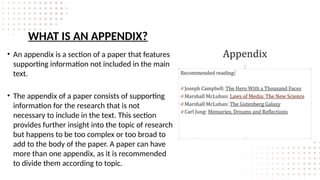
WHAT IS AN APPENDIX?
• An appendix is a section of a paper that features
supporting information not included in the main
text.
• The appendix of a paper consists of supporting
information for the research that is not
necessary to include in the text. This section
provides further insight into the topic of research
but happens to be too complex or too broad to
add to the body of the paper. A paper can have
more than one appendix, as it is recommended
to divide them according to topic.
What type of information includes an appendix?
Surveys. Since many researchers base their methodology on surveys, these are commonly
found attached as appendices. Surveys must be included exactly as they were presented to
the respondents, and exactly how they were answered so the reader can get a real picture of
the findings.
Interviews. Whether it’s a transcript or a recording, interviews are usually included as an
appendix. The list of questions and the real answers must be presented for complete
transparency.
Correspondence. All types of communication with collaborators regarding the research
should be Included as an appendix. These can be emails, text messages, letters, transcripts of
audio messages, etc
Research tools. Any instrument used to perform the research should be acknowledged in
an appendix to give the reader insight into the process. For instance, audio recorders,
cameras, special software, etc.
Non-textual items. If the research includes too many graphs, tables, figures, illustrations,
photos or charts, these should be added as an appendix.
Statistical data. When raw data is too long, it should be attached to the research as an
appendix. Even if only one part of the data was used, the complete data must be given.
The purpose of an appendix
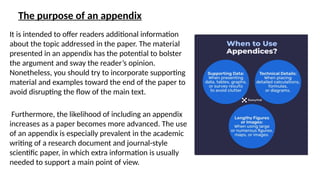
It is intended to offer readers additional information
about the topic addressed in the paper. The material
presented in an appendix has the potential to bolster
the argument and sway the reader’s opinion.
Nonetheless, you should try to incorporate supporting
material and examples toward the end of the paper to
avoid disrupting the flow of the main text.
Furthermore, the likelihood of including an appendix
increases as a paper becomes more advanced. The use
of an appendix is especially prevalent in the academic
writing of a research document and journal-style
scientific paper, in which extra information is usually
needed to support a main point of view.
The format of an appendix
The format of an appendix will vary based on the type of citation style you’re using, as
well as the guidelines of the journal or class for which the paper is being written. Here are
some general appendix formatting rules:
Appendices should be divided by topic or by set of data.
Appendices are included in the table of contents.
The most common heading for an appendix is Appendix A or 1, centered, in bold, followed
by a title describing its content.
An appendix should be located before or after the list of references.
Each appendix should start on a new page.
Each page includes a page number.
• Appendices follow a sequential order, meaning they appear in the order in which they
are referred to throughout the paper.
Every Appendix Should Contain:
1) A clear title: The title of the appendix should be concise and descriptive, clearly indicating what information is
contained within it. For example, ‘Appendix A: Data Tables for Study Results or ‘Appendix B: Images of
Experimental Setup.’
2) A list of contents : Including a table of contents in the appendix can be helpful for readers to navigate the
information provided. For example:
Table of Contents:
A. Data Tables for Study Results
B. Images of Experimental Setup
C. Survey Questions and Responses
D. Sample Interview Transcripts .
3) Page numbers: The appendix should be a separate page, independently numbered from the main
body of the paper, and specified uniformly (e.g., ‘Appendix A,’ ‘Appendix B,’ etc.). For example:
Appendix A
Page 1 of 5
4)Relevant information: The appendix should contain all the relevant information supporting the
main arguments of the document, including tables of data, raw statistical data, charts, or other
documents. For example:
Figure 1: Experimental Results
[insert graph or chart here]
5)Proper formatting: The appendix should be formatted in accordance with the specific requirements of the chosen
citation style (e.g., APA, MLA, Chicago). For example
Appendix B: Survey Questions and Responses
[insert survey questions and responses here, formatted following APA style guidelines]
6) Clear labelling: Each element should have a clear appendix label so readers can easily understand its relevance to
the paper. For example:
Table 1: Demographic Characteristics of Survey Respondents
7)Concise explanation: It is important to provide short detailed descriptions of each element in the Appendix so that
readers can understand its importance. For example:
Appendix C: Sample Interview Transcripts
Transcripts of the three interviews with the study participants shall be included for reference. These interviews provide
further insights into the experiences of participants and their views on the subject addressed in this document.
GENERAL APPENDIX FORMAT
• Heading ‘Appendix#’
• Reference list
• Index table
• Page number
• Footnotes
The guidelines for Appendix APA:
The appendix begins with the heading ‘Appendix’ followed by ABC.
It should also be written on top of the appendix title.
Abstracts
Every appendix follows the order of the stated information in the paper.
Include the appendix after the reference list.
Include page numbers for each appendix.
Appendices are to have their own page, regardless of the size.
• Include Footnotes.
STYLES OF APPENDIX
APPENDIX APA
Rules for APA
All appendices should include their own point.
Include a title for each appendix.
For multiple appendices, use ABC for tilting them.
For reference within the body, include (see appendix a) after the text.
The title should be centred.
All appendices are to have their own page, regardless of the size.
Paragraph One should be written without indents.
The rest of the paragraphs should have the intended formatting.
• Include double spacing.
Guidelines for an Appendix Chicago Style
More than one appendix is described as appendices.
The font required for the appendix Chicago style is Times New Roman.
The text size should be 12 points.
The page numbers should be displayed on the top right of each page.
The page numbers should also be labeled as ‘Page 1,2,3’.
Avoid including a page number on the front cover.
The bibliography should be the final new page. It should not share a page with any other content.
• It is possible to include footnotes in the bibliography.
APPENDIX CHICAGO STYLE
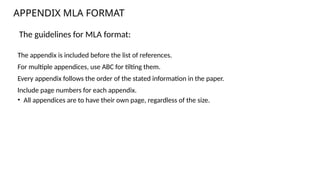
The guidelines for MLA format:
The appendix is included before the list of references.
For multiple appendices, use ABC for tilting them.
Every appendix follows the order of the stated information in the paper.
Include page numbers for each appendix.
• All appendices are to have their own page, regardless of the size.
APPENDIX MLA FORMAT
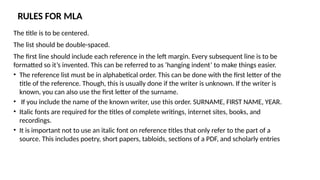
RULES FOR MLA
The title is to be centered.
The list should be double-spaced.
The first line should include each reference in the left margin. Every subsequent line is to be
formatted so it’s invented. This can be referred to as ‘hanging indent’ to make things easier.
• The reference list must be in alphabetical order. This can be done with the first letter of the
title of the reference. Though, this is usually done if the writer is unknown. If the writer is
known, you can also use the first letter of the surname.
• If you include the name of the known writer, use this order. SURNAME, FIRST NAME, YEAR.
• Italic fonts are required for the titles of complete writings, internet sites, books, and
recordings.
• It is important not to use an italic font on reference titles that only refer to the part of a
source. This includes poetry, short papers, tabloids, sections of a PDF, and scholarly entries
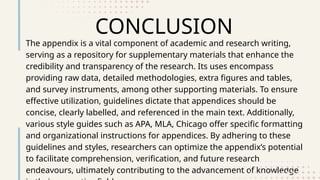
CONCLUSION
The appendix is a vital component of academic and research writing,
serving as a repository for supplementary materials that enhance the
credibility and transparency of the research. Its uses encompass
providing raw data, detailed methodologies, extra figures and tables,
and survey instruments, among other supporting materials. To ensure
effective utilization, guidelines dictate that appendices should be
concise, clearly labelled, and referenced in the main text. Additionally,
various style guides such as APA, MLA, Chicago offer specific formatting
and organizational instructions for appendices. By adhering to these
guidelines and styles, researchers can optimize the appendix’s potential
to facilitate comprehension, verification, and future research
endeavours, ultimately contributing to the advancement of knowledge
THANK YOU

appendix.scientific writing in research .pptx

  • 1.
  • 2.
    An appendix isa supplementary section at the end of a document, such as a research paper, thesis, or report, that provides additional information that supports the main text. Its primary use is to include materials that are not essential for understanding the main argument or findings but offer further context, clarification, or detail. The importance of an appendix lies in its ability to enhance the credibility and transparency of the research by providing raw data, extra figures and tables, detailed methodologies, survey instruments, and other relevant materials that may not be feasible to include in the main text. By separating this supplementary information from the main text, the appendix helps to maintain clarity and concision while still providing valuable resources for readers who require more in-depth information. INTRODUCTION
  • 3.
    WHAT IS ANAPPENDIX? • An appendix is a section of a paper that features supporting information not included in the main text. • The appendix of a paper consists of supporting information for the research that is not necessary to include in the text. This section provides further insight into the topic of research but happens to be too complex or too broad to add to the body of the paper. A paper can have more than one appendix, as it is recommended to divide them according to topic.
  • 4.
    What type ofinformation includes an appendix? Surveys. Since many researchers base their methodology on surveys, these are commonly found attached as appendices. Surveys must be included exactly as they were presented to the respondents, and exactly how they were answered so the reader can get a real picture of the findings. Interviews. Whether it’s a transcript or a recording, interviews are usually included as an appendix. The list of questions and the real answers must be presented for complete transparency. Correspondence. All types of communication with collaborators regarding the research should be Included as an appendix. These can be emails, text messages, letters, transcripts of audio messages, etc
  • 5.
    Research tools. Anyinstrument used to perform the research should be acknowledged in an appendix to give the reader insight into the process. For instance, audio recorders, cameras, special software, etc. Non-textual items. If the research includes too many graphs, tables, figures, illustrations, photos or charts, these should be added as an appendix. Statistical data. When raw data is too long, it should be attached to the research as an appendix. Even if only one part of the data was used, the complete data must be given.
  • 6.
    The purpose ofan appendix It is intended to offer readers additional information about the topic addressed in the paper. The material presented in an appendix has the potential to bolster the argument and sway the reader’s opinion. Nonetheless, you should try to incorporate supporting material and examples toward the end of the paper to avoid disrupting the flow of the main text. Furthermore, the likelihood of including an appendix increases as a paper becomes more advanced. The use of an appendix is especially prevalent in the academic writing of a research document and journal-style scientific paper, in which extra information is usually needed to support a main point of view.
  • 7.
    The format ofan appendix The format of an appendix will vary based on the type of citation style you’re using, as well as the guidelines of the journal or class for which the paper is being written. Here are some general appendix formatting rules: Appendices should be divided by topic or by set of data. Appendices are included in the table of contents. The most common heading for an appendix is Appendix A or 1, centered, in bold, followed by a title describing its content. An appendix should be located before or after the list of references. Each appendix should start on a new page. Each page includes a page number. • Appendices follow a sequential order, meaning they appear in the order in which they are referred to throughout the paper.
  • 8.
    Every Appendix ShouldContain: 1) A clear title: The title of the appendix should be concise and descriptive, clearly indicating what information is contained within it. For example, ‘Appendix A: Data Tables for Study Results or ‘Appendix B: Images of Experimental Setup.’ 2) A list of contents : Including a table of contents in the appendix can be helpful for readers to navigate the information provided. For example: Table of Contents: A. Data Tables for Study Results B. Images of Experimental Setup C. Survey Questions and Responses D. Sample Interview Transcripts .
  • 9.
    3) Page numbers:The appendix should be a separate page, independently numbered from the main body of the paper, and specified uniformly (e.g., ‘Appendix A,’ ‘Appendix B,’ etc.). For example: Appendix A Page 1 of 5 4)Relevant information: The appendix should contain all the relevant information supporting the main arguments of the document, including tables of data, raw statistical data, charts, or other documents. For example: Figure 1: Experimental Results [insert graph or chart here]
  • 10.
    5)Proper formatting: Theappendix should be formatted in accordance with the specific requirements of the chosen citation style (e.g., APA, MLA, Chicago). For example Appendix B: Survey Questions and Responses [insert survey questions and responses here, formatted following APA style guidelines] 6) Clear labelling: Each element should have a clear appendix label so readers can easily understand its relevance to the paper. For example: Table 1: Demographic Characteristics of Survey Respondents 7)Concise explanation: It is important to provide short detailed descriptions of each element in the Appendix so that readers can understand its importance. For example: Appendix C: Sample Interview Transcripts Transcripts of the three interviews with the study participants shall be included for reference. These interviews provide further insights into the experiences of participants and their views on the subject addressed in this document.
  • 11.
    GENERAL APPENDIX FORMAT •Heading ‘Appendix#’ • Reference list • Index table • Page number • Footnotes
  • 12.
    The guidelines forAppendix APA: The appendix begins with the heading ‘Appendix’ followed by ABC. It should also be written on top of the appendix title. Abstracts Every appendix follows the order of the stated information in the paper. Include the appendix after the reference list. Include page numbers for each appendix. Appendices are to have their own page, regardless of the size. • Include Footnotes. STYLES OF APPENDIX APPENDIX APA
  • 13.
    Rules for APA Allappendices should include their own point. Include a title for each appendix. For multiple appendices, use ABC for tilting them. For reference within the body, include (see appendix a) after the text. The title should be centred. All appendices are to have their own page, regardless of the size. Paragraph One should be written without indents. The rest of the paragraphs should have the intended formatting. • Include double spacing.
  • 14.
    Guidelines for anAppendix Chicago Style More than one appendix is described as appendices. The font required for the appendix Chicago style is Times New Roman. The text size should be 12 points. The page numbers should be displayed on the top right of each page. The page numbers should also be labeled as ‘Page 1,2,3’. Avoid including a page number on the front cover. The bibliography should be the final new page. It should not share a page with any other content. • It is possible to include footnotes in the bibliography. APPENDIX CHICAGO STYLE
  • 15.
    The guidelines forMLA format: The appendix is included before the list of references. For multiple appendices, use ABC for tilting them. Every appendix follows the order of the stated information in the paper. Include page numbers for each appendix. • All appendices are to have their own page, regardless of the size. APPENDIX MLA FORMAT
  • 16.
    RULES FOR MLA Thetitle is to be centered. The list should be double-spaced. The first line should include each reference in the left margin. Every subsequent line is to be formatted so it’s invented. This can be referred to as ‘hanging indent’ to make things easier. • The reference list must be in alphabetical order. This can be done with the first letter of the title of the reference. Though, this is usually done if the writer is unknown. If the writer is known, you can also use the first letter of the surname. • If you include the name of the known writer, use this order. SURNAME, FIRST NAME, YEAR. • Italic fonts are required for the titles of complete writings, internet sites, books, and recordings. • It is important not to use an italic font on reference titles that only refer to the part of a source. This includes poetry, short papers, tabloids, sections of a PDF, and scholarly entries
  • 17.
    CONCLUSION The appendix isa vital component of academic and research writing, serving as a repository for supplementary materials that enhance the credibility and transparency of the research. Its uses encompass providing raw data, detailed methodologies, extra figures and tables, and survey instruments, among other supporting materials. To ensure effective utilization, guidelines dictate that appendices should be concise, clearly labelled, and referenced in the main text. Additionally, various style guides such as APA, MLA, Chicago offer specific formatting and organizational instructions for appendices. By adhering to these guidelines and styles, researchers can optimize the appendix’s potential to facilitate comprehension, verification, and future research endeavours, ultimately contributing to the advancement of knowledge
  • 18.