Research Paper
Formatting
Essentials of APA Format
What is APA Style?
 APA Style was developed in 1929 by social and
behavioral scientists for authors on how to prepare
manuscripts for APA journals;
 Later used for theses, term papers, etc.;
 The latest edition was released in 2010 and includes
information on:
 Ethics in publishing;
 Parts of a manuscript;
 Guidance on writing journal articles;
 Information on grammar and punctuation;
 The use of graphics and illustrations;
 How to cite sources;
 The journal publishing process;
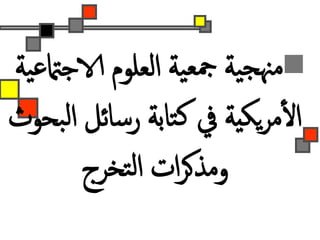
‫الاجامت‬ ‫العلوم‬ ‫ية‬‫مجع‬ ‫ية‬‫مهنج‬‫ية‬‫ع‬
‫ا‬ ‫رسائل‬ ‫تابة‬‫ك‬ ‫يف‬ ‫ية‬‫يك‬‫ر‬‫م‬‫أ‬‫ل‬‫ا‬‫بحوث‬‫ل‬
‫تخرج‬‫ل‬‫ا‬ ‫ات‬‫ر‬‫ومذك‬
 The APA style refers to the method of writing
research papers recommended by the American
Psychological Association;
 The APA style is used in the social sciences and
is governed by two basic ideas:
 The first is that a scientific paper attempts to
show something that has already been proven
true, so it calls for the past or present perfect
tense when you cite the work of others;
 Second, the year of publication is important, so
you need to feature it immediately after any
named source in the text;
 APA Style is meant to provide authors
guidelines for the formatting of research
papers and instructions for citing those
individuals who had a direct influence on
their work;
What is APA Format?
 A parenthetical documentation style
 Meaning citations appear in the
text of the paper
 Commonly utilized for research in science-
related fields, as opposed to MLA style,
which is used for research in the liberal
arts;
 Provides researchers with a format for
cross-referencing their sources from the
parenthetical references to the
reference page;
Why Use APA Format?
 Allows readers to cross-reference
the researchers sources easily;
 Provides consistent format within a
discipline;
 Gives credibility to the researcher;
 Protects the researchers from plagiarism;
Where Is APA Format Found?
 Publication Manual of the American
Psychological Association, 6th ed. (2010)
 Websites:
 http://www.wssu.edu/library/guides/apa.asp (quick
guide)
 http://www.apastyle.org (electronic sources)
 http://www.valencia.cc.fl.us/lrcwest/apapaper.html
(sample paper)
 http://www.liunet.edu/cwis/cwp/library/workshop/
citapa.htm (examples)
 http://owl.english.purdue.edu (examples)
 http://www.english.uiuc.edu/cws/wworkshop/biblio
graphy/apa/apamenu.htm (examples)
 http://www.miracosta.cc.ca.us/home/jmegill/Sabba
tical/apa/apaquiz.html (quiz)
GENERAL FORMAT
 Teachers usually ask students to prepare
their research papers or projects according
to formats that are used in their fields;
 Before a student begins working on such
an assignment, it is important to acquire
the guidelines from the teacher;
 Essential parts of an APA research paper
are:
MARGINS
 Margins in APA format should be one
inch at the top and bottom and on both
sides of each page of the text;
FONT AND FONT SIZE
 It is essential to use Times New Roman
12 when typing a paper in APA format;
 Courier New 12 can also be used in
typing an APA paper;
PAPER
 Use only white, 8 ½” by 11” paper of
good quality;
 Print on only one side of the paper;
SPACING
 The entire paper should be double spaced;
 Do not single space anything in the paper;
HEADER/PAGE NUMBERS
 All pages after the title page should have
an abbreviated title, in all capital letters,
that is flush with the left margin;
 Page numbers should be flush with the
right margin;
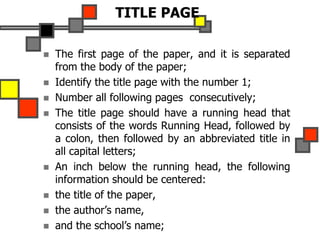
TITLE PAGE
 The first page of the paper, and it is separated
from the body of the paper;
 Identify the title page with the number 1;
 Number all following pages consecutively;
 The title page should have a running head that
consists of the words Running Head, followed by
a colon, then followed by an abbreviated title in
all capital letters;
 An inch below the running head, the following
information should be centered:
 the title of the paper,
 the author’s name,
 and the school’s name;
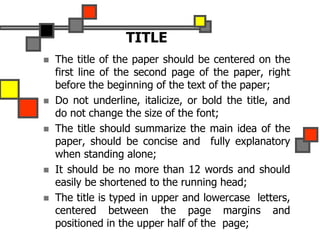
TITLE
 The title of the paper should be centered on the
first line of the second page of the paper, right
before the beginning of the text of the paper;
 Do not underline, italicize, or bold the title, and
do not change the size of the font;
 The title should summarize the main idea of the
paper, should be concise and fully explanatory
when standing alone;
 It should be no more than 12 words and should
easily be shortened to the running head;
 The title is typed in upper and lowercase letters,
centered between the page margins and
positioned in the upper half of the page;
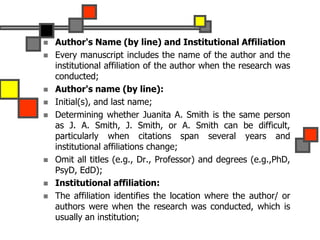
 Author's Name (by line) and Institutional Affiliation
 Every manuscript includes the name of the author and the
institutional affiliation of the author when the research was
conducted;
 Author's name (by line):
 Initial(s), and last name;
 Determining whether Juanita A. Smith is the same person
as J. A. Smith, J. Smith, or A. Smith can be difficult,
particularly when citations span several years and
institutional affiliations change;
 Omit all titles (e.g., Dr., Professor) and degrees (e.g.,PhD,
PsyD, EdD);
 Institutional affiliation:
 The affiliation identifies the location where the author/ or
authors were when the research was conducted, which is
usually an institution;
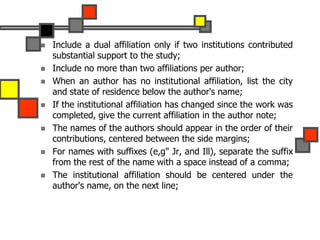
 Include a dual affiliation only if two institutions contributed
substantial support to the study;
 Include no more than two affiliations per author;
 When an author has no institutional affiliation, list the city
and state of residence below the author's name;
 If the institutional affiliation has changed since the work was
completed, give the current affiliation in the author note;
 The names of the authors should appear in the order of their
contributions, centered between the side margins;
 For names with suffixes (e,g" Jr, and Ill), separate the suffix
from the rest of the name with a space instead of a comma;
 The institutional affiliation should be centered under the
author's name, on the next line;
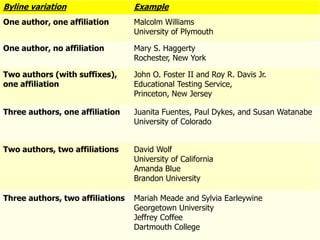
Byline variation Example
One author, one affiliation Malcolm Williams
University of Plymouth
One author, no affiliation Mary S. Haggerty
Rochester, New York
Two authors (with suffixes),
one affiliation
John O. Foster II and Roy R. Davis Jr.
Educational Testing Service,
Princeton, New Jersey
Three authors, one affiliation Juanita Fuentes, Paul Dykes, and Susan Watanabe
University of Colorado
Two authors, two affiliations David Wolf
University of California
Amanda Blue
Brandon University
Three authors, two affiliations Mariah Meade and Sylvia Earleywine
Georgetown University
Jeffrey Coffee
Dartmouth College
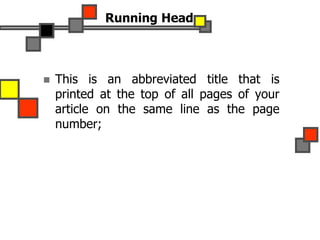
Running Head
 This is an abbreviated title that is
printed at the top of all pages of your
article on the same line as the page
number;
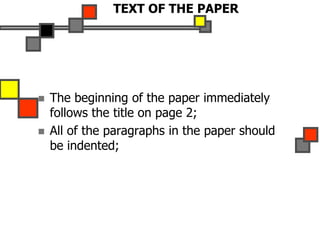
TEXT OF THE PAPER
 The beginning of the paper immediately
follows the title on page 2;
 All of the paragraphs in the paper should
be indented;
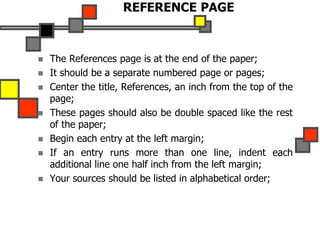
REFERENCE PAGE
 The References page is at the end of the paper;
 It should be a separate numbered page or pages;
 Center the title, References, an inch from the top of the
page;
 These pages should also be double spaced like the rest
of the paper;
 Begin each entry at the left margin;
 If an entry runs more than one line, indent each
additional line one half inch from the left margin;
 Your sources should be listed in alphabetical order;
General Format: Content
The final paper should include, in the order indicated below,
as many of the following sections as are applicable, each of
which should begin on a separate page:
 title page, which includes a running head, page header, title,
author and institution name
 abstract
 text
 references
 appendixes
 author note
 footnotes/endnotes
 dedications
 tables
 figures
General Format
 Typed (12 pt.)
 Times New Roman or Courier font preferred
 Double-spaced throughout the paper
 27 lines of text maximum per page
 Standard-sized (8.5 X 11 inches) white paper
 Margins of 1 inch on all sides
Structuring an APA Style Research Paper
Abstract (75-120 words)
 A brief comprehensive summary of the paper which allows the reader
to survey the contents of the paper quickly;
The abstract will be:
• Accurate & Self-contained: stand on its own to reflect the
contents of the paper;
• Concise and Specific: make sentences as informative and as brief
as possible;
• Non-evaluative: report information objectively;
 Begin the abstract on page 2 and identify
it with a running head;
 The word Abstract should be in upper and
lowercase letters centered at the top of
the page;
 An abstract is a single paragraph,
doublespaced;
 Consider writing the abstract after the
entire paper has been written;
Introduction
 The introduction begins on Page 3;
 Start this page by retyping your title (centered), then
begin typing the section (on the next double spaced
line) using normal (5 space indented) paragraphs;
 Do not type the word Introduction;
 The main purpose of this section is to tell the reader
why you performed the study;
 You have to inform the reader of the research question
and indicate why it is important, and how it is unique
when compared to previous studies;
 It starts out broad and becomes more and more
specific;
 Then go on to review the relevant literature;
 Then go on to make clear the connection between
previous research and the present work;
 You might include any hypotheses and the rationale for
them.
 The final paragraph usually contains a statement which
clearly and explicitly states why the study was performed,
such as: "The purpose of this study was to... " or "The
present study was designed to investigate the... " .
 This section should contain an absolute minimum of four
paragraphs: the general introduction, the literature
review, the connection of the present study to the
literature, and the explicit statement of purpose.
Method
 Describe the research and include all details on how the study
was conducted;
 Identify subsections: participants, measures and procedure;
 Each section should be labeled appropriately and placed in bold
face at the left-hand side of the page;
Participants:
 This section is labeled as subjects or participants depending
on whether animals or humans are used in the study;
 If animals are used, use the term subjects;
 If humans are used, use the term participants;
 Do not purposely start a new page for this section;
 Type the appropriate title for this subsection flush with the
left margin and italicize it;
 Indicate who participated in the study, how many, and how
were they selected;
 Include any details which are relevant to the study;
 For animals, include the gender, age, strain, weight;
 For humans, include the gender, age, race/ethnicity, and,
when appropriate, the socioeconomic status, disability
status, sexual orientation, etc.
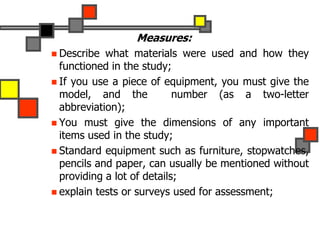
Measures:
 Describe what materials were used and how they
functioned in the study;
 If you use a piece of equipment, you must give the
model, and the number (as a two-letter
abbreviation);
 You must give the dimensions of any important
items used in the study;
 Standard equipment such as furniture, stopwatches,
pencils and paper, can usually be mentioned without
providing a lot of details;
 explain tests or surveys used for assessment;
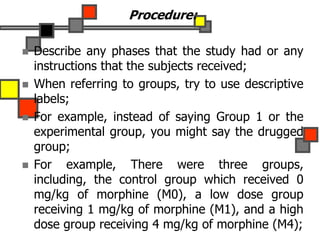
Procedure:
 Describe any phases that the study had or any
instructions that the subjects received;
 When referring to groups, try to use descriptive
labels;
 For example, instead of saying Group 1 or the
experimental group, you might say the drugged
group;
 For example, There were three groups,
including, the control group which received 0
mg/kg of morphine (M0), a low dose group
receiving 1 mg/kg of morphine (M1), and a high
dose group receiving 4 mg/kg of morphine (M4);
Results
 Objectively inform the reader of the data
collected and the statistical treatment of
them;
 Include all pertinent tables and/or figures
to further describe data collected;
 Do not include an evaluation or analysis of
the data;
Discussion
 The purpose of this section is to evaluate and
interpret the results;
 Analyze the data and interpret the implications of the
data with respect to the original hypothesis;
 Compare the results of the current study to the work
of the previous research that was discussed in the
introduction;
 Recommend what should be done next in regard to
future research related to the subject of the research;
 It is also important to discuss how the results relate to
the literature you cited in the introduction;
 You might also mention any limitations of the study and
any suggestions for future research in this section;
 Finally, you need an ending paragraph in which you make
a final summary statement of the conclusions you have
drawn;
 You are also encouraged to comment on the importance
and relevance of your findings;
 Thus, this section should contain an absolute minimum of
three paragraphs: the non-technical summary, discussion
of the results and their implications, and the concluding
paragraph;
References
 The references page will list only sources actually cited
in the paper;
 Start on a new page;
 Center the word References at the top;
 Double space;
 Any citations made in the manuscript must be
presented in this section and vice versa;
 If something is not cited in the text, then it should not
appear in this section;
 This section is alphabetized by last name (of the first
author involved in the study);
 A hanging indent is employed for each reference, that
is, the first line is not indented and the rest are five-
space indented.
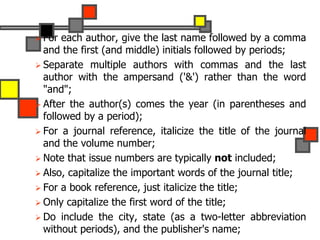
 For each author, give the last name followed by a comma
and the first (and middle) initials followed by periods;
 Separate multiple authors with commas and the last
author with the ampersand ('&') rather than the word
"and";
 After the author(s) comes the year (in parentheses and
followed by a period);
 For a journal reference, italicize the title of the journal
and the volume number;
 Note that issue numbers are typically not included;
 Also, capitalize the important words of the journal title;
 For a book reference, just italicize the title;
 Only capitalize the first word of the title;
 Do include the city, state (as a two-letter abbreviation
without periods), and the publisher's name;
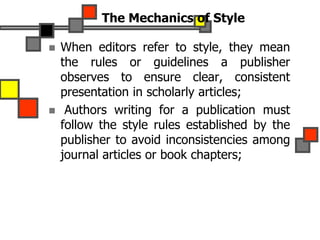
The Mechanics of Style
 When editors refer to style, they mean
the rules or guidelines a publisher
observes to ensure clear, consistent
presentation in scholarly articles;
 Authors writing for a publication must
follow the style rules established by the
publisher to avoid inconsistencies among
journal articles or book chapters;
Punctuation
 Punctuation establishes the cadence of a
sentence, telling the reader where to
pause (comma, semicolon, and colon),
stop (period and question mark), or take a
detour (dash, parentheses, and brackets);
 Punctuation of a sentence usually denotes
a pause in thought; different kinds of
punctuation indicate different kinds and
lengths of pauses;
Spacing After Punctuation Marks
 Insert one space after:
 commas, colons, and semicolons;
 periods that separate parts of a reference
citation;
 periods of the initials in personal names
(e.g., J. R. Zhang).
 Exception:
 Do not insert a space after internal periods
in abbreviations (e.g., a.m., i.e., U.S.);
 Space twice after punctuation marks at the
end of a sentence;
Period
 Use a period to end a complete sentence;
 Periods are used with abbreviations as follows:
 Use periods with:
 initials of names (J. R. Smith);
 abbreviation for United States when it is used as
an adjective (U.S. Navy);
 reference abbreviations (Vol. 1, 2nd ed., p. 6);
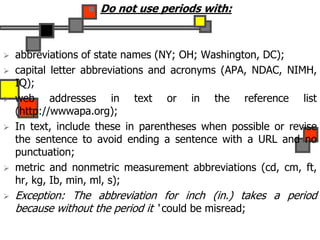
 Do not use periods with:
 abbreviations of state names (NY; OH; Washington, DC);
 capital letter abbreviations and acronyms (APA, NDAC, NIMH,
IQ);
 web addresses in text or in the reference list
(http://wwwapa.org);
 In text, include these in parentheses when possible or revise
the sentence to avoid ending a sentence with a URL and no
punctuation;
 metric and nonmetric measurement abbreviations (cd, cm, ft,
hr, kg, Ib, min, ml, s);
 Exception: The abbreviation for inch (in.) takes a period
because without the period it ‘ could be misread;
Comma
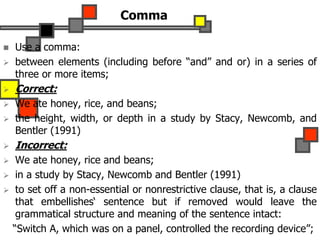
 Use a comma:
 between elements (including before “and” and or) in a series of
three or more items;
 Correct:
 We ate honey, rice, and beans;
 the height, width, or depth in a study by Stacy, Newcomb, and
Bentler (1991)
 Incorrect:
 We ate honey, rice and beans;
 in a study by Stacy, Newcomb and Bentler (1991)
 to set off a non-essential or nonrestrictive clause, that is, a clause
that embellishes‘ sentence but if removed would leave the
grammatical structure and meaning of the sentence intact:
“Switch A, which was on a panel, controlled the recording device”;
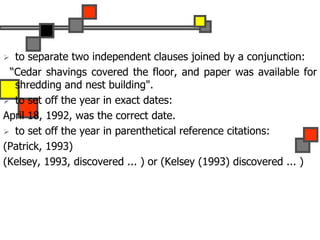
 to separate two independent clauses joined by a conjunction:
“Cedar shavings covered the floor, and paper was available for
shredding and nest building".
 to set off the year in exact dates:
April 18, 1992, was the correct date.
 to set off the year in parenthetical reference citations:
(Patrick, 1993)
(Kelsey, 1993, discovered ... ) or (Kelsey (1993) discovered ... )
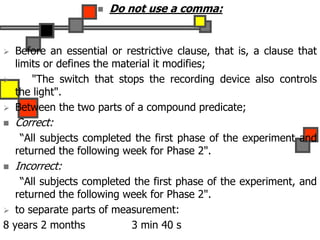
 Do not use a comma:
 Before an essential or restrictive clause, that is, a clause that
limits or defines the material it modifies;
 "The switch that stops the recording device also controls
the light".
 Between the two parts of a compound predicate;
 Correct:
“All subjects completed the first phase of the experiment and
returned the following week for Phase 2".
 Incorrect:
“All subjects completed the first phase of the experiment, and
returned the following week for Phase 2".
 to separate parts of measurement:
8 years 2 months 3 min 40 s
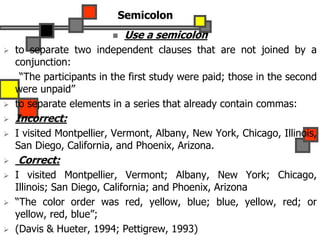
Semicolon
 Use a semicolon
 to separate two independent clauses that are not joined by a
conjunction:
“The participants in the first study were paid; those in the second
were unpaid”
 to separate elements in a series that already contain commas:
 Incorrect:
 I visited Montpellier, Vermont, Albany, New York, Chicago, Illinois,
San Diego, California, and Phoenix, Arizona.
 Correct:
 I visited Montpellier, Vermont; Albany, New York; Chicago,
Illinois; San Diego, California; and Phoenix, Arizona
 “The color order was red, yellow, blue; blue, yellow, red; or
yellow, red, blue”;
 (Davis & Hueter, 1994; Pettigrew, 1993)
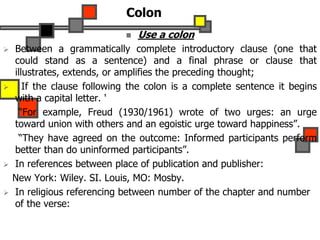
Colon
 Use a colon
 Between a grammatically complete introductory clause (one that
could stand as a sentence) and a final phrase or clause that
illustrates, extends, or amplifies the preceding thought;
 If the clause following the colon is a complete sentence it begins
with a capital letter. '
“For example, Freud (1930/1961) wrote of two urges: an urge
toward union with others and an egoistic urge toward happiness”.
“They have agreed on the outcome: Informed participants perform
better than do uninformed participants”.
 In references between place of publication and publisher:
New York: Wiley. SI. Louis, MO: Mosby.
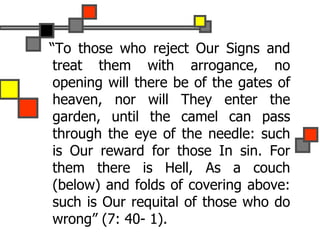
 In religious referencing between number of the chapter and number
of the verse:
“To those who reject Our Signs and
treat them with arrogance, no
opening will there be of the gates of
heaven, nor will They enter the
garden, until the camel can pass
through the eye of the needle: such
is Our reward for those In sin. For
them there is Hell, As a couch
(below) and folds of covering above:
such is Our requital of those who do
wrong” (7: 40- 1).
Quotation Marks
 Use double quotation marks:
 To introduce a word or phrase used as an ironic comment, as slang, or
as an invented or coined expression:
Correct:
considered "normal" behavior
the "good-outcome" variable ... the good-outcome variable [no quotation
marks after the initial usage]
Incorrect:
considered 'normal' behavior
the "good-outcome" variable ... the "good-outcome" variable
 to set off the title of an article or chapter in a periodical or book when
the title is mentioned in text.
Riger's (1992) article, "Epistemological Debates, Feminist Voices: Science,
Social Values, and the Study of Women"
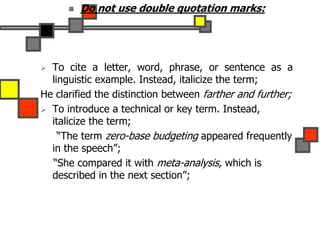
 Do not use double quotation marks:
 To cite a letter, word, phrase, or sentence as a
linguistic example. Instead, italicize the term;
He clarified the distinction between farther and further;
 To introduce a technical or key term. Instead,
italicize the term;
“The term zero-base budgeting appeared frequently
in the speech”;
“She compared it with meta-analysis, which is
described in the next section”;
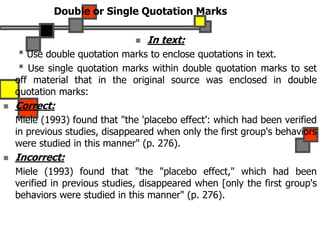
Double or Single Quotation Marks
 In text:
* Use double quotation marks to enclose quotations in text.
* Use single quotation marks within double quotation marks to set
off material that in the original source was enclosed in double
quotation marks:
 Correct:
Miele (1993) found that "the 'placebo effect’: which had been verified
in previous studies, disappeared when only the first group's behaviors
were studied in this manner" (p. 276).
 Incorrect:
Miele (1993) found that "the "placebo effect," which had been
verified in previous studies, disappeared when [only the first group's
behaviors were studied in this manner" (p. 276).
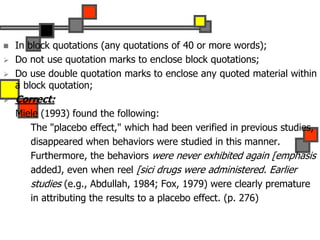
 In block quotations (any quotations of 40 or more words);
 Do not use quotation marks to enclose block quotations;
 Do use double quotation marks to enclose any quoted material within
a block quotation;
 Correct:
Miele (1993) found the following:
The "placebo effect," which had been verified in previous studies,
disappeared when behaviors were studied in this manner.
Furthermore, the behaviors were never exhibited again [emphasis
addedJ, even when reel [sici drugs were administered. Earlier
studies (e.g., Abdullah, 1984; Fox, 1979) were clearly premature
in attributing the results to a placebo effect. (p. 276)
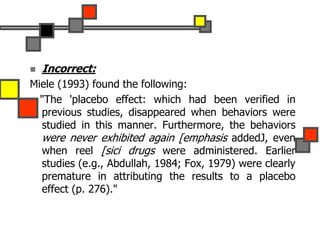
 Incorrect:
Miele (1993) found the following:
"The 'placebo effect: which had been verified in
previous studies, disappeared when behaviors were
studied in this manner. Furthermore, the behaviors
were never exhibited again [emphasis addedJ, even
when reel [sici drugs were administered. Earlier
studies (e.g., Abdullah, 1984; Fox, 1979) were clearly
premature in attributing the results to a placebo
effect (p. 276)."
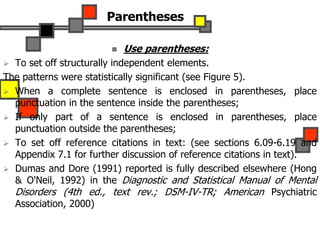
Parentheses
 Use parentheses:
 To set off structurally independent elements.
The patterns were statistically significant (see Figure 5).
 When a complete sentence is enclosed in parentheses, place
punctuation in the sentence inside the parentheses;
 If only part of a sentence is enclosed in parentheses, place
punctuation outside the parentheses;
 To set off reference citations in text: (see sections 6.09-6.19 and
Appendix 7.1 for further discussion of reference citations in text).
 Dumas and Dore (1991) reported is fully described elsewhere (Hong
& O'Neil, 1992) in the Diagnostic and Statistical Manual of Mental
Disorders (4th ed., text rev.; DSM-IV-TR; American Psychiatric
Association, 2000)
 To introduce an abbreviation:
effect on the galvanic skin response (GSR)
 To set off letters that identify items in a series within a
sentence or paragraph:
The subject areas included (a) synonyms associated with
cultural interactions, (b) descriptors for ethnic group
membership, and (c) psychological symptoms and outcomes
associated with bicultural adaptation;
 To group mathematical expressions: (k - 1 )/(g - 2)
 To enclose the citation or page number of a direct
quotation:
The author stated, "The effect disappeared within minutes"
(Lopez, 1993, p. 311), but she did not say which effect;
 Lopez (1993) found that "the effect disappeared within
minutes" (p. 311), but she did not say which effect; to
enclose statistical values: was statistically significant (p=
.031)
Slash
 Use a slash:
 to indicate per to separate units of measurement
accompanied by a numerical value: 0.5 deg/s
 7.4 mg/kg
 to set off English phonemes: /0/
 to cite a republished work in text: Freud
(1923/1961);
Hyphenation
 Use no space before or after (e.g.,
trial-by-trial analysis);
 In general, words with prefixes such
as non, semi, pre, post, anti, multi,
and inter are not hyphenated:
 pretest, posttest, antibiotic,
antisocial, nonprofit, semipro,
multiphased, subsample;
 All self- compounds are hyphenated:
self-esteem, self-efficacy;
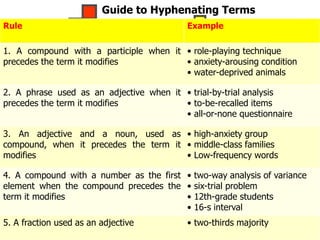
Guide to Hyphenating Terms
Rule Example
1. A compound with a participle when it
precedes the term it modifies
• role-playing technique
• anxiety-arousing condition
• water-deprived animals
2. A phrase used as an adjective when it
precedes the term it modifies
• trial-by-trial analysis
• to-be-recalled items
• all-or-none questionnaire
3. An adjective and a noun, used as
compound, when it precedes the term it
modifies
• high-anxiety group
• middle-class families
• Low-frequency words
4. A compound with a number as the first
element when the compound precedes the
term it modifies
• two-way analysis of variance
• six-trial problem
• 12th-grade students
• 16-s interval
5. A fraction used as an adjective • two-thirds majority
Do not hyphenate
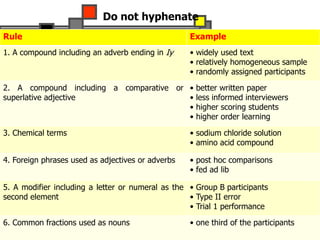
Rule Example
1. A compound including an adverb ending in Iy • widely used text
• relatively homogeneous sample
• randomly assigned participants
2. A compound including a comparative or
superlative adjective
• better written paper
• less informed interviewers
• higher scoring students
• higher order learning
3. Chemical terms • sodium chloride solution
• amino acid compound
4. Foreign phrases used as adjectives or adverbs • post hoc comparisons
• fed ad lib
5. A modifier including a letter or numeral as the
second element
• Group B participants
• Type II error
• Trial 1 performance
6. Common fractions used as nouns • one third of the participants
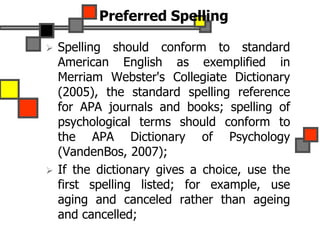
Preferred Spelling
 Spelling should conform to standard
American English as exemplified in
Merriam Webster's Collegiate Dictionary
(2005), the standard spelling reference
for APA journals and books; spelling of
psychological terms should conform to
the APA Dictionary of Psychology
(VandenBos, 2007);
 If the dictionary gives a choice, use the
first spelling listed; for example, use
aging and canceled rather than ageing
and cancelled;
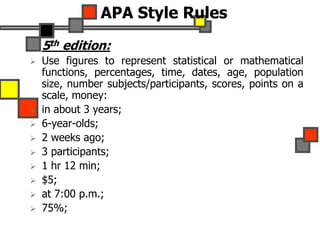
APA Style Rules
 5th edition:
 Use figures to represent statistical or mathematical
functions, percentages, time, dates, age, population
size, number subjects/participants, scores, points on a
scale, money:
 in about 3 years;
 6-year-olds;
 2 weeks ago;
 3 participants;
 1 hr 12 min;
 $5;
 at 7:00 p.m.;
 75%;
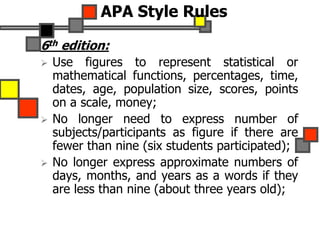
APA Style Rules
6th edition:
 Use figures to represent statistical or
mathematical functions, percentages, time,
dates, age, population size, scores, points
on a scale, money;
 No longer need to express number of
subjects/participants as figure if there are
fewer than nine (six students participated);
 No longer express approximate numbers of
days, months, and years as a words if they
are less than nine (about three years old);
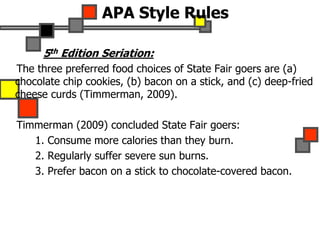
5th Edition Seriation:
The three preferred food choices of State Fair goers are (a)
chocolate chip cookies, (b) bacon on a stick, and (c) deep-fried
cheese curds (Timmerman, 2009).
Timmerman (2009) concluded State Fair goers:
1. Consume more calories than they burn.
2. Regularly suffer severe sun burns.
3. Prefer bacon on a stick to chocolate-covered bacon.
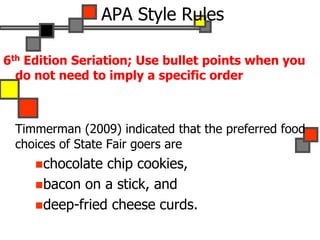
APA Style Rules
6th Edition Seriation; Use bullet points when you
do not need to imply a specific order
Timmerman (2009) indicated that the preferred food
choices of State Fair goers are
chocolate chip cookies,
bacon on a stick, and
deep-fried cheese curds.
APA Style Rules
APA Style Rules
 Do not capitalize the names of models or theories (theory of
learned behavior);
 Do not capitalize the names of disorders or diseases (bipolar
disorder, posttraumatic stress disorder [PTSD], multiple
sclerosis);
 Express the word website as one word, lowercase;
 Double space the reference list;
 Include the running head on every page in the location of the
former page header;
 Running head is flush left and page number is flush right;
 Limit your use of the pronoun we to refer only to yourself and
the coauthor(s) of a paper;
Cross-Referencing Sources
 Cross-referencing allows readers to locate
the original source material;
 This is of great value for researchers who
may want to locate the sources for their own
research studies;
Establishing Credibility
 The proper use of APA style shows the
credibility of researchers;
 Such researchers show accountability to
their source material;
Avoiding Plagiarism
 Proper citation of your sources in APA style
can help you avoid plagiarism, which is a
serious offense;
 Plagiarism may result in anything
from failure of the assignment to
expulsion from school;
APA Style: Two Main Concerns
 In-text & Parenthetical Citations;
 Reference List;
In- Text/ Parenthetical Documentation
 Parenthetical citation: the technical term used in APA
style to refer to a popular form of footnoting;
 When you use the ideas or language of someone else,
you can refer your readers easily to that resource by
using something called a parenthetical citation;
 Your readers should be able to discover the source of
any language or ideas you have used in writing your
paper/project that are not your own;
 Information Required:
- Author(s) name;
- Date of Publication;
- Page number (for direct quotations);
 In this context, performance testing borrowed
from the field of vocational testing in which a
test taker needs to carry out realistic tasks
applying language skills in actual or simulated
settings (Carroll and Hall, 1985).
Citing References in Text
 References in APA publications are cited in text with an
author-date citation system and are listed
alphabetically in the reference list;
 This style of citation briefly identifies the source for
readers and enables them to locate the source of
information in the alphabetical reference list at the end
of the article;
 Each reference cited in text must appear in the
reference list, and each entry in the reference list must
be cited in text;
When Are Parenthetical Citations Used?
 When quoting words that are not your own:
 Quoting means to repeat another source word for word,
using quotation marks;
 When summarizing facts and ideas from a source:
 Summarizing means to take ideas from a large
passage of another source and condense them, using
your own words;
 When paraphrasing a source:
 Paraphrasing means to use the ideas from another
source but change the phrasing into your own words;
Citation Format
Source with one author
Parenthetical: (Sinatra, 2007)
In-text: Sinatra (2007)
Source with two authors
Parenthetical: (Sinatra & Garland, 2007)
In-text: Sinatra and Garland (2007)
Source with three to five authors
First parenthetical: (Sinatra, Garland, & Fitzgerald, 2007)
Second and subsequent parenthetical: (Sinatra et al., 2007)
First in-text: Sinatra, Garland, and Fitzgerald (2007)
Second and subsequent in-text: Sinatra et al. (2007)
Source with six or more authors
Parenthetical: (Sinatra et al., 2007)
In-text: Sinatra et al. (2007)
Citation Format
Personal communication:
Parenthetical: (H. R. Marshall, personal communication, September 17, 2009)
In-text: H. R. Marshall (personal communication, September 17, 2009)
Secondary source material:
Parenthetical: (Marshall, as cited in Cook, 2009)
In-Text: Marshall (as cited in Cook, 2009)
Attributing an assertion to multiple sources:
Parenthetical: (Paiste, 2004; Sabian, 2005; Zildjian, 2001)
alphabetical (as they appear in reference list) and separated by semicolons
In-text: Paiste (2004), Sabian (2005), and Zildjian (2001)
Multiple sources with same author and year:
Parenthetical: (Marshall, 2009a)…(Marshall, 2009b)…(Marshall, 2009c)
In-text: Marshall (2009a)…Marshall (2009b)…Marshall (2009c)
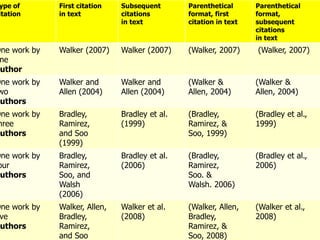
ype of
itation
First citation
in text
Subsequent
citations
in text
Parenthetical
format, first
citation in text
Parenthetical
format,
subsequent
citations
in text
One work by
ne
uthor
Walker (2007) Walker (2007) (Walker, 2007) (Walker, 2007)
One work by
wo
uthors
Walker and
Allen (2004)
Walker and
Allen (2004)
(Walker &
Allen, 2004)
(Walker &
Allen, 2004)
One work by
hree
uthors
Bradley,
Ramirez,
and Soo
(1999)
Bradley et al.
(1999)
(Bradley,
Ramirez, &
Soo, 1999)
(Bradley et al.,
1999)
One work by
our
uthors
Bradley,
Ramirez,
Soo, and
Walsh
(2006)
Bradley et al.
(2006)
(Bradley,
Ramirez,
Soo. &
Walsh. 2006)
(Bradley et al.,
2006)
One work by
ve
uthors
Walker, Allen,
Bradley,
Ramirez,
and Soo
Walker et al.
(2008)
(Walker, Allen,
Bradley,
Ramirez, &
Soo, 2008)
(Walker et al.,
2008)
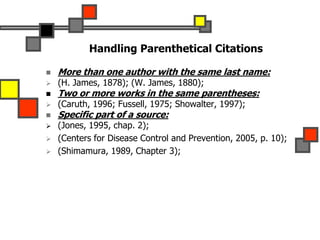
Handling Parenthetical Citations
 More than one author with the same last name:
 (H. James, 1878); (W. James, 1880);
 Two or more works in the same parentheses:
 (Caruth, 1996; Fussell, 1975; Showalter, 1997);
 Specific part of a source:
 (Jones, 1995, chap. 2);
 (Centers for Disease Control and Prevention, 2005, p. 10);
 (Shimamura, 1989, Chapter 3);
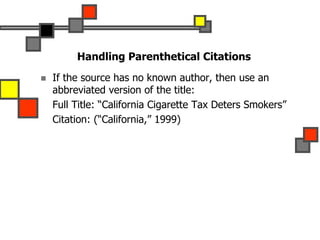
Handling Parenthetical Citations
 If the source has no known author, then use an
abbreviated version of the title:
Full Title: “California Cigarette Tax Deters Smokers”
Citation: (“California,” 1999)
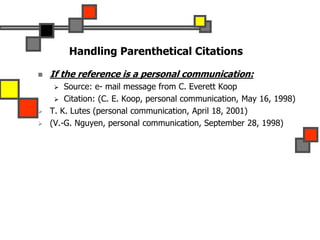
Handling Parenthetical Citations
 If the reference is a personal communication:
 Source: e- mail message from C. Everett Koop
 Citation: (C. E. Koop, personal communication, May 16, 1998)
 T. K. Lutes (personal communication, April 18, 2001)
 (V.-G. Nguyen, personal communication, September 28, 1998)
Secondary Sources
 For example, If Allport’s work is cited in
Nicholson and you did not read Allport's
work, list the Nicholson reference in the
reference list;
 In the text, use the following citation:
Allport's diary (as cited in Nicholson, 2003).
Sample Parenthetical Citations
Recently, the history of warfare has been significantly
revised by Higonnet et al (1987), Marcus (1989), and Raitt and
Tate (1997) to include women’s personal and cultural
responses to battle and its resultant traumatic effects.
Feminist researchers now concur that “It is no longer true
to claim that women's responses to the war have been ignored”
(Raitt & Tate, p. 2). Though these studies focus solely on
women's experiences, they err by collectively perpetuating the
masculine-centered impressions originating in Fussell (1975)
and Bergonzi (1996).
However, Tylee (1990) further criticizes Fussell, arguing
that his study “treated memory and culture as if they belonged
to a sphere beyond the existence of individuals or the control
of institutions” (p. 6).
Handling Quotes in the Text
 When a quotation is used in the text, include the
author, year and page number;
 Enclose in parentheses;
 40 words or less: incorporate into text and use
double quotation marks ;
 Longer than 40 words: use double spaced block
with no quotation marks, each line indented 5
spaces from left margin;
Handling Quotes in the Text
Two types of citations for quotations:
 If the author’s name appears in the text of the
paper, only the date is cited
 If the author’s name does not appear in the
text of the paper, both the name and date
are cited, separated by a comma
Citing Short Quotations (fewer than 40 words):
 When you incorporate a direct quotation into a sentence,
you must cite its source;
 Lee (2007) stated, “The ability to think critically is needed in
this revolutionary age of technological change” (p. 82).
OR
 One researcher believed that “the ability to think critically is
needed in this revolutionary age of technological change”
(Lee, 2007, p. 82).
Citing Long Quotations (40 or more words):
If the quotation is long (40 or more words), you must use
 a block format in which all lines of the quotation are
indented approximately ½ inch from the left margin;
 no quotation marks;
Citing Summaries or Paraphrases
 Even if you put information in your own words by summarizing
or paraphrasing, you must cite the original author or
researcher;
 For example, a paraphrase of Lee’s earlier quotation would be
cited as follows:
 One researcher believed that flexibly applied thinking is vital to
cope with rapidly changing technology (Lee, 2007, p. 82).
OR:
 Lee (2007) believed that flexibly applied thinking is vital to cope
with rapidly changing technology (p. 82).
Citing Information When You Have Not Seen the Original Source
 Sometimes an author writes about research that someone
else has done, but you are unable to track down the
original research report;
 In the sample paraphrase below, Pither and Soden’s
research is taken from a journal article written by Lee;
 Pither and Soden’s 2000 review found little empirical
research on university students’ critical thinking (as cited in
Lee, 2007, p. 83).
Citing Information If No Page Numbers Are Available
 Many electronic sources such as websites contain no page
numbers, so you cannot include a page number for the in-text
citation;
 The exception is for PDFs, which normally show original page
numbers;
 If the source has no page numbers but it explicitly numbers
the paragraphs, you can include paragraph number(s),
preceded by the abbreviation “para.” in the citation
parentheses;
Reference Page
 A list of every source that is made reference to in the
research paper;
 Provides the information necessary for a reader to
locate and retrieve any sources cited in the research
paper;
 Each source cited in the research paper must appear on
the reference page, and vice versa;
Reference Page: A Few Rules
 Put at the end of paper
 Begin reference list on a separate page using
References as the title, centered at the top
 Use italics for Titles
 Authors:
 Last name first
 List alphabetized by author
 Indent ½ inch from left margin after first line of entry
(hanging indentation)
 Only first word of title is capitalized
 Use & rather than and for multiple authors
 Choose and include only the sources that you used in the
research;
 APA requires that the reference list to be:
 double- spaced;
 Entries having a hanging indent;
 Each entry should contain:
 Author;
 Year of publication;
 Title;
 Publishing date;
 Abbreviations: Acceptable abbreviations in the reference
list for parts of books and other publications include the
following:
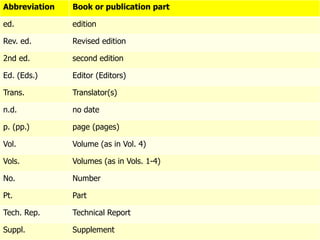
Abbreviation Book or publication part
ed. edition
Rev. ed. Revised edition
2nd ed. second edition
Ed. (Eds.) Editor (Editors)
Trans. Translator(s)
n.d. no date
p. (pp.) page (pages)
Vol. Volume (as in Vol. 4)
Vols. Volumes (as in Vols. 1-4)
No. Number
Pt. Part
Tech. Rep. Technical Report
Suppl. Supplement
Arabic numerals
 APA style uses arabic numerals because
they are easier to comprehend than
Roman numerals;
 Order of References in the Reference List:
 Alphabetizing names:
 Arrange entries in alphabetical order:
 by the surname of the first author followed by initials of the author's
given name, and use the following rules for:
 Alphabetize by the author's surname:
 Alphabetize letter by letter:
 When alphabetizing surnames, remember that "nothing precedes
something":
 Brown, J. R., precedes Browning, A. R., even though “i“ precedes “j" in
the alphabet;
 Singh, Y, precedes Singh Siddhu, N.
 Lopez, M. E., precedes Lopez de Molina, G.
 Ibn Abdulaziz, T., precedes Ibn Nidal, A K. M.
 Girard, J.-B., precedes Girard-Perregaux, A S.
 Villafuerte, S. A, precedes Villa-Lobos, J.
 Benjamin, A S., precedes Ben Yaakov, D.
 Alphabetize the prefixes M’, Mc., and Mac.
 Alphabetize entries with numerals chronologically: (e.g., Macomber,
J. II, precedes Macomber, J., III);
 Order of several works by the same author:
 When ordering several works by the order of several works by the
same first author, give the author’s name in the first and all
subsequent references:
 Upenieks, V. (2003).
 Upenieks, V. (2005).
 One-author entries precede multiple-author entries beginning with
the same surname (even if the multiple-author work was published
earlier):
 Alleyne, R. L. (2001).
 Alleyne, R. L., & Evans, A. J. (1999).
 References with the same first author and different second or third
authors are arranged alphabetically by the surname of the second
author or the third:
 Boockvar, K. S., & Burack, O. R. (2007).
 Boockvar, K. S., Carlson LaCorte, H., Giambanco, V., Fnedman,
B., & Siu, A.(2006).
 Hayward, D., Firsching, A., & Brown, J. (1999).
 Hayward, D., Firsching, A., & Smigel, J. (1999).
 References with the same authors in the same order are
arranged by year of publication, the earliest first:
 Cabading, J. R., & Wright, K. (2000).
 Cabading, J. R., & Wright, K. (2001).
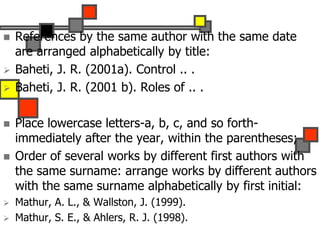
 References by the same author with the same date
are arranged alphabetically by title:
 Baheti, J. R. (2001a). Control .. .
 Baheti, J. R. (2001 b). Roles of .. .
 Place lowercase letters-a, b, c, and so forth-
immediately after the year, within the parentheses;
 Order of several works by different first authors with
the same surname: arrange works by different authors
with the same surname alphabetically by first initial:
 Mathur, A. L., & Wallston, J. (1999).
 Mathur, S. E., & Ahlers, R. J. (1998).
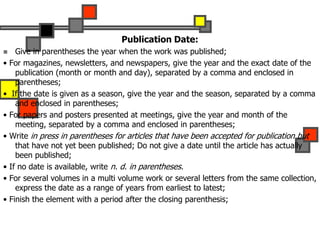
Publication Date:
 Give in parentheses the year when the work was published;
• For magazines, newsletters, and newspapers, give the year and the exact date of the
publication (month or month and day), separated by a comma and enclosed in
parentheses;
• If the date is given as a season, give the year and the season, separated by a comma
and enclosed in parentheses;
• For papers and posters presented at meetings, give the year and month of the
meeting, separated by a comma and enclosed in parentheses;
• Write in press in parentheses for articles that have been accepted for publication but
that have not yet been published; Do not give a date until the article has actually
been published;
• If no date is available, write n. d. in parentheses.
• For several volumes in a multi volume work or several letters from the same collection,
express the date as a range of years from earliest to latest;
• Finish the element with a period after the closing parenthesis;
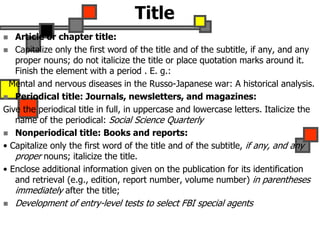
Title
 Article or chapter title:
 Capitalize only the first word of the title and of the subtitle, if any, and any
proper nouns; do not italicize the title or place quotation marks around it.
Finish the element with a period . E. g.:
Mental and nervous diseases in the Russo-Japanese war: A historical analysis.
 Periodical title: Journals, newsletters, and magazines:
Give the periodical title in full, in uppercase and lowercase letters. Italicize the
name of the periodical: Social Science Quarterly
 Nonperiodical title: Books and reports:
• Capitalize only the first word of the title and of the subtitle, if any, and any
proper nouns; italicize the title.
• Enclose additional information given on the publication for its identification
and retrieval (e.g., edition, report number, volume number) in parentheses
immediately after the title;
 Development of entry-level tests to select FBI special agents
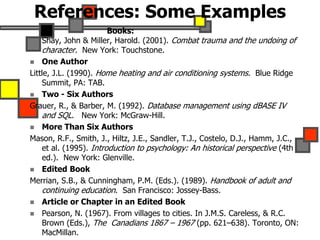
References: Some Examples
Books:
Shay, John & Miller, Harold. (2001). Combat trauma and the undoing of
character. New York: Touchstone.
 One Author
Little, J.L. (1990). Home heating and air conditioning systems. Blue Ridge
Summit, PA: TAB.
 Two - Six Authors
Grauer, R., & Barber, M. (1992). Database management using dBASE IV
and SQL. New York: McGraw-Hill.
 More Than Six Authors
Mason, R.F., Smith, J., Hiltz, J.E., Sandler, T.J., Costelo, D.J., Hamm, J.C.,
et al. (1995). Introduction to psychology: An historical perspective (4th
ed.). New York: Glenville.
 Edited Book
Merrian, S.B., & Cunningham, P.M. (Eds.). (1989). Handbook of adult and
continuing education. San Francisco: Jossey-Bass.
 Article or Chapter in an Edited Book
 Pearson, N. (1967). From villages to cities. In J.M.S. Careless, & R.C.
Brown (Eds.), The Canadians 1867 – 1967 (pp. 621–638). Toronto, ON:
MacMillan.
 Entry in an Encyclopedia
 Faber, B. L. (2003). Grasshopper. In World book encyclopedia
(Vol. 8, pp. 327–328). Chicago: World Book.
 Periodical Articles:
 Article in Magazine:
Birnbaum, J.H. (1995, May 15). The gospel according to Bob.
Time, 125, 18–27.
 Article in Periodical Paginated by Issue
Kiser, K. (1999, May). What keeps you up at nights? Training, 55
(2), 30–37.
 Article in a Quarterly Periodical
Roth, R. (1999). Don’t just yell louder: Find your voice. Public
Relations Quarterly, 44 (1), 27.
 Article in Newspaper (with author):
Hiller, S. (1996, November 7). System needs a fix. The Daily News, p.4.
 Article in Newspaper (no author):
Province pulls plug on toxic hotel bill. (1999, June 15). Chronicle Herald, pp. A1, A5.
 Electronic Resources:
 Web Site:
Kemf, E., & Jackson, P. (1994, October). Asian elephants in the wild. Retrieved from
http://www.panda.org/resources/publications/species/w-elephants/page1.htm
 Web Site (no author, no date):
Behaviour and habits of the cobra. (n.d.). Retrieved from
http://www.usk.library.edu/cobra.html
 Periodical Article in a WWW Database (including articles in NSCC Library
databases):
Foubister, V. (2000, March 6). Gene therapy fosters hope. American Medical News,
43 (9), 10. Retrieved from Health Reference Center-Academic database.
 Document Available on a University Program or Department Web
Site:
Information literacy at Roger Williams University. (2002, July 15). Retrieved
from http://library.rwu.edu/about/infolit.html
 Article in an Internet-Only Journal
Helton, R., & Esrock, S. (1998, April/May). Positioning and marketing
academic libraries to students. MLS: Marketing Library Services, 12 (3).
Retrieved from http://www.infotoday.com/mls/apr98/mls-cont.htm
 Personal Communication:
 Personal communication may include letters, memorandums, personal
interviews, telephone conversations, etc;
 It may also include electronic communication such as e-mails or messages
from electronic bulletin boards/discussion groups (non-archived only);
 As most personal communication is considered to be unavailable for
retrieval by a reader of a research paper, they are usually not included in
the References but can be cited in text;
 Examples of personal communications available electronically and which
may be included in the list of References include:
 Message Posted to a Newsgroup
Smith, J. (2002, June 13). Vision [Msg 56]. Message posted to
news://eyes.opthamology
 Messages Posted to an Electronic Mailing List (Listserv)
Davison, J. (2002, May 13). Techniques for an effective interview.
Message posted to Tel-Links
 electronic mailing list, archived at http://www.tel.uk/mail-
archive/ref/msg00897.htm
 Message Posted to an Online Forum or Discussion Group
Simon, H. (2001, July 11). New trends in effective customer service
[Msg.45]. Message posted to
http://groups.yahoo.com/group/customerservice/message/46
References
For more details, see Publication
Manual of the American
Psychological Association, 6th ed.
(2010)
APA powerpoint
APA powerpoint

APA powerpoint

  • 1.
  • 2.
  • 3.
    What is APAStyle?  APA Style was developed in 1929 by social and behavioral scientists for authors on how to prepare manuscripts for APA journals;  Later used for theses, term papers, etc.;  The latest edition was released in 2010 and includes information on:  Ethics in publishing;  Parts of a manuscript;  Guidance on writing journal articles;  Information on grammar and punctuation;  The use of graphics and illustrations;  How to cite sources;  The journal publishing process;
  • 5.
    ‫الاجامت‬ ‫العلوم‬ ‫ية‬‫مجع‬‫ية‬‫مهنج‬‫ية‬‫ع‬ ‫ا‬ ‫رسائل‬ ‫تابة‬‫ك‬ ‫يف‬ ‫ية‬‫يك‬‫ر‬‫م‬‫أ‬‫ل‬‫ا‬‫بحوث‬‫ل‬ ‫تخرج‬‫ل‬‫ا‬ ‫ات‬‫ر‬‫ومذك‬
  • 6.
     The APAstyle refers to the method of writing research papers recommended by the American Psychological Association;  The APA style is used in the social sciences and is governed by two basic ideas:  The first is that a scientific paper attempts to show something that has already been proven true, so it calls for the past or present perfect tense when you cite the work of others;  Second, the year of publication is important, so you need to feature it immediately after any named source in the text;
  • 7.
     APA Styleis meant to provide authors guidelines for the formatting of research papers and instructions for citing those individuals who had a direct influence on their work;
  • 8.
    What is APAFormat?  A parenthetical documentation style  Meaning citations appear in the text of the paper
  • 9.
     Commonly utilizedfor research in science- related fields, as opposed to MLA style, which is used for research in the liberal arts;  Provides researchers with a format for cross-referencing their sources from the parenthetical references to the reference page;
  • 10.
    Why Use APAFormat?  Allows readers to cross-reference the researchers sources easily;  Provides consistent format within a discipline;  Gives credibility to the researcher;  Protects the researchers from plagiarism;
  • 11.
    Where Is APAFormat Found?  Publication Manual of the American Psychological Association, 6th ed. (2010)  Websites:  http://www.wssu.edu/library/guides/apa.asp (quick guide)  http://www.apastyle.org (electronic sources)  http://www.valencia.cc.fl.us/lrcwest/apapaper.html (sample paper)  http://www.liunet.edu/cwis/cwp/library/workshop/ citapa.htm (examples)  http://owl.english.purdue.edu (examples)  http://www.english.uiuc.edu/cws/wworkshop/biblio graphy/apa/apamenu.htm (examples)  http://www.miracosta.cc.ca.us/home/jmegill/Sabba tical/apa/apaquiz.html (quiz)
  • 12.
    GENERAL FORMAT  Teachersusually ask students to prepare their research papers or projects according to formats that are used in their fields;  Before a student begins working on such an assignment, it is important to acquire the guidelines from the teacher;  Essential parts of an APA research paper are:
  • 13.
    MARGINS  Margins inAPA format should be one inch at the top and bottom and on both sides of each page of the text;
  • 14.
    FONT AND FONTSIZE  It is essential to use Times New Roman 12 when typing a paper in APA format;  Courier New 12 can also be used in typing an APA paper;
  • 15.
    PAPER  Use onlywhite, 8 ½” by 11” paper of good quality;  Print on only one side of the paper;
  • 16.
    SPACING  The entirepaper should be double spaced;  Do not single space anything in the paper;
  • 17.
    HEADER/PAGE NUMBERS  Allpages after the title page should have an abbreviated title, in all capital letters, that is flush with the left margin;  Page numbers should be flush with the right margin;
  • 18.
    TITLE PAGE  Thefirst page of the paper, and it is separated from the body of the paper;  Identify the title page with the number 1;  Number all following pages consecutively;  The title page should have a running head that consists of the words Running Head, followed by a colon, then followed by an abbreviated title in all capital letters;  An inch below the running head, the following information should be centered:  the title of the paper,  the author’s name,  and the school’s name;
  • 19.
    TITLE  The titleof the paper should be centered on the first line of the second page of the paper, right before the beginning of the text of the paper;  Do not underline, italicize, or bold the title, and do not change the size of the font;  The title should summarize the main idea of the paper, should be concise and fully explanatory when standing alone;  It should be no more than 12 words and should easily be shortened to the running head;  The title is typed in upper and lowercase letters, centered between the page margins and positioned in the upper half of the page;
  • 20.
     Author's Name(by line) and Institutional Affiliation  Every manuscript includes the name of the author and the institutional affiliation of the author when the research was conducted;  Author's name (by line):  Initial(s), and last name;  Determining whether Juanita A. Smith is the same person as J. A. Smith, J. Smith, or A. Smith can be difficult, particularly when citations span several years and institutional affiliations change;  Omit all titles (e.g., Dr., Professor) and degrees (e.g.,PhD, PsyD, EdD);  Institutional affiliation:  The affiliation identifies the location where the author/ or authors were when the research was conducted, which is usually an institution;
  • 21.
     Include adual affiliation only if two institutions contributed substantial support to the study;  Include no more than two affiliations per author;  When an author has no institutional affiliation, list the city and state of residence below the author's name;  If the institutional affiliation has changed since the work was completed, give the current affiliation in the author note;  The names of the authors should appear in the order of their contributions, centered between the side margins;  For names with suffixes (e,g" Jr, and Ill), separate the suffix from the rest of the name with a space instead of a comma;  The institutional affiliation should be centered under the author's name, on the next line;
  • 22.
    Byline variation Example Oneauthor, one affiliation Malcolm Williams University of Plymouth One author, no affiliation Mary S. Haggerty Rochester, New York Two authors (with suffixes), one affiliation John O. Foster II and Roy R. Davis Jr. Educational Testing Service, Princeton, New Jersey Three authors, one affiliation Juanita Fuentes, Paul Dykes, and Susan Watanabe University of Colorado Two authors, two affiliations David Wolf University of California Amanda Blue Brandon University Three authors, two affiliations Mariah Meade and Sylvia Earleywine Georgetown University Jeffrey Coffee Dartmouth College
  • 23.
    Running Head  Thisis an abbreviated title that is printed at the top of all pages of your article on the same line as the page number;
  • 24.
    TEXT OF THEPAPER  The beginning of the paper immediately follows the title on page 2;  All of the paragraphs in the paper should be indented;
  • 25.
    REFERENCE PAGE  TheReferences page is at the end of the paper;  It should be a separate numbered page or pages;  Center the title, References, an inch from the top of the page;  These pages should also be double spaced like the rest of the paper;  Begin each entry at the left margin;  If an entry runs more than one line, indent each additional line one half inch from the left margin;  Your sources should be listed in alphabetical order;
  • 26.
    General Format: Content Thefinal paper should include, in the order indicated below, as many of the following sections as are applicable, each of which should begin on a separate page:  title page, which includes a running head, page header, title, author and institution name  abstract  text  references  appendixes  author note  footnotes/endnotes  dedications  tables  figures
  • 27.
    General Format  Typed(12 pt.)  Times New Roman or Courier font preferred  Double-spaced throughout the paper  27 lines of text maximum per page  Standard-sized (8.5 X 11 inches) white paper  Margins of 1 inch on all sides
  • 28.
    Structuring an APAStyle Research Paper Abstract (75-120 words)  A brief comprehensive summary of the paper which allows the reader to survey the contents of the paper quickly; The abstract will be: • Accurate & Self-contained: stand on its own to reflect the contents of the paper; • Concise and Specific: make sentences as informative and as brief as possible; • Non-evaluative: report information objectively;
  • 29.
     Begin theabstract on page 2 and identify it with a running head;  The word Abstract should be in upper and lowercase letters centered at the top of the page;  An abstract is a single paragraph, doublespaced;  Consider writing the abstract after the entire paper has been written;
  • 30.
    Introduction  The introductionbegins on Page 3;  Start this page by retyping your title (centered), then begin typing the section (on the next double spaced line) using normal (5 space indented) paragraphs;  Do not type the word Introduction;  The main purpose of this section is to tell the reader why you performed the study;  You have to inform the reader of the research question and indicate why it is important, and how it is unique when compared to previous studies;  It starts out broad and becomes more and more specific;  Then go on to review the relevant literature;  Then go on to make clear the connection between previous research and the present work;
  • 31.
     You mightinclude any hypotheses and the rationale for them.  The final paragraph usually contains a statement which clearly and explicitly states why the study was performed, such as: "The purpose of this study was to... " or "The present study was designed to investigate the... " .  This section should contain an absolute minimum of four paragraphs: the general introduction, the literature review, the connection of the present study to the literature, and the explicit statement of purpose.
  • 32.
    Method  Describe theresearch and include all details on how the study was conducted;  Identify subsections: participants, measures and procedure;  Each section should be labeled appropriately and placed in bold face at the left-hand side of the page;
  • 33.
    Participants:  This sectionis labeled as subjects or participants depending on whether animals or humans are used in the study;  If animals are used, use the term subjects;  If humans are used, use the term participants;  Do not purposely start a new page for this section;  Type the appropriate title for this subsection flush with the left margin and italicize it;  Indicate who participated in the study, how many, and how were they selected;  Include any details which are relevant to the study;  For animals, include the gender, age, strain, weight;  For humans, include the gender, age, race/ethnicity, and, when appropriate, the socioeconomic status, disability status, sexual orientation, etc.
  • 34.
    Measures:  Describe whatmaterials were used and how they functioned in the study;  If you use a piece of equipment, you must give the model, and the number (as a two-letter abbreviation);  You must give the dimensions of any important items used in the study;  Standard equipment such as furniture, stopwatches, pencils and paper, can usually be mentioned without providing a lot of details;  explain tests or surveys used for assessment;
  • 35.
    Procedure:  Describe anyphases that the study had or any instructions that the subjects received;  When referring to groups, try to use descriptive labels;  For example, instead of saying Group 1 or the experimental group, you might say the drugged group;  For example, There were three groups, including, the control group which received 0 mg/kg of morphine (M0), a low dose group receiving 1 mg/kg of morphine (M1), and a high dose group receiving 4 mg/kg of morphine (M4);
  • 36.
    Results  Objectively informthe reader of the data collected and the statistical treatment of them;  Include all pertinent tables and/or figures to further describe data collected;  Do not include an evaluation or analysis of the data;
  • 37.
    Discussion  The purposeof this section is to evaluate and interpret the results;  Analyze the data and interpret the implications of the data with respect to the original hypothesis;  Compare the results of the current study to the work of the previous research that was discussed in the introduction;  Recommend what should be done next in regard to future research related to the subject of the research;  It is also important to discuss how the results relate to the literature you cited in the introduction;
  • 38.
     You mightalso mention any limitations of the study and any suggestions for future research in this section;  Finally, you need an ending paragraph in which you make a final summary statement of the conclusions you have drawn;  You are also encouraged to comment on the importance and relevance of your findings;  Thus, this section should contain an absolute minimum of three paragraphs: the non-technical summary, discussion of the results and their implications, and the concluding paragraph;
  • 39.
    References  The referencespage will list only sources actually cited in the paper;  Start on a new page;  Center the word References at the top;  Double space;  Any citations made in the manuscript must be presented in this section and vice versa;  If something is not cited in the text, then it should not appear in this section;  This section is alphabetized by last name (of the first author involved in the study);  A hanging indent is employed for each reference, that is, the first line is not indented and the rest are five- space indented.
  • 40.
     For eachauthor, give the last name followed by a comma and the first (and middle) initials followed by periods;  Separate multiple authors with commas and the last author with the ampersand ('&') rather than the word "and";  After the author(s) comes the year (in parentheses and followed by a period);  For a journal reference, italicize the title of the journal and the volume number;  Note that issue numbers are typically not included;  Also, capitalize the important words of the journal title;  For a book reference, just italicize the title;  Only capitalize the first word of the title;  Do include the city, state (as a two-letter abbreviation without periods), and the publisher's name;
  • 41.
    The Mechanics ofStyle  When editors refer to style, they mean the rules or guidelines a publisher observes to ensure clear, consistent presentation in scholarly articles;  Authors writing for a publication must follow the style rules established by the publisher to avoid inconsistencies among journal articles or book chapters;
  • 42.
    Punctuation  Punctuation establishesthe cadence of a sentence, telling the reader where to pause (comma, semicolon, and colon), stop (period and question mark), or take a detour (dash, parentheses, and brackets);  Punctuation of a sentence usually denotes a pause in thought; different kinds of punctuation indicate different kinds and lengths of pauses;
  • 43.
    Spacing After PunctuationMarks  Insert one space after:  commas, colons, and semicolons;  periods that separate parts of a reference citation;  periods of the initials in personal names (e.g., J. R. Zhang).
  • 44.
     Exception:  Donot insert a space after internal periods in abbreviations (e.g., a.m., i.e., U.S.);  Space twice after punctuation marks at the end of a sentence;
  • 45.
    Period  Use aperiod to end a complete sentence;  Periods are used with abbreviations as follows:  Use periods with:  initials of names (J. R. Smith);  abbreviation for United States when it is used as an adjective (U.S. Navy);  reference abbreviations (Vol. 1, 2nd ed., p. 6);
  • 46.
     Do notuse periods with:  abbreviations of state names (NY; OH; Washington, DC);  capital letter abbreviations and acronyms (APA, NDAC, NIMH, IQ);  web addresses in text or in the reference list (http://wwwapa.org);  In text, include these in parentheses when possible or revise the sentence to avoid ending a sentence with a URL and no punctuation;  metric and nonmetric measurement abbreviations (cd, cm, ft, hr, kg, Ib, min, ml, s);  Exception: The abbreviation for inch (in.) takes a period because without the period it ‘ could be misread;
  • 47.
    Comma  Use acomma:  between elements (including before “and” and or) in a series of three or more items;  Correct:  We ate honey, rice, and beans;  the height, width, or depth in a study by Stacy, Newcomb, and Bentler (1991)  Incorrect:  We ate honey, rice and beans;  in a study by Stacy, Newcomb and Bentler (1991)  to set off a non-essential or nonrestrictive clause, that is, a clause that embellishes‘ sentence but if removed would leave the grammatical structure and meaning of the sentence intact: “Switch A, which was on a panel, controlled the recording device”;
  • 48.
     to separatetwo independent clauses joined by a conjunction: “Cedar shavings covered the floor, and paper was available for shredding and nest building".  to set off the year in exact dates: April 18, 1992, was the correct date.  to set off the year in parenthetical reference citations: (Patrick, 1993) (Kelsey, 1993, discovered ... ) or (Kelsey (1993) discovered ... )
  • 49.
     Do notuse a comma:  Before an essential or restrictive clause, that is, a clause that limits or defines the material it modifies;  "The switch that stops the recording device also controls the light".  Between the two parts of a compound predicate;  Correct: “All subjects completed the first phase of the experiment and returned the following week for Phase 2".  Incorrect: “All subjects completed the first phase of the experiment, and returned the following week for Phase 2".  to separate parts of measurement: 8 years 2 months 3 min 40 s
  • 50.
    Semicolon  Use asemicolon  to separate two independent clauses that are not joined by a conjunction: “The participants in the first study were paid; those in the second were unpaid”  to separate elements in a series that already contain commas:  Incorrect:  I visited Montpellier, Vermont, Albany, New York, Chicago, Illinois, San Diego, California, and Phoenix, Arizona.  Correct:  I visited Montpellier, Vermont; Albany, New York; Chicago, Illinois; San Diego, California; and Phoenix, Arizona  “The color order was red, yellow, blue; blue, yellow, red; or yellow, red, blue”;  (Davis & Hueter, 1994; Pettigrew, 1993)
  • 51.
    Colon  Use acolon  Between a grammatically complete introductory clause (one that could stand as a sentence) and a final phrase or clause that illustrates, extends, or amplifies the preceding thought;  If the clause following the colon is a complete sentence it begins with a capital letter. ' “For example, Freud (1930/1961) wrote of two urges: an urge toward union with others and an egoistic urge toward happiness”. “They have agreed on the outcome: Informed participants perform better than do uninformed participants”.  In references between place of publication and publisher: New York: Wiley. SI. Louis, MO: Mosby.  In religious referencing between number of the chapter and number of the verse:
  • 52.
    “To those whoreject Our Signs and treat them with arrogance, no opening will there be of the gates of heaven, nor will They enter the garden, until the camel can pass through the eye of the needle: such is Our reward for those In sin. For them there is Hell, As a couch (below) and folds of covering above: such is Our requital of those who do wrong” (7: 40- 1).
  • 53.
    Quotation Marks  Usedouble quotation marks:  To introduce a word or phrase used as an ironic comment, as slang, or as an invented or coined expression: Correct: considered "normal" behavior the "good-outcome" variable ... the good-outcome variable [no quotation marks after the initial usage] Incorrect: considered 'normal' behavior the "good-outcome" variable ... the "good-outcome" variable  to set off the title of an article or chapter in a periodical or book when the title is mentioned in text. Riger's (1992) article, "Epistemological Debates, Feminist Voices: Science, Social Values, and the Study of Women"
  • 54.
     Do notuse double quotation marks:  To cite a letter, word, phrase, or sentence as a linguistic example. Instead, italicize the term; He clarified the distinction between farther and further;  To introduce a technical or key term. Instead, italicize the term; “The term zero-base budgeting appeared frequently in the speech”; “She compared it with meta-analysis, which is described in the next section”;
  • 55.
    Double or SingleQuotation Marks  In text: * Use double quotation marks to enclose quotations in text. * Use single quotation marks within double quotation marks to set off material that in the original source was enclosed in double quotation marks:  Correct: Miele (1993) found that "the 'placebo effect’: which had been verified in previous studies, disappeared when only the first group's behaviors were studied in this manner" (p. 276).  Incorrect: Miele (1993) found that "the "placebo effect," which had been verified in previous studies, disappeared when [only the first group's behaviors were studied in this manner" (p. 276).
  • 56.
     In blockquotations (any quotations of 40 or more words);  Do not use quotation marks to enclose block quotations;  Do use double quotation marks to enclose any quoted material within a block quotation;  Correct: Miele (1993) found the following: The "placebo effect," which had been verified in previous studies, disappeared when behaviors were studied in this manner. Furthermore, the behaviors were never exhibited again [emphasis addedJ, even when reel [sici drugs were administered. Earlier studies (e.g., Abdullah, 1984; Fox, 1979) were clearly premature in attributing the results to a placebo effect. (p. 276)
  • 57.
     Incorrect: Miele (1993)found the following: "The 'placebo effect: which had been verified in previous studies, disappeared when behaviors were studied in this manner. Furthermore, the behaviors were never exhibited again [emphasis addedJ, even when reel [sici drugs were administered. Earlier studies (e.g., Abdullah, 1984; Fox, 1979) were clearly premature in attributing the results to a placebo effect (p. 276)."
  • 58.
    Parentheses  Use parentheses: To set off structurally independent elements. The patterns were statistically significant (see Figure 5).  When a complete sentence is enclosed in parentheses, place punctuation in the sentence inside the parentheses;  If only part of a sentence is enclosed in parentheses, place punctuation outside the parentheses;  To set off reference citations in text: (see sections 6.09-6.19 and Appendix 7.1 for further discussion of reference citations in text).  Dumas and Dore (1991) reported is fully described elsewhere (Hong & O'Neil, 1992) in the Diagnostic and Statistical Manual of Mental Disorders (4th ed., text rev.; DSM-IV-TR; American Psychiatric Association, 2000)
  • 59.
     To introducean abbreviation: effect on the galvanic skin response (GSR)  To set off letters that identify items in a series within a sentence or paragraph: The subject areas included (a) synonyms associated with cultural interactions, (b) descriptors for ethnic group membership, and (c) psychological symptoms and outcomes associated with bicultural adaptation;  To group mathematical expressions: (k - 1 )/(g - 2)  To enclose the citation or page number of a direct quotation: The author stated, "The effect disappeared within minutes" (Lopez, 1993, p. 311), but she did not say which effect;  Lopez (1993) found that "the effect disappeared within minutes" (p. 311), but she did not say which effect; to enclose statistical values: was statistically significant (p= .031)
  • 60.
    Slash  Use aslash:  to indicate per to separate units of measurement accompanied by a numerical value: 0.5 deg/s  7.4 mg/kg  to set off English phonemes: /0/  to cite a republished work in text: Freud (1923/1961);
  • 61.
    Hyphenation  Use nospace before or after (e.g., trial-by-trial analysis);  In general, words with prefixes such as non, semi, pre, post, anti, multi, and inter are not hyphenated:  pretest, posttest, antibiotic, antisocial, nonprofit, semipro, multiphased, subsample;  All self- compounds are hyphenated: self-esteem, self-efficacy;
  • 62.
    Guide to HyphenatingTerms Rule Example 1. A compound with a participle when it precedes the term it modifies • role-playing technique • anxiety-arousing condition • water-deprived animals 2. A phrase used as an adjective when it precedes the term it modifies • trial-by-trial analysis • to-be-recalled items • all-or-none questionnaire 3. An adjective and a noun, used as compound, when it precedes the term it modifies • high-anxiety group • middle-class families • Low-frequency words 4. A compound with a number as the first element when the compound precedes the term it modifies • two-way analysis of variance • six-trial problem • 12th-grade students • 16-s interval 5. A fraction used as an adjective • two-thirds majority
  • 63.
    Do not hyphenate RuleExample 1. A compound including an adverb ending in Iy • widely used text • relatively homogeneous sample • randomly assigned participants 2. A compound including a comparative or superlative adjective • better written paper • less informed interviewers • higher scoring students • higher order learning 3. Chemical terms • sodium chloride solution • amino acid compound 4. Foreign phrases used as adjectives or adverbs • post hoc comparisons • fed ad lib 5. A modifier including a letter or numeral as the second element • Group B participants • Type II error • Trial 1 performance 6. Common fractions used as nouns • one third of the participants
  • 64.
    Preferred Spelling  Spellingshould conform to standard American English as exemplified in Merriam Webster's Collegiate Dictionary (2005), the standard spelling reference for APA journals and books; spelling of psychological terms should conform to the APA Dictionary of Psychology (VandenBos, 2007);  If the dictionary gives a choice, use the first spelling listed; for example, use aging and canceled rather than ageing and cancelled;
  • 65.
    APA Style Rules 5th edition:  Use figures to represent statistical or mathematical functions, percentages, time, dates, age, population size, number subjects/participants, scores, points on a scale, money:  in about 3 years;  6-year-olds;  2 weeks ago;  3 participants;  1 hr 12 min;  $5;  at 7:00 p.m.;  75%;
  • 66.
    APA Style Rules 6thedition:  Use figures to represent statistical or mathematical functions, percentages, time, dates, age, population size, scores, points on a scale, money;  No longer need to express number of subjects/participants as figure if there are fewer than nine (six students participated);  No longer express approximate numbers of days, months, and years as a words if they are less than nine (about three years old);
  • 67.
    5th Edition Seriation: Thethree preferred food choices of State Fair goers are (a) chocolate chip cookies, (b) bacon on a stick, and (c) deep-fried cheese curds (Timmerman, 2009). Timmerman (2009) concluded State Fair goers: 1. Consume more calories than they burn. 2. Regularly suffer severe sun burns. 3. Prefer bacon on a stick to chocolate-covered bacon. APA Style Rules
  • 68.
    6th Edition Seriation;Use bullet points when you do not need to imply a specific order Timmerman (2009) indicated that the preferred food choices of State Fair goers are chocolate chip cookies, bacon on a stick, and deep-fried cheese curds. APA Style Rules
  • 69.
    APA Style Rules Do not capitalize the names of models or theories (theory of learned behavior);  Do not capitalize the names of disorders or diseases (bipolar disorder, posttraumatic stress disorder [PTSD], multiple sclerosis);  Express the word website as one word, lowercase;  Double space the reference list;  Include the running head on every page in the location of the former page header;  Running head is flush left and page number is flush right;  Limit your use of the pronoun we to refer only to yourself and the coauthor(s) of a paper;
  • 70.
    Cross-Referencing Sources  Cross-referencingallows readers to locate the original source material;  This is of great value for researchers who may want to locate the sources for their own research studies;
  • 71.
    Establishing Credibility  Theproper use of APA style shows the credibility of researchers;  Such researchers show accountability to their source material;
  • 72.
    Avoiding Plagiarism  Propercitation of your sources in APA style can help you avoid plagiarism, which is a serious offense;  Plagiarism may result in anything from failure of the assignment to expulsion from school;
  • 73.
    APA Style: TwoMain Concerns  In-text & Parenthetical Citations;  Reference List;
  • 74.
    In- Text/ ParentheticalDocumentation  Parenthetical citation: the technical term used in APA style to refer to a popular form of footnoting;  When you use the ideas or language of someone else, you can refer your readers easily to that resource by using something called a parenthetical citation;  Your readers should be able to discover the source of any language or ideas you have used in writing your paper/project that are not your own;  Information Required: - Author(s) name; - Date of Publication; - Page number (for direct quotations);
  • 75.
     In thiscontext, performance testing borrowed from the field of vocational testing in which a test taker needs to carry out realistic tasks applying language skills in actual or simulated settings (Carroll and Hall, 1985).
  • 76.
    Citing References inText  References in APA publications are cited in text with an author-date citation system and are listed alphabetically in the reference list;  This style of citation briefly identifies the source for readers and enables them to locate the source of information in the alphabetical reference list at the end of the article;  Each reference cited in text must appear in the reference list, and each entry in the reference list must be cited in text;
  • 77.
    When Are ParentheticalCitations Used?  When quoting words that are not your own:  Quoting means to repeat another source word for word, using quotation marks;  When summarizing facts and ideas from a source:  Summarizing means to take ideas from a large passage of another source and condense them, using your own words;  When paraphrasing a source:  Paraphrasing means to use the ideas from another source but change the phrasing into your own words;
  • 78.
    Citation Format Source withone author Parenthetical: (Sinatra, 2007) In-text: Sinatra (2007) Source with two authors Parenthetical: (Sinatra & Garland, 2007) In-text: Sinatra and Garland (2007) Source with three to five authors First parenthetical: (Sinatra, Garland, & Fitzgerald, 2007) Second and subsequent parenthetical: (Sinatra et al., 2007) First in-text: Sinatra, Garland, and Fitzgerald (2007) Second and subsequent in-text: Sinatra et al. (2007) Source with six or more authors Parenthetical: (Sinatra et al., 2007) In-text: Sinatra et al. (2007)
  • 79.
    Citation Format Personal communication: Parenthetical:(H. R. Marshall, personal communication, September 17, 2009) In-text: H. R. Marshall (personal communication, September 17, 2009) Secondary source material: Parenthetical: (Marshall, as cited in Cook, 2009) In-Text: Marshall (as cited in Cook, 2009) Attributing an assertion to multiple sources: Parenthetical: (Paiste, 2004; Sabian, 2005; Zildjian, 2001) alphabetical (as they appear in reference list) and separated by semicolons In-text: Paiste (2004), Sabian (2005), and Zildjian (2001) Multiple sources with same author and year: Parenthetical: (Marshall, 2009a)…(Marshall, 2009b)…(Marshall, 2009c) In-text: Marshall (2009a)…Marshall (2009b)…Marshall (2009c)
  • 80.
    ype of itation First citation intext Subsequent citations in text Parenthetical format, first citation in text Parenthetical format, subsequent citations in text One work by ne uthor Walker (2007) Walker (2007) (Walker, 2007) (Walker, 2007) One work by wo uthors Walker and Allen (2004) Walker and Allen (2004) (Walker & Allen, 2004) (Walker & Allen, 2004) One work by hree uthors Bradley, Ramirez, and Soo (1999) Bradley et al. (1999) (Bradley, Ramirez, & Soo, 1999) (Bradley et al., 1999) One work by our uthors Bradley, Ramirez, Soo, and Walsh (2006) Bradley et al. (2006) (Bradley, Ramirez, Soo. & Walsh. 2006) (Bradley et al., 2006) One work by ve uthors Walker, Allen, Bradley, Ramirez, and Soo Walker et al. (2008) (Walker, Allen, Bradley, Ramirez, & Soo, 2008) (Walker et al., 2008)
  • 81.
    Handling Parenthetical Citations More than one author with the same last name:  (H. James, 1878); (W. James, 1880);  Two or more works in the same parentheses:  (Caruth, 1996; Fussell, 1975; Showalter, 1997);  Specific part of a source:  (Jones, 1995, chap. 2);  (Centers for Disease Control and Prevention, 2005, p. 10);  (Shimamura, 1989, Chapter 3);
  • 82.
    Handling Parenthetical Citations If the source has no known author, then use an abbreviated version of the title: Full Title: “California Cigarette Tax Deters Smokers” Citation: (“California,” 1999)
  • 83.
    Handling Parenthetical Citations If the reference is a personal communication:  Source: e- mail message from C. Everett Koop  Citation: (C. E. Koop, personal communication, May 16, 1998)  T. K. Lutes (personal communication, April 18, 2001)  (V.-G. Nguyen, personal communication, September 28, 1998)
  • 84.
    Secondary Sources  Forexample, If Allport’s work is cited in Nicholson and you did not read Allport's work, list the Nicholson reference in the reference list;  In the text, use the following citation: Allport's diary (as cited in Nicholson, 2003).
  • 85.
    Sample Parenthetical Citations Recently,the history of warfare has been significantly revised by Higonnet et al (1987), Marcus (1989), and Raitt and Tate (1997) to include women’s personal and cultural responses to battle and its resultant traumatic effects. Feminist researchers now concur that “It is no longer true to claim that women's responses to the war have been ignored” (Raitt & Tate, p. 2). Though these studies focus solely on women's experiences, they err by collectively perpetuating the masculine-centered impressions originating in Fussell (1975) and Bergonzi (1996). However, Tylee (1990) further criticizes Fussell, arguing that his study “treated memory and culture as if they belonged to a sphere beyond the existence of individuals or the control of institutions” (p. 6).
  • 86.
    Handling Quotes inthe Text  When a quotation is used in the text, include the author, year and page number;  Enclose in parentheses;  40 words or less: incorporate into text and use double quotation marks ;  Longer than 40 words: use double spaced block with no quotation marks, each line indented 5 spaces from left margin;
  • 87.
    Handling Quotes inthe Text Two types of citations for quotations:  If the author’s name appears in the text of the paper, only the date is cited  If the author’s name does not appear in the text of the paper, both the name and date are cited, separated by a comma
  • 88.
    Citing Short Quotations(fewer than 40 words):  When you incorporate a direct quotation into a sentence, you must cite its source;  Lee (2007) stated, “The ability to think critically is needed in this revolutionary age of technological change” (p. 82). OR  One researcher believed that “the ability to think critically is needed in this revolutionary age of technological change” (Lee, 2007, p. 82). Citing Long Quotations (40 or more words): If the quotation is long (40 or more words), you must use  a block format in which all lines of the quotation are indented approximately ½ inch from the left margin;  no quotation marks;
  • 89.
    Citing Summaries orParaphrases  Even if you put information in your own words by summarizing or paraphrasing, you must cite the original author or researcher;  For example, a paraphrase of Lee’s earlier quotation would be cited as follows:  One researcher believed that flexibly applied thinking is vital to cope with rapidly changing technology (Lee, 2007, p. 82). OR:  Lee (2007) believed that flexibly applied thinking is vital to cope with rapidly changing technology (p. 82).
  • 90.
    Citing Information WhenYou Have Not Seen the Original Source  Sometimes an author writes about research that someone else has done, but you are unable to track down the original research report;  In the sample paraphrase below, Pither and Soden’s research is taken from a journal article written by Lee;  Pither and Soden’s 2000 review found little empirical research on university students’ critical thinking (as cited in Lee, 2007, p. 83).
  • 91.
    Citing Information IfNo Page Numbers Are Available  Many electronic sources such as websites contain no page numbers, so you cannot include a page number for the in-text citation;  The exception is for PDFs, which normally show original page numbers;  If the source has no page numbers but it explicitly numbers the paragraphs, you can include paragraph number(s), preceded by the abbreviation “para.” in the citation parentheses;
  • 92.
    Reference Page  Alist of every source that is made reference to in the research paper;  Provides the information necessary for a reader to locate and retrieve any sources cited in the research paper;  Each source cited in the research paper must appear on the reference page, and vice versa;
  • 93.
    Reference Page: AFew Rules  Put at the end of paper  Begin reference list on a separate page using References as the title, centered at the top  Use italics for Titles  Authors:  Last name first  List alphabetized by author  Indent ½ inch from left margin after first line of entry (hanging indentation)  Only first word of title is capitalized  Use & rather than and for multiple authors
  • 94.
     Choose andinclude only the sources that you used in the research;  APA requires that the reference list to be:  double- spaced;  Entries having a hanging indent;  Each entry should contain:  Author;  Year of publication;  Title;  Publishing date;  Abbreviations: Acceptable abbreviations in the reference list for parts of books and other publications include the following:
  • 95.
    Abbreviation Book orpublication part ed. edition Rev. ed. Revised edition 2nd ed. second edition Ed. (Eds.) Editor (Editors) Trans. Translator(s) n.d. no date p. (pp.) page (pages) Vol. Volume (as in Vol. 4) Vols. Volumes (as in Vols. 1-4) No. Number Pt. Part Tech. Rep. Technical Report Suppl. Supplement
  • 96.
    Arabic numerals  APAstyle uses arabic numerals because they are easier to comprehend than Roman numerals;
  • 97.
     Order ofReferences in the Reference List:  Alphabetizing names:  Arrange entries in alphabetical order:  by the surname of the first author followed by initials of the author's given name, and use the following rules for:  Alphabetize by the author's surname:  Alphabetize letter by letter:  When alphabetizing surnames, remember that "nothing precedes something":  Brown, J. R., precedes Browning, A. R., even though “i“ precedes “j" in the alphabet;  Singh, Y, precedes Singh Siddhu, N.  Lopez, M. E., precedes Lopez de Molina, G.  Ibn Abdulaziz, T., precedes Ibn Nidal, A K. M.  Girard, J.-B., precedes Girard-Perregaux, A S.  Villafuerte, S. A, precedes Villa-Lobos, J.  Benjamin, A S., precedes Ben Yaakov, D.
  • 98.
     Alphabetize theprefixes M’, Mc., and Mac.  Alphabetize entries with numerals chronologically: (e.g., Macomber, J. II, precedes Macomber, J., III);  Order of several works by the same author:  When ordering several works by the order of several works by the same first author, give the author’s name in the first and all subsequent references:  Upenieks, V. (2003).  Upenieks, V. (2005).  One-author entries precede multiple-author entries beginning with the same surname (even if the multiple-author work was published earlier):  Alleyne, R. L. (2001).  Alleyne, R. L., & Evans, A. J. (1999).
  • 99.
     References withthe same first author and different second or third authors are arranged alphabetically by the surname of the second author or the third:  Boockvar, K. S., & Burack, O. R. (2007).  Boockvar, K. S., Carlson LaCorte, H., Giambanco, V., Fnedman, B., & Siu, A.(2006).  Hayward, D., Firsching, A., & Brown, J. (1999).  Hayward, D., Firsching, A., & Smigel, J. (1999).  References with the same authors in the same order are arranged by year of publication, the earliest first:  Cabading, J. R., & Wright, K. (2000).  Cabading, J. R., & Wright, K. (2001).
  • 100.
     References bythe same author with the same date are arranged alphabetically by title:  Baheti, J. R. (2001a). Control .. .  Baheti, J. R. (2001 b). Roles of .. .  Place lowercase letters-a, b, c, and so forth- immediately after the year, within the parentheses;  Order of several works by different first authors with the same surname: arrange works by different authors with the same surname alphabetically by first initial:  Mathur, A. L., & Wallston, J. (1999).  Mathur, S. E., & Ahlers, R. J. (1998).
  • 101.
    Publication Date:  Givein parentheses the year when the work was published; • For magazines, newsletters, and newspapers, give the year and the exact date of the publication (month or month and day), separated by a comma and enclosed in parentheses; • If the date is given as a season, give the year and the season, separated by a comma and enclosed in parentheses; • For papers and posters presented at meetings, give the year and month of the meeting, separated by a comma and enclosed in parentheses; • Write in press in parentheses for articles that have been accepted for publication but that have not yet been published; Do not give a date until the article has actually been published; • If no date is available, write n. d. in parentheses. • For several volumes in a multi volume work or several letters from the same collection, express the date as a range of years from earliest to latest; • Finish the element with a period after the closing parenthesis;
  • 102.
    Title  Article orchapter title:  Capitalize only the first word of the title and of the subtitle, if any, and any proper nouns; do not italicize the title or place quotation marks around it. Finish the element with a period . E. g.: Mental and nervous diseases in the Russo-Japanese war: A historical analysis.  Periodical title: Journals, newsletters, and magazines: Give the periodical title in full, in uppercase and lowercase letters. Italicize the name of the periodical: Social Science Quarterly  Nonperiodical title: Books and reports: • Capitalize only the first word of the title and of the subtitle, if any, and any proper nouns; italicize the title. • Enclose additional information given on the publication for its identification and retrieval (e.g., edition, report number, volume number) in parentheses immediately after the title;  Development of entry-level tests to select FBI special agents
  • 103.
    References: Some Examples Books: Shay,John & Miller, Harold. (2001). Combat trauma and the undoing of character. New York: Touchstone.  One Author Little, J.L. (1990). Home heating and air conditioning systems. Blue Ridge Summit, PA: TAB.  Two - Six Authors Grauer, R., & Barber, M. (1992). Database management using dBASE IV and SQL. New York: McGraw-Hill.  More Than Six Authors Mason, R.F., Smith, J., Hiltz, J.E., Sandler, T.J., Costelo, D.J., Hamm, J.C., et al. (1995). Introduction to psychology: An historical perspective (4th ed.). New York: Glenville.  Edited Book Merrian, S.B., & Cunningham, P.M. (Eds.). (1989). Handbook of adult and continuing education. San Francisco: Jossey-Bass.  Article or Chapter in an Edited Book  Pearson, N. (1967). From villages to cities. In J.M.S. Careless, & R.C. Brown (Eds.), The Canadians 1867 – 1967 (pp. 621–638). Toronto, ON: MacMillan.
  • 104.
     Entry inan Encyclopedia  Faber, B. L. (2003). Grasshopper. In World book encyclopedia (Vol. 8, pp. 327–328). Chicago: World Book.  Periodical Articles:  Article in Magazine: Birnbaum, J.H. (1995, May 15). The gospel according to Bob. Time, 125, 18–27.  Article in Periodical Paginated by Issue Kiser, K. (1999, May). What keeps you up at nights? Training, 55 (2), 30–37.  Article in a Quarterly Periodical Roth, R. (1999). Don’t just yell louder: Find your voice. Public Relations Quarterly, 44 (1), 27.
  • 105.
     Article inNewspaper (with author): Hiller, S. (1996, November 7). System needs a fix. The Daily News, p.4.  Article in Newspaper (no author): Province pulls plug on toxic hotel bill. (1999, June 15). Chronicle Herald, pp. A1, A5.  Electronic Resources:  Web Site: Kemf, E., & Jackson, P. (1994, October). Asian elephants in the wild. Retrieved from http://www.panda.org/resources/publications/species/w-elephants/page1.htm  Web Site (no author, no date): Behaviour and habits of the cobra. (n.d.). Retrieved from http://www.usk.library.edu/cobra.html  Periodical Article in a WWW Database (including articles in NSCC Library databases): Foubister, V. (2000, March 6). Gene therapy fosters hope. American Medical News, 43 (9), 10. Retrieved from Health Reference Center-Academic database.
  • 106.
     Document Availableon a University Program or Department Web Site: Information literacy at Roger Williams University. (2002, July 15). Retrieved from http://library.rwu.edu/about/infolit.html  Article in an Internet-Only Journal Helton, R., & Esrock, S. (1998, April/May). Positioning and marketing academic libraries to students. MLS: Marketing Library Services, 12 (3). Retrieved from http://www.infotoday.com/mls/apr98/mls-cont.htm  Personal Communication:  Personal communication may include letters, memorandums, personal interviews, telephone conversations, etc;  It may also include electronic communication such as e-mails or messages from electronic bulletin boards/discussion groups (non-archived only);  As most personal communication is considered to be unavailable for retrieval by a reader of a research paper, they are usually not included in the References but can be cited in text;  Examples of personal communications available electronically and which may be included in the list of References include:
  • 107.
     Message Postedto a Newsgroup Smith, J. (2002, June 13). Vision [Msg 56]. Message posted to news://eyes.opthamology  Messages Posted to an Electronic Mailing List (Listserv) Davison, J. (2002, May 13). Techniques for an effective interview. Message posted to Tel-Links  electronic mailing list, archived at http://www.tel.uk/mail- archive/ref/msg00897.htm  Message Posted to an Online Forum or Discussion Group Simon, H. (2001, July 11). New trends in effective customer service [Msg.45]. Message posted to http://groups.yahoo.com/group/customerservice/message/46
  • 108.
    References For more details,see Publication Manual of the American Psychological Association, 6th ed. (2010)