Unit: I
Introduction to Nutrition and Food Science, Food
Groups and Food Pyramid Balanced diet for different
age groups, Recommended dietary Allowances
Assessment of Nutritional Status.
Attribution-NonCommercial-ShareAlike
4.0 International (CC BY-NC-SA 4.0)
Unit: I
Assessment of Nutritional Status
Attribution-NonCommercial-ShareAlike
4.0 International (CC BY-NC-SA 4.0)
What is Food nutritional assessment ?
Nutritional assessment is the interpretation of
anthropometric, biochemical (laboratory), clinical and
dietary data to determine whether a person or groups of
people are well nourished or malnourished (over-nourished
or under-nourished).
The ABCD methods
Nutritional assessment can be done using the ABCD
methods. These refer to the following:
A. Anthropometry
B. Biochemical/biophysical methods
C. Clinical methods
D. Dietary methods.
A: Anthropometry
โ€ข anthropometry - Anthropo means โ€˜humanโ€™ and metry
means โ€˜measurementโ€™.
โ€ข uses several different measurements including length,
height, weight and head circumference.
A: Anthropometry
Length
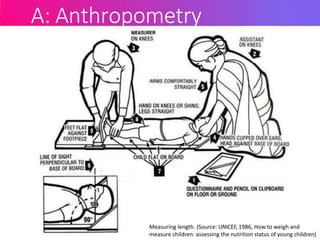
โ€ข A wooden measuring board (also called sliding board) is used for
measuring the length of children under 2 yrs old to the nearest
millimetre
โ€ข Measuring the child lying down always gives readings greater
than the childโ€™s actual height by 1-2 cm.
A: Anthropometry
Measuring length. (Source: UNICEF, 1986, How to weigh and
measure children: assessing the nutrition status of young children)
A: Anthropometry
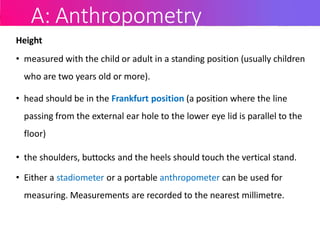
Height
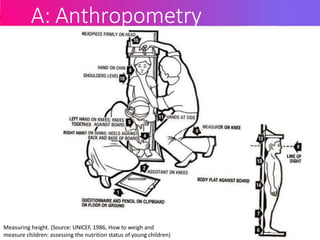
โ€ข measured with the child or adult in a standing position (usually children
who are two years old or more).
โ€ข head should be in the Frankfurt position (a position where the line
passing from the external ear hole to the lower eye lid is parallel to the
floor)
โ€ข the shoulders, buttocks and the heels should touch the vertical stand.
โ€ข Either a stadiometer or a portable anthropometer can be used for
measuring. Measurements are recorded to the nearest millimetre.
A: Anthropometry
Measuring height. (Source: UNICEF, 1986, How to weigh and
measure children: assessing the nutrition status of young children)
A: Anthropometry
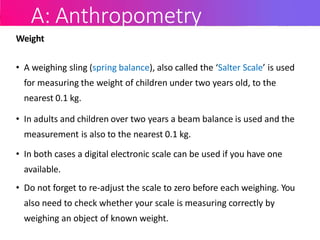
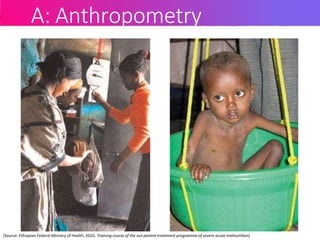
Weight
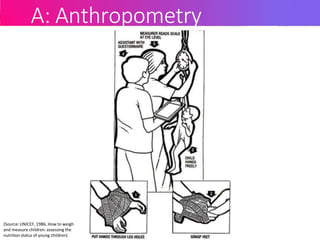
โ€ข A weighing sling (spring balance), also called the โ€˜Salter Scaleโ€™ is used
for measuring the weight of children under two years old, to the
nearest 0.1 kg.
โ€ข In adults and children over two years a beam balance is used and the
measurement is also to the nearest 0.1 kg.
โ€ข In both cases a digital electronic scale can be used if you have one
available.
โ€ข Do not forget to re-adjust the scale to zero before each weighing. You
also need to check whether your scale is measuring correctly by
weighing an object of known weight.
A: Anthropometry
(Source: UNICEF, 1986, How to weigh
and measure children: assessing the
nutrition status of young children)
A: Anthropometry
(Source: Ethiopian Federal Ministry of Health, 2010, Training course of the out patient treatment programme of severe acute malnutrition)
A: Anthropometry
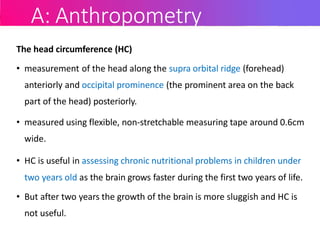
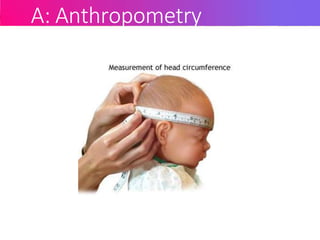
The head circumference (HC)
โ€ข measurement of the head along the supra orbital ridge (forehead)
anteriorly and occipital prominence (the prominent area on the back
part of the head) posteriorly.
โ€ข measured using flexible, non-stretchable measuring tape around 0.6cm
wide.
โ€ข HC is useful in assessing chronic nutritional problems in children under
two years old as the brain grows faster during the first two years of life.
โ€ข But after two years the growth of the brain is more sluggish and HC is
not useful.
A: Anthropometry
Converting measurements to indices
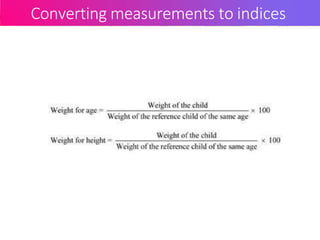
โ€ข Weight-for-age is an index used in
growth monitoring for assessing children
who may be underweight. You assess
weight-for-age of all children under two
years old when you carry out your
community-based nutrition (CBN)
activities every month
โ€ข Height-for age is an index used for
assessing stunting (chronic malnutrition
in children). Stunted children have poor
physical and intellectual performance
and lower work output leading to lower
productivity at individual level and poor
socioeconomic development at the
community level
An index is a combination of two measurements or one
measurement plus the personโ€™s age.
Converting measurements to indices
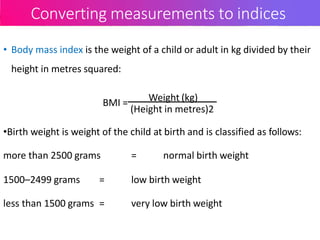
โ€ข Body mass index is the weight of a child or adult in kg divided by their
height in metres squared:
BMI = Weight (kg)
(Height in metres)2
โ€ขBirth weight is weight of the child at birth and is classified as follows:
more than 2500 grams = normal birth weight
1500โ€“2499 grams = low birth weight
less than 1500 grams = very low birth weight
Converting measurements to indices
Indicator
โ€ข An indicator is an index (for example, a scale
showing weight for age, or weight for height)
combined with specific cut-off values that help you
determine whether a child is underweight or
malnourished
Indicator
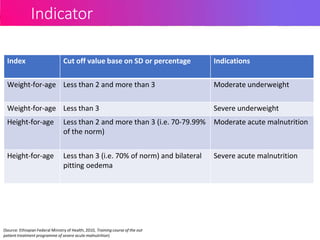
Index Cut off value base on SD or percentage Indications
Weight-for-age Less than 2 and more than 3 Moderate underweight
Weight-for-age Less than 3 Severe underweight
Height-for-age Less than 2 and more than 3 (i.e. 70-79.99%
of the norm)
Moderate acute malnutrition
Height-for-age Less than 3 (i.e. 70% of norm) and bilateral
pitting oedema
Severe acute malnutrition
(Source: Ethiopian Federal Ministry of Health, 2010, Training course of the out
patient treatment programme of severe acute malnutrition)
Measurements of fat-mass (fatness)
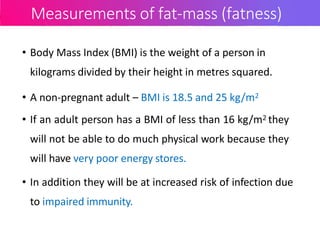
โ€ข Body Mass Index (BMI) is the weight of a person in
kilograms divided by their height in metres squared.
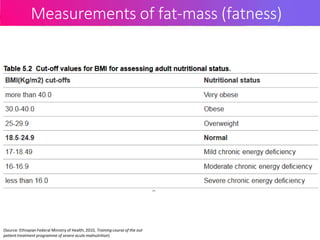
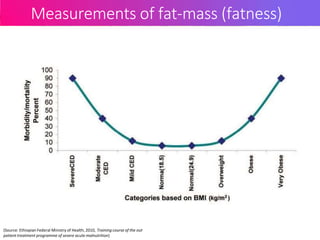
โ€ข A non-pregnant adult โ€“ BMI is 18.5 and 25 kg/m2
โ€ข If an adult person has a BMI of less than 16 kg/m2 they
will not be able to do much physical work because they
will have very poor energy stores.
โ€ข In addition they will be at increased risk of infection due
to impaired immunity.
Measurements of fat-mass (fatness)
(Source: Ethiopian Federal Ministry of Health, 2010, Training course of the out
patient treatment programme of severe acute malnutrition)
Measurements of fat-mass (fatness)
(Source: Ethiopian Federal Ministry of Health, 2010, Training course of the out
patient treatment programme of severe acute malnutrition)
Measuring fat-free mass (muscle mass)
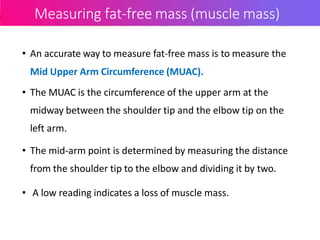
โ€ข An accurate way to measure fat-free mass is to measure the
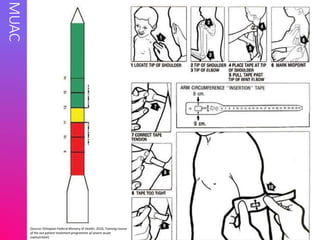
Mid Upper Arm Circumference (MUAC).
โ€ข The MUAC is the circumference of the upper arm at the
midway between the shoulder tip and the elbow tip on the
left arm.
โ€ข The mid-arm point is determined by measuring the distance
from the shoulder tip to the elbow and dividing it by two.
โ€ข A low reading indicates a loss of muscle mass.
MUAC
(Source:Ethiopian Federal Ministry of Health, 2010, Training course
of the out patient treatment programme of severe acute
malnutrition)
Measuring fat-free mass (muscle mass)
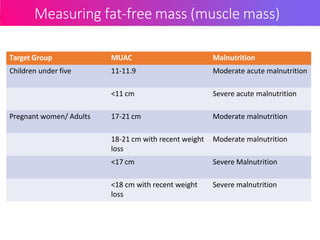
Target Group MUAC Malnutrition
Children under five 11-11.9 Moderate acute malnutrition
<11 cm Severe acute malnutrition
Pregnant women/ Adults 17-21 cm Moderate malnutrition
18-21 cm with recent weight
loss
Moderate malnutrition
<17 cm Severe Malnutrition
<18 cm with recent weight
loss
Severe malnutrition
Clinical methods of assessing nutritional status
Clinical methods of assessing nutritional status involve
โ€ข checking signs of deficiency at specific places on the body
โ€ข asking the patient whether they have any symptoms that might
suggest nutrient deficiency from the patient.
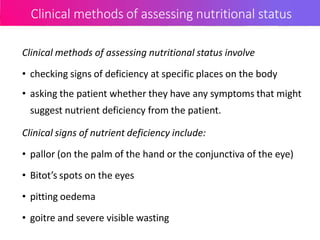
Clinical signs of nutrient deficiency include:
โ€ข pallor (on the palm of the hand or the conjunctiva of the eye)
โ€ข Bitotโ€™s spots on the eyes
โ€ข pitting oedema
โ€ข goitre and severe visible wasting
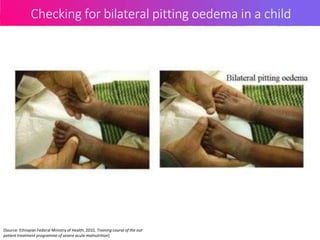
Checking for bilateral pitting oedema in a child
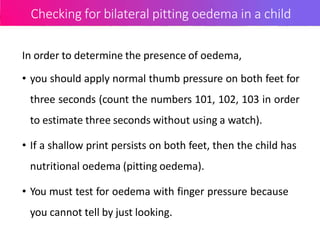
In order to determine the presence of oedema,
โ€ข you should apply normal thumb pressure on both feet for
three seconds (count the numbers 101, 102, 103 in order
to estimate three seconds without using a watch).
โ€ข If a shallow print persists on both feet, then the child has
nutritional oedema (pitting oedema).
โ€ข You must test for oedema with finger pressure because
you cannot tell by just looking.
Checking for bilateral pitting oedema in a child
(Source: Ethiopian Federal Ministry of Health, 2010, Training course of the out
patient treatment programme of severe acute malnutrition)
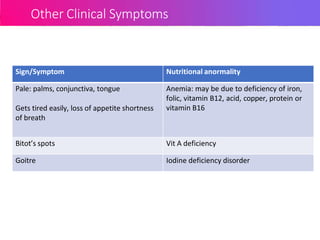
Other Clinical Symptoms
Bitotโ€™s spots
These are a sign of vitamin A deficiency.
Look at the figure; as you can see, these
spots are a creamy colour and appear on the
white of the eye.
Goitre is a swelling on the neck and is the
only visible sign of iodine deficiency
(Source: Ethiopian Federal Ministry of Health, 2010, Training course of the out
patient treatment programme of severe acute malnutrition)
Other Clinical Symptoms
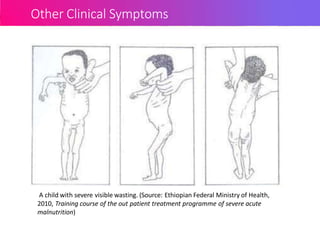
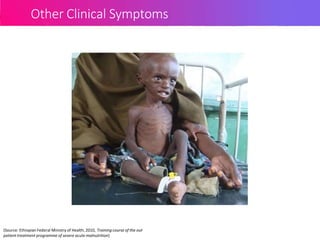
Visible severe wasting
โ€ข In order to determine the presence of visible severe wasting for children
younger than six months, you will need to ask the mother to remove all of
the childโ€™s clothing so you can look at the arms, thighs and buttocks for loss
of muscle bulk. Sagging skin and buttocks indicates visible severe wasting
Other Clinical Symptoms
A child with severe visible wasting. (Source: Ethiopian Federal Ministry of Health,
2010, Training course of the out patient treatment programme of severe acute
malnutrition)
Other Clinical Symptoms
(Source: Ethiopian Federal Ministry of Health, 2010, Training course of the out
patient treatment programme of severe acute malnutrition)
Other Clinical Symptoms
Sign/Symptom Nutritional anormality
Pale: palms, conjunctiva, tongue
Gets tired easily, loss of appetite shortness
of breath
Anemia: may be due to deficiency of iron,
folic, vitamin B12, acid, copper, protein or
vitamin B16
Bitotโ€™s spots Vit A deficiency
Goitre Iodine deficiency disorder
Dietary methods of assessing nutritional status
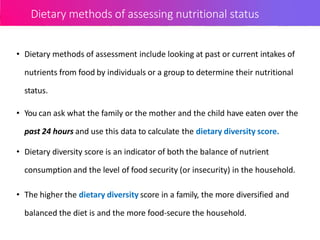
โ€ข Dietary methods of assessment include looking at past or current intakes of
nutrients from food by individuals or a group to determine their nutritional
status.
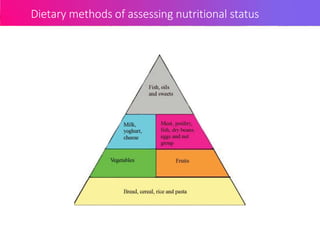
โ€ข You can ask what the family or the mother and the child have eaten over the
past 24 hours and use this data to calculate the dietary diversity score.
โ€ข Dietary diversity score is an indicator of both the balance of nutrient
consumption and the level of food security (or insecurity) in the household.
โ€ข The higher the dietary diversity score in a family, the more diversified and
balanced the diet is and the more food-secure the household.
Dietary methods of assessing nutritional status
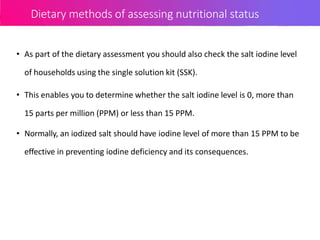
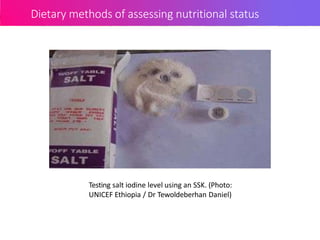
โ€ข As part of the dietary assessment you should also check the salt iodine level
of households using the single solution kit (SSK).
โ€ข This enables you to determine whether the salt iodine level is 0, more than
15 parts per million (PPM) or less than 15 PPM.
โ€ข Normally, an iodized salt should have iodine level of more than 15 PPM to be
effective in preventing iodine deficiency and its consequences.
Dietary methods of assessing nutritional status
Testing salt iodine level using an SSK. (Photo:
UNICEF Ethiopia / Dr Tewoldeberhan Daniel)

nutritional assessment and ABCD ASSESSMENTppt

  • 1.
    Unit: I Introduction toNutrition and Food Science, Food Groups and Food Pyramid Balanced diet for different age groups, Recommended dietary Allowances Assessment of Nutritional Status. Attribution-NonCommercial-ShareAlike 4.0 International (CC BY-NC-SA 4.0)
  • 2.
    Unit: I Assessment ofNutritional Status Attribution-NonCommercial-ShareAlike 4.0 International (CC BY-NC-SA 4.0)
  • 3.
    What is Foodnutritional assessment ? Nutritional assessment is the interpretation of anthropometric, biochemical (laboratory), clinical and dietary data to determine whether a person or groups of people are well nourished or malnourished (over-nourished or under-nourished).
  • 4.
    The ABCD methods Nutritionalassessment can be done using the ABCD methods. These refer to the following: A. Anthropometry B. Biochemical/biophysical methods C. Clinical methods D. Dietary methods.
  • 5.
    A: Anthropometry โ€ข anthropometry- Anthropo means โ€˜humanโ€™ and metry means โ€˜measurementโ€™. โ€ข uses several different measurements including length, height, weight and head circumference.
  • 6.
    A: Anthropometry Length โ€ข Awooden measuring board (also called sliding board) is used for measuring the length of children under 2 yrs old to the nearest millimetre โ€ข Measuring the child lying down always gives readings greater than the childโ€™s actual height by 1-2 cm.
  • 7.
    A: Anthropometry Measuring length.(Source: UNICEF, 1986, How to weigh and measure children: assessing the nutrition status of young children)
  • 8.
    A: Anthropometry Height โ€ข measuredwith the child or adult in a standing position (usually children who are two years old or more). โ€ข head should be in the Frankfurt position (a position where the line passing from the external ear hole to the lower eye lid is parallel to the floor) โ€ข the shoulders, buttocks and the heels should touch the vertical stand. โ€ข Either a stadiometer or a portable anthropometer can be used for measuring. Measurements are recorded to the nearest millimetre.
  • 9.
    A: Anthropometry Measuring height.(Source: UNICEF, 1986, How to weigh and measure children: assessing the nutrition status of young children)
  • 10.
    A: Anthropometry Weight โ€ข Aweighing sling (spring balance), also called the โ€˜Salter Scaleโ€™ is used for measuring the weight of children under two years old, to the nearest 0.1 kg. โ€ข In adults and children over two years a beam balance is used and the measurement is also to the nearest 0.1 kg. โ€ข In both cases a digital electronic scale can be used if you have one available. โ€ข Do not forget to re-adjust the scale to zero before each weighing. You also need to check whether your scale is measuring correctly by weighing an object of known weight.
  • 11.
    A: Anthropometry (Source: UNICEF,1986, How to weigh and measure children: assessing the nutrition status of young children)
  • 12.
    A: Anthropometry (Source: EthiopianFederal Ministry of Health, 2010, Training course of the out patient treatment programme of severe acute malnutrition)
  • 13.
    A: Anthropometry The headcircumference (HC) โ€ข measurement of the head along the supra orbital ridge (forehead) anteriorly and occipital prominence (the prominent area on the back part of the head) posteriorly. โ€ข measured using flexible, non-stretchable measuring tape around 0.6cm wide. โ€ข HC is useful in assessing chronic nutritional problems in children under two years old as the brain grows faster during the first two years of life. โ€ข But after two years the growth of the brain is more sluggish and HC is not useful.
  • 14.
  • 15.
    Converting measurements toindices โ€ข Weight-for-age is an index used in growth monitoring for assessing children who may be underweight. You assess weight-for-age of all children under two years old when you carry out your community-based nutrition (CBN) activities every month โ€ข Height-for age is an index used for assessing stunting (chronic malnutrition in children). Stunted children have poor physical and intellectual performance and lower work output leading to lower productivity at individual level and poor socioeconomic development at the community level An index is a combination of two measurements or one measurement plus the personโ€™s age.
  • 16.
    Converting measurements toindices โ€ข Body mass index is the weight of a child or adult in kg divided by their height in metres squared: BMI = Weight (kg) (Height in metres)2 โ€ขBirth weight is weight of the child at birth and is classified as follows: more than 2500 grams = normal birth weight 1500โ€“2499 grams = low birth weight less than 1500 grams = very low birth weight
  • 17.
  • 18.
    Indicator โ€ข An indicatoris an index (for example, a scale showing weight for age, or weight for height) combined with specific cut-off values that help you determine whether a child is underweight or malnourished
  • 19.
    Indicator Index Cut offvalue base on SD or percentage Indications Weight-for-age Less than 2 and more than 3 Moderate underweight Weight-for-age Less than 3 Severe underweight Height-for-age Less than 2 and more than 3 (i.e. 70-79.99% of the norm) Moderate acute malnutrition Height-for-age Less than 3 (i.e. 70% of norm) and bilateral pitting oedema Severe acute malnutrition (Source: Ethiopian Federal Ministry of Health, 2010, Training course of the out patient treatment programme of severe acute malnutrition)
  • 20.
    Measurements of fat-mass(fatness) โ€ข Body Mass Index (BMI) is the weight of a person in kilograms divided by their height in metres squared. โ€ข A non-pregnant adult โ€“ BMI is 18.5 and 25 kg/m2 โ€ข If an adult person has a BMI of less than 16 kg/m2 they will not be able to do much physical work because they will have very poor energy stores. โ€ข In addition they will be at increased risk of infection due to impaired immunity.
  • 21.
    Measurements of fat-mass(fatness) (Source: Ethiopian Federal Ministry of Health, 2010, Training course of the out patient treatment programme of severe acute malnutrition)
  • 22.
    Measurements of fat-mass(fatness) (Source: Ethiopian Federal Ministry of Health, 2010, Training course of the out patient treatment programme of severe acute malnutrition)
  • 23.
    Measuring fat-free mass(muscle mass) โ€ข An accurate way to measure fat-free mass is to measure the Mid Upper Arm Circumference (MUAC). โ€ข The MUAC is the circumference of the upper arm at the midway between the shoulder tip and the elbow tip on the left arm. โ€ข The mid-arm point is determined by measuring the distance from the shoulder tip to the elbow and dividing it by two. โ€ข A low reading indicates a loss of muscle mass.
  • 24.
    MUAC (Source:Ethiopian Federal Ministryof Health, 2010, Training course of the out patient treatment programme of severe acute malnutrition)
  • 25.
    Measuring fat-free mass(muscle mass) Target Group MUAC Malnutrition Children under five 11-11.9 Moderate acute malnutrition <11 cm Severe acute malnutrition Pregnant women/ Adults 17-21 cm Moderate malnutrition 18-21 cm with recent weight loss Moderate malnutrition <17 cm Severe Malnutrition <18 cm with recent weight loss Severe malnutrition
  • 26.
    Clinical methods ofassessing nutritional status Clinical methods of assessing nutritional status involve โ€ข checking signs of deficiency at specific places on the body โ€ข asking the patient whether they have any symptoms that might suggest nutrient deficiency from the patient. Clinical signs of nutrient deficiency include: โ€ข pallor (on the palm of the hand or the conjunctiva of the eye) โ€ข Bitotโ€™s spots on the eyes โ€ข pitting oedema โ€ข goitre and severe visible wasting
  • 27.
    Checking for bilateralpitting oedema in a child In order to determine the presence of oedema, โ€ข you should apply normal thumb pressure on both feet for three seconds (count the numbers 101, 102, 103 in order to estimate three seconds without using a watch). โ€ข If a shallow print persists on both feet, then the child has nutritional oedema (pitting oedema). โ€ข You must test for oedema with finger pressure because you cannot tell by just looking.
  • 28.
    Checking for bilateralpitting oedema in a child (Source: Ethiopian Federal Ministry of Health, 2010, Training course of the out patient treatment programme of severe acute malnutrition)
  • 29.
    Other Clinical Symptoms Bitotโ€™sspots These are a sign of vitamin A deficiency. Look at the figure; as you can see, these spots are a creamy colour and appear on the white of the eye. Goitre is a swelling on the neck and is the only visible sign of iodine deficiency (Source: Ethiopian Federal Ministry of Health, 2010, Training course of the out patient treatment programme of severe acute malnutrition)
  • 30.
    Other Clinical Symptoms Visiblesevere wasting โ€ข In order to determine the presence of visible severe wasting for children younger than six months, you will need to ask the mother to remove all of the childโ€™s clothing so you can look at the arms, thighs and buttocks for loss of muscle bulk. Sagging skin and buttocks indicates visible severe wasting
  • 31.
    Other Clinical Symptoms Achild with severe visible wasting. (Source: Ethiopian Federal Ministry of Health, 2010, Training course of the out patient treatment programme of severe acute malnutrition)
  • 32.
    Other Clinical Symptoms (Source:Ethiopian Federal Ministry of Health, 2010, Training course of the out patient treatment programme of severe acute malnutrition)
  • 33.
    Other Clinical Symptoms Sign/SymptomNutritional anormality Pale: palms, conjunctiva, tongue Gets tired easily, loss of appetite shortness of breath Anemia: may be due to deficiency of iron, folic, vitamin B12, acid, copper, protein or vitamin B16 Bitotโ€™s spots Vit A deficiency Goitre Iodine deficiency disorder
  • 34.
    Dietary methods ofassessing nutritional status โ€ข Dietary methods of assessment include looking at past or current intakes of nutrients from food by individuals or a group to determine their nutritional status. โ€ข You can ask what the family or the mother and the child have eaten over the past 24 hours and use this data to calculate the dietary diversity score. โ€ข Dietary diversity score is an indicator of both the balance of nutrient consumption and the level of food security (or insecurity) in the household. โ€ข The higher the dietary diversity score in a family, the more diversified and balanced the diet is and the more food-secure the household.
  • 35.
    Dietary methods ofassessing nutritional status
  • 36.
    Dietary methods ofassessing nutritional status โ€ข As part of the dietary assessment you should also check the salt iodine level of households using the single solution kit (SSK). โ€ข This enables you to determine whether the salt iodine level is 0, more than 15 parts per million (PPM) or less than 15 PPM. โ€ข Normally, an iodized salt should have iodine level of more than 15 PPM to be effective in preventing iodine deficiency and its consequences.
  • 37.
    Dietary methods ofassessing nutritional status Testing salt iodine level using an SSK. (Photo: UNICEF Ethiopia / Dr Tewoldeberhan Daniel)