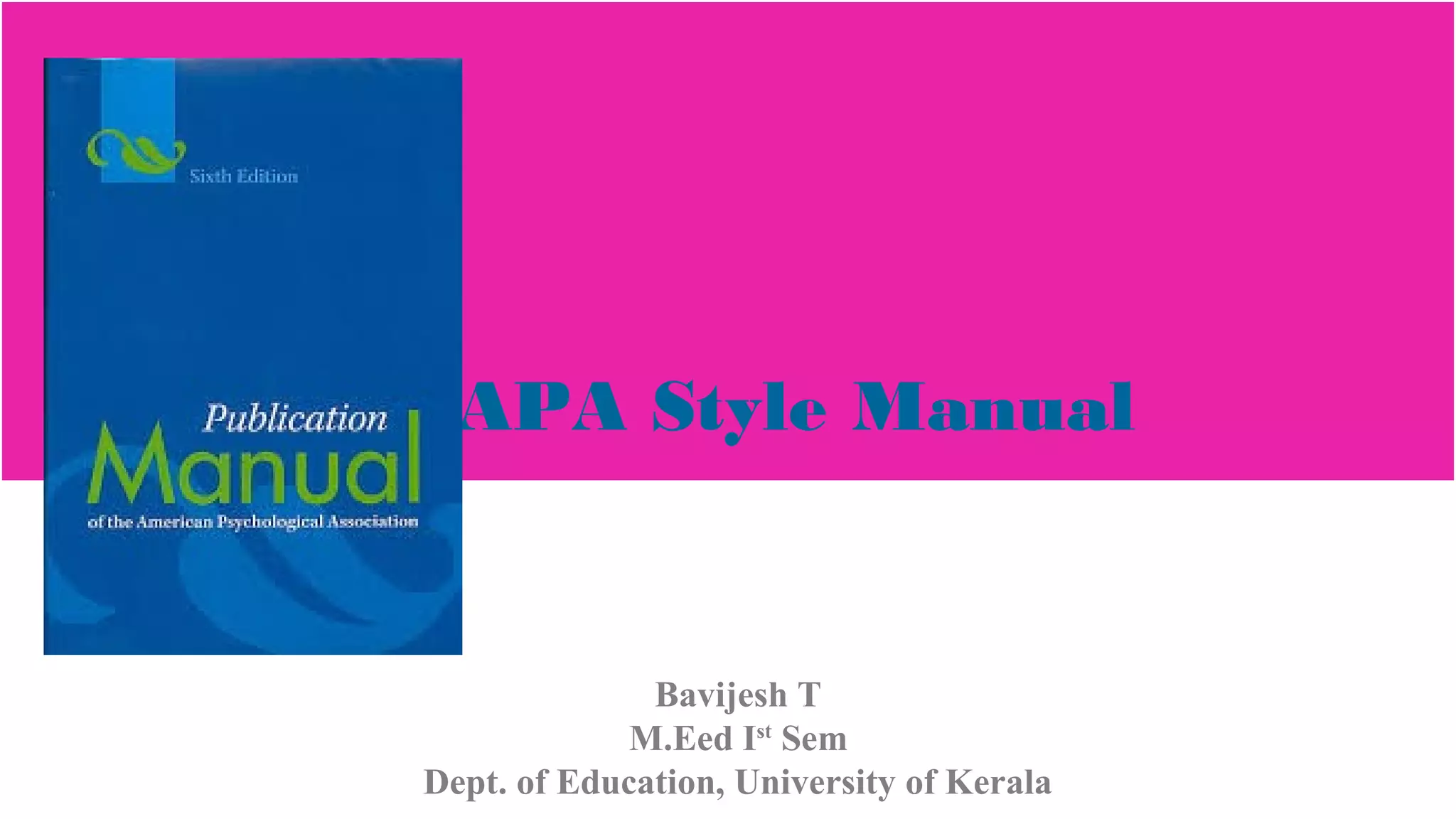
APA Style Manual
Bavijesh T
M.Eed Ist
Sem
Dept. of Education, University of Kerala
Presentation on
APA Style Manual
APA Style originated in 1929, when a group of psychologists,
anthropologists, and business managers convened and sought to establish a
simple set of procedures, or style rules, that would codify the many
components of scientific writing to increase the ease of reading
comprehension.
As with other editorial styles, APA Style consists of rules or guidelines that
a publisher observes to ensure clear and consistent presentation of written
material. It concerns uniform use of such elements as selection of headings,
tone, and length;punctuation and abbreviations;presentation of numbers and
statistics;construction of tables and figures,citation of references; and many
other elements that are a part of a manuscript.
APA Style : A prelude
Presentation on
APA Style ...
What ???
APA Style consists of rules or guidelines that observes to ensure
clear and consistent presentation of written material.
Allows readers to cross-reference your sources easily
Provides consistent format within a discipline
Gives you credibility as a writer
Protects yourself from plagiarism
Why ???
Presentation on
APA Style Manual
APA style was developed by social and behavioral scientists to standardize
scientific writing
APA Style Used for
 Term paper
 Research Report
 Empirical Studies
 Literature Review
 Theoretical articles
 Methodological articles
 Case studies
APA Style ...
Basic Introduction
When preparing your manuscript for submission, format it as follows
Use a serif typeface, such as Times New Roman, for the text of your
manuscript. Use a Sans serif typeface, such as Arial, for figure labels
Double-space the entire manuscript. Double-space between lines of body
text and Titles, headings, and block Quotations. Double-space the
reference list and figure captions
Indent the first line of every paragraph one-half inch
Align the text to the left-hand margin, leaving a “ragged” right margin
Presentation on
Manuscript Structure
Title page
Abstract
Introdcution
Methods
Result
Discussion
References
Appendices
Title page
The title page needs to include 4 items
The title of your paper. The title should concisely state the topic of the paper and the
variables or theoretical issues that are being explored in relation to that topic. The title should be
about 10-12 words long. The title should be centered in the middle of your page.
The author’s name and institutional affiliation. The institutional affiliation is just the
name of the place (usually a college or university) where the research was conducted. The author's
name and institutional affiliation should be centered and placed directly below the title.
A running head. This is just an abbreviated version of your title, and should include no more
than 50 characters (including spaces and punctuation). The running head is what appears at the top
of each page next to the page number throughout the paper. The running head designation should
be left justified and appear at the top of hte page after the page number.
A page number. Page numbers should appear on the title page in the upper right hand
corner, after the running head. Pages should then be numbered consecutively in the upper right
hand corner throughout the paper.
The title of your paper
The author’s name and institutional
affiliation
A running head.
A page number
back
Abstract
The abstract should contain a complete but concise summary of your paper
and should not contain more than 120 words. You should not repeat your title
in the abstract because this is redundant and takes up precious space.
Submitting a manuscript for publication, or preparing a more formal report,
you will need to include an abstract.
The abstract is a summary of your paper and is generally the first thing your
reader will read after the title. It allows readers to get an idea of what you say
in your paper, so they can decide if they want to read the entire paper.
Therefore, this is a very important section because you want people to actually
read what you spent so much time writing.
back
Introduction
In addition to a title page and an abstract, the text of your paper should
be broken into sections. For these sections, following sections should begin
on the same page where the previous o ne left off, and not necessarily on a
new page.
In this section, you are essentially providing background information on
the topic. You should explain why the topic is important and give the reader an
idea of where you are going in your paper (i.e., what aspects of the topic you
will be focusing on). The introduction should be clearly organized and
flow nicely.
Note: the introduction section should not be labeled "Introduction"; just use the title of your paper.
back
Methods
The Method section is where you describe what you did and how you
conducted your study. This is very important because other researchers may
use this information to try to replicate your study and see if they come up with
the same results.
There are three main subsections in the Method section:
Participants or Subjects,
Apparatus
Procedure
back
Result
The Results section is where you summarize the data you collected and
present the main findings (even those that are counter to your hypotheses).
You should also explain what analyses were used (e.g., one-way ANOVA, t-
test).
A common way to report results is to:
Restate your hypothesis for the reader
Summarize the results for each of the statistical tests you completed for
that hypothesis
Repeat steps 1 and 2 for each subsequent hypothesis.
back
Discussion
The Discussion section is where you interpret and evaluate your findings.
Your job here is to address the questions/issues raised in the introduction in
light of the results. However, you should not be restating your results or points
you have already made. You will want to organize your discussion section into
three parts:
Part 1: Reviewing hypotheses and results
Part 2: Discussing the findings in the context of the existing literature
and addressing the limitations of your study.
Part 3: Summarizing the study’s contribution to the literature and
providing suggestions for future research.
back
Reference
Your reference list should appear at the end of your paper. It provides the
information necessary for a reader to locate and retrieve any source you cite
in the body of the paper. In your reference list, you provide information about:
the author(s) of each work or the institution or group that created the work
the date that the work was published
the title of each work
whether the work appears as part of a larger work (such as an article in a
journal or newspaper, or a chapter in an essay collection)
where the work was published
who published the work
information that would help someone retrieve the work (such as a web page
address or an access number for an electronic database)
Gender
Author Citing
In-Text Example
"It is self-identification..." (Fuller, 2011, pp.
34-35). OR Fuller (2011, pp. 34-35)
suggests that self identification...
Reference List Example
Fuller, C. F. (2011). Sociology, gender and educational
aspirations: Girls and their ambitions. Albany, NY:
Continuum International.
Single Author
Two Author
3-5 Author
More than 6
No Author
Gender
Author Citing
In-Text Example
According to Weinberg and Gould
(2011) ...
OR
... this is evident (Weinberg & Gould,
2011).
Reference List Example
Weinberg, R. S., & Gould, D. (2011). Foundations
of sport and exercise psychology (6th ed.).
Champaign, IL: Human Kinetics.
Single Author
Two Author
3-5 Author
More than 6
No Author
Gender
Single Author
Two Author
3-5 Author
More than 6
No Author
Author Citing
In-Text Example
... events are a celebration (Allen et al.,
2011).
OR Allen et al. (2011) have stated ...
Reference List Example
Allen, J. E., O'Toole, W., & Donnell, J.-B. (2011).
Festival and special event management (5th ed.).
Milton, QLD: John Wiley & Sons.
Cite all of the authors the first time the reference occurs. In
subsequent citations include only the surname of the first author
followed by et al. and the year, e.g.
Gender
Single Author
Two Author
3-5 Author
More than 6
Research Centre
Author Citing
In-Text Example
Mussen et al. (1995) have found ...
OR
... for all learning (Mussen et al., 1995).
Reference List Example
Mussen, P., Rozenweig, M. R., Aronson, E., Elkind, D.,
Feshbach, S. T., & Geiwitz, P. J. (1995).
Psychology: An introduction (7th ed.). Albany, NY:
Thompson Delmar Learning.
Gender
Single Author
Two Author
3-5 Author
More than 6
No Author
Author Citing
In-Text Example
As defined in the Style Manual for Authors,
Editors and Printers (2002) reference lists
should be double spaced.
Reference List Example
Style manual for authors, editors and printers. (2002).
(6th ed.). Canberra, ACT: AGPS.
How to cite ...
Book
Shay, J. (1994). Achilles in Vietnam: Combat
trauma and the undoing of character. New
York: Touchstone.
Article in a magazine
Klein, J. (1998, October 5). Dizzy days. The
NewYorker, 40-45.
How to cite ...
Web page
Poland, D. (1998, October 26). The hot button. Roughcut.
Retrieved October 28, 1998 from http://www.roughcut.com
A newspaper article
Tommasini, A. (1998, October 27). Master teachers
whose artistry glows in private. New York Times, p. B2.
How to cite ...
A source with no known author
Cigarette sales fall 30% as California tax rises. (1999, September
14). New York Times, p. A17.
Online resources
Kenneth, I. A. (2000). A Buddhist response to the nature of
human rights. Journal of Buddhist Ethics, 8(4).Retrieved
February 20, 2001, from
http://www.cac.psu.edu/jbe/twocont.html
Appendixes
Your paper may have more than one appendix. Usually, each distinct item
has it’s own appendix. If your paper only has one appendix, label it
"Appendix" (without quotes.) If there is more than one appendix, label them
"Appendix A," "Appendix B," etc.
Reference
American Psychological Association. (2012). APA style guide to electronic
references.
The Basics of APA Style. (n.d.). Retrieved January 16, 2016, from
http://www.apastyle.org/learn/tutorials/basics-tutorial.aspx

APA Style manual

  • 1.
    APA Style Manual BavijeshT M.Eed Ist Sem Dept. of Education, University of Kerala
  • 2.
    Presentation on APA StyleManual APA Style originated in 1929, when a group of psychologists, anthropologists, and business managers convened and sought to establish a simple set of procedures, or style rules, that would codify the many components of scientific writing to increase the ease of reading comprehension. As with other editorial styles, APA Style consists of rules or guidelines that a publisher observes to ensure clear and consistent presentation of written material. It concerns uniform use of such elements as selection of headings, tone, and length;punctuation and abbreviations;presentation of numbers and statistics;construction of tables and figures,citation of references; and many other elements that are a part of a manuscript. APA Style : A prelude
  • 3.
    Presentation on APA Style... What ??? APA Style consists of rules or guidelines that observes to ensure clear and consistent presentation of written material. Allows readers to cross-reference your sources easily Provides consistent format within a discipline Gives you credibility as a writer Protects yourself from plagiarism Why ???
  • 4.
    Presentation on APA StyleManual APA style was developed by social and behavioral scientists to standardize scientific writing APA Style Used for  Term paper  Research Report  Empirical Studies  Literature Review  Theoretical articles  Methodological articles  Case studies APA Style ...
  • 5.
    Basic Introduction When preparingyour manuscript for submission, format it as follows Use a serif typeface, such as Times New Roman, for the text of your manuscript. Use a Sans serif typeface, such as Arial, for figure labels Double-space the entire manuscript. Double-space between lines of body text and Titles, headings, and block Quotations. Double-space the reference list and figure captions Indent the first line of every paragraph one-half inch Align the text to the left-hand margin, leaving a “ragged” right margin
  • 6.
    Presentation on Manuscript Structure Titlepage Abstract Introdcution Methods Result Discussion References Appendices
  • 7.
    Title page The titlepage needs to include 4 items The title of your paper. The title should concisely state the topic of the paper and the variables or theoretical issues that are being explored in relation to that topic. The title should be about 10-12 words long. The title should be centered in the middle of your page. The author’s name and institutional affiliation. The institutional affiliation is just the name of the place (usually a college or university) where the research was conducted. The author's name and institutional affiliation should be centered and placed directly below the title. A running head. This is just an abbreviated version of your title, and should include no more than 50 characters (including spaces and punctuation). The running head is what appears at the top of each page next to the page number throughout the paper. The running head designation should be left justified and appear at the top of hte page after the page number. A page number. Page numbers should appear on the title page in the upper right hand corner, after the running head. Pages should then be numbered consecutively in the upper right hand corner throughout the paper.
  • 8.
    The title ofyour paper The author’s name and institutional affiliation A running head. A page number back
  • 9.
    Abstract The abstract shouldcontain a complete but concise summary of your paper and should not contain more than 120 words. You should not repeat your title in the abstract because this is redundant and takes up precious space. Submitting a manuscript for publication, or preparing a more formal report, you will need to include an abstract. The abstract is a summary of your paper and is generally the first thing your reader will read after the title. It allows readers to get an idea of what you say in your paper, so they can decide if they want to read the entire paper. Therefore, this is a very important section because you want people to actually read what you spent so much time writing.
  • 10.
  • 11.
    Introduction In addition toa title page and an abstract, the text of your paper should be broken into sections. For these sections, following sections should begin on the same page where the previous o ne left off, and not necessarily on a new page. In this section, you are essentially providing background information on the topic. You should explain why the topic is important and give the reader an idea of where you are going in your paper (i.e., what aspects of the topic you will be focusing on). The introduction should be clearly organized and flow nicely. Note: the introduction section should not be labeled "Introduction"; just use the title of your paper. back
  • 12.
    Methods The Method sectionis where you describe what you did and how you conducted your study. This is very important because other researchers may use this information to try to replicate your study and see if they come up with the same results. There are three main subsections in the Method section: Participants or Subjects, Apparatus Procedure back
  • 13.
    Result The Results sectionis where you summarize the data you collected and present the main findings (even those that are counter to your hypotheses). You should also explain what analyses were used (e.g., one-way ANOVA, t- test). A common way to report results is to: Restate your hypothesis for the reader Summarize the results for each of the statistical tests you completed for that hypothesis Repeat steps 1 and 2 for each subsequent hypothesis. back
  • 14.
    Discussion The Discussion sectionis where you interpret and evaluate your findings. Your job here is to address the questions/issues raised in the introduction in light of the results. However, you should not be restating your results or points you have already made. You will want to organize your discussion section into three parts: Part 1: Reviewing hypotheses and results Part 2: Discussing the findings in the context of the existing literature and addressing the limitations of your study. Part 3: Summarizing the study’s contribution to the literature and providing suggestions for future research. back
  • 15.
    Reference Your reference listshould appear at the end of your paper. It provides the information necessary for a reader to locate and retrieve any source you cite in the body of the paper. In your reference list, you provide information about: the author(s) of each work or the institution or group that created the work the date that the work was published the title of each work whether the work appears as part of a larger work (such as an article in a journal or newspaper, or a chapter in an essay collection) where the work was published who published the work information that would help someone retrieve the work (such as a web page address or an access number for an electronic database)
  • 16.
    Gender Author Citing In-Text Example "Itis self-identification..." (Fuller, 2011, pp. 34-35). OR Fuller (2011, pp. 34-35) suggests that self identification... Reference List Example Fuller, C. F. (2011). Sociology, gender and educational aspirations: Girls and their ambitions. Albany, NY: Continuum International. Single Author Two Author 3-5 Author More than 6 No Author
  • 17.
    Gender Author Citing In-Text Example Accordingto Weinberg and Gould (2011) ... OR ... this is evident (Weinberg & Gould, 2011). Reference List Example Weinberg, R. S., & Gould, D. (2011). Foundations of sport and exercise psychology (6th ed.). Champaign, IL: Human Kinetics. Single Author Two Author 3-5 Author More than 6 No Author
  • 18.
    Gender Single Author Two Author 3-5Author More than 6 No Author Author Citing In-Text Example ... events are a celebration (Allen et al., 2011). OR Allen et al. (2011) have stated ... Reference List Example Allen, J. E., O'Toole, W., & Donnell, J.-B. (2011). Festival and special event management (5th ed.). Milton, QLD: John Wiley & Sons. Cite all of the authors the first time the reference occurs. In subsequent citations include only the surname of the first author followed by et al. and the year, e.g.
  • 19.
    Gender Single Author Two Author 3-5Author More than 6 Research Centre Author Citing In-Text Example Mussen et al. (1995) have found ... OR ... for all learning (Mussen et al., 1995). Reference List Example Mussen, P., Rozenweig, M. R., Aronson, E., Elkind, D., Feshbach, S. T., & Geiwitz, P. J. (1995). Psychology: An introduction (7th ed.). Albany, NY: Thompson Delmar Learning.
  • 20.
    Gender Single Author Two Author 3-5Author More than 6 No Author Author Citing In-Text Example As defined in the Style Manual for Authors, Editors and Printers (2002) reference lists should be double spaced. Reference List Example Style manual for authors, editors and printers. (2002). (6th ed.). Canberra, ACT: AGPS.
  • 21.
    How to cite... Book Shay, J. (1994). Achilles in Vietnam: Combat trauma and the undoing of character. New York: Touchstone. Article in a magazine Klein, J. (1998, October 5). Dizzy days. The NewYorker, 40-45.
  • 22.
    How to cite... Web page Poland, D. (1998, October 26). The hot button. Roughcut. Retrieved October 28, 1998 from http://www.roughcut.com A newspaper article Tommasini, A. (1998, October 27). Master teachers whose artistry glows in private. New York Times, p. B2.
  • 23.
    How to cite... A source with no known author Cigarette sales fall 30% as California tax rises. (1999, September 14). New York Times, p. A17. Online resources Kenneth, I. A. (2000). A Buddhist response to the nature of human rights. Journal of Buddhist Ethics, 8(4).Retrieved February 20, 2001, from http://www.cac.psu.edu/jbe/twocont.html
  • 24.
    Appendixes Your paper mayhave more than one appendix. Usually, each distinct item has it’s own appendix. If your paper only has one appendix, label it "Appendix" (without quotes.) If there is more than one appendix, label them "Appendix A," "Appendix B," etc.
  • 25.
    Reference American Psychological Association.(2012). APA style guide to electronic references. The Basics of APA Style. (n.d.). Retrieved January 16, 2016, from http://www.apastyle.org/learn/tutorials/basics-tutorial.aspx