Presentation
Topic : Anorectal abscess
Department of surgery
Swornim Gyawali
Intern GMC
Todays objective
• Patient complaint and clinical finding
• Differential diagnosis
• Workup
• Ano-rectal anatomy review
• Topic discussion
• Management
Patient complaints of :
• dull perianal discomfort and pruritus
• exacerbated by movement and increased perineal
pressure from sitting or defecation
• present with swelling around the rectum
• perirectal drainage that may be bloody, purulent, or
mucoid
( note: ischiorectal abscess often present with systemic
fevers, chills, and severe perirectal pain)
On examination:
• normal vital signs on initial evaluation
• Physical examination: a small, erythematous,
well-defined, fluctuant, subcutaneous mass
near the anal orifice
• DRE: a fluctuant, indurated mass may be
encountered
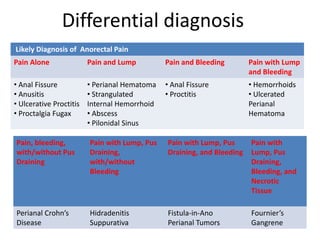
Likely Diagnosis of Anorectal Pain
Pain Alone Pain and Lump Pain and Bleeding Pain with Lump
and Bleeding
• Anal Fissure
• Anusitis
• Ulcerative Proctitis
• Proctalgia Fugax
• Perianal Hematoma
• Strangulated
Internal Hemorrhoid
• Abscess
• Pilonidal Sinus
• Anal Fissure
• Proctitis
• Hemorrhoids
• Ulcerated
Perianal
Hematoma
Pain, bleeding,
with/without Pus
Draining
Pain with Lump, Pus
Draining,
with/without
Bleeding
Pain with Lump, Pus
Draining, and Bleeding
Pain with
Lump, Pus
Draining,
Bleeding, and
Necrotic
Tissue
Perianal Crohn’s
Disease
Hidradenitis
Suppurativa
Fistula-in-Ano
Perianal Tumors
Fournier’s
Gangrene
Differential diagnosis
Workup/Investigations :
• CBC with differential : may show leukocytosis
• Pus cultures
• Blood cultures
• confirmation by means of anal
ultrasonography, CT or MRI
• Plain x-rays little clinical significance
Anorectal Abscess
infection arising in the cryptoglandular
epithelium lining the anal canal
Anatomy review
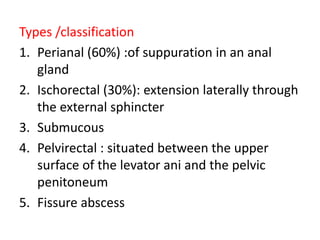
Types /classification
1. Perianal (60%) :of suppuration in an anal
gland
2. Ischorectal (30%): extension laterally through
the external sphincter
3. Submucous
4. Pelvirectal : situated between the upper
surface of the levator ani and the pelvic
penitoneum
5. Fissure abscess
Classification
Etiology
• Non specific :Cryptoglandular in origin.
• Specific :
1. Infection : E.coli , Staph. , strep. , Bacteroids
2. Irritation : Crohn’s disease, ulcerative colitis, FB
3. Immune compromised state : DM,AIDS,malignancy
4. Others : TB, STDs, Radiation therapy,
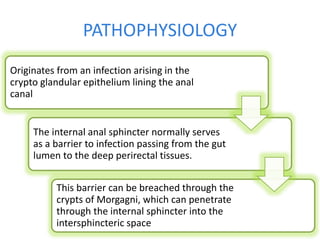
PATHOPHYSIOLOGY
Originates from an infection arising in the
crypto glandular epithelium lining the anal
canal
The internal anal sphincter normally serves
as a barrier to infection passing from the gut
lumen to the deep perirectal tissues.
This barrier can be breached through the
crypts of Morgagni, which can penetrate
through the internal sphincter into the
intersphincteric space
PATHOPHYSIOLOGY
Once infection gains access to the
intersphincteric space, it has easy
access to the adjacent perirectal
spaces
Extension of the infection can
involve the intersphincteric
space 2–5%, ischiorectal space
20-25% , or even the
supralevator space 2.5%.
Epidemology
• May resolve itself
• third and fourth decades of life
• quite common in infants too
• Men are affected more frequently than
women 2:1 – 3:1
• relation between the formation of ano-rectal
abscesses and bowel habits
Management
• Early surgical drainage of the purulent
collection
• Primary antibiotic therapy alone is ineffective
• Any delay : augments tissue damage, may
impair sphincter continence function,
promote stricture and/or fistula formation
• Ability to drain an anorectal abscess depends
on patient comfort and on the location and
accessibility of abscess.
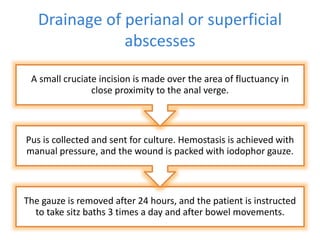
Drainage of perianal or superficial
abscesses
The gauze is removed after 24 hours, and the patient is instructed
to take sitz baths 3 times a day and after bowel movements.
Pus is collected and sent for culture. Hemostasis is achieved with
manual pressure, and the wound is packed with iodophor gauze.
A small cruciate incision is made over the area of fluctuancy in
close proximity to the anal verge.
Post operative
• analgesics and stool softeners are prescribed
to relieve pain and prevent constipation.
• Antibiotic therapy when indicated– to cover
aerobes and anaerobes e.g. ciprofloxacin 500
mg PO 2x daily for 5 days
• follow up: 2-3 weeks for wound evaluation
and inspection for possible fistula-in-ano.
COMPLICATIONS
Fistula-in-Ano
Fournier’s Gangrene
Carcinoma
Death
Fecal Incontinence
PROGNOSIS
Drainage alone results in cure for
50%.
50% will have recurrences and
develop an anal fistula.
Thank you !!!
• Refrences
Bailey & Love's Short Practice of Surgery 25th
edition
Manipal manual of surgery 3rd edition
SRB’s manual of surgery 4th edition

Anorectal abscess

  • 1.
    Presentation Topic : Anorectalabscess Department of surgery Swornim Gyawali Intern GMC
  • 2.
    Todays objective • Patientcomplaint and clinical finding • Differential diagnosis • Workup • Ano-rectal anatomy review • Topic discussion • Management
  • 3.
    Patient complaints of: • dull perianal discomfort and pruritus • exacerbated by movement and increased perineal pressure from sitting or defecation • present with swelling around the rectum • perirectal drainage that may be bloody, purulent, or mucoid ( note: ischiorectal abscess often present with systemic fevers, chills, and severe perirectal pain)
  • 4.
    On examination: • normalvital signs on initial evaluation • Physical examination: a small, erythematous, well-defined, fluctuant, subcutaneous mass near the anal orifice • DRE: a fluctuant, indurated mass may be encountered
  • 6.
    Likely Diagnosis ofAnorectal Pain Pain Alone Pain and Lump Pain and Bleeding Pain with Lump and Bleeding • Anal Fissure • Anusitis • Ulcerative Proctitis • Proctalgia Fugax • Perianal Hematoma • Strangulated Internal Hemorrhoid • Abscess • Pilonidal Sinus • Anal Fissure • Proctitis • Hemorrhoids • Ulcerated Perianal Hematoma Pain, bleeding, with/without Pus Draining Pain with Lump, Pus Draining, with/without Bleeding Pain with Lump, Pus Draining, and Bleeding Pain with Lump, Pus Draining, Bleeding, and Necrotic Tissue Perianal Crohn’s Disease Hidradenitis Suppurativa Fistula-in-Ano Perianal Tumors Fournier’s Gangrene Differential diagnosis
  • 8.
    Workup/Investigations : • CBCwith differential : may show leukocytosis • Pus cultures • Blood cultures • confirmation by means of anal ultrasonography, CT or MRI • Plain x-rays little clinical significance
  • 9.
    Anorectal Abscess infection arisingin the cryptoglandular epithelium lining the anal canal
  • 10.
  • 11.
    Types /classification 1. Perianal(60%) :of suppuration in an anal gland 2. Ischorectal (30%): extension laterally through the external sphincter 3. Submucous 4. Pelvirectal : situated between the upper surface of the levator ani and the pelvic penitoneum 5. Fissure abscess
  • 12.
  • 13.
    Etiology • Non specific:Cryptoglandular in origin. • Specific : 1. Infection : E.coli , Staph. , strep. , Bacteroids 2. Irritation : Crohn’s disease, ulcerative colitis, FB 3. Immune compromised state : DM,AIDS,malignancy 4. Others : TB, STDs, Radiation therapy,
  • 14.
    PATHOPHYSIOLOGY Originates from aninfection arising in the crypto glandular epithelium lining the anal canal The internal anal sphincter normally serves as a barrier to infection passing from the gut lumen to the deep perirectal tissues. This barrier can be breached through the crypts of Morgagni, which can penetrate through the internal sphincter into the intersphincteric space
  • 15.
    PATHOPHYSIOLOGY Once infection gainsaccess to the intersphincteric space, it has easy access to the adjacent perirectal spaces Extension of the infection can involve the intersphincteric space 2–5%, ischiorectal space 20-25% , or even the supralevator space 2.5%.
  • 16.
    Epidemology • May resolveitself • third and fourth decades of life • quite common in infants too • Men are affected more frequently than women 2:1 – 3:1 • relation between the formation of ano-rectal abscesses and bowel habits
  • 17.
    Management • Early surgicaldrainage of the purulent collection • Primary antibiotic therapy alone is ineffective • Any delay : augments tissue damage, may impair sphincter continence function, promote stricture and/or fistula formation • Ability to drain an anorectal abscess depends on patient comfort and on the location and accessibility of abscess.
  • 18.
    Drainage of perianalor superficial abscesses The gauze is removed after 24 hours, and the patient is instructed to take sitz baths 3 times a day and after bowel movements. Pus is collected and sent for culture. Hemostasis is achieved with manual pressure, and the wound is packed with iodophor gauze. A small cruciate incision is made over the area of fluctuancy in close proximity to the anal verge.
  • 20.
    Post operative • analgesicsand stool softeners are prescribed to relieve pain and prevent constipation. • Antibiotic therapy when indicated– to cover aerobes and anaerobes e.g. ciprofloxacin 500 mg PO 2x daily for 5 days • follow up: 2-3 weeks for wound evaluation and inspection for possible fistula-in-ano.
  • 21.
  • 22.
    PROGNOSIS Drainage alone resultsin cure for 50%. 50% will have recurrences and develop an anal fistula.
  • 23.
    Thank you !!! •Refrences Bailey & Love's Short Practice of Surgery 25th edition Manipal manual of surgery 3rd edition SRB’s manual of surgery 4th edition