APPENDICITICS
ANGAL SAJI
FIRST YEAR MSC NURSING
AIIMS,BBSR
INTRODUCTION
Appendicitis is an inflammation of the appendix, a finger-
shaped pouch that projects from colon on the lower right side
of abdomen. Appendicitis causes pain in lower right abdomen.
However, in most people, pain begins around the navel and
then moves.
As inflammation worsens, appendicitis pain typically increases
and eventually becomes severe. Although anyone can develop
appendicitis, most often it occurs in people between the ages
of 10 and 30.
ANATOMY & PHYSIOLOGY
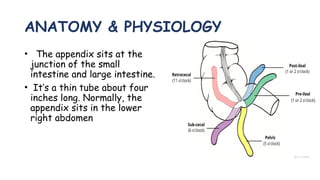
• The appendix sits at the
junction of the small
intestine and large intestine.
• It’s a thin tube about four
inches long. Normally, the
appendix sits in the lower
right abdomen
DEFINITION
Appendicitis is an inflammation of the vermiform appendix
that develops most commonly in adolescents and young adults.
INCIDENCE
• Appendicitis is the most common acute surgical condition
of the abdomen.
• Approximately 7 % of the population will have appendicitis in
their lifetime, with the peak incidence occurring between
the ages of 10 and 30 years.
ETIOLOGY
OBSTRUCTIVE CAUSES
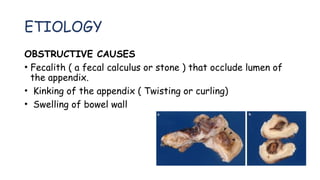
• Fecalith ( a fecal calculus or stone ) that occlude lumen of
the appendix.
• Kinking of the appendix ( Twisting or curling)
• Swelling of bowel wall
NONOBSTRUCTIVE CAUSES
• Haematogenous spread of infection
• Vascular occlusion
• Trauma
• Diet lacking fibres
PATHOPHYSIOLOGY
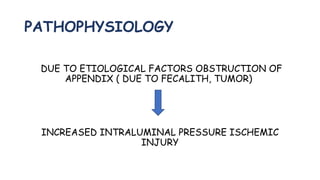
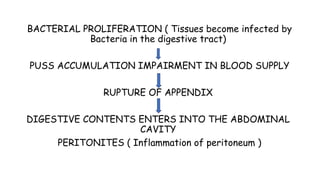
DUE TO ETIOLOGICAL FACTORS OBSTRUCTION OF
APPENDIX ( DUE TO FECALITH, TUMOR)
INCREASED INTRALUMINAL PRESSURE ISCHEMIC
INJURY
BACTERIAL PROLIFERATION ( Tissues become infected by
Bacteria in the digestive tract)
PUSS ACCUMULATION IMPAIRMENT IN BLOOD SUPPLY
RUPTURE OF APPENDIX
DIGESTIVE CONTENTS ENTERS INTO THE ABDOMINAL
CAVITY
PERITONITES ( Inflammation of peritoneum )
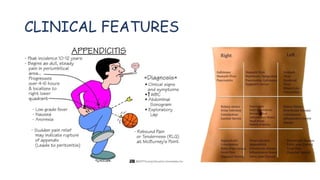
CLINICAL FEATURES
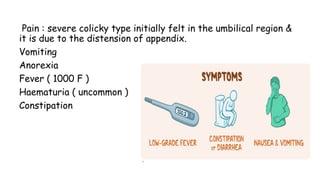
Pain : severe colicky type initially felt in the umbilical region &
it is due to the distension of appendix.
Vomiting
Anorexia
Fever ( 1000 F )
Haematuria ( uncommon )
Constipation
CARDINAL SIGNS
The 5 important cardinal signs of appendicitis are
• PSOA’S SIGN
• ROVSING’S SIGN
• OBTURATOR’S SIGN
• BLOOMBERG’S SIGN
• MCBURNEY’S SIGN
ROVSING’S SIGN
• The Rovsing’s sign is positive when pressure over the
patient’s left lower quadrant causes pain in the right lower
quadrant.
PSOA’S SIGN
• Psoas sign is right lower-quadrant pain that is produced with
the patient extending the hip due to inflammation of the
peritoneum. Straightening out the leg causes the pain
because it stretches the muscles.
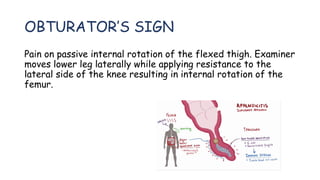
OBTURATOR’S SIGN
Pain on passive internal rotation of the flexed thigh. Examiner
moves lower leg laterally while applying resistance to the
lateral side of the knee resulting in internal rotation of the
femur.
BLOOMBERG’S SIGN
Bloomberg’s sign also referred as rebound tenderness .
Deep palpation of the viscera over the suspected inflamed
appendix followed by sudden release of the pressure causes
the severe pain on the site.
This indicates positive Blumberg's sign & peritonitis.
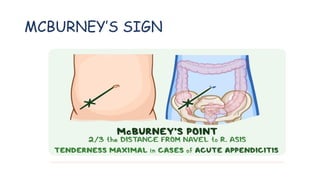
MCBURNEY’S SIGN
Mc Burney’s Point is two third away from umbilicus to
Anterior superior iliac spine
To elicit Mc burney’s sign patient should be in supine position
with his knees slightly flexed and his abdominal muscles
relaxed.
Palpate deeply and slowly in the right lower quadrant over
McBurney’s point ,located about 2” from the Rt. Ant. Sup.
Iliac Spine, On a line between the spine and umbilicus.
Pain and tenderness is a positive sign and indicates
appendicitis.
Others include
Cough tenderness Indicate inflammation of Parietal
Peritoneum
Guarding and Rigidity Present in the right iliac fossa.
Rectal examination There is tenderness in the right rectal
wall
Per Vaginal Examination Presence of ovarian mass
MURPHY’S TRAID
Pain first, Followed by vomiting and then fever is called
Murphy’s traid or syndrome of appendicitis ( Murphy’s
Syndrome)
CLINICAL STAGES
The stages of appendicitis can be divided into early,
suppurative, gangrenous.
Early stage appendicitis
In the early stage of appendicitis, obstruction of the
appendiceal lumen leads to Mucosal edema, mucosal
ulceration, bacterial diapedesis, appendiceal distention due to
accumulated fluid, and increasing intraluminal pressure.
The visceral afferent nerve fibers are stimulated, and the
patient perceives mild visceral periumbilical or epigastric pain,
which usually lasts four to six hours
Gangrenous appendicitis — Intramural venous and arterial
thrombosis , resulting in gangrenous appendicitis
• Suppurative appendicitis Increasing intraluminal

pressures eventually exceed capillary perfusion pressure. 
Transmural spread of bacteria causes acute suppurative
appendicitis. When the inflamed serosa of the appendix

comes in contact with the parietal peritoneum, patients
typically experience the classic shift of pain from the
periumbilicus to the right lower abdominal quadrant (RLQ),
which is continuous and more severe than the early visceral
pain.
DIAGNOSTIC MEASURES
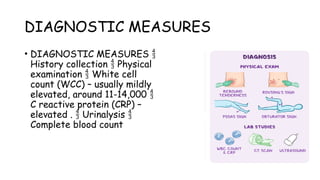
• DIAGNOSTIC MEASURES 
History collection Physical

examination White cell

count (WCC) – usually mildly
elevated, around 11-14,000 
C reactive protein (CRP) –
elevated . Urinalysis
 
Complete blood count
•  CT - Scan Ultrasound - visualise tubular structures &

cysts USG is not accurate as CT sometimes difficult to see

appendix Magnetic resonance imaging x- ray
 
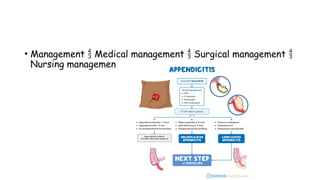
• Management Medical management Surgical management
  
Nursing managemen
• Medical Management Goal of medical management includes 
To treat infections To prevent further complications
 
Medication therapy includes Antibiotic therapy examples

cephalosporin Anti inflammatory drugs. Metrogyl
 
Analgesics Fluid therapy.

• SURGICAL MANAGEMENT The surgical procedure for the

removal of the appendix is called an appendectomy. 
Appendectomy can be performed through open or
laparoscopic surgery. Laparoscopic appendectomy has

several advantages over open appendectomy as an
intervention for acute appendicitis.
• Pre- operative Preparation Once diagnosis is suspected,

the Patient is Admitted to hospital IV Fluid s – isotonic

Saline or Ringer lactate is given. Ryle’s tube is not

necessary in simple appendicitis. Second generation

Cephalosporin along with metronidazole is given. Informed

consent is taken.
• Appendicectomy Appendicectomy is a surgical procedure to

remove the appendix from the abdomen. It can be
performed either with a small incision on the abdomen or
laparoscopically (key hole surgery). Indications for open

appendicectomy Dense adhesions due to inflammation or

prior surgical procedures. Perforated or gangrenous

appendicitis. Generalized peritonitis

• Lap . Appendicectomy Become popular nowadays Less post
 
operative pain Speedy recovery If intraoperative
 
complications that cannot be handled with laparoscopy arise
during laparoscopic appendectomy, conversion to an open
appendectomy
• 34. NURSING MANAGEMENT .35. . Nursing Assessment
History collection Medical history  complaints of pain
 
in postoperative wound appendectomy, nausea, vomiting,

increased body temperature, increased leukocytes. Past

medical history Physical Examination Cardiovascular
 
System To determine vital signs, presence or absence of
jugular venous distension, pallor, edema, and abnormal heart
sounds
• • Hematologic System To determine whether there is an
increase in leukocytes ( sign of infection and bleeding). 
Urogenital System Assess Whether or not the tension of
the bladder and lower back pain complaints. Musculoskeletal

System To determine whether there is difficulty in

movement, pain in bones, joints and there is a fracture or
not. The immune system To determine whether there is

lymph node enlargement.
• Investigations Routine blood tests To determine an
 
increase in leukocytes is a sign of infection. Abdominal

examination To know the existence of post-surgical

complications.
• NURSING DIAGNOSIS Preoperative Appendectomy
Acute pain related to distention of the intestinal tissue by

inflammation. Anxiety related to change in health status.

Risk for deficient fluid volume related to preoperative

vomiting.
POSTOPERATIVE NURSING
DIAGNOSIS
• Acute pain related to the presence of postoperative wound
appendectomy.
• Impaired nutrition less than body requirements related to
reduced anorexia, nausea.
• Deficient knowledge about the care and diseases related to
lack of information
• Risk for infection related to surgical incision.
COMPLICATIONS
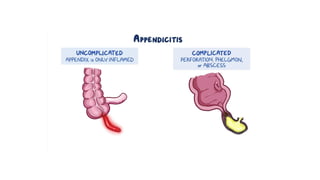
Appendicitis can cause serious complications, such as
 A ruptured appendix
 A rupture spreads infection throughout abdomen (peritonitis). life-

threatening.
 This condition requires immediate surgery to remove the appendix and
clean your abdominal cavity.
 A pocket of pus that forms in the abdomen.
 If appendix bursts, Patient may develop a pocket of infection (abscess).
 In most cases, a surgeon drains the abscess by placing a tube through
abdominal wall into the abscess site
 The tube is left in place for two weeks,
 Antibiotics are given to clear the infection
RESEARCH STUDY
Research studies on Status of Day Care Laparoscopic Appendectomy in
Developing Countries.
RESULT
The results were encouraging with 87% patients discharged on the same
day 13% on the next day in the early morning.

Among the next day discharged cases, only 03% stayed for medical
reasons (nausea, vomiting, and pain) while 10% stayed as their
attendants declined to leave (social reasons), even though they were
medically eligible for discharge from the hospital.
There were no significant postoperative complications except tolerable
pain in all patients and mild to moderate nausea/vomiting in 80%.There
was no readmission. The mean length of hospital stay was 11.20 hours
CONCLUSION
Appendicitis is an inflammation of the appendix, a finger-
shaped pouch that projects colon on the lower right side of
your abdomen. Appendicitis causes pain in your lower right
abdomen. However, in most people, pain begins around the
navel and then moves. As inflammation worsens, appendicitis
pain typically increases and eventually becomes severe.
BIBLIOGRAPHY
• BLACK M. JOYCE, Medical Surgical Nursing, published by
Elsevier, Edition 8th ,volume -2,page no.1406
• Brunner and Suddarth’s,Textbook of medical surgical
nursing, published by Lippincott Williams and Wilkins,
Edition 11th ,volume 1,page no. 854
• Smeltzer C. Suzane,Textbook of medical surgical nursing,
published by Lippincott ,Edition 9th, page no. 789

APPENDICITITS.pptx MSC NURSING SEMINAR PPT

  • 1.
  • 3.
    INTRODUCTION Appendicitis is aninflammation of the appendix, a finger- shaped pouch that projects from colon on the lower right side of abdomen. Appendicitis causes pain in lower right abdomen. However, in most people, pain begins around the navel and then moves. As inflammation worsens, appendicitis pain typically increases and eventually becomes severe. Although anyone can develop appendicitis, most often it occurs in people between the ages of 10 and 30.
  • 4.
    ANATOMY & PHYSIOLOGY •The appendix sits at the junction of the small intestine and large intestine. • It’s a thin tube about four inches long. Normally, the appendix sits in the lower right abdomen
  • 5.
    DEFINITION Appendicitis is aninflammation of the vermiform appendix that develops most commonly in adolescents and young adults.
  • 6.
    INCIDENCE • Appendicitis isthe most common acute surgical condition of the abdomen. • Approximately 7 % of the population will have appendicitis in their lifetime, with the peak incidence occurring between the ages of 10 and 30 years.
  • 7.
    ETIOLOGY OBSTRUCTIVE CAUSES • Fecalith( a fecal calculus or stone ) that occlude lumen of the appendix. • Kinking of the appendix ( Twisting or curling) • Swelling of bowel wall
  • 8.
    NONOBSTRUCTIVE CAUSES • Haematogenousspread of infection • Vascular occlusion • Trauma • Diet lacking fibres
  • 9.
    PATHOPHYSIOLOGY DUE TO ETIOLOGICALFACTORS OBSTRUCTION OF APPENDIX ( DUE TO FECALITH, TUMOR) INCREASED INTRALUMINAL PRESSURE ISCHEMIC INJURY
  • 10.
    BACTERIAL PROLIFERATION (Tissues become infected by Bacteria in the digestive tract) PUSS ACCUMULATION IMPAIRMENT IN BLOOD SUPPLY RUPTURE OF APPENDIX DIGESTIVE CONTENTS ENTERS INTO THE ABDOMINAL CAVITY PERITONITES ( Inflammation of peritoneum )
  • 11.
  • 12.
    Pain : severecolicky type initially felt in the umbilical region & it is due to the distension of appendix. Vomiting Anorexia Fever ( 1000 F ) Haematuria ( uncommon ) Constipation
  • 13.
    CARDINAL SIGNS The 5important cardinal signs of appendicitis are • PSOA’S SIGN • ROVSING’S SIGN • OBTURATOR’S SIGN • BLOOMBERG’S SIGN • MCBURNEY’S SIGN
  • 14.
    ROVSING’S SIGN • TheRovsing’s sign is positive when pressure over the patient’s left lower quadrant causes pain in the right lower quadrant.
  • 15.
    PSOA’S SIGN • Psoassign is right lower-quadrant pain that is produced with the patient extending the hip due to inflammation of the peritoneum. Straightening out the leg causes the pain because it stretches the muscles.
  • 16.
    OBTURATOR’S SIGN Pain onpassive internal rotation of the flexed thigh. Examiner moves lower leg laterally while applying resistance to the lateral side of the knee resulting in internal rotation of the femur.
  • 17.
    BLOOMBERG’S SIGN Bloomberg’s signalso referred as rebound tenderness . Deep palpation of the viscera over the suspected inflamed appendix followed by sudden release of the pressure causes the severe pain on the site. This indicates positive Blumberg's sign & peritonitis.
  • 18.
  • 19.
    Mc Burney’s Pointis two third away from umbilicus to Anterior superior iliac spine To elicit Mc burney’s sign patient should be in supine position with his knees slightly flexed and his abdominal muscles relaxed. Palpate deeply and slowly in the right lower quadrant over McBurney’s point ,located about 2” from the Rt. Ant. Sup. Iliac Spine, On a line between the spine and umbilicus. Pain and tenderness is a positive sign and indicates appendicitis.
  • 20.
    Others include Cough tendernessIndicate inflammation of Parietal Peritoneum Guarding and Rigidity Present in the right iliac fossa. Rectal examination There is tenderness in the right rectal wall Per Vaginal Examination Presence of ovarian mass
  • 21.
    MURPHY’S TRAID Pain first,Followed by vomiting and then fever is called Murphy’s traid or syndrome of appendicitis ( Murphy’s Syndrome)
  • 22.
    CLINICAL STAGES The stagesof appendicitis can be divided into early, suppurative, gangrenous. Early stage appendicitis In the early stage of appendicitis, obstruction of the appendiceal lumen leads to Mucosal edema, mucosal ulceration, bacterial diapedesis, appendiceal distention due to accumulated fluid, and increasing intraluminal pressure.
  • 24.
    The visceral afferentnerve fibers are stimulated, and the patient perceives mild visceral periumbilical or epigastric pain, which usually lasts four to six hours Gangrenous appendicitis — Intramural venous and arterial thrombosis , resulting in gangrenous appendicitis
  • 25.
    • Suppurative appendicitisIncreasing intraluminal  pressures eventually exceed capillary perfusion pressure.  Transmural spread of bacteria causes acute suppurative appendicitis. When the inflamed serosa of the appendix  comes in contact with the parietal peritoneum, patients typically experience the classic shift of pain from the periumbilicus to the right lower abdominal quadrant (RLQ), which is continuous and more severe than the early visceral pain.
  • 26.
    DIAGNOSTIC MEASURES • DIAGNOSTICMEASURES  History collection Physical  examination White cell  count (WCC) – usually mildly elevated, around 11-14,000  C reactive protein (CRP) – elevated . Urinalysis   Complete blood count
  • 27.
    •  CT- Scan Ultrasound - visualise tubular structures &  cysts USG is not accurate as CT sometimes difficult to see  appendix Magnetic resonance imaging x- ray  
  • 28.
    • Management Medicalmanagement Surgical management    Nursing managemen
  • 29.
    • Medical ManagementGoal of medical management includes  To treat infections To prevent further complications   Medication therapy includes Antibiotic therapy examples  cephalosporin Anti inflammatory drugs. Metrogyl   Analgesics Fluid therapy. 
  • 30.
    • SURGICAL MANAGEMENTThe surgical procedure for the  removal of the appendix is called an appendectomy.  Appendectomy can be performed through open or laparoscopic surgery. Laparoscopic appendectomy has  several advantages over open appendectomy as an intervention for acute appendicitis.
  • 31.
    • Pre- operativePreparation Once diagnosis is suspected,  the Patient is Admitted to hospital IV Fluid s – isotonic  Saline or Ringer lactate is given. Ryle’s tube is not  necessary in simple appendicitis. Second generation  Cephalosporin along with metronidazole is given. Informed  consent is taken.
  • 32.
    • Appendicectomy Appendicectomyis a surgical procedure to  remove the appendix from the abdomen. It can be performed either with a small incision on the abdomen or laparoscopically (key hole surgery). Indications for open  appendicectomy Dense adhesions due to inflammation or  prior surgical procedures. Perforated or gangrenous  appendicitis. Generalized peritonitis 
  • 33.
    • Lap .Appendicectomy Become popular nowadays Less post   operative pain Speedy recovery If intraoperative   complications that cannot be handled with laparoscopy arise during laparoscopic appendectomy, conversion to an open appendectomy
  • 34.
    • 34. NURSINGMANAGEMENT .35. . Nursing Assessment History collection Medical history  complaints of pain   in postoperative wound appendectomy, nausea, vomiting,  increased body temperature, increased leukocytes. Past  medical history Physical Examination Cardiovascular   System To determine vital signs, presence or absence of jugular venous distension, pallor, edema, and abnormal heart sounds
  • 35.
    • • HematologicSystem To determine whether there is an increase in leukocytes ( sign of infection and bleeding).  Urogenital System Assess Whether or not the tension of the bladder and lower back pain complaints. Musculoskeletal  System To determine whether there is difficulty in  movement, pain in bones, joints and there is a fracture or not. The immune system To determine whether there is  lymph node enlargement.
  • 36.
    • Investigations Routineblood tests To determine an   increase in leukocytes is a sign of infection. Abdominal  examination To know the existence of post-surgical  complications.
  • 37.
    • NURSING DIAGNOSISPreoperative Appendectomy Acute pain related to distention of the intestinal tissue by  inflammation. Anxiety related to change in health status.  Risk for deficient fluid volume related to preoperative  vomiting.
  • 38.
    POSTOPERATIVE NURSING DIAGNOSIS • Acutepain related to the presence of postoperative wound appendectomy. • Impaired nutrition less than body requirements related to reduced anorexia, nausea. • Deficient knowledge about the care and diseases related to lack of information • Risk for infection related to surgical incision.
  • 39.
    COMPLICATIONS Appendicitis can causeserious complications, such as  A ruptured appendix  A rupture spreads infection throughout abdomen (peritonitis). life-  threatening.  This condition requires immediate surgery to remove the appendix and clean your abdominal cavity.  A pocket of pus that forms in the abdomen.  If appendix bursts, Patient may develop a pocket of infection (abscess).  In most cases, a surgeon drains the abscess by placing a tube through abdominal wall into the abscess site  The tube is left in place for two weeks,  Antibiotics are given to clear the infection
  • 40.
    RESEARCH STUDY Research studieson Status of Day Care Laparoscopic Appendectomy in Developing Countries. RESULT The results were encouraging with 87% patients discharged on the same day 13% on the next day in the early morning.  Among the next day discharged cases, only 03% stayed for medical reasons (nausea, vomiting, and pain) while 10% stayed as their attendants declined to leave (social reasons), even though they were medically eligible for discharge from the hospital. There were no significant postoperative complications except tolerable pain in all patients and mild to moderate nausea/vomiting in 80%.There was no readmission. The mean length of hospital stay was 11.20 hours
  • 41.
    CONCLUSION Appendicitis is aninflammation of the appendix, a finger- shaped pouch that projects colon on the lower right side of your abdomen. Appendicitis causes pain in your lower right abdomen. However, in most people, pain begins around the navel and then moves. As inflammation worsens, appendicitis pain typically increases and eventually becomes severe.
  • 42.
    BIBLIOGRAPHY • BLACK M.JOYCE, Medical Surgical Nursing, published by Elsevier, Edition 8th ,volume -2,page no.1406 • Brunner and Suddarth’s,Textbook of medical surgical nursing, published by Lippincott Williams and Wilkins, Edition 11th ,volume 1,page no. 854 • Smeltzer C. Suzane,Textbook of medical surgical nursing, published by Lippincott ,Edition 9th, page no. 789