1
JUBA TEACHING HOSPITAL DEPARTMENT
OF SURGERY
TOPIC: APPENDICITIS
PRAPERED BY HO. DOMINIC MATONG WOL
SUPPERVISED BY SURGEON
DR.JOHN CHOL
SPECIALIST DR. ALIER MARKO
2
TOPIC OUTLINE
• Introduction
• Surgical Anatomy
• Duplications and positions of the appendix.
• Etiology and pathogenesis, clinical features differential
diagnosis, investigations and complications
• Treatment
• Appendicitis in infancy/children, elderly and pregnancy
3
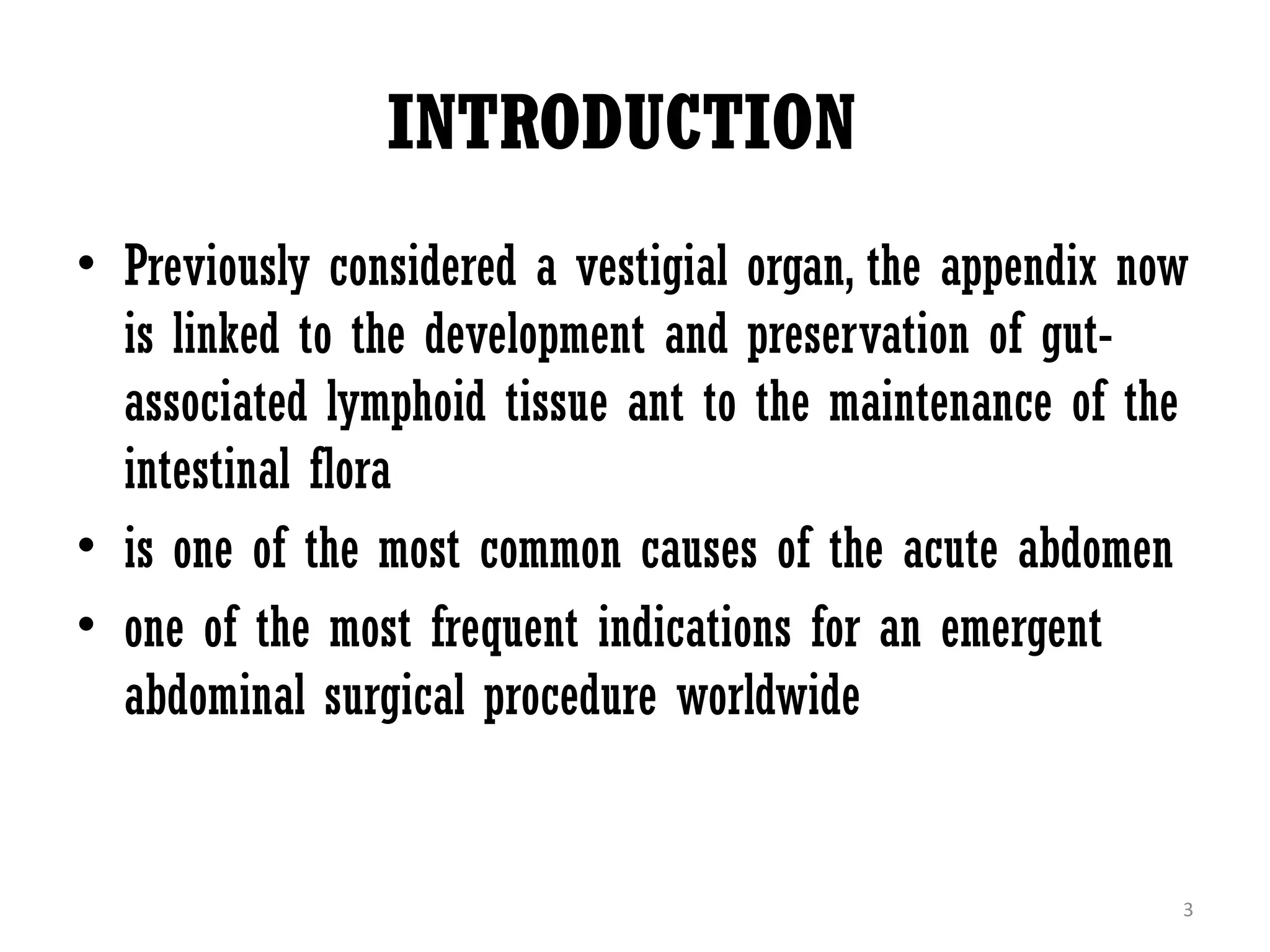
INTRODUCTION
• Previously considered a vestigial organ, the appendix now
is linked to the development and preservation of gut-
associated lymphoid tissue ant to the maintenance of the
intestinal flora
• is one of the most common causes of the acute abdomen
• one of the most frequent indications for an emergent
abdominal surgical procedure worldwide
4
INTRODUCTION
• Appendicitis occurs most frequently in the second and
third decades of life
• It is also higher among men (male to female ratio of
1.4:1)
5
SURGICAL ANATOMY
• It is located at the terminal end of the caecum where
three taeniae join
• The appendix is a true diverticulum of the cecum about
2 cm below the ileocaecal orifice
• Usually, around 5-10 cm in length but can be variable
• diameter of lumen is 1-3 mm (matchstick)
6
SURGICAL ANATOMY
• Mesoappendix is extension of the mesentery contains
appendicular artery, a branch of ileocolic artery
• Often an accessory appendicular artery (of Seshachalam)
may be present
7
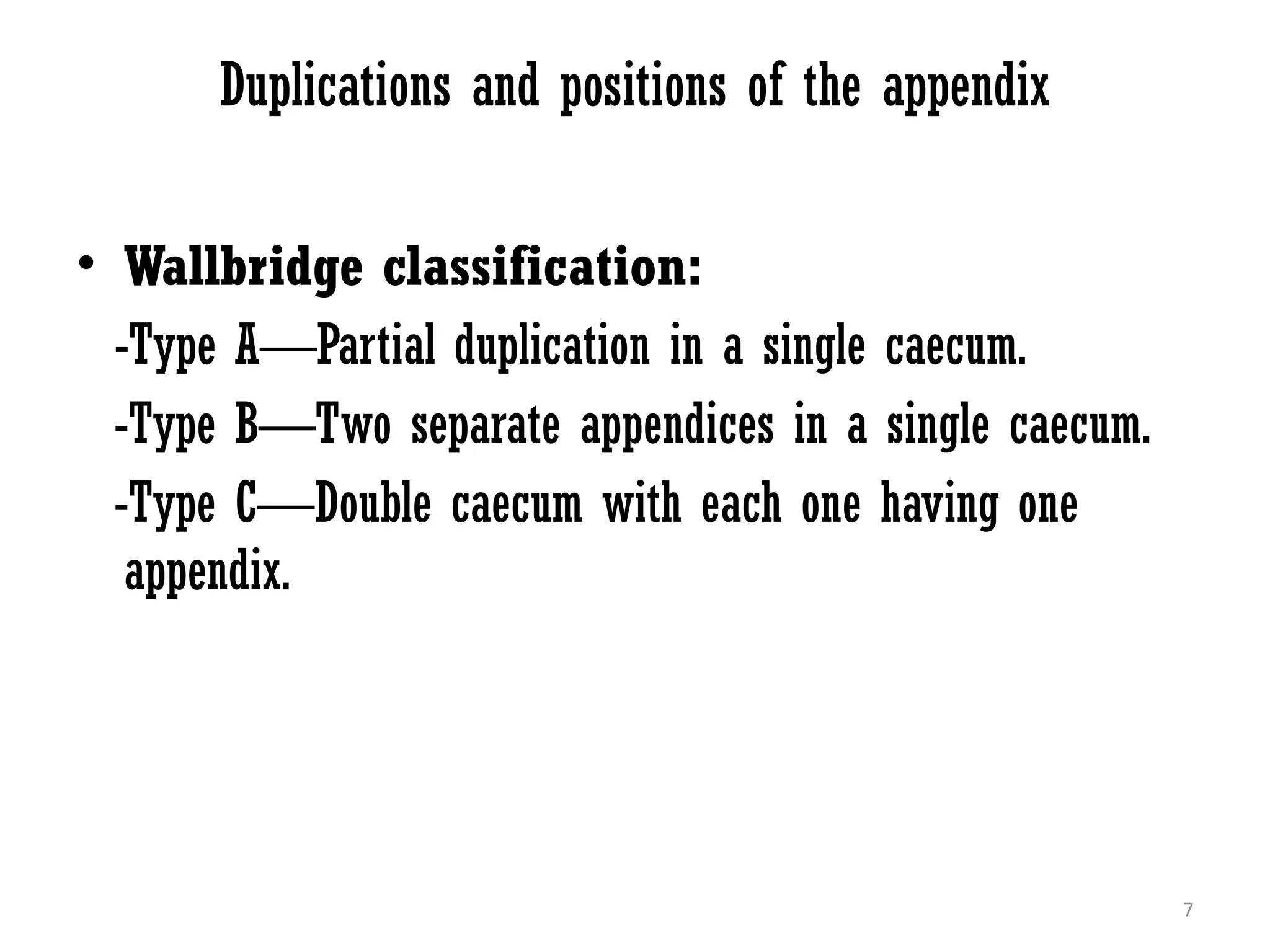
Duplications and positions of the appendix
• Wallbridge classification:
-Type A—Partial duplication in a single caecum.
-Type B—Two separate appendices in a single caecum.
-Type C—Double caecum with each one having one
appendix.
8
9
Most common position is retrocaecal (75%).Next
common is pelvic (21%).
10
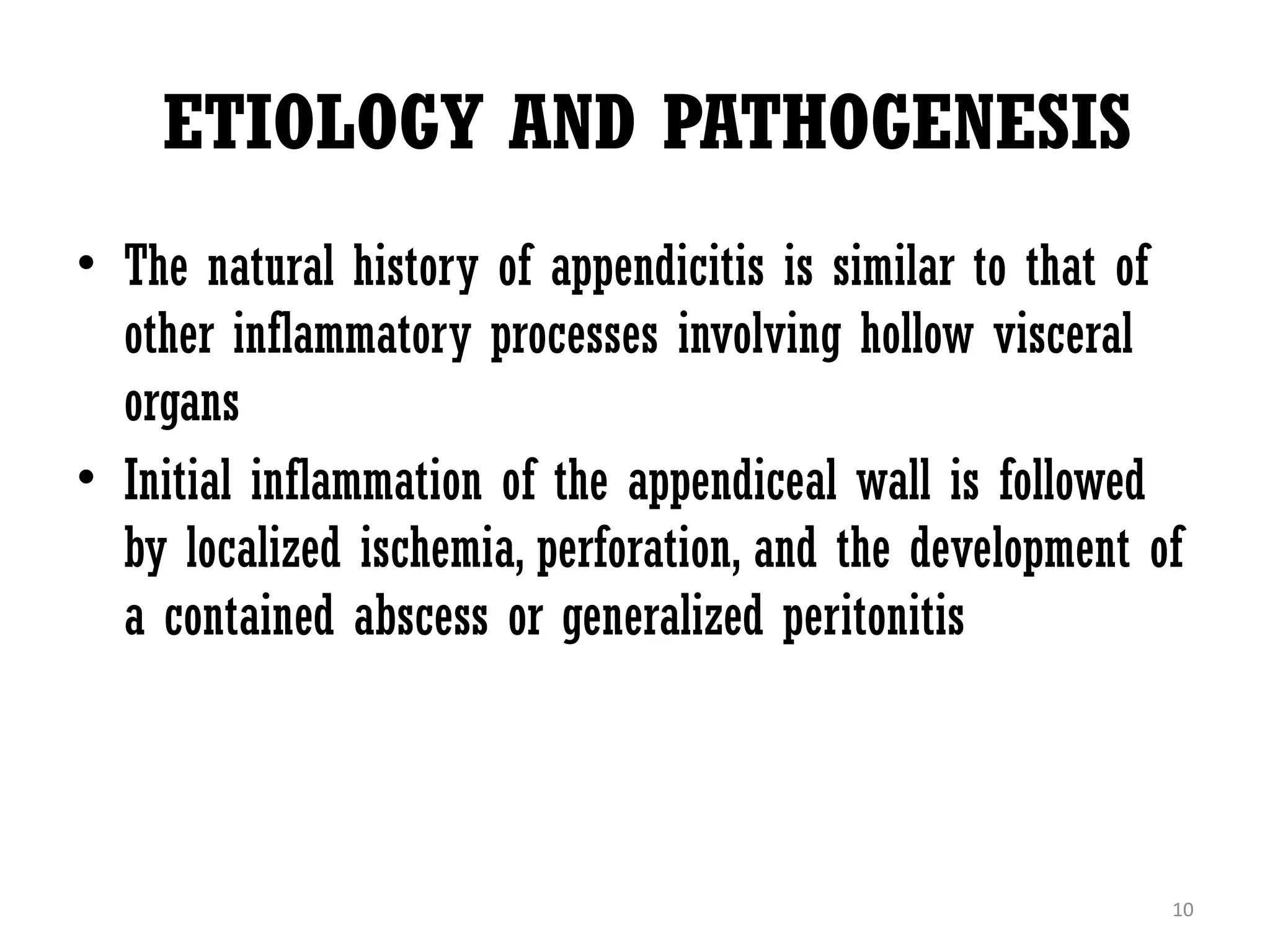
ETIOLOGY AND PATHOGENESIS
• The natural history of appendicitis is similar to that of
other inflammatory processes involving hollow visceral
organs
• Initial inflammation of the appendiceal wall is followed
by localized ischemia, perforation, and the development of
a contained abscess or generalized peritonitis
11
ETIOLOGY AND PATHOGENESIS
• Appendiceal obstruction may be caused by fecaliths (hard
fecal masses), foreign body, lymphoid hyperplasia,
infectious processes, and benign or malignant tumors
• When obstruction of the appendix is the cause of
appendicitis, the obstruction leads to an increase in
luminal and intramural pressure, resulting in thrombosis
and occlusion of the small vessels in the appendiceal
wall, and stasis of lymphatic flow
12
ETIOLOGY AND PATHOGENESIS
• As the appendix becomes engorged, the visceral afferent
nerve fibers entering the spinal cord at T8-T10 are
stimulated, leading to vague central or periumbilical
abdominal pain
• Well-localized pain occurs later in the course when
inflammation involves the adjacent parietal peritoneum.
13
ETIOLOGY AND PATHOGENESIS
• Once significant inflammation and necrosis occur, the
appendix is at risk of perforation, which leads to
localized abscess formation or diffuse peritonitis.
14
TYPES OF APPENDICITIS
• Acute non obstructive appendicitis (catarrhal)
• Acute obstructive appendicitis
• Recurrent appendicitis
• Subacute appendicitis is milder form of acute
appendicitis
15
CLINICAL FEATURES
Clinical manifestations:
History
o Right lower quadrant (right anterior iliac fossa) abdominal pain
o Anorexia
o Nausea and vomiting
o Fever
 Murphy’s triad: pain, vomiting and temperature
16
CLINICAL FEATURES
• In many patients, initial features are atypical or nonspecific, and
can include:
Indigestion
Flatulence
Bowel irregularity
Diarrhea
Generalized malaise
17
CLINICAL FEATURES
Physical examination:
• Tenderness and rebound tenderness at McBurney’s point in right
iliac fossa ( release sign – Blumberg’s sign) are typical
• Rovsing’s sign
• Cope’s psoas’ test
• Obturator test
• P/R examination shows tenderness in right side of the rectum.
18
CLINICAL FEATURES
• Hyperaesthesia in ‘Sherren’s triangle’.
• Bastedo sign( air through rectum)
19
20
CLINICAL FEATURES
McBurney’s point Sherren’s triangle
21
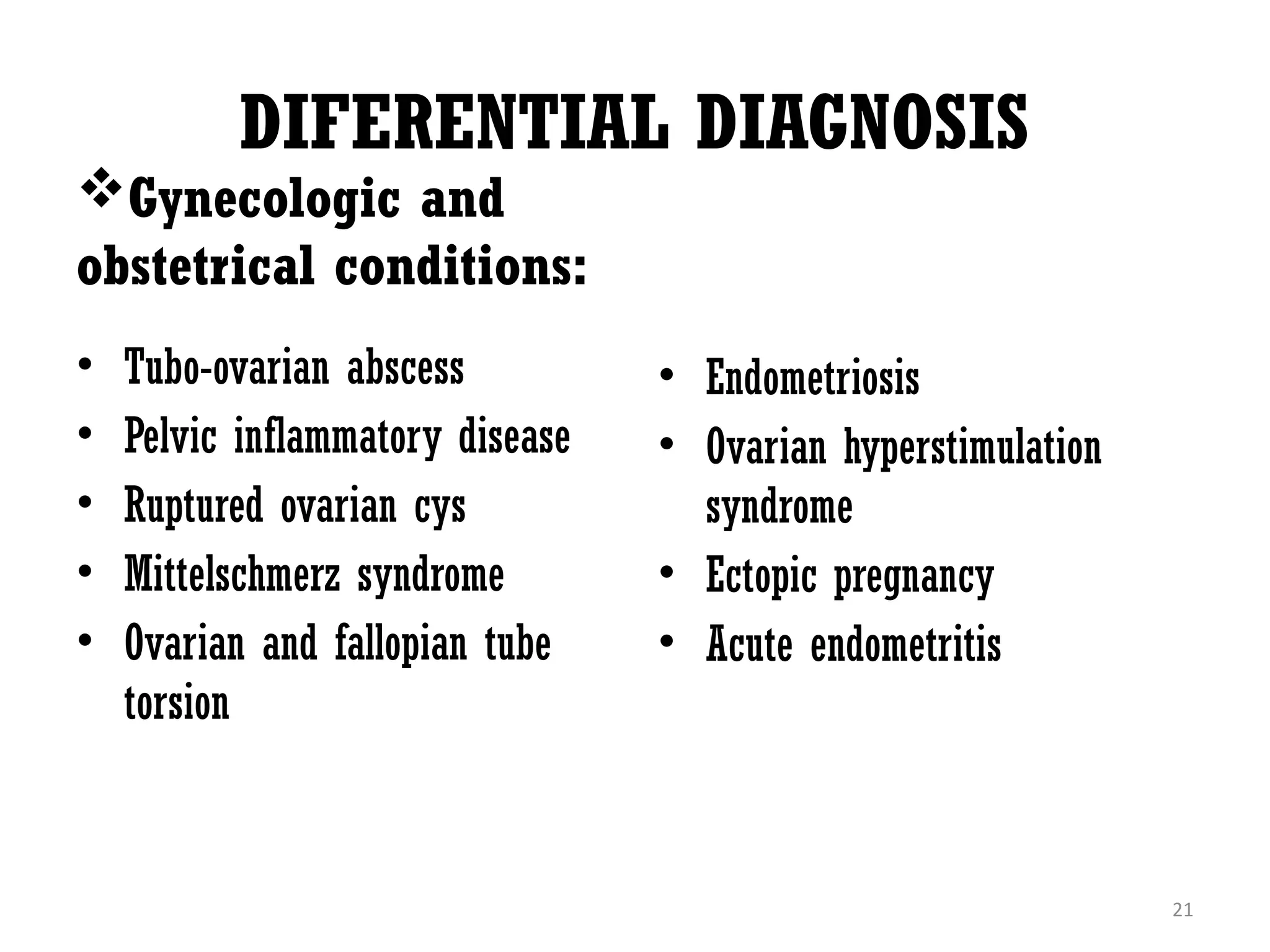
DIFERENTIAL DIAGNOSIS
Gynecologic and
obstetrical conditions:
• Tubo-ovarian abscess
• Pelvic inflammatory disease
• Ruptured ovarian cys
• Mittelschmerz syndrome
• Ovarian and fallopian tube
torsion
• Endometriosis
• Ovarian hyperstimulation
syndrome
• Ectopic pregnancy
• Acute endometritis
22
DIFERENTIAL DIAGNOSIS
Urologic conditions:
o Renal colic
o Testicular torsion
o Epididymitis
o Torsion of the appendix testis or appendix epididymis
23
DIFERENTIAL DIAGNOSIS
Others:
Perforated peptic ulcer
Acute cholecystitis
Enterocolitis
Mesenteric lymphadenitis
Lobar pneumonia
Crohn’s disease
Acute pancreatitis
Meckel’s diverticulitis
Diabetic abdomen
Intussusception
Roundworm colic
Carcinoma caecum – acute features
Mesenteric ischaemia
Intestinal obstruction
Aortic aneurysm leak
24
INVESTIGATIONS
Laboratory findings:
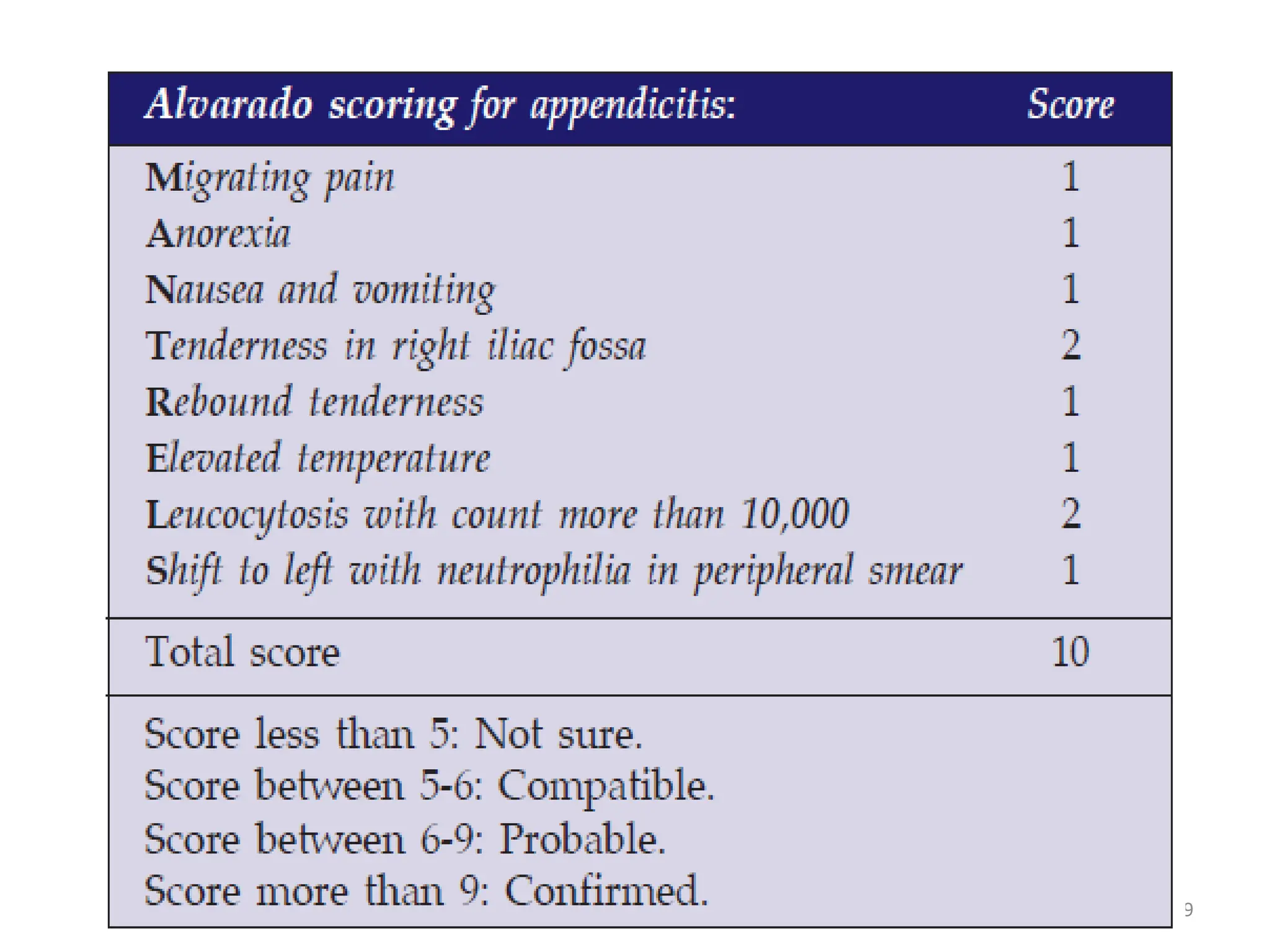
 CBC - Total leucocyte count is increased.
 Urine HCG in females
Imaging studies:
 Abdominal U/S
o Noncompressible appendix of size > 6 mm AP diameter.
o Appendicolith.
o Periappendicular fluid.
25
INVESTIGATIONS
 Computed tomography( abdominalCT with contrast)
findings:
o Enlarged appendiceal diameter >6 mm with an occluded lumen
o Appendiceal wall thickening (>2 mm)
o Appendiceal wall enhancement
o Appendicolith (seen in approximately 25 percent of patients)
o periappendicular fluid collection
o presence of mass/abscess
o Associated pathology like carcinoma can be identified
26
INVESTIGATIONS
 Plain radiograph( abdominal X-ray) findings:
Plain radiographs are usually not helpful for establishing the
diagnosis of appendicitis;
o Right lower quadrant appendicolith
o Localized right lower quadrant ileus
o Loss of the psoas shadow
o Free air (occasionally)
o Deformity of cecal outline
o Right lower quadrant soft tissue density
27
A ppendicolith on abdominal films
28
INVESTIGATIONS
 Magnetic resonance imaging(MRI):
o An enlarged fluid-filled appendix (>7 mm in diameter) is
considered an abnormal finding
o An appendix with a diameter of 6 to 7 mm is considered
an inconclusive finding
29
TREATMENT
• Surgery-Appendicectomy
• Postoperatively, IV fluids, antibiotics
are continued
• Once bowel sounds are heard, oral
diet is started.
30
COMPLICATIONS
preoperative complications:
o Gangrenous appendix perforates causing localized or generalized
peritonitis
o Abscess formation ( appendicular abscess)
o Mass formation (appendicular mass)
31
COMPLICATIONS
Postoperative complications:
o Paralytic ileus
o Reactionary haemorrhage due to slipping of ligature of the
appendicular artery
o Residual abscess (pelvic, paracolic, local, subdiaphragmatic)
32
COMPLICATIONS
Postoperative complications:
o Adhesions and intestinal obstruction
o Right inguinal hernia
o Wound infection 10%
o Faecal fistula
o Respiratory problems and DVT
33
APPENDICULAR MASS
• It is the localisation of infection occurring 3 to 5 days after an
attack of acute appendicitis.
• Inflamed appendix, greater omentum, oedematous caecum, parietal
peritoneum and dilated ileum (Ileus) forms a mass in the right
iliac fossa.
• This mass is tender, smooth, firm, well localised, not moving with
respiration, not mobile, all borders well made out (well localized)
and resonant on percussion. Patient may have fever and features
of toxicity.
34
APPENDICULAR MASS
Diagnosis:
• Hx, P/E and
• Investigations (WBC is increased, U/S confirms the mass).
Treatment:
Conservative (Ochsner-Sherren Regimen).
• Temp, BP, Pulse chart.
• Marking the mass to identify the progression/regression.
• Antibiotics
35
APPENDICULAR MASS
• IV fluids.
• Analgesics.
• Initial nasogastric aspiration.
Patient usually shows response by 48 to 72 hours.
Patient is discharged and advised to come for interval
appendicectomy after 6 weeks.
36
APPENDICULAR MASS
• Criteria to discontinue Ochsner-Sherren regimen:
1. Patient becomes more toxic
2. Persistent vomiting
3. Increase or spread of pain abdomen
4. Increased size of the mass
5. Suppuration (abscess formation) in the mass
 Treatment is immediate surgery
37
APPENDICULAR MASS
• Contraindications for Ochsner-Sherren Regimen
1.When diagnosis is in doubt.
2. In acute appendicitis in children and elderly.
3. In burst, gangrenous appendicitis.
4. In patients in whom diffuse peritonitis sets in.
 Treatment is immediate surgery
38
APPENDICITIS IN SPECIAL GROUPS
• Acute appendicitis in infancy:
Even though it is rare, when it occurs, it has got 80% chances of
perforation with high mortality (50%).
• Acute appendicitis in children:
Here localization is not present, and so peritonitis occurs early. It
requires early surgery. Dehydration, septicemia are common.
39
APPENDICITIS IN SPECIAL GROUPS
• In pregnancy:
Appendix shifts to upper abdomen. So pain is higher and more
lateral. After 6 months, maternal mortality increases by 10 times
than usual and also leads to premature labour. Appendicitis is the
most common non-gynaecologic surgical emergency during
pregnancy. Incidence of perforation is highest in 3rd trimester.
Surgery is the treatment. Fetal death rate is 5%.
40
APPENDICITIS IN SPECIAL GROUPS
• In elderly:
Gangrene and perforation are common. Because of lax abdominal
wall, localization is poor and so peritonitis sets in early.
41
SRB’ S MANUAL OF SURGERY
VAILEY AND LOVE OF SURGERY
SCHWARTE ‘S PRINCIPLES OF
SURGERY

Acute appendicitis, diagnosis and management.pptx

  • 1.
    1 JUBA TEACHING HOSPITALDEPARTMENT OF SURGERY TOPIC: APPENDICITIS PRAPERED BY HO. DOMINIC MATONG WOL SUPPERVISED BY SURGEON DR.JOHN CHOL SPECIALIST DR. ALIER MARKO
  • 2.
    2 TOPIC OUTLINE • Introduction •Surgical Anatomy • Duplications and positions of the appendix. • Etiology and pathogenesis, clinical features differential diagnosis, investigations and complications • Treatment • Appendicitis in infancy/children, elderly and pregnancy
  • 3.
    3 INTRODUCTION • Previously considereda vestigial organ, the appendix now is linked to the development and preservation of gut- associated lymphoid tissue ant to the maintenance of the intestinal flora • is one of the most common causes of the acute abdomen • one of the most frequent indications for an emergent abdominal surgical procedure worldwide
  • 4.
    4 INTRODUCTION • Appendicitis occursmost frequently in the second and third decades of life • It is also higher among men (male to female ratio of 1.4:1)
  • 5.
    5 SURGICAL ANATOMY • Itis located at the terminal end of the caecum where three taeniae join • The appendix is a true diverticulum of the cecum about 2 cm below the ileocaecal orifice • Usually, around 5-10 cm in length but can be variable • diameter of lumen is 1-3 mm (matchstick)
  • 6.
    6 SURGICAL ANATOMY • Mesoappendixis extension of the mesentery contains appendicular artery, a branch of ileocolic artery • Often an accessory appendicular artery (of Seshachalam) may be present
  • 7.
    7 Duplications and positionsof the appendix • Wallbridge classification: -Type A—Partial duplication in a single caecum. -Type B—Two separate appendices in a single caecum. -Type C—Double caecum with each one having one appendix.
  • 8.
  • 9.
    9 Most common positionis retrocaecal (75%).Next common is pelvic (21%).
  • 10.
    10 ETIOLOGY AND PATHOGENESIS •The natural history of appendicitis is similar to that of other inflammatory processes involving hollow visceral organs • Initial inflammation of the appendiceal wall is followed by localized ischemia, perforation, and the development of a contained abscess or generalized peritonitis
  • 11.
    11 ETIOLOGY AND PATHOGENESIS •Appendiceal obstruction may be caused by fecaliths (hard fecal masses), foreign body, lymphoid hyperplasia, infectious processes, and benign or malignant tumors • When obstruction of the appendix is the cause of appendicitis, the obstruction leads to an increase in luminal and intramural pressure, resulting in thrombosis and occlusion of the small vessels in the appendiceal wall, and stasis of lymphatic flow
  • 12.
    12 ETIOLOGY AND PATHOGENESIS •As the appendix becomes engorged, the visceral afferent nerve fibers entering the spinal cord at T8-T10 are stimulated, leading to vague central or periumbilical abdominal pain • Well-localized pain occurs later in the course when inflammation involves the adjacent parietal peritoneum.
  • 13.
    13 ETIOLOGY AND PATHOGENESIS •Once significant inflammation and necrosis occur, the appendix is at risk of perforation, which leads to localized abscess formation or diffuse peritonitis.
  • 14.
    14 TYPES OF APPENDICITIS •Acute non obstructive appendicitis (catarrhal) • Acute obstructive appendicitis • Recurrent appendicitis • Subacute appendicitis is milder form of acute appendicitis
  • 15.
    15 CLINICAL FEATURES Clinical manifestations: History oRight lower quadrant (right anterior iliac fossa) abdominal pain o Anorexia o Nausea and vomiting o Fever  Murphy’s triad: pain, vomiting and temperature
  • 16.
    16 CLINICAL FEATURES • Inmany patients, initial features are atypical or nonspecific, and can include: Indigestion Flatulence Bowel irregularity Diarrhea Generalized malaise
  • 17.
    17 CLINICAL FEATURES Physical examination: •Tenderness and rebound tenderness at McBurney’s point in right iliac fossa ( release sign – Blumberg’s sign) are typical • Rovsing’s sign • Cope’s psoas’ test • Obturator test • P/R examination shows tenderness in right side of the rectum.
  • 18.
    18 CLINICAL FEATURES • Hyperaesthesiain ‘Sherren’s triangle’. • Bastedo sign( air through rectum)
  • 19.
  • 20.
  • 21.
    21 DIFERENTIAL DIAGNOSIS Gynecologic and obstetricalconditions: • Tubo-ovarian abscess • Pelvic inflammatory disease • Ruptured ovarian cys • Mittelschmerz syndrome • Ovarian and fallopian tube torsion • Endometriosis • Ovarian hyperstimulation syndrome • Ectopic pregnancy • Acute endometritis
  • 22.
    22 DIFERENTIAL DIAGNOSIS Urologic conditions: oRenal colic o Testicular torsion o Epididymitis o Torsion of the appendix testis or appendix epididymis
  • 23.
    23 DIFERENTIAL DIAGNOSIS Others: Perforated pepticulcer Acute cholecystitis Enterocolitis Mesenteric lymphadenitis Lobar pneumonia Crohn’s disease Acute pancreatitis Meckel’s diverticulitis Diabetic abdomen Intussusception Roundworm colic Carcinoma caecum – acute features Mesenteric ischaemia Intestinal obstruction Aortic aneurysm leak
  • 24.
    24 INVESTIGATIONS Laboratory findings:  CBC- Total leucocyte count is increased.  Urine HCG in females Imaging studies:  Abdominal U/S o Noncompressible appendix of size > 6 mm AP diameter. o Appendicolith. o Periappendicular fluid.
  • 25.
    25 INVESTIGATIONS  Computed tomography(abdominalCT with contrast) findings: o Enlarged appendiceal diameter >6 mm with an occluded lumen o Appendiceal wall thickening (>2 mm) o Appendiceal wall enhancement o Appendicolith (seen in approximately 25 percent of patients) o periappendicular fluid collection o presence of mass/abscess o Associated pathology like carcinoma can be identified
  • 26.
    26 INVESTIGATIONS  Plain radiograph(abdominal X-ray) findings: Plain radiographs are usually not helpful for establishing the diagnosis of appendicitis; o Right lower quadrant appendicolith o Localized right lower quadrant ileus o Loss of the psoas shadow o Free air (occasionally) o Deformity of cecal outline o Right lower quadrant soft tissue density
  • 27.
    27 A ppendicolith onabdominal films
  • 28.
    28 INVESTIGATIONS  Magnetic resonanceimaging(MRI): o An enlarged fluid-filled appendix (>7 mm in diameter) is considered an abnormal finding o An appendix with a diameter of 6 to 7 mm is considered an inconclusive finding
  • 29.
    29 TREATMENT • Surgery-Appendicectomy • Postoperatively,IV fluids, antibiotics are continued • Once bowel sounds are heard, oral diet is started.
  • 30.
    30 COMPLICATIONS preoperative complications: o Gangrenousappendix perforates causing localized or generalized peritonitis o Abscess formation ( appendicular abscess) o Mass formation (appendicular mass)
  • 31.
    31 COMPLICATIONS Postoperative complications: o Paralyticileus o Reactionary haemorrhage due to slipping of ligature of the appendicular artery o Residual abscess (pelvic, paracolic, local, subdiaphragmatic)
  • 32.
    32 COMPLICATIONS Postoperative complications: o Adhesionsand intestinal obstruction o Right inguinal hernia o Wound infection 10% o Faecal fistula o Respiratory problems and DVT
  • 33.
    33 APPENDICULAR MASS • Itis the localisation of infection occurring 3 to 5 days after an attack of acute appendicitis. • Inflamed appendix, greater omentum, oedematous caecum, parietal peritoneum and dilated ileum (Ileus) forms a mass in the right iliac fossa. • This mass is tender, smooth, firm, well localised, not moving with respiration, not mobile, all borders well made out (well localized) and resonant on percussion. Patient may have fever and features of toxicity.
  • 34.
    34 APPENDICULAR MASS Diagnosis: • Hx,P/E and • Investigations (WBC is increased, U/S confirms the mass). Treatment: Conservative (Ochsner-Sherren Regimen). • Temp, BP, Pulse chart. • Marking the mass to identify the progression/regression. • Antibiotics
  • 35.
    35 APPENDICULAR MASS • IVfluids. • Analgesics. • Initial nasogastric aspiration. Patient usually shows response by 48 to 72 hours. Patient is discharged and advised to come for interval appendicectomy after 6 weeks.
  • 36.
    36 APPENDICULAR MASS • Criteriato discontinue Ochsner-Sherren regimen: 1. Patient becomes more toxic 2. Persistent vomiting 3. Increase or spread of pain abdomen 4. Increased size of the mass 5. Suppuration (abscess formation) in the mass  Treatment is immediate surgery
  • 37.
    37 APPENDICULAR MASS • Contraindicationsfor Ochsner-Sherren Regimen 1.When diagnosis is in doubt. 2. In acute appendicitis in children and elderly. 3. In burst, gangrenous appendicitis. 4. In patients in whom diffuse peritonitis sets in.  Treatment is immediate surgery
  • 38.
    38 APPENDICITIS IN SPECIALGROUPS • Acute appendicitis in infancy: Even though it is rare, when it occurs, it has got 80% chances of perforation with high mortality (50%). • Acute appendicitis in children: Here localization is not present, and so peritonitis occurs early. It requires early surgery. Dehydration, septicemia are common.
  • 39.
    39 APPENDICITIS IN SPECIALGROUPS • In pregnancy: Appendix shifts to upper abdomen. So pain is higher and more lateral. After 6 months, maternal mortality increases by 10 times than usual and also leads to premature labour. Appendicitis is the most common non-gynaecologic surgical emergency during pregnancy. Incidence of perforation is highest in 3rd trimester. Surgery is the treatment. Fetal death rate is 5%.
  • 40.
    40 APPENDICITIS IN SPECIALGROUPS • In elderly: Gangrene and perforation are common. Because of lax abdominal wall, localization is poor and so peritonitis sets in early.
  • 41.
    41 SRB’ S MANUALOF SURGERY VAILEY AND LOVE OF SURGERY SCHWARTE ‘S PRINCIPLES OF SURGERY