
Linking Effective Leadership to Productivity in the
Public Sector
Need, Challenges and Constraints
Linking Effective Leadership to
Productivity in the Public Sector –
Need, Challenges and Constraints
Dr. Tim A. Mau
Associate Professor of Political Science
University of Guelph
Guelph, Ontario Canada N1G 2W1
tmau@uoguelph.ca
Workshop on Developing the APO Public Sector Leadership Framework
Manila, Philippines
Monday, November 14, 2016 (11:15 – 12:30)
Context
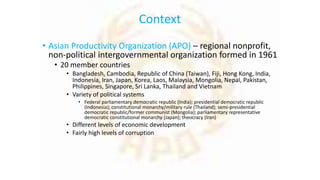
• Asian Productivity Organization (APO) – regional nonprofit,
non-political intergovernmental organization formed in 1961
• 20 member countries
• Bangladesh, Cambodia, Republic of China (Taiwan), Fiji, Hong Kong, India,
Indonesia, Iran, Japan, Korea, Laos, Malaysia, Mongolia, Nepal, Pakistan,
Philippines, Singapore, Sri Lanka, Thailand and Vietnam
• Variety of political systems
• Federal parliamentary democratic republic (India); presidential democratic republic
(Indonesia); constitutional monarchy/military rule (Thailand); semi-presidential
democratic republic/former communist (Mongolia); parliamentary representative
democratic constitutional monarchy (Japan); theocracy (Iran)
• Different levels of economic development
• Fairly high levels of corruption
Context
• APO Mission – “contribute to the sustainable socio-
economic development of Asia and the Pacific through
enhancing productivity”
• Importance of the public sector
• Direct and indirect contributions to GDP
• Business development
• Employment generation
• Challenge is to ensure efficiency and effectiveness in the
public sector
• How will that be accomplished?
• Managerial/leadership capacity
Discussion
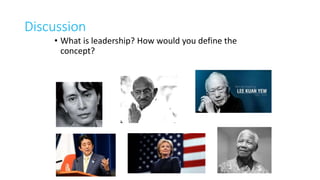
• What is leadership? How would you define the
concept?
Defining Leadership
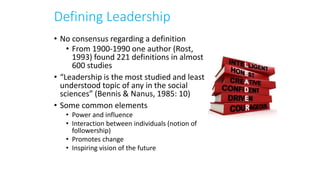
• No consensus regarding a definition
• From 1900-1990 one author (Rost,
1993) found 221 definitions in almost
600 studies
• “Leadership is the most studied and least
understood topic of any in the social
sciences” (Bennis & Nanus, 1985: 10)
• Some common elements
• Power and influence
• Interaction between individuals (notion of
followership)
• Promotes change
• Inspiring vision of the future
Defining Leadership
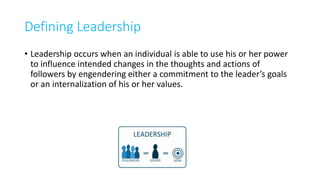
• Leadership occurs when an individual is able to use his or her power
to influence intended changes in the thoughts and actions of
followers by engendering either a commitment to the leader’s goals
or an internalization of his or her values.
Public Sector Leadership: An Oxymoron?
• Can—or should—public servants even provide leadership?
• Historic neglect by political scientists and public administration scholars
• Democratic theory – politics-administration dichotomy
• Public servants should be “on tap” not “on top”
The Leadership Imperative
• “Leadership is not just a right of public managers. It is an
obligation” (Behn, 1998: 209).
• By exercising leadership, public sector managers can
overcome some of the imperfections of the political
system
• 7 basic failures
• Organizational
• Analytical
• Executive
• Legislative
• Political
• Civic
• Judicial
The Leadership Imperative
• Rationale for leadership in the public and private
sectors is essentially the same
• Cope with rapid and continuous change
• Deal with turbulence and uncertainty
• Provide direction and vision
• Focus employees on organizational mission
• Achieve greater efficiency and effectiveness
• Foster greater employee satisfaction
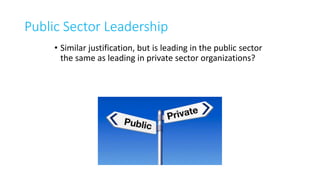
Public Sector Leadership
• Similar justification, but is leading in the public sector
the same as leading in private sector organizations?
Public Sector vs. Private Sector Management
(Leadership?)
• “I conclude that public and private management are
at least as different as they are similar, and that the
differences are more important than the similarities.”
Graham Allison, 1979
Public vs. Private Management
• Shared managerial functions – POSDCORB
• Planning
• Organizing
• Staffing
• Directing
• CO-ordinating
• Reporting
• Budgeting
Public vs. Private Management
• Differences
1) Public goods/interest vs.
Profit/bottom line
2) Public administration – less
efficient
• Economic Considerations
• No profit motivation
• Provision of unprofitable services
Public vs. Private Management
• Differences
2) Public administration – less
efficient
• Political considerations
• Elections
• Duration
• Cabinet solidarity
• Ministerial interference
• Need for consistency in program
delivery
• Need to protect minister
• Re-election
• Neutrality
Public vs. Private Management
• Differences
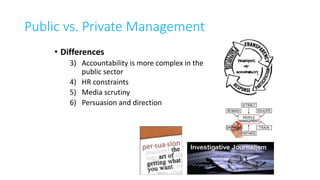
3) Accountability is more complex in the
public sector
4) HR constraints
5) Media scrutiny
6) Persuasion and direction
Public vs. Private Leadership
• Would those same considerations hold true when
distinguishing public sector from private sector
leadership?
Public vs. Private Leadership
• Same important distinctions hold true for leadership
• Leading in the public sector – more complex and ambiguous
• 2006 Public Policy Forum (Côté, 2006) survey of public and private sector
leaders
• Leadership, therefore, is situational or contingent
• Leadership skills that were previously successful may not work in new
situations or changed environments (Van Wart, 2013)
• Public sector leadership has evolved in response to developments in
the private sector
Evolution of Public Sector Leadership
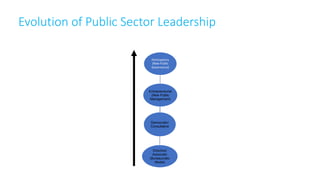
Democratic/
Consultative
Participatory
(New Public
Governance)
Entrepreneurial
(New Public
Management)
Directive/
Autocratic
(Bureaucratic
Model)
Public Sector Leadership Competency Models
• Another area where the public sector has looked to
the private sector for inspiration/best practice
• Common public sector practice around the world
• Convergence with private sector models
• Most effectively used across the full spectrum of HR
functions (recruitment, selection, promotion, training,
evaluation)
Limitations of Leadership Competency
Models
• Focus on past or present rather than future
• Too generic
• Too complex/too many competencies
• Construct validity
• Lack of results
Canada – Key Leadership Competencies (2004)
• “From a foundation of values and ethics, public
service leaders deliver results through strategic
thinking, engagement and management
excellence.”
• 4 competencies
• Strategic thinking
• Engagement
• Management Excellence
• Values and ethics
• Elegant in its simplicity
• Key emphasis on public sector values & ethics
Canada – Key Leadership Competencies (2015)
• Updated framework
• 6 competencies
• Create vision and strategy
• Mobilize people
• Uphold integrity and respect
• Collaborate with partners and stakeholders
• Promote innovation and guide change
• Achieve results
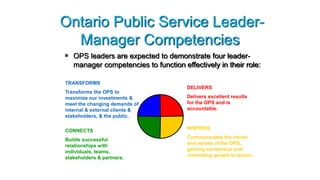
Ontario Public Service Leader-
Manager Competencies
DELIVERS
Delivers excellent results
for the OPS and is
accountable.
TRANSFORMS
Transforms the OPS to
maximize our investments &
meet the changing demands of
internal & external clients &
stakeholders, & the public.
INSPIRES
Communicates the vision
and values of the OPS,
gaining consensus and
motivating people to action.
CONNECTS
Builds successful
relationships with
individuals, teams,
stakeholders & partners.
 OPS leaders are expected to demonstrate four leader-
manager competencies to function effectively in their role:
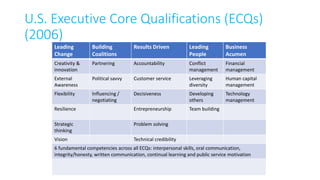
U.S. Executive Core Qualifications (ECQs)
(2006)
Leading
Change
Building
Coalitions
Results Driven Leading
People
Business
Acumen
Creativity &
innovation
Partnering Accountability Conflict
management
Financial
management
External
Awareness
Political savvy Customer service Leveraging
diversity
Human capital
management
Flexibility Influencing /
negotiating
Decisiveness Developing
others
Technology
management
Resilience Entrepreneurship Team building
Strategic
thinking
Problem solving
Vision Technical credibility
6 fundamental competencies across all ECQs: interpersonal skills, oral communication,
integrity/honesty, written communication, continual learning and public service motivation
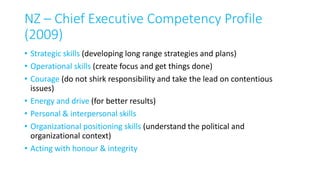
NZ – Chief Executive Competency Profile
(2009)
• Strategic skills (developing long range strategies and plans)
• Operational skills (create focus and get things done)
• Courage (do not shirk responsibility and take the lead on contentious
issues)
• Energy and drive (for better results)
• Personal & interpersonal skills
• Organizational positioning skills (understand the political and
organizational context)
• Acting with honour & integrity
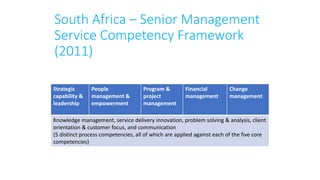
South Africa – Senior Management
Service Competency Framework
(2011)
Strategic
capability &
leadership
People
management &
empowerment
Program &
project
management
Financial
management
Change
management
Knowledge management, service delivery innovation, problem solving & analysis, client
orientation & customer focus, and communication
(5 distinct process competencies, all of which are applied against each of the five core
competencies)
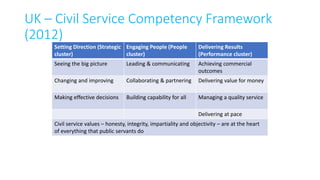
UK – Civil Service Competency Framework
(2012)
Setting Direction (Strategic
cluster)
Engaging People (People
cluster)
Delivering Results
(Performance cluster)
Seeing the big picture Leading & communicating Achieving commercial
outcomes
Changing and improving Collaborating & partnering Delivering value for money
Making effective decisions Building capability for all Managing a quality service
Delivering at pace
Civil service values – honesty, integrity, impartiality and objectivity – are at the heart
of everything that public servants do
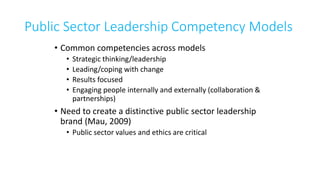
Public Sector Leadership Competency Models
• Common competencies across models
• Strategic thinking/leadership
• Leading/coping with change
• Results focused
• Engaging people internally and externally (collaboration &
partnerships)
• Need to create a distinctive public sector leadership
brand (Mau, 2009)
• Public sector values and ethics are critical
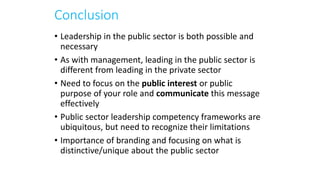
Conclusion
• Leadership in the public sector is both possible and
necessary
• As with management, leading in the public sector is
different from leading in the private sector
• Need to focus on the public interest or public
purpose of your role and communicate this message
effectively
• Public sector leadership competency frameworks are
ubiquitous, but need to recognize their limitations
• Importance of branding and focusing on what is
distinctive/unique about the public sector
Thank You! Dr. Tim A. Mau
Associate Professor of Political Science
University of Guelph
Guelph, Ontario Canada N1G 2W1
tmau@uoguelph.ca
Workshop on Developing the APO Public
Sector Leadership FrameworkManila,
Philippines
Monday, November 14, 2016 (11:15 – 12:30)

Apo leadership workshop

  • 1.
    Linking Effective Leadershipto Productivity in the Public Sector Need, Challenges and Constraints
  • 2.
    Linking Effective Leadershipto Productivity in the Public Sector – Need, Challenges and Constraints Dr. Tim A. Mau Associate Professor of Political Science University of Guelph Guelph, Ontario Canada N1G 2W1 tmau@uoguelph.ca Workshop on Developing the APO Public Sector Leadership Framework Manila, Philippines Monday, November 14, 2016 (11:15 – 12:30)
  • 3.
    Context • Asian ProductivityOrganization (APO) – regional nonprofit, non-political intergovernmental organization formed in 1961 • 20 member countries • Bangladesh, Cambodia, Republic of China (Taiwan), Fiji, Hong Kong, India, Indonesia, Iran, Japan, Korea, Laos, Malaysia, Mongolia, Nepal, Pakistan, Philippines, Singapore, Sri Lanka, Thailand and Vietnam • Variety of political systems • Federal parliamentary democratic republic (India); presidential democratic republic (Indonesia); constitutional monarchy/military rule (Thailand); semi-presidential democratic republic/former communist (Mongolia); parliamentary representative democratic constitutional monarchy (Japan); theocracy (Iran) • Different levels of economic development • Fairly high levels of corruption
  • 4.
    Context • APO Mission– “contribute to the sustainable socio- economic development of Asia and the Pacific through enhancing productivity” • Importance of the public sector • Direct and indirect contributions to GDP • Business development • Employment generation • Challenge is to ensure efficiency and effectiveness in the public sector • How will that be accomplished? • Managerial/leadership capacity
  • 5.
    Discussion • What isleadership? How would you define the concept?
  • 6.
    Defining Leadership • Noconsensus regarding a definition • From 1900-1990 one author (Rost, 1993) found 221 definitions in almost 600 studies • “Leadership is the most studied and least understood topic of any in the social sciences” (Bennis & Nanus, 1985: 10) • Some common elements • Power and influence • Interaction between individuals (notion of followership) • Promotes change • Inspiring vision of the future
  • 7.
    Defining Leadership • Leadershipoccurs when an individual is able to use his or her power to influence intended changes in the thoughts and actions of followers by engendering either a commitment to the leader’s goals or an internalization of his or her values.
  • 8.
    Public Sector Leadership:An Oxymoron? • Can—or should—public servants even provide leadership? • Historic neglect by political scientists and public administration scholars • Democratic theory – politics-administration dichotomy • Public servants should be “on tap” not “on top”
  • 9.
    The Leadership Imperative •“Leadership is not just a right of public managers. It is an obligation” (Behn, 1998: 209). • By exercising leadership, public sector managers can overcome some of the imperfections of the political system • 7 basic failures • Organizational • Analytical • Executive • Legislative • Political • Civic • Judicial
  • 10.
    The Leadership Imperative •Rationale for leadership in the public and private sectors is essentially the same • Cope with rapid and continuous change • Deal with turbulence and uncertainty • Provide direction and vision • Focus employees on organizational mission • Achieve greater efficiency and effectiveness • Foster greater employee satisfaction
  • 11.
    Public Sector Leadership •Similar justification, but is leading in the public sector the same as leading in private sector organizations?
  • 12.
    Public Sector vs.Private Sector Management (Leadership?) • “I conclude that public and private management are at least as different as they are similar, and that the differences are more important than the similarities.” Graham Allison, 1979
  • 13.
    Public vs. PrivateManagement • Shared managerial functions – POSDCORB • Planning • Organizing • Staffing • Directing • CO-ordinating • Reporting • Budgeting
  • 14.
    Public vs. PrivateManagement • Differences 1) Public goods/interest vs. Profit/bottom line 2) Public administration – less efficient • Economic Considerations • No profit motivation • Provision of unprofitable services
  • 15.
    Public vs. PrivateManagement • Differences 2) Public administration – less efficient • Political considerations • Elections • Duration • Cabinet solidarity • Ministerial interference • Need for consistency in program delivery • Need to protect minister • Re-election • Neutrality
  • 16.
    Public vs. PrivateManagement • Differences 3) Accountability is more complex in the public sector 4) HR constraints 5) Media scrutiny 6) Persuasion and direction
  • 17.
    Public vs. PrivateLeadership • Would those same considerations hold true when distinguishing public sector from private sector leadership?
  • 18.
    Public vs. PrivateLeadership • Same important distinctions hold true for leadership • Leading in the public sector – more complex and ambiguous • 2006 Public Policy Forum (Côté, 2006) survey of public and private sector leaders • Leadership, therefore, is situational or contingent • Leadership skills that were previously successful may not work in new situations or changed environments (Van Wart, 2013) • Public sector leadership has evolved in response to developments in the private sector
  • 19.
    Evolution of PublicSector Leadership Democratic/ Consultative Participatory (New Public Governance) Entrepreneurial (New Public Management) Directive/ Autocratic (Bureaucratic Model)
  • 20.
    Public Sector LeadershipCompetency Models • Another area where the public sector has looked to the private sector for inspiration/best practice • Common public sector practice around the world • Convergence with private sector models • Most effectively used across the full spectrum of HR functions (recruitment, selection, promotion, training, evaluation)
  • 21.
    Limitations of LeadershipCompetency Models • Focus on past or present rather than future • Too generic • Too complex/too many competencies • Construct validity • Lack of results
  • 22.
    Canada – KeyLeadership Competencies (2004) • “From a foundation of values and ethics, public service leaders deliver results through strategic thinking, engagement and management excellence.” • 4 competencies • Strategic thinking • Engagement • Management Excellence • Values and ethics • Elegant in its simplicity • Key emphasis on public sector values & ethics
  • 23.
    Canada – KeyLeadership Competencies (2015) • Updated framework • 6 competencies • Create vision and strategy • Mobilize people • Uphold integrity and respect • Collaborate with partners and stakeholders • Promote innovation and guide change • Achieve results
  • 24.
    Ontario Public ServiceLeader- Manager Competencies DELIVERS Delivers excellent results for the OPS and is accountable. TRANSFORMS Transforms the OPS to maximize our investments & meet the changing demands of internal & external clients & stakeholders, & the public. INSPIRES Communicates the vision and values of the OPS, gaining consensus and motivating people to action. CONNECTS Builds successful relationships with individuals, teams, stakeholders & partners.  OPS leaders are expected to demonstrate four leader- manager competencies to function effectively in their role:
  • 25.
    U.S. Executive CoreQualifications (ECQs) (2006) Leading Change Building Coalitions Results Driven Leading People Business Acumen Creativity & innovation Partnering Accountability Conflict management Financial management External Awareness Political savvy Customer service Leveraging diversity Human capital management Flexibility Influencing / negotiating Decisiveness Developing others Technology management Resilience Entrepreneurship Team building Strategic thinking Problem solving Vision Technical credibility 6 fundamental competencies across all ECQs: interpersonal skills, oral communication, integrity/honesty, written communication, continual learning and public service motivation
  • 26.
    NZ – ChiefExecutive Competency Profile (2009) • Strategic skills (developing long range strategies and plans) • Operational skills (create focus and get things done) • Courage (do not shirk responsibility and take the lead on contentious issues) • Energy and drive (for better results) • Personal & interpersonal skills • Organizational positioning skills (understand the political and organizational context) • Acting with honour & integrity
  • 27.
    South Africa –Senior Management Service Competency Framework (2011) Strategic capability & leadership People management & empowerment Program & project management Financial management Change management Knowledge management, service delivery innovation, problem solving & analysis, client orientation & customer focus, and communication (5 distinct process competencies, all of which are applied against each of the five core competencies)
  • 28.
    UK – CivilService Competency Framework (2012) Setting Direction (Strategic cluster) Engaging People (People cluster) Delivering Results (Performance cluster) Seeing the big picture Leading & communicating Achieving commercial outcomes Changing and improving Collaborating & partnering Delivering value for money Making effective decisions Building capability for all Managing a quality service Delivering at pace Civil service values – honesty, integrity, impartiality and objectivity – are at the heart of everything that public servants do
  • 29.
    Public Sector LeadershipCompetency Models • Common competencies across models • Strategic thinking/leadership • Leading/coping with change • Results focused • Engaging people internally and externally (collaboration & partnerships) • Need to create a distinctive public sector leadership brand (Mau, 2009) • Public sector values and ethics are critical
  • 30.
    Conclusion • Leadership inthe public sector is both possible and necessary • As with management, leading in the public sector is different from leading in the private sector • Need to focus on the public interest or public purpose of your role and communicate this message effectively • Public sector leadership competency frameworks are ubiquitous, but need to recognize their limitations • Importance of branding and focusing on what is distinctive/unique about the public sector
  • 31.
    Thank You! Dr.Tim A. Mau Associate Professor of Political Science University of Guelph Guelph, Ontario Canada N1G 2W1 tmau@uoguelph.ca Workshop on Developing the APO Public Sector Leadership FrameworkManila, Philippines Monday, November 14, 2016 (11:15 – 12:30)