Module 4
OD Consultants and their skills
OD consultants’ role and skills
• Entering
• Source clients
• • Build relationships
• • Learn company jargon
• • “Presenting problem” challenge • Time consuming • Stressful phase • Select project/client according to own criteria • Unpredictable outcome • Ready access to
clients • Ready relationships • Knows company jargon • Understands root causes • Time efficient • Congenial phase • Obligated to work with everyone.
• Contracting • Formal documents • Can terminate the project at will • Guard against out-of-pocket expenses • Information confidential • Loss of contract at stake
• Maintain third-party role • Informal agreements • Must complete projects assigned • No out-of-pocket expenses • Information can be open or confidential • Risk of
client retaliation and loss of job at stake.
• Diagnosing • Meet most organization members for the first time • Prestige from being external • Build trust quickly • Confidential data can increase political
sensitivities • Has relationships with many organization members • Prestige determined by job rank and client stature • Sustain reputation as trustworthy over time
• Data openly shared can reduce political intrigue • Confine activities within boundaries of the client organization.
Factors influencing OD
• Leadership and Organizational Development
• Innovation and Organizational Development
• Inter-functional coordination, communication, knowledge sharing and
organizational development.
• Information and Communication Technology and Organizational
Development.
Refer the article
• NIJBMR-3(7)-103-108_ Factors important IN OD
Definition of organisational politics
• Organisational politics is referred to the self-interest and agenda
of an individual in an organisation without any concern about its
impact on the objective of the company to achieve its goals. It is
a process that is related to the self-serving human behaviour
and his interactions involving authority and power.
Some important reasons for
organisational politics :- (Refer word file for Notes)
These Reasons describes the role of politics in OD
• Do not want to work hard
• Cannot adjust to change
• Personal relationships
• Lack of clarity
• Manipulations
• Jealousy
• Lack of trust
• Blame game
• Gossips
• Struggle for power
• Promotions are less plentiful
• Reward system
• Changes in upper levels
Organizational culture
• Organizational culture provides the members with a common system of norms,
beliefs, and meaning which is very important. This provides the basis of mutual
understanding and communication among individuals in the organization. This
significantly influences efficiency in the organization and ability to deal with
change
• Article titled ‘Understanding the Influence of Organizational Culture and Group
Dynamics on Organizational Change and Learning’, Colleen & Kline (2008) notes
that group and organizational learning highly influences organizational change. It
also influences individual’s capacity to learn and adapt to changes in the
organization.
Can Culture Affect Organizational Development? (Refer word file for notes)
• Culture is one of the strongest forces within any organization. It is designed to last
for generations and is made up of interlocking entities (vision, mission, processes,
ethics, values, behaviors, methods, etc.) – all of which come together to form a
complex web that serves as a foundation for the organization’s internal and
external structure. It is usually built to stand the test of time and as such, it is
designed in such way that changing it becomes impossible.
• It is usually the binding force of the organization and this means that everything
and everyone in the organization is connected to it. No reasonable change can
occur or stand the test of time if it goes contrary to the culture of the organization;
this means that any development that takes place within the organization has to be
connected (directly or indirectly) to the culture of the organization.
• This is why one-time attempts designed to change culture rarely work. This has
remained a major challenge for change leaders who try to create new cultures or
try to introduce changes that are contrary to existing culture.
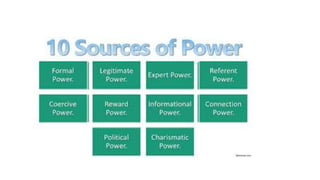
Power and influence tactics
What is power and influence tactics?
• In sum, influence tactics are behaviors that allow individuals to exert
power, while power is an ability that arises from both organizational
(e.g., position) and personal (e.g., expertise) sources.
• There are 9 organizational power tactics. These tactics are ways in
which individuals translate power bases into specific actions. The 9
influence tactics are legitimacy, rational persuasion, inspirational
appeals, consultation, exchange, personal appeals, ingratiation,
pressure and coalitions. Rational persuasion.
CONSTRUCTIVE POLITICS
• Constructive politics is a progression and has shortcomings and
risks, too. A factor to consider is how well informed we are, as a
people, in judging policy options or the trustworthiness of
politicians and political parties.
• In constructive politics, certain rules must be observed to
prevent too much playing with people’s sentiments or
misleading them.
CONSTRUCTIVE POLITICS
• Working Toward More Inclusive and Representative
Governance
• In a time of heightened polarization, it’s difficult for America to
get anything done — even on priorities that are widely shared.
And large portions of the population are underrepresented in
decisions that affect us all. The Constructive Politics strategy
promotes pluralism: the notion that everyone belongs, that
differences make us stronger, and that public policy should
serve the country as a whole.
Module 4.pptx OD Consultants

Module 4.pptx OD Consultants

  • 1.
    Module 4 OD Consultantsand their skills
  • 2.
    OD consultants’ roleand skills • Entering • Source clients • • Build relationships • • Learn company jargon • • “Presenting problem” challenge • Time consuming • Stressful phase • Select project/client according to own criteria • Unpredictable outcome • Ready access to clients • Ready relationships • Knows company jargon • Understands root causes • Time efficient • Congenial phase • Obligated to work with everyone. • Contracting • Formal documents • Can terminate the project at will • Guard against out-of-pocket expenses • Information confidential • Loss of contract at stake • Maintain third-party role • Informal agreements • Must complete projects assigned • No out-of-pocket expenses • Information can be open or confidential • Risk of client retaliation and loss of job at stake. • Diagnosing • Meet most organization members for the first time • Prestige from being external • Build trust quickly • Confidential data can increase political sensitivities • Has relationships with many organization members • Prestige determined by job rank and client stature • Sustain reputation as trustworthy over time • Data openly shared can reduce political intrigue • Confine activities within boundaries of the client organization.
  • 8.
    Factors influencing OD •Leadership and Organizational Development • Innovation and Organizational Development • Inter-functional coordination, communication, knowledge sharing and organizational development. • Information and Communication Technology and Organizational Development.
  • 10.
    Refer the article •NIJBMR-3(7)-103-108_ Factors important IN OD
  • 11.
    Definition of organisationalpolitics • Organisational politics is referred to the self-interest and agenda of an individual in an organisation without any concern about its impact on the objective of the company to achieve its goals. It is a process that is related to the self-serving human behaviour and his interactions involving authority and power.
  • 12.
    Some important reasonsfor organisational politics :- (Refer word file for Notes) These Reasons describes the role of politics in OD • Do not want to work hard • Cannot adjust to change • Personal relationships • Lack of clarity • Manipulations • Jealousy • Lack of trust • Blame game • Gossips • Struggle for power • Promotions are less plentiful • Reward system • Changes in upper levels
  • 13.
    Organizational culture • Organizationalculture provides the members with a common system of norms, beliefs, and meaning which is very important. This provides the basis of mutual understanding and communication among individuals in the organization. This significantly influences efficiency in the organization and ability to deal with change • Article titled ‘Understanding the Influence of Organizational Culture and Group Dynamics on Organizational Change and Learning’, Colleen & Kline (2008) notes that group and organizational learning highly influences organizational change. It also influences individual’s capacity to learn and adapt to changes in the organization.
  • 14.
    Can Culture AffectOrganizational Development? (Refer word file for notes) • Culture is one of the strongest forces within any organization. It is designed to last for generations and is made up of interlocking entities (vision, mission, processes, ethics, values, behaviors, methods, etc.) – all of which come together to form a complex web that serves as a foundation for the organization’s internal and external structure. It is usually built to stand the test of time and as such, it is designed in such way that changing it becomes impossible. • It is usually the binding force of the organization and this means that everything and everyone in the organization is connected to it. No reasonable change can occur or stand the test of time if it goes contrary to the culture of the organization; this means that any development that takes place within the organization has to be connected (directly or indirectly) to the culture of the organization. • This is why one-time attempts designed to change culture rarely work. This has remained a major challenge for change leaders who try to create new cultures or try to introduce changes that are contrary to existing culture.
  • 15.
    Power and influencetactics What is power and influence tactics? • In sum, influence tactics are behaviors that allow individuals to exert power, while power is an ability that arises from both organizational (e.g., position) and personal (e.g., expertise) sources. • There are 9 organizational power tactics. These tactics are ways in which individuals translate power bases into specific actions. The 9 influence tactics are legitimacy, rational persuasion, inspirational appeals, consultation, exchange, personal appeals, ingratiation, pressure and coalitions. Rational persuasion.
  • 16.
    CONSTRUCTIVE POLITICS • Constructivepolitics is a progression and has shortcomings and risks, too. A factor to consider is how well informed we are, as a people, in judging policy options or the trustworthiness of politicians and political parties. • In constructive politics, certain rules must be observed to prevent too much playing with people’s sentiments or misleading them.
  • 17.
    CONSTRUCTIVE POLITICS • WorkingToward More Inclusive and Representative Governance • In a time of heightened polarization, it’s difficult for America to get anything done — even on priorities that are widely shared. And large portions of the population are underrepresented in decisions that affect us all. The Constructive Politics strategy promotes pluralism: the notion that everyone belongs, that differences make us stronger, and that public policy should serve the country as a whole.

Editor's Notes

  • #10 OD and power  Enter OD, a practice that dances to the tune of management while nurturing the illusion among the workforce of engagement and freedom. We can dispense with the stopwatch-wielding overseer that first appeared in the early 20th Century, scowling over the shoulders of those on the production line and forcing them to work at an unreasonable pace. Instead, we usher in the OD consultants, with their pockets packed with Post-its, felt pens and Blu Tack, seeking to sanitise corporate life with the notions of staff involvement, engagement and empowerment. These efforts are hollow because they seemingly offer space and opportunity for people to play an active part in the workplace when, in reality, the old constraints of power remain solidly in place.  This is a fiction to which it is depressingly easy to subscribe. Senior leaders, deprived of the instruments by which to actively direct those who work below them, ponder the question ‘Why won’t they…’. They commission internal or external OD consultants in the expectation that they will nudge ‘them’ into doing what’s expected. The workforce, meanwhile, ponder in hushed voices and away from the prying ears of the layers of management as to ‘Why won’t they…’. The regular complaint is the leaders are failing to listen to what is being said across the organisation.  In a recent discussion that I organised with other OD practitioners, the term I landed on was ‘unsightedness’. Senior leaders cannot see what is happening in their organisations, relying instead on layer upon layer of metrical information that reveals nothing real across its red, amber and green columns. The workforce peer up into the clouds at the top of the organisation and generate distorted opinions about what senior leadership are actually up to. OD practitioners could act as a channel between these two relatively isolated positions. But we need to find ways to assert our independence and neutrality, which represents a significant challenge.