Communicating with Influence
A view of public-private comparison
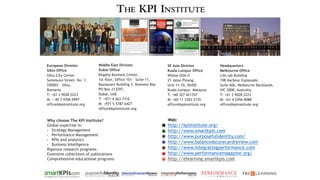
Web:
http://kpiinstitute.org/
http://www.smartkpis.com
http://www.purposefulidentity.com/
http://www.balancedscorecardreview.com
http://www.integratingperformance.com
http://www.performancemagazine.org/
http://elearning.smartkpis.com
Why choose The KPI Institute?
Global expertise in:
• Strategy Management
• Performance Management
• KPIs and analytics
• Business Intelligence
Rigorous research programs
Extensive collections of publications
Comprehensive educational programs
Headquarters
Melbourne Office
Life.lab Building
198 Harbour Esplanade,
Suite 606, Melbourne Docklands,
VIC 3008, Australia
T: +61 3 9028 2223
M: +61 4 2456 8088
office@kpiinstitute.org
Middle East Division
Dubai Office
Regalia Business Center,
1st floor, Office 101 – Suite 11,
Baysquare Building 3, Business Bay
PO Box 213297,
Dubai, UAE
T: +971 4 563 7316
M: +971 5 5787 6427
office@kpiinstitute.org
European Division
Sibiu Office
Sibiu City Center
Somesului Street, No. 3
550003 - Sibiu,
Romania
T: +61 3 9028 2223
M: + 40 7 4706 0997
office@kpiinstitute.org
SE Asia Division
Kuala Lumpur Office
Wisma UOA II
21 Jalan Pinang,
Unit 11-10, 50450
Kuala Lumpur, Malaysia
T: +60 327 421357
M: +60 11 3303 2135
office@kpiinstitute.org
© The KPI Institute 2016
CONTACT DETAILS
www.purposefulidentity.com
www.balancedscorecardreview.co
m
www.integratingperformance.com
KEY RESOURCES
3
Life.lab Building
Suite 606, 198 Harbour Esplanade
Melbourne Docklands, VIC 3008
Australia
office@kpiinstitute.org
+61 3 9028 2223
ADDITIONAL RESOURCES
© The KPI Institute 2016 4
© The KPI Institute 2016 5
© The KPI Institute 2016 6
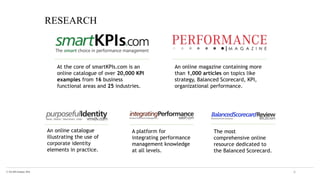
At the core of smartKPIs.com is an
online catalogue of over 20,000 KPI
examples from 16 business
functional areas and 25 industries.
An online magazine containing more
than 1,000 articles on topics like
strategy, Balanced Scorecard, KPI,
organizational performance.
An online catalogue
illustrating the use of
corporate identity
elements in practice.
A platform for
integrating performance
management knowledge
at all levels.
The most
comprehensive online
resource dedicated to
the Balanced Scorecard.
RESEARCH
© The KPI Institute 2016
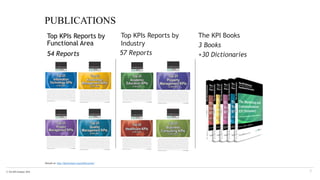
Top KPIs Reports by
Functional Area
54 Reports
7
Details at: http://kpiinstitute.org/publications/
Top KPIs Reports by
Industry
57 Reports
PUBLICATIONS
The KPI Books
3 Books
+30 Dictionaries
© The KPI Institute 2016 8
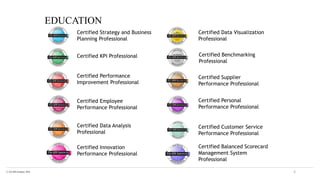
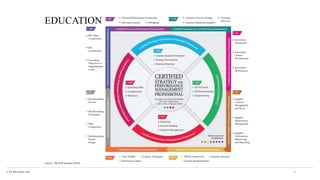
Certified Strategy and Business
Planning Professional
Certified Data Visualization
Professional
Certified Benchmarking
Professional
Certified Supplier
Performance Professional
Certified Customer Service
Performance Professional
Certified Personal
Performance Professional
Certified KPI Professional
Certified Performance
Improvement Professional
Certified Employee
Performance Professional
Certified Data Analysis
Professional
EDUCATION
Certified Innovation
Performance Professional
Certified Balanced Scorecard
Management System
Professional
© The KPI Institute 2016 9
EDUCATION
Source: The KPI Institute (2016)
© The KPI Institute 2016
In-house training and advisory services
OUR CLIENTS
10
Telecommunications
Aviation
Chemicals
Utilities
Public Authority
Financial Services
© The KPI Institute 2016
Open Courses
OUR CLIENTS
11
Manufacturing Chemicals Public Authority
Aviation Healthcare Financial Services
© The KPI Institute 2016
Economics | Business Administration | Performance Management
PROFESSIONAL FORMATION
Professional Associations CertificationsAcademic
© The KPI Institute 2016 13
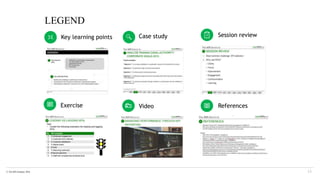
Key learning points Case study Session review
Exercise Video References
LEGEND
© The KPI Institute 2016
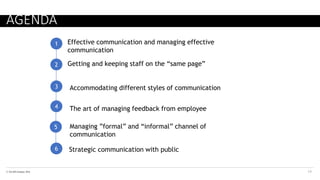
AGENDA
14
1 Effective communication and managing effective
communication
2 Getting and keeping staff on the “same page”
3 Accommodating different styles of communication
4 The art of managing feedback from employee
5 Managing ”formal” and “informal” channel of
communication
6 Strategic communication with public
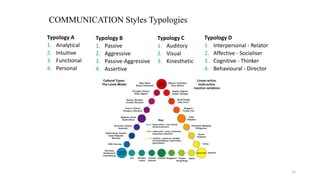
COMMUNICATION Styles Typologies
15
Typology A
1. Analytical
2. Intuitive
3. Functional
4. Personal
Typology C
1. Auditory
2. Visual
3. Kinesthetic
Typology B
1. Passive
2. Aggressive
3. Passive-Aggressive
4. Assertive
Typology D
1. Interpersonal - Relator
2. Affective - Socialiser
3. Cognitive - Thinker
4. Behavioural - Director
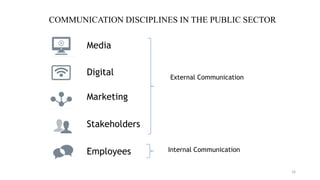
COMMUNICATION DISCIPLINES IN THE PUBLIC SECTOR
16
Media
Digital
Marketing
Stakeholders
Employees
External Communication
Internal Communication
© The KPI Institute 2016
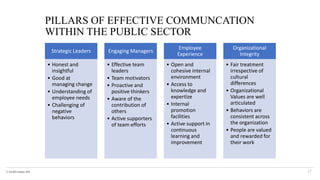
Strategic Leaders
• Honest and
insightful
• Good at
managing change
• Understanding of
employee needs
• Challenging of
negative
behaviors
Engaging Managers
• Effective team
leaders
• Team motivators
• Proactive and
positive thinkers
• Aware of the
contribution of
others
• Active supporters
of team efforts
Employee
Experience
• Open and
cohesive internal
environment
• Access to
knowledge and
expertize
• Internal
promotion
facilities
• Active support in
continuous
learning and
improvement
Organizational
Integrity
• Fair treatment
irrespective of
cultural
differences
• Organizational
Values are well
articulated
• Behaviors are
consistent across
the organization
• People are valued
and rewarded for
their work
PILLARS OF EFFECTIVE COMMUNCATION
WITHIN THE PUBLIC SECTOR
17
© The KPI Institute 2016
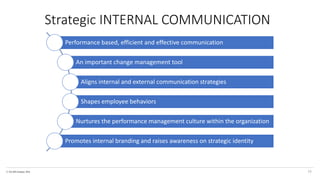
Performance based, efficient and effective communication
An important change management tool
Aligns internal and external communication strategies
Shapes employee behaviors
Nurtures the performance management culture within the organization
Promotes internal branding and raises awareness on strategic identity
Strategic INTERNAL COMMUNICATION
18
© The KPI Institute 2016
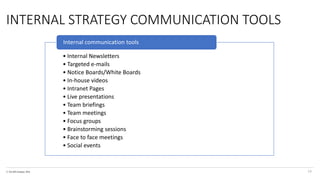
• Internal Newsletters
• Targeted e-mails
• Notice Boards/White Boards
• In-house videos
• Intranet Pages
• Live presentations
• Team briefings
• Team meetings
• Focus groups
• Brainstorming sessions
• Face to face meetings
• Social events
Internal communication tools
INTERNAL STRATEGY COMMUNICATION TOOLS
19
© The KPI Institute 2016
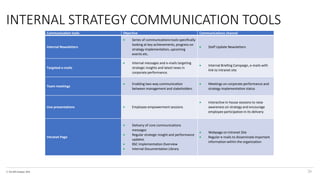
Communication tools Objective Communications channel
Internal Newsletters
 Series of communications tools specifically
looking at key achievements, progress on
strategy implementation, upcoming
events etc.
 Staff Update Newsletters
Targeted e-mails
 Internal messages and e-mails targeting
strategic insights and latest news in
corporate performance.
 Internal Briefing Campaign, e-mails with
link to intranet site
Team meetings
 Enabling two-way communication
between management and stakeholders
 Meetings on corporate performance and
strategy implementation status
Live presentations  Employee empowerment sessions
 Interactive in-house sessions to raise
awareness on strategy and encourage
employee participation in its delivery
Intranet Page
 Delivery of core communications
messages
 Regular strategic insight and performance
updates
 BSC Implementation Overview
 Internal Documentation Library
 Webpage on Intranet Site
 Regular e-mails to disseminate important
information within the organization
INTERNAL STRATEGY COMMUNICATION TOOLS
20
© The KPI Institute 2016
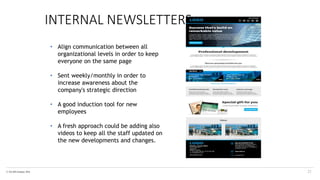
INTERNAL NEWSLETTERS
21
• Align communication between all
organizational levels in order to keep
everyone on the same page
• Sent weekly/monthly in order to
increase awareness about the
company's strategic direction
• A good induction tool for new
employees
• A fresh approach could be adding also
videos to keep all the staff updated on
the new developments and changes.
© The KPI Institute 2016
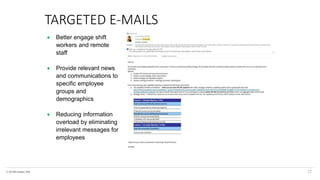
TARGETED E-MAILS
22
 Better engage shift
workers and remote
staff
 Provide relevant news
and communications to
specific employee
groups and
demographics
 Reducing information
overload by eliminating
irrelevant messages for
employees
© The KPI Institute 2016
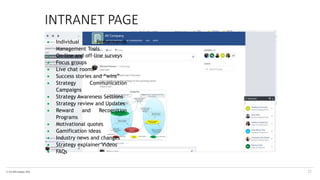
INTRANET PAGE
23
 Individual Performance
Management Tools
 On-line and off-line surveys
 Focus groups
 Live chat rooms
 Success stories and “wins”
 Strategy Communication
Campaigns
 Strategy Awareness Sessions
 Strategy review and Updates
 Reward and Recognition
Programs
 Motivational quotes
 Gamification ideas
 Industry news and changes
 Strategy explainer Videos
 FAQs
© The KPI Institute 2016
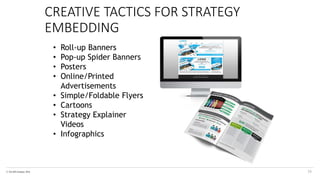
CREATIVE TACTICS FOR STRATEGY
EMBEDDING
24
• Roll-up Banners
• Pop-up Spider Banners
• Posters
• Online/Printed
Advertisements
• Simple/Foldable Flyers
• Cartoons
• Strategy Explainer
Videos
• Infographics
© The KPI Institute 2016
VISUAL STRATEGY MAPS
25
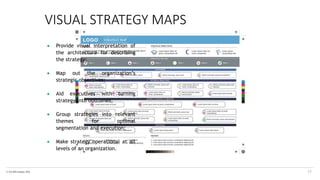
 Provide visual interpretation of
the architecture for describing
the strategy;
 Map out the organization’s
strategic objectives;
 Aid executives with turning
strategy into outcomes;
 Group strategies into relevant
themes for optimal
segmentation and execution;
 Make strategy operational at all
levels of an organization.
© The KPI Institute 2016
UK Government Communication Service (2016)
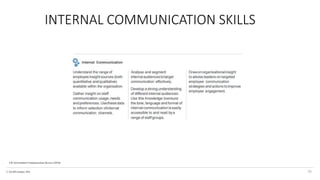
INTERNAL COMMUNICATION SKILLS
26
© The KPI Institute 2016
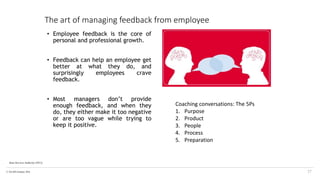
• Employee feedback is the core of
personal and professional growth.
• Feedback can help an employee get
better at what they do, and
surprisingly employees crave
feedback.
• Most managers don’t provide
enough feedback, and when they
do, they either make it too negative
or are too vague while trying to
keep it positive.
State Services Authority (2012)
The art of managing feedback from employee
27
Coaching conversations: The 5Ps
1. Purpose
2. Product
3. People
4. Process
5. Preparation
© The KPI Institute 2016
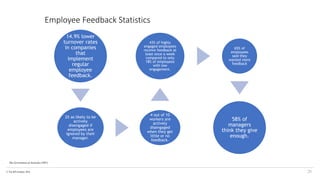
14.9% lower
turnover rates
in companies
that
implement
regular
employee
feedback.
2X as likely to be
actively
disengaged if
employees are
ignored by their
manager.
4 out of 10
workers are
actively
disengaged
when they get
little or no
feedback.
43% of highly
engaged employees
receive feedback at
least once a week
compared to only
18% of employees
with low
engagement.
65% of
employees
said they
wanted more
feedback
58% of
managers
think they give
enough.
The Government of Australia (2007)
Employee Feedback Statistics
28
© The KPI Institute 2016
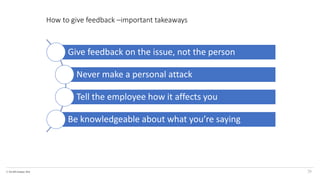
Give feedback on the issue, not the person
Never make a personal attack
Tell the employee how it affects you
Be knowledgeable about what you’re saying
How to give feedback –important takeaways
29
© The KPI Institute 2016
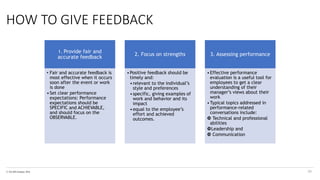
1. Provide fair and
accurate feedback
• Fair and accurate feedback is
most effective when it occurs
soon after the event or work
is done
•Set clear performance
expectations: Performance
expectations should be
SPECIFIC and ACHIEVABLE,
and should focus on the
OBSERVABLE.
2. Focus on strengths
•Positive feedback should be
timely and:
•relevant to the individual’s
style and preferences
•specific, giving examples of
work and behavior and its
impact
•equal to the employee’s
effort and achieved
outcomes.
3. Assessing performance
•Effective performance
evaluation is a useful tool for
employees to get a clear
understanding of their
manager’s views about their
work
•Typical topics addressed in
performance-related
conversations include:
 Technical and professional
abilities
Leadership and
 Communication
HOW TO GIVE FEEDBACK
30
© The KPI Institute 2016
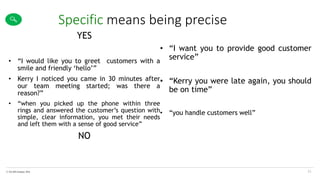
YES
• “I would like you to greet customers with a
smile and friendly ‘hello’”
• Kerry I noticed you came in 30 minutes after
our team meeting started; was there a
reason?”
• “when you picked up the phone within three
rings and answered the customer’s question with
simple, clear information, you met their needs
and left them with a sense of good service”
NO
• “I want you to provide good customer
service”
• “Kerry you were late again, you should
be on time”
• “you handle customers well”
Specific means being precise
31
© The KPI Institute 2016
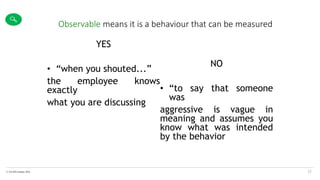
YES
• “when you shouted...”
the employee knows
exactly
what you are discussing
NO
• “to say that someone
was
aggressive is vague in
meaning and assumes you
know what was intended
by the behavior
Observable means it is a behaviour that can be measured
32
© The KPI Institute 2016
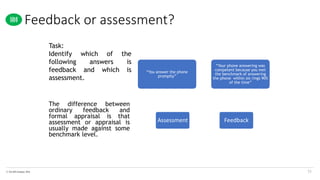
The difference between
ordinary feedback and
formal appraisal is that
assessment or appraisal is
usually made against some
benchmark level.
Feedback or assessment?
33
“You answer the phone
promptly”
“Your phone answering was
competent because you met
the benchmark of answering
the phone within six rings 90%
of the time”
Assessment Feedback
Task:
Identify which of the
following answers is
feedback and which is
assessment.
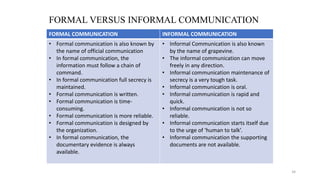
FORMAL VERSUS INFORMAL COMMUNICATION
34
FORMAL COMMUNICATION INFORMAL COMMUNICATION
• Formal communication is also known by
the name of official communication
• In formal communication, the
information must follow a chain of
command.
• In formal communication full secrecy is
maintained.
• Formal communication is written.
• Formal communication is time-
consuming.
• Formal communication is more reliable.
• Formal communication is designed by
the organization.
• In formal communication, the
documentary evidence is always
available.
• Informal Communication is also known
by the name of grapevine.
• The informal communication can move
freely in any direction.
• Informal communication maintenance of
secrecy is a very tough task.
• Informal communication is oral.
• Informal communication is rapid and
quick.
• Informal communication is not so
reliable.
• Informal communication starts itself due
to the urge of ‘human to talk’.
• Informal communication the supporting
documents are not available.
STRATEGIC COMMUNICATION WITH THE PUBLIC
35
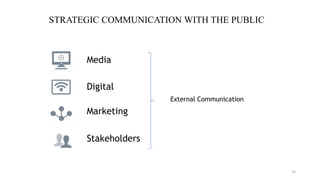
Media
Digital
Marketing
Stakeholders
External Communication
© The KPI Institute 2016
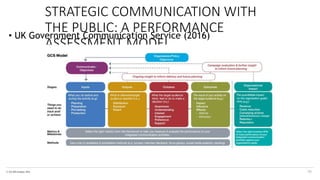
• UK Government Communication Service (2016)
STRATEGIC COMMUNICATION WITH
THE PUBLIC: A PERFORMANCE
ASSESSMENT MODEL
36
© The KPI Institute 2016
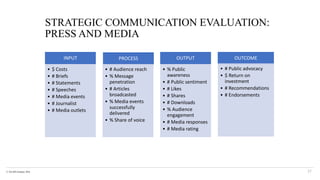
STRATEGIC COMMUNICATION EVALUATION:
PRESS AND MEDIA
37
INPUT
• $ Costs
• # Briefs
• # Statements
• # Speeches
• # Media events
• # Journalist
• # Media outlets
PROCESS
• # Audience reach
• % Message
penetration
• # Articles
broadcasted
• % Media events
successfully
delivered
• % Share of voice
OUTPUT
• % Public
awareness
• # Public sentiment
• # Likes
• # Shares
• # Downloads
• % Audience
engagement
• # Media responses
• # Media rating
OUTCOME
• # Public advocacy
• $ Return on
investment
• # Recommendations
• # Endorsements
© The KPI Institute 2016
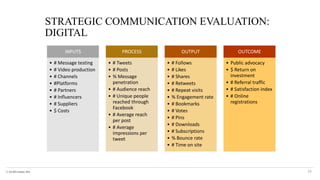
STRATEGIC COMMUNICATION EVALUATION:
DIGITAL
38
INPUTS
• # Message testing
• # Video production
• # Channels
• #Platforms
• # Partners
• # Influencers
• # Suppliers
• $ Costs
PROCESS
• # Tweets
• # Posts
• % Message
penetration
• # Audience reach
• # Unique people
reached through
Facebook
• # Average reach
per post
• # Average
impressions per
tweet
OUTPUT
• # Follows
• # Likes
• # Shares
• # Retweets
• # Repeat visits
• % Engagement rate
• # Bookmarks
• # Votes
• # Pins
• # Downloads
• # Subscriptions
• % Bounce rate
• # Time on site
OUTCOME
• Public advocacy
• $ Return on
investment
• # Referral traffic
• # Satisfaction index
• # Online
registrations
© The KPI Institute 2016
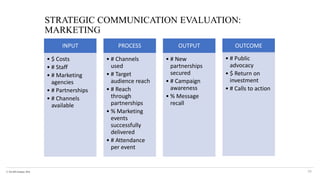
INPUT
• $ Costs
• # Staff
• # Marketing
agencies
• # Partnerships
• # Channels
available
PROCESS
• # Channels
used
• # Target
audience reach
• # Reach
through
partnerships
• % Marketing
events
successfully
delivered
• # Attendance
per event
OUTPUT
• # New
partnerships
secured
• # Campaign
awareness
• % Message
recall
OUTCOME
• # Public
advocacy
• $ Return on
investment
• # Calls to action
STRATEGIC COMMUNICATION EVALUATION:
MARKETING
39
© The KPI Institute 2016
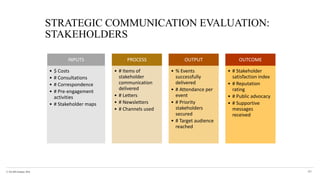
STRATEGIC COMMUNICATION EVALUATION:
STAKEHOLDERS
40
INPUTS
• $ Costs
• # Consultations
• # Correspondence
• # Pre-engagement
activities
• # Stakeholder maps
PROCESS
• # Items of
stakeholder
communication
delivered
• # Letters
• # Newsletters
• # Channels used
OUTPUT
• % Events
successfully
delivered
• # Attendance per
event
• # Priority
stakeholders
secured
• # Target audience
reached
OUTCOME
• # Stakeholder
satisfaction index
• # Reputation
rating
• # Public advocacy
• # Supportive
messages
received
© The KPI Institute 2016
UK Government Communication Service (2016)
CORE COMMMUNICATION SKILLS
41
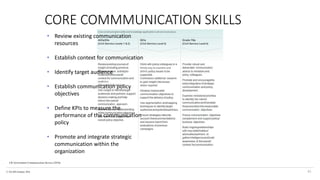
• Review existing communication
resources
• Establish context for communication
• Identify target audience
• Establish communication policy
objectives
• Define KPIs to measure the
performance of the communication
policy
• Promote and integrate strategic
communication within the
organization
© The KPI Institute 2016
UK Government Communication Service (2016)
DISCIPLINE RELATED
COMMUNICATION SKILLS
42
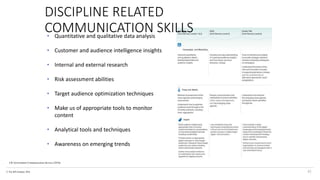
• Quantitative and qualitative data analysis
• Customer and audience intelligence insights
• Internal and external research
• Risk assessment abilities
• Target audience optimization techniques
• Make us of appropriate tools to monitor
content
• Analytical tools and techniques
• Awareness on emerging trends
© The KPI Institute 2016
1. The Government of Australia (2007), Managing People, Managing Performance, Good Practice Guide.
Available at: http://publicsector.sa.gov.au/wp-content/uploads/20070101-Good-practice-guide-
Managing-people-managing-performance.pdf
2. Government Communication Service (2016), GCS Evaluation Framework. Available at:
https://gcs.civilservice.gov.uk/wp-content/uploads/2016/01/GCS-Evaluation-Framework.pdf
3. Government Communication Service (2016), Government Communication Professional Competency
Framework. Available at: https://gcs.civilservice.gov.uk/wp-
content/uploads/2016/06/gcs.civilservice...competency-Framework-Feb-16-1.pdf
4. Government of Canada (2016), A Leadership Development Framework for the Public Service of
Canada. Available at: https://www.tbs-sct.gc.ca/psm-fpfm/learning-apprentissage/ptm-grt/ldf-cpl-
eng.asp
5. Queensland Government (2016), Capability Frameworks and Strategies. Available at:
https://www.qld.gov.au/gov/workforce-capability-success-profile
6. State Services Authority (2012), Talking Performance, available at: http://vpsc.vic.gov.au/wp-
content/uploads/2015/03/WFP_Talk_Performance_-EL_Guide.pdf
REFERENCES
43
Thank You! Aurel Brudan
Chief Executive Officer, The KPI Institute
198 Harbour Esplanade, Suite 606. Melbourne
Docklands, VIC 3008, Australia
T: +61 3 9028 2223 | M: +61 4 2456 8088
E: aurel.brudan@kpiinstitute.com | W:
www.kpiinstitute.org
15th of November 2016| Manila | Philippines

Apo leardership workshop ii

  • 1.
    Communicating with Influence Aview of public-private comparison
  • 2.
    Web: http://kpiinstitute.org/ http://www.smartkpis.com http://www.purposefulidentity.com/ http://www.balancedscorecardreview.com http://www.integratingperformance.com http://www.performancemagazine.org/ http://elearning.smartkpis.com Why choose TheKPI Institute? Global expertise in: • Strategy Management • Performance Management • KPIs and analytics • Business Intelligence Rigorous research programs Extensive collections of publications Comprehensive educational programs Headquarters Melbourne Office Life.lab Building 198 Harbour Esplanade, Suite 606, Melbourne Docklands, VIC 3008, Australia T: +61 3 9028 2223 M: +61 4 2456 8088 office@kpiinstitute.org Middle East Division Dubai Office Regalia Business Center, 1st floor, Office 101 – Suite 11, Baysquare Building 3, Business Bay PO Box 213297, Dubai, UAE T: +971 4 563 7316 M: +971 5 5787 6427 office@kpiinstitute.org European Division Sibiu Office Sibiu City Center Somesului Street, No. 3 550003 - Sibiu, Romania T: +61 3 9028 2223 M: + 40 7 4706 0997 office@kpiinstitute.org SE Asia Division Kuala Lumpur Office Wisma UOA II 21 Jalan Pinang, Unit 11-10, 50450 Kuala Lumpur, Malaysia T: +60 327 421357 M: +60 11 3303 2135 office@kpiinstitute.org
  • 3.
    © The KPIInstitute 2016 CONTACT DETAILS www.purposefulidentity.com www.balancedscorecardreview.co m www.integratingperformance.com KEY RESOURCES 3 Life.lab Building Suite 606, 198 Harbour Esplanade Melbourne Docklands, VIC 3008 Australia office@kpiinstitute.org +61 3 9028 2223 ADDITIONAL RESOURCES
  • 4.
    © The KPIInstitute 2016 4
  • 5.
    © The KPIInstitute 2016 5
  • 6.
    © The KPIInstitute 2016 6 At the core of smartKPIs.com is an online catalogue of over 20,000 KPI examples from 16 business functional areas and 25 industries. An online magazine containing more than 1,000 articles on topics like strategy, Balanced Scorecard, KPI, organizational performance. An online catalogue illustrating the use of corporate identity elements in practice. A platform for integrating performance management knowledge at all levels. The most comprehensive online resource dedicated to the Balanced Scorecard. RESEARCH
  • 7.
    © The KPIInstitute 2016 Top KPIs Reports by Functional Area 54 Reports 7 Details at: http://kpiinstitute.org/publications/ Top KPIs Reports by Industry 57 Reports PUBLICATIONS The KPI Books 3 Books +30 Dictionaries
  • 8.
    © The KPIInstitute 2016 8 Certified Strategy and Business Planning Professional Certified Data Visualization Professional Certified Benchmarking Professional Certified Supplier Performance Professional Certified Customer Service Performance Professional Certified Personal Performance Professional Certified KPI Professional Certified Performance Improvement Professional Certified Employee Performance Professional Certified Data Analysis Professional EDUCATION Certified Innovation Performance Professional Certified Balanced Scorecard Management System Professional
  • 9.
    © The KPIInstitute 2016 9 EDUCATION Source: The KPI Institute (2016)
  • 10.
    © The KPIInstitute 2016 In-house training and advisory services OUR CLIENTS 10 Telecommunications Aviation Chemicals Utilities Public Authority Financial Services
  • 11.
    © The KPIInstitute 2016 Open Courses OUR CLIENTS 11 Manufacturing Chemicals Public Authority Aviation Healthcare Financial Services
  • 12.
    © The KPIInstitute 2016 Economics | Business Administration | Performance Management PROFESSIONAL FORMATION Professional Associations CertificationsAcademic
  • 13.
    © The KPIInstitute 2016 13 Key learning points Case study Session review Exercise Video References LEGEND
  • 14.
    © The KPIInstitute 2016 AGENDA 14 1 Effective communication and managing effective communication 2 Getting and keeping staff on the “same page” 3 Accommodating different styles of communication 4 The art of managing feedback from employee 5 Managing ”formal” and “informal” channel of communication 6 Strategic communication with public
  • 15.
    COMMUNICATION Styles Typologies 15 TypologyA 1. Analytical 2. Intuitive 3. Functional 4. Personal Typology C 1. Auditory 2. Visual 3. Kinesthetic Typology B 1. Passive 2. Aggressive 3. Passive-Aggressive 4. Assertive Typology D 1. Interpersonal - Relator 2. Affective - Socialiser 3. Cognitive - Thinker 4. Behavioural - Director
  • 16.
    COMMUNICATION DISCIPLINES INTHE PUBLIC SECTOR 16 Media Digital Marketing Stakeholders Employees External Communication Internal Communication
  • 17.
    © The KPIInstitute 2016 Strategic Leaders • Honest and insightful • Good at managing change • Understanding of employee needs • Challenging of negative behaviors Engaging Managers • Effective team leaders • Team motivators • Proactive and positive thinkers • Aware of the contribution of others • Active supporters of team efforts Employee Experience • Open and cohesive internal environment • Access to knowledge and expertize • Internal promotion facilities • Active support in continuous learning and improvement Organizational Integrity • Fair treatment irrespective of cultural differences • Organizational Values are well articulated • Behaviors are consistent across the organization • People are valued and rewarded for their work PILLARS OF EFFECTIVE COMMUNCATION WITHIN THE PUBLIC SECTOR 17
  • 18.
    © The KPIInstitute 2016 Performance based, efficient and effective communication An important change management tool Aligns internal and external communication strategies Shapes employee behaviors Nurtures the performance management culture within the organization Promotes internal branding and raises awareness on strategic identity Strategic INTERNAL COMMUNICATION 18
  • 19.
    © The KPIInstitute 2016 • Internal Newsletters • Targeted e-mails • Notice Boards/White Boards • In-house videos • Intranet Pages • Live presentations • Team briefings • Team meetings • Focus groups • Brainstorming sessions • Face to face meetings • Social events Internal communication tools INTERNAL STRATEGY COMMUNICATION TOOLS 19
  • 20.
    © The KPIInstitute 2016 Communication tools Objective Communications channel Internal Newsletters  Series of communications tools specifically looking at key achievements, progress on strategy implementation, upcoming events etc.  Staff Update Newsletters Targeted e-mails  Internal messages and e-mails targeting strategic insights and latest news in corporate performance.  Internal Briefing Campaign, e-mails with link to intranet site Team meetings  Enabling two-way communication between management and stakeholders  Meetings on corporate performance and strategy implementation status Live presentations  Employee empowerment sessions  Interactive in-house sessions to raise awareness on strategy and encourage employee participation in its delivery Intranet Page  Delivery of core communications messages  Regular strategic insight and performance updates  BSC Implementation Overview  Internal Documentation Library  Webpage on Intranet Site  Regular e-mails to disseminate important information within the organization INTERNAL STRATEGY COMMUNICATION TOOLS 20
  • 21.
    © The KPIInstitute 2016 INTERNAL NEWSLETTERS 21 • Align communication between all organizational levels in order to keep everyone on the same page • Sent weekly/monthly in order to increase awareness about the company's strategic direction • A good induction tool for new employees • A fresh approach could be adding also videos to keep all the staff updated on the new developments and changes.
  • 22.
    © The KPIInstitute 2016 TARGETED E-MAILS 22  Better engage shift workers and remote staff  Provide relevant news and communications to specific employee groups and demographics  Reducing information overload by eliminating irrelevant messages for employees
  • 23.
    © The KPIInstitute 2016 INTRANET PAGE 23  Individual Performance Management Tools  On-line and off-line surveys  Focus groups  Live chat rooms  Success stories and “wins”  Strategy Communication Campaigns  Strategy Awareness Sessions  Strategy review and Updates  Reward and Recognition Programs  Motivational quotes  Gamification ideas  Industry news and changes  Strategy explainer Videos  FAQs
  • 24.
    © The KPIInstitute 2016 CREATIVE TACTICS FOR STRATEGY EMBEDDING 24 • Roll-up Banners • Pop-up Spider Banners • Posters • Online/Printed Advertisements • Simple/Foldable Flyers • Cartoons • Strategy Explainer Videos • Infographics
  • 25.
    © The KPIInstitute 2016 VISUAL STRATEGY MAPS 25  Provide visual interpretation of the architecture for describing the strategy;  Map out the organization’s strategic objectives;  Aid executives with turning strategy into outcomes;  Group strategies into relevant themes for optimal segmentation and execution;  Make strategy operational at all levels of an organization.
  • 26.
    © The KPIInstitute 2016 UK Government Communication Service (2016) INTERNAL COMMUNICATION SKILLS 26
  • 27.
    © The KPIInstitute 2016 • Employee feedback is the core of personal and professional growth. • Feedback can help an employee get better at what they do, and surprisingly employees crave feedback. • Most managers don’t provide enough feedback, and when they do, they either make it too negative or are too vague while trying to keep it positive. State Services Authority (2012) The art of managing feedback from employee 27 Coaching conversations: The 5Ps 1. Purpose 2. Product 3. People 4. Process 5. Preparation
  • 28.
    © The KPIInstitute 2016 14.9% lower turnover rates in companies that implement regular employee feedback. 2X as likely to be actively disengaged if employees are ignored by their manager. 4 out of 10 workers are actively disengaged when they get little or no feedback. 43% of highly engaged employees receive feedback at least once a week compared to only 18% of employees with low engagement. 65% of employees said they wanted more feedback 58% of managers think they give enough. The Government of Australia (2007) Employee Feedback Statistics 28
  • 29.
    © The KPIInstitute 2016 Give feedback on the issue, not the person Never make a personal attack Tell the employee how it affects you Be knowledgeable about what you’re saying How to give feedback –important takeaways 29
  • 30.
    © The KPIInstitute 2016 1. Provide fair and accurate feedback • Fair and accurate feedback is most effective when it occurs soon after the event or work is done •Set clear performance expectations: Performance expectations should be SPECIFIC and ACHIEVABLE, and should focus on the OBSERVABLE. 2. Focus on strengths •Positive feedback should be timely and: •relevant to the individual’s style and preferences •specific, giving examples of work and behavior and its impact •equal to the employee’s effort and achieved outcomes. 3. Assessing performance •Effective performance evaluation is a useful tool for employees to get a clear understanding of their manager’s views about their work •Typical topics addressed in performance-related conversations include:  Technical and professional abilities Leadership and  Communication HOW TO GIVE FEEDBACK 30
  • 31.
    © The KPIInstitute 2016 YES • “I would like you to greet customers with a smile and friendly ‘hello’” • Kerry I noticed you came in 30 minutes after our team meeting started; was there a reason?” • “when you picked up the phone within three rings and answered the customer’s question with simple, clear information, you met their needs and left them with a sense of good service” NO • “I want you to provide good customer service” • “Kerry you were late again, you should be on time” • “you handle customers well” Specific means being precise 31
  • 32.
    © The KPIInstitute 2016 YES • “when you shouted...” the employee knows exactly what you are discussing NO • “to say that someone was aggressive is vague in meaning and assumes you know what was intended by the behavior Observable means it is a behaviour that can be measured 32
  • 33.
    © The KPIInstitute 2016 The difference between ordinary feedback and formal appraisal is that assessment or appraisal is usually made against some benchmark level. Feedback or assessment? 33 “You answer the phone promptly” “Your phone answering was competent because you met the benchmark of answering the phone within six rings 90% of the time” Assessment Feedback Task: Identify which of the following answers is feedback and which is assessment.
  • 34.
    FORMAL VERSUS INFORMALCOMMUNICATION 34 FORMAL COMMUNICATION INFORMAL COMMUNICATION • Formal communication is also known by the name of official communication • In formal communication, the information must follow a chain of command. • In formal communication full secrecy is maintained. • Formal communication is written. • Formal communication is time- consuming. • Formal communication is more reliable. • Formal communication is designed by the organization. • In formal communication, the documentary evidence is always available. • Informal Communication is also known by the name of grapevine. • The informal communication can move freely in any direction. • Informal communication maintenance of secrecy is a very tough task. • Informal communication is oral. • Informal communication is rapid and quick. • Informal communication is not so reliable. • Informal communication starts itself due to the urge of ‘human to talk’. • Informal communication the supporting documents are not available.
  • 35.
    STRATEGIC COMMUNICATION WITHTHE PUBLIC 35 Media Digital Marketing Stakeholders External Communication
  • 36.
    © The KPIInstitute 2016 • UK Government Communication Service (2016) STRATEGIC COMMUNICATION WITH THE PUBLIC: A PERFORMANCE ASSESSMENT MODEL 36
  • 37.
    © The KPIInstitute 2016 STRATEGIC COMMUNICATION EVALUATION: PRESS AND MEDIA 37 INPUT • $ Costs • # Briefs • # Statements • # Speeches • # Media events • # Journalist • # Media outlets PROCESS • # Audience reach • % Message penetration • # Articles broadcasted • % Media events successfully delivered • % Share of voice OUTPUT • % Public awareness • # Public sentiment • # Likes • # Shares • # Downloads • % Audience engagement • # Media responses • # Media rating OUTCOME • # Public advocacy • $ Return on investment • # Recommendations • # Endorsements
  • 38.
    © The KPIInstitute 2016 STRATEGIC COMMUNICATION EVALUATION: DIGITAL 38 INPUTS • # Message testing • # Video production • # Channels • #Platforms • # Partners • # Influencers • # Suppliers • $ Costs PROCESS • # Tweets • # Posts • % Message penetration • # Audience reach • # Unique people reached through Facebook • # Average reach per post • # Average impressions per tweet OUTPUT • # Follows • # Likes • # Shares • # Retweets • # Repeat visits • % Engagement rate • # Bookmarks • # Votes • # Pins • # Downloads • # Subscriptions • % Bounce rate • # Time on site OUTCOME • Public advocacy • $ Return on investment • # Referral traffic • # Satisfaction index • # Online registrations
  • 39.
    © The KPIInstitute 2016 INPUT • $ Costs • # Staff • # Marketing agencies • # Partnerships • # Channels available PROCESS • # Channels used • # Target audience reach • # Reach through partnerships • % Marketing events successfully delivered • # Attendance per event OUTPUT • # New partnerships secured • # Campaign awareness • % Message recall OUTCOME • # Public advocacy • $ Return on investment • # Calls to action STRATEGIC COMMUNICATION EVALUATION: MARKETING 39
  • 40.
    © The KPIInstitute 2016 STRATEGIC COMMUNICATION EVALUATION: STAKEHOLDERS 40 INPUTS • $ Costs • # Consultations • # Correspondence • # Pre-engagement activities • # Stakeholder maps PROCESS • # Items of stakeholder communication delivered • # Letters • # Newsletters • # Channels used OUTPUT • % Events successfully delivered • # Attendance per event • # Priority stakeholders secured • # Target audience reached OUTCOME • # Stakeholder satisfaction index • # Reputation rating • # Public advocacy • # Supportive messages received
  • 41.
    © The KPIInstitute 2016 UK Government Communication Service (2016) CORE COMMMUNICATION SKILLS 41 • Review existing communication resources • Establish context for communication • Identify target audience • Establish communication policy objectives • Define KPIs to measure the performance of the communication policy • Promote and integrate strategic communication within the organization
  • 42.
    © The KPIInstitute 2016 UK Government Communication Service (2016) DISCIPLINE RELATED COMMUNICATION SKILLS 42 • Quantitative and qualitative data analysis • Customer and audience intelligence insights • Internal and external research • Risk assessment abilities • Target audience optimization techniques • Make us of appropriate tools to monitor content • Analytical tools and techniques • Awareness on emerging trends
  • 43.
    © The KPIInstitute 2016 1. The Government of Australia (2007), Managing People, Managing Performance, Good Practice Guide. Available at: http://publicsector.sa.gov.au/wp-content/uploads/20070101-Good-practice-guide- Managing-people-managing-performance.pdf 2. Government Communication Service (2016), GCS Evaluation Framework. Available at: https://gcs.civilservice.gov.uk/wp-content/uploads/2016/01/GCS-Evaluation-Framework.pdf 3. Government Communication Service (2016), Government Communication Professional Competency Framework. Available at: https://gcs.civilservice.gov.uk/wp- content/uploads/2016/06/gcs.civilservice...competency-Framework-Feb-16-1.pdf 4. Government of Canada (2016), A Leadership Development Framework for the Public Service of Canada. Available at: https://www.tbs-sct.gc.ca/psm-fpfm/learning-apprentissage/ptm-grt/ldf-cpl- eng.asp 5. Queensland Government (2016), Capability Frameworks and Strategies. Available at: https://www.qld.gov.au/gov/workforce-capability-success-profile 6. State Services Authority (2012), Talking Performance, available at: http://vpsc.vic.gov.au/wp- content/uploads/2015/03/WFP_Talk_Performance_-EL_Guide.pdf REFERENCES 43
  • 44.
    Thank You! AurelBrudan Chief Executive Officer, The KPI Institute 198 Harbour Esplanade, Suite 606. Melbourne Docklands, VIC 3008, Australia T: +61 3 9028 2223 | M: +61 4 2456 8088 E: aurel.brudan@kpiinstitute.com | W: www.kpiinstitute.org 15th of November 2016| Manila | Philippines