Impact of Cultural Variations On International Recruitment and Selection Methods                                 (with prospective of financial organizations)Presenters and Task AssignedUmair Bajwa                  (Cultural Variations)
Salman Farooq              (International Recruitment and Selection)
Ene  Onyinyechukwu   (Key Challenges and Action Plan)
Aleksandrs Golubev     (Implementation and Strategic Planning)Cultural Variations" Culture is more often a source of conflict than of synergy.    Cultural differences are a nuisance at best and often a disaster."Prof. Geert Hofstede, Emeritus Professor, Maastricht University.
Example for cultural variationsWhen negotiating in Western countries, the objective is to work toward a target of mutual understanding and agreement and 'shake-hands' when that agreement is reached - a cultural signal of the end of negotiations and the start of 'working together'.
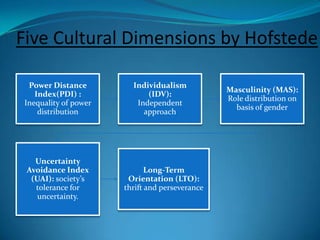
In Middle Eastern countries much negotiation takes place leading into the 'agreement', signified by shaking hands. However, the deal is not complete in the Middle Eastern culture. In fact, it is a cultural sign that 'serious' negotiations are just beginning.Five Cultural Dimensions by Hofstede
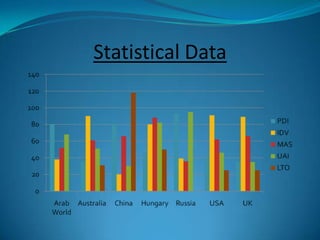
Statistical Data
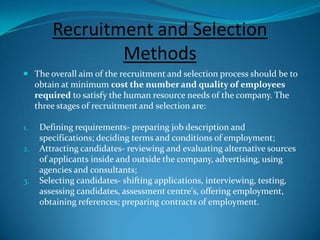
Recruitment and Selection Methods The overall aim of the recruitment and selection process should be to obtain at minimum cost the number and quality of employees required to satisfy the human resource needs of the company. The three stages of recruitment and selection are:Defining requirements- preparing job description and specifications; deciding terms and conditions of employment; Attracting candidates- reviewing and evaluating alternative sources of applicants inside and outside the company, advertising, using agencies and consultants;Selecting candidates- shifting applications, interviewing, testing, assessing candidates, assessment centre's, offering employment, obtaining references; preparing contracts of employment.
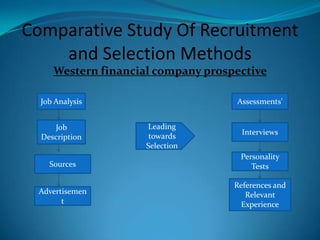
Comparative Study Of Recruitment and Selection Methods Western financial company prospectiveJob AnalysisAssessments' Job DescriptionLeading towards  SelectionInterviewsPersonality TestsSourcesReferences and Relevant ExperienceAdvertisement
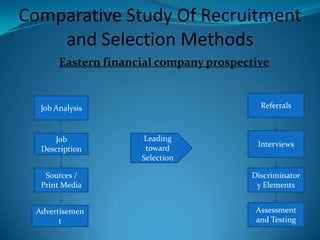
Comparative Study Of Recruitment and Selection Methods Eastern financial company prospectiveReferralsJob AnalysisInterviewsJob DescriptionLeading toward SelectionSources / Print MediaDiscriminatory ElementsAssessment and TestingAdvertisement
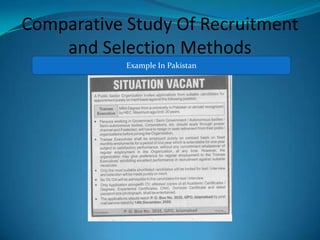
Comparative Study Of Recruitment and Selection Methods Example In Pakistan
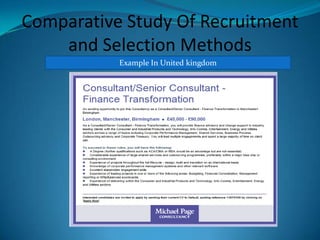
Comparative Study Of Recruitment and Selection Methods Example In United kingdom
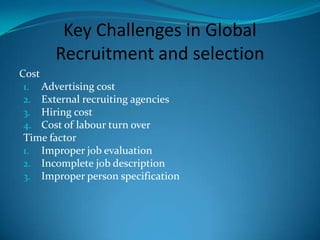
Key Challenges in Global Recruitment and selectionCostAdvertising costExternal recruiting agenciesHiring cost Cost of labour turn overTime factorImproper job evaluationIncomplete job descriptionImproper person specification
Key Challenges in Global Recruitment and selectionDiscriminationGenderEthnicity and ReligionAge Technology
HRM Strategy & ImplementationRecruitment and Selection process success depends on company ability to adjust to local conditions or particular region.HRM practices in Egypt: the influence of national context investigate problem of culture influence.Adoption of practices consistent with the traditions ofthe socio-cultural context should be implemented.(Leat, EL-Kot, 2008).
HRM Strategy & ImplementationExternal forces and pressures can influence selection  & recruitment process Candidate Recruitment and Selection in Latin America (Siavelis, Morgetstern, 2008) demonstrates  developing economies governments  often have its stake of interest, therefore, may apply pressure by enforcing strict rules.
HRM Strategy & ImplementationGovernment rules may require foreign company to recruit and select from localcandidate pool which lacks relevant skills.On the other hand, recruiting and selecting from local labour assists in positioning  foreign company as local and helps to build trust among community. Moreover, recruitment patterns in the republic of Korea indicate foreign businesses tend to recruit workers who possess local context knowledge. ( Lovell, Lee, Hui Sok, 2007).
HRM Strategy & ImplementationRecruitment approaches differ geographicallyE-recruitment, website recruitment is less effective in developing countries because people less experienced at dealing with technology. However e-recruitment, professional agencies and associations approaches tend to dominate within the developed economies.

HRM Cultural presentation

  • 1.
    Impact of CulturalVariations On International Recruitment and Selection Methods (with prospective of financial organizations)Presenters and Task AssignedUmair Bajwa (Cultural Variations)
  • 2.
    Salman Farooq (International Recruitment and Selection)
  • 3.
    Ene Onyinyechukwu (Key Challenges and Action Plan)
  • 4.
    Aleksandrs Golubev (Implementation and Strategic Planning)Cultural Variations" Culture is more often a source of conflict than of synergy. Cultural differences are a nuisance at best and often a disaster."Prof. Geert Hofstede, Emeritus Professor, Maastricht University.
  • 5.
    Example for culturalvariationsWhen negotiating in Western countries, the objective is to work toward a target of mutual understanding and agreement and 'shake-hands' when that agreement is reached - a cultural signal of the end of negotiations and the start of 'working together'.
  • 6.
    In Middle Easterncountries much negotiation takes place leading into the 'agreement', signified by shaking hands. However, the deal is not complete in the Middle Eastern culture. In fact, it is a cultural sign that 'serious' negotiations are just beginning.Five Cultural Dimensions by Hofstede
  • 7.
  • 8.
    Recruitment and SelectionMethods The overall aim of the recruitment and selection process should be to obtain at minimum cost the number and quality of employees required to satisfy the human resource needs of the company. The three stages of recruitment and selection are:Defining requirements- preparing job description and specifications; deciding terms and conditions of employment; Attracting candidates- reviewing and evaluating alternative sources of applicants inside and outside the company, advertising, using agencies and consultants;Selecting candidates- shifting applications, interviewing, testing, assessing candidates, assessment centre's, offering employment, obtaining references; preparing contracts of employment.
  • 9.
    Comparative Study OfRecruitment and Selection Methods Western financial company prospectiveJob AnalysisAssessments' Job DescriptionLeading towards SelectionInterviewsPersonality TestsSourcesReferences and Relevant ExperienceAdvertisement
  • 10.
    Comparative Study OfRecruitment and Selection Methods Eastern financial company prospectiveReferralsJob AnalysisInterviewsJob DescriptionLeading toward SelectionSources / Print MediaDiscriminatory ElementsAssessment and TestingAdvertisement
  • 11.
    Comparative Study OfRecruitment and Selection Methods Example In Pakistan
  • 12.
    Comparative Study OfRecruitment and Selection Methods Example In United kingdom
  • 13.
    Key Challenges inGlobal Recruitment and selectionCostAdvertising costExternal recruiting agenciesHiring cost Cost of labour turn overTime factorImproper job evaluationIncomplete job descriptionImproper person specification
  • 14.
    Key Challenges inGlobal Recruitment and selectionDiscriminationGenderEthnicity and ReligionAge Technology
  • 15.
    HRM Strategy &ImplementationRecruitment and Selection process success depends on company ability to adjust to local conditions or particular region.HRM practices in Egypt: the influence of national context investigate problem of culture influence.Adoption of practices consistent with the traditions ofthe socio-cultural context should be implemented.(Leat, EL-Kot, 2008).
  • 16.
    HRM Strategy &ImplementationExternal forces and pressures can influence selection & recruitment process Candidate Recruitment and Selection in Latin America (Siavelis, Morgetstern, 2008) demonstrates developing economies governments often have its stake of interest, therefore, may apply pressure by enforcing strict rules.
  • 17.
    HRM Strategy &ImplementationGovernment rules may require foreign company to recruit and select from localcandidate pool which lacks relevant skills.On the other hand, recruiting and selecting from local labour assists in positioning foreign company as local and helps to build trust among community. Moreover, recruitment patterns in the republic of Korea indicate foreign businesses tend to recruit workers who possess local context knowledge. ( Lovell, Lee, Hui Sok, 2007).
  • 18.
    HRM Strategy &ImplementationRecruitment approaches differ geographicallyE-recruitment, website recruitment is less effective in developing countries because people less experienced at dealing with technology. However e-recruitment, professional agencies and associations approaches tend to dominate within the developed economies.

Editor's Notes

  • #5 Power Distance Index (PDI) that is the extent to which the less powerful members of organizations and institutions (like the family) accept and expect that power is distributed unequally. This represents inequality (more versus less), but defined from below, not from above.Individualism (IDV) on the one side versus its opposite, collectivism, that is the degree to which individuals are inte-grated into groups.Masculinity (MAS) versus its opposite, femininity, refers to the distribution of roles between the genders which is another fundamental issue for any society to which a range of solutions are found.Uncertainty Avoidance Index (UAI) deals with a society's tolerance for uncertainty and ambiguity; it ultimately refers to man's search for Truth. Long-Term Orientation (LTO) versus short-term orientation: this fifth dimension was found in a study among students in 23 countries around the world, using a questionnaire designed by Chinese scholars It can be said to deal with Virtue regardless of Truth. Values associated with Long Term Orientation are thrift and perseverance; values associated with Short Term Orientation are respect for tradition, fulfilling social obligations, and protecting one's 'face'.
  • #6 Power Distance Index (PDI),Individualism (IDV),Masculinity (MAS),Uncertainty Avoidance Index (UAI), Long-Term Orientation (LTO)