



monarchE Trial
Adjuvant Treatment with Abimaciclib + ET vs. ET Therapy Alone in High-
Risk Patients with Node Positive, HR+/HER2-, Early Breast Cancer
Hasan Arafat
Resident Physician
Augusta Victoria Hospital
Introduction
• More than 90% of patients with breast cancer are diagnosed at an
early stage
• 70% of those are HR+/HER2-
• Standard treatment varies depending on the risk of recurrence, but
it’s usually a combination of surgery, radiotherapy,
adjuvant/neoadjuvant chemotherapy and endocrine therapy
Introduction
• Adjuvant endocrine therapy (aromatase inhibitors (AI) and/or
antiestrogens with/without ovarian suppression) is the standard
treatment for HR+/HER2- early breast cancer
• It has been associated with a significant decrease in the risk of
recurrence and death
• However, 20% of patient experiences recurrence in the first 10 years,
often with distant metastasis
Introduction
• Patients at high-risk clinical/pathological features have a higher risk of
recurrence especially in the early few years of adjuvant ET
• It’s crucial to optimize adjuvant therapy to prevent early recurrences
& metastasis for these patients
Introduction
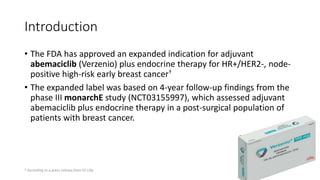
• The FDA has approved an expanded indication for adjuvant
abemaciclib (Verzenio) plus endocrine therapy for HR+/HER2-, node-
positive high-risk early breast cancer†
• The expanded label was based on 4-year follow-up findings from the
phase III monarchE study (NCT03155997), which assessed adjuvant
abemaciclib plus endocrine therapy in a post-surgical population of
patients with breast cancer.
† According to a press release from Eli Lilly.
Introduction
• Abemaciclib is an oral, continuously dosed, cyclin-dependent kinase
4/6 (CDK4/6) inhibitor approved in combination with ET for the
treatment of HR+/HER2- advanced breast cancer on the basis of
significant improvement in:
• PFS & OS in combination with fulvestrant (George W. Sledge, Toi et al. 2017)
• PFS in combination with non-steroidal AI (Jiang, Hu et al. 2019)
• It is approved in 1st and 2nd line in HR+/HER2- MBC
• MonarchE trial objective: exploring the combination of abemaciclib &
ET in the adjuvant setting
Introduction
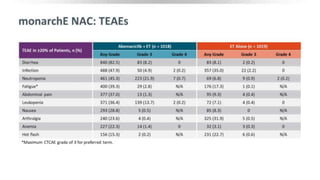
• The most common side effect of Verzenio is diarrhea, and for most
people it begins during the first week or so of treatment
• Other less common side effects include:
• Hematological derangement (leukopenia, anemia, thrombocytopenia)
• Poor appetite, nausea, vomiting and abdominal pain
• Headache
• Hair loss
• Rare but serious side effects:
• Hepatic dysfunction
• Severe neutropenia
• Coagulopathy
• Lung toxicity
Introduction
• MonarchE is an open label, global, randomized, phase III trial that
investigated the addition of abemaciclib to standard adjuvant ET in
patients with HR+/HER2-, LN+, high-risk EBC
• The design of monarchE was motivated by large clinical datasets in
EBC, which all noted a subset of HR+/HER2- patients with high-risk
clinical features and/or highly-proliferative disease that were likely to
experience recurrence quickly
Introduction
• The goal of monarchE was to treat patients with primary endocrine-
resistant disease who were likely to experience recurrence earlier in
the course of their disease, esp. in the first 5 years
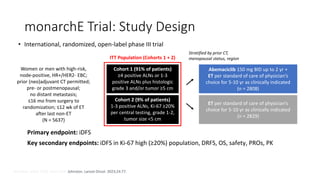
monarchE Trial: Study Design
• International, randomized, open-label phase III trial
Hamilton. ASCO 2023. Abstr 501. Johnston. Lancet Oncol. 2023;24:77.
Women or men with high-risk,
node-positive, HR+/HER2- EBC;
prior (neo)adjuvant CT permitted;
pre- or postmenopausal;
no distant metastasis;
≤16 mo from surgery to
randomization; ≤12 wk of ET
after last non-ET
(N = 5637)
Abemaciclib 150 mg BID up to 2 yr +
ET per standard of care of physician’s
choice for 5-10 yr as clinically indicated
(n = 2808)
ET per standard of care of physician’s
choice for 5-10 yr as clinically indicated
(n = 2829)
Cohort 1 (91% of patients)
≥4 positive ALNs or 1-3
positive ALNs plus histologic
grade 3 and/or tumor ≥5 cm
Cohort 2 (9% of patients)
1-3 positive ALNs, Ki-67 ≥20%
per central testing, grade 1-2,
tumor size <5 cm
ITT Population (Cohorts 1 + 2)
Stratified by prior CT,
menopausal status, region
 Primary endpoint: iDFS
 Key secondary endpoints: iDFS in Ki-67 high (≥20%) population, DRFS, OS, safety, PROs, PK
Percentage of patients aged ≥75 yr: 3%
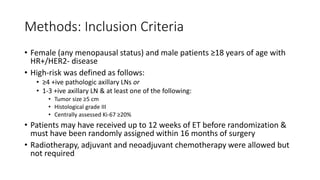
Methods: Inclusion Criteria
• Female (any menopausal status) and male patients ≥18 years of age with
HR+/HER2- disease
• High-risk was defined as follows:
• ≥4 +ive pathologic axillary LNs or
• 1-3 +ive axillary LN & at least one of the following:
• Tumor size ≥5 cm
• Histological grade III
• Centrally assessed Ki-67 ≥20%
• Patients may have received up to 12 weeks of ET before randomization &
must have been randomly assigned within 16 months of surgery
• Radiotherapy, adjuvant and neoadjuvant chemotherapy were allowed but
not required
Methods: Exclusion Criteria
• Occult breast cancer
• Metastatic disease
• Node-negative breast cancer
• Patients with inflammatory breast cancer
• Patients who had received treatment with ET for breast cancer
prevention, raloxifene, and/or a CDK4/6 inhibitor
• Patients with a history of VTE
Methods: Study Design & Setting
• An interactive web response system was used to randomly assign
patients to receive either:
• Abemaciclib (150 mg PO BID) plus ET, or
• ET alone
• Stratification factors:
• Previous chemotherapy (neoadjuvant, adjuvant or both)
• Menopausal status (at the time of diagnosis)
• Region (North America, Europe, Asia, etc.)
Methods: Study Design & Setting
• Patients were treated for 2 years (treatment period) or until meeting
criteria for discontinuation
• After the treatment period, all patients continued ET for 5-10 years,
as clinically indicated
• The 2-year treatment duration was chosen based on historical studies
indicating recurrence events peaked at 2 years for patients with EBC
• Post-discontinuation treatment was at the discretion of the
investigator
• Crossover was not permitted at any time
Methods: Study Design & Setting
• Visits occurred every:
• Two weeks for the first 2 months
• Monthly from months 3-6
• Every 3 months until the end of year 2
• Thereafter every 6 months until year 5
• Then annually from years 6-10
Methods: Study Design & Setting
• All randomly assigned patients were followed for:
• Local/regional and distant recurrence
• Overall survival
• On each visit, patients were assessed by a medically-qualified
individual with:
• History
• PE
• Adverse effects
• Hematology and chemistry
• Tests to confirm recurrence if there were signs/symptoms of recurrence
Methods: Statistical Analysis
• The primary endpoint was invasive disease-free survival (iDFS),
measured from the date of randomization to the date of first
occurrence of:
• Ipsilateral invasive breast tumor recurrence
• Local/regional invasive breast cancer recurrence
• Distant recurrence
• Death attributable to any cause
• Contralateral invasive breast cancer
• Second primary non-invasive breast cancer
Methods: Statistical Analysis
• All patients who experienced local recurrence continued to be
followed for distant recurrence
• Distant relapse-free survival (DRFS), a secondary endpoint, was
defined as the time from randomization to distant recurrence or
death from any cause, whichever occurred first
• Other secondary endpoints:
• OS
• Safety
• Pharmacokinetics
• Patient reported outcomes
Methods: Statistical Analysis
• The study was powered at approx. 85% to detect the superiority of
abemaciclib+ET vs. ET in terms of iDFS, assuming a HR of 0.73 at a
cumulative two-sided α level of 0.05, with a 5-year iDFS rate of 82.5%
in the control arm for this high-risk population
• This required approximately 390 iDFS events in the ITT population at
the time of the primary analysis
Methods: Statistical Analysis
• There are two planned efficacy interim analyses at approx. 50% and
75% of the total required events
• Efficacy analyses were performed on the ITT population
• The primary objective was to test the superiority of the abemaciclib
plus ET versus ET on iDFS
• Safety was analyzed in all randomly assigned patients who received at
least one dose of study treatment
• Adverse effects were graded according to Common Terminology
Criteria Adverse Events v4.0
Results
“In the monarchE trial, with additional follow-up, the benefit of
adjuvant abemaciclib deepened in magnitude, with an increase in
absolute invasive disease–free survival and distant recurrence–free
survival benefit at 4 years, as compared to the 2-year and 3-year rates,”
- Johnston S, ASCO 2022
Results
• From July 2017 to August 2019, 5,637 patients from 603 sites in 38
countries were randomly assigned 1:1 to receive either abemaciclib
plus ET or ET alone
• Baseline characteristics were balanced between study arms
• The population had a median age of 51 years (12.6% patients ≤40
years) & was predominantly female (99.4%), postmenopausal (56.5%)
at the time of Dx
• Nearly 60% of patients were eligible on the basis of four or more
nodes
Results
• Median follow-up period was 42 months (IQR 37-47).
• Median iDFS was not reached in either group
Results
• A total of 95.4% of patients had received radiotherapy, and 95.4% of
patients had received prior chemotherapy
• 37.0% neoadjuvant
• 58.3% adjuvant
• 3.5% received both
• AIs were prescribed as the first ET in 68.3% of patients (including
14.2% treated with AI (+) ovarian function suppression)
• Tamoxifen in 31.4%
Results
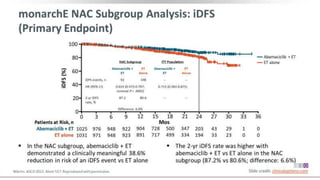
• The benefit of adjuvant abemaciclib was maintained (HR, 0.664; 95%
CI, 0.578-0.762; nominal P < .0001) and the 4-year iDFS rates were
85.8% vs 79.4%, with and without abemaciclib, respectively.
• The absolute difference in iDFS was 6.4%, an increase compared with
2.8% at 2 years (92.7% vs 89.9%) and 4.8% at 3 years (89.2% vs
84.4%).
Results
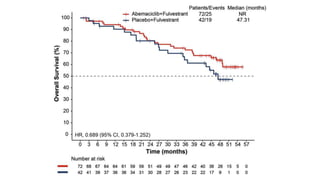
• At the time of data analysis, no patients were still receiving
abemaciclib and OS data were immature; however, investigators
reported that a lower number of deaths were reported among
patients who received abemaciclib (n = 157; 5.6%) vs endocrine
therapy alone (n = 173; 6.1%). The HR for reduction in the risk of
death was 0.929 (95% CI, 0.748-1.153; log-rank p = .503) and the
median duration of treatment in both groups was 24 months during
the study period.
Results
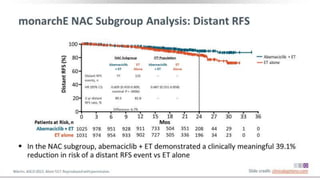
• Updated data for the secondary end point of DRFS demonstrated that
the addition of abemaciclib reduced the risk of distant recurrence by
approximately 34% (HR, 0.659; 95% CI, 0.567-0.767; nominal p <
.0001).
• The 4-year DRFS rate for those who received abemaciclib was 88.4%
vs 82.5% for an absolute difference of 5.9%.
• DRFS also trended toward sustained improvement compared with an
absolute difference of 2.5% at 2 years (94.0% vs 91.6%) and 4.1% at 3
years (90.8% vs 86.8%).
Results
• In a detailed analysis of DRFS events, fewer patients with metastatic
disease were reported in the abemaciclib arm (n = 329) compared
with the endocrine therapy–alone arm (n = 422).
• In the experimental arm, 125 patients were alive with metastatic
disease, 118 died because of breast cancer, and 39 died of causes not
related to breast cancer.
• In the standard-of-care arm, 249 patients were alive with metastatic
disease, 139 died because of breast cancer, and 34 died from other
causes.
Results
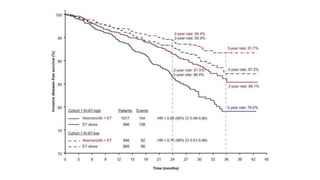
• For those with Ki-67–low disease in cohort 1, the 4-year IDFS rates
were 88.8% with abemaciclib (n = 946) vs 82.4% with endocrine
therapy alone (n = 968; HR, 0.624; 95% CI, 0.478-0.814).
• The 4-year DRFS rates in this cohort were 91.0% with abemaciclib vs
85.4% with endocrine therapy alone (HR, 0.613; 95% CI, 0.458-0.821).
• Ki-67 as a marker of cell proliferation was analyzed in a pretreatment
biopsy centrally in pretreated patients in cohort 1 and what we could
see is that Ki-67 was clearly prognostic, but not predictive of
abemaciclib benefit in this
Results
• Patients with a high Ki-67 index treated with endocrine therapy alone
had a much worse prognosis. “[For those who received endocrine
therapy alone], 25% have relapsed by 4 years, compared with 17%
with a low Ki-67]”.
Conclusions
• Adjuvant abemaciclib reduces the risk of recurrence.
• The benefit is sustained beyond the completion of treatment with an
absolute increase at 4 years, further supporting the use of
abemaciclib in patients with high-risk hormone receptor-positive,
HER2-negative early breast cancer.
• Further follow-up is needed to establish whether overall survival can
be improved with abemaciclib plus endocrine therapy in these
patients.

MonarchE

  • 1.
    monarchE Trial Adjuvant Treatmentwith Abimaciclib + ET vs. ET Therapy Alone in High- Risk Patients with Node Positive, HR+/HER2-, Early Breast Cancer Hasan Arafat Resident Physician Augusta Victoria Hospital
  • 2.
    Introduction • More than90% of patients with breast cancer are diagnosed at an early stage • 70% of those are HR+/HER2- • Standard treatment varies depending on the risk of recurrence, but it’s usually a combination of surgery, radiotherapy, adjuvant/neoadjuvant chemotherapy and endocrine therapy
  • 3.
    Introduction • Adjuvant endocrinetherapy (aromatase inhibitors (AI) and/or antiestrogens with/without ovarian suppression) is the standard treatment for HR+/HER2- early breast cancer • It has been associated with a significant decrease in the risk of recurrence and death • However, 20% of patient experiences recurrence in the first 10 years, often with distant metastasis
  • 4.
    Introduction • Patients athigh-risk clinical/pathological features have a higher risk of recurrence especially in the early few years of adjuvant ET • It’s crucial to optimize adjuvant therapy to prevent early recurrences & metastasis for these patients
  • 5.
    Introduction • The FDAhas approved an expanded indication for adjuvant abemaciclib (Verzenio) plus endocrine therapy for HR+/HER2-, node- positive high-risk early breast cancer† • The expanded label was based on 4-year follow-up findings from the phase III monarchE study (NCT03155997), which assessed adjuvant abemaciclib plus endocrine therapy in a post-surgical population of patients with breast cancer. † According to a press release from Eli Lilly.
  • 6.
    Introduction • Abemaciclib isan oral, continuously dosed, cyclin-dependent kinase 4/6 (CDK4/6) inhibitor approved in combination with ET for the treatment of HR+/HER2- advanced breast cancer on the basis of significant improvement in: • PFS & OS in combination with fulvestrant (George W. Sledge, Toi et al. 2017) • PFS in combination with non-steroidal AI (Jiang, Hu et al. 2019) • It is approved in 1st and 2nd line in HR+/HER2- MBC • MonarchE trial objective: exploring the combination of abemaciclib & ET in the adjuvant setting
  • 7.
    Introduction • The mostcommon side effect of Verzenio is diarrhea, and for most people it begins during the first week or so of treatment • Other less common side effects include: • Hematological derangement (leukopenia, anemia, thrombocytopenia) • Poor appetite, nausea, vomiting and abdominal pain • Headache • Hair loss • Rare but serious side effects: • Hepatic dysfunction • Severe neutropenia • Coagulopathy • Lung toxicity
  • 9.
    Introduction • MonarchE isan open label, global, randomized, phase III trial that investigated the addition of abemaciclib to standard adjuvant ET in patients with HR+/HER2-, LN+, high-risk EBC • The design of monarchE was motivated by large clinical datasets in EBC, which all noted a subset of HR+/HER2- patients with high-risk clinical features and/or highly-proliferative disease that were likely to experience recurrence quickly
  • 10.
    Introduction • The goalof monarchE was to treat patients with primary endocrine- resistant disease who were likely to experience recurrence earlier in the course of their disease, esp. in the first 5 years
  • 11.
    monarchE Trial: StudyDesign • International, randomized, open-label phase III trial Hamilton. ASCO 2023. Abstr 501. Johnston. Lancet Oncol. 2023;24:77. Women or men with high-risk, node-positive, HR+/HER2- EBC; prior (neo)adjuvant CT permitted; pre- or postmenopausal; no distant metastasis; ≤16 mo from surgery to randomization; ≤12 wk of ET after last non-ET (N = 5637) Abemaciclib 150 mg BID up to 2 yr + ET per standard of care of physician’s choice for 5-10 yr as clinically indicated (n = 2808) ET per standard of care of physician’s choice for 5-10 yr as clinically indicated (n = 2829) Cohort 1 (91% of patients) ≥4 positive ALNs or 1-3 positive ALNs plus histologic grade 3 and/or tumor ≥5 cm Cohort 2 (9% of patients) 1-3 positive ALNs, Ki-67 ≥20% per central testing, grade 1-2, tumor size <5 cm ITT Population (Cohorts 1 + 2) Stratified by prior CT, menopausal status, region  Primary endpoint: iDFS  Key secondary endpoints: iDFS in Ki-67 high (≥20%) population, DRFS, OS, safety, PROs, PK Percentage of patients aged ≥75 yr: 3%
  • 12.
    Methods: Inclusion Criteria •Female (any menopausal status) and male patients ≥18 years of age with HR+/HER2- disease • High-risk was defined as follows: • ≥4 +ive pathologic axillary LNs or • 1-3 +ive axillary LN & at least one of the following: • Tumor size ≥5 cm • Histological grade III • Centrally assessed Ki-67 ≥20% • Patients may have received up to 12 weeks of ET before randomization & must have been randomly assigned within 16 months of surgery • Radiotherapy, adjuvant and neoadjuvant chemotherapy were allowed but not required
  • 13.
    Methods: Exclusion Criteria •Occult breast cancer • Metastatic disease • Node-negative breast cancer • Patients with inflammatory breast cancer • Patients who had received treatment with ET for breast cancer prevention, raloxifene, and/or a CDK4/6 inhibitor • Patients with a history of VTE
  • 14.
    Methods: Study Design& Setting • An interactive web response system was used to randomly assign patients to receive either: • Abemaciclib (150 mg PO BID) plus ET, or • ET alone • Stratification factors: • Previous chemotherapy (neoadjuvant, adjuvant or both) • Menopausal status (at the time of diagnosis) • Region (North America, Europe, Asia, etc.)
  • 15.
    Methods: Study Design& Setting • Patients were treated for 2 years (treatment period) or until meeting criteria for discontinuation • After the treatment period, all patients continued ET for 5-10 years, as clinically indicated • The 2-year treatment duration was chosen based on historical studies indicating recurrence events peaked at 2 years for patients with EBC • Post-discontinuation treatment was at the discretion of the investigator • Crossover was not permitted at any time
  • 16.
    Methods: Study Design& Setting • Visits occurred every: • Two weeks for the first 2 months • Monthly from months 3-6 • Every 3 months until the end of year 2 • Thereafter every 6 months until year 5 • Then annually from years 6-10
  • 17.
    Methods: Study Design& Setting • All randomly assigned patients were followed for: • Local/regional and distant recurrence • Overall survival • On each visit, patients were assessed by a medically-qualified individual with: • History • PE • Adverse effects • Hematology and chemistry • Tests to confirm recurrence if there were signs/symptoms of recurrence
  • 18.
    Methods: Statistical Analysis •The primary endpoint was invasive disease-free survival (iDFS), measured from the date of randomization to the date of first occurrence of: • Ipsilateral invasive breast tumor recurrence • Local/regional invasive breast cancer recurrence • Distant recurrence • Death attributable to any cause • Contralateral invasive breast cancer • Second primary non-invasive breast cancer
  • 19.
    Methods: Statistical Analysis •All patients who experienced local recurrence continued to be followed for distant recurrence • Distant relapse-free survival (DRFS), a secondary endpoint, was defined as the time from randomization to distant recurrence or death from any cause, whichever occurred first • Other secondary endpoints: • OS • Safety • Pharmacokinetics • Patient reported outcomes
  • 20.
    Methods: Statistical Analysis •The study was powered at approx. 85% to detect the superiority of abemaciclib+ET vs. ET in terms of iDFS, assuming a HR of 0.73 at a cumulative two-sided α level of 0.05, with a 5-year iDFS rate of 82.5% in the control arm for this high-risk population • This required approximately 390 iDFS events in the ITT population at the time of the primary analysis
  • 21.
    Methods: Statistical Analysis •There are two planned efficacy interim analyses at approx. 50% and 75% of the total required events • Efficacy analyses were performed on the ITT population • The primary objective was to test the superiority of the abemaciclib plus ET versus ET on iDFS • Safety was analyzed in all randomly assigned patients who received at least one dose of study treatment • Adverse effects were graded according to Common Terminology Criteria Adverse Events v4.0
  • 22.
    Results “In the monarchEtrial, with additional follow-up, the benefit of adjuvant abemaciclib deepened in magnitude, with an increase in absolute invasive disease–free survival and distant recurrence–free survival benefit at 4 years, as compared to the 2-year and 3-year rates,” - Johnston S, ASCO 2022
  • 23.
    Results • From July2017 to August 2019, 5,637 patients from 603 sites in 38 countries were randomly assigned 1:1 to receive either abemaciclib plus ET or ET alone • Baseline characteristics were balanced between study arms • The population had a median age of 51 years (12.6% patients ≤40 years) & was predominantly female (99.4%), postmenopausal (56.5%) at the time of Dx • Nearly 60% of patients were eligible on the basis of four or more nodes
  • 24.
    Results • Median follow-upperiod was 42 months (IQR 37-47). • Median iDFS was not reached in either group
  • 25.
    Results • A totalof 95.4% of patients had received radiotherapy, and 95.4% of patients had received prior chemotherapy • 37.0% neoadjuvant • 58.3% adjuvant • 3.5% received both • AIs were prescribed as the first ET in 68.3% of patients (including 14.2% treated with AI (+) ovarian function suppression) • Tamoxifen in 31.4%
  • 26.
    Results • The benefitof adjuvant abemaciclib was maintained (HR, 0.664; 95% CI, 0.578-0.762; nominal P < .0001) and the 4-year iDFS rates were 85.8% vs 79.4%, with and without abemaciclib, respectively. • The absolute difference in iDFS was 6.4%, an increase compared with 2.8% at 2 years (92.7% vs 89.9%) and 4.8% at 3 years (89.2% vs 84.4%).
  • 27.
    Results • At thetime of data analysis, no patients were still receiving abemaciclib and OS data were immature; however, investigators reported that a lower number of deaths were reported among patients who received abemaciclib (n = 157; 5.6%) vs endocrine therapy alone (n = 173; 6.1%). The HR for reduction in the risk of death was 0.929 (95% CI, 0.748-1.153; log-rank p = .503) and the median duration of treatment in both groups was 24 months during the study period.
  • 28.
    Results • Updated datafor the secondary end point of DRFS demonstrated that the addition of abemaciclib reduced the risk of distant recurrence by approximately 34% (HR, 0.659; 95% CI, 0.567-0.767; nominal p < .0001). • The 4-year DRFS rate for those who received abemaciclib was 88.4% vs 82.5% for an absolute difference of 5.9%. • DRFS also trended toward sustained improvement compared with an absolute difference of 2.5% at 2 years (94.0% vs 91.6%) and 4.1% at 3 years (90.8% vs 86.8%).
  • 29.
    Results • In adetailed analysis of DRFS events, fewer patients with metastatic disease were reported in the abemaciclib arm (n = 329) compared with the endocrine therapy–alone arm (n = 422). • In the experimental arm, 125 patients were alive with metastatic disease, 118 died because of breast cancer, and 39 died of causes not related to breast cancer. • In the standard-of-care arm, 249 patients were alive with metastatic disease, 139 died because of breast cancer, and 34 died from other causes.
  • 30.
    Results • For thosewith Ki-67–low disease in cohort 1, the 4-year IDFS rates were 88.8% with abemaciclib (n = 946) vs 82.4% with endocrine therapy alone (n = 968; HR, 0.624; 95% CI, 0.478-0.814). • The 4-year DRFS rates in this cohort were 91.0% with abemaciclib vs 85.4% with endocrine therapy alone (HR, 0.613; 95% CI, 0.458-0.821). • Ki-67 as a marker of cell proliferation was analyzed in a pretreatment biopsy centrally in pretreated patients in cohort 1 and what we could see is that Ki-67 was clearly prognostic, but not predictive of abemaciclib benefit in this
  • 31.
    Results • Patients witha high Ki-67 index treated with endocrine therapy alone had a much worse prognosis. “[For those who received endocrine therapy alone], 25% have relapsed by 4 years, compared with 17% with a low Ki-67]”.
  • 38.
    Conclusions • Adjuvant abemaciclibreduces the risk of recurrence. • The benefit is sustained beyond the completion of treatment with an absolute increase at 4 years, further supporting the use of abemaciclib in patients with high-risk hormone receptor-positive, HER2-negative early breast cancer. • Further follow-up is needed to establish whether overall survival can be improved with abemaciclib plus endocrine therapy in these patients.

Editor's Notes

  • #7 Ibrance (chemical name: palbociclib) Kisqali (chemical name: ribociclib) Verzenio (chemical name: abemaciclib)
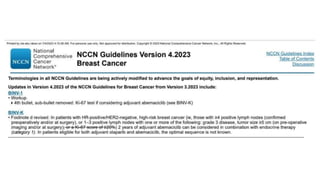
  • #9 NCCN guidelines recommends that patients with HR positive/HER2 negative, high risk BC (defined as having >/=4 positive LN (confirmed pre-operatively and/or at surgery), or 1-3 LN with >/=1 of the following: grade 3 dz, tumor size >/=5 cm (on pre-operative imaging and/or at surgery), receive 2 years of adjuvant abemaciclib along with endocrine therapy. Ki 67 score was removed from the determinants of high-risk breast cancer
  • #12 ALN, axillary lymph node; CT, chemotherapy; DRFS, distant relapse–free survival; EBC, early breast cancer; ET, endocrine therapy; HR, hormone receptor; iDFS, invasive disease–free survival; ITT, intention-to-treat; OS, overall survival; PK, pharmacokinetics; PRO, patient-reported outcome.
  • #16 Abemaciclib for 2 years, then to continue ET for 10 years
  • #20 Primary endpoint(s) are typically efficacy measures that address the main research question [3]. Secondary endpoints are generally not sufficient to influence decision-making alone, but may support the claim of efficacy by demonstrating additional effects or by supporting a causal mechanism [2].
  • #25 IQR: interquartile range, contains the second and third quartiles, or the middle half of your data set Median iDFS: 390