Antepartum
Hemorrhage
Sherin shana E P
Govt.college of Nursing
Kozhikode
Obstetrics is very often a
"bloody business."
• Bleeding per vaginum after 20 weeks’
gestation.
• Complicates close to 4% of all pregnancies
and is a MEDICAL EMERGENCY!
• One of 3 leading causes of Maternal
mortality
• Major contributor to Perinatal loss
What are the most common causes of
Antepartum Hemorrhage ?
Causes
Pregnancy related
 placenta previa
 abruptio placenta
 vasa previa
 rupture of marginal sinus of placenta
 unclassified
Causes
Local factors
 cervical polyp
 bleeding cervical erosion
 carcinoma cervix(rare)
First aid management
• Insert 2 wide bore cannulae
• Blood sample
• Immediately start IV crystalloid solutions
• Provide 100% oxygen via mask
• Warm the women
• Insert Foley catheter
• Monitor blood pressure and pulse/ 5 min
• Monitor urine output /hour
Investigations
• Laboratory investigations:
-ABO blood group and Rh type
-Crossmatch atleast 2 units of blood
-CBC
-Fibrinogen, PTT, PT,CT
-Serum creatinine or BUN
-Urine analysis for protein and RBCs
Management of APH
• Call for help
• Keep women NPO
• NO digital examination until Placenta
praevia is ruled out.
• Concurrent evaluation and resuscitation
MATERNAL RESUSCITATION IS THE
BEST FETAL RESUSCITATION
Management of APH
MATERNAL EVALUATION
• History-
Trauma , Intercourse,
Pain? fetal movements?
Previous ANC , USG
Other complications like HT
Past Obstetric history
Management of APH
• Maternal Haemodynamic assessment
• Clinical signs – may be misleading
assess urine output
CVP catheter
• Treat Shock
IV line
Colloids / Blood & Blood Products
OXYGEN
Correct coagulopathy
12
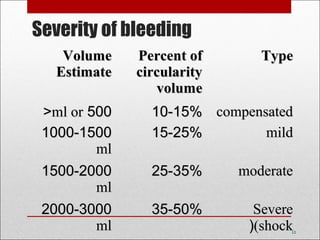
Severity of bleeding
VolumeVolume
EstimateEstimate
Percent ofPercent of
circularitycircularity
volumevolume
TypeType
500500ml orml or<< 10-15%10-15% compensatedcompensated
1000-15001000-1500
mlml
15-25%15-25% mildmild
1500-20001500-2000
mlml
25-35%25-35% moderatemoderate
2000-30002000-3000
mlml
35-50%35-50% SevereSevere
(shock(shock((
Physical examination
• General examination:-
pallor
tachycardia, hypotenstion
signs of shock
• Abdominal examination: -
uterine tenderness / rigidity / consistency
fundal height
FHS
• Pelvic examination:
Inspect the external genitalia and vagina
No vaginal examination before excluding placenta previa
Ultrasound
• Confirm the fetal viability
• Localize the site of placenta
• Estimating the gestational age
• Retroplacental hematoma
• In case of severe bleeding, first aid management and
then quickly start active management .
• Even if the amount of bleeding is mild, NEVER
perform PV examination until placenta previa has
been excluded by US
Diagnosis – Placenta Previa
• Painless vaginal bleeding
• Symptoms and signs
-shock
-bleeding may be precipitated by intercourse
-relaxed uterus
-normal fetal condition
-abnormal presentations and lie
• Vaginal bleeding along with intermitent / constant
abdominal pain
• Symptoms and signs:
-Shock
-tense/tender uterus
-decreased /absent fetal movements.
-fetal distress/absent fetal heart sound.
Diagnosis – Abruptio placenta
• Mild vaginal bleeding after 24 w(mild)
• Symptoms and signs
-clinically stable
-fetal assessment showed fetal distress
that cannot be explained by the mild bleeding.
Diagnosis -Vasa previa
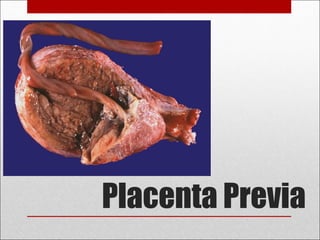
Placenta Previa
Placenta Previa
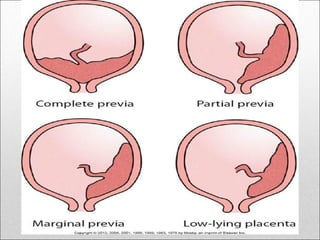
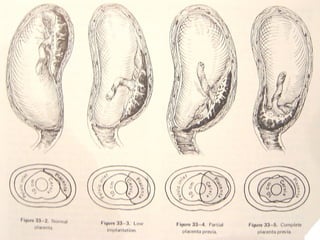
Defined as a placenta implanted in the
lower segment of the uterus, presenting
ahead of the leading pole of the fetus.
Placenta Previa
• Incidence about 1 in 300
• Perinatal morbidity and mortality are
primarily related to the complications of
prematurity, because the hemorrhage is
maternal.
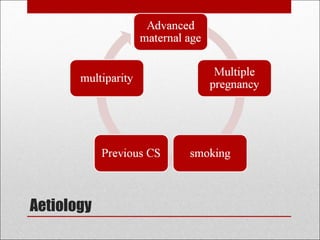
Aetiology
classification
24
Symptoms
• The most characteristic event in placenta
previa is painless hemorrhage.
• This usually occurs near the end of or after
the second trimester.
• The initial bleeding is rarely so profuse as to
prove fatal.
• It usually ceases spontaneously, only to recur.
Signs
• Tachycardia or hypotension
depending on blood loss
• Anemia
• Uterus relaxed
• Abnormal lie or presentation
• Fetal heart present
Complications
- shock
- postpartum hemorrhage
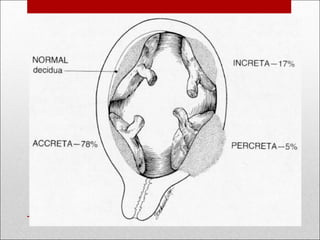
- high risk for PPH and
- placenta accreta/ increta/ percreta
a common finding is at the site of a previous
cesarean section
Diagnosis
The diagnosis of placenta previa can seldom
be established firmly by clinical examination.
Vaginal examination is never permissible
because even the gentlest examination of this
sort can cause torrential hemorrhage.
Diagnosis
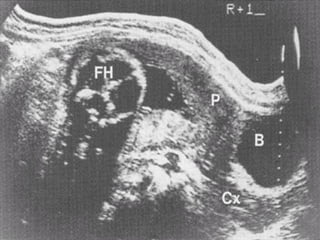
• The simplest and safest method of placental
localization is provided by transabdominal
sonography.
• Transvaginal ultrasonography has substantively
improved diagnostic accuracy of placenta previa.
• MRI
• At 18 weeks, 5-10% of placentas are low lying.
Transvaginal ultrasound is safe in the presence
of placenta praevia and is more accurate than
transabdominal ultrasound in locating the
placenta.
Diagnosis
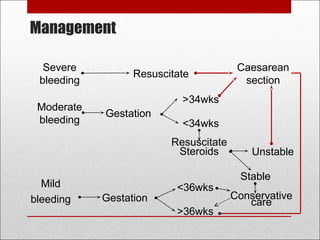
Management
Severe
bleeding
Caesarean
section
Moderate
bleeding
Gestation
>34wks
<34wks
Resuscitate
Steroids Unstable
Stable
Resuscitate
Mild
bleeding Gestation
<36wks
Conservative
care
>36wks
Indications to terminate
• Women in labour
• Bleeding is heavy
• Gestational age >/= 37 weeks
• Fetal distress
• IUFD and /or fatal congenital anomalies
Management
• Expectant line (conservative) - Macafee
Johnsons regime
Management
• Delivery is by Caesarean section in
almost all cases.
• Occasionally Caesarean hysterectomy
necessary.
Management
• In cases of previous CS with anterior
placenta previa, high chance of adherent
placenta
• USG Doppler to confirm
• Elective classical caesarean hysterectomy in
such cases
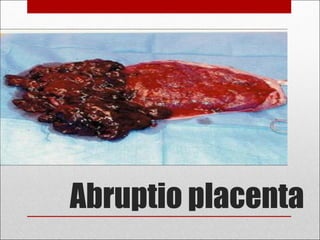
Abruptio placenta
Abruptio placenta
Premature separation of a normally
situated placenta
Abruptio Placentae
• Incidence: 0.5 – 1.3%
severe abruption : 1 in 400 deliveries
• PNM rate – up to 25%
accounts for 12-14 % of all stillbirths
adverse sequelae in survivors
• Maternal morbidity and mortality
Abruptio placenta
• Bleeding with placental abruption is almost
always maternal.
• Significant fetal bleeding is more likely to be
seen with traumatic abruption.
• In this circumstance, fetal bleeding results from
a tear or fracture in the placenta rather than from
the placental separation itself.
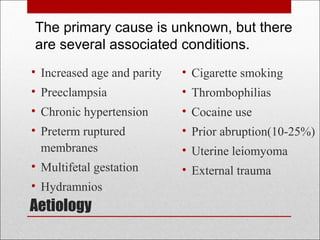
Aetiology
• Increased age and parity
• Preeclampsia
• Chronic hypertension
• Preterm ruptured
membranes
• Multifetal gestation
• Hydramnios
• Cigarette smoking
• Thrombophilias
• Cocaine use
• Prior abruption(10-25%)
• Uterine leiomyoma
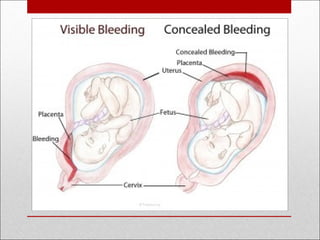
• External trauma
The primary cause is unknown, but there
are several associated conditions.
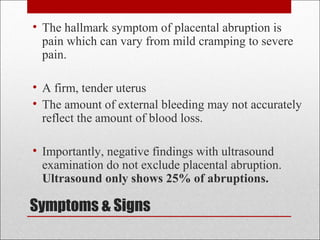
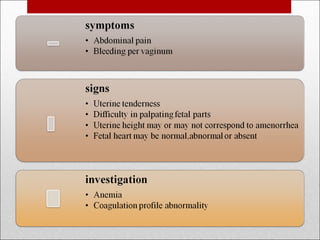
Symptoms & Signs
• The hallmark symptom of placental abruption is
pain which can vary from mild cramping to severe
pain.
• A firm, tender uterus
• The amount of external bleeding may not accurately
reflect the amount of blood loss.
• Importantly, negative findings with ultrasound
examination do not exclude placental abruption.
Ultrasound only shows 25% of abruptions.
Differential diagnosis
• Severe cases – diagnosis is obvious
• Milder cases –
Placenta previa
Other causes
Preterm labour
Role of USG
Sensitivity poor (<40%)
Rules out Placenta previa
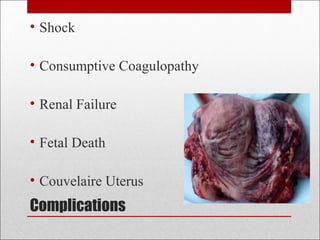
Complications
• Shock
• Consumptive Coagulopathy
• Renal Failure
• Fetal Death
• Couvelaire Uterus
Lab Investigations
• Diagnosis mainly clinical
• Hb, PCV, Peripheral smear
• Coagulopathy – Thrombocytopenia, prolonged
PT, PTT
hypofibrinogenemia (<150mg/dl)
elevated FDP, D-dimer
(clot observation test)
• Fetomaternal hemorrhage (Kleihauer Betke
test)
• Renal functions
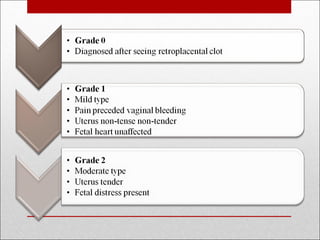
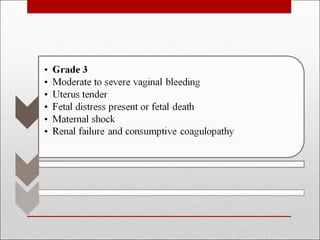
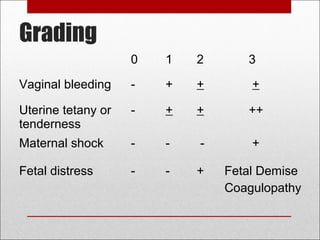
Grading
0 1 2 3
Vaginal bleeding - + + +
Uterine tetany or
tenderness
- + + ++
Maternal shock - - - +
Fetal distress - - + Fetal Demise
Coagulopathy
Management
• Mild cases
If bleeding stops and fetus in good
condition ,pregnancy allowed to continue till
36-37weeks
Requires careful observation
Management
• Severe cases
IV line
Venous sample for Hb , cross matching, CT
USG -retroplacental clot
Catheterise-output 30ml/Hr
Management
• In severe cases immediate delivery is
indicated
• Amniotomy and oxytocin augmentation
• If slow progress of labour or deterioration
of maternal condition –emergency CS
Complications
• Maternal shock
• Fetal death
• Uterine atony leading to PPH
• Amniotic fluid embolism
• Consumptive Coagulopathy( 30%)
• Renal failure
The principal cause of maternal death is renal
failure due to prolonged hypotension .
Fetal, neonatal outcome
• Perinatal mortality -20-25%
• 20% dead at admission
• 20 – 40% die later
• Prematurity, intranatal hypoxia
• Neonatal coagulopathy
• SGA
• Congenital anomalies
Maternal Prognosis
• Maternal Mortality: 0.5 – 5 %
Causes – haemorrhage
cardiac
renal failure
Management
• Depends on – severity of abruption
- condition of mother and baby
- presence of complications
• 3 factors influence management
Maternal haemodynamic status
Fetal condition
Fetal gestational age
Management
• Expectant management ??
• Active management
Termination
CS / Vaginal delivery ??
• Management of complications
Management
Expectant management:
• Diagnosis is uncertain
• Fetus – no e/o compromise
• Facilities for immediate intervention
*Till– 37wks/ bleeding recurs/ fetus deteriorates
Tocolysis contraindicated.
Management
Indications for CS
• Live, mature fetus; Vaginal Delivery not
imminent
• Live, mature fetus; CTG shows distress
• Obstetric indications – transverse lie, failed
induction..
• Uncontrolled hemorrhage, expanding uterus with
concealed hemorrhage, Couvelaire Uterus,
refractory uterus
Management

Vaginal delivery
• Severe abruption, dead fetus
• Non – viable fetus
• Limited degree of separation, CTG reassuring
(Exceptions – uncontrolled h’age)
•Amniotomy, augmentation
•Abruption delivery interval
•Adequate maternal stabilisation
Management
Early amniotomy
• Hastens delivery
• Reduces extravasation into myometrium
• Reduces entry of thromboplastin into circulation
• Encourages contractions – reduces bleeding
Augmentation
• If no rhythmic contractions
• Standard doses
Management of Complications
Renal Failure
• Acute tubular necrosis / Cortical necrosis
• Haemorrhage impairs renal perfusion
• Coexistent PIH – renal vasospasm
• Intravascular coagulation
Adequate & vigorous hydration
Dialysis
Management of Complications
DIC
• Incidence 10% (severe abruption – 30%)
• Spontaneous resolution after delivery
• Volume replacement, clotting factor replacement
• Fresh whole blood
• Packed cells with FFP and Platelets
• Cryoprecipitate, fibrinogen concentrates
• NO heparin or antifibrinolytic agents
• CS – Platelets 50,000/cmm
Management of Complications
PPH
• Poor myometrial contractility following
infiltration with blood (Couvelaire Uterus)
• FDPs inhibit myometrial contractions
•Incidence 25%
•Transfusion, oxytocics, surgery
Management of Complications
Rhesus isoimmunisation
• Feto-maternal hemorrhage significant
• Kleihauer Betke test
• Anti D administration
Future pregnancies
• Recurrent abruption (25%)
• Spontaneous abortion
• Early termination?
• Improve nutrition, stop smoking,weight gain, etc
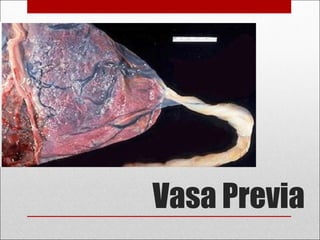
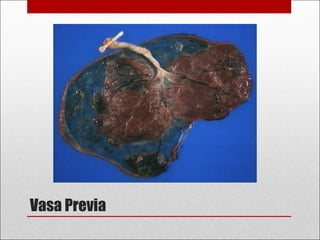
Vasa Previa
Vasa Previa
• Rarely reported condition in which the fetal
vessels from the placenta cross the entrance to
the birth canal.
• Incidence varies, but most resources note
occurrence in 1:3000 pregnancies.
• Associated with a high fetal mortality rate (50-
95%) which can be attributed to rapid fetal
exsanguination resulting from the vessels tearing
during labor
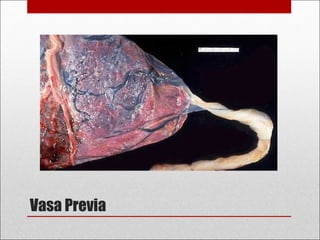
Vasa Previa
There are three causes typically noted for vasa
previa:
1. Bi-lobed placenta
2. Velamentous insertion of the umbilical cord
3. Succenturiate (Accessory) lobe
Vasa Previa
Vasa Previa
Vasa Previa
Risk Factors:
• Bilobed and succenturiate placentas
• Velamentous insertion of the cord
• Low-lying placenta
• Multiple gestation
• Pregnancies resulting from in vitro fertilization
• Palpable vessel on vaginal exam
Vasa Previa
Management:
• When vasa previa is detected prior to labor, the baby
has a much greater chance of surviving.
• It can be detected during pregnancy with use of
transvaginal sonography.
• When vasa previa is diagnosed prior to labor,
elective caesarian is the delivery method of choice.
Summary
Medical Emergency
Whatever be the cause, institute first aid.
Resuscitation and Evaluation
simultaneously
Summary
History taking from patient /relatives
/doctor
Physical examination – General,
Abdominal, Local, (Vaginal examination
only after excluding placenta previa)
Relevant investigations
Summary
Once diagnosis is confirmed, appropriate
management.
Team work would be of great help in
bringing down the Maternal & Perinatal
morbidity/mortality.
ANTEPARTUM HEMMORHAGE

ANTEPARTUM HEMMORHAGE

  • 1.
    Antepartum Hemorrhage Sherin shana EP Govt.college of Nursing Kozhikode
  • 2.
    Obstetrics is veryoften a "bloody business."
  • 3.
    • Bleeding pervaginum after 20 weeks’ gestation. • Complicates close to 4% of all pregnancies and is a MEDICAL EMERGENCY! • One of 3 leading causes of Maternal mortality • Major contributor to Perinatal loss
  • 4.
    What are themost common causes of Antepartum Hemorrhage ?
  • 5.
    Causes Pregnancy related  placentaprevia  abruptio placenta  vasa previa  rupture of marginal sinus of placenta  unclassified
  • 6.
    Causes Local factors  cervicalpolyp  bleeding cervical erosion  carcinoma cervix(rare)
  • 7.
    First aid management •Insert 2 wide bore cannulae • Blood sample • Immediately start IV crystalloid solutions • Provide 100% oxygen via mask • Warm the women • Insert Foley catheter • Monitor blood pressure and pulse/ 5 min • Monitor urine output /hour
  • 8.
    Investigations • Laboratory investigations: -ABOblood group and Rh type -Crossmatch atleast 2 units of blood -CBC -Fibrinogen, PTT, PT,CT -Serum creatinine or BUN -Urine analysis for protein and RBCs
  • 9.
    Management of APH •Call for help • Keep women NPO • NO digital examination until Placenta praevia is ruled out. • Concurrent evaluation and resuscitation MATERNAL RESUSCITATION IS THE BEST FETAL RESUSCITATION
  • 10.
    Management of APH MATERNALEVALUATION • History- Trauma , Intercourse, Pain? fetal movements? Previous ANC , USG Other complications like HT Past Obstetric history
  • 11.
    Management of APH •Maternal Haemodynamic assessment • Clinical signs – may be misleading assess urine output CVP catheter • Treat Shock IV line Colloids / Blood & Blood Products OXYGEN Correct coagulopathy
  • 12.
    12 Severity of bleeding VolumeVolume EstimateEstimate PercentofPercent of circularitycircularity volumevolume TypeType 500500ml orml or<< 10-15%10-15% compensatedcompensated 1000-15001000-1500 mlml 15-25%15-25% mildmild 1500-20001500-2000 mlml 25-35%25-35% moderatemoderate 2000-30002000-3000 mlml 35-50%35-50% SevereSevere (shock(shock((
  • 13.
    Physical examination • Generalexamination:- pallor tachycardia, hypotenstion signs of shock • Abdominal examination: - uterine tenderness / rigidity / consistency fundal height FHS • Pelvic examination: Inspect the external genitalia and vagina No vaginal examination before excluding placenta previa
  • 14.
    Ultrasound • Confirm thefetal viability • Localize the site of placenta • Estimating the gestational age • Retroplacental hematoma • In case of severe bleeding, first aid management and then quickly start active management . • Even if the amount of bleeding is mild, NEVER perform PV examination until placenta previa has been excluded by US
  • 15.
    Diagnosis – PlacentaPrevia • Painless vaginal bleeding • Symptoms and signs -shock -bleeding may be precipitated by intercourse -relaxed uterus -normal fetal condition -abnormal presentations and lie
  • 16.
    • Vaginal bleedingalong with intermitent / constant abdominal pain • Symptoms and signs: -Shock -tense/tender uterus -decreased /absent fetal movements. -fetal distress/absent fetal heart sound. Diagnosis – Abruptio placenta
  • 17.
    • Mild vaginalbleeding after 24 w(mild) • Symptoms and signs -clinically stable -fetal assessment showed fetal distress that cannot be explained by the mild bleeding. Diagnosis -Vasa previa
  • 18.
  • 19.
    Placenta Previa Defined asa placenta implanted in the lower segment of the uterus, presenting ahead of the leading pole of the fetus.
  • 20.
    Placenta Previa • Incidenceabout 1 in 300 • Perinatal morbidity and mortality are primarily related to the complications of prematurity, because the hemorrhage is maternal.
  • 21.
  • 23.
  • 24.
  • 25.
    Symptoms • The mostcharacteristic event in placenta previa is painless hemorrhage. • This usually occurs near the end of or after the second trimester. • The initial bleeding is rarely so profuse as to prove fatal. • It usually ceases spontaneously, only to recur.
  • 26.
    Signs • Tachycardia orhypotension depending on blood loss • Anemia • Uterus relaxed • Abnormal lie or presentation • Fetal heart present
  • 27.
    Complications - shock - postpartumhemorrhage - high risk for PPH and - placenta accreta/ increta/ percreta a common finding is at the site of a previous cesarean section
  • 29.
    Diagnosis The diagnosis ofplacenta previa can seldom be established firmly by clinical examination. Vaginal examination is never permissible because even the gentlest examination of this sort can cause torrential hemorrhage.
  • 30.
    Diagnosis • The simplestand safest method of placental localization is provided by transabdominal sonography. • Transvaginal ultrasonography has substantively improved diagnostic accuracy of placenta previa. • MRI • At 18 weeks, 5-10% of placentas are low lying.
  • 31.
    Transvaginal ultrasound issafe in the presence of placenta praevia and is more accurate than transabdominal ultrasound in locating the placenta. Diagnosis
  • 32.
  • 33.
    Indications to terminate •Women in labour • Bleeding is heavy • Gestational age >/= 37 weeks • Fetal distress • IUFD and /or fatal congenital anomalies
  • 34.
    Management • Expectant line(conservative) - Macafee Johnsons regime
  • 35.
    Management • Delivery isby Caesarean section in almost all cases. • Occasionally Caesarean hysterectomy necessary.
  • 36.
    Management • In casesof previous CS with anterior placenta previa, high chance of adherent placenta • USG Doppler to confirm • Elective classical caesarean hysterectomy in such cases
  • 37.
  • 38.
    Abruptio placenta Premature separationof a normally situated placenta
  • 39.
    Abruptio Placentae • Incidence:0.5 – 1.3% severe abruption : 1 in 400 deliveries • PNM rate – up to 25% accounts for 12-14 % of all stillbirths adverse sequelae in survivors • Maternal morbidity and mortality
  • 40.
    Abruptio placenta • Bleedingwith placental abruption is almost always maternal. • Significant fetal bleeding is more likely to be seen with traumatic abruption. • In this circumstance, fetal bleeding results from a tear or fracture in the placenta rather than from the placental separation itself.
  • 43.
    Aetiology • Increased ageand parity • Preeclampsia • Chronic hypertension • Preterm ruptured membranes • Multifetal gestation • Hydramnios • Cigarette smoking • Thrombophilias • Cocaine use • Prior abruption(10-25%) • Uterine leiomyoma • External trauma The primary cause is unknown, but there are several associated conditions.
  • 44.
    Symptoms & Signs •The hallmark symptom of placental abruption is pain which can vary from mild cramping to severe pain. • A firm, tender uterus • The amount of external bleeding may not accurately reflect the amount of blood loss. • Importantly, negative findings with ultrasound examination do not exclude placental abruption. Ultrasound only shows 25% of abruptions.
  • 45.
    Differential diagnosis • Severecases – diagnosis is obvious • Milder cases – Placenta previa Other causes Preterm labour Role of USG Sensitivity poor (<40%) Rules out Placenta previa
  • 46.
    Complications • Shock • ConsumptiveCoagulopathy • Renal Failure • Fetal Death • Couvelaire Uterus
  • 47.
    Lab Investigations • Diagnosismainly clinical • Hb, PCV, Peripheral smear • Coagulopathy – Thrombocytopenia, prolonged PT, PTT hypofibrinogenemia (<150mg/dl) elevated FDP, D-dimer (clot observation test) • Fetomaternal hemorrhage (Kleihauer Betke test) • Renal functions
  • 51.
    Grading 0 1 23 Vaginal bleeding - + + + Uterine tetany or tenderness - + + ++ Maternal shock - - - + Fetal distress - - + Fetal Demise Coagulopathy
  • 52.
    Management • Mild cases Ifbleeding stops and fetus in good condition ,pregnancy allowed to continue till 36-37weeks Requires careful observation
  • 53.
    Management • Severe cases IVline Venous sample for Hb , cross matching, CT USG -retroplacental clot Catheterise-output 30ml/Hr
  • 54.
    Management • In severecases immediate delivery is indicated • Amniotomy and oxytocin augmentation • If slow progress of labour or deterioration of maternal condition –emergency CS
  • 55.
    Complications • Maternal shock •Fetal death • Uterine atony leading to PPH • Amniotic fluid embolism • Consumptive Coagulopathy( 30%) • Renal failure The principal cause of maternal death is renal failure due to prolonged hypotension .
  • 56.
    Fetal, neonatal outcome •Perinatal mortality -20-25% • 20% dead at admission • 20 – 40% die later • Prematurity, intranatal hypoxia • Neonatal coagulopathy • SGA • Congenital anomalies
  • 57.
    Maternal Prognosis • MaternalMortality: 0.5 – 5 % Causes – haemorrhage cardiac renal failure
  • 58.
    Management • Depends on– severity of abruption - condition of mother and baby - presence of complications • 3 factors influence management Maternal haemodynamic status Fetal condition Fetal gestational age
  • 59.
    Management • Expectant management?? • Active management Termination CS / Vaginal delivery ?? • Management of complications
  • 60.
    Management Expectant management: • Diagnosisis uncertain • Fetus – no e/o compromise • Facilities for immediate intervention *Till– 37wks/ bleeding recurs/ fetus deteriorates Tocolysis contraindicated.
  • 61.
    Management Indications for CS •Live, mature fetus; Vaginal Delivery not imminent • Live, mature fetus; CTG shows distress • Obstetric indications – transverse lie, failed induction.. • Uncontrolled hemorrhage, expanding uterus with concealed hemorrhage, Couvelaire Uterus, refractory uterus
  • 62.
    Management Vaginal delivery • Severeabruption, dead fetus • Non – viable fetus • Limited degree of separation, CTG reassuring (Exceptions – uncontrolled h’age) •Amniotomy, augmentation •Abruption delivery interval •Adequate maternal stabilisation
  • 63.
    Management Early amniotomy • Hastensdelivery • Reduces extravasation into myometrium • Reduces entry of thromboplastin into circulation • Encourages contractions – reduces bleeding Augmentation • If no rhythmic contractions • Standard doses
  • 64.
    Management of Complications RenalFailure • Acute tubular necrosis / Cortical necrosis • Haemorrhage impairs renal perfusion • Coexistent PIH – renal vasospasm • Intravascular coagulation Adequate & vigorous hydration Dialysis
  • 65.
    Management of Complications DIC •Incidence 10% (severe abruption – 30%) • Spontaneous resolution after delivery • Volume replacement, clotting factor replacement • Fresh whole blood • Packed cells with FFP and Platelets • Cryoprecipitate, fibrinogen concentrates • NO heparin or antifibrinolytic agents • CS – Platelets 50,000/cmm
  • 66.
    Management of Complications PPH •Poor myometrial contractility following infiltration with blood (Couvelaire Uterus) • FDPs inhibit myometrial contractions •Incidence 25% •Transfusion, oxytocics, surgery
  • 67.
    Management of Complications Rhesusisoimmunisation • Feto-maternal hemorrhage significant • Kleihauer Betke test • Anti D administration
  • 68.
    Future pregnancies • Recurrentabruption (25%) • Spontaneous abortion • Early termination? • Improve nutrition, stop smoking,weight gain, etc
  • 69.
  • 70.
    Vasa Previa • Rarelyreported condition in which the fetal vessels from the placenta cross the entrance to the birth canal. • Incidence varies, but most resources note occurrence in 1:3000 pregnancies. • Associated with a high fetal mortality rate (50- 95%) which can be attributed to rapid fetal exsanguination resulting from the vessels tearing during labor
  • 71.
    Vasa Previa There arethree causes typically noted for vasa previa: 1. Bi-lobed placenta 2. Velamentous insertion of the umbilical cord 3. Succenturiate (Accessory) lobe
  • 72.
  • 73.
  • 74.
    Vasa Previa Risk Factors: •Bilobed and succenturiate placentas • Velamentous insertion of the cord • Low-lying placenta • Multiple gestation • Pregnancies resulting from in vitro fertilization • Palpable vessel on vaginal exam
  • 75.
    Vasa Previa Management: • Whenvasa previa is detected prior to labor, the baby has a much greater chance of surviving. • It can be detected during pregnancy with use of transvaginal sonography. • When vasa previa is diagnosed prior to labor, elective caesarian is the delivery method of choice.
  • 76.
    Summary Medical Emergency Whatever bethe cause, institute first aid. Resuscitation and Evaluation simultaneously
  • 77.
    Summary History taking frompatient /relatives /doctor Physical examination – General, Abdominal, Local, (Vaginal examination only after excluding placenta previa) Relevant investigations
  • 78.
    Summary Once diagnosis isconfirmed, appropriate management. Team work would be of great help in bringing down the Maternal & Perinatal morbidity/mortality.

Editor's Notes

  • #12 Normotensive – may have been hypertensive initially Normal pulse – on hydration may show tachycardia Momnitor urine out put , at least 30 ml / hr ensures good renal perfusion, and ARF is a common cause of death Monitor CVP – hydrate accordingly Maintain Hct of at least 30 %
  • #30 Placenta previa or abruption should always be suspected in women with uterine bleeding during the latter half of pregnancy. The possibility of placenta previa should not be dismissed until appropriate evaluation, including sonography, has clearly proved its absence.
  • #48 Peripheral smear - platelets reduced, schistocytes present indicating intravaxscular coagulation Clot observation test – every hour, a venous sample is drawn and observed: failure to clot in 5 – 10 mins and lysis of a fromed clot when the tube is gently shaken indicates clotting def, mailnly reduced fibrinogen and platelets.
  • #65 ATN – recovery is ususally complete Cortical necrosis – prognosis depends on extent of necrosis ARF in pregnant women – more than half are asso with abruption