Apexification
                      By

           Ahmad mostafa hussein

Demonstrator, Department of Dental Biomaterials
   Faculty of Dentistry, Mansoura university


                    2012
Introduction
What is the difference between:

     Apexification and apexogenesis


                             ?
Apexogenesis
* Vital pulp therapy in an immature tooth to
  permit continued root growth and apical
  closure.
* Depending on the extent of pulp damage, pulp
  capping or shallow or conventional pulpotomy
  may be indicated.
* Materials: Ca(OH)2 (calcium hydroxide)
             or MTA (mineral trioxide aggregate).
             MTA is the material of choice.
Apexification
* Root-end closure.
* It is the induction of a calcific barrier across an
  open apex.
* Materials: Ca(OH)2 (has serious disadvantages)

             or MTA.
             MTA is the material of choice.
In case of open apex
What is the treatment of:
  •Reversible pulpitis

  •Irreversible pulpitis or necrotic pulp


                                      ?
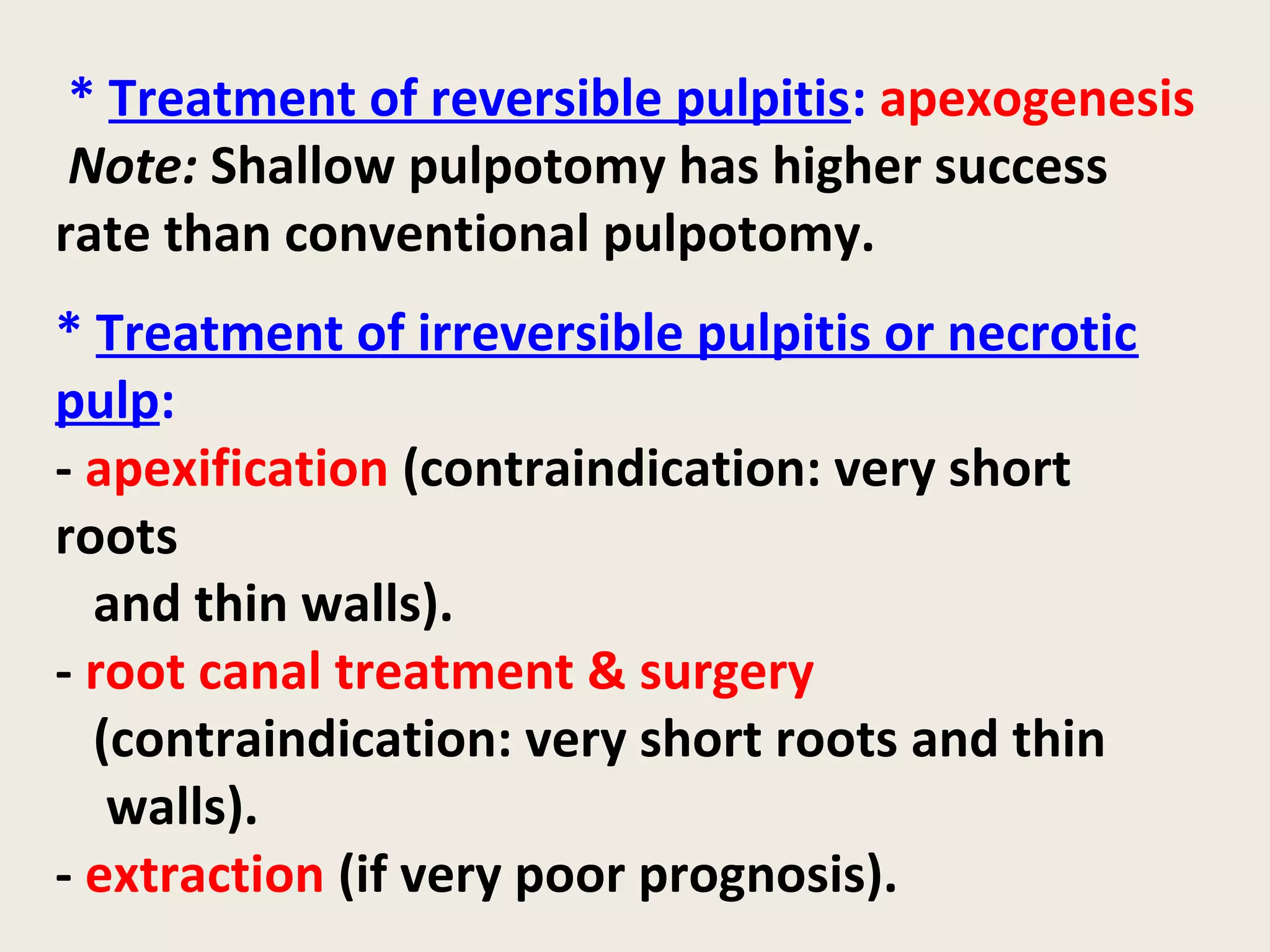
* Treatment of reversible pulpitis: apexogenesis
 Note: Shallow pulpotomy has higher success
rate than conventional pulpotomy.
* Treatment of irreversible pulpitis or necrotic
pulp:
- apexification (contraindication: very short
roots
  and thin walls).
- root canal treatment & surgery
  (contraindication: very short roots and thin
   walls).
- extraction (if very poor prognosis).
In case of immature open apex
How can we differentiate between:
  • Normal radiolucency surrounding immature
    open apex
  • Pathologic radiolucency resulting from a
    necrotic pulp


                               ?
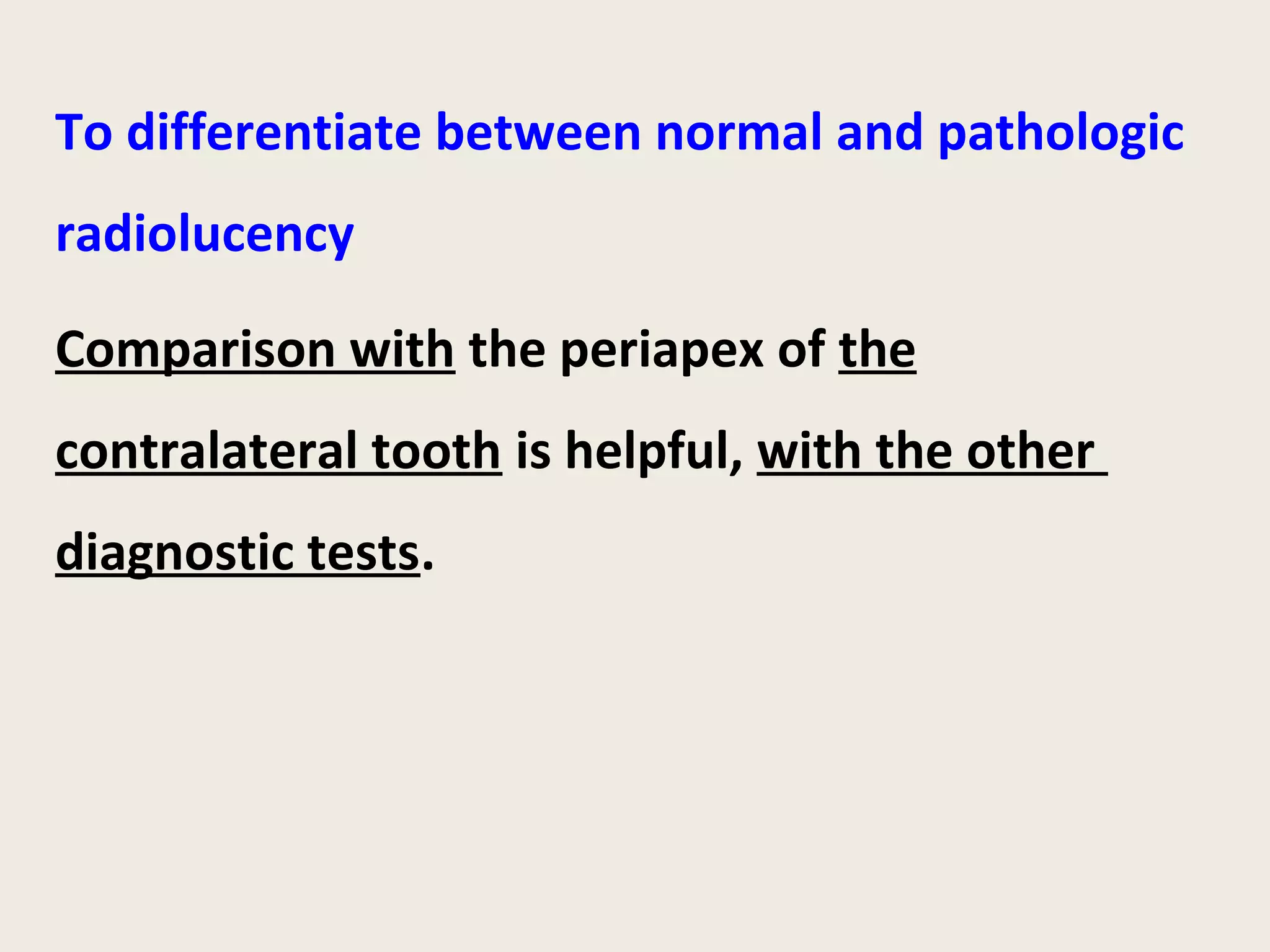
To differentiate between normal and pathologic
radiolucency

Comparison with the periapex of the
contralateral tooth is helpful, with the other
diagnostic tests.
Apexification
•Definition

•The factors most responsible for apical closure

•Causes of failure

•The materials used for apexification:
     * Ca(OH)2 (calcium hydroxide)
     * MTA (mineral trioxide aggregate)
       MTA is the material of choice.
Apexification
* Root-end closure.
* It is the induction of a calcific barrier across
  an open apex.
* The factors most responsible for apical closure
  are thorough débridement & coronal seal.
* Causes of failure: bacterial contamination.
* Apexification involves cleaning & shaping,
  followed by placement of Ca(OH)2 or MTA
  to the apex.
Ca(OH)2
1. Advantages

2. Serious disadvantages

3. Mineralization induced by Ca(OH)2 is
 affected by …………………………....

                 …………………………...
Ca(OH)2
Advantages
1) alkaline pH
2) bactericidal
3) stimulate apical calcification.
Note: The reaction of periapical tissues to Ca(OH)2 is
similar to that of pulp tissue.
Ca(OH)2 produces a multilayered sterile necrosis
permitting subjacent mineralization.
Ca(OH)2
Serious disadvantages
1)long treatment period, usually takes 6-9
months, & may extend up to 21 months.
2)must be replaced at monthy intervals &
removed some months after placement
   before final obturation.
3)multiple visits by the patient.
4)possible recontamination may occur.
5)weaken the root dentin & the risk of teeth
fracture.
Ca(OH)2
Mechanism of mineralization induced by Ca(OH) 2
* Calcium ions dissociated from Ca(OH)2 are
  critical for inducing the mineralization of
  osteoblasts.
* Hydroxyl ions did not have any effect on the
  mineralization.
* The mineralization activity of Ca(OH)2 was
  higher at pH 7.4 than at pH 8.5. Mineralization
  activity was higher under neutral conditions.
MTA
1.Advantages
2.Disadvantages
3.Uses
4.Composition
5.Types (gray MTA & white MTA)
6.Formation of hydroxyapatite
7.Manipulation
(mixing, insertion, thickness, radiograph,
moist cotton pellet, temporary restoration)
   Obturation & permanent restoration
MTA
Advantages
1) Save treatment time. High success rate. It is the material of choice for
  apexification & apexogenesis.
2) Alkaline pH, which may impart antibacterial effect on some facultative
  bacteria.
3) Can induce formation (regeneration) of dentin, cementum, bone &
   periodontal ligament.
4) Excellent biocompatibility and appropriate mechanical properties.
5) Excellent sealing ability.
6) Produces an artificial barrier, against which an obturating material can
   be condensed.
7) Hardens (sets) in the presence of moisture.
8) More radiopaque than Ca(OH)2.
9) Vasoconstrictive. This could be beneficial for hemostasis (most
   importantly in pulp capping).
MTA
Disadvantages
1)Long setting time (2-4 h after mixing).
2)Poor handling properties. The loose
  sandy nature of the mixture causes much

  difficulty for insertion & packing of MTA.
3)High cost.
MTA
Uses
1)Apexogenesis, direct pulp capping and
  pulpotomy.
2)Apexification, and root-end filling.
3)Repair of root perforations.
4)Repair of internal and external resorption.
MTA
Composition
* MTA is mainly composed of 3 powder ingredients,
which are 75% Portland cement, 20% bismuth
oxide, 5% gypsum; lime (CaO), silica (SiO2) &
bismuth oxide (Bi2O3) are the 3 main oxides in the
cement.
* Portland cement is the major constituent. It is
responsible for the setting & biologic properties.
* Bismuth oxide provides radiopacity.
* Gypsum is an important determinant of setting
time.
* Portland cement is composed of 4 major components;
tricalcium silicate, dicalcium silicate, tricalcium
aluminate, & tetracalcium aluminoferrite.
* Tricalcium silicate is the most important constituent
of Portland cement. It is the major component in the
formation of calcium silicate hydrate which gives early
strength to Portland cement.
* Dicalcium silicate hydrates more slowly than
tricalcium silicate & is responsiple for the latter’s
strength.
* Aluminoferrite (contains iron) is present in gray MTA.
It is responsible for the gray discoloration. It may
discolor the tooth.
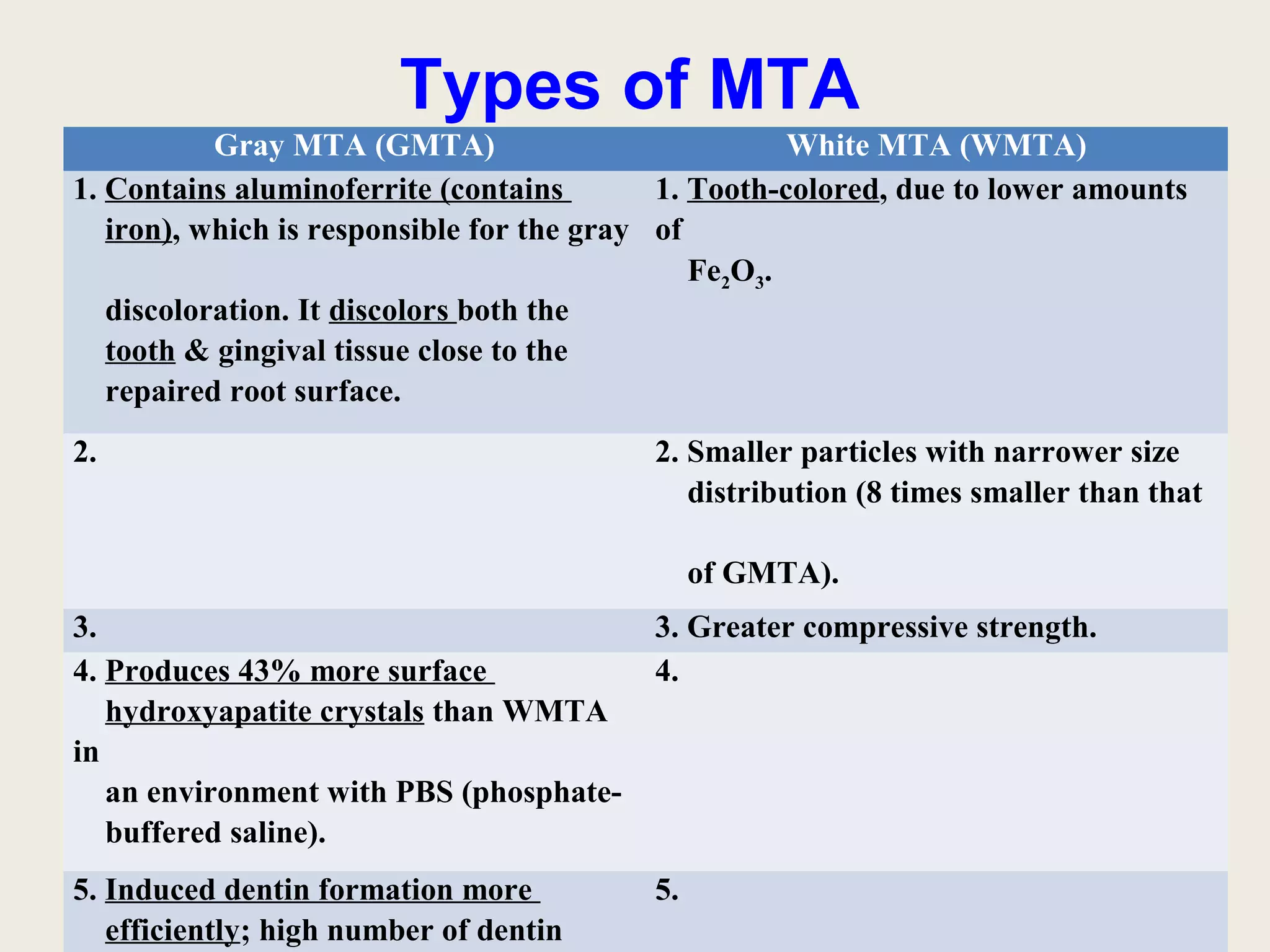
Types of MTA
           Gray MTA (GMTA)                            White MTA (WMTA)
1. Contains aluminoferrite (contains        1. Tooth-colored, due to lower amounts
   iron), which is responsible for the gray of
                                               Fe2O3.
   discoloration. It discolors both the
   tooth & gingival tissue close to the
   repaired root surface.
2.                                        2. Smaller particles with narrower size
                                             distribution (8 times smaller than that

                                               of GMTA).
3.                                        3. Greater compressive strength.
4. Produces 43% more surface              4.
   hydroxyapatite crystals than WMTA
in
   an environment with PBS (phosphate-
   buffered saline).
5. Induced dentin formation more          5.
   efficiently; high number of dentin
MTA
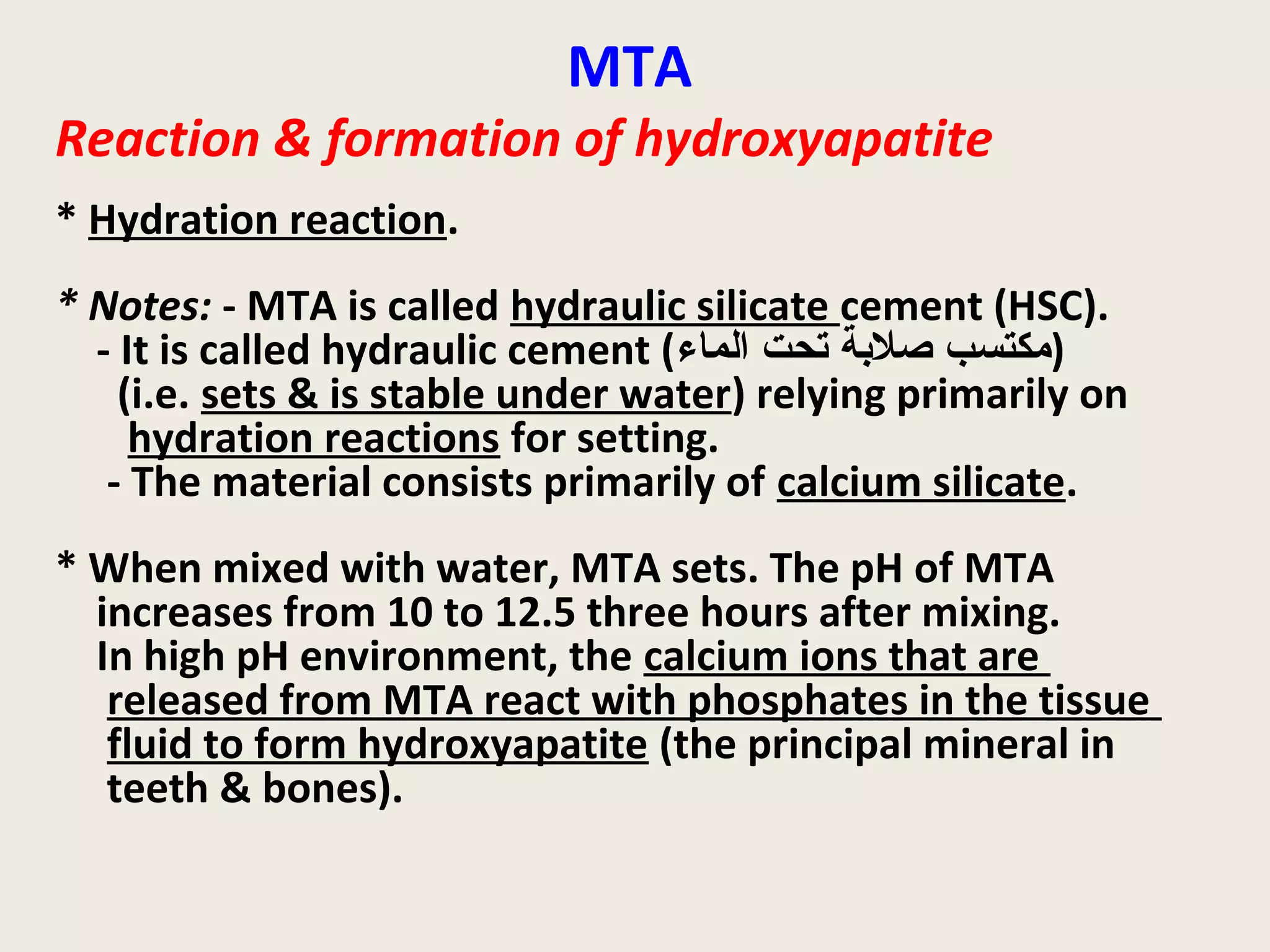
Reaction & formation of hydroxyapatite
* Hydration reaction.
* Notes: - MTA is called hydraulic silicate cement (HSC).
  - It is called hydraulic cement (‫)مكتسب صلةبة تحت الماء‬
    (i.e. sets & is stable under water) relying primarily on
     hydration reactions for setting.
   - The material consists primarily of calcium silicate.
* When mixed with water, MTA sets. The pH of MTA
  increases from 10 to 12.5 three hours after mixing.
  In high pH environment, the calcium ions that are
   released from MTA react with phosphates in the tissue
   fluid to form hydroxyapatite (the principal mineral in
   teeth & bones).
MTA
Manipulation
Mixing: gray MTA & white MTA are mixed with supplied
sterile water in a powder to liquid ratio of 3:1 according to
the manufacturer’s instruction.
Note: Poor handling properties. The loose sandy nature of
the mixture causes much difficulty for the insertion &
packing of MTA.

Insertion: Ultrasonic-assisted condensation [the ultrasonic
vibration applied to endodontic plugger(condenser)] is
more efficient than hand condensation in:
    - the apical flowing of MTA (enable better flow).
    - delaying bacterial leakage (enable better adaptation).
    - the production of denser MTA apical plug.
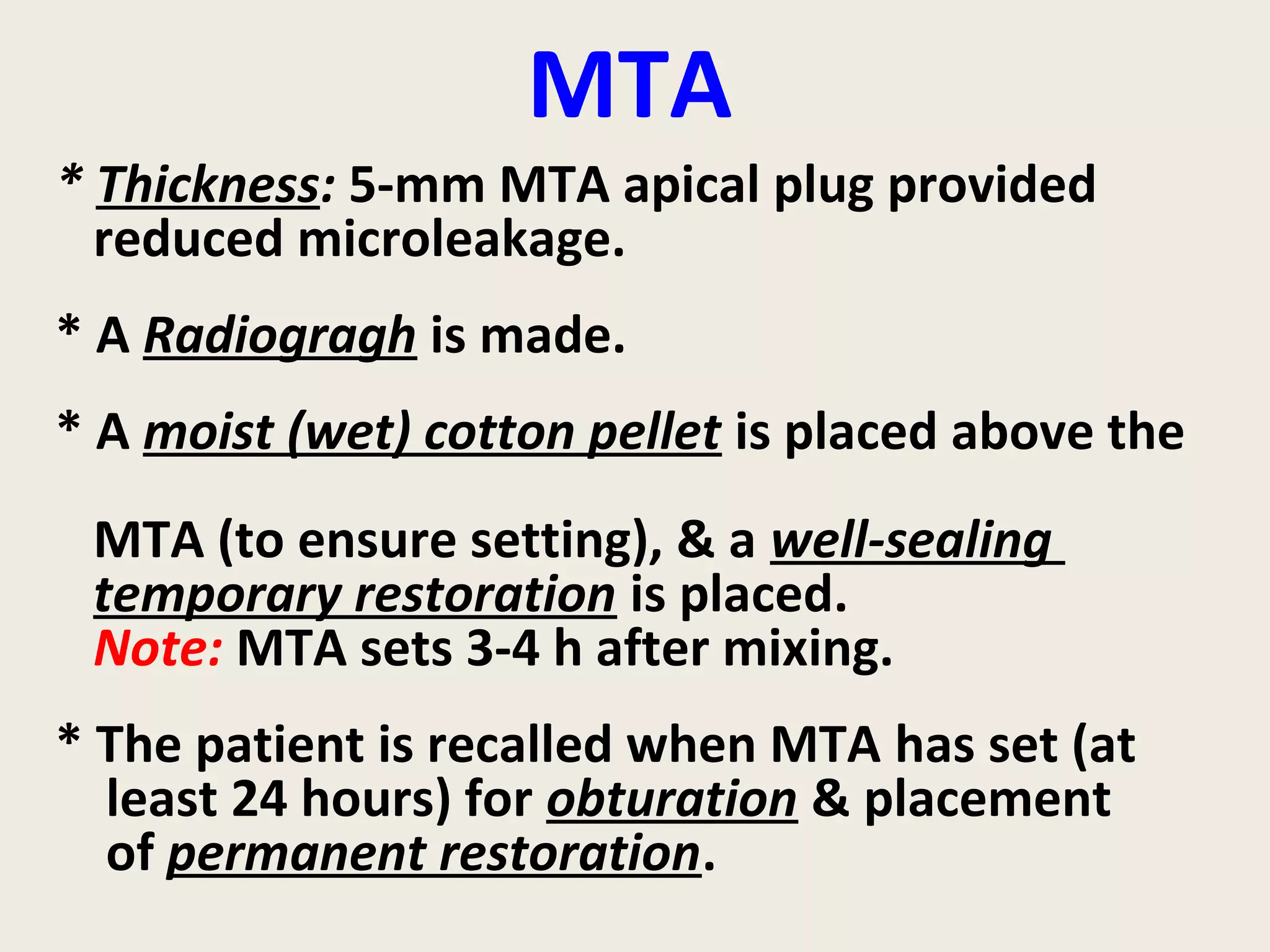
MTA
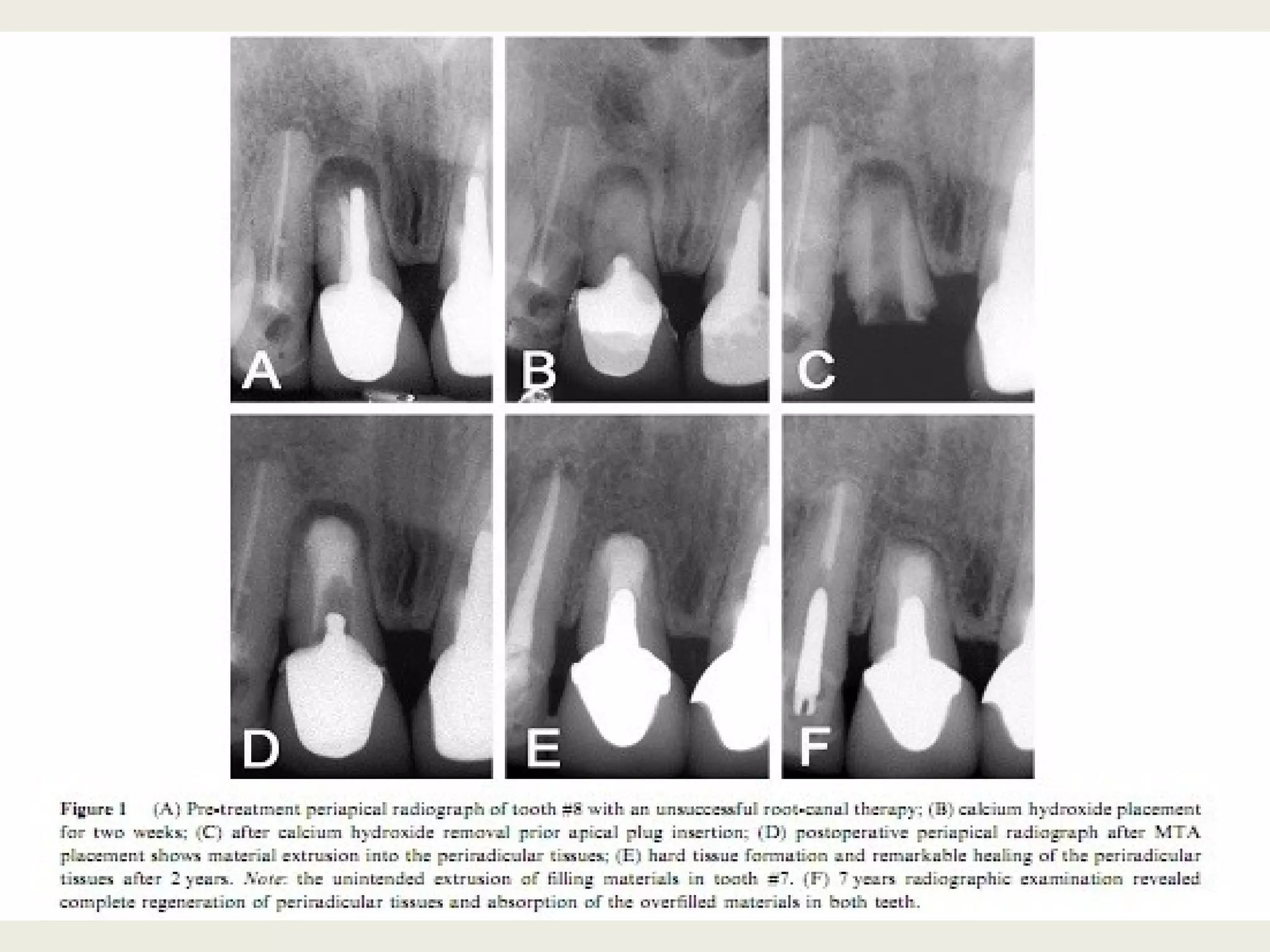
* Thickness: 5-mm MTA apical plug provided
  reduced microleakage.
* A Radiogragh is made.
* A moist (wet) cotton pellet is placed above the
 MTA (to ensure setting), & a well-sealing
 temporary restoration is placed.
 Note: MTA sets 3-4 h after mixing.
* The patient is recalled when MTA has set (at
  least 24 hours) for obturation & placement
  of permanent restoration.
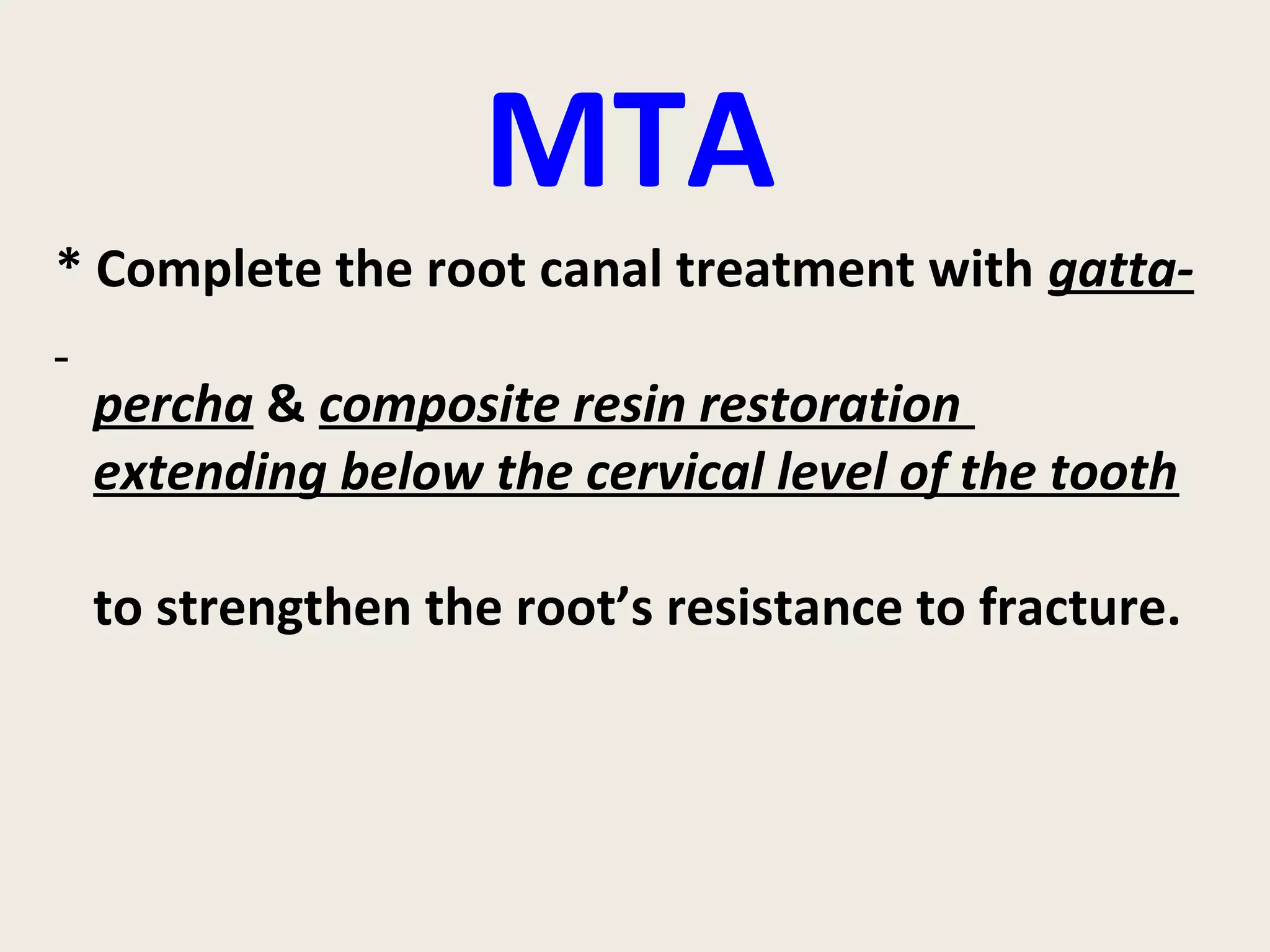
MTA
* Complete the root canal treatment with gatta-

 percha & composite resin restoration
 extending below the cervical level of the tooth

 to strengthen the root’s resistance to fracture.
MTA
Note
* The role of posts & luting agents in
  reinforcing root filled immature anterior
  teeth remains unclear.
Apexification  apexogenesis  MTA  mineral trioxide aggregate powerpoint presentation

Apexification apexogenesis MTA mineral trioxide aggregate powerpoint presentation

  • 1.
    Apexification By Ahmad mostafa hussein Demonstrator, Department of Dental Biomaterials Faculty of Dentistry, Mansoura university 2012
  • 2.
  • 3.
    What is thedifference between: Apexification and apexogenesis ?
  • 4.
    Apexogenesis * Vital pulptherapy in an immature tooth to permit continued root growth and apical closure. * Depending on the extent of pulp damage, pulp capping or shallow or conventional pulpotomy may be indicated. * Materials: Ca(OH)2 (calcium hydroxide) or MTA (mineral trioxide aggregate). MTA is the material of choice.
  • 5.
    Apexification * Root-end closure. *It is the induction of a calcific barrier across an open apex. * Materials: Ca(OH)2 (has serious disadvantages) or MTA. MTA is the material of choice.
  • 6.
    In case ofopen apex What is the treatment of: •Reversible pulpitis •Irreversible pulpitis or necrotic pulp ?
  • 7.
    * Treatment ofreversible pulpitis: apexogenesis Note: Shallow pulpotomy has higher success rate than conventional pulpotomy. * Treatment of irreversible pulpitis or necrotic pulp: - apexification (contraindication: very short roots and thin walls). - root canal treatment & surgery (contraindication: very short roots and thin walls). - extraction (if very poor prognosis).
  • 8.
    In case ofimmature open apex How can we differentiate between: • Normal radiolucency surrounding immature open apex • Pathologic radiolucency resulting from a necrotic pulp ?
  • 9.
    To differentiate betweennormal and pathologic radiolucency Comparison with the periapex of the contralateral tooth is helpful, with the other diagnostic tests.
  • 10.
    Apexification •Definition •The factors mostresponsible for apical closure •Causes of failure •The materials used for apexification: * Ca(OH)2 (calcium hydroxide) * MTA (mineral trioxide aggregate) MTA is the material of choice.
  • 11.
    Apexification * Root-end closure. *It is the induction of a calcific barrier across an open apex. * The factors most responsible for apical closure are thorough débridement & coronal seal. * Causes of failure: bacterial contamination. * Apexification involves cleaning & shaping, followed by placement of Ca(OH)2 or MTA to the apex.
  • 12.
    Ca(OH)2 1. Advantages 2. Seriousdisadvantages 3. Mineralization induced by Ca(OH)2 is affected by ………………………….... …………………………...
  • 13.
    Ca(OH)2 Advantages 1) alkaline pH 2)bactericidal 3) stimulate apical calcification. Note: The reaction of periapical tissues to Ca(OH)2 is similar to that of pulp tissue. Ca(OH)2 produces a multilayered sterile necrosis permitting subjacent mineralization.
  • 14.
    Ca(OH)2 Serious disadvantages 1)long treatmentperiod, usually takes 6-9 months, & may extend up to 21 months. 2)must be replaced at monthy intervals & removed some months after placement before final obturation. 3)multiple visits by the patient. 4)possible recontamination may occur. 5)weaken the root dentin & the risk of teeth fracture.
  • 15.
    Ca(OH)2 Mechanism of mineralizationinduced by Ca(OH) 2 * Calcium ions dissociated from Ca(OH)2 are critical for inducing the mineralization of osteoblasts. * Hydroxyl ions did not have any effect on the mineralization. * The mineralization activity of Ca(OH)2 was higher at pH 7.4 than at pH 8.5. Mineralization activity was higher under neutral conditions.
  • 16.
    MTA 1.Advantages 2.Disadvantages 3.Uses 4.Composition 5.Types (gray MTA& white MTA) 6.Formation of hydroxyapatite 7.Manipulation (mixing, insertion, thickness, radiograph, moist cotton pellet, temporary restoration) Obturation & permanent restoration
  • 17.
    MTA Advantages 1) Save treatmenttime. High success rate. It is the material of choice for apexification & apexogenesis. 2) Alkaline pH, which may impart antibacterial effect on some facultative bacteria. 3) Can induce formation (regeneration) of dentin, cementum, bone & periodontal ligament. 4) Excellent biocompatibility and appropriate mechanical properties. 5) Excellent sealing ability. 6) Produces an artificial barrier, against which an obturating material can be condensed. 7) Hardens (sets) in the presence of moisture. 8) More radiopaque than Ca(OH)2. 9) Vasoconstrictive. This could be beneficial for hemostasis (most importantly in pulp capping).
  • 18.
    MTA Disadvantages 1)Long setting time(2-4 h after mixing). 2)Poor handling properties. The loose sandy nature of the mixture causes much difficulty for insertion & packing of MTA. 3)High cost.
  • 19.
    MTA Uses 1)Apexogenesis, direct pulpcapping and pulpotomy. 2)Apexification, and root-end filling. 3)Repair of root perforations. 4)Repair of internal and external resorption.
  • 20.
    MTA Composition * MTA ismainly composed of 3 powder ingredients, which are 75% Portland cement, 20% bismuth oxide, 5% gypsum; lime (CaO), silica (SiO2) & bismuth oxide (Bi2O3) are the 3 main oxides in the cement. * Portland cement is the major constituent. It is responsible for the setting & biologic properties. * Bismuth oxide provides radiopacity. * Gypsum is an important determinant of setting time.
  • 21.
    * Portland cementis composed of 4 major components; tricalcium silicate, dicalcium silicate, tricalcium aluminate, & tetracalcium aluminoferrite. * Tricalcium silicate is the most important constituent of Portland cement. It is the major component in the formation of calcium silicate hydrate which gives early strength to Portland cement. * Dicalcium silicate hydrates more slowly than tricalcium silicate & is responsiple for the latter’s strength. * Aluminoferrite (contains iron) is present in gray MTA. It is responsible for the gray discoloration. It may discolor the tooth.
  • 22.
    Types of MTA Gray MTA (GMTA) White MTA (WMTA) 1. Contains aluminoferrite (contains 1. Tooth-colored, due to lower amounts iron), which is responsible for the gray of Fe2O3. discoloration. It discolors both the tooth & gingival tissue close to the repaired root surface. 2. 2. Smaller particles with narrower size distribution (8 times smaller than that of GMTA). 3. 3. Greater compressive strength. 4. Produces 43% more surface 4. hydroxyapatite crystals than WMTA in an environment with PBS (phosphate- buffered saline). 5. Induced dentin formation more 5. efficiently; high number of dentin
  • 23.
    MTA Reaction & formationof hydroxyapatite * Hydration reaction. * Notes: - MTA is called hydraulic silicate cement (HSC). - It is called hydraulic cement (‫)مكتسب صلةبة تحت الماء‬ (i.e. sets & is stable under water) relying primarily on hydration reactions for setting. - The material consists primarily of calcium silicate. * When mixed with water, MTA sets. The pH of MTA increases from 10 to 12.5 three hours after mixing. In high pH environment, the calcium ions that are released from MTA react with phosphates in the tissue fluid to form hydroxyapatite (the principal mineral in teeth & bones).
  • 24.
    MTA Manipulation Mixing: gray MTA& white MTA are mixed with supplied sterile water in a powder to liquid ratio of 3:1 according to the manufacturer’s instruction. Note: Poor handling properties. The loose sandy nature of the mixture causes much difficulty for the insertion & packing of MTA. Insertion: Ultrasonic-assisted condensation [the ultrasonic vibration applied to endodontic plugger(condenser)] is more efficient than hand condensation in: - the apical flowing of MTA (enable better flow). - delaying bacterial leakage (enable better adaptation). - the production of denser MTA apical plug.
  • 25.
    MTA * Thickness: 5-mmMTA apical plug provided reduced microleakage. * A Radiogragh is made. * A moist (wet) cotton pellet is placed above the MTA (to ensure setting), & a well-sealing temporary restoration is placed. Note: MTA sets 3-4 h after mixing. * The patient is recalled when MTA has set (at least 24 hours) for obturation & placement of permanent restoration.
  • 26.
    MTA * Complete theroot canal treatment with gatta- percha & composite resin restoration extending below the cervical level of the tooth to strengthen the root’s resistance to fracture.
  • 27.
    MTA Note * The roleof posts & luting agents in reinforcing root filled immature anterior teeth remains unclear.