Mineral trioxide aggregate
By Hyder Mohammed
INTRODUCTION
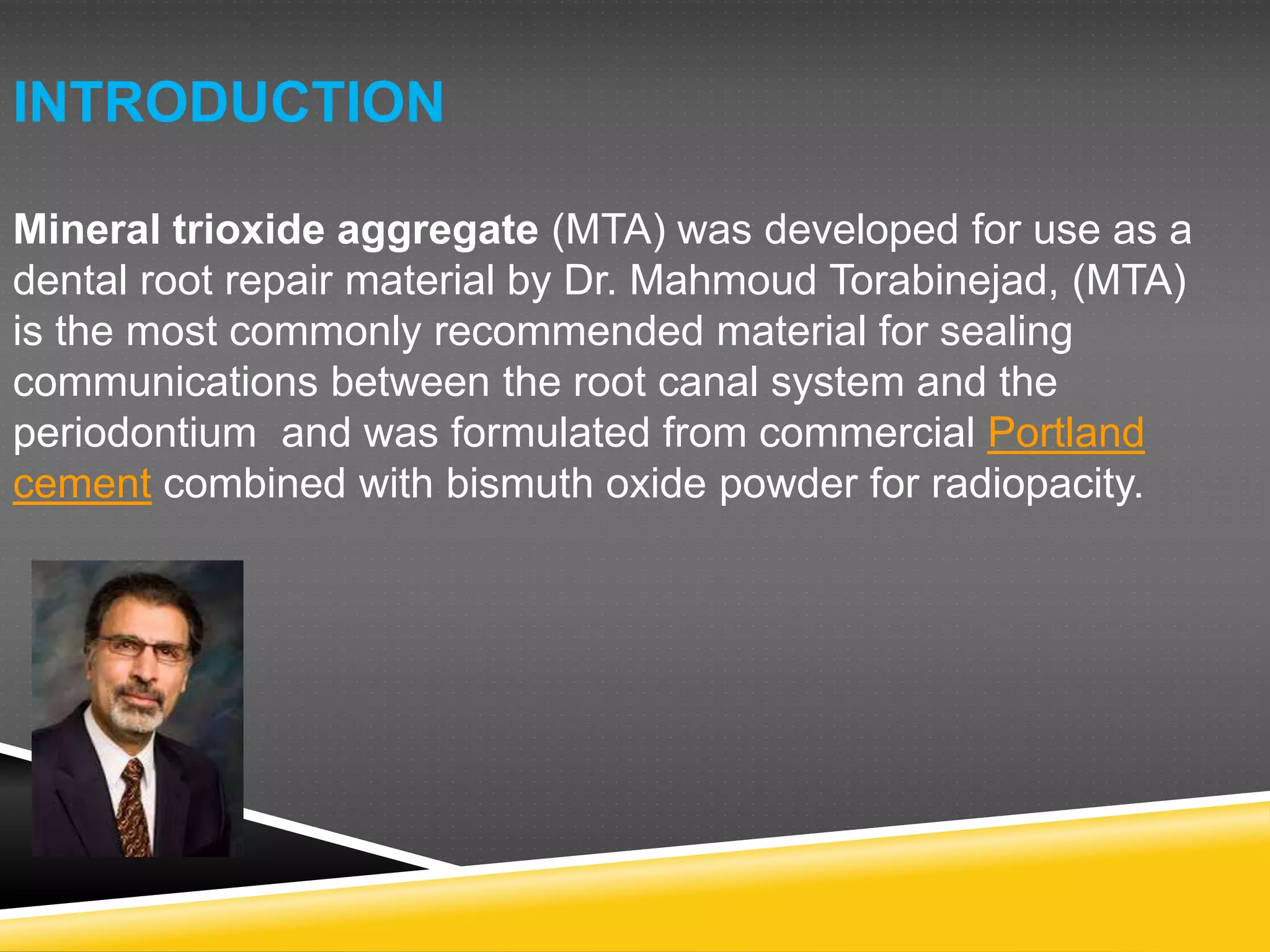
Mineral trioxide aggregate (MTA) was developed for use as a
dental root repair material by Dr. Mahmoud Torabinejad, (MTA)
is the most commonly recommended material for sealing
communications between the root canal system and the
periodontium and was formulated from commercial Portland
cement combined with bismuth oxide powder for radiopacity.
MTA COMPOSITION
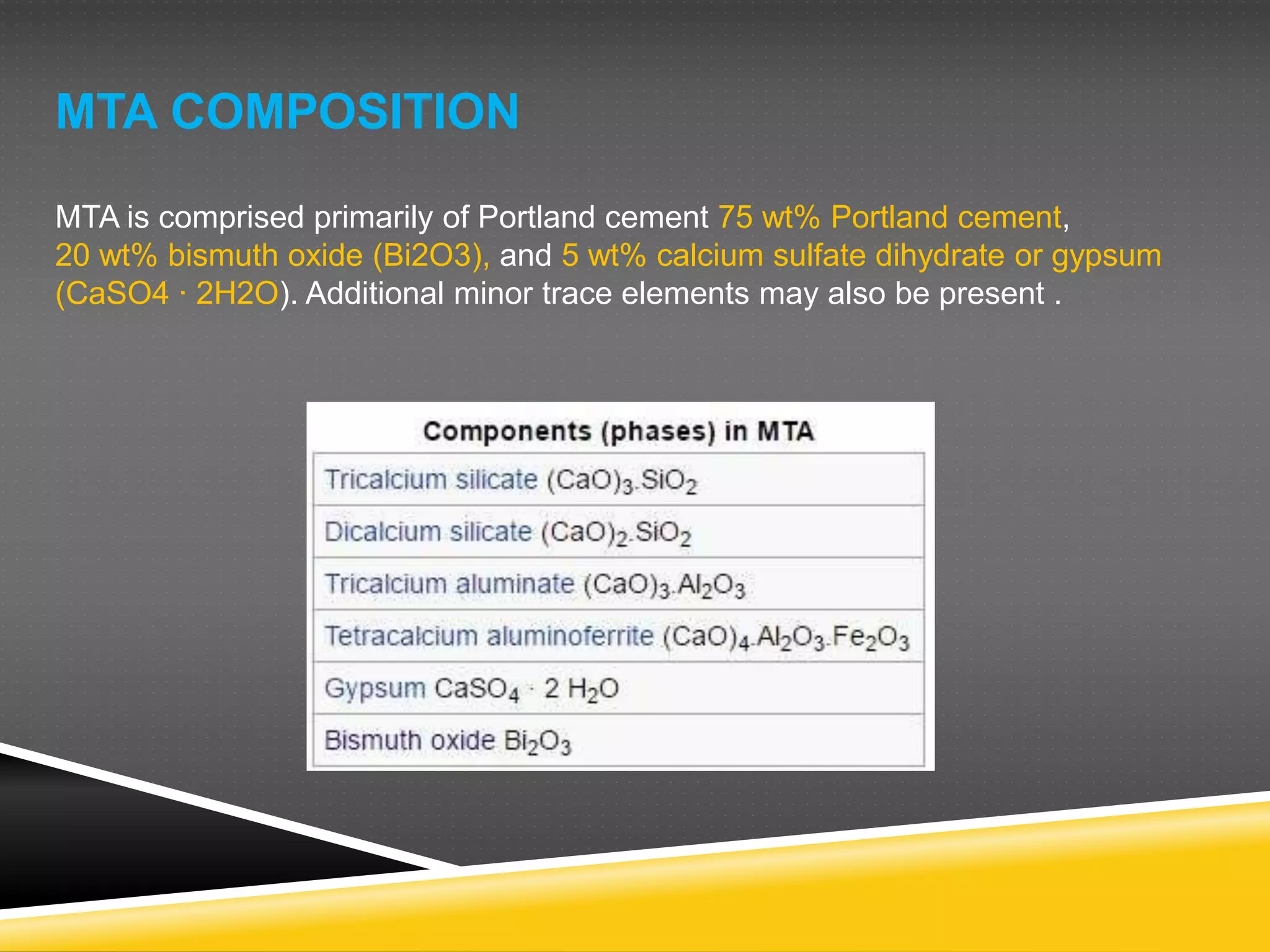
MTA is comprised primarily of Portland cement 75 wt% Portland cement,
20 wt% bismuth oxide (Bi2O3), and 5 wt% calcium sulfate dihydrate or gypsum
(CaSO4 ∙ 2H2O). Additional minor trace elements may also be present .
Types of MTA:
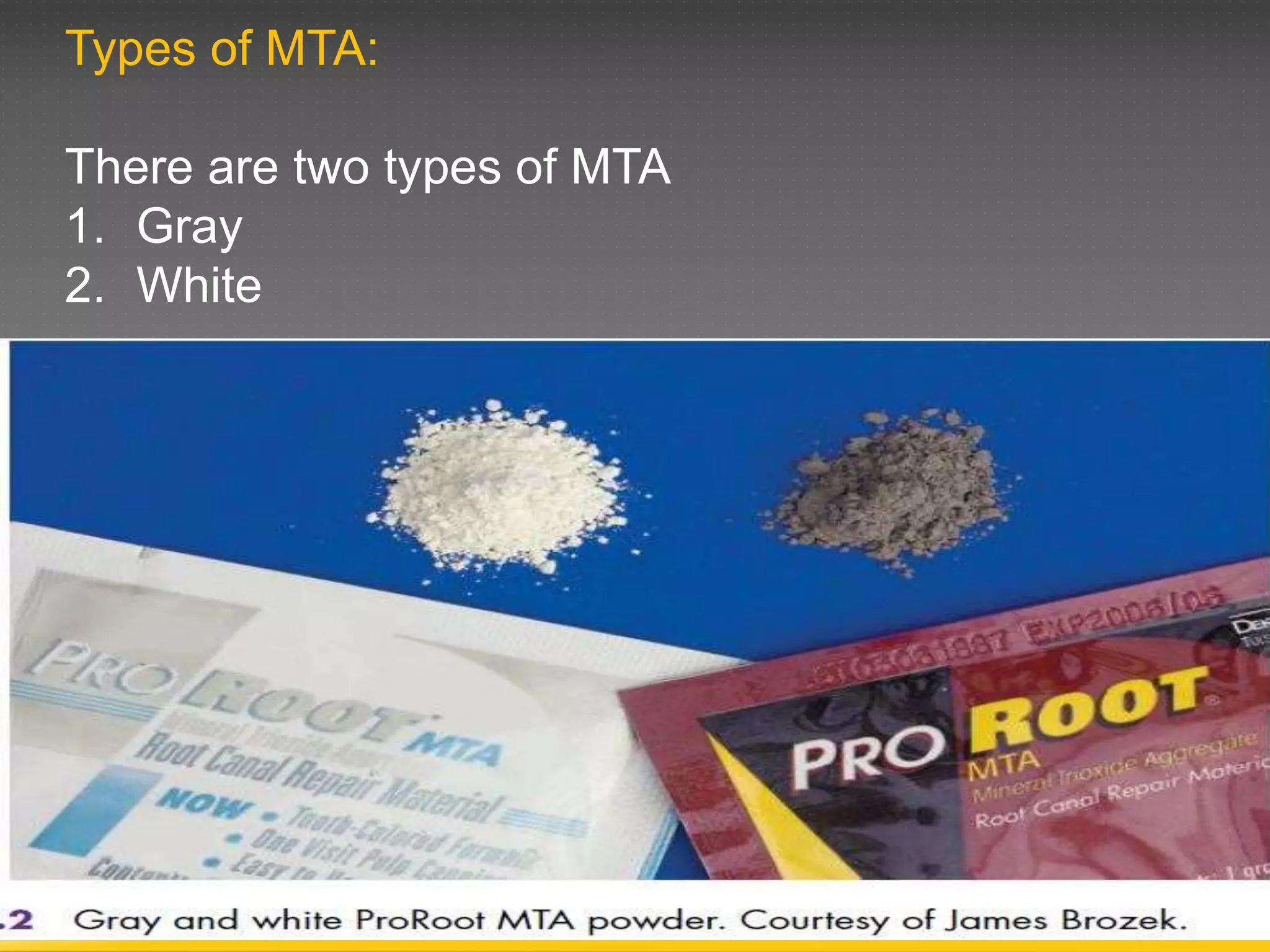
There are two types of MTA
1. Gray
2. White
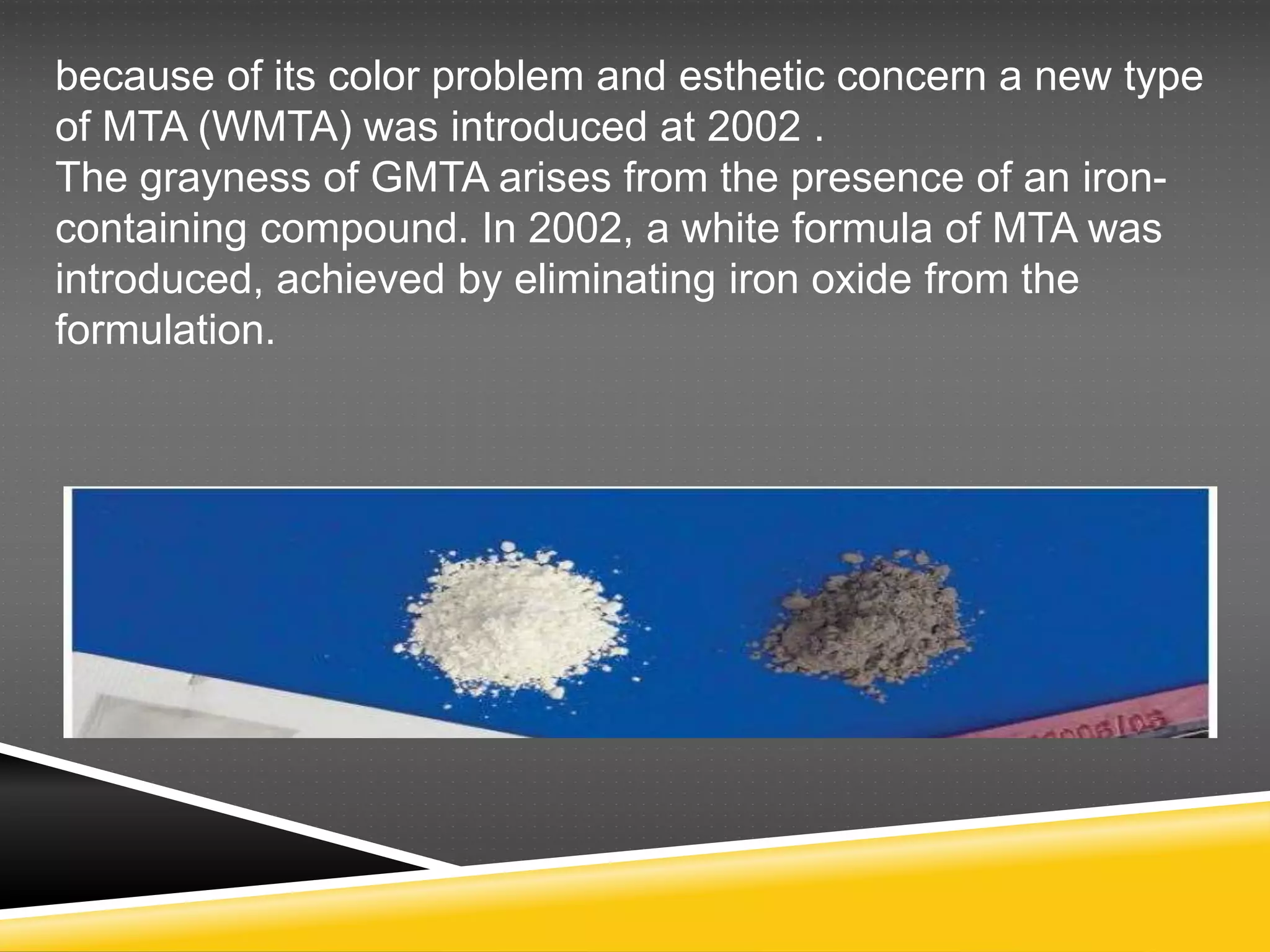
because of its color problem and esthetic concern a new type
of MTA (WMTA) was introduced at 2002 .
The grayness of GMTA arises from the presence of an iron-
containing compound. In 2002, a white formula of MTA was
introduced, achieved by eliminating iron oxide from the
formulation.
Characteristics of MTA
1. Biocompatible with periradicular tissues
2. Non cytotoxic to cells, but antimicrobial to bacteria
3. Non-resorbable
4. Minimal leakage around the margins.
5. Very basic AKA alkaline initial pH: 10.2 initially and it rose to
12.5 after 3 hours .
6. MTA powder contains fine hydrophilic particles that set in
the presence of moisture
7. Compressive strength develops over a period of 28 days,
similar to Portland cement. Strengths of more than 133 MPa
.
8. MTA displays low or nearly no solubility
9. Radio opaque
Disadvantages of MTA
- Slow setting time 4 hrs
- Difficult manipulation
- High cost
:
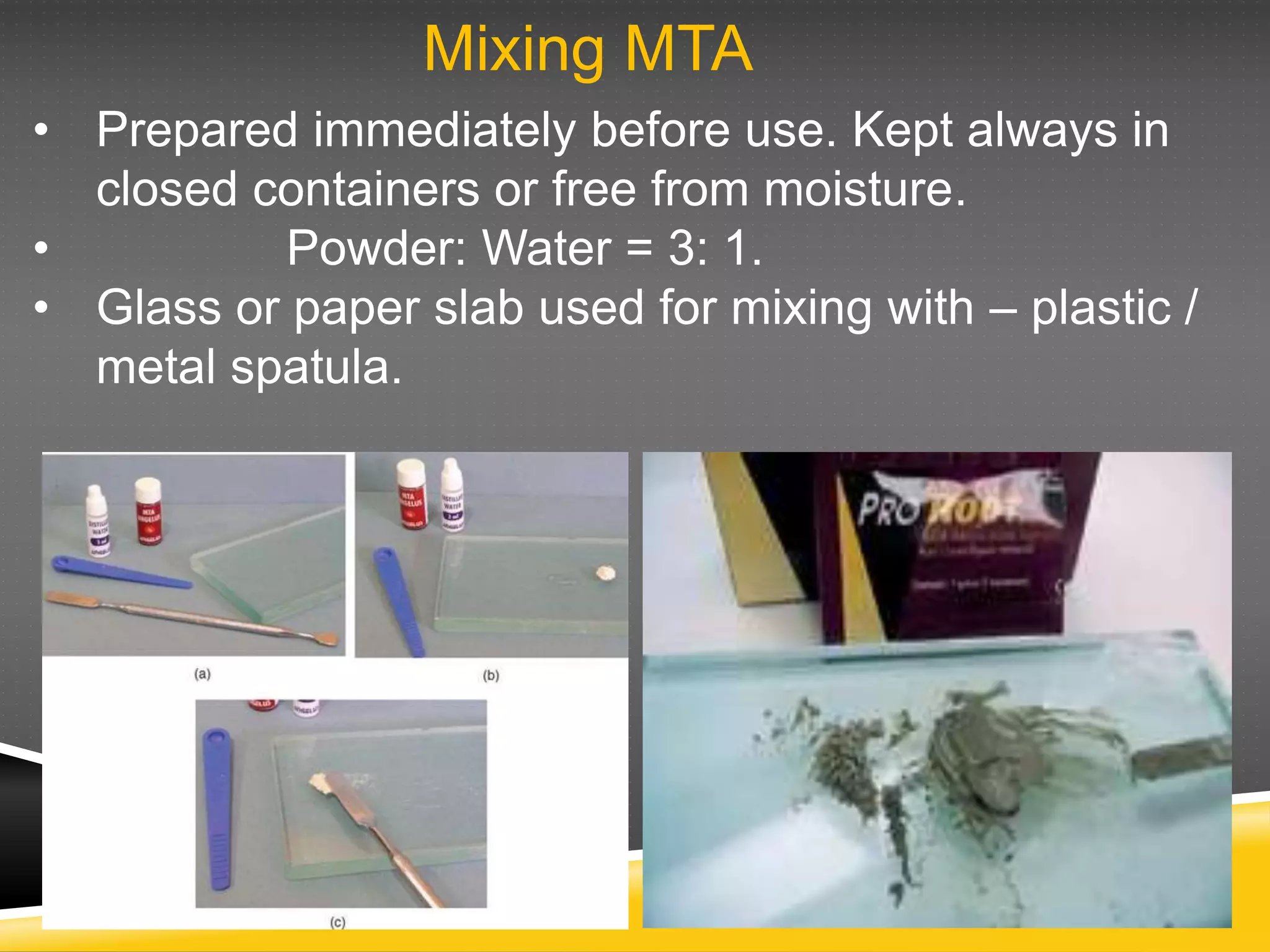
Mixing MTA
• Prepared immediately before use. Kept always in
closed containers or free from moisture.
• Powder: Water = 3: 1.
• Glass or paper slab used for mixing with – plastic /
metal spatula.
MECHANISM OF ACTION:
From the time that MTA is placed in direct contact with human
tissues, it appears that the material does the following3
I. Creates an antibacterial environment by its alkaline pH
II. Modulâtes cytokine production
III. Encourages differentiation and migration of hard tissue-
producing cells and
IV. Forms HA (or carbonated apatite) on the MTA surface and
provides a biologic seal.
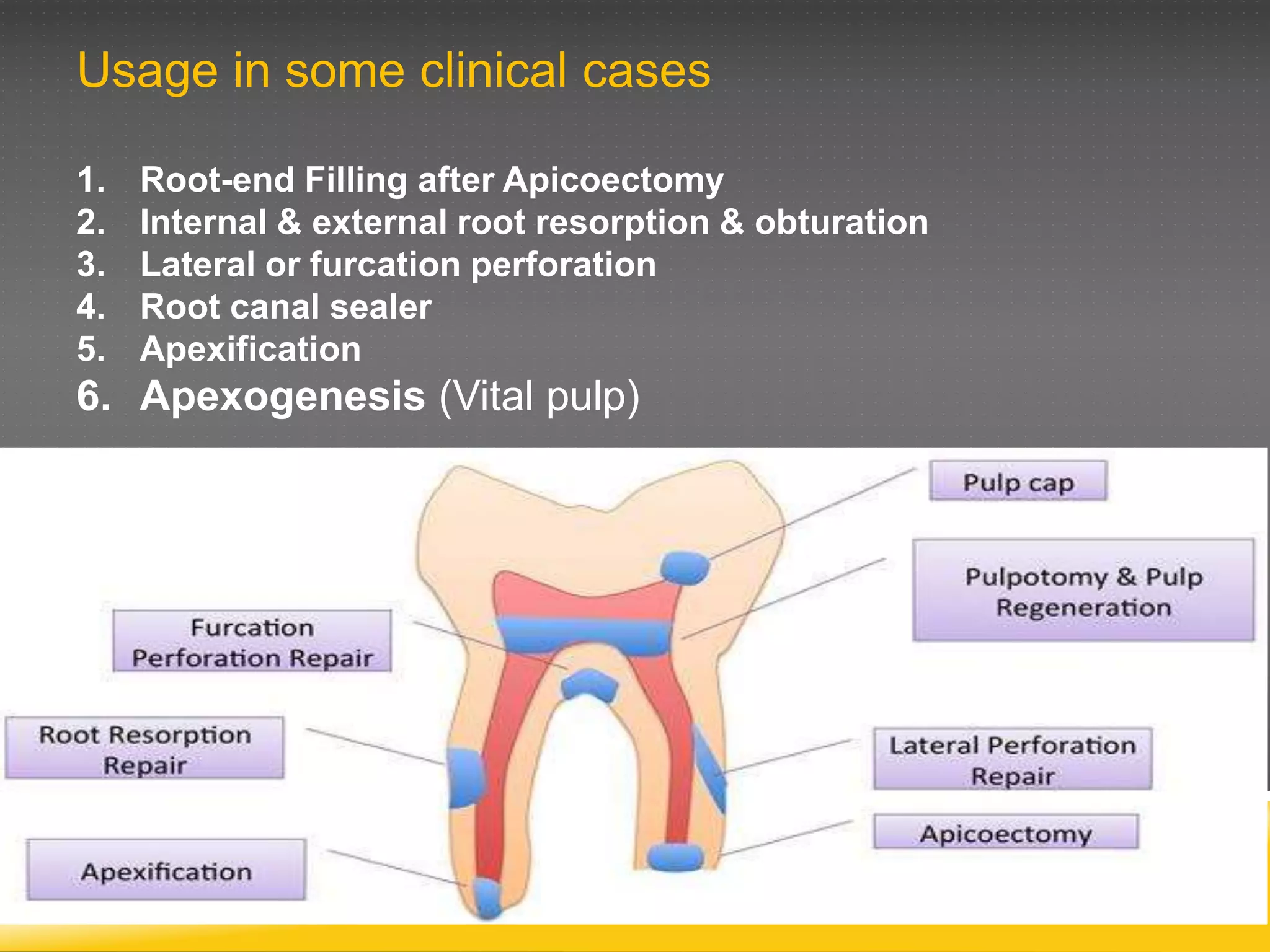
Usage in some clinical cases
1. Root-end Filling after Apicoectomy
2. Internal & external root resorption & obturation
3. Lateral or furcation perforation
4. Root canal sealer
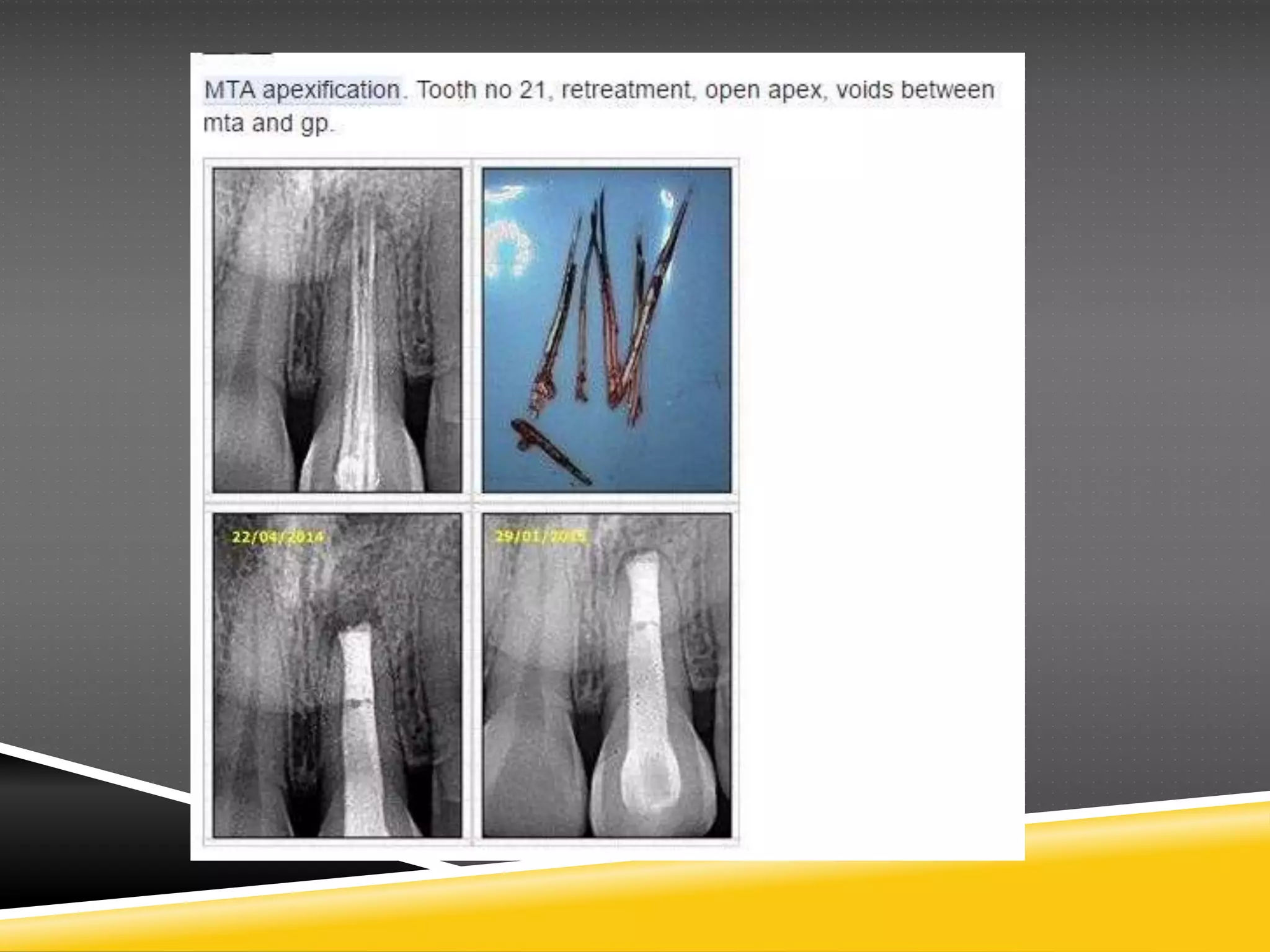
5. Apexification
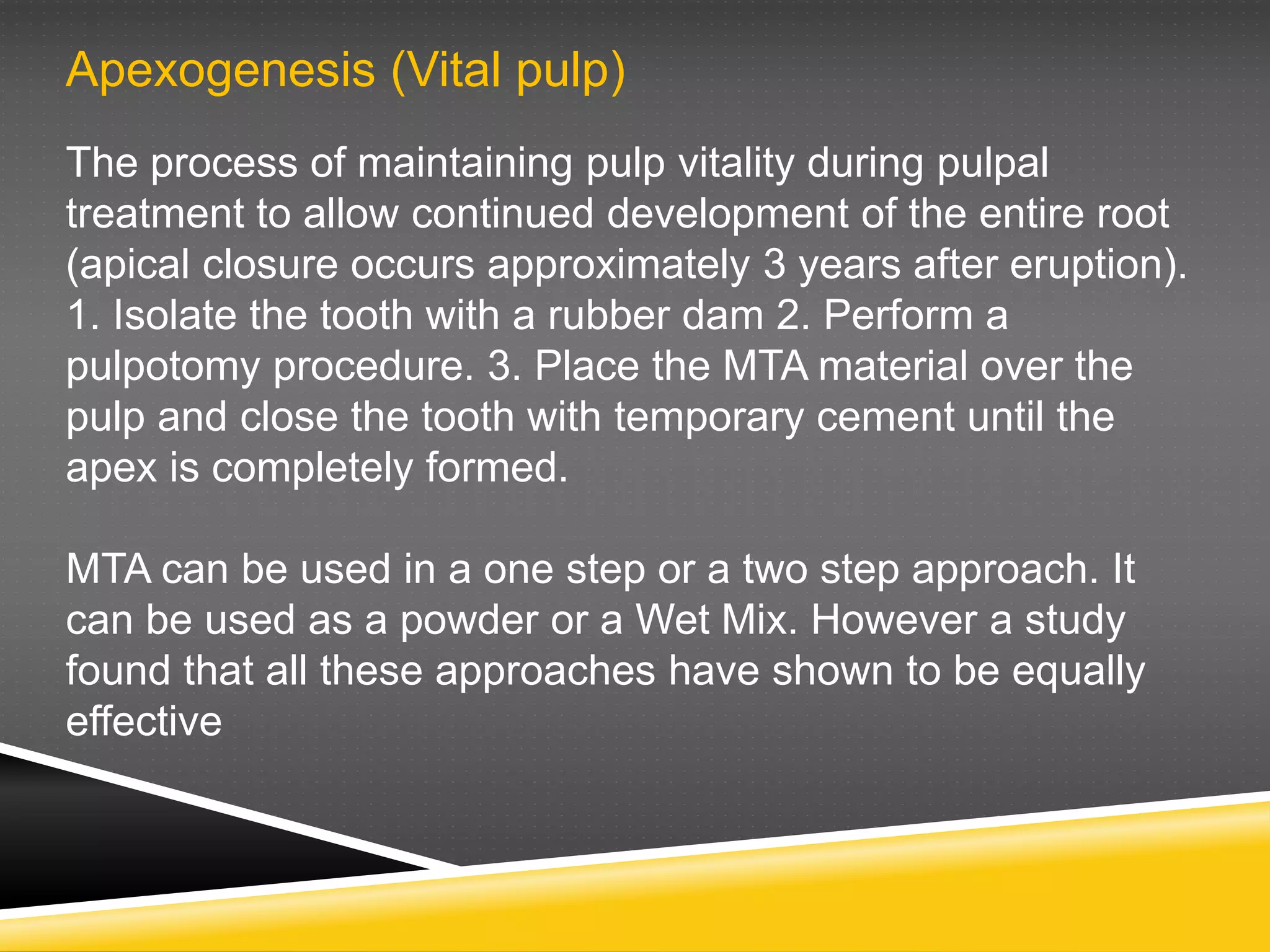
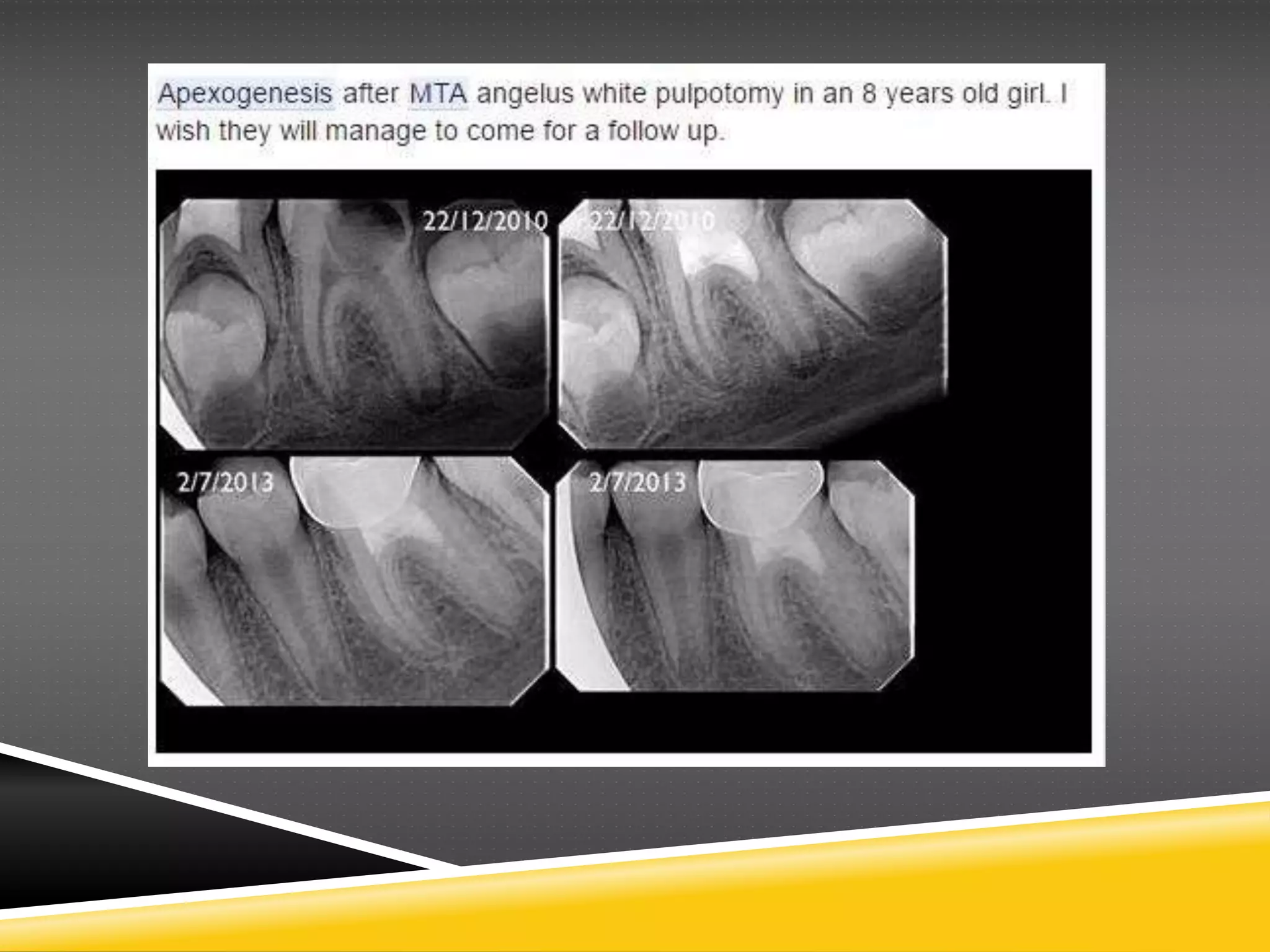
6. Apexogenesis (Vital pulp)
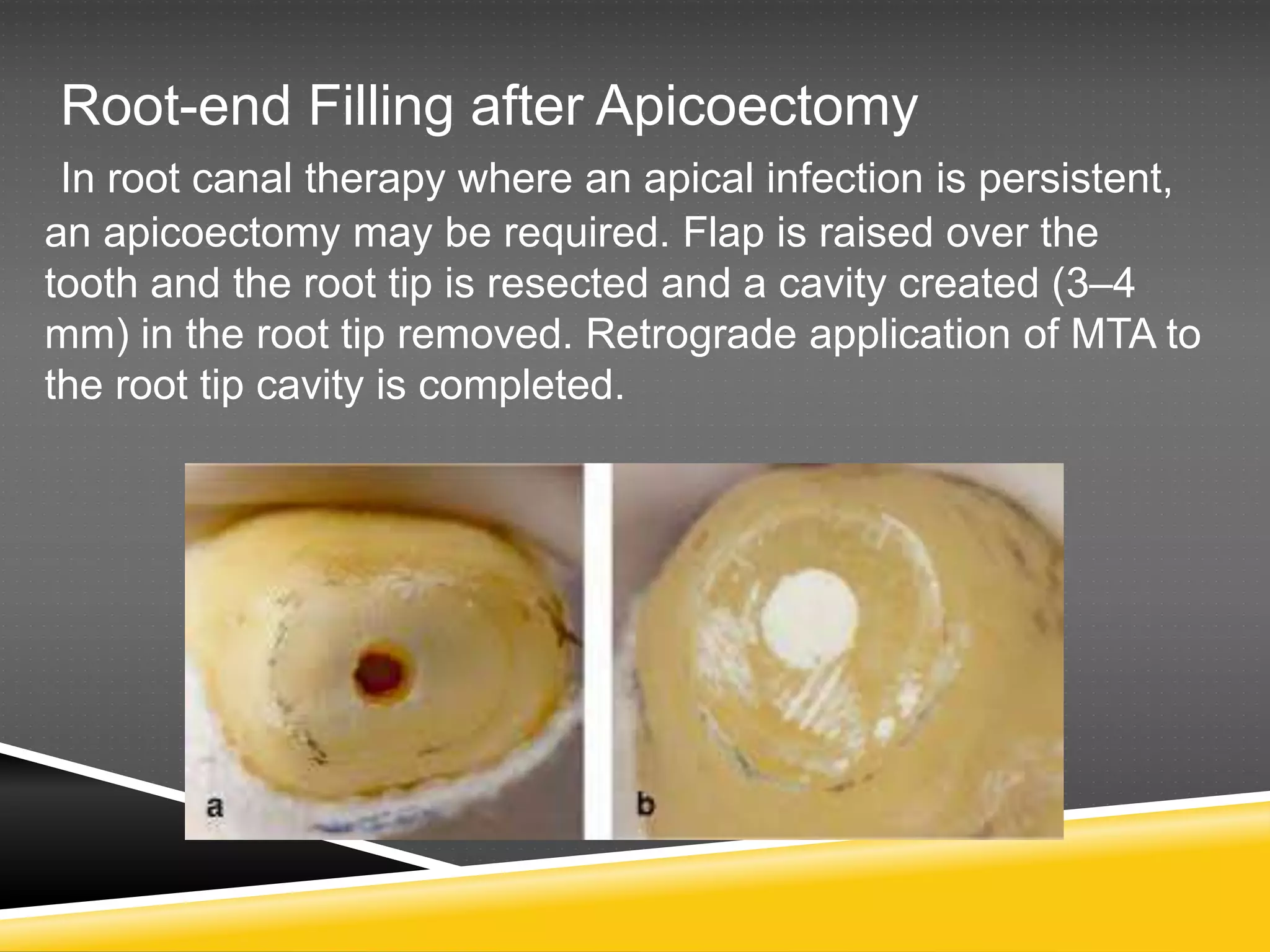
Root-end Filling after Apicoectomy
In root canal therapy where an apical infection is persistent,
an apicoectomy may be required. Flap is raised over the
tooth and the root tip is resected and a cavity created (3–4
mm) in the root tip removed. Retrograde application of MTA to
the root tip cavity is completed.
Internal & external root resorption & obturation
In internal resorption, root canal therapy is performed, a putty
mixture of MTA is inserted in the canal using pluggers to the
level of the defect. Gutta percha and root canal sealer are
placed above the defect to complete the root canal treatment.
In direct cases, the canal may be completely obturated with
MTA. The MTA will provide structure and strength to the tooth
by replacing the resorbed tooth structure. In external
resorption, after root canal therapy is performed, the flap is
raised over the tooth and the defect removed from the root
surface with a round bur. Retrograde application of MTA to the
root surface is then completed.
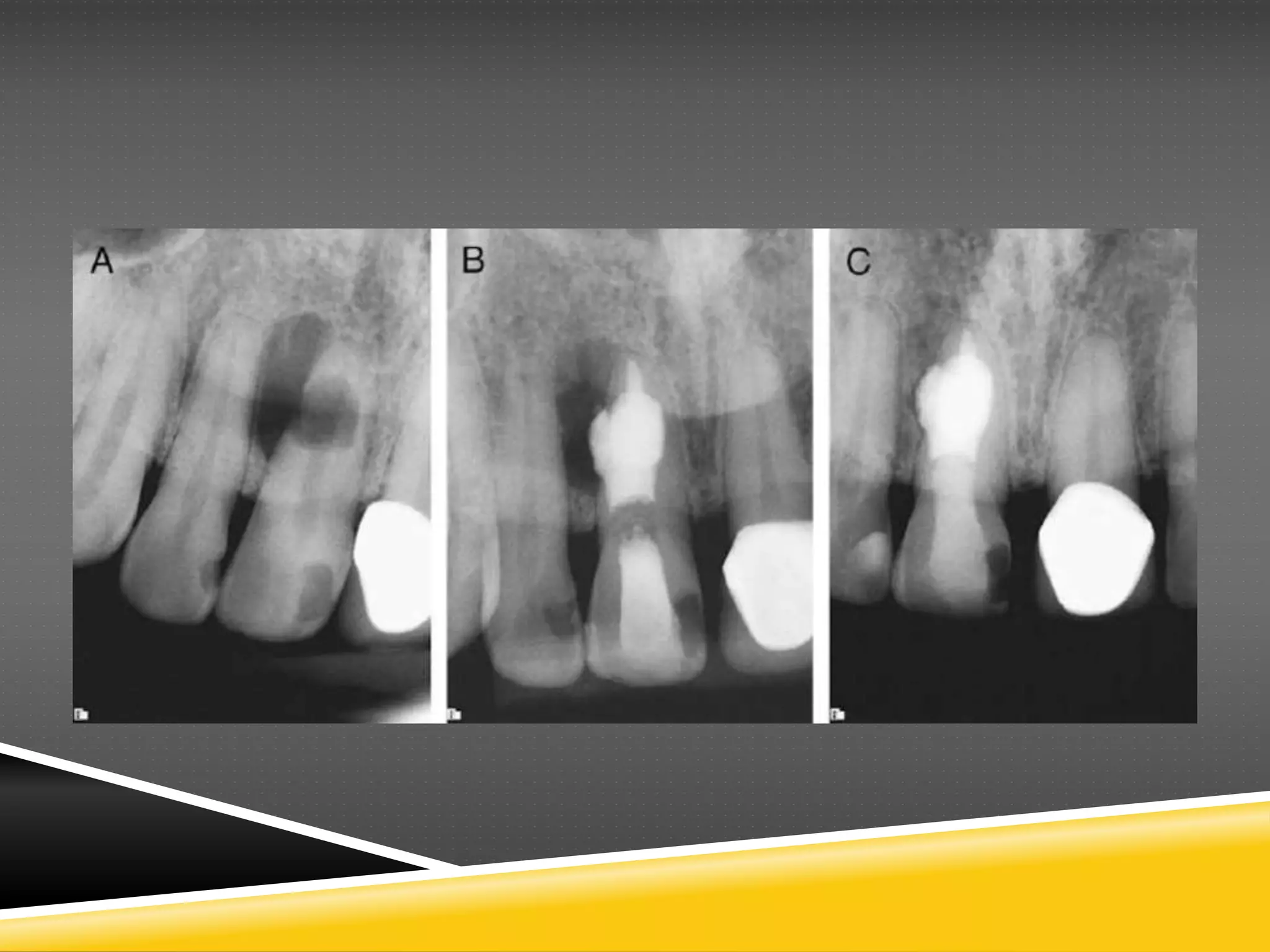
Lateral or furcation perforation
Lateral perforation occurs when an instrument has perforated
the root during cleaning & shaping of the canal by the dentist.
If it happens, one should finish cleaning & shaping of the
canal, irrigate the canal with sodium hypochlorite to disinfect it
and dry it with a paper point. The perforation can be sealed
with a thick mixture of an MTA-type product, preventing
bacterial ingress. Make sure that you can locate the canal
while the MTA has not set and remove the excess material
from the area.
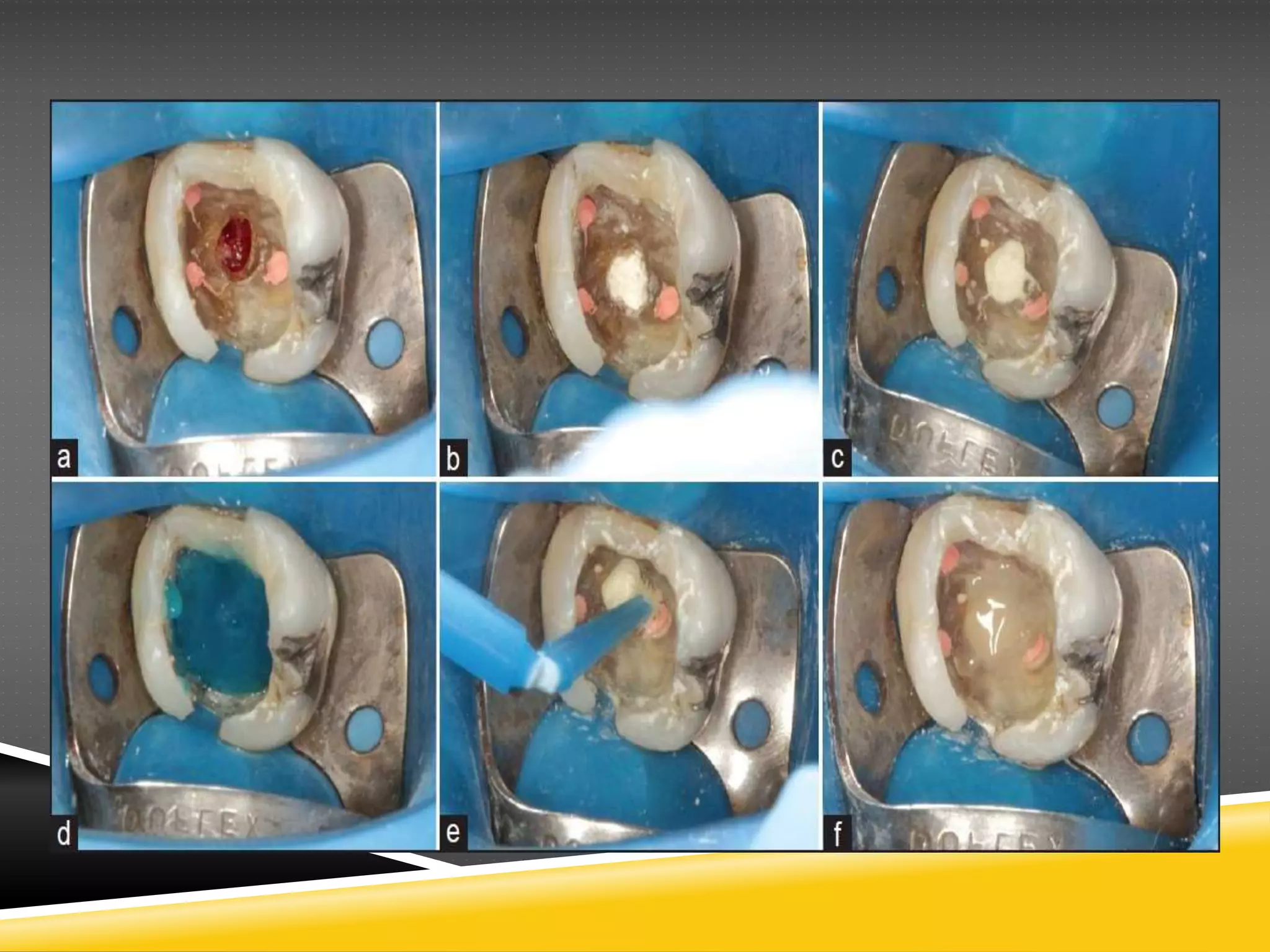
Apexification (Necrotic pulp)
When the root is incompletely formed in adolescents and an
infection occurs, apexification can be performed to maintain
the tooth in position as the roots develop. In case of non-vital
pulp: 1. Isolate the tooth with a rubber dam 2. perform root
canal treatment. 3. Mix MTA and insert it to the apex of the
tooth, creating a 3 mm thickness of plug. 5. Fill the canal with
sealer and gutta percha. Alternatively, revascularization
techniques are being used where an antibiotic is locally
administered. Later a blood clot is formed in the canal and a
coronal plug of MTA is placed.
Apexogenesis (Vital pulp)
The process of maintaining pulp vitality during pulpal
treatment to allow continued development of the entire root
(apical closure occurs approximately 3 years after eruption).
1. Isolate the tooth with a rubber dam 2. Perform a
pulpotomy procedure. 3. Place the MTA material over the
pulp and close the tooth with temporary cement until the
apex is completely formed.
MTA can be used in a one step or a two step approach. It
can be used as a powder or a Wet Mix. However a study
found that all these approaches have shown to be equally
effective
MTA
MTA

MTA

  • 1.
  • 2.
    INTRODUCTION Mineral trioxide aggregate(MTA) was developed for use as a dental root repair material by Dr. Mahmoud Torabinejad, (MTA) is the most commonly recommended material for sealing communications between the root canal system and the periodontium and was formulated from commercial Portland cement combined with bismuth oxide powder for radiopacity.
  • 3.
    MTA COMPOSITION MTA iscomprised primarily of Portland cement 75 wt% Portland cement, 20 wt% bismuth oxide (Bi2O3), and 5 wt% calcium sulfate dihydrate or gypsum (CaSO4 ∙ 2H2O). Additional minor trace elements may also be present .
  • 4.
    Types of MTA: Thereare two types of MTA 1. Gray 2. White
  • 5.
    because of itscolor problem and esthetic concern a new type of MTA (WMTA) was introduced at 2002 . The grayness of GMTA arises from the presence of an iron- containing compound. In 2002, a white formula of MTA was introduced, achieved by eliminating iron oxide from the formulation.
  • 6.
    Characteristics of MTA 1.Biocompatible with periradicular tissues 2. Non cytotoxic to cells, but antimicrobial to bacteria 3. Non-resorbable 4. Minimal leakage around the margins. 5. Very basic AKA alkaline initial pH: 10.2 initially and it rose to 12.5 after 3 hours . 6. MTA powder contains fine hydrophilic particles that set in the presence of moisture 7. Compressive strength develops over a period of 28 days, similar to Portland cement. Strengths of more than 133 MPa . 8. MTA displays low or nearly no solubility 9. Radio opaque
  • 7.
    Disadvantages of MTA -Slow setting time 4 hrs - Difficult manipulation - High cost :
  • 8.
    Mixing MTA • Preparedimmediately before use. Kept always in closed containers or free from moisture. • Powder: Water = 3: 1. • Glass or paper slab used for mixing with – plastic / metal spatula.
  • 13.
    MECHANISM OF ACTION: Fromthe time that MTA is placed in direct contact with human tissues, it appears that the material does the following3 I. Creates an antibacterial environment by its alkaline pH II. Modulâtes cytokine production III. Encourages differentiation and migration of hard tissue- producing cells and IV. Forms HA (or carbonated apatite) on the MTA surface and provides a biologic seal.
  • 14.
    Usage in someclinical cases 1. Root-end Filling after Apicoectomy 2. Internal & external root resorption & obturation 3. Lateral or furcation perforation 4. Root canal sealer 5. Apexification 6. Apexogenesis (Vital pulp)
  • 15.
    Root-end Filling afterApicoectomy In root canal therapy where an apical infection is persistent, an apicoectomy may be required. Flap is raised over the tooth and the root tip is resected and a cavity created (3–4 mm) in the root tip removed. Retrograde application of MTA to the root tip cavity is completed.
  • 16.
    Internal & externalroot resorption & obturation In internal resorption, root canal therapy is performed, a putty mixture of MTA is inserted in the canal using pluggers to the level of the defect. Gutta percha and root canal sealer are placed above the defect to complete the root canal treatment. In direct cases, the canal may be completely obturated with MTA. The MTA will provide structure and strength to the tooth by replacing the resorbed tooth structure. In external resorption, after root canal therapy is performed, the flap is raised over the tooth and the defect removed from the root surface with a round bur. Retrograde application of MTA to the root surface is then completed.
  • 18.
    Lateral or furcationperforation Lateral perforation occurs when an instrument has perforated the root during cleaning & shaping of the canal by the dentist. If it happens, one should finish cleaning & shaping of the canal, irrigate the canal with sodium hypochlorite to disinfect it and dry it with a paper point. The perforation can be sealed with a thick mixture of an MTA-type product, preventing bacterial ingress. Make sure that you can locate the canal while the MTA has not set and remove the excess material from the area.
  • 20.
    Apexification (Necrotic pulp) Whenthe root is incompletely formed in adolescents and an infection occurs, apexification can be performed to maintain the tooth in position as the roots develop. In case of non-vital pulp: 1. Isolate the tooth with a rubber dam 2. perform root canal treatment. 3. Mix MTA and insert it to the apex of the tooth, creating a 3 mm thickness of plug. 5. Fill the canal with sealer and gutta percha. Alternatively, revascularization techniques are being used where an antibiotic is locally administered. Later a blood clot is formed in the canal and a coronal plug of MTA is placed.
  • 22.
    Apexogenesis (Vital pulp) Theprocess of maintaining pulp vitality during pulpal treatment to allow continued development of the entire root (apical closure occurs approximately 3 years after eruption). 1. Isolate the tooth with a rubber dam 2. Perform a pulpotomy procedure. 3. Place the MTA material over the pulp and close the tooth with temporary cement until the apex is completely formed. MTA can be used in a one step or a two step approach. It can be used as a powder or a Wet Mix. However a study found that all these approaches have shown to be equally effective