‫الرحيم‬ ‫الرحمن‬ ‫هللا‬ ‫بسم‬
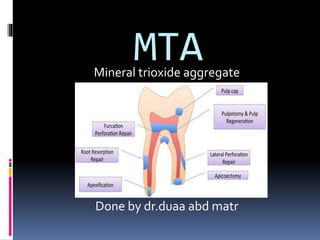
MTAMineral trioxide aggregate
Done by dr.duaa abd matr
INTRODUCTION
Mineral Trioxide Aggregate (MTA) is a new material with
numerous exciting clinical applications.
MTA be one of the most versatile materials of this century in
the field of dentistry. Some of the appreciable
properties of MTA include its good physical properties and its
ability to stimulate tissue regeneration
as well as good pulp response.
HISTORY
It was introduced by mohmoud torabinejad
in 1993
It was improved for human usage by 1998
This material appear to be improvement
over other material for some procedure
that involve root repair and bone healing
Composition
MTA is mainly composed of 3
powder ingredients
* Portland cement(75%) is the major constituent.
It is responsible for the setting & biologic
properties.
* Bismuth oxide(20%) provides radiopacity.
* Gypsum (5%)is an important determinant of
setting time.
Portland cement is composed of 4 major
Components
dicalcium silicate
tricalcium aluminate
tetracalcium aluminoferrite
tricalcium silicate
* Dicalcium silicate hydrates more slowly than
tricalcium silicate & is responsiple for the latter’s
strength
* Tricalcium silicate is the most
important constituent of Portland
cement. It is the major component in the
formation of calcium silicate hydrate
which gives early strength to Portland
cement
.
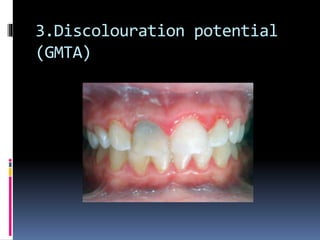
* Aluminoferrite (contains iron) is present
in gray MTA. It is responsible for the gray
discoloration. It may discolor the tooth.
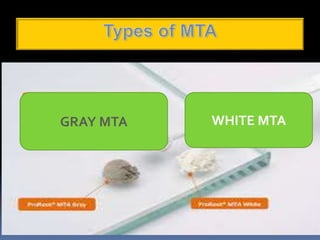
GRAY MTA WHITE MTA
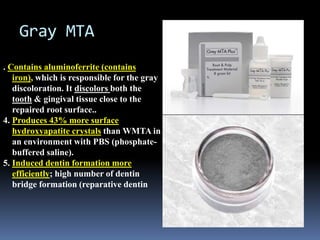
Gray MTA
. Contains aluminoferrite (contains
iron), which is responsible for the gray
discoloration. It discolors both the
tooth & gingival tissue close to the
repaired root surface..
4. Produces 43% more surface
hydroxyapatite crystals than WMTA in
an environment with PBS (phosphate-
buffered saline).
5. Induced dentin formation more
efficiently; high number of dentin
bridge formation (reparative dentin
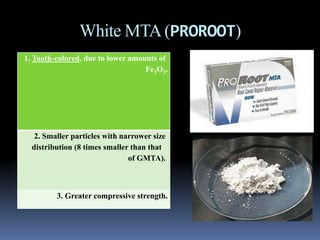
White MTA(PROROOT)
1. Tooth-colored, due to lower amounts of
Fe2O3.
2. Smaller particles with narrower size
distribution (8 times smaller than that
of GMTA).
3. Greater compressive strength.
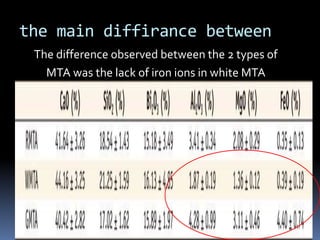
the main diffirance between
The difference observed between the 2 types of
MTA was the lack of iron ions in white MTA
* Hydration reaction.
* Notes: - MTA is called hydraulic silicate cement (HSC).
- It is called hydraulic cement
(i.e. sets & is stable under water) relying primarily on
hydration reactions for setting.
-The material consists primarily of calcium silicate.
*When mixed with water, MTA sets.The pH of MTA
increases from 10 to 12.5 three hours after mixing.
In high pH environment, the calcium ions that are
released from MTA react with phosphates in the tissue
fluid to form hydroxyapatite (the principal mineral in
teeth & bones).
MTA
Manipulation
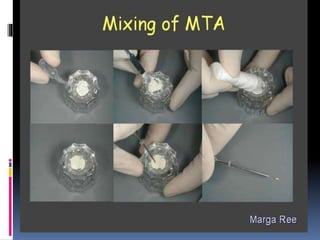
Mixing: gray MTA & white MTA are mixed with
supplied sterile water in a powder to liquid
ratio of 3:1 according to the manufacturer’s
instruction.
Note: Poor handling properties.The loose sandy
nature of the mixture causes much difficulty
for the insertion & packing of MTA.
.
Insertion: Ultrasonic-assisted condensation [the
ultrasonic vibration applied to endodontic
plugger(condenser)] is more efficient than hand
condensation in:
- the apical flowing of MTA (enable better flow).
- delaying bacterial leakage (enable better
adaptation).
- the production of denser MTA apical plug
MTA
*Thickness: 5-mm MTA apical plug provided
reduced microleakage.
* A Radiogragh is made.
* A moist (wet) cotton pellet is placed above the
MTA (to ensure setting), & a well-sealing
temporary restoration is placed.
Note: MTA sets 3-4 h after mixing.
*The patient is recalled when MTA has set (at
least 24 hours) for obturation & placement
of permanent restoration.
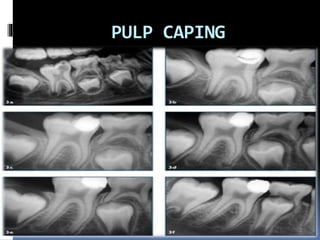
PULP CAPING
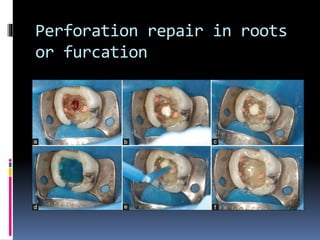
Perforation repair in roots
or furcation
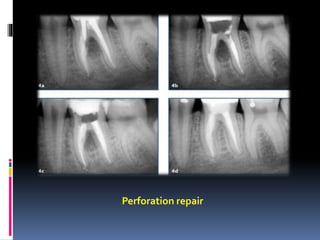
Perforation repair
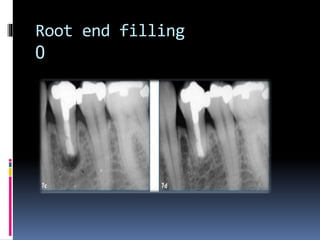
Root end filling
0
Apexification and apexogenesis
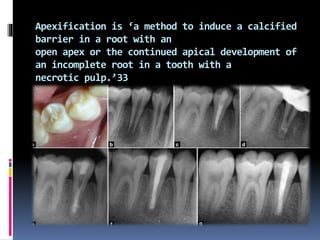
Apexification is ‘a method to induce a calcified
barrier in a root with an
open apex or the continued apical development of
an incomplete root in a tooth with a
necrotic pulp.’33
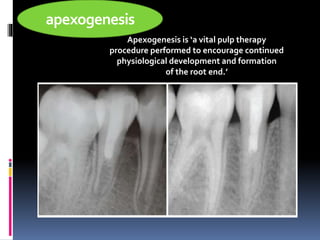
apexogenesis
Apexogenesis is ‘a vital pulp therapy
procedure performed to encourage continued
physiological development and formation
of the root end.’
contraindication
This material is not recommended for
obturation to the primary teeth that expect
to exfoliate since it slowly absorb
1. (Bacteriostatic)
due to Highly alkaline pH
Ph=10.2 increase to 12.5 after 3 hr
of mixing
2.Save treatment time. High success
rate.
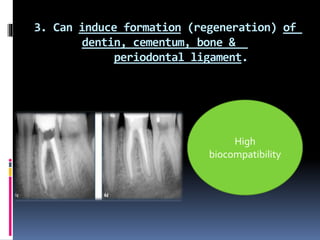
3. Can induce formation (regeneration) of
dentin, cementum, bone &
periodontal ligament.
High
biocompatibility
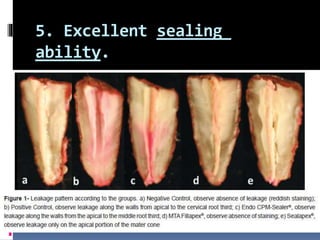
5. Excellent sealing
ability.
Due to setting expansion
Advantages of its longer setting time are
that, the quicker a material sets the
more it shrinks.This explains why MTA
in previous experiments had
significantly less dye and bacterial
leakage than other materials tested as
root filling materials.1,4,5
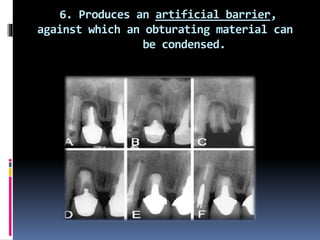
6. Produces an artificial barrier,
against which an obturating material can
be condensed.
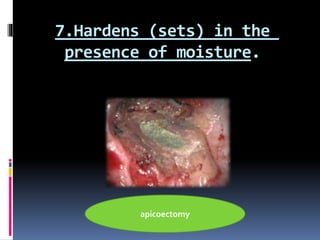
7.Hardens (sets) in the
presence of moisture.
apicoectomy
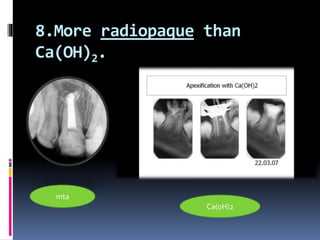
8.More radiopaque than
Ca(OH)2.
mta
Ca(oH)2
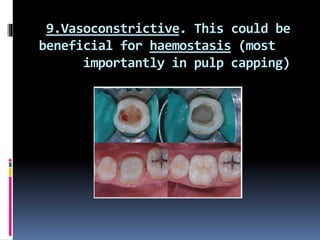
9.Vasoconstrictive. This could be
beneficial for haemostasis (most
importantly in pulp capping)
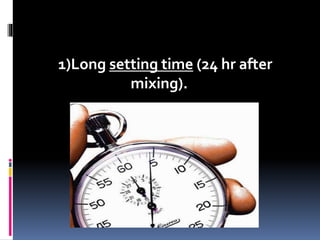
1)Long setting time (24 hr after
mixing).
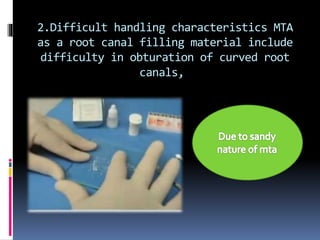
2.Difficult handling characteristics MTA
as a root canal filling material include
difficulty in obturation of curved root
canals,
3.Discolouration potential
(GMTA)
4.An absence of a known
solvent for set MTA. -
Difficulty in removal after
curing
3.High cost.
REFERENCES1. Parirokh M and Torabinejad M. Mineral trioxide aggregate: a comprehensive literature review- part I : chemical, Physical, and
Antibacterial Properties. J Endod 2010;36:16-27.
2. Parirokh M and Torabinejad M. Mineral trioxide aggregate: a comprehensive literature review- part II : leakage and
Biocompatibility Investigations J Endod 2010;36:190-202.
3. Parirokh M and Torabinejad M. Mineral trioxide aggregate: a comprehensive literature review- part III : clinical Applications,
Drawbacks, and Mechanism of Action J Endod 2010;36:400-413.
4. Mahmoud Torabinejad and T.T, Pit Ford: Physical and chemical properties of a new root end filing materials. The American
Association of Endodontics Vol, 21, No. 7 July 1995.
5. Santos AD, Moraes JC, Arau´ jo EB, Yukimitu K, Vale´rio Filho WV. Physico-chemical properties of MTA and a novel experimental
cement. Int Endod J 2005;38:443-447.
6. G. De-Deus, V. Petruccelli, E. Gurgel-Filho , T. Coutinho-Filho MTA versus Portland cement as repair material for furcal
perforations: a laboratory study using a polymicrobial leakage model. Int Endod J 2006;39:293-298.
7. Tziafas D, Pantelidou O, Alvanou A, Belibasakis G, Papadimitriou S. The dentinogenic effect of mineral trioxide aggregate (MTA)
in short-term capping experiments. Int Endod J 2002;35:245-254.
8. Bargholz C. Perforation repair with mineral trioxide aggregate: a modified matrix concept. Int Endod J 2005;38:59-69.
9. Islam I, Chng HK, Yap AU. X-ray diffraction analysis of mineral trioxide aggregate and Portland cement. Int Endod J 2006;39:220-
225.
10. Effect of Mineral trioxide aggregate on proliferation of cultured human dental pulp cells. Int Endod J,2006;39:415- 422.
11. Camilleri J, Pitt Ford TR. Mineral trioxide aggregate: a review of the constituents and biological properties of the material.
Int Endod J 2006;39:747-54.
12. Felippe WT, Felippe MC, Rocha MJ. The effect of mineral trioxide aggregate on the apexification and periapical healing of teeth
with incomplete root formation. Int Endod J 2006;39:2-9.
13. Song JS, Mante FK, Romanow WJ, Kim S. Chemical analysis of powder and set forms of Portland cement, gray ProRoot , white ProRoot
MTA, and gray MTA-Angelus. Oral Surg Oral Med Oral Pathol Oral Radiol Endod 2006;102:809-15.
14. Menezes R, da Silva Neto UX, Carneiro E, Letra A, Bramante CM, Bernadinelli N. MTA repair of a supracrestal perforation: a case
report. J Endod 2005;31:212-214.
15. Baek SH, Plenk H Jr., Kim S. Periapical tissue responses and cementum regeneration with amalgam, Super EBA, and MTA as root-end
filling materials. J Endod 2005;31:444-449.
16. Bortoluzzi EA, Broon NJ, Bramante CM, Garcia RB, de Moraes IG, Bernardineli N. Sealing ability of MTA and radiopaque Portland
cement with or without calciumchloride for rootend filling. J Endod 2006;32:897-900.
17. Torabinejad M, Chivian N. Clinical applications of mineral trioxide aggregate. J Endod 1999;25:197-205.
18. M. Torabeinejad and T.R. Pitt Ford : Antibacterial effects of some root end filling material. The American Association of
Endodontists Vo.21, No.8, August 1995.
19. Torabinejad M, Chivian N. Clinical applications of mineral trioxide aggregate. J Endod 1999;25:197-205.
20. M. Torabinejad and T.R. Pitt Ford : Sealing ability of mineral trioxide aggregate when used as a root end filling materials. The
American Association of Endodontists Vo.19., No. 12, Dec. 1999.
mta

mta

  • 1.
  • 2.
  • 3.
    INTRODUCTION Mineral Trioxide Aggregate(MTA) is a new material with numerous exciting clinical applications. MTA be one of the most versatile materials of this century in the field of dentistry. Some of the appreciable properties of MTA include its good physical properties and its ability to stimulate tissue regeneration as well as good pulp response.
  • 4.
    HISTORY It was introducedby mohmoud torabinejad in 1993 It was improved for human usage by 1998 This material appear to be improvement over other material for some procedure that involve root repair and bone healing
  • 5.
    Composition MTA is mainlycomposed of 3 powder ingredients
  • 6.
    * Portland cement(75%)is the major constituent. It is responsible for the setting & biologic properties. * Bismuth oxide(20%) provides radiopacity. * Gypsum (5%)is an important determinant of setting time.
  • 7.
    Portland cement iscomposed of 4 major Components dicalcium silicate tricalcium aluminate tetracalcium aluminoferrite tricalcium silicate
  • 8.
    * Dicalcium silicatehydrates more slowly than tricalcium silicate & is responsiple for the latter’s strength * Tricalcium silicate is the most important constituent of Portland cement. It is the major component in the formation of calcium silicate hydrate which gives early strength to Portland cement
  • 9.
    . * Aluminoferrite (containsiron) is present in gray MTA. It is responsible for the gray discoloration. It may discolor the tooth.
  • 10.
  • 11.
    Gray MTA . Containsaluminoferrite (contains iron), which is responsible for the gray discoloration. It discolors both the tooth & gingival tissue close to the repaired root surface.. 4. Produces 43% more surface hydroxyapatite crystals than WMTA in an environment with PBS (phosphate- buffered saline). 5. Induced dentin formation more efficiently; high number of dentin bridge formation (reparative dentin
  • 12.
    White MTA(PROROOT) 1. Tooth-colored,due to lower amounts of Fe2O3. 2. Smaller particles with narrower size distribution (8 times smaller than that of GMTA). 3. Greater compressive strength.
  • 13.
    the main diffirancebetween The difference observed between the 2 types of MTA was the lack of iron ions in white MTA
  • 14.
    * Hydration reaction. *Notes: - MTA is called hydraulic silicate cement (HSC). - It is called hydraulic cement (i.e. sets & is stable under water) relying primarily on hydration reactions for setting. -The material consists primarily of calcium silicate. *When mixed with water, MTA sets.The pH of MTA increases from 10 to 12.5 three hours after mixing. In high pH environment, the calcium ions that are released from MTA react with phosphates in the tissue fluid to form hydroxyapatite (the principal mineral in teeth & bones).
  • 15.
    MTA Manipulation Mixing: gray MTA& white MTA are mixed with supplied sterile water in a powder to liquid ratio of 3:1 according to the manufacturer’s instruction. Note: Poor handling properties.The loose sandy nature of the mixture causes much difficulty for the insertion & packing of MTA. .
  • 17.
    Insertion: Ultrasonic-assisted condensation[the ultrasonic vibration applied to endodontic plugger(condenser)] is more efficient than hand condensation in: - the apical flowing of MTA (enable better flow). - delaying bacterial leakage (enable better adaptation). - the production of denser MTA apical plug
  • 18.
    MTA *Thickness: 5-mm MTAapical plug provided reduced microleakage. * A Radiogragh is made. * A moist (wet) cotton pellet is placed above the MTA (to ensure setting), & a well-sealing temporary restoration is placed. Note: MTA sets 3-4 h after mixing. *The patient is recalled when MTA has set (at least 24 hours) for obturation & placement of permanent restoration.
  • 20.
  • 21.
    Perforation repair inroots or furcation
  • 22.
  • 23.
  • 24.
  • 25.
    Apexification is ‘amethod to induce a calcified barrier in a root with an open apex or the continued apical development of an incomplete root in a tooth with a necrotic pulp.’33
  • 26.
    apexogenesis Apexogenesis is ‘avital pulp therapy procedure performed to encourage continued physiological development and formation of the root end.’
  • 27.
    contraindication This material isnot recommended for obturation to the primary teeth that expect to exfoliate since it slowly absorb
  • 28.
    1. (Bacteriostatic) due toHighly alkaline pH Ph=10.2 increase to 12.5 after 3 hr of mixing
  • 29.
    2.Save treatment time.High success rate.
  • 30.
    3. Can induceformation (regeneration) of dentin, cementum, bone & periodontal ligament. High biocompatibility
  • 31.
  • 32.
    Due to settingexpansion Advantages of its longer setting time are that, the quicker a material sets the more it shrinks.This explains why MTA in previous experiments had significantly less dye and bacterial leakage than other materials tested as root filling materials.1,4,5
  • 33.
    6. Produces anartificial barrier, against which an obturating material can be condensed.
  • 34.
    7.Hardens (sets) inthe presence of moisture. apicoectomy
  • 35.
  • 36.
    9.Vasoconstrictive. This couldbe beneficial for haemostasis (most importantly in pulp capping)
  • 38.
    1)Long setting time(24 hr after mixing).
  • 39.
    2.Difficult handling characteristicsMTA as a root canal filling material include difficulty in obturation of curved root canals,
  • 40.
  • 41.
    4.An absence ofa known solvent for set MTA. - Difficulty in removal after curing
  • 42.
  • 43.
    REFERENCES1. Parirokh Mand Torabinejad M. Mineral trioxide aggregate: a comprehensive literature review- part I : chemical, Physical, and Antibacterial Properties. J Endod 2010;36:16-27. 2. Parirokh M and Torabinejad M. Mineral trioxide aggregate: a comprehensive literature review- part II : leakage and Biocompatibility Investigations J Endod 2010;36:190-202. 3. Parirokh M and Torabinejad M. Mineral trioxide aggregate: a comprehensive literature review- part III : clinical Applications, Drawbacks, and Mechanism of Action J Endod 2010;36:400-413. 4. Mahmoud Torabinejad and T.T, Pit Ford: Physical and chemical properties of a new root end filing materials. The American Association of Endodontics Vol, 21, No. 7 July 1995. 5. Santos AD, Moraes JC, Arau´ jo EB, Yukimitu K, Vale´rio Filho WV. Physico-chemical properties of MTA and a novel experimental cement. Int Endod J 2005;38:443-447. 6. G. De-Deus, V. Petruccelli, E. Gurgel-Filho , T. Coutinho-Filho MTA versus Portland cement as repair material for furcal perforations: a laboratory study using a polymicrobial leakage model. Int Endod J 2006;39:293-298. 7. Tziafas D, Pantelidou O, Alvanou A, Belibasakis G, Papadimitriou S. The dentinogenic effect of mineral trioxide aggregate (MTA) in short-term capping experiments. Int Endod J 2002;35:245-254. 8. Bargholz C. Perforation repair with mineral trioxide aggregate: a modified matrix concept. Int Endod J 2005;38:59-69. 9. Islam I, Chng HK, Yap AU. X-ray diffraction analysis of mineral trioxide aggregate and Portland cement. Int Endod J 2006;39:220- 225. 10. Effect of Mineral trioxide aggregate on proliferation of cultured human dental pulp cells. Int Endod J,2006;39:415- 422. 11. Camilleri J, Pitt Ford TR. Mineral trioxide aggregate: a review of the constituents and biological properties of the material. Int Endod J 2006;39:747-54. 12. Felippe WT, Felippe MC, Rocha MJ. The effect of mineral trioxide aggregate on the apexification and periapical healing of teeth with incomplete root formation. Int Endod J 2006;39:2-9. 13. Song JS, Mante FK, Romanow WJ, Kim S. Chemical analysis of powder and set forms of Portland cement, gray ProRoot , white ProRoot MTA, and gray MTA-Angelus. Oral Surg Oral Med Oral Pathol Oral Radiol Endod 2006;102:809-15. 14. Menezes R, da Silva Neto UX, Carneiro E, Letra A, Bramante CM, Bernadinelli N. MTA repair of a supracrestal perforation: a case report. J Endod 2005;31:212-214. 15. Baek SH, Plenk H Jr., Kim S. Periapical tissue responses and cementum regeneration with amalgam, Super EBA, and MTA as root-end filling materials. J Endod 2005;31:444-449. 16. Bortoluzzi EA, Broon NJ, Bramante CM, Garcia RB, de Moraes IG, Bernardineli N. Sealing ability of MTA and radiopaque Portland cement with or without calciumchloride for rootend filling. J Endod 2006;32:897-900. 17. Torabinejad M, Chivian N. Clinical applications of mineral trioxide aggregate. J Endod 1999;25:197-205. 18. M. Torabeinejad and T.R. Pitt Ford : Antibacterial effects of some root end filling material. The American Association of Endodontists Vo.21, No.8, August 1995. 19. Torabinejad M, Chivian N. Clinical applications of mineral trioxide aggregate. J Endod 1999;25:197-205. 20. M. Torabinejad and T.R. Pitt Ford : Sealing ability of mineral trioxide aggregate when used as a root end filling materials. The American Association of Endodontists Vo.19., No. 12, Dec. 1999.