History of Africa


     Africa Unit
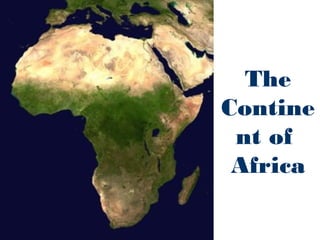
The
Contine
 nt of
 Africa
Early Civilizations
     of Africa


     Africa Unit
Where Civilization Began
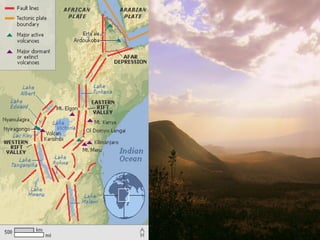
• Olduvai Gorge – located on the edge of
  the Great Rift Valley in Tanzania

• Archaeologists – Mary and Louis
  Leakey discovered bone over 2 million
  years old

• This has led some scientists to believe
  that the first people were from Africa
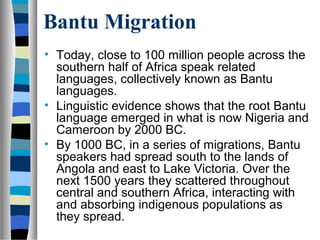
Bantu Migration
• Today, close to 100 million people across the
  southern half of Africa speak related
  languages, collectively known as Bantu
  languages.
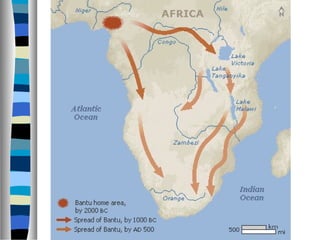
• Linguistic evidence shows that the root Bantu
  language emerged in what is now Nigeria and
  Cameroon by 2000 BC.
• By 1000 BC, in a series of migrations, Bantu
  speakers had spread south to the lands of
  Angola and east to Lake Victoria. Over the
  next 1500 years they scattered throughout
  central and southern Africa, interacting with
  and absorbing indigenous populations as
  they spread.
The Gold – Salt Trade
• Traveling caravans crossed the vast
  Sahara desert to the Middle East
• Travelers looked to profit from the
  desert crossing with large trades
• The savanna lands of West Africa
  lacked salt, which is essential to
  survival
• In West Africa, salt was more valuable
  than gold
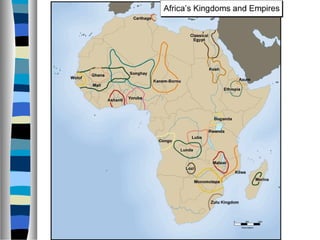
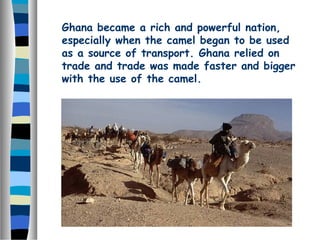
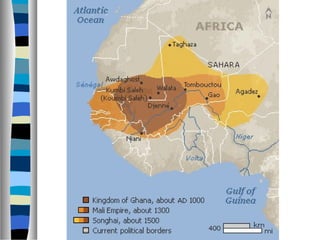
Ghana became a rich and powerful nation,
especially when the camel began to be used
as a source of transport. Ghana relied on
trade and trade was made faster and bigger
with the use of the camel.
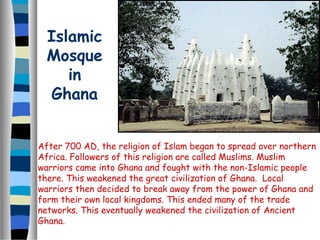
Islamic
  Mosque
     in
  Ghana


After 700 AD, the religion of Islam began to spread over northern
Africa. Followers of this religion are called Muslims. Muslim
warriors came into Ghana and fought with the non-Islamic people
there. This weakened the great civilization of Ghana. Local
warriors then decided to break away from the power of Ghana and
form their own local kingdoms. This ended many of the trade
networks. This eventually weakened the civilization of Ancient
Ghana.
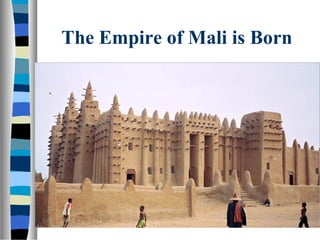
The Empire of Mali is Born
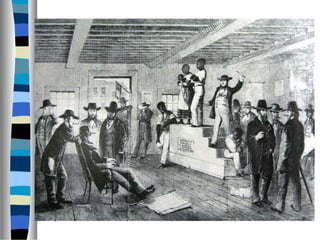
The Slave Trade


    Africa Unit
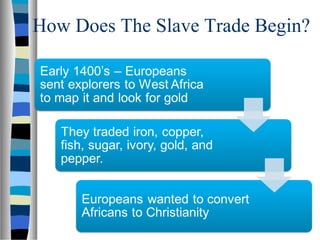
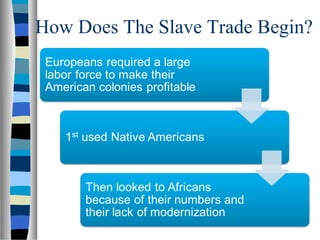
How Does The Slave Trade Begin?
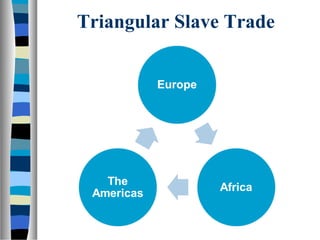
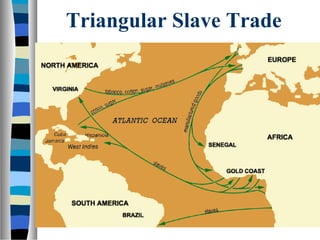
Triangular Slave Trade
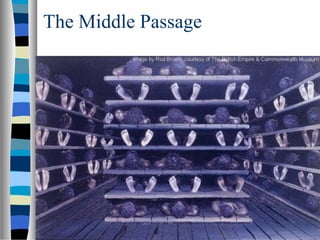
The Middle Passage
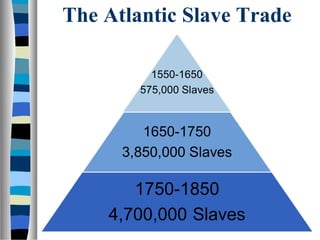
The Atlantic Slave Trade
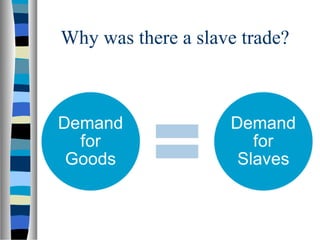
Why was there a slave trade?
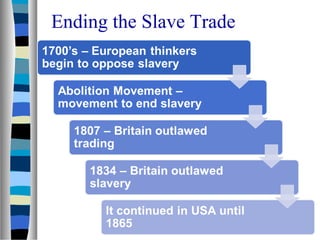
Ending the Slave Trade
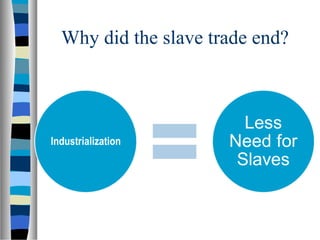
Why did the slave trade end?
African Diaspora

• The slave trade sent millions of
  Africans overseas this created a
  scattering of individuals
• Survivors struggled to hold on to their
  culture

• African people and their culture of
  food, music, dance, and tradition was
  spread across a wide area.
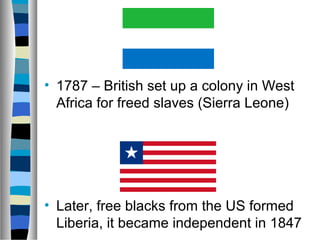
• 1787 – British set up a colony in West
  Africa for freed slaves (Sierra Leone)


• Later, free blacks from the US formed
  Liberia, it became independent in 1847
Age of Imperialism


      Africa Unit
Tribalism in Africa
• Tribalism – Pride and loyalty to ones
  people within Africa being based on
  tribal boundaries

Historical Significance
• Europeans did not understand or
  respect Tribalism.
• This has resulted in additional conflict
  being created in Africa which has
  continued to last to present day
Imperialism
   (Colonialism) (Colonization)

• “WHEN A MORE POWERFUL
  NATION TAKES OVER A WEAKER
  NATION FOR ECONOMIC,
  STRATEGIC, OR POLITICAL
  REASONS.”
Main Cause of African Imperialism

Economic Motives
• European factories need raw materials
  to run.
• Coal / Iron Ore / Oil / Cotton / Rubber
• These raw materials are found in Africa.
Strategic Motives
• Offers port cities between Europe and
  Asia
Causes of African Imperialism
Political Motives
• Prestige – The more land you control
  the more powerful you are

Religious (Spiritual) Motives
• Christians believed that it was their duty
  to spread the ideals of Christianity
• White Man’s Burden – Duty of the white
  race to bring the superior white culture
  to non-whites
Boers (Dutch) vs. British
• The Dutch (Boers) had settled in Cape Town
  in 1652
• Early 1800’s – British won control of the
  Cape colony from the Boers
• The Boers retreated on the “Great Trek”
  northward
• The Boers set up two independent republics
  in the 1850’s
1. Orange Free State
2. Transvaal
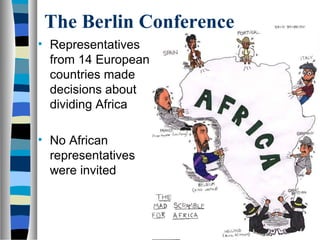
The Berlin Conference
• Representatives
  from 14 European
  countries made
  decisions about
  dividing Africa

• No African
  representatives
  were invited
The Scramble for Colonies
• Some colonies
  were taken by
  force but most
  were voluntarily
  given up

• Treaties were
  negotiated with
  African leaders
New Patterns of Government
African Independence


      Africa Unit
Steps to African Independence
Kenya Fights for Independence
• In Kenya, white settlers had moved in and
  displaced African farmers, mostly of the
  Kikuyu tribe.
• Jomo Kenyatta was a spokesman for the
  Kikuyu and led the movement to get
  Europeans off their land.
• Kenyatta supported nonviolent methods,
  but others turned to guerrilla warfare.
• By 1952, they began to attack European
  settlers.
Kenya Fights for Independence
• The British called the guerrillas Mau Mau and
  pictured them as savages.
• The British imprisoned Kenyatta and threw
  thousands of Kikuyu into concentration
  camps.
• The British went on to bomb the Mau Mau
  fighters, armed only with swords.
• The rebels were crushed, but not the freedom
  movement.
• When the British released Kenyatta in 1963,
  he became the first prime minister of an
  independent Kenya.
Apartheid in
South Africa


   Africa Unit
Origins of Apartheid

• 1910 Britain granted S. Africa self-rule
• Whites make up 13% of Africa’s pop.
• 77% are black
• 1948 – Nationalist party comes to
  power
• Supported by white farmers (Boers)
• They set up apartheid – rigid separation
  of races
The Republic of South Africa
• S. Africans were classified as black,
  white, “coloured” (mixed), Asians
• Pass laws were created
• White only busses, beaches,
  bathrooms, restaurants, and schools
• Opposition groups were banned from
  speaking out (ANC)
• Nelson Mandela is imprisoned for 27
  years for opposing racial segregation
Struggle Against Apartheid

• Archbishop Desmond Tutu strongly
  opposed apartheid, but not through
  violence (won Nobel Peace Prize)
• Freedom marches and boycotts spread
  across South Africa
• During the 1980’s economic sanction
  were imposed by the United States and
  other nations
Apartheid Ends
• F.W. De Klerk lifts ban on opposition
  groups
• 1990 – Nelson Mandela is released
  from prison
• His release symbolized hope for the
  people of South Africa
• 1991 – Africans were no longer
  classified by race
• 1992 – citizenship is given to blacks
• 1994 – Mandela is elected President

African history

  • 1.
    History of Africa Africa Unit
  • 2.
  • 3.
    Early Civilizations of Africa Africa Unit
  • 4.
    Where Civilization Began •Olduvai Gorge – located on the edge of the Great Rift Valley in Tanzania • Archaeologists – Mary and Louis Leakey discovered bone over 2 million years old • This has led some scientists to believe that the first people were from Africa
  • 6.
    Bantu Migration • Today,close to 100 million people across the southern half of Africa speak related languages, collectively known as Bantu languages. • Linguistic evidence shows that the root Bantu language emerged in what is now Nigeria and Cameroon by 2000 BC. • By 1000 BC, in a series of migrations, Bantu speakers had spread south to the lands of Angola and east to Lake Victoria. Over the next 1500 years they scattered throughout central and southern Africa, interacting with and absorbing indigenous populations as they spread.
  • 9.
    The Gold –Salt Trade • Traveling caravans crossed the vast Sahara desert to the Middle East • Travelers looked to profit from the desert crossing with large trades • The savanna lands of West Africa lacked salt, which is essential to survival • In West Africa, salt was more valuable than gold
  • 10.
    Ghana became arich and powerful nation, especially when the camel began to be used as a source of transport. Ghana relied on trade and trade was made faster and bigger with the use of the camel.
  • 11.
    Islamic Mosque in Ghana After 700 AD, the religion of Islam began to spread over northern Africa. Followers of this religion are called Muslims. Muslim warriors came into Ghana and fought with the non-Islamic people there. This weakened the great civilization of Ghana. Local warriors then decided to break away from the power of Ghana and form their own local kingdoms. This ended many of the trade networks. This eventually weakened the civilization of Ancient Ghana.
  • 12.
    The Empire ofMali is Born
  • 15.
    The Slave Trade Africa Unit
  • 16.
    How Does TheSlave Trade Begin?
  • 17.
    How Does TheSlave Trade Begin?
  • 18.
  • 19.
  • 20.
  • 21.
  • 23.
    Why was therea slave trade?
  • 24.
  • 25.
    Why did theslave trade end?
  • 26.
    African Diaspora • Theslave trade sent millions of Africans overseas this created a scattering of individuals • Survivors struggled to hold on to their culture • African people and their culture of food, music, dance, and tradition was spread across a wide area.
  • 27.
    • 1787 –British set up a colony in West Africa for freed slaves (Sierra Leone) • Later, free blacks from the US formed Liberia, it became independent in 1847
  • 28.
  • 29.
    Tribalism in Africa •Tribalism – Pride and loyalty to ones people within Africa being based on tribal boundaries Historical Significance • Europeans did not understand or respect Tribalism. • This has resulted in additional conflict being created in Africa which has continued to last to present day
  • 30.
    Imperialism (Colonialism) (Colonization) • “WHEN A MORE POWERFUL NATION TAKES OVER A WEAKER NATION FOR ECONOMIC, STRATEGIC, OR POLITICAL REASONS.”
  • 31.
    Main Cause ofAfrican Imperialism Economic Motives • European factories need raw materials to run. • Coal / Iron Ore / Oil / Cotton / Rubber • These raw materials are found in Africa. Strategic Motives • Offers port cities between Europe and Asia
  • 32.
    Causes of AfricanImperialism Political Motives • Prestige – The more land you control the more powerful you are Religious (Spiritual) Motives • Christians believed that it was their duty to spread the ideals of Christianity • White Man’s Burden – Duty of the white race to bring the superior white culture to non-whites
  • 33.
    Boers (Dutch) vs.British • The Dutch (Boers) had settled in Cape Town in 1652 • Early 1800’s – British won control of the Cape colony from the Boers • The Boers retreated on the “Great Trek” northward • The Boers set up two independent republics in the 1850’s 1. Orange Free State 2. Transvaal
  • 34.
    The Berlin Conference •Representatives from 14 European countries made decisions about dividing Africa • No African representatives were invited
  • 35.
    The Scramble forColonies • Some colonies were taken by force but most were voluntarily given up • Treaties were negotiated with African leaders
  • 37.
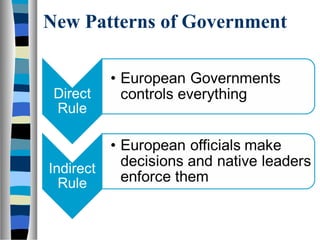
    New Patterns ofGovernment
  • 38.
  • 40.
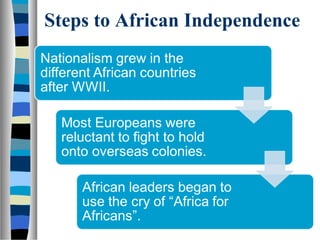
    Steps to AfricanIndependence
  • 41.
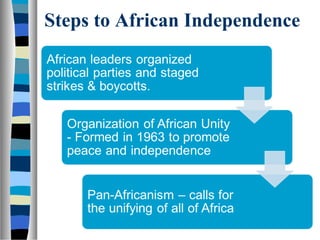
    Steps to AfricanIndependence
  • 42.
    Kenya Fights forIndependence • In Kenya, white settlers had moved in and displaced African farmers, mostly of the Kikuyu tribe. • Jomo Kenyatta was a spokesman for the Kikuyu and led the movement to get Europeans off their land. • Kenyatta supported nonviolent methods, but others turned to guerrilla warfare. • By 1952, they began to attack European settlers.
  • 43.
    Kenya Fights forIndependence • The British called the guerrillas Mau Mau and pictured them as savages. • The British imprisoned Kenyatta and threw thousands of Kikuyu into concentration camps. • The British went on to bomb the Mau Mau fighters, armed only with swords. • The rebels were crushed, but not the freedom movement. • When the British released Kenyatta in 1963, he became the first prime minister of an independent Kenya.
  • 44.
  • 45.
    Origins of Apartheid •1910 Britain granted S. Africa self-rule • Whites make up 13% of Africa’s pop. • 77% are black • 1948 – Nationalist party comes to power • Supported by white farmers (Boers) • They set up apartheid – rigid separation of races
  • 46.
    The Republic ofSouth Africa • S. Africans were classified as black, white, “coloured” (mixed), Asians • Pass laws were created • White only busses, beaches, bathrooms, restaurants, and schools • Opposition groups were banned from speaking out (ANC) • Nelson Mandela is imprisoned for 27 years for opposing racial segregation
  • 47.
    Struggle Against Apartheid •Archbishop Desmond Tutu strongly opposed apartheid, but not through violence (won Nobel Peace Prize) • Freedom marches and boycotts spread across South Africa • During the 1980’s economic sanction were imposed by the United States and other nations
  • 48.
    Apartheid Ends • F.W.De Klerk lifts ban on opposition groups • 1990 – Nelson Mandela is released from prison • His release symbolized hope for the people of South Africa • 1991 – Africans were no longer classified by race • 1992 – citizenship is given to blacks • 1994 – Mandela is elected President

Editor's Notes

  • #10 http://www.berkeleychemical.com/cuts2.jpg http://www.hmskc.com/images/Gold%20Bar.jpg
  • #18 cnnstudentnews.cnn.com/.../map.slave.trade.jpg
  • #20 http://content.answers.com/main/content/wp/en/thumb/c/ce/300px-Triangle_trade.png
  • #27 http://pages.prodigy.net/stevesoares/photos/marvaille.jpg
  • #28 http://www.sahistory.org.za/pages/town&c/africa/maps/AFRICA-sierra-leone.gif
  • #29 http://www.great-britain.co.uk/buttons-&-icons/ukmap4.gif
  • #34 http://www.tokencoins.com/graphics/samap5b.jpg
  • #36 http://web.bvu.edu/organizations/tack/2000/02/11/Photos/Medicine%20Bottle.jpg http://www.earth.uni.edu/EECP/mid/treaty.gif
  • #38 http://images.google.com/imgres?imgurl=http://xvinci.com/26things/images/money.jpg&imgrefurl=http://xvinci.com/26things/money.html&h=450&w=600&sz=82&hl=en&start=5&tbnid=7znUwoNn0FhrxM:&tbnh=101&tbnw=135&prev=/images%3Fq%3Dmoney%26svnum%3D10%26hl%3Den%26lr%3D%26rls%3DDKUS,DKUS:2006-40,DKUS:en
  • #45 http://www.johannesburg-venues.co.za/newimages/johannesburg-venues-cityscape.jpg