The Mongols
I. Background The Mongols were  nomads  from the eastern steppe (fields) in loosely organized  clans .
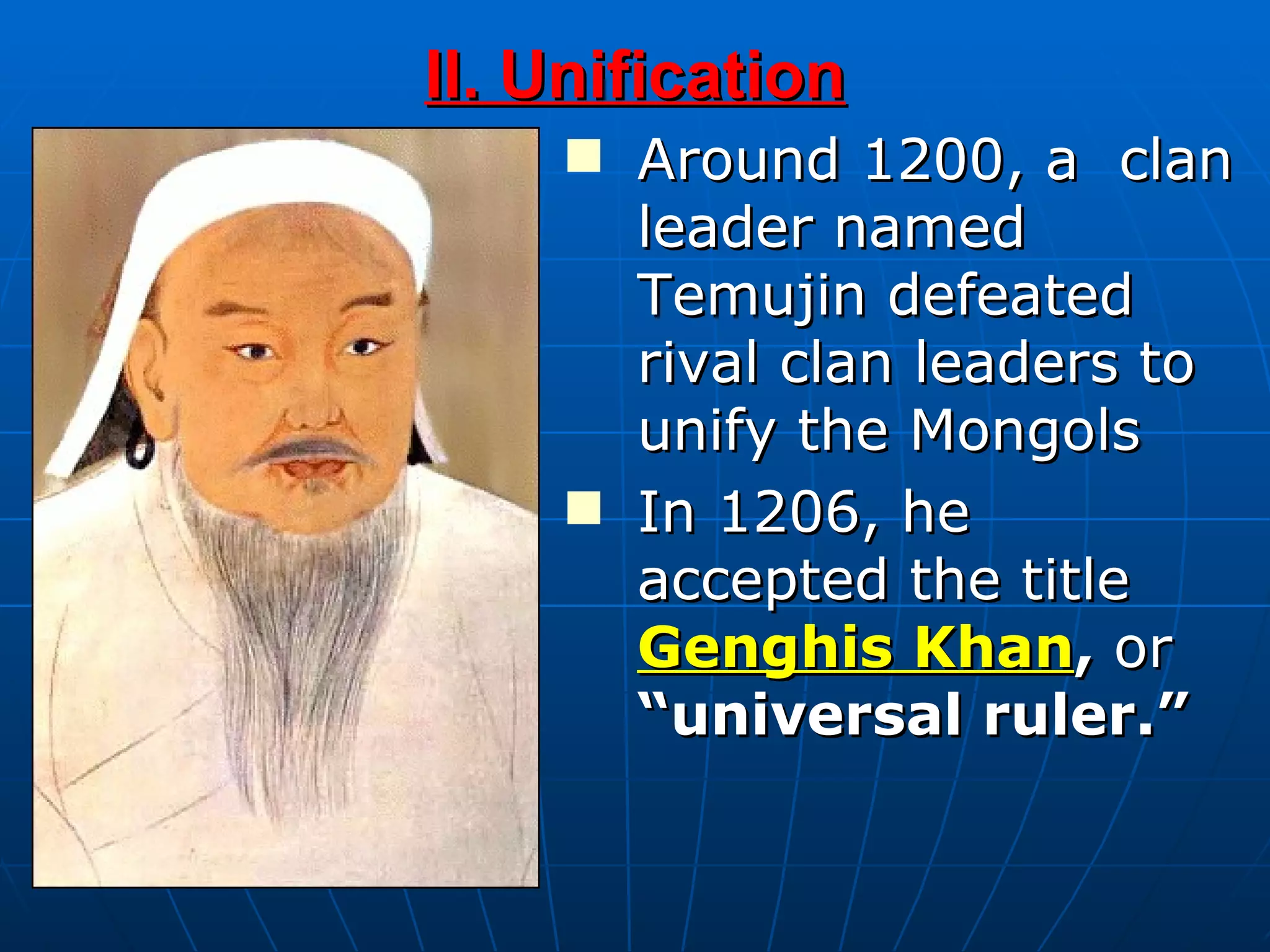
Around 1200, a  clan leader named Temujin defeated rival clan leaders to unify the Mongols  In 1206, he accepted the title  Genghis Khan ,  or  “universal ruler.” II. Unification
According to legend, Temujin was born with a blood clot in his fist. In his lifetime, his hands were covered with the blood of others. When Temujin was about nine, the Tatars, a rival clan, poisoned his father. When in manhood, he fought and defeated the Tatars, slaughtering every male taller than a cart axel. DON’T WRITE THIS!
IV. The Mongol “War Machine” Mongols were skilled horsemen  Weapons  1. bows, swords, javelins, hooked lances,  canons  (new technology used to defeat the Chinese)
C. Strategy- 1. Mock retreats tricked the enemy 2. Flag signals 3. Terrified enemies into surrender If a city refused to open its gates to him, he might kill the entire population upon capture DON’T WRITE THIS!
Mongol armies developed a system of signal flags used during battle. The black and white flags transmitted orders to Mongol units who moved swiftly while confusing and overwhelming their disorganized opponents. At night, lanterns and flaming arrows were used in place of flags. DON’T WRITE THIS!
Each Mongol soldier wore a long silk undershirt. When hit with an arrow, he could remove it by carefully pulling on the silk, which usually entered the wound with the arrow. Upon witnessing Mongols pulling arrows from their bodies, some became convinced that the Mongols  were superhuman! DON’T WRITE THIS!
Mongol soldiers often died of infection from battle wounds caused, in part, to poor hygiene. Mongol warriors rarely washed. When they did, they used urine from their horses. Their clothing was often worn until it literally rotted off. DON’T WRITE THIS!
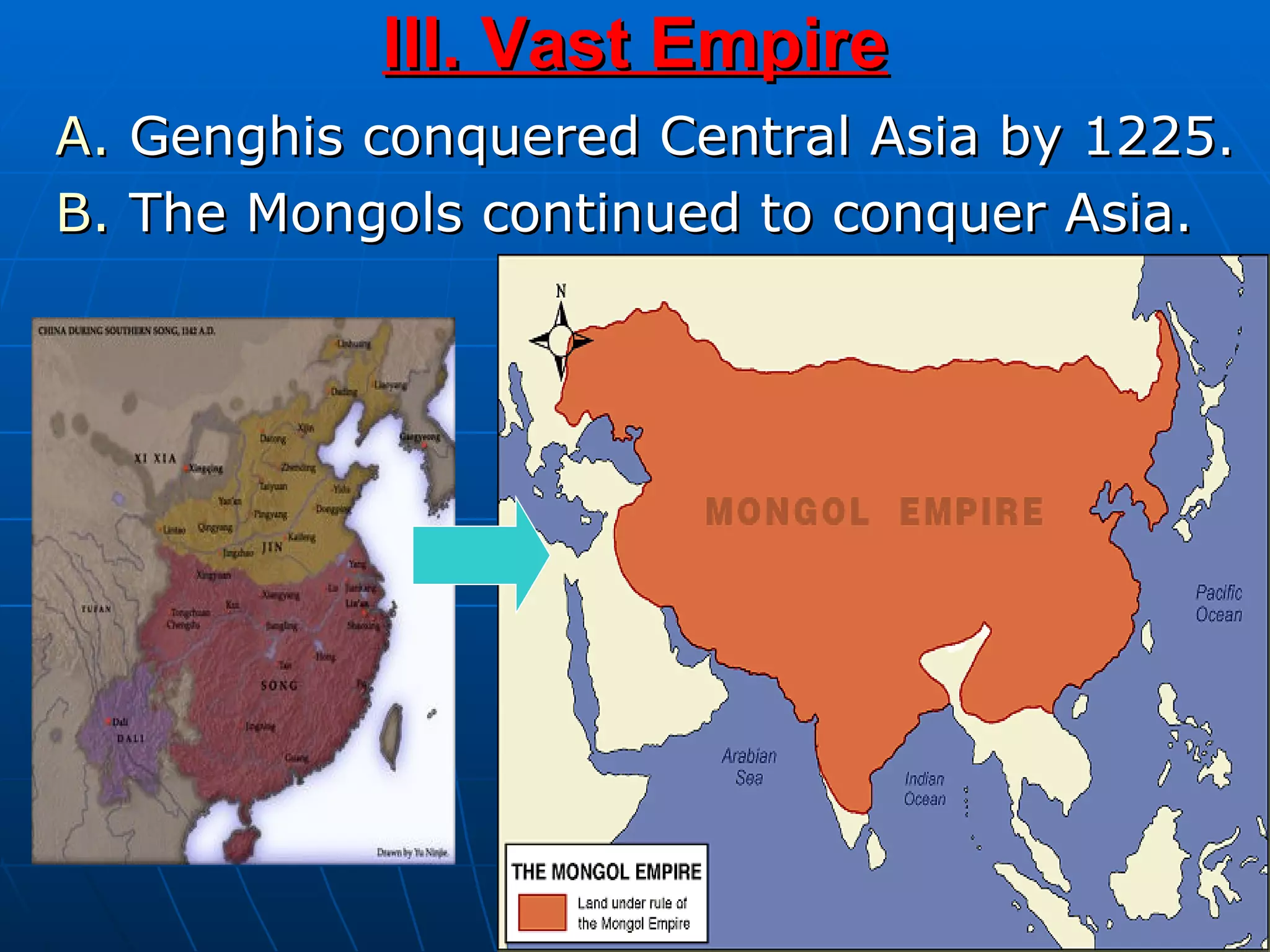
III. Vast Empire Genghis conquered Central Asia by 1225. The Mongols continued to conquer Asia.
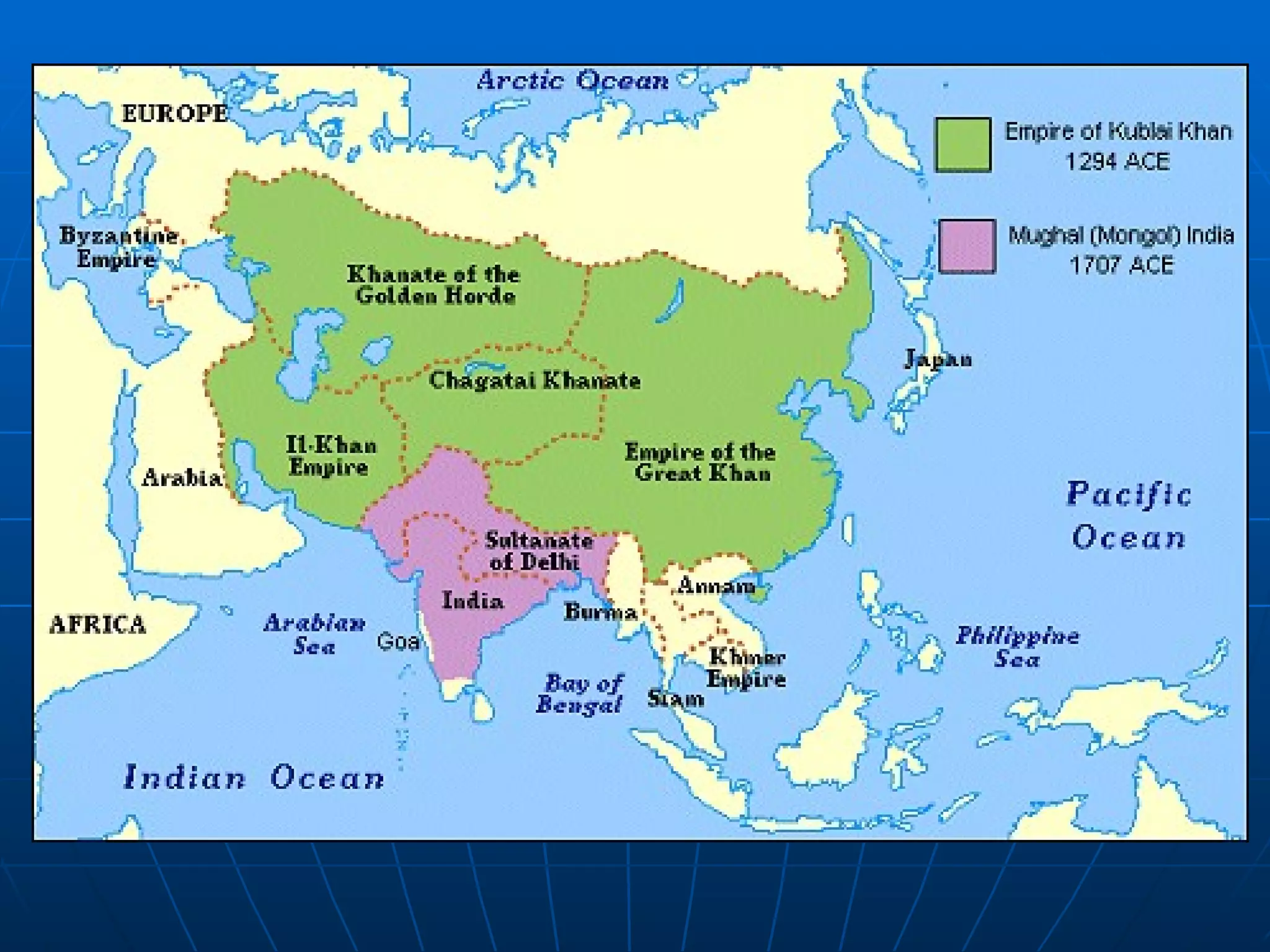
By 1260, the Mongols had divided their huge empire into four regions, or  khanates . A descendant of Genghis ruled each khanate. DON’T WRITE THIS! Mongolia and China Central Asia Russia Persia
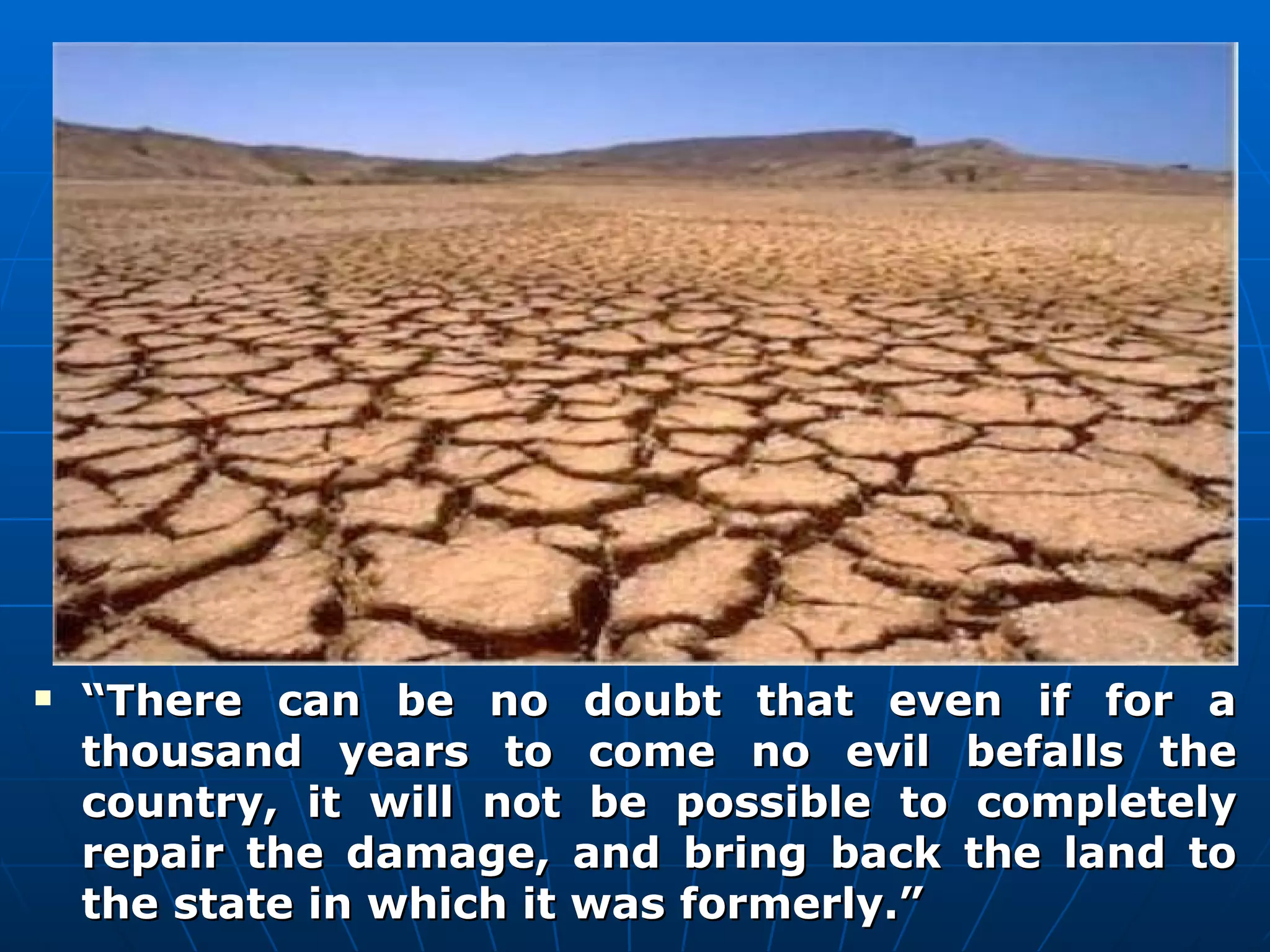
“ There can be no doubt that even if for a thousand years to come no evil befalls the country, it will not be possible to completely repair the damage, and bring back the land to the state in which it was formerly.” “ There can be no doubt that even if for a thousand years to come no evil befalls the country, it will not be possible to completely repair the damage, and bring back the land to the state in which it was formerly.”
C. As rulers:  1. While ferocious in war, the Mongols were  tolerant  rulers.
V.  The Pax Mongolia During the 1200’s and 1300s, the Mongols imposed stability and order across Eurasia. This period is called the  Pax Mongolia , or Mongol Peace. Traders, travelers and missionaries enjoyed safety along the Silk Road.
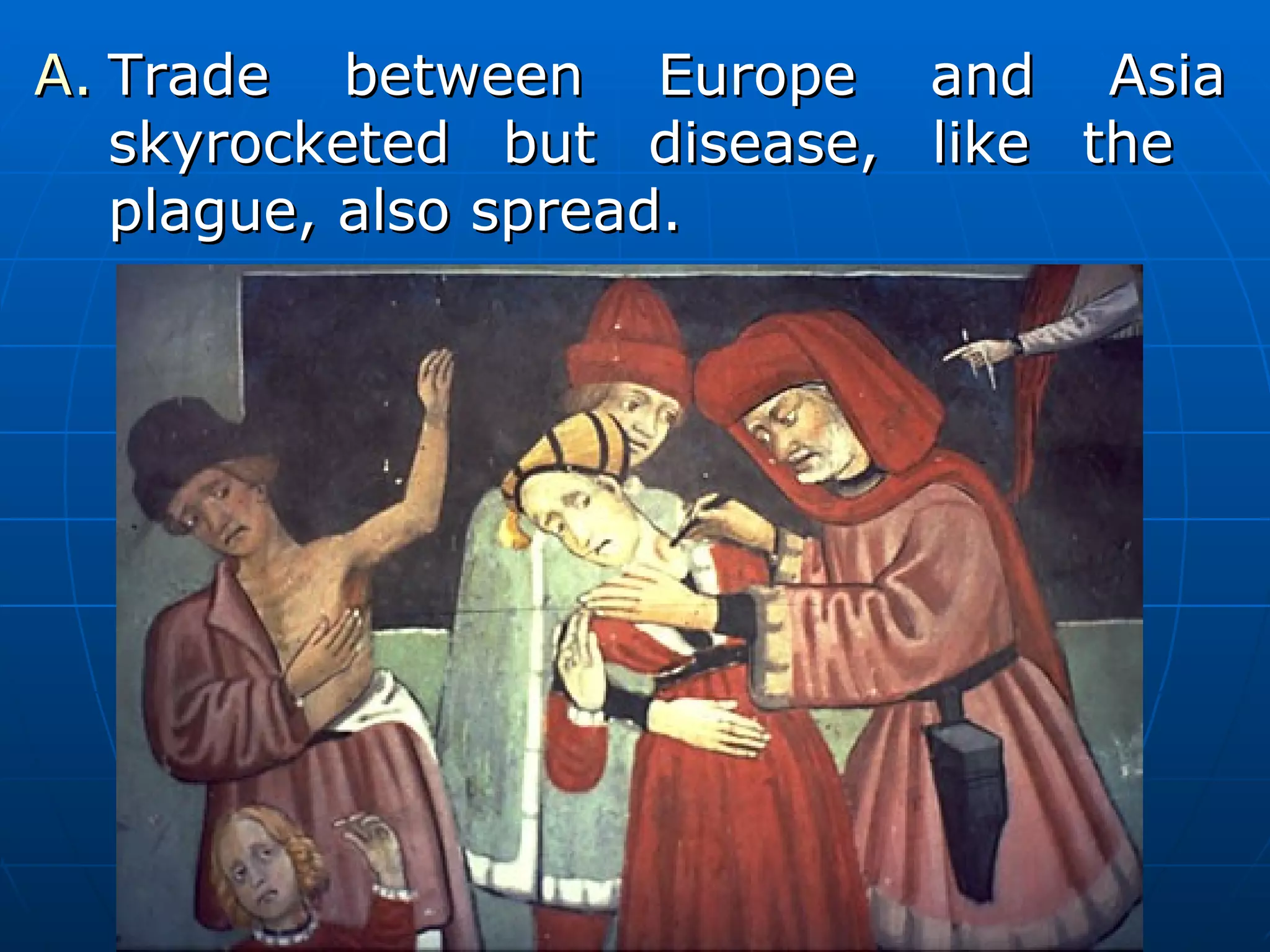
Trade between Europe and Asia skyrocketed but disease, like the  plague, also spread.
VI. Kublai Khan Genghiz Khan’s grandson. He  founded the  Yuan dynasty  in China He reserved gov’t jobs for Mongols.  The Chinese resented this.
 
 
The walls were covered with gold and silver and the Dining Hall was so large that it could easily dine 6,000 people. The palace was made of cane supported by 200 silk cords, which could be taken to pieces and transported easily when the Emperor moved. There too, the Khan kept a stud of 10,000 white horses, whose milk was reserved for his family and for a tribe which had won a victory for Genghis Khan.  DON’T WRITE THIS!
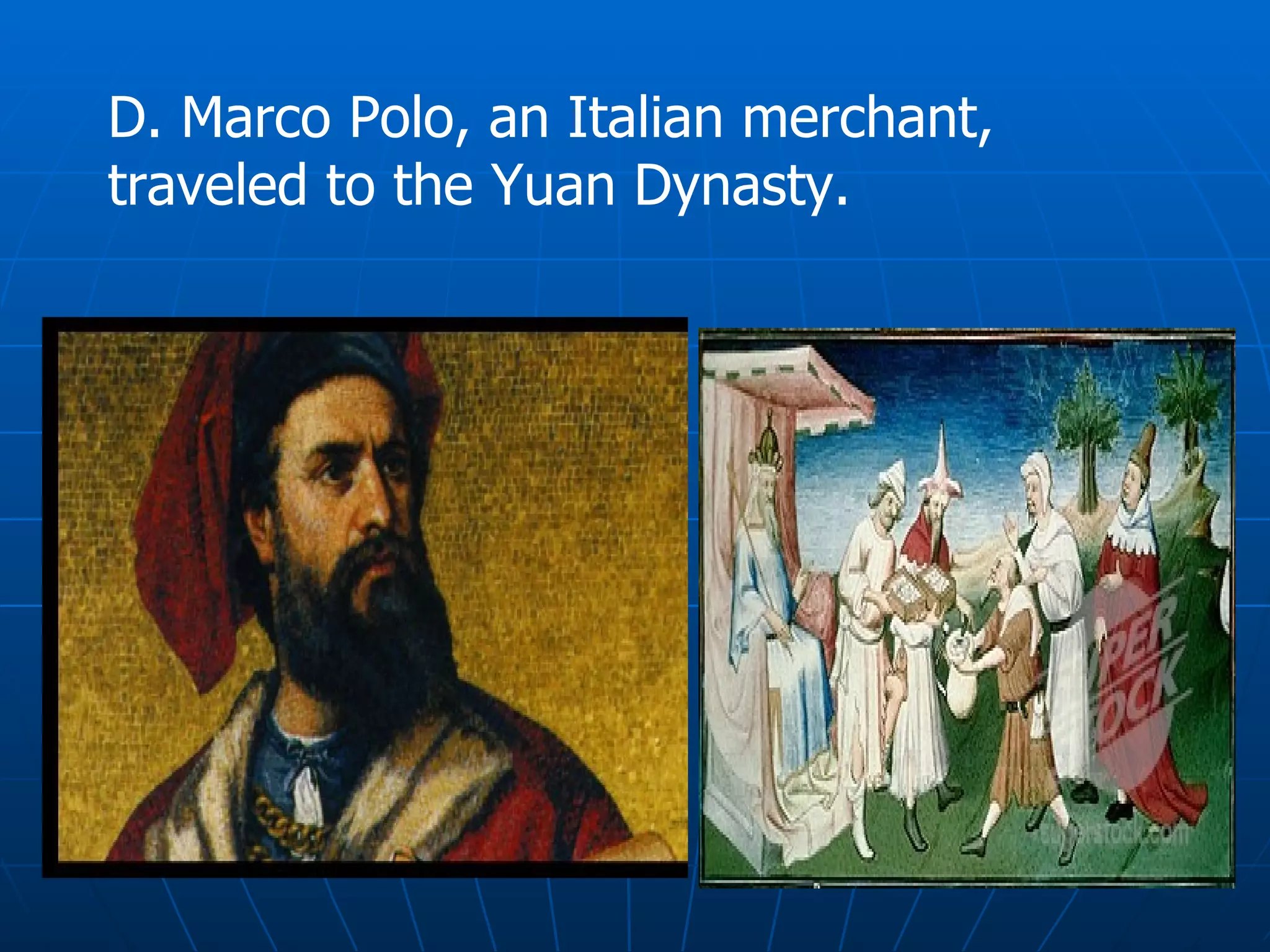
D. Marco Polo, an Italian merchant, traveled to the Yuan Dynasty.
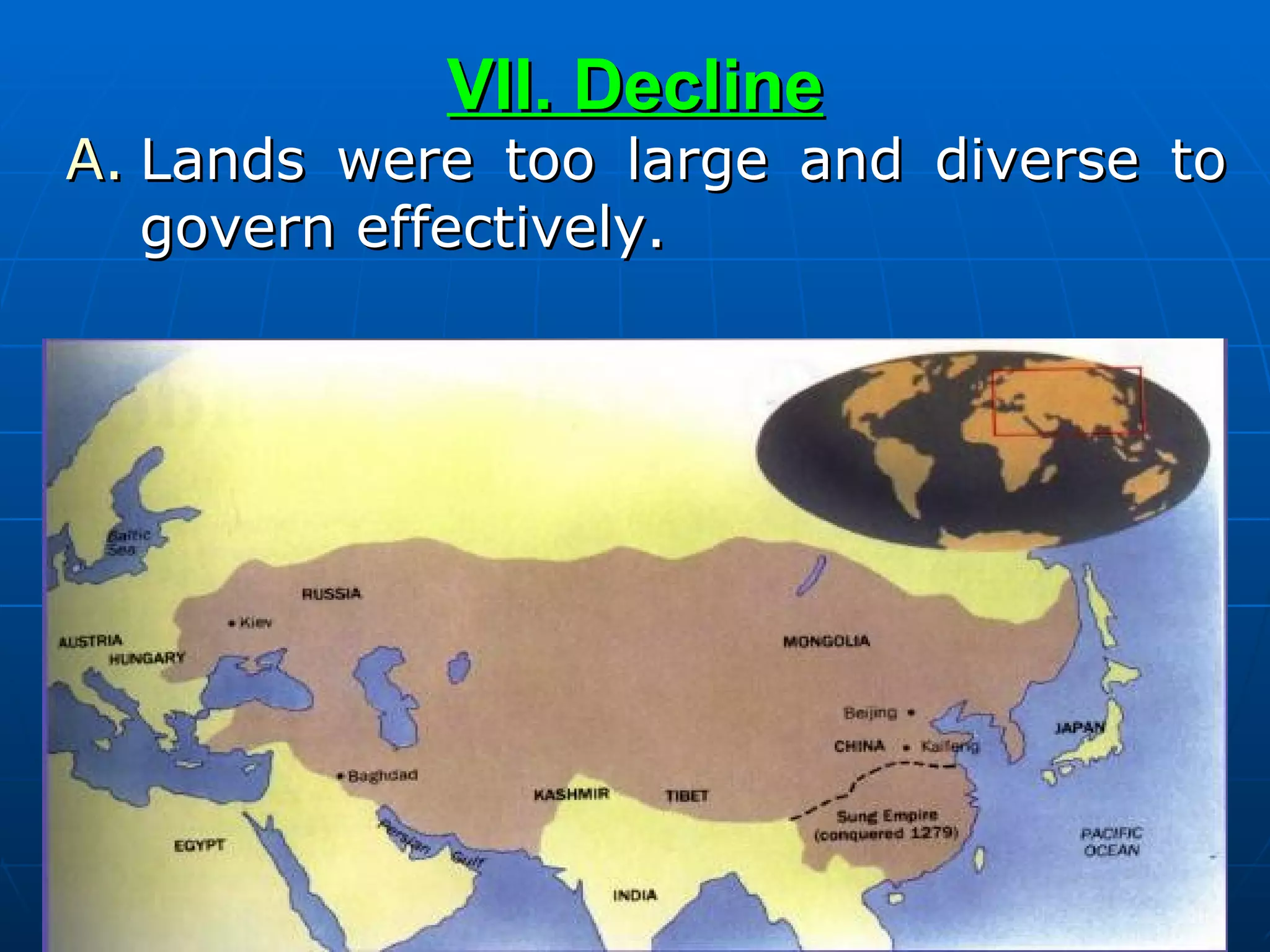
VII. Decline Lands were too large and diverse to govern effectively.
Mongols had little experience in gov’t.
After the death of the Khans, the Mongols got pushed back behind the Great Wall.
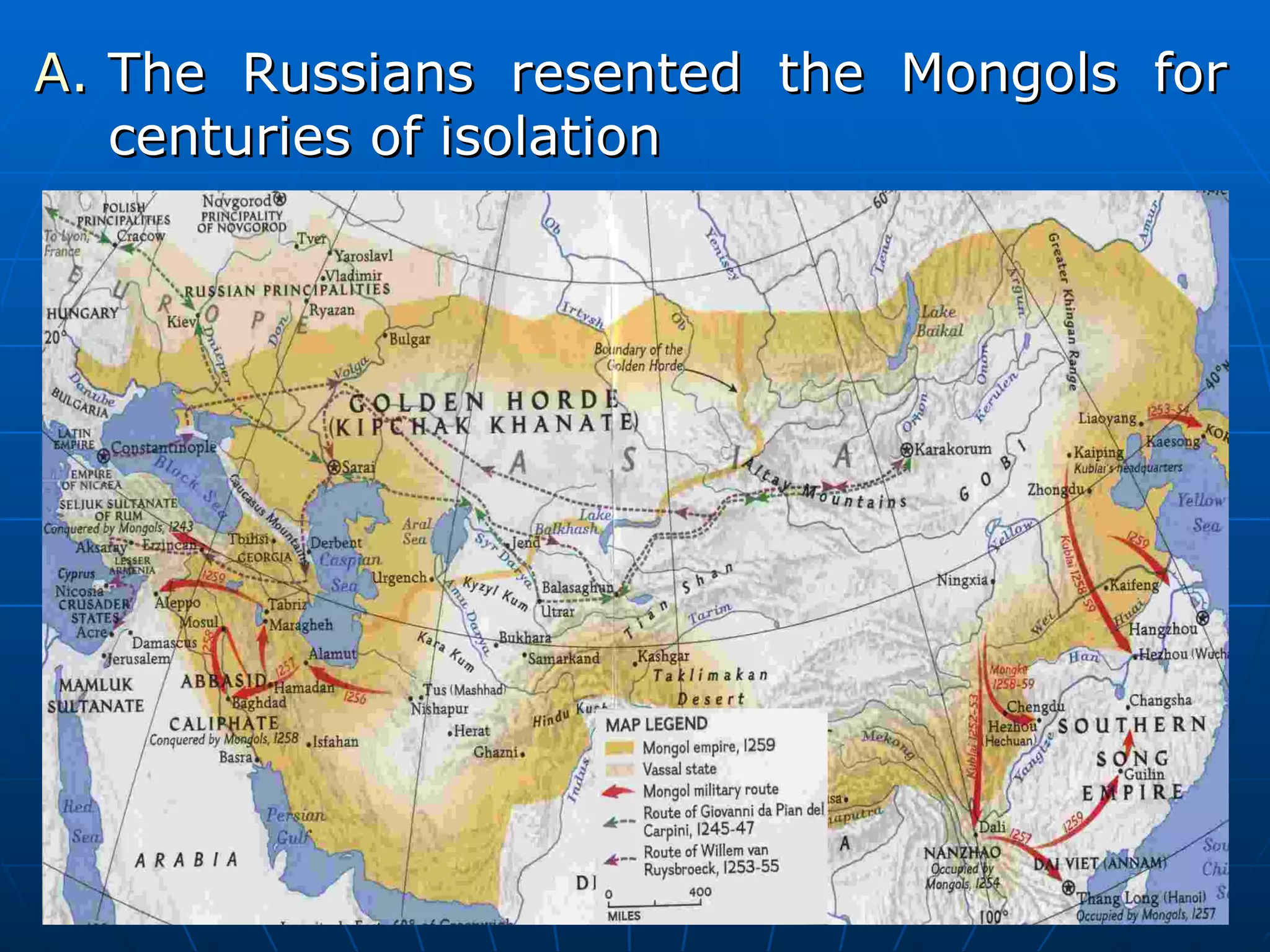
The Russians resented the Mongols for centuries of isolation
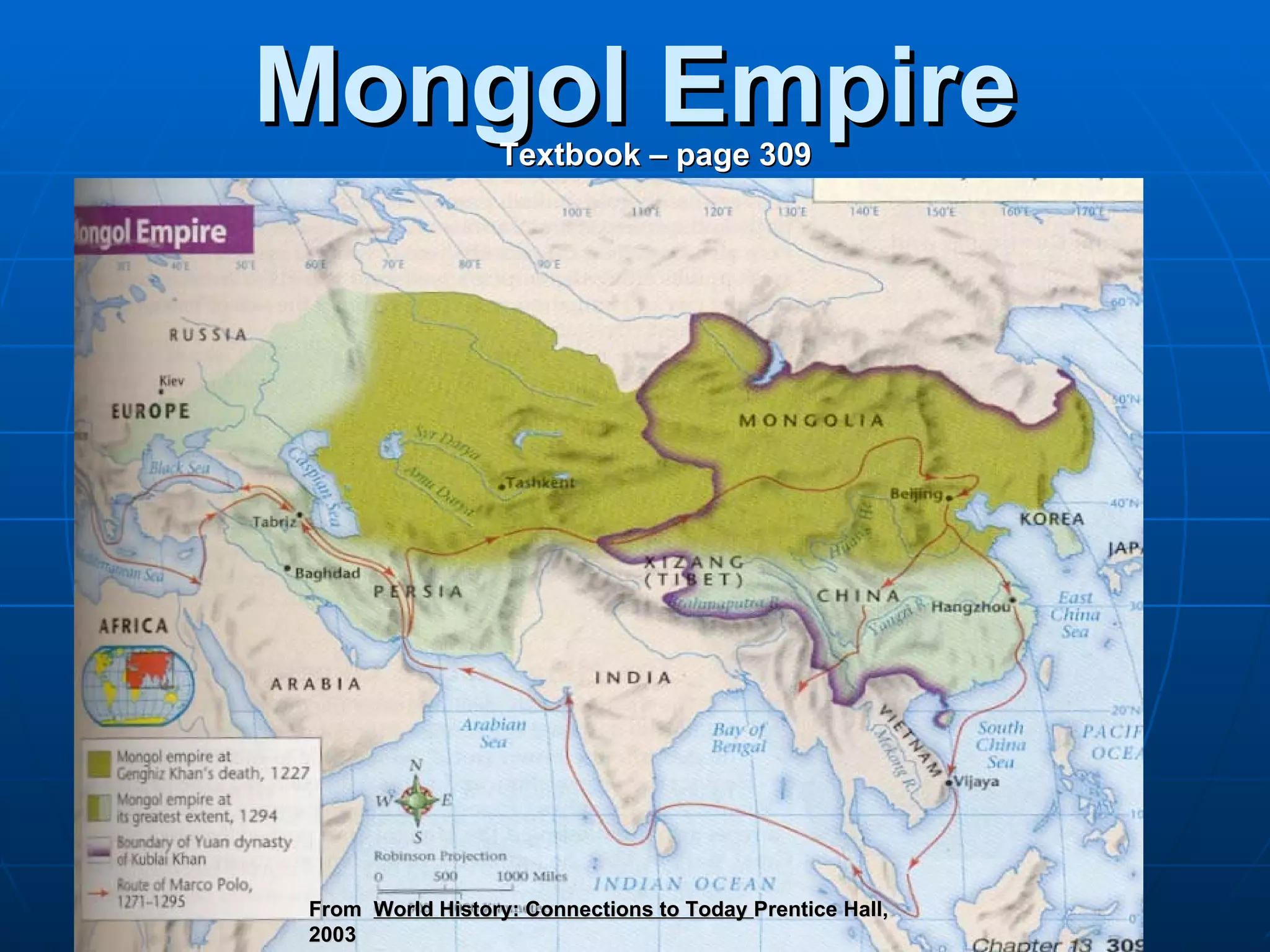
Mongol Empire Textbook – page 309 From  World History: Connections to Today  Prentice Hall, 2003
 

Mongols

  • 1.
  • 2.
    I. Background TheMongols were nomads from the eastern steppe (fields) in loosely organized clans .
  • 3.
    Around 1200, a clan leader named Temujin defeated rival clan leaders to unify the Mongols In 1206, he accepted the title Genghis Khan , or “universal ruler.” II. Unification
  • 4.
    According to legend,Temujin was born with a blood clot in his fist. In his lifetime, his hands were covered with the blood of others. When Temujin was about nine, the Tatars, a rival clan, poisoned his father. When in manhood, he fought and defeated the Tatars, slaughtering every male taller than a cart axel. DON’T WRITE THIS!
  • 5.
    IV. The Mongol“War Machine” Mongols were skilled horsemen Weapons 1. bows, swords, javelins, hooked lances, canons (new technology used to defeat the Chinese)
  • 6.
    C. Strategy- 1.Mock retreats tricked the enemy 2. Flag signals 3. Terrified enemies into surrender If a city refused to open its gates to him, he might kill the entire population upon capture DON’T WRITE THIS!
  • 7.
    Mongol armies developeda system of signal flags used during battle. The black and white flags transmitted orders to Mongol units who moved swiftly while confusing and overwhelming their disorganized opponents. At night, lanterns and flaming arrows were used in place of flags. DON’T WRITE THIS!
  • 8.
    Each Mongol soldierwore a long silk undershirt. When hit with an arrow, he could remove it by carefully pulling on the silk, which usually entered the wound with the arrow. Upon witnessing Mongols pulling arrows from their bodies, some became convinced that the Mongols were superhuman! DON’T WRITE THIS!
  • 9.
    Mongol soldiers oftendied of infection from battle wounds caused, in part, to poor hygiene. Mongol warriors rarely washed. When they did, they used urine from their horses. Their clothing was often worn until it literally rotted off. DON’T WRITE THIS!
  • 10.
    III. Vast EmpireGenghis conquered Central Asia by 1225. The Mongols continued to conquer Asia.
  • 11.
    By 1260, theMongols had divided their huge empire into four regions, or khanates . A descendant of Genghis ruled each khanate. DON’T WRITE THIS! Mongolia and China Central Asia Russia Persia
  • 12.
    “ There canbe no doubt that even if for a thousand years to come no evil befalls the country, it will not be possible to completely repair the damage, and bring back the land to the state in which it was formerly.” “ There can be no doubt that even if for a thousand years to come no evil befalls the country, it will not be possible to completely repair the damage, and bring back the land to the state in which it was formerly.”
  • 13.
    C. As rulers: 1. While ferocious in war, the Mongols were tolerant rulers.
  • 14.
    V. ThePax Mongolia During the 1200’s and 1300s, the Mongols imposed stability and order across Eurasia. This period is called the Pax Mongolia , or Mongol Peace. Traders, travelers and missionaries enjoyed safety along the Silk Road.
  • 15.
    Trade between Europeand Asia skyrocketed but disease, like the plague, also spread.
  • 16.
    VI. Kublai KhanGenghiz Khan’s grandson. He founded the Yuan dynasty in China He reserved gov’t jobs for Mongols. The Chinese resented this.
  • 17.
  • 18.
  • 19.
    The walls werecovered with gold and silver and the Dining Hall was so large that it could easily dine 6,000 people. The palace was made of cane supported by 200 silk cords, which could be taken to pieces and transported easily when the Emperor moved. There too, the Khan kept a stud of 10,000 white horses, whose milk was reserved for his family and for a tribe which had won a victory for Genghis Khan. DON’T WRITE THIS!
  • 20.
    D. Marco Polo,an Italian merchant, traveled to the Yuan Dynasty.
  • 21.
    VII. Decline Landswere too large and diverse to govern effectively.
  • 22.
    Mongols had littleexperience in gov’t.
  • 23.
    After the deathof the Khans, the Mongols got pushed back behind the Great Wall.
  • 24.
    The Russians resentedthe Mongols for centuries of isolation
  • 25.
    Mongol Empire Textbook– page 309 From World History: Connections to Today Prentice Hall, 2003
  • 26.