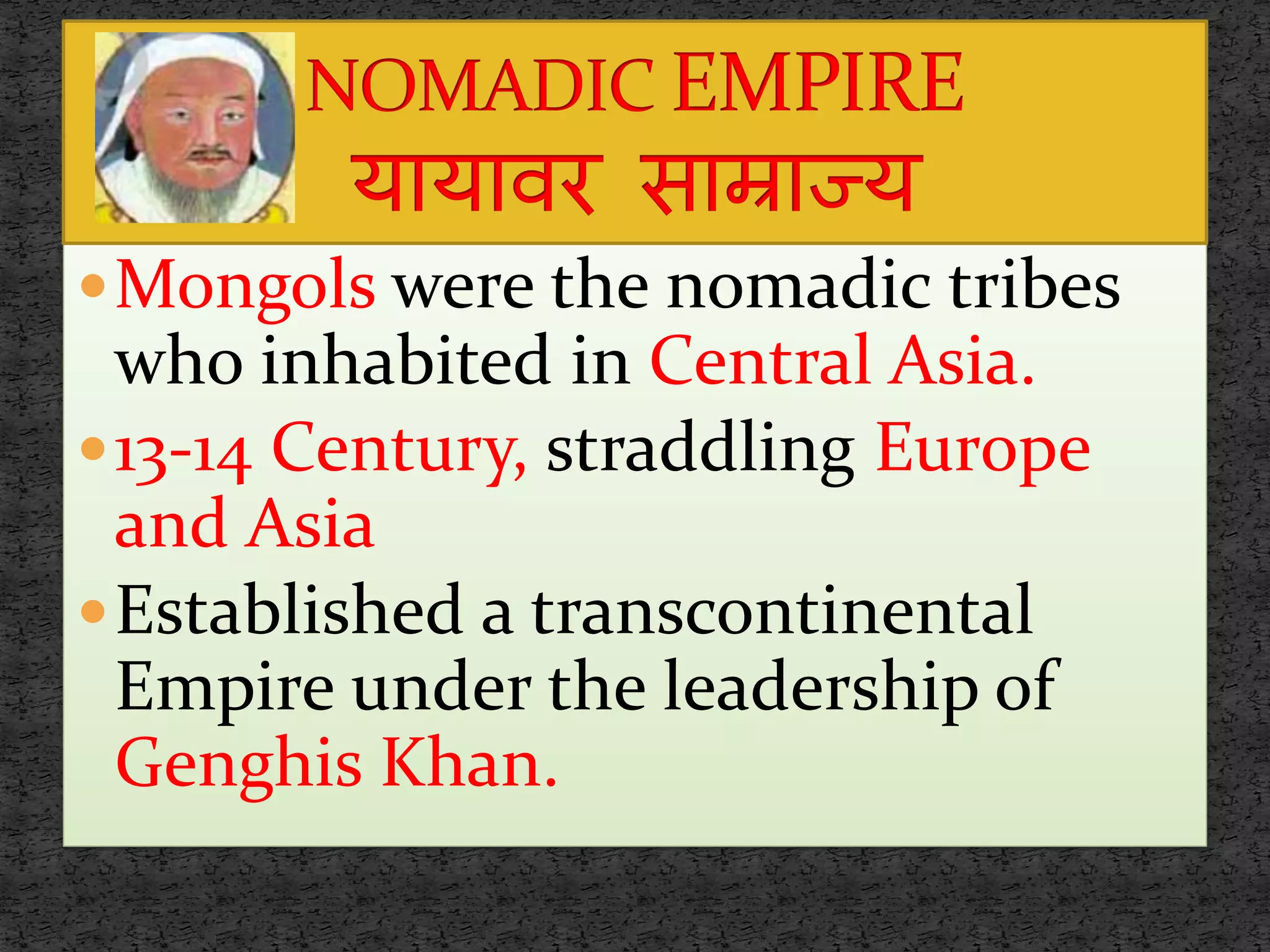
Mongols were the nomadic tribes
who inhabited in Central Asia.
13-14 Century, straddling Europe
and Asia
Established a transcontinental
Empire under the leadership of
Genghis Khan.
 Chronicles, Travelogues, and
Documents by city based litterateurs
 Two Russian Reserch Work –
1. Boris Vladimirtsov Yakovlevichand
2. Vasily Vladimisrovich Bartold
Most trustworthy account-
1. The Secret History of Mongols
2. Travelogues accounts of Marco Polo
 Consolidating his hold over the Mongol Tribes
 campaigns into adjoining area in North China,
Transoxiana, Afganistan, Eastern Iran and Russian
Steppes
Grandson Mongke (1226-70 CE) warned the
French Ruler Louis IX
Batu, another grandson devasted Russian lands up
to Moscow, seized Poland and Hungry, camped
outside Vienna
MIDDLE EAST, CHINA, EUROPE
 The Nomadic People inhabiting present
Mongolia in Central Asia
 Pastoralists and Hunter-gatherers
 They were constantly at war with other
tribes like Tatars, Naimans and Khitans.
 Reared goats and Camels for getting milk,
meat and wool.
 Predatory raids in search of livestock
 Geographical conditions were not in favour
of adapting agriculture.
 Social Life-
1. Patriarchal in nature.
2. The eldest male was the head of family, take
care of others
3. The rich families were larger in size
4. Polygamy was in practice
5. Constant wars among different sections of
society
6. Female assist their male counterparts in the
battlefield
Trade
1. Trade with neighboring countries
2. Based on barter system
3. Agricultural produce and Iron
utensils from China were exchanged
for horses, furs and game trapped in
the steppe
4. It was done in tense situation, both
wanted more profit
1. Born in the year………………………………………………….
2. Father’s name…………………………………………………….
3. Mother………………………………………………………………
4. Belonged to……………………………………… tribe.
5. Original Name……………………………………………
6. Early Achievements…………………………………….....
…………………………………………………………………….
…………………………………………………………………….
 Through the 1180s and 1190s, Temujin remained an
ally of Ong Khan and used the alliance to defeat
powerful adversaries like Jamuqa.
 Temujin felt confident enough to move against
other tribes: the powerful Tatars (his father’s
assassins), the Kereyits and Ong Khan himself in
1203.
 The final defeat of the Naiman people and the
powerful Jamuqa in 1206.
 he was proclaimed the ‘Great Khan of the Mongols’
(Qa’an) with the title Genghis Khan, the ‘Oceanic
Khan’ or ‘Universal Ruler’.
 By 1209, the Hsi Hsia were defeated.
 The ‘Great Wall of China’ was breached in 1213 and
Peking sacked in 1215.
 Long drawn-out battles against the Chin
continued until 1234
 But Genghis Khan was satisfied enough with the
progress of his campaigns to return to his
Mongolian homeland in 1216
 and leave the military affairs of the region to his
subordinates.
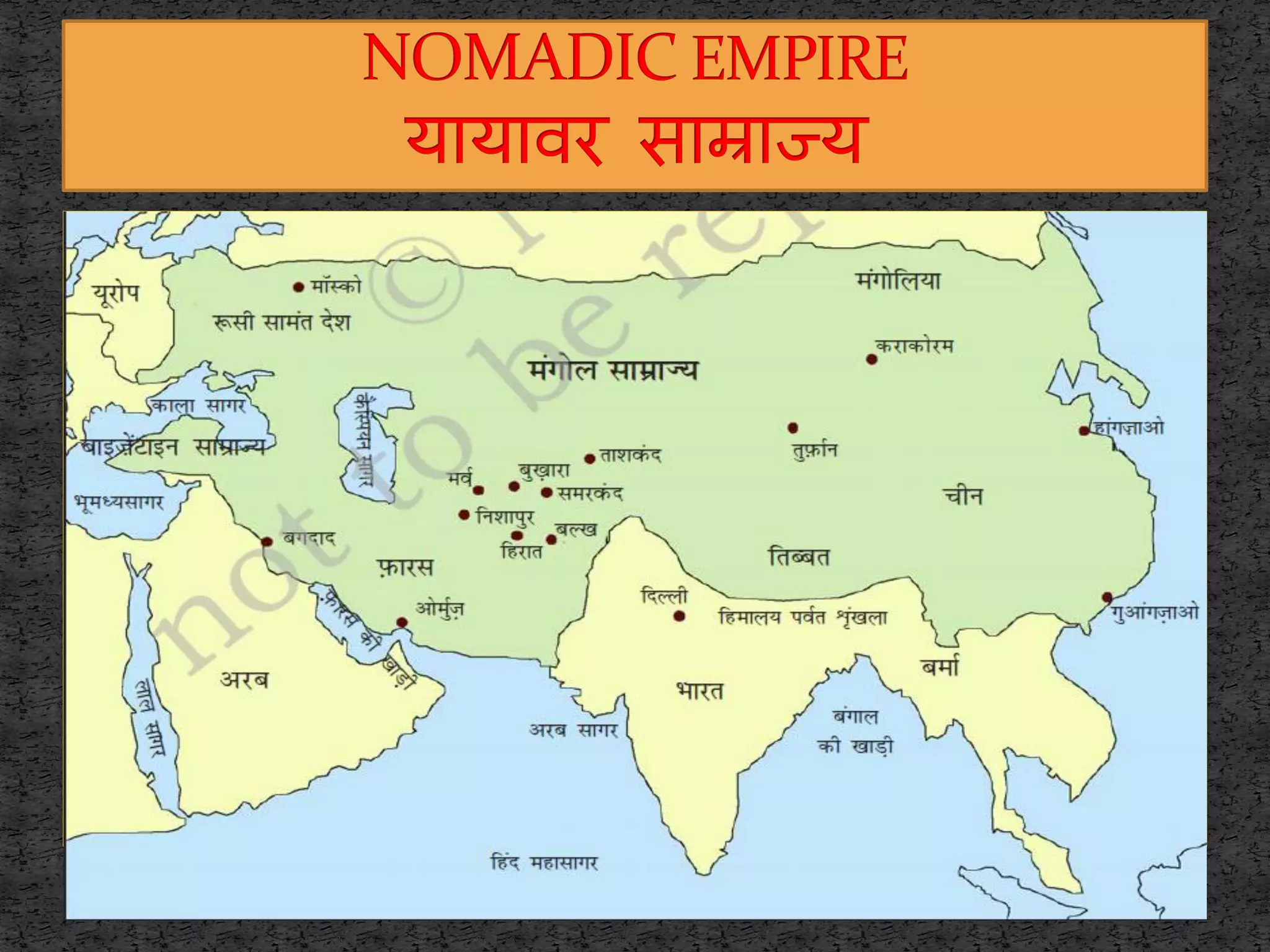
In the campaigns between
1219 and 1221 the great cities –
Otrar, Bukhara, Samarqand,
Balkh, Gurganj, Merv,
Nishapur and Herat –
surrendered to the Mongol
forces.
c. 1167 -Birth of Temujin
1160s-70s -Years spent in slavery and struggle
1180s-90s- Period of alliance formation
1203-27 -Expansion and triumph
1206 -Temujin proclaimed Genghis Khan,
‘Universal Ruler’ of the Mongols
1227 -Death of Genghis Khan
1. The horse-riding skills of the Mongols
2. The Turks provided speed and mobility to the army;
3. Their abilities as rapid-shooting archers
4. its knowledge of the terrain and the weather to do
the unimaginable.
5. They carried out campaigns in the depths of winter,
treating frozen
6. Rivers as highways to enemy cities and camps.
7. Genghis Khan learnt the importance of siege engines
and naphtha bombardment very quickly.
8. His engineers prepared light portable equipment,
which was used against opponents with devastating
effect.
 Genghis Khan worked to systematically
erase the old tribal identities of the different
groups who joined his confederacy.
 His army was organised according to the old
steppe system of decimal units: in divisions
of 10s, 100s, 1,000s and [notionally] 10,000
soldiers.
 The new military contingents were required
to serve under his four sons and specially
chosen captains of his army units called
noyan.
 Genghis Khan assigned the responsibility of governing
the newly-conquered people to his four sons.
 These comprised the four ulus, a term that did not
originally mean fixed territories.
1. The eldest son,Jochi- the Russian steppes
2. The second son, Chaghatai-Transoxanian steppe and
lands north of the Pamir mountains
3. Third son, Ogodei, would succeed him as the Great
Khan and on accession the Prince established his
capital at Karakorum.
4. Fourth Son-Toluy, received the ancestral lands of
Mongolia.
 Genghis Khan had already fashioned a rapid courier
system (YAM) that connected the distant areas of his
regime.
 For the maintenance of this communication system
the Mongol nomads contributed a tenth of their herd
– either horses or livestock – as provisions. This was
called the qubcur tax.
 Communication and ease of travel was vital to retain
the coherence of the Mongol regime and travellers
were given a pass (paiza in Persian; gerege in
Mongolian) for safe conduct.
 Traders paid the baj tax for the same purpose.

NOMADIC EMPIRE.pdf

  • 1.
    Mongols were thenomadic tribes who inhabited in Central Asia. 13-14 Century, straddling Europe and Asia Established a transcontinental Empire under the leadership of Genghis Khan.
  • 2.
     Chronicles, Travelogues,and Documents by city based litterateurs  Two Russian Reserch Work – 1. Boris Vladimirtsov Yakovlevichand 2. Vasily Vladimisrovich Bartold Most trustworthy account- 1. The Secret History of Mongols 2. Travelogues accounts of Marco Polo
  • 3.
     Consolidating hishold over the Mongol Tribes  campaigns into adjoining area in North China, Transoxiana, Afganistan, Eastern Iran and Russian Steppes Grandson Mongke (1226-70 CE) warned the French Ruler Louis IX Batu, another grandson devasted Russian lands up to Moscow, seized Poland and Hungry, camped outside Vienna MIDDLE EAST, CHINA, EUROPE
  • 5.
     The NomadicPeople inhabiting present Mongolia in Central Asia  Pastoralists and Hunter-gatherers  They were constantly at war with other tribes like Tatars, Naimans and Khitans.  Reared goats and Camels for getting milk, meat and wool.  Predatory raids in search of livestock  Geographical conditions were not in favour of adapting agriculture.
  • 6.
     Social Life- 1.Patriarchal in nature. 2. The eldest male was the head of family, take care of others 3. The rich families were larger in size 4. Polygamy was in practice 5. Constant wars among different sections of society 6. Female assist their male counterparts in the battlefield
  • 7.
    Trade 1. Trade withneighboring countries 2. Based on barter system 3. Agricultural produce and Iron utensils from China were exchanged for horses, furs and game trapped in the steppe 4. It was done in tense situation, both wanted more profit
  • 10.
    1. Born inthe year…………………………………………………. 2. Father’s name……………………………………………………. 3. Mother……………………………………………………………… 4. Belonged to……………………………………… tribe. 5. Original Name…………………………………………… 6. Early Achievements……………………………………..... ……………………………………………………………………. …………………………………………………………………….
  • 11.
     Through the1180s and 1190s, Temujin remained an ally of Ong Khan and used the alliance to defeat powerful adversaries like Jamuqa.  Temujin felt confident enough to move against other tribes: the powerful Tatars (his father’s assassins), the Kereyits and Ong Khan himself in 1203.  The final defeat of the Naiman people and the powerful Jamuqa in 1206.  he was proclaimed the ‘Great Khan of the Mongols’ (Qa’an) with the title Genghis Khan, the ‘Oceanic Khan’ or ‘Universal Ruler’.
  • 12.
     By 1209,the Hsi Hsia were defeated.  The ‘Great Wall of China’ was breached in 1213 and Peking sacked in 1215.  Long drawn-out battles against the Chin continued until 1234  But Genghis Khan was satisfied enough with the progress of his campaigns to return to his Mongolian homeland in 1216  and leave the military affairs of the region to his subordinates.
  • 13.
    In the campaignsbetween 1219 and 1221 the great cities – Otrar, Bukhara, Samarqand, Balkh, Gurganj, Merv, Nishapur and Herat – surrendered to the Mongol forces.
  • 14.
    c. 1167 -Birthof Temujin 1160s-70s -Years spent in slavery and struggle 1180s-90s- Period of alliance formation 1203-27 -Expansion and triumph 1206 -Temujin proclaimed Genghis Khan, ‘Universal Ruler’ of the Mongols 1227 -Death of Genghis Khan
  • 16.
    1. The horse-ridingskills of the Mongols 2. The Turks provided speed and mobility to the army; 3. Their abilities as rapid-shooting archers 4. its knowledge of the terrain and the weather to do the unimaginable. 5. They carried out campaigns in the depths of winter, treating frozen 6. Rivers as highways to enemy cities and camps. 7. Genghis Khan learnt the importance of siege engines and naphtha bombardment very quickly. 8. His engineers prepared light portable equipment, which was used against opponents with devastating effect.
  • 17.
     Genghis Khanworked to systematically erase the old tribal identities of the different groups who joined his confederacy.  His army was organised according to the old steppe system of decimal units: in divisions of 10s, 100s, 1,000s and [notionally] 10,000 soldiers.  The new military contingents were required to serve under his four sons and specially chosen captains of his army units called noyan.
  • 18.
     Genghis Khanassigned the responsibility of governing the newly-conquered people to his four sons.  These comprised the four ulus, a term that did not originally mean fixed territories. 1. The eldest son,Jochi- the Russian steppes 2. The second son, Chaghatai-Transoxanian steppe and lands north of the Pamir mountains 3. Third son, Ogodei, would succeed him as the Great Khan and on accession the Prince established his capital at Karakorum. 4. Fourth Son-Toluy, received the ancestral lands of Mongolia.
  • 19.
     Genghis Khanhad already fashioned a rapid courier system (YAM) that connected the distant areas of his regime.  For the maintenance of this communication system the Mongol nomads contributed a tenth of their herd – either horses or livestock – as provisions. This was called the qubcur tax.  Communication and ease of travel was vital to retain the coherence of the Mongol regime and travellers were given a pass (paiza in Persian; gerege in Mongolian) for safe conduct.  Traders paid the baj tax for the same purpose.