Unit 1:  Introduction
 
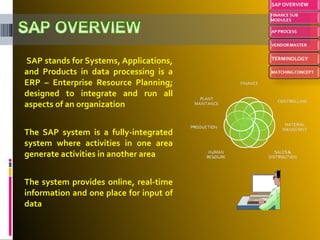
SAP stands for Systems, Applications, and Products in data processing is a ERP – Enterprise Resource Planning; designed to integrate and run all aspects of an organization The SAP system is a fully-integrated system where activities in one area generate activities in another area The system provides online, real-time information and one place for input of data
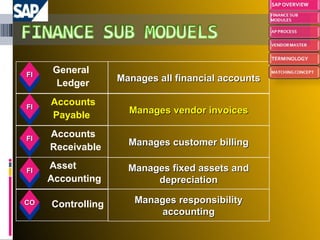
Manages vendor invoices Manages responsibility accounting Manages all financial accounts Manages customer billing Manages fixed assets and depreciation Accounts Receivable FI Controlling Accounts Payable Asset  Accounting FI CO FI General Ledger FI
 
 
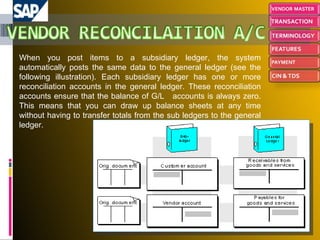
When you post items to a subsidiary ledger, the system automatically posts the same data to the general ledger (see the following illustration). Each subsidiary ledger has one or more reconciliation accounts in the general ledger. These reconciliation accounts ensure that the balance of G/L  accounts is always zero. This means that you can draw up balance sheets at any time without having to transfer totals from the sub ledgers to the general ledger.
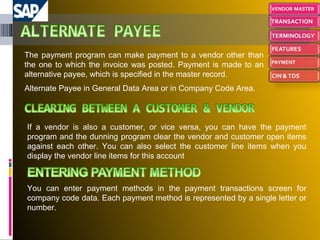
The payment program can make payment to a vendor other than the one to which the invoice was posted. Payment is made to an alternative payee, which is specified in the master record. Alternate Payee in General Data Area or in Company Code Area. If a vendor is also a customer, or vice versa, you can have the payment program and the dunning program clear the vendor and customer open items against each other. You can also select the customer line items when you display the vendor line items for this account You can enter payment methods in the payment transactions screen for company code data. Each payment method is represented by a single letter or number.
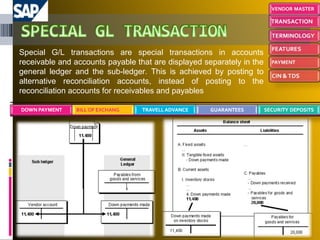
Special G/L transactions are special transactions in accounts receivable and accounts payable that are displayed separately in the general ledger and the sub-ledger. This is achieved by posting to alternative reconciliation accounts, instead of posting to the reconciliation accounts for receivables and payables
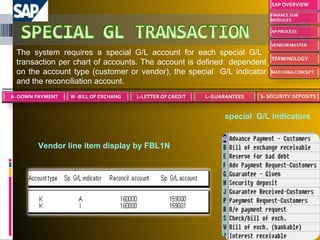
The system requires a special G/L account for each special G/L  transaction per chart of accounts. The account is defined  dependent on the account type (customer or vendor), the special  G/L indicator and the reconciliation account. special  G/L indicators   Vendor line item display by FBL1N
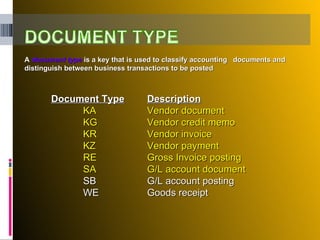
Document Type Description KA Vendor document KG Vendor credit memo KR Vendor invoice KZ Vendor payment RE Gross Invoice posting SA G/L account document SB G/L account posting WE Goods receipt A  document type  is a key that is used to classify accounting  documents and distinguish between business transactions to be posted
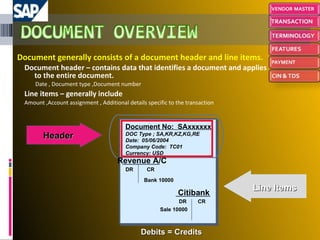
Document generally consists of a document header and line items.  Document header – contains data that identifies a document and applies to the entire document. Date , Document type ,Document number Line items – generally include   Amount ,Account assignment , Additional details specific to the transaction Document No:  SAxxxxxx DOC Type ; SA,KR,KZ,KG,RE Date:  05/06/2004 Company Code:  TC01 Currency: USD Header Line Items Debits = Credits Revenue A/C Citibank DR DR CR CR Bank 10000 Sale 10000
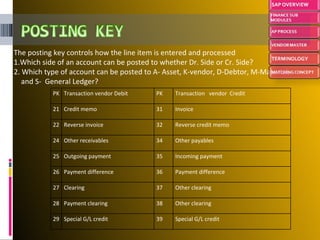
The posting key controls how the line item is entered and processed  1.Which side of an account can be posted to whether Dr. Side or Cr. Side? 2. Which type of account can be posted to A- Asset, K-vendor, D-Debtor, M-Material,  and S-  General Ledger? PK Transaction vendor Debit PK Transaction  vendor  Credit 21 Credit memo  31 Invoice  22 Reverse invoice  32 Reverse credit memo  24 Other receivables  34 Other payables  25 Outgoing payment  35 Incoming payment  26 Payment difference  36 Payment difference  27 Clearing  37 Other clearing  28 Payment clearing  38 Other clearing  29 Special G/L credit 39 Special G/L credit
 

Ap training 1

  • 1.
    Unit 1: Introduction
  • 2.
  • 3.
    SAP stands forSystems, Applications, and Products in data processing is a ERP – Enterprise Resource Planning; designed to integrate and run all aspects of an organization The SAP system is a fully-integrated system where activities in one area generate activities in another area The system provides online, real-time information and one place for input of data
  • 4.
    Manages vendor invoicesManages responsibility accounting Manages all financial accounts Manages customer billing Manages fixed assets and depreciation Accounts Receivable FI Controlling Accounts Payable Asset Accounting FI CO FI General Ledger FI
  • 5.
  • 6.
  • 7.
    When you postitems to a subsidiary ledger, the system automatically posts the same data to the general ledger (see the following illustration). Each subsidiary ledger has one or more reconciliation accounts in the general ledger. These reconciliation accounts ensure that the balance of G/L accounts is always zero. This means that you can draw up balance sheets at any time without having to transfer totals from the sub ledgers to the general ledger.
  • 8.
    The payment programcan make payment to a vendor other than the one to which the invoice was posted. Payment is made to an alternative payee, which is specified in the master record. Alternate Payee in General Data Area or in Company Code Area. If a vendor is also a customer, or vice versa, you can have the payment program and the dunning program clear the vendor and customer open items against each other. You can also select the customer line items when you display the vendor line items for this account You can enter payment methods in the payment transactions screen for company code data. Each payment method is represented by a single letter or number.
  • 9.
    Special G/L transactionsare special transactions in accounts receivable and accounts payable that are displayed separately in the general ledger and the sub-ledger. This is achieved by posting to alternative reconciliation accounts, instead of posting to the reconciliation accounts for receivables and payables
  • 10.
    The system requiresa special G/L account for each special G/L transaction per chart of accounts. The account is defined dependent on the account type (customer or vendor), the special G/L indicator and the reconciliation account. special G/L indicators Vendor line item display by FBL1N
  • 11.
    Document Type DescriptionKA Vendor document KG Vendor credit memo KR Vendor invoice KZ Vendor payment RE Gross Invoice posting SA G/L account document SB G/L account posting WE Goods receipt A document type is a key that is used to classify accounting documents and distinguish between business transactions to be posted
  • 12.
    Document generally consistsof a document header and line items. Document header – contains data that identifies a document and applies to the entire document. Date , Document type ,Document number Line items – generally include Amount ,Account assignment , Additional details specific to the transaction Document No: SAxxxxxx DOC Type ; SA,KR,KZ,KG,RE Date: 05/06/2004 Company Code: TC01 Currency: USD Header Line Items Debits = Credits Revenue A/C Citibank DR DR CR CR Bank 10000 Sale 10000
  • 13.
    The posting keycontrols how the line item is entered and processed 1.Which side of an account can be posted to whether Dr. Side or Cr. Side? 2. Which type of account can be posted to A- Asset, K-vendor, D-Debtor, M-Material, and S- General Ledger? PK Transaction vendor Debit PK Transaction vendor Credit 21 Credit memo 31 Invoice 22 Reverse invoice 32 Reverse credit memo 24 Other receivables 34 Other payables 25 Outgoing payment 35 Incoming payment 26 Payment difference 36 Payment difference 27 Clearing 37 Other clearing 28 Payment clearing 38 Other clearing 29 Special G/L credit 39 Special G/L credit
  • 14.