Wed 27 th  Feb DO NOW: Name 3 aspects of climate Temperature, rainfall, sunshine, wind, seasons, humidity, weather, droughts, hurricanes, monsoons Level 2 Geography
Skills – pg48 Due: Friday 29 th  Feb No essay practice this week. Homework for Week 5:
Learning Intention: To be able to describe different climatic processes Climatic Patterns and Processes
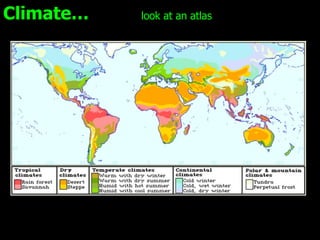
Climate…  look at an atlas
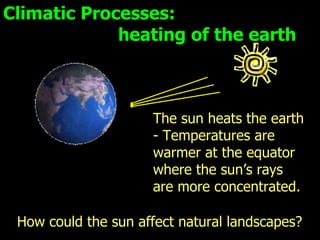
Climatic Processes:  heating of the earth The sun heats the earth - Temperatures are warmer at the equator where the sun’s rays are more concentrated. How could the sun affect natural landscapes?
Latitude:  Generally the closer to the Equator the warmer the temperature. This is because light at the Equator hits at less of an angle than at the poles. Northland at 36°S has an average temp of 14°C, whereas at Tongariro at 39°S has an average temp of 7°C. Altitude:  Saturated air cools at the rate of 0.6°C per 100 vertical metres. Relief:  This can cause orographic rain (Rangipo Desert) and cause wind funnelling (e.g. Cook Strait). Climate Controls  copy
Climatic Processes:  Aeolian Processes Wind – occurs through the heating and cooling of air. Air rises because it’s warm, then cools and falls. (convection current) How do you think wind could affect natural landscapes?  - Erosion (when something is warn away) - Deposition – when particles are deposited somewhere)
Climatic Processes:  Precipitation Rain…Snow…Hail…Drizzle…  How do you think precipitation could affect natural landscapes?  Erosion – rainfall wears away soils and rocks Helps grow vegetation Creates flooding which erodes, transports and deposits soil particles.
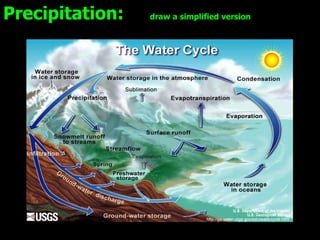
Precipitation:  draw a simplified version
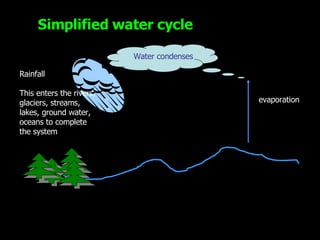
evaporation Water condenses Rainfall This enters the rivers, glaciers, streams, lakes, ground water, oceans to complete the system Simplified water cycle
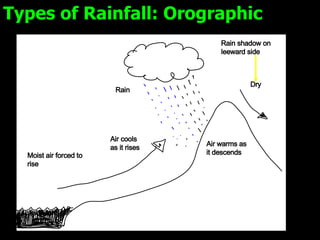
Types of Rainfall: Orographic  Moist air forced to rise  Rain shadow on leeward side  Air warms as it descends   Air cools as it rises  Rain  Dry
Where could orographic rainfall occur in NZ? - West side of the mountain ranges Where would the rain shadows be? - Eastern side of the mountain ranges What does leeward mean? lee – shelterd area Leeward – the sheltered side of something. Eg the Desert Road is the sheltered (leeward) side of Mt Ruapehu. Write generalisations to answer these questions
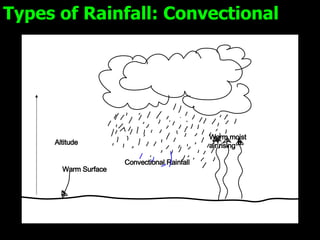
Warm Surface  Warm moist air rising  Altitude   Convectional Rainfall  Types of Rainfall: Convectional
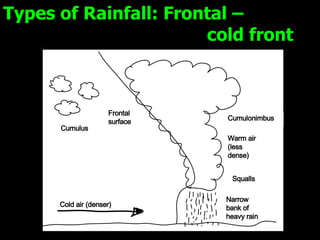
Types of Rainfall: Frontal –  cold front Narrow bank of heavy rain  Cumulus   Cumulonimbus   Squalls  Cold air (denser) Warm air (less dense)  Frontal surface
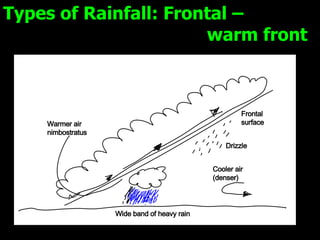
Types of Rainfall: Frontal –  warm front Drizzle   Warmer air nimbostratus  Frontal surface  Wide band of heavy rain Cooler air (denser)
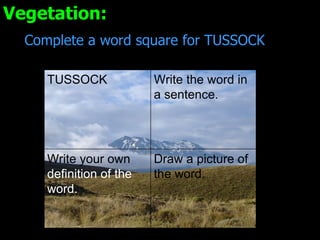
Vegetation: Complete a word square for TUSSOCK Draw a picture of the word. Write your own  definition of the word. Write the word in a sentence. TUSSOCK
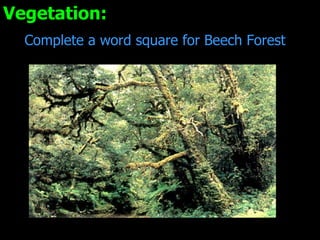
Vegetation: Complete a word square for Beech Forest
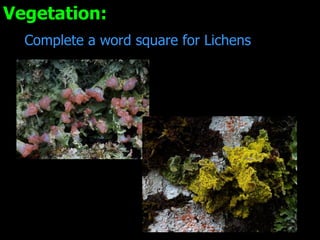
Vegetation: Complete a word square for Lichens
Tell the person beside you how orographic rainfall occurs.
Reflection Have you achieved today’s Learning Intention? Write down any questions that you have from today’s lesson. In your groups, work out the question you can’t answer. Learning Intention: To be able to describe different climatic processes
? Answer: ? Answer: ? Answer: ? Answer: ? Answer: ? Answer:

Climate Patterns And Processes

  • 1.
    Wed 27 th Feb DO NOW: Name 3 aspects of climate Temperature, rainfall, sunshine, wind, seasons, humidity, weather, droughts, hurricanes, monsoons Level 2 Geography
  • 2.
    Skills – pg48Due: Friday 29 th Feb No essay practice this week. Homework for Week 5:
  • 3.
    Learning Intention: Tobe able to describe different climatic processes Climatic Patterns and Processes
  • 4.
    Climate… lookat an atlas
  • 5.
    Climatic Processes: heating of the earth The sun heats the earth - Temperatures are warmer at the equator where the sun’s rays are more concentrated. How could the sun affect natural landscapes?
  • 6.
    Latitude: Generallythe closer to the Equator the warmer the temperature. This is because light at the Equator hits at less of an angle than at the poles. Northland at 36°S has an average temp of 14°C, whereas at Tongariro at 39°S has an average temp of 7°C. Altitude: Saturated air cools at the rate of 0.6°C per 100 vertical metres. Relief: This can cause orographic rain (Rangipo Desert) and cause wind funnelling (e.g. Cook Strait). Climate Controls copy
  • 7.
    Climatic Processes: Aeolian Processes Wind – occurs through the heating and cooling of air. Air rises because it’s warm, then cools and falls. (convection current) How do you think wind could affect natural landscapes? - Erosion (when something is warn away) - Deposition – when particles are deposited somewhere)
  • 8.
    Climatic Processes: Precipitation Rain…Snow…Hail…Drizzle… How do you think precipitation could affect natural landscapes? Erosion – rainfall wears away soils and rocks Helps grow vegetation Creates flooding which erodes, transports and deposits soil particles.
  • 9.
    Precipitation: drawa simplified version
  • 10.
    evaporation Water condensesRainfall This enters the rivers, glaciers, streams, lakes, ground water, oceans to complete the system Simplified water cycle
  • 11.
    Types of Rainfall:Orographic Moist air forced to rise Rain shadow on leeward side Air warms as it descends Air cools as it rises Rain Dry
  • 12.
    Where could orographicrainfall occur in NZ? - West side of the mountain ranges Where would the rain shadows be? - Eastern side of the mountain ranges What does leeward mean? lee – shelterd area Leeward – the sheltered side of something. Eg the Desert Road is the sheltered (leeward) side of Mt Ruapehu. Write generalisations to answer these questions
  • 13.
    Warm Surface Warm moist air rising Altitude Convectional Rainfall Types of Rainfall: Convectional
  • 14.
    Types of Rainfall:Frontal – cold front Narrow bank of heavy rain Cumulus Cumulonimbus Squalls Cold air (denser) Warm air (less dense) Frontal surface
  • 15.
    Types of Rainfall:Frontal – warm front Drizzle Warmer air nimbostratus Frontal surface Wide band of heavy rain Cooler air (denser)
  • 16.
    Vegetation: Complete aword square for TUSSOCK Draw a picture of the word. Write your own definition of the word. Write the word in a sentence. TUSSOCK
  • 17.
    Vegetation: Complete aword square for Beech Forest
  • 18.
    Vegetation: Complete aword square for Lichens
  • 19.
    Tell the personbeside you how orographic rainfall occurs.
  • 20.
    Reflection Have youachieved today’s Learning Intention? Write down any questions that you have from today’s lesson. In your groups, work out the question you can’t answer. Learning Intention: To be able to describe different climatic processes
  • 21.
    ? Answer: ?Answer: ? Answer: ? Answer: ? Answer: ? Answer:

Editor's Notes

  • #2 Answers: B (the smaller the number the bigger the scale because the map is bigger – less is being shown) 1cm on the map = 6,000cm on the land Map B has the larger scale – showing more detail. (not trying to show as many centimetres as the other one – makes it a larger scale)