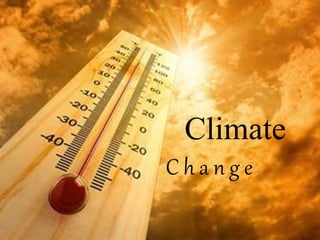
Climate
C h a n g e
.
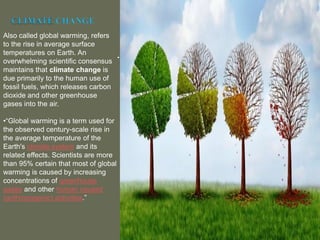
Also called global warming, refers
to the rise in average surface
temperatures on Earth. An
overwhelming scientific consensus
maintains that climate change is
due primarily to the human use of
fossil fuels, which releases carbon
dioxide and other greenhouse
gases into the air.
•“Global warming is a term used for
the observed century-scale rise in
the average temperature of the
Earth's climate system and its
related effects. Scientists are more
than 95% certain that most of global
warming is caused by increasing
concentrations of greenhouse
gases and other human caused
(anthropogenic) activities.”
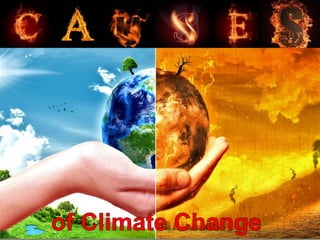
Some Major Causes of Climate Change
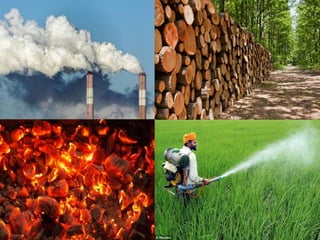
● : When fossil fuels are burned they release carbon dioxide
into the atmosphere which contributes to global warming. Using fossil fuels to
generate energy also releases pollutants into the atmosphere - such as sulphur
dioxide.
● : is the permanent destruction of forests in order to make the
land available for other uses. Global warming,weather pattern,water
cycle,ocean acidification and quality of life can be the effect of continuous
deforestation.
● : The coal industry uses enough fresh water to meet
the basic needs of one billion people. Yet we are already at risk of a global water
supply crisis. Adding further strain on our water supplies, pollution from coal
mines and coal plants contaminates groundwater and waterways.
● : Fertilizers consists of substances and chemicals like
methane, carbon dioxide, ammonia, and nitrogen, the emission of which has
contributed to a great extent in the quantity of greenhouse gases present in the
environment. This in turn is leading to global warming and weather changes.
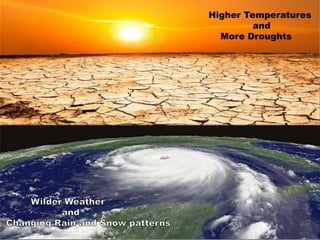
Higher Temperatures
and
More Droughts
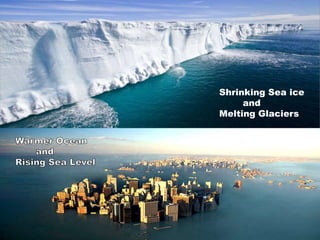
Shrinking Sea ice
and
Melting Glaciers
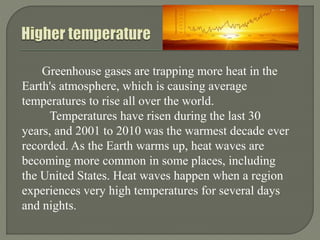
Greenhouse gases are trapping more heat in the
Earth's atmosphere, which is causing average
temperatures to rise all over the world.
Temperatures have risen during the last 30
years, and 2001 to 2010 was the warmest decade ever
recorded. As the Earth warms up, heat waves are
becoming more common in some places, including
the United States. Heat waves happen when a region
experiences very high temperatures for several days
and nights.
 One impact of drought on communities is its effect on water
supply. When drought conditions persist with no relief, or not enough
precipitation to lift the drought conditions, water restrictions are put into
place by local or state governments. This is important since communities
need to ration water consumption so that the reservoirs and streams do not
run too low on water to meet the needs of utility companies and others
who use water as well as the local ecosystems.
A final impact of drought can be reduced electrical generation. In
the Southeast, most power generation depends on the use of water for
hydropower or coal-burning and nuclear plants, so if water use is
restricted, then power plants may need to be shut down and more
expensive kinds of energy generation such as burning natural gas may
need to be used. This is particularly a problem when the drought is
accompanied by high temperatures and increased demand for air
conditioning.
 Hurricanes and other tropical storms get their energy from warm ocean
water. As the top layer of the ocean gets warmer, hurricanes and other
tropical storms grow stronger, with faster winds and heavier rain. Because
of higher temperatures and increased evaporation, climate change causes
other types of storms to get stronger, too.
Warmer than usual sea-surface temperatures helped fuel Hurricane
Sandy in 2012, causing billions of dollars of destruction in the Northeast
U.S. Abnormally severe rainstorms this year in the U.S., China and
elsewhere were attributed to the effects of global warming. In late April
some parts of Florida and Alabama received 11 inches of rain in one 24-
hour period.While some areas of the U.S. are receiving record rainfall,
other areas are experiencing record droughts,including the Western states.
Droughts, along with the hot temperatures and dry conditions that
causethem, increase the frequency of wildfires.
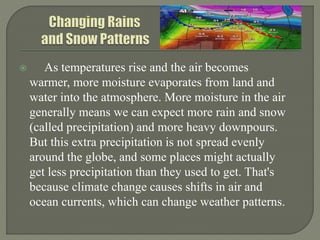
 As temperatures rise and the air becomes
warmer, more moisture evaporates from land and
water into the atmosphere. More moisture in the air
generally means we can expect more rain and snow
(called precipitation) and more heavy downpours.
But this extra precipitation is not spread evenly
around the globe, and some places might actually
get less precipitation than they used to get. That's
because climate change causes shifts in air and
ocean currents, which can change weather patterns.
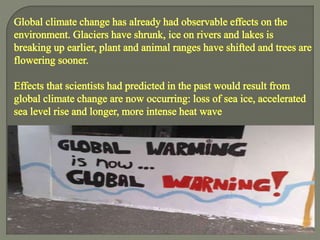
 And the effects, according to an international team, are
equally clear—sea levels are rising faster than predicted,
which could bring about disastrous effects for people and
wildlife.
 Rising seas would increase the risk of catastrophic
flooding like that caused by Hurricane Sandy last month in
New York and New Jersey. Environmental damage may
include widespread erosion, contamination of aquifers and
crops, and harm to marine life. And in the long term, rising
seas may force hundreds of millions of people who live along
the coast to abandon their homes.
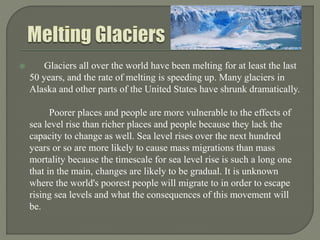
 Glaciers all over the world have been melting for at least the last
50 years, and the rate of melting is speeding up. Many glaciers in
Alaska and other parts of the United States have shrunk dramatically.
Poorer places and people are more vulnerable to the effects of
sea level rise than richer places and people because they lack the
capacity to change as well. Sea level rises over the next hundred
years or so are more likely to cause mass migrations than mass
mortality because the timescale for sea level rise is such a long one
that in the main, changes are likely to be gradual. It is unknown
where the world's poorest people will migrate to in order to escape
rising sea levels and what the consequences of this movement will
be.
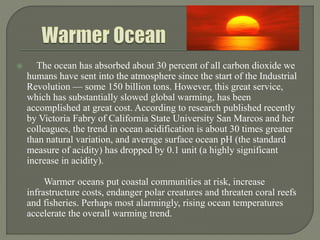
 The ocean has absorbed about 30 percent of all carbon dioxide we
humans have sent into the atmosphere since the start of the Industrial
Revolution — some 150 billion tons. However, this great service,
which has substantially slowed global warming, has been
accomplished at great cost. According to research published recently
by Victoria Fabry of California State University San Marcos and her
colleagues, the trend in ocean acidification is about 30 times greater
than natural variation, and average surface ocean pH (the standard
measure of acidity) has dropped by 0.1 unit (a highly significant
increase in acidity).
Warmer oceans put coastal communities at risk, increase
infrastructure costs, endanger polar creatures and threaten coral reefs
and fisheries. Perhaps most alarmingly, rising ocean temperatures
accelerate the overall warming trend.
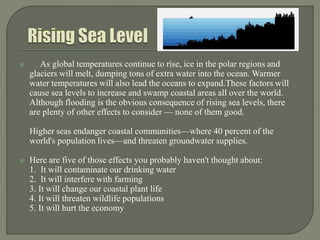
 As global temperatures continue to rise, ice in the polar regions and
glaciers will melt, dumping tons of extra water into the ocean. Warmer
water temperatures will also lead the oceans to expand.These factors will
cause sea levels to increase and swamp coastal areas all over the world.
Although flooding is the obvious consequence of rising sea levels, there
are plenty of other effects to consider — none of them good.
Higher seas endanger coastal communities—where 40 percent of the
world's population lives—and threaten groundwater supplies.
 Here are five of those effects you probably haven't thought about:
1. It will contaminate our drinking water
2. It will interfere with farming
3. It will change our coastal plant life
4. It will threaten wildlife populations
5. It will hurt the economy
 Developing countries, who did not significantly contribute to the
amount of greenhouse gases in the atmosphere, will now be at an
even greater disadvantage when it comes to dealing with the effects
of climate change. Developing countries already struggle with lack
of infrastructure and less technological and financial resources,
among a number of other concerns that will hinder their ability to
adapt. Furthermore, these countries are dependent on the resources
they do have to deal with high rates of poverty and income
inequality, both of which, as we stated, will be exacerbated with
climate change. For example, public funds that could have originally
been used towards education will now have to go to sea walls,
increased irrigation, or storm water systems to adapt. Although this
reality is discussed as a part of the United Nations Framework
Convention on Climate Change (UNFCCC), technological and
financial assistance to developing countries isn’t even close to
sufficient
 Many are afraid that tackling climate change
is going to be too costly. But increasingly,
studies are showing action will not just be
cheaper than inaction, but could actually result
in economic, environmental and even health
benefits, while improving sustainability.
Climate change

Climate change

  • 1.
  • 3.
    . Also called globalwarming, refers to the rise in average surface temperatures on Earth. An overwhelming scientific consensus maintains that climate change is due primarily to the human use of fossil fuels, which releases carbon dioxide and other greenhouse gases into the air. •“Global warming is a term used for the observed century-scale rise in the average temperature of the Earth's climate system and its related effects. Scientists are more than 95% certain that most of global warming is caused by increasing concentrations of greenhouse gases and other human caused (anthropogenic) activities.”
  • 6.
    Some Major Causesof Climate Change ● : When fossil fuels are burned they release carbon dioxide into the atmosphere which contributes to global warming. Using fossil fuels to generate energy also releases pollutants into the atmosphere - such as sulphur dioxide. ● : is the permanent destruction of forests in order to make the land available for other uses. Global warming,weather pattern,water cycle,ocean acidification and quality of life can be the effect of continuous deforestation. ● : The coal industry uses enough fresh water to meet the basic needs of one billion people. Yet we are already at risk of a global water supply crisis. Adding further strain on our water supplies, pollution from coal mines and coal plants contaminates groundwater and waterways. ● : Fertilizers consists of substances and chemicals like methane, carbon dioxide, ammonia, and nitrogen, the emission of which has contributed to a great extent in the quantity of greenhouse gases present in the environment. This in turn is leading to global warming and weather changes.
  • 9.
  • 10.
  • 11.
    Greenhouse gases aretrapping more heat in the Earth's atmosphere, which is causing average temperatures to rise all over the world. Temperatures have risen during the last 30 years, and 2001 to 2010 was the warmest decade ever recorded. As the Earth warms up, heat waves are becoming more common in some places, including the United States. Heat waves happen when a region experiences very high temperatures for several days and nights.
  • 12.
     One impactof drought on communities is its effect on water supply. When drought conditions persist with no relief, or not enough precipitation to lift the drought conditions, water restrictions are put into place by local or state governments. This is important since communities need to ration water consumption so that the reservoirs and streams do not run too low on water to meet the needs of utility companies and others who use water as well as the local ecosystems. A final impact of drought can be reduced electrical generation. In the Southeast, most power generation depends on the use of water for hydropower or coal-burning and nuclear plants, so if water use is restricted, then power plants may need to be shut down and more expensive kinds of energy generation such as burning natural gas may need to be used. This is particularly a problem when the drought is accompanied by high temperatures and increased demand for air conditioning.
  • 13.
     Hurricanes andother tropical storms get their energy from warm ocean water. As the top layer of the ocean gets warmer, hurricanes and other tropical storms grow stronger, with faster winds and heavier rain. Because of higher temperatures and increased evaporation, climate change causes other types of storms to get stronger, too. Warmer than usual sea-surface temperatures helped fuel Hurricane Sandy in 2012, causing billions of dollars of destruction in the Northeast U.S. Abnormally severe rainstorms this year in the U.S., China and elsewhere were attributed to the effects of global warming. In late April some parts of Florida and Alabama received 11 inches of rain in one 24- hour period.While some areas of the U.S. are receiving record rainfall, other areas are experiencing record droughts,including the Western states. Droughts, along with the hot temperatures and dry conditions that causethem, increase the frequency of wildfires.
  • 14.
     As temperaturesrise and the air becomes warmer, more moisture evaporates from land and water into the atmosphere. More moisture in the air generally means we can expect more rain and snow (called precipitation) and more heavy downpours. But this extra precipitation is not spread evenly around the globe, and some places might actually get less precipitation than they used to get. That's because climate change causes shifts in air and ocean currents, which can change weather patterns.
  • 15.
     And theeffects, according to an international team, are equally clear—sea levels are rising faster than predicted, which could bring about disastrous effects for people and wildlife.  Rising seas would increase the risk of catastrophic flooding like that caused by Hurricane Sandy last month in New York and New Jersey. Environmental damage may include widespread erosion, contamination of aquifers and crops, and harm to marine life. And in the long term, rising seas may force hundreds of millions of people who live along the coast to abandon their homes.
  • 16.
     Glaciers allover the world have been melting for at least the last 50 years, and the rate of melting is speeding up. Many glaciers in Alaska and other parts of the United States have shrunk dramatically. Poorer places and people are more vulnerable to the effects of sea level rise than richer places and people because they lack the capacity to change as well. Sea level rises over the next hundred years or so are more likely to cause mass migrations than mass mortality because the timescale for sea level rise is such a long one that in the main, changes are likely to be gradual. It is unknown where the world's poorest people will migrate to in order to escape rising sea levels and what the consequences of this movement will be.
  • 17.
     The oceanhas absorbed about 30 percent of all carbon dioxide we humans have sent into the atmosphere since the start of the Industrial Revolution — some 150 billion tons. However, this great service, which has substantially slowed global warming, has been accomplished at great cost. According to research published recently by Victoria Fabry of California State University San Marcos and her colleagues, the trend in ocean acidification is about 30 times greater than natural variation, and average surface ocean pH (the standard measure of acidity) has dropped by 0.1 unit (a highly significant increase in acidity). Warmer oceans put coastal communities at risk, increase infrastructure costs, endanger polar creatures and threaten coral reefs and fisheries. Perhaps most alarmingly, rising ocean temperatures accelerate the overall warming trend.
  • 18.
     As globaltemperatures continue to rise, ice in the polar regions and glaciers will melt, dumping tons of extra water into the ocean. Warmer water temperatures will also lead the oceans to expand.These factors will cause sea levels to increase and swamp coastal areas all over the world. Although flooding is the obvious consequence of rising sea levels, there are plenty of other effects to consider — none of them good. Higher seas endanger coastal communities—where 40 percent of the world's population lives—and threaten groundwater supplies.  Here are five of those effects you probably haven't thought about: 1. It will contaminate our drinking water 2. It will interfere with farming 3. It will change our coastal plant life 4. It will threaten wildlife populations 5. It will hurt the economy
  • 20.
     Developing countries,who did not significantly contribute to the amount of greenhouse gases in the atmosphere, will now be at an even greater disadvantage when it comes to dealing with the effects of climate change. Developing countries already struggle with lack of infrastructure and less technological and financial resources, among a number of other concerns that will hinder their ability to adapt. Furthermore, these countries are dependent on the resources they do have to deal with high rates of poverty and income inequality, both of which, as we stated, will be exacerbated with climate change. For example, public funds that could have originally been used towards education will now have to go to sea walls, increased irrigation, or storm water systems to adapt. Although this reality is discussed as a part of the United Nations Framework Convention on Climate Change (UNFCCC), technological and financial assistance to developing countries isn’t even close to sufficient
  • 21.
     Many areafraid that tackling climate change is going to be too costly. But increasingly, studies are showing action will not just be cheaper than inaction, but could actually result in economic, environmental and even health benefits, while improving sustainability.