Climate Control and
Ozone Depletion
Chapter 19
Core Case Study: Studying a Volcano to
Understand Climate Change
 June 1991: Mount Pinatubo (Philippines)
exploded
 Airborne pollutants, deaths, and damage
 Affected climate temperature
 Climate predictions based on the forecasts of
James Hansen of NASA
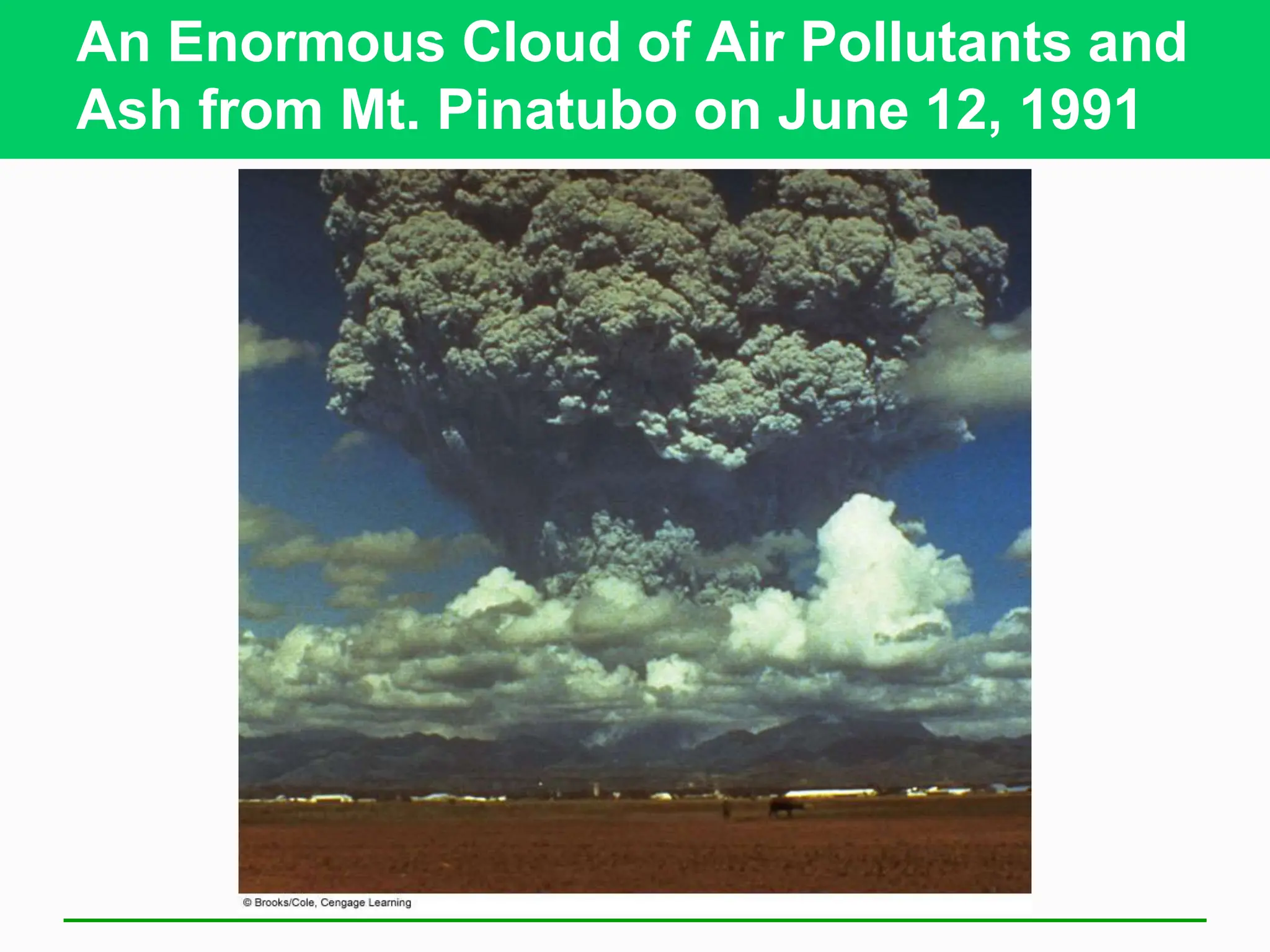
An Enormous Cloud of Air Pollutants and
Ash from Mt. Pinatubo on June 12, 1991
Global Warming and Global Cooling
Are Not New (1)
 Over the past 4.7 billion years the climate has
been altered by
• Volcanic emissions
• Changes in solar input
• Movement of the continents
• Impacts by meteors
 Over the past 900,000 years
• Glacial and interglacial periods
Global Warming and Global Cooling
Are Not New (2)
 Over the past 10,000 years
• Interglacial period
 Over the past 1,000 years
• Temperature stable
 Over the past 100 years
• Temperature changes; methods of determination
Estimated Changes in the Average
Global Temperature of the Atmosphere
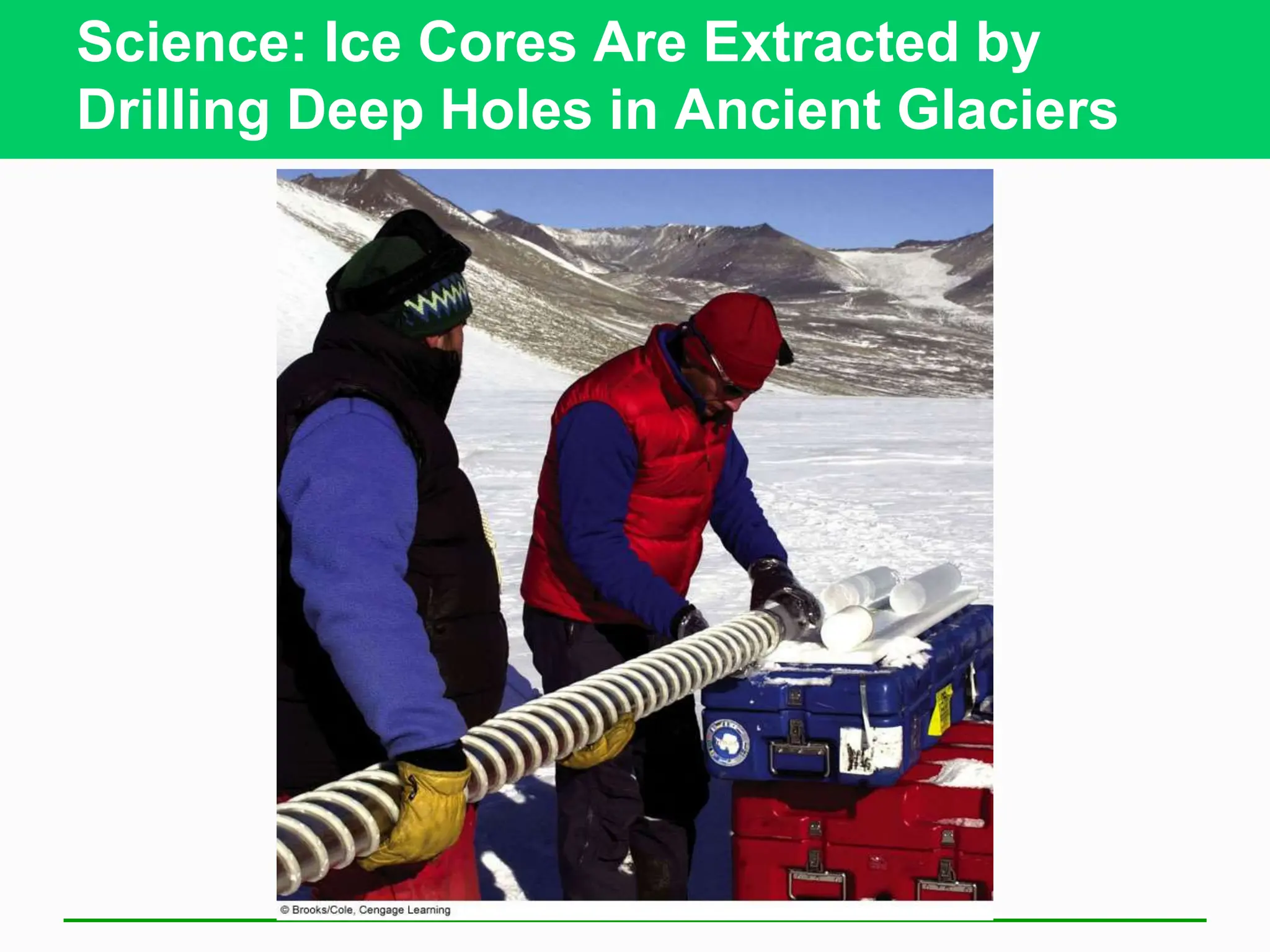
Science: Ice Cores Are Extracted by
Drilling Deep Holes in Ancient Glaciers
Our Climate, Lives, and Economies
Depend on the Natural Greenhouse Effect
 Without the natural greenhouse effect
• Cold, uninhabitable earth
Human Activities Emit Large Quantities
of Greenhouses Gases (1)
 Since the Industrial Revolution
• CO2, CH4, and N2O emissions higher
• Main sources: agriculture, deforestation, and
burning of fossil fuels
 Correlation of rising CO2 and CH4 with rising
global temperatures
 Countries with the largest CO2 emissions
Melting of Alaska’s Muir Glacier
between 1948 and 2004
The Big Melt: Some of the Floating Sea
Ice in the Arctic Sea
What Is the Scientific Consensus about
Future Temperature Change?
 Mathematical models used for predictions
 Global warming: rapid rate
 Human factors are the major cause of
temperature rise since 1950
 Human factors will become a greater risk factor
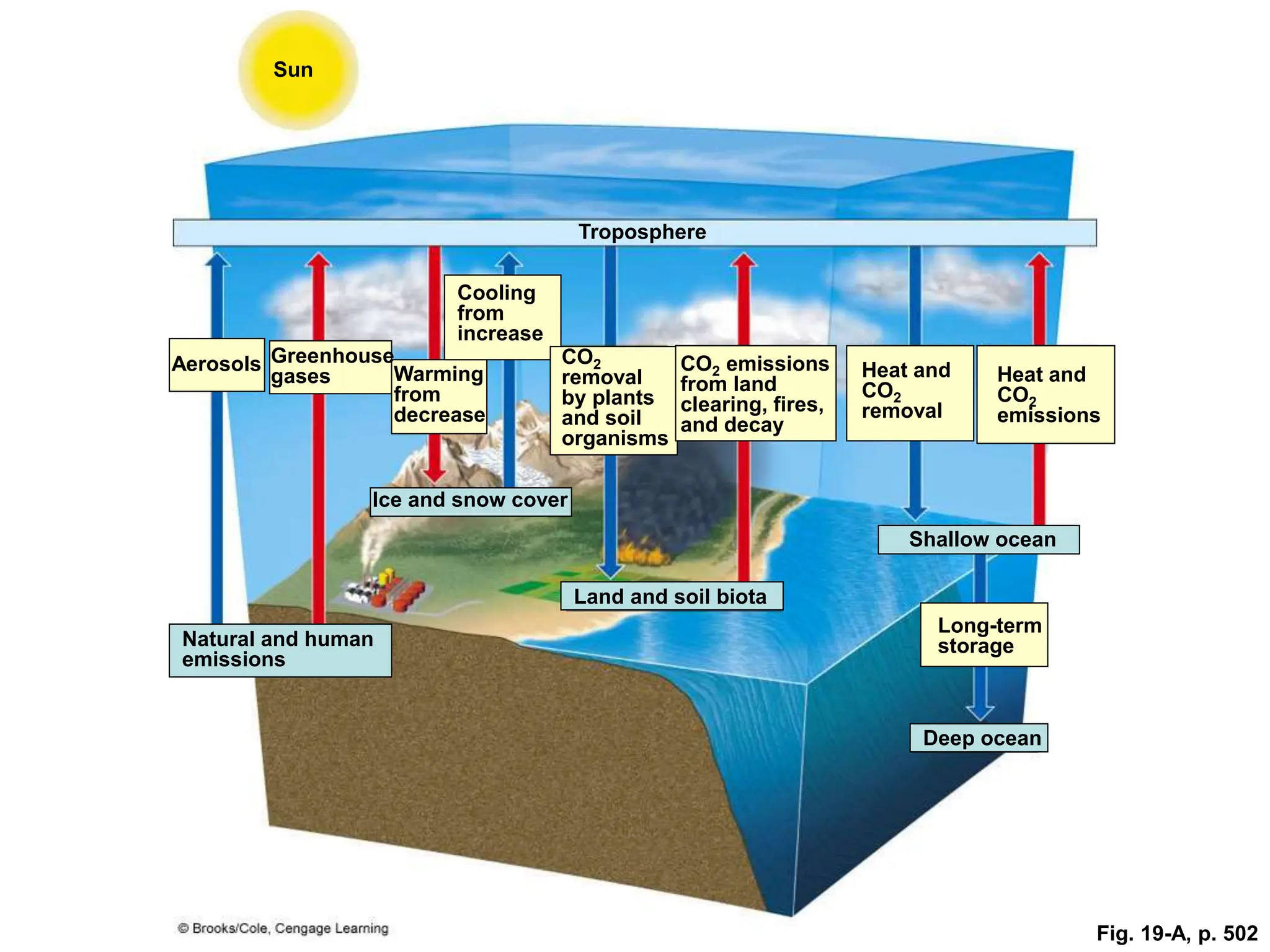
Fig. 19-A, p. 502
Sun
Troposphere
Cooling
from
increase
Aerosols Greenhouse
gases Warming
from
decrease
CO2
removal
by plants
and soil
organisms
CO2 emissions
from land
clearing, fires,
and decay
Heat and
CO2
removal
Heat and
CO2
emissions
Ice and snow cover
Shallow ocean
Land and soil biota
Long-term
storage
Natural and human
emissions
Deep ocean
Comparison of Measured Temperature
from 1860–2007 and Projected Changes
Is a Hotter Sun the Culprit?
 Since 1975
• Troposphere has warmed
• Stratosphere has cooled
 This is not what a hotter sun would do
Can the Oceans Save Us?
 Solubility of CO2 in ocean water
 Warmer oceans
• CO2 levels increasing acidity
• Effect on atmospheric levels of CO2
• Effect on coral reefs
 Antarctica’s Southern Ocean and the North
Atlantic Ocean
• Decrease in CO2 uptake
• Significance on global CO2 levels
There Is Uncertainty about the Effects of
Cloud Cover on Global Warming
 Warmer temperatures create more clouds
• Thick, light-colored low altitude clouds: decrease
surface temperature
• Thin, cirrus clouds at high altitudes: increase
surface temperature
 Effect of jet entrails on climate temperature
Outdoor Air Pollution Can Temporarily
Slow Global Warming
 Aerosol and soot pollutants
• Will not enhance or counteract projected global
warming
• Fall back to the earth or are washed out of the
lower atmosphere
• Reduction: especially in developed countries
Enhanced Global Warming Could Have
Severe Consequences
 Tipping point and irreversible climate change
 Worst-case scenarios
• Ecosystems collapsing
• Low-lying cities flooded
• Wildfires in forests
• Prolonged droughts: grasslands become dust
bowls
• More destructive storms
• Glaciers shrinking; rivers drying up
Severe Drought Is Increasing:
The Browning of the Earth
 Accelerate global warming, lead to more drought
 Biodiversity will decrease
 NPP will decrease
 Dry climate ecosystems will increase
 Other effects of prolonged lack of water
Ice and Snow Are Melting (1)
 Why will global warming be worse in the polar
regions?
 Important climate role of floating sea ice
 Mountain glaciers affected by
• Average snowfall
• Average warm temperatures
Ice and Snow Are Melting (2)
 Europe’s Alps
• Glaciers are disappearing
 South America
• Glaciers are disappearing
 Greenland
• Warmer temperatures
Science Focus: Melting Ice in Greenland
 Largest island: 80% composed of glaciers
 10% of the world’s fresh water
 1996–2007: net loss of ice doubled
 Effect on sea level if melting continues
Areas of Glacial Ice Melting in Greenland
during Summer 1982–2007 Increased
Sea Levels Are Rising (1)
 Expansion of warm water
 Melting of land-based ice
 What about Greenland?
Sea Levels Are Rising (2)
 Projected irreversible effect
• Degradation and loss of 1/3 of coastal estuaries,
wetlands, and coral reefs
• Disruption of coastal fisheries
• Flooding of
• Low-lying barrier islands and coastal areas
• Agricultural lowlands and deltas
• Contamination of freshwater aquifers
• Submergence of low-lying islands in the Pacific
and Indian Oceans and the Caribbean
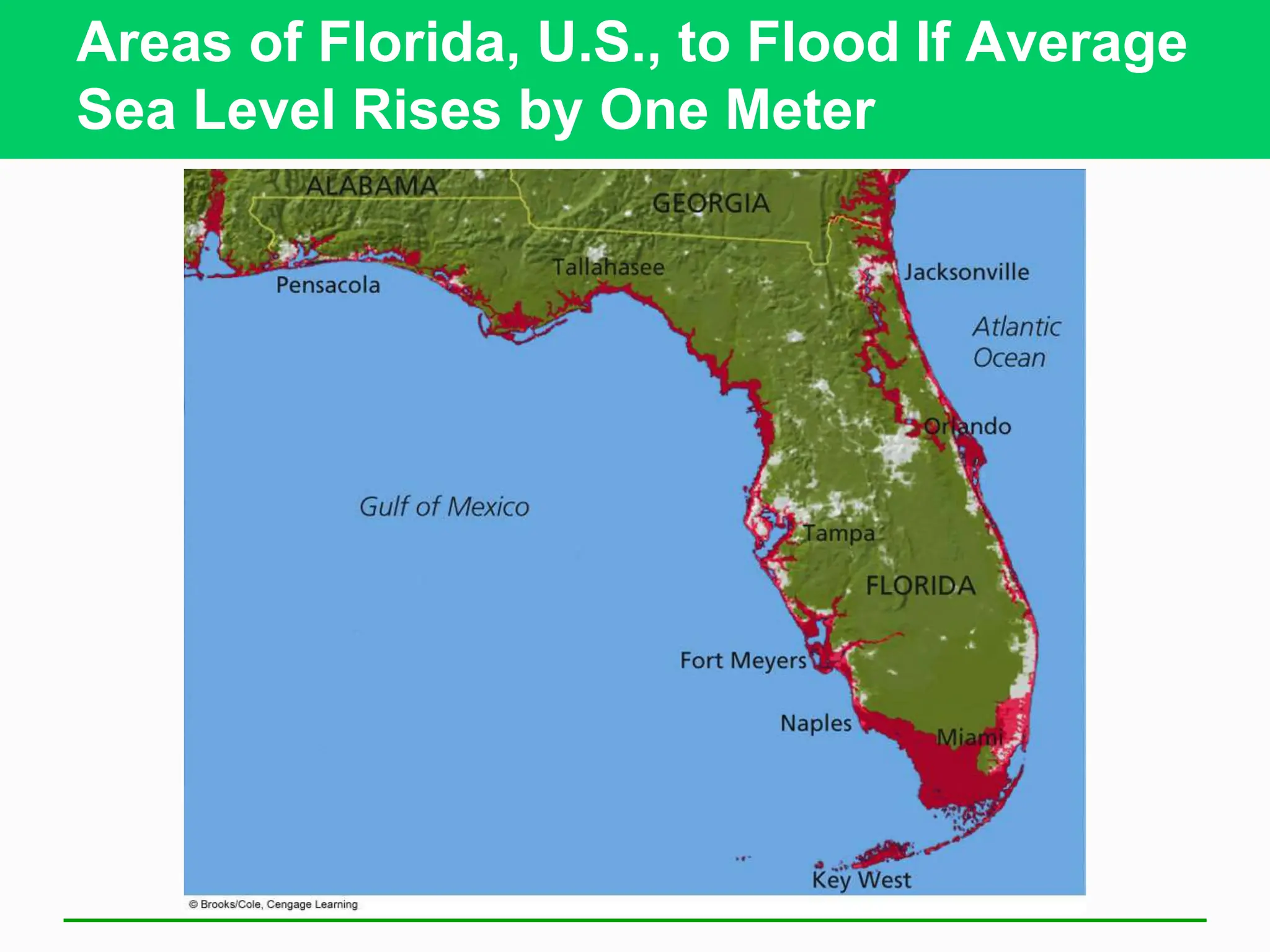
Areas of Florida, U.S., to Flood If Average
Sea Level Rises by One Meter
Low-Lying Island Nation: Maldives in
the Indian Ocean
Permafrost Is Likely to Melt: Another
Dangerous Scenario
 Carbon present as CH4 in permafrost soils and
lake bottoms
 2004: Arctic Climate Impact Assessment
• 10–20% of the permafrost might melt this century
 Effect on global warming
Projected Decline in Arctic Tundra in
Portions of Russia from 2004 to 2100
Ocean Currents Are Changing but the
Threat Is Unknown
 Melting glaciers, particularly in Greenland
 Increased rain in the North Atlantic
 Not thought to be an immediate problem on the
ocean currents
Extreme Weather Will Increase in Some
Areas
 Heat waves and droughts in some areas
 Prolonged rains and flooding in other areas
 Will storms get worse?
• More studies needed
 Hurricanes Katrina and Rita
Global Warming Is a Major Threat to
Biodiversity (1)
 Most susceptible ecosystems
• Coral reefs
• Polar seas
• Coastal wetland
• High-elevation mountaintops
• Alpine and arctic tundra
Global Warming Is a Major Threat to
Biodiversity (2)
 What about
• Migratory animals
• Forests
 Which organisms could increase with global
warming? Significance?
• Insects
• Fungi
• Microbes
Exploding Populations of Mountain Pine
Beetles in British Columbia, Canada
Climate Change Will Shift Areas Where
Crops Can Be Grown
 Regions of farming may shift
• Decrease in tropical and subtropical areas
• Increase in northern latitudes
• Less productivity; soil not as fertile
 Genetically engineered crops more tolerant to
drought
Climate Change Will Threaten the Health
of Many People
 Deaths from heat waves will increase
 Deaths from cold weather will decrease
 Higher temperatures can cause
• Increased flooding
• Increase in some forms of air pollution, more O3
• More insects, microbes, toxic molds, and fungi
Dealing with Climate Change Is Difficult
 Global problem
 Long-lasting effects
 Long-term political problem
 Harmful and beneficial impacts of climate
change unevenly spread
 Many proposed actions disrupt economies and
lifestyles
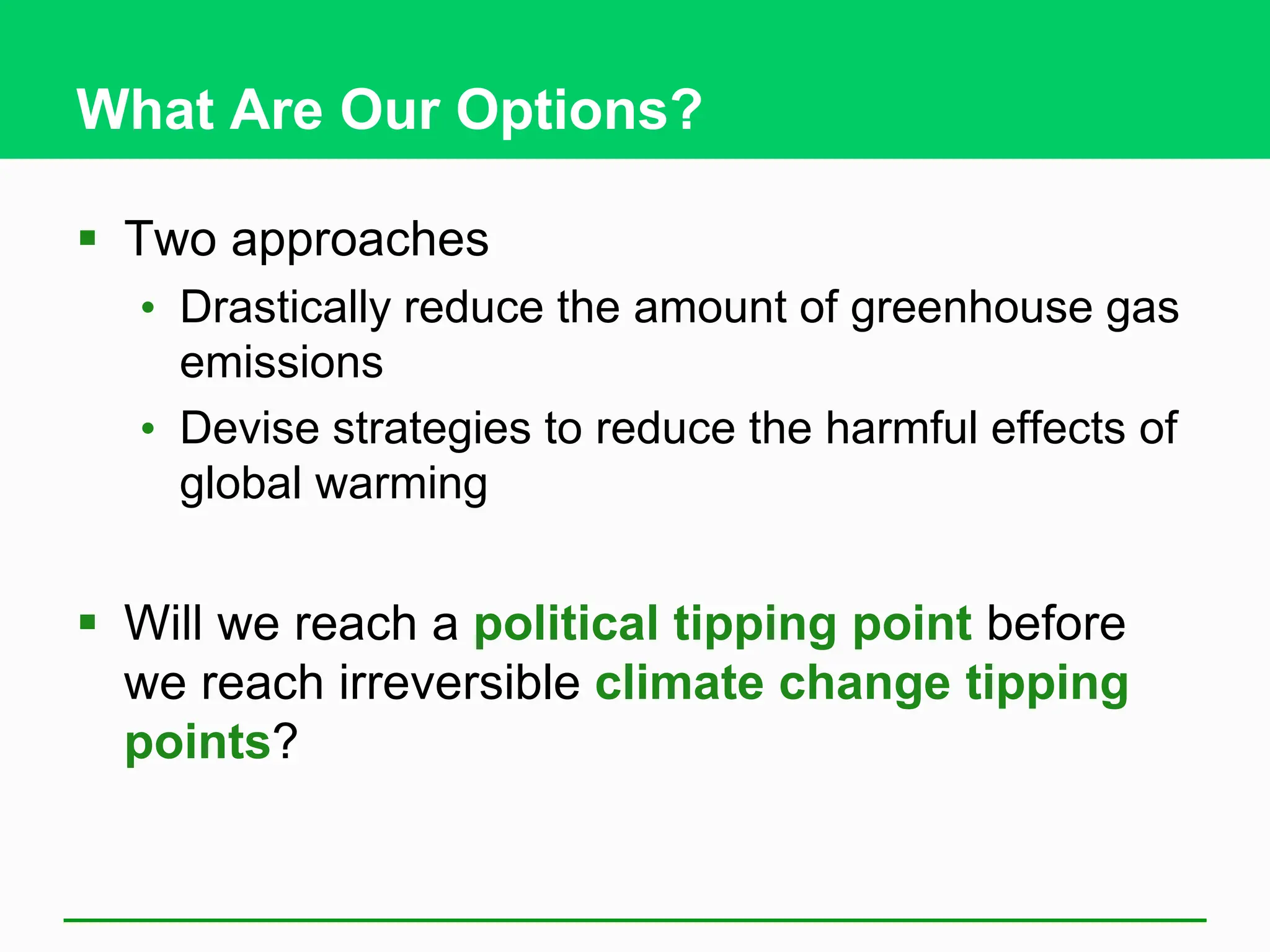
What Are Our Options?
 Two approaches
• Drastically reduce the amount of greenhouse gas
emissions
• Devise strategies to reduce the harmful effects of
global warming
 Will we reach a political tipping point before
we reach irreversible climate change tipping
points?
Avoiding Catastrophe: We Can Reduce
the Threat of Climate Change (1)
 Input or prevention strategies
 Improve energy efficiency to reduce fossil fuel
use
 Stop cutting down tropical forests
 Output strategy
• Capture and store CO2
Avoiding Catastrophe: We Can Reduce
the Threat of Climate Change (2)
 Socolow and Pacala
• Climate stabilization wedges
• Keep CO2 emissions to 2007 levels by 2057
 Brown: need to do more
• Cut CO2 emissions by 80% by 2020
• 2008 book: Plan B 3.0: Mobilizing to Save
Civilization
Avoiding Catastrophe: We Can Reduce
the Threat of Climate Change (3)
 Output solutions
• Massive global tree planting; how many?
• Wangari Maathai
• Great Wall of Trees: China and Africa
• Plant fast-growing perennials on degraded land
• Capturing and storing CO2
Case Study: Is Capturing and Storing
CO2 the Answer? (1)
 Carbon capture and storage (CCS)
 Several problems with this approach
• Power plants using CCS
• More expensive to build
• None exist
• Unproven technology
• Large inputs of energy to work
• Increasing CO2 emissions
Case Study: Is Capturing and Storing
CO2 the Answer? (2)
 Problems with carbon capture and storage
cont…
• Promotes the continued use of coal (world’s
dirtiest fuel)
• Effect of government subsidies and tax breaks
• Stored CO2 would have to remain sealed forever:
no leaking
Should We Use Geo-Engineering Schemes
to Help Slow Climate Change? (1)
 CCS
 Injection of sulfate particles into the stratosphere
• Would it have a cooling effect?
• Would it accelerate O3 depletion?
Should We Use Geo-Engineering Schemes
to Help Slow Climate Change? (2)
 Remove HCl from seawater
• Effects on ecology?
 Pump up nutrient-rich deep ocean water and
cause algal blooms
 Re-ice the Arctic
 If any of these fixes fail, what about a rebound
effect?
How Much Will It Cost to Slow
Climate Change?
 Short-term costs lower
 Local and global economies may be boosted
Governments Can Help Reduce the
Threat of Climate Change
 Strictly regulate CO2 and CH4 as pollutants
 Cap-and-trade approach
 Increase subsidies to encourage use of energy-
efficient technology
 Technology transfer
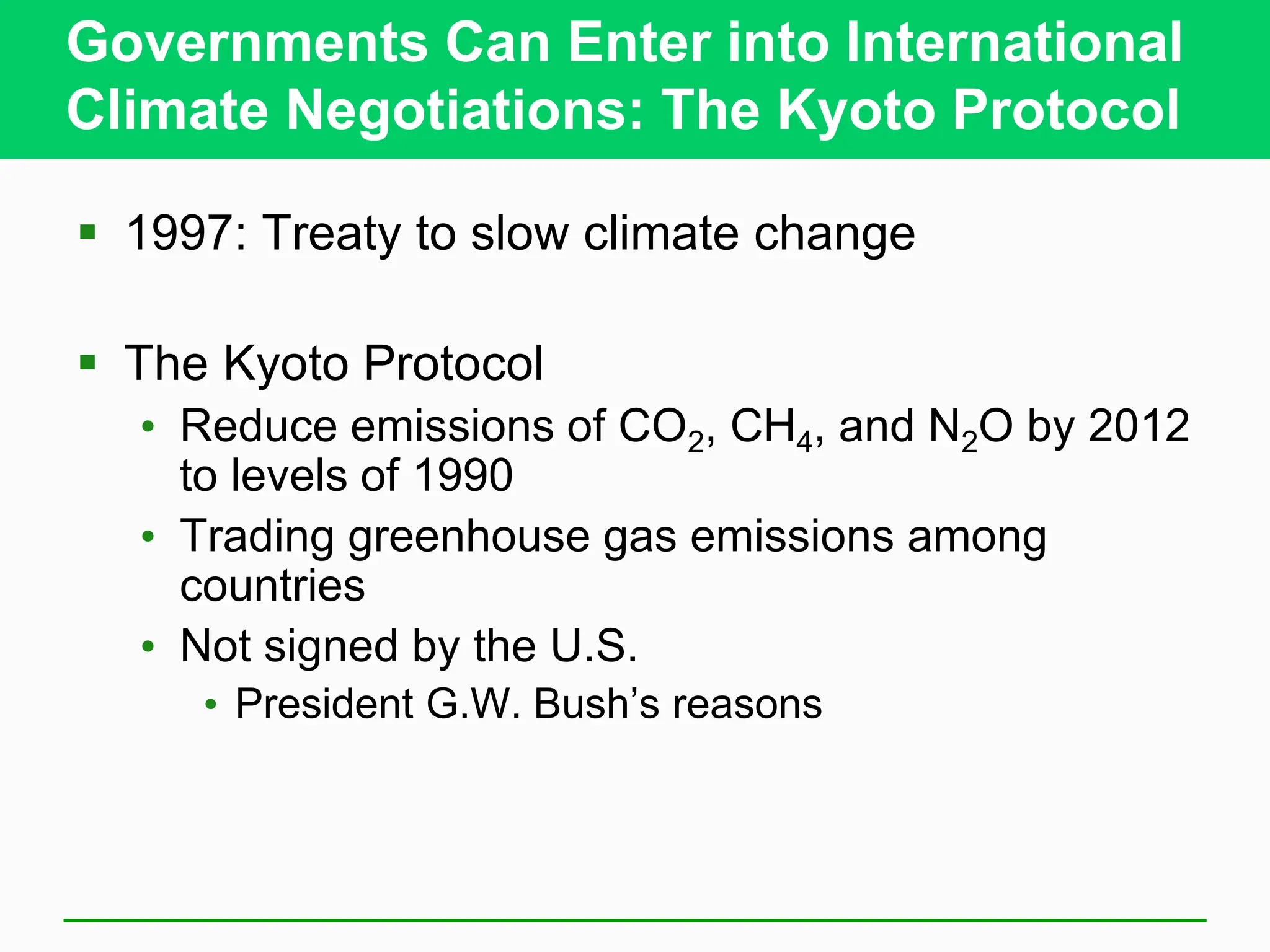
Governments Can Enter into International
Climate Negotiations: The Kyoto Protocol
 1997: Treaty to slow climate change
 The Kyoto Protocol
• Reduce emissions of CO2, CH4, and N2O by 2012
to levels of 1990
• Trading greenhouse gas emissions among
countries
• Not signed by the U.S.
• President G.W. Bush’s reasons
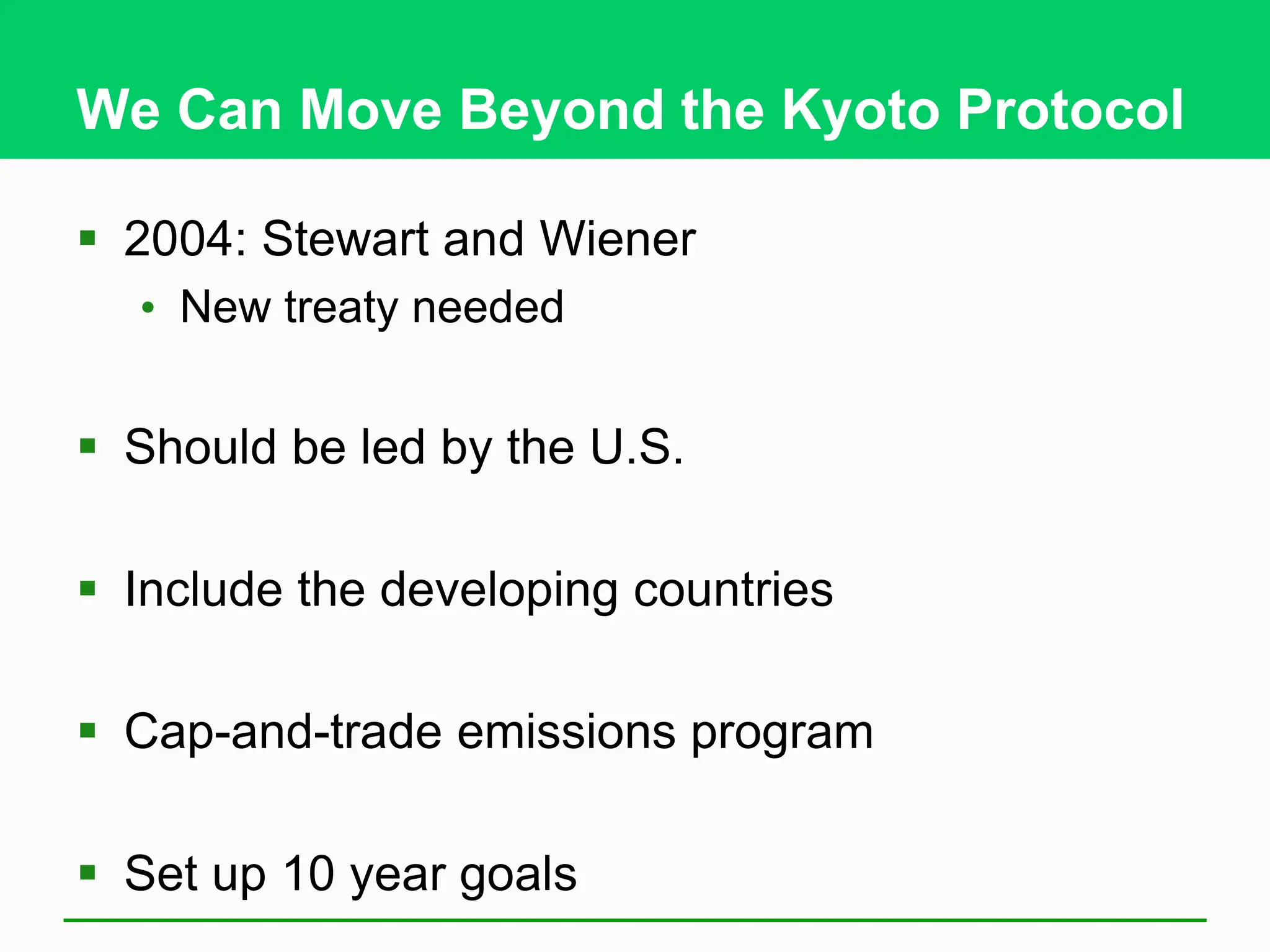
We Can Move Beyond the Kyoto Protocol
 2004: Stewart and Wiener
• New treaty needed
 Should be led by the U.S.
 Include the developing countries
 Cap-and-trade emissions program
 Set up 10 year goals
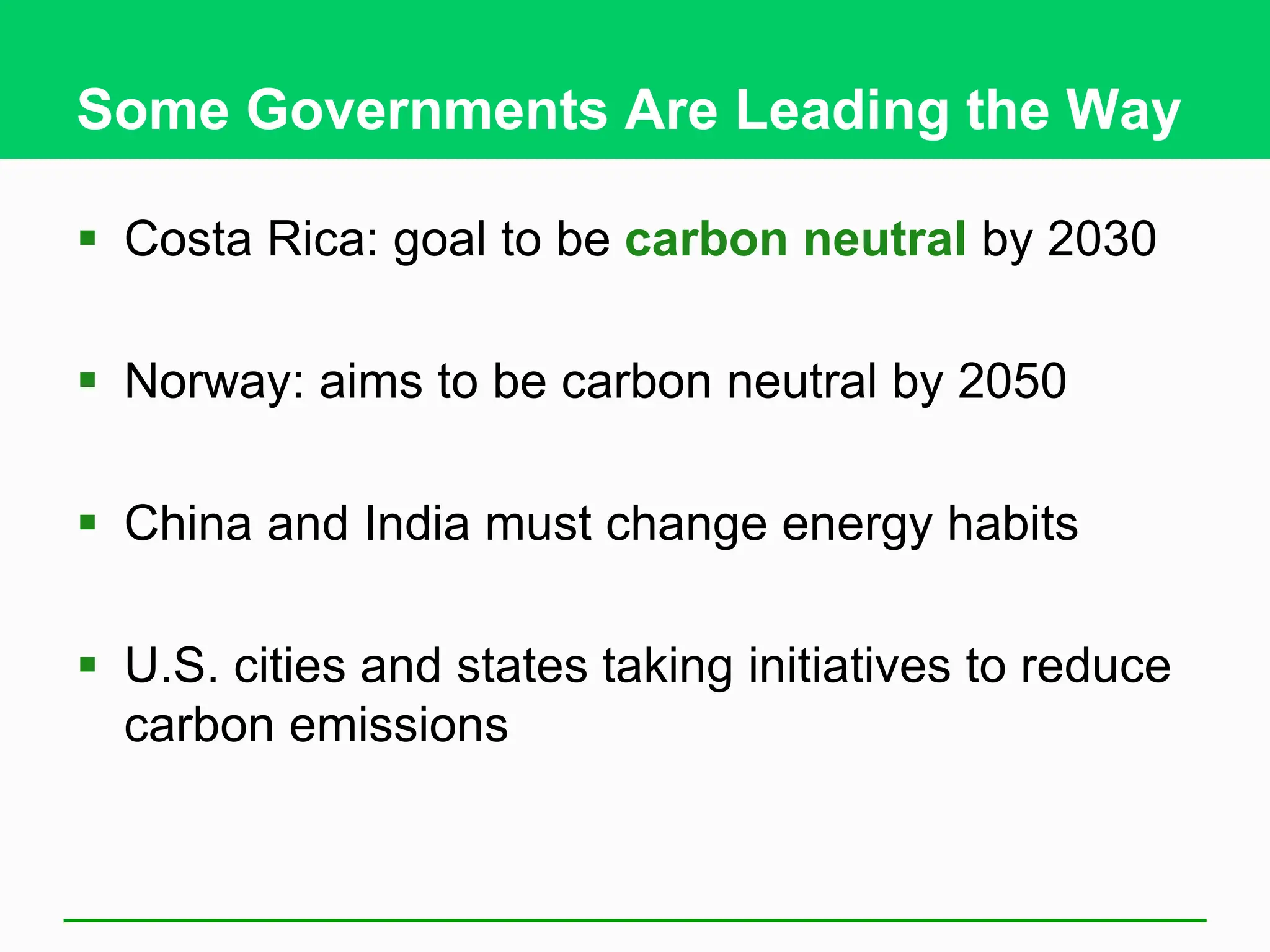
Some Governments Are Leading the Way
 Costa Rica: goal to be carbon neutral by 2030
 Norway: aims to be carbon neutral by 2050
 China and India must change energy habits
 U.S. cities and states taking initiatives to reduce
carbon emissions
Case Study: Reducing Greenhouse Gas
Emissions in California
 Use of energy-efficient appliances and buildings
 Incentives for consumers to use less energy
 Why is California suing the federal government?
Some Companies and Schools Are
Reducing Their Carbon Footprints (1)
 Major global companies reducing greenhouse
gas emissions
• Alcoa
• DuPont
• IBM
• Toyota
• GE
• Wal-Mart
• Fluorescent light bulbs
• Auxiliary power units on truck fleets
Some Companies and Schools Are
Reducing Their Carbon Footprints (2)
 Colleges and universities reducing greenhouse
gas emissions
• Oberlin College, Ohio, U.S.
• 25 Colleges in Pennsylvania, U.S.
• Yale University, CT, U.S.
 What is your carbon footprint?
 What can you do?
We Can Prepare for the Harmful Effects
of Climate Change (1)
 Reduce greenhouse gas emissions as much as
possible
 Move people from low-lying coastal areas
 Limit coastal building
 Remove hazardous material storage tanks away
from the coast
We Can Prepare for the Harmful Effects
of Climate Change (2)
 Genetically engineer crops more tolerant to
drought
 Stockpile 1–5 years of key foods
 Waste less water
 Connect wildlife reserves with corridors
Ways to Prepare for the Possible Long-
Term Harmful Effects of Climate Change
Our Use of Certain Chemicals Threatens
the Ozone Layer
 Ozone Thinning
• Seasonal depletion in the stratosphere
• Antarctica and Arctic
 1930: Midgely
• Discovered the first CFC
 1984: Rowland and Molina
• CFCs were depleting O3
 Other ozone-depleting chemicals
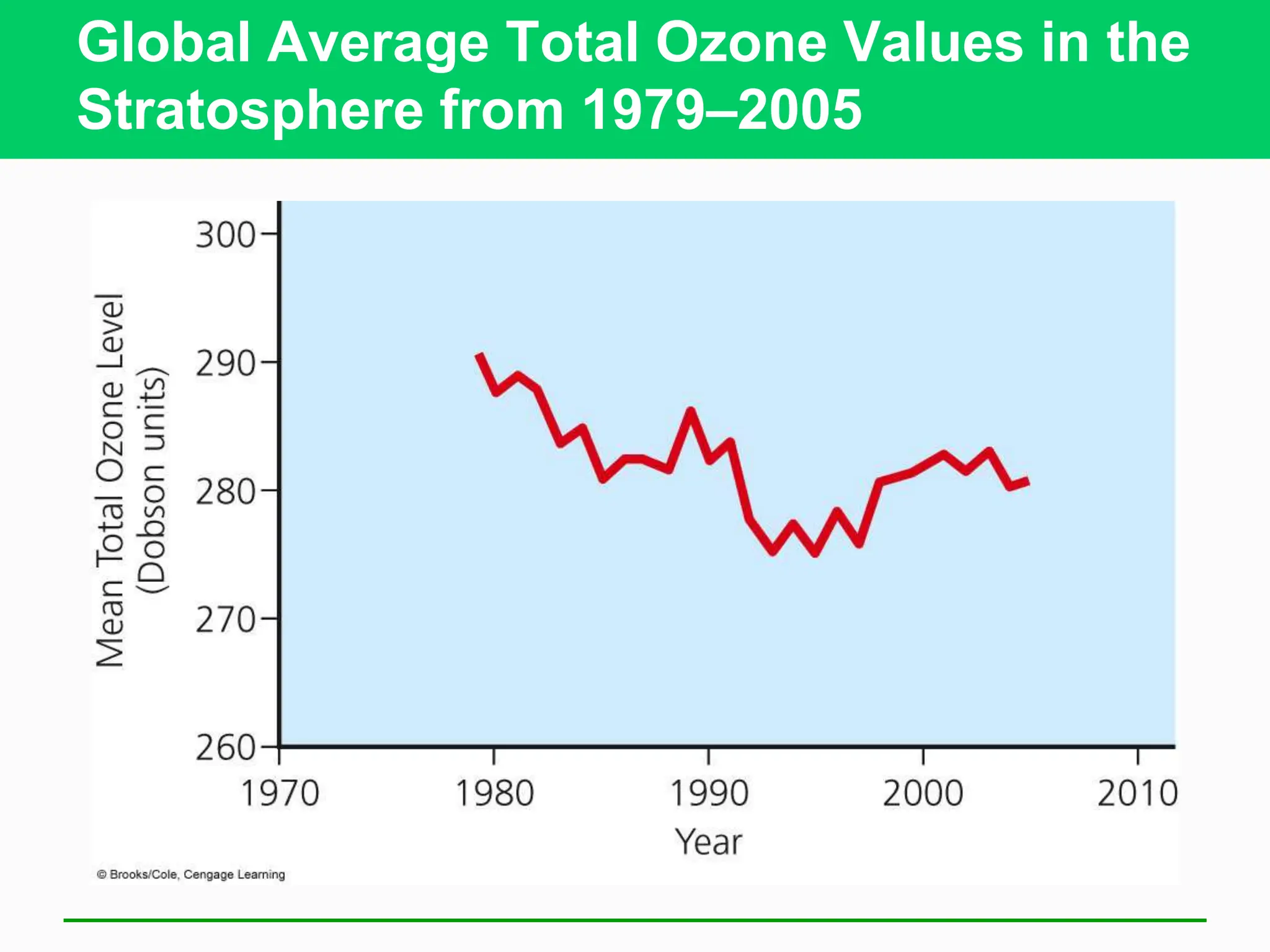
Global Average Total Ozone Values in the
Stratosphere from 1979–2005
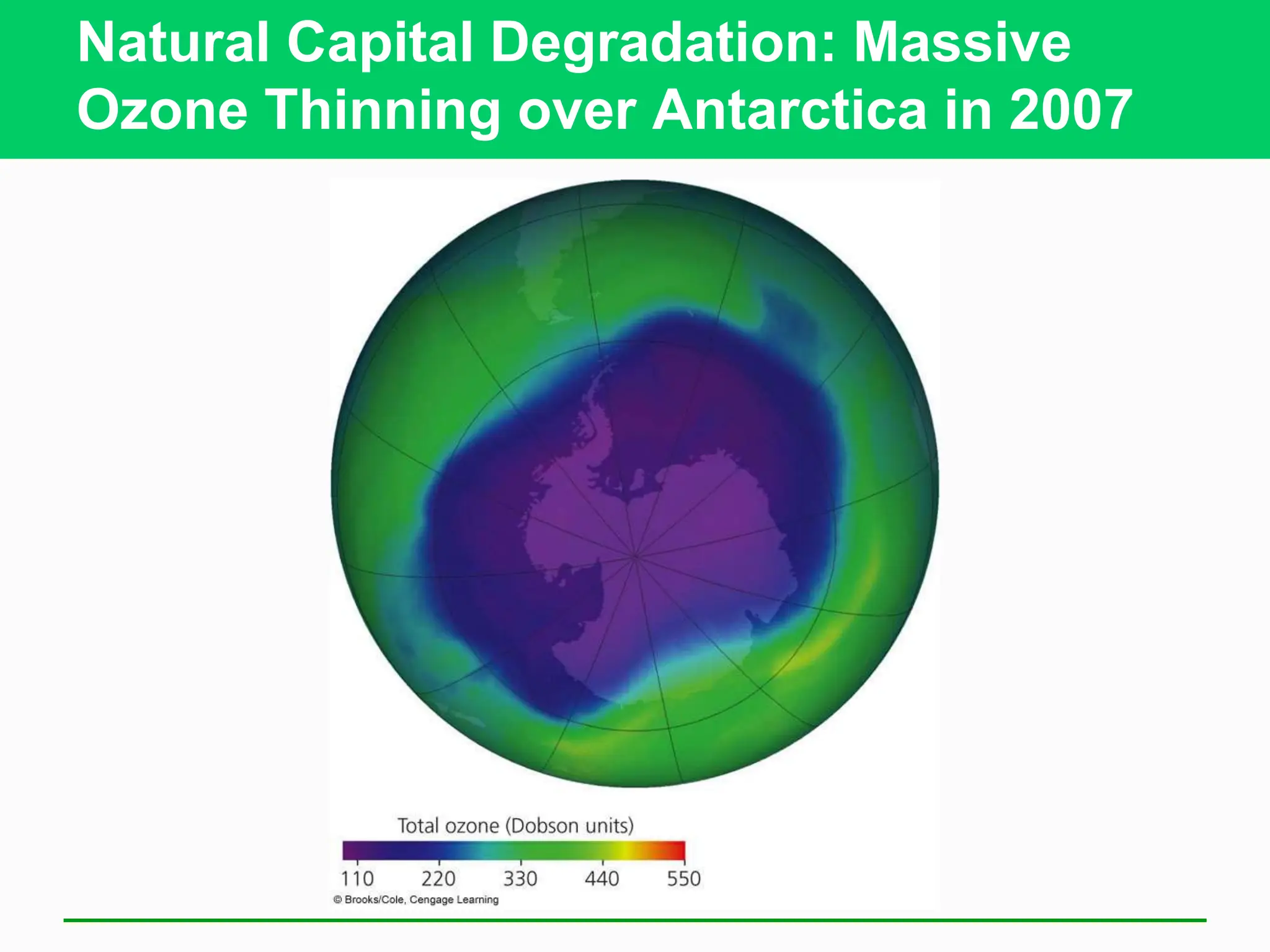
Natural Capital Degradation: Massive
Ozone Thinning over Antarctica in 2007
Science Focus: Rowland and Moline—A
Scientific Story of Courage and Persistence
 Research
• CFCs are persistent in the atmosphere
• Rise into the stratosphere over 11-20 years
• Break down under high-energy UV radiation
• Halogens produced accelerate the breakdown of
O3 to O2
• Each CFC molecule can last 65-385 years
 1988: Dupont stopped producing CFCs
 1995: Nobel Prize in chemistry
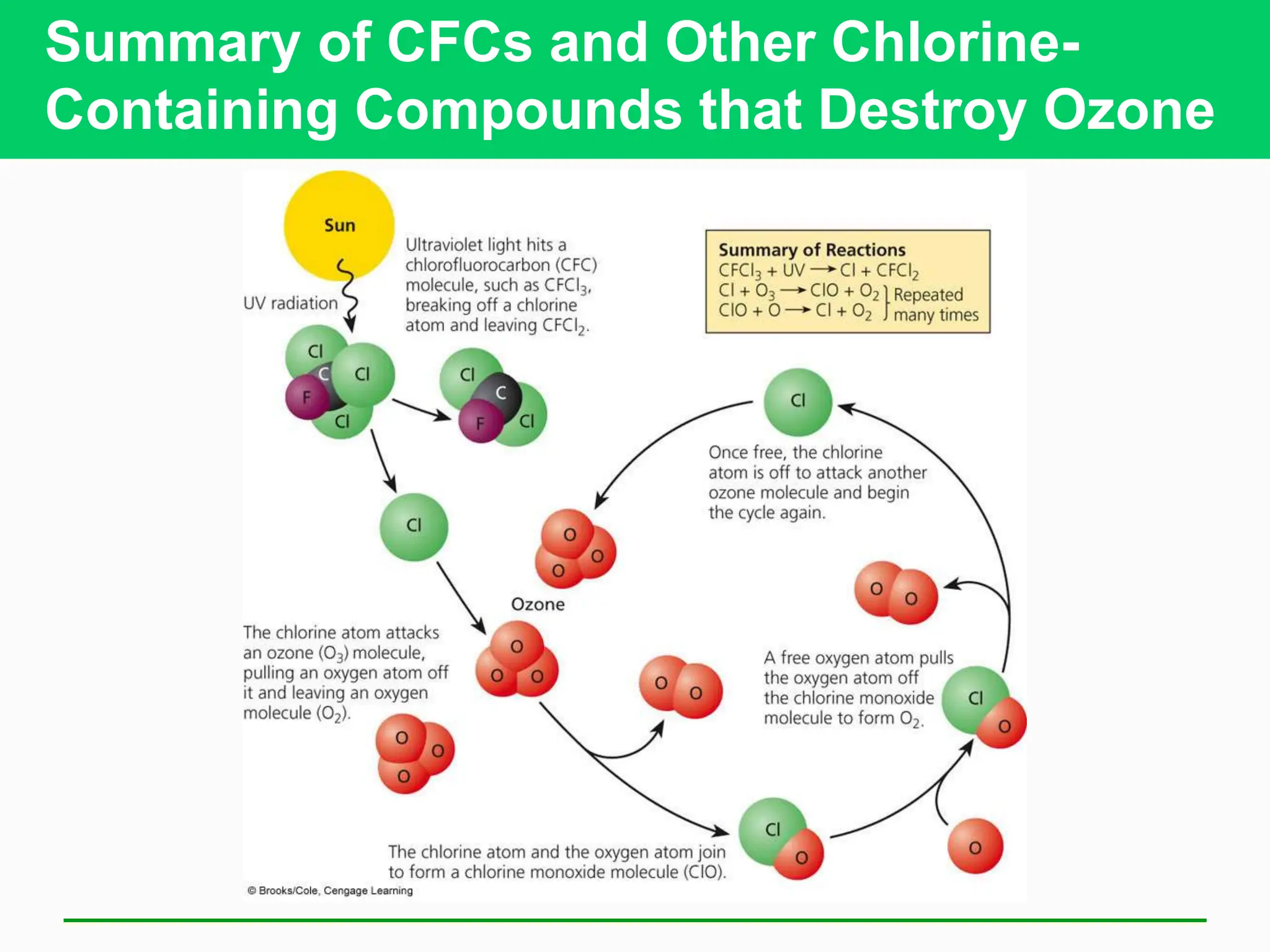
Summary of CFCs and Other Chlorine-
Containing Compounds that Destroy Ozone
Why Should We Worry about
Ozone Depletion?
 Damaging UV-A and UV-B radiation
• Increase eye cataracts and skin cancer
 Impair or destroy phytoplankton
• Significance?
Science Focus: Skin Cancer
 Squamous cell carcinoma
 Basal cell carcinoma
 Melanoma
 Effect of UV-B radiation
 How safe are tanning salons?
Structure of the Human Skin and the
Relationship between UV and Skin Cancer
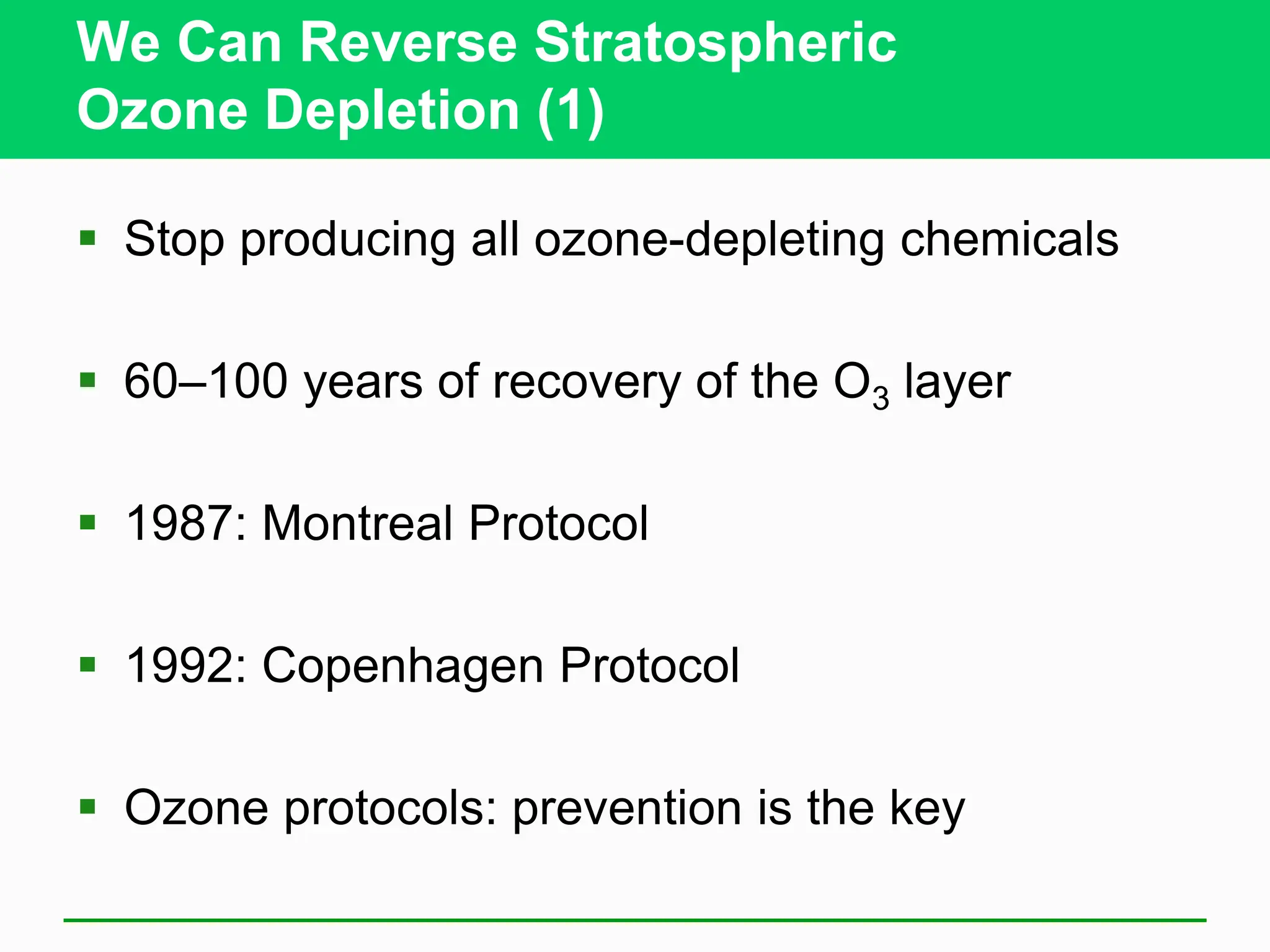
We Can Reverse Stratospheric
Ozone Depletion (1)
 Stop producing all ozone-depleting chemicals
 60–100 years of recovery of the O3 layer
 1987: Montreal Protocol
 1992: Copenhagen Protocol
 Ozone protocols: prevention is the key

Climate Change and Ozone Depletion.ppt

  • 1.
    Climate Control and OzoneDepletion Chapter 19
  • 2.
    Core Case Study:Studying a Volcano to Understand Climate Change  June 1991: Mount Pinatubo (Philippines) exploded  Airborne pollutants, deaths, and damage  Affected climate temperature  Climate predictions based on the forecasts of James Hansen of NASA
  • 3.
    An Enormous Cloudof Air Pollutants and Ash from Mt. Pinatubo on June 12, 1991
  • 4.
    Global Warming andGlobal Cooling Are Not New (1)  Over the past 4.7 billion years the climate has been altered by • Volcanic emissions • Changes in solar input • Movement of the continents • Impacts by meteors  Over the past 900,000 years • Glacial and interglacial periods
  • 5.
    Global Warming andGlobal Cooling Are Not New (2)  Over the past 10,000 years • Interglacial period  Over the past 1,000 years • Temperature stable  Over the past 100 years • Temperature changes; methods of determination
  • 6.
    Estimated Changes inthe Average Global Temperature of the Atmosphere
  • 7.
    Science: Ice CoresAre Extracted by Drilling Deep Holes in Ancient Glaciers
  • 8.
    Our Climate, Lives,and Economies Depend on the Natural Greenhouse Effect  Without the natural greenhouse effect • Cold, uninhabitable earth
  • 9.
    Human Activities EmitLarge Quantities of Greenhouses Gases (1)  Since the Industrial Revolution • CO2, CH4, and N2O emissions higher • Main sources: agriculture, deforestation, and burning of fossil fuels  Correlation of rising CO2 and CH4 with rising global temperatures  Countries with the largest CO2 emissions
  • 10.
    Melting of Alaska’sMuir Glacier between 1948 and 2004
  • 11.
    The Big Melt:Some of the Floating Sea Ice in the Arctic Sea
  • 12.
    What Is theScientific Consensus about Future Temperature Change?  Mathematical models used for predictions  Global warming: rapid rate  Human factors are the major cause of temperature rise since 1950  Human factors will become a greater risk factor
  • 13.
    Fig. 19-A, p.502 Sun Troposphere Cooling from increase Aerosols Greenhouse gases Warming from decrease CO2 removal by plants and soil organisms CO2 emissions from land clearing, fires, and decay Heat and CO2 removal Heat and CO2 emissions Ice and snow cover Shallow ocean Land and soil biota Long-term storage Natural and human emissions Deep ocean
  • 14.
    Comparison of MeasuredTemperature from 1860–2007 and Projected Changes
  • 15.
    Is a HotterSun the Culprit?  Since 1975 • Troposphere has warmed • Stratosphere has cooled  This is not what a hotter sun would do
  • 16.
    Can the OceansSave Us?  Solubility of CO2 in ocean water  Warmer oceans • CO2 levels increasing acidity • Effect on atmospheric levels of CO2 • Effect on coral reefs  Antarctica’s Southern Ocean and the North Atlantic Ocean • Decrease in CO2 uptake • Significance on global CO2 levels
  • 17.
    There Is Uncertaintyabout the Effects of Cloud Cover on Global Warming  Warmer temperatures create more clouds • Thick, light-colored low altitude clouds: decrease surface temperature • Thin, cirrus clouds at high altitudes: increase surface temperature  Effect of jet entrails on climate temperature
  • 18.
    Outdoor Air PollutionCan Temporarily Slow Global Warming  Aerosol and soot pollutants • Will not enhance or counteract projected global warming • Fall back to the earth or are washed out of the lower atmosphere • Reduction: especially in developed countries
  • 19.
    Enhanced Global WarmingCould Have Severe Consequences  Tipping point and irreversible climate change  Worst-case scenarios • Ecosystems collapsing • Low-lying cities flooded • Wildfires in forests • Prolonged droughts: grasslands become dust bowls • More destructive storms • Glaciers shrinking; rivers drying up
  • 20.
    Severe Drought IsIncreasing: The Browning of the Earth  Accelerate global warming, lead to more drought  Biodiversity will decrease  NPP will decrease  Dry climate ecosystems will increase  Other effects of prolonged lack of water
  • 21.
    Ice and SnowAre Melting (1)  Why will global warming be worse in the polar regions?  Important climate role of floating sea ice  Mountain glaciers affected by • Average snowfall • Average warm temperatures
  • 22.
    Ice and SnowAre Melting (2)  Europe’s Alps • Glaciers are disappearing  South America • Glaciers are disappearing  Greenland • Warmer temperatures
  • 23.
    Science Focus: MeltingIce in Greenland  Largest island: 80% composed of glaciers  10% of the world’s fresh water  1996–2007: net loss of ice doubled  Effect on sea level if melting continues
  • 24.
    Areas of GlacialIce Melting in Greenland during Summer 1982–2007 Increased
  • 25.
    Sea Levels AreRising (1)  Expansion of warm water  Melting of land-based ice  What about Greenland?
  • 26.
    Sea Levels AreRising (2)  Projected irreversible effect • Degradation and loss of 1/3 of coastal estuaries, wetlands, and coral reefs • Disruption of coastal fisheries • Flooding of • Low-lying barrier islands and coastal areas • Agricultural lowlands and deltas • Contamination of freshwater aquifers • Submergence of low-lying islands in the Pacific and Indian Oceans and the Caribbean
  • 27.
    Areas of Florida,U.S., to Flood If Average Sea Level Rises by One Meter
  • 28.
    Low-Lying Island Nation:Maldives in the Indian Ocean
  • 29.
    Permafrost Is Likelyto Melt: Another Dangerous Scenario  Carbon present as CH4 in permafrost soils and lake bottoms  2004: Arctic Climate Impact Assessment • 10–20% of the permafrost might melt this century  Effect on global warming
  • 30.
    Projected Decline inArctic Tundra in Portions of Russia from 2004 to 2100
  • 31.
    Ocean Currents AreChanging but the Threat Is Unknown  Melting glaciers, particularly in Greenland  Increased rain in the North Atlantic  Not thought to be an immediate problem on the ocean currents
  • 32.
    Extreme Weather WillIncrease in Some Areas  Heat waves and droughts in some areas  Prolonged rains and flooding in other areas  Will storms get worse? • More studies needed  Hurricanes Katrina and Rita
  • 33.
    Global Warming Isa Major Threat to Biodiversity (1)  Most susceptible ecosystems • Coral reefs • Polar seas • Coastal wetland • High-elevation mountaintops • Alpine and arctic tundra
  • 34.
    Global Warming Isa Major Threat to Biodiversity (2)  What about • Migratory animals • Forests  Which organisms could increase with global warming? Significance? • Insects • Fungi • Microbes
  • 35.
    Exploding Populations ofMountain Pine Beetles in British Columbia, Canada
  • 36.
    Climate Change WillShift Areas Where Crops Can Be Grown  Regions of farming may shift • Decrease in tropical and subtropical areas • Increase in northern latitudes • Less productivity; soil not as fertile  Genetically engineered crops more tolerant to drought
  • 37.
    Climate Change WillThreaten the Health of Many People  Deaths from heat waves will increase  Deaths from cold weather will decrease  Higher temperatures can cause • Increased flooding • Increase in some forms of air pollution, more O3 • More insects, microbes, toxic molds, and fungi
  • 38.
    Dealing with ClimateChange Is Difficult  Global problem  Long-lasting effects  Long-term political problem  Harmful and beneficial impacts of climate change unevenly spread  Many proposed actions disrupt economies and lifestyles
  • 39.
    What Are OurOptions?  Two approaches • Drastically reduce the amount of greenhouse gas emissions • Devise strategies to reduce the harmful effects of global warming  Will we reach a political tipping point before we reach irreversible climate change tipping points?
  • 40.
    Avoiding Catastrophe: WeCan Reduce the Threat of Climate Change (1)  Input or prevention strategies  Improve energy efficiency to reduce fossil fuel use  Stop cutting down tropical forests  Output strategy • Capture and store CO2
  • 41.
    Avoiding Catastrophe: WeCan Reduce the Threat of Climate Change (2)  Socolow and Pacala • Climate stabilization wedges • Keep CO2 emissions to 2007 levels by 2057  Brown: need to do more • Cut CO2 emissions by 80% by 2020 • 2008 book: Plan B 3.0: Mobilizing to Save Civilization
  • 42.
    Avoiding Catastrophe: WeCan Reduce the Threat of Climate Change (3)  Output solutions • Massive global tree planting; how many? • Wangari Maathai • Great Wall of Trees: China and Africa • Plant fast-growing perennials on degraded land • Capturing and storing CO2
  • 43.
    Case Study: IsCapturing and Storing CO2 the Answer? (1)  Carbon capture and storage (CCS)  Several problems with this approach • Power plants using CCS • More expensive to build • None exist • Unproven technology • Large inputs of energy to work • Increasing CO2 emissions
  • 44.
    Case Study: IsCapturing and Storing CO2 the Answer? (2)  Problems with carbon capture and storage cont… • Promotes the continued use of coal (world’s dirtiest fuel) • Effect of government subsidies and tax breaks • Stored CO2 would have to remain sealed forever: no leaking
  • 45.
    Should We UseGeo-Engineering Schemes to Help Slow Climate Change? (1)  CCS  Injection of sulfate particles into the stratosphere • Would it have a cooling effect? • Would it accelerate O3 depletion?
  • 46.
    Should We UseGeo-Engineering Schemes to Help Slow Climate Change? (2)  Remove HCl from seawater • Effects on ecology?  Pump up nutrient-rich deep ocean water and cause algal blooms  Re-ice the Arctic  If any of these fixes fail, what about a rebound effect?
  • 47.
    How Much WillIt Cost to Slow Climate Change?  Short-term costs lower  Local and global economies may be boosted
  • 48.
    Governments Can HelpReduce the Threat of Climate Change  Strictly regulate CO2 and CH4 as pollutants  Cap-and-trade approach  Increase subsidies to encourage use of energy- efficient technology  Technology transfer
  • 49.
    Governments Can Enterinto International Climate Negotiations: The Kyoto Protocol  1997: Treaty to slow climate change  The Kyoto Protocol • Reduce emissions of CO2, CH4, and N2O by 2012 to levels of 1990 • Trading greenhouse gas emissions among countries • Not signed by the U.S. • President G.W. Bush’s reasons
  • 50.
    We Can MoveBeyond the Kyoto Protocol  2004: Stewart and Wiener • New treaty needed  Should be led by the U.S.  Include the developing countries  Cap-and-trade emissions program  Set up 10 year goals
  • 51.
    Some Governments AreLeading the Way  Costa Rica: goal to be carbon neutral by 2030  Norway: aims to be carbon neutral by 2050  China and India must change energy habits  U.S. cities and states taking initiatives to reduce carbon emissions
  • 52.
    Case Study: ReducingGreenhouse Gas Emissions in California  Use of energy-efficient appliances and buildings  Incentives for consumers to use less energy  Why is California suing the federal government?
  • 53.
    Some Companies andSchools Are Reducing Their Carbon Footprints (1)  Major global companies reducing greenhouse gas emissions • Alcoa • DuPont • IBM • Toyota • GE • Wal-Mart • Fluorescent light bulbs • Auxiliary power units on truck fleets
  • 54.
    Some Companies andSchools Are Reducing Their Carbon Footprints (2)  Colleges and universities reducing greenhouse gas emissions • Oberlin College, Ohio, U.S. • 25 Colleges in Pennsylvania, U.S. • Yale University, CT, U.S.  What is your carbon footprint?  What can you do?
  • 55.
    We Can Preparefor the Harmful Effects of Climate Change (1)  Reduce greenhouse gas emissions as much as possible  Move people from low-lying coastal areas  Limit coastal building  Remove hazardous material storage tanks away from the coast
  • 56.
    We Can Preparefor the Harmful Effects of Climate Change (2)  Genetically engineer crops more tolerant to drought  Stockpile 1–5 years of key foods  Waste less water  Connect wildlife reserves with corridors
  • 57.
    Ways to Preparefor the Possible Long- Term Harmful Effects of Climate Change
  • 58.
    Our Use ofCertain Chemicals Threatens the Ozone Layer  Ozone Thinning • Seasonal depletion in the stratosphere • Antarctica and Arctic  1930: Midgely • Discovered the first CFC  1984: Rowland and Molina • CFCs were depleting O3  Other ozone-depleting chemicals
  • 59.
    Global Average TotalOzone Values in the Stratosphere from 1979–2005
  • 60.
    Natural Capital Degradation:Massive Ozone Thinning over Antarctica in 2007
  • 61.
    Science Focus: Rowlandand Moline—A Scientific Story of Courage and Persistence  Research • CFCs are persistent in the atmosphere • Rise into the stratosphere over 11-20 years • Break down under high-energy UV radiation • Halogens produced accelerate the breakdown of O3 to O2 • Each CFC molecule can last 65-385 years  1988: Dupont stopped producing CFCs  1995: Nobel Prize in chemistry
  • 62.
    Summary of CFCsand Other Chlorine- Containing Compounds that Destroy Ozone
  • 63.
    Why Should WeWorry about Ozone Depletion?  Damaging UV-A and UV-B radiation • Increase eye cataracts and skin cancer  Impair or destroy phytoplankton • Significance?
  • 64.
    Science Focus: SkinCancer  Squamous cell carcinoma  Basal cell carcinoma  Melanoma  Effect of UV-B radiation  How safe are tanning salons?
  • 65.
    Structure of theHuman Skin and the Relationship between UV and Skin Cancer
  • 66.
    We Can ReverseStratospheric Ozone Depletion (1)  Stop producing all ozone-depleting chemicals  60–100 years of recovery of the O3 layer  1987: Montreal Protocol  1992: Copenhagen Protocol  Ozone protocols: prevention is the key

Editor's Notes

  • #14 Figure 19.A Science: simplified model of some major processes that interact to determine the average temperature and greenhouse gas content of the lower atmosphere and thus the earth’s climate. Red arrows show processes that warm the atmosphere and blue arrows show those that cool the atmosphere. Question: Why do you think a decrease in snow and ice cover would increase global warming?