A Seminar on
Ultraviolet-Visible Spectroscopy
By:- Momin Abdulhameed Shabbir
(M.pharm-I Biopharmaceutics Roll No. 6)
Under guidance of:- Dr.M.S.Charde
(HOD Dept of Chemistry)
Introduction
• Absorption of visible and ultraviolet (UV) radiation
is associated with excitation of electrons, in both
atoms and molecules, from lower to higher energy
levels.
• Each wavelength of light has a particular energy
associated with it. If that particular amount of energy is
just right for making one of these electronic transitions,
then that wavelength will be absorbed.
• Excited electrons can return to the ground state by
vibrational transitions through smaller energy
increments.
2
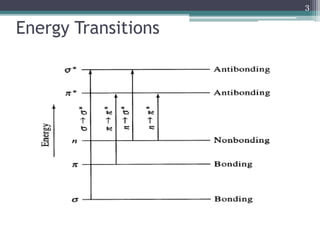
Energy Transitions
3
Transitions
• Four types of electronic transition are possible. i. σ ⇾ σ* transition
ii. n ⇾ σ* transition iii. n ⇾ π* transition iv. π ⇾ π* transition.
• An electron in a bonding σ orbital of a molecule is excited to the
corresponding anti-bonding orbital by the absorption of radiation.
To induce a σ ⇾ σ* transition, it required LARGE ENERGY. Ex:
Methane, Methane contain only single C-H bonds it undergo only
σ ⇾ σ* transition only, it gives absorption maximum at 125nm.
• Saturated compounds containing atoms with unshared electron pairs
are undergo n ⇾ σ* transition. It require less energy than the σ ⇾
σ* type. Most of the absorption peaks appearing below 200nm. In
the presence of polar solvents the absorption maximum tend to shift
shorter wavelength Ex: Water , ethanol.
4
Cont.
• Most organic compounds are undergo transitions for n ⇾ π* and
π ⇾ π* transition. Because energies required for processes bring the
absorption peaks into spectral region. Both transition require the
presence of an unsaturated functional group to the ´∏´ orbitals. Ex:
For π ⇾ π* ⧐ Alkenes, compounds, alkynes carbonyl For n ⇾ π* ⧐
carbonyl compounds.
5
Beer’s & Lambert’s Law
Lambert’s Law
• When a monochromatic radiation is passed
through a solution, the decrease in the intensity of
radiation with thickness of the solution is directly
proportional to the intensity of the incident light.
Beer’s Law
• When a monochromatic radiation is passed
through a solution, the decrease in the intensity of
radiation with thickness of the solution is directly
proportional to the intensity of the incident light
as well as concentration of the solution.
6
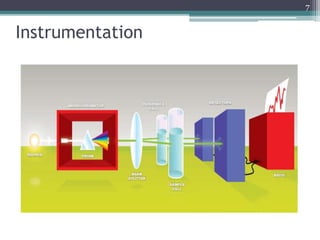
Instrumentation
7
Woodward fieser rule
• In 1945 Robert burn woodward gave certain
rules for correlating maximum wavelength with
molecular structure.
• In 1959 luis fedrick fieser modified this rules
with more experimental data and modified rules
known as woodward fieser rules
8
• It mean each type of diene or triene system is having
a certain fixed values at which abosrption takes place;
this constitutes the base value or parent value.
• The contribution made by various alkyl substituents
or ring residue, double bond extending conjugation
and polar groups such as -Cl,-Br etc … are added to
the base value to obtain for a particular compound
9
PARENT VALUES AND INCREMENTS FOR DIFFERENT
SUBSTITUENTS/GROUPS FOR CALULATING MAXIMUM
WAVELENGTH
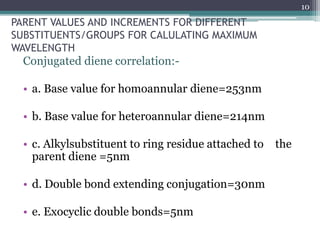
Conjugated diene correlation:-
• a. Base value for homoannular diene=253nm
• b. Base value for heteroannular diene=214nm
• c. Alkylsubstituent to ring residue attached to the
parent diene =5nm
• d. Double bond extending conjugation=30nm
• e. Exocyclic double bonds=5nm
10
Fieser & kuhn rule
• In the number of conjugated double bonds is more than 4, the
woodward and fieser rules may not be applicable and hence
fieser with kuhn has derived an equation for predicting the
λmax
• λmax= 114+5M+n(48.0-1.7n)-16.5 Rendo-10 Rexo
M= no. of alkyl substitutents
N = no. of conjugated double bonds
Rendo= no. of rings with endocyclic bonds
Rexo= no. of rings with exocyclic bonds
11
Applications of UV Visible
Spectroscopy
• Qualitative & Quantitative Analysis: – It is used for
characterizing aromatic compounds and conjugated olefins.
• It can be used to find out molar concentration of the solute
under study.
• Detection of impurities: – It is one of the important method to
detect impurities in organic solvents.
• Identification of inorganic and organic species
• Detection of isomers are possible.
12
Reference
• Instrumental Organic Spectroscopy, Y. R. Sharma.
• wikipedia.org / wiki/ Ultraviolet visible spectroscopy
• Principles of instrumental analysis, D.A. Skoog & West.
• Instrumental methods of chemical analysis, G.R.
Chatwal, S.K.Anand.
13
14

Seminar on uv spectroscopy

  • 1.
    A Seminar on Ultraviolet-VisibleSpectroscopy By:- Momin Abdulhameed Shabbir (M.pharm-I Biopharmaceutics Roll No. 6) Under guidance of:- Dr.M.S.Charde (HOD Dept of Chemistry)
  • 2.
    Introduction • Absorption ofvisible and ultraviolet (UV) radiation is associated with excitation of electrons, in both atoms and molecules, from lower to higher energy levels. • Each wavelength of light has a particular energy associated with it. If that particular amount of energy is just right for making one of these electronic transitions, then that wavelength will be absorbed. • Excited electrons can return to the ground state by vibrational transitions through smaller energy increments. 2
  • 3.
  • 4.
    Transitions • Four typesof electronic transition are possible. i. σ ⇾ σ* transition ii. n ⇾ σ* transition iii. n ⇾ π* transition iv. π ⇾ π* transition. • An electron in a bonding σ orbital of a molecule is excited to the corresponding anti-bonding orbital by the absorption of radiation. To induce a σ ⇾ σ* transition, it required LARGE ENERGY. Ex: Methane, Methane contain only single C-H bonds it undergo only σ ⇾ σ* transition only, it gives absorption maximum at 125nm. • Saturated compounds containing atoms with unshared electron pairs are undergo n ⇾ σ* transition. It require less energy than the σ ⇾ σ* type. Most of the absorption peaks appearing below 200nm. In the presence of polar solvents the absorption maximum tend to shift shorter wavelength Ex: Water , ethanol. 4
  • 5.
    Cont. • Most organiccompounds are undergo transitions for n ⇾ π* and π ⇾ π* transition. Because energies required for processes bring the absorption peaks into spectral region. Both transition require the presence of an unsaturated functional group to the ´∏´ orbitals. Ex: For π ⇾ π* ⧐ Alkenes, compounds, alkynes carbonyl For n ⇾ π* ⧐ carbonyl compounds. 5
  • 6.
    Beer’s & Lambert’sLaw Lambert’s Law • When a monochromatic radiation is passed through a solution, the decrease in the intensity of radiation with thickness of the solution is directly proportional to the intensity of the incident light. Beer’s Law • When a monochromatic radiation is passed through a solution, the decrease in the intensity of radiation with thickness of the solution is directly proportional to the intensity of the incident light as well as concentration of the solution. 6
  • 7.
  • 8.
    Woodward fieser rule •In 1945 Robert burn woodward gave certain rules for correlating maximum wavelength with molecular structure. • In 1959 luis fedrick fieser modified this rules with more experimental data and modified rules known as woodward fieser rules 8
  • 9.
    • It meaneach type of diene or triene system is having a certain fixed values at which abosrption takes place; this constitutes the base value or parent value. • The contribution made by various alkyl substituents or ring residue, double bond extending conjugation and polar groups such as -Cl,-Br etc … are added to the base value to obtain for a particular compound 9
  • 10.
    PARENT VALUES ANDINCREMENTS FOR DIFFERENT SUBSTITUENTS/GROUPS FOR CALULATING MAXIMUM WAVELENGTH Conjugated diene correlation:- • a. Base value for homoannular diene=253nm • b. Base value for heteroannular diene=214nm • c. Alkylsubstituent to ring residue attached to the parent diene =5nm • d. Double bond extending conjugation=30nm • e. Exocyclic double bonds=5nm 10
  • 11.
    Fieser & kuhnrule • In the number of conjugated double bonds is more than 4, the woodward and fieser rules may not be applicable and hence fieser with kuhn has derived an equation for predicting the λmax • λmax= 114+5M+n(48.0-1.7n)-16.5 Rendo-10 Rexo M= no. of alkyl substitutents N = no. of conjugated double bonds Rendo= no. of rings with endocyclic bonds Rexo= no. of rings with exocyclic bonds 11
  • 12.
    Applications of UVVisible Spectroscopy • Qualitative & Quantitative Analysis: – It is used for characterizing aromatic compounds and conjugated olefins. • It can be used to find out molar concentration of the solute under study. • Detection of impurities: – It is one of the important method to detect impurities in organic solvents. • Identification of inorganic and organic species • Detection of isomers are possible. 12
  • 13.
    Reference • Instrumental OrganicSpectroscopy, Y. R. Sharma. • wikipedia.org / wiki/ Ultraviolet visible spectroscopy • Principles of instrumental analysis, D.A. Skoog & West. • Instrumental methods of chemical analysis, G.R. Chatwal, S.K.Anand. 13
  • 14.