Chapter 6

Energy Flow in the
Life of a Cell

Lectures by
Gregory Ahearn
University of North Florida

Copyright © 2009 Pearson Education, Inc..
5.1 What Is Energy?
 Energy is the capacity to do work.
• Synthesizing molecules
• Moving objects
• Generating heat and light

Copyright © 2009 Pearson Education Inc.
5.1 What Is Energy?
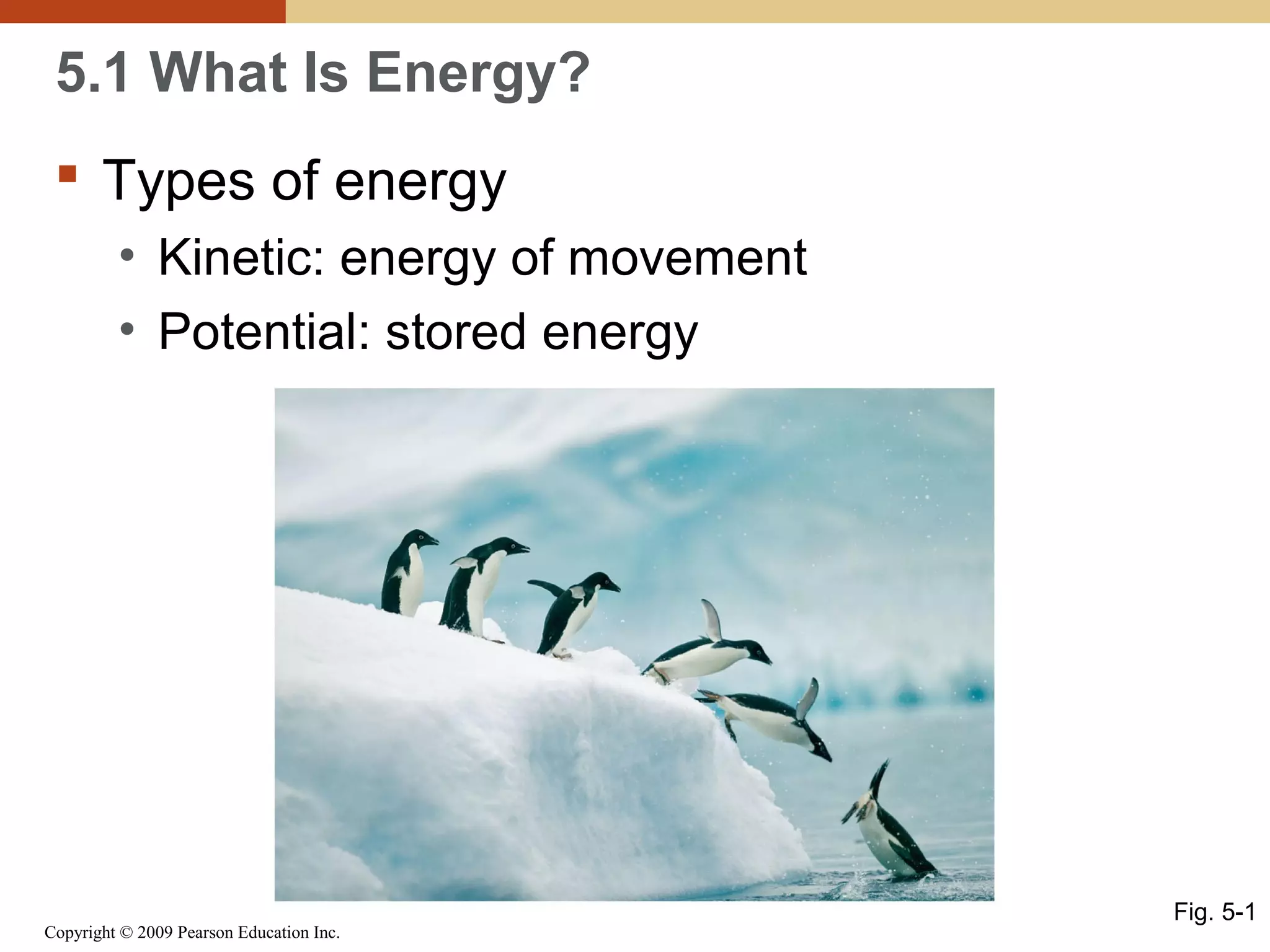
 Types of energy
• Kinetic: energy of movement
• Potential: stored energy

Copyright © 2009 Pearson Education Inc.

Fig. 5-1
5.1 What Is Energy?
 First Law of Thermodynamics
• “Energy cannot be created nor destroyed, but
it can change its form.”
• Example: potential energy in gasoline can be
converted to kinetic energy in a car, but the
energy is not lost

Copyright © 2009 Pearson Education Inc.
5.1 What Is Energy?
 Second Law of Thermodynamics
• “When energy is converted from one form to
another, the amount of useful energy
decreases.”
• No process is 100% efficient.
• Example: more potential energy is in the
gasoline than is transferred to the kinetic
energy of the car moving
• Where is the rest of the energy? It is released
in a less useful form as heat—the total energy
is maintained.
Copyright © 2009 Pearson Education Inc.
5.1 What Is Energy?
 Matter tends to become less organized.
• There is a continual decrease in useful
energy, and a build up of heat and other nonuseful forms of energy.
• Entropy: the spontaneous reduction in ordered
forms of energy, and an increase in
randomness and disorder as reactions
proceed
• Example: gasoline is made up of an eightcarbon molecule that is highly ordered
• When broken down to single carbons in CO2, it
is less ordered and more random.
Copyright © 2009 Pearson Education Inc.
5.1 What Is Energy?
 In order to keep useful energy flowing in
ecosystems where the plants and animals
produce more random forms of energy, new
energy must be brought in.

Copyright © 2009 Pearson Education Inc.
5.1 What Is Energy?
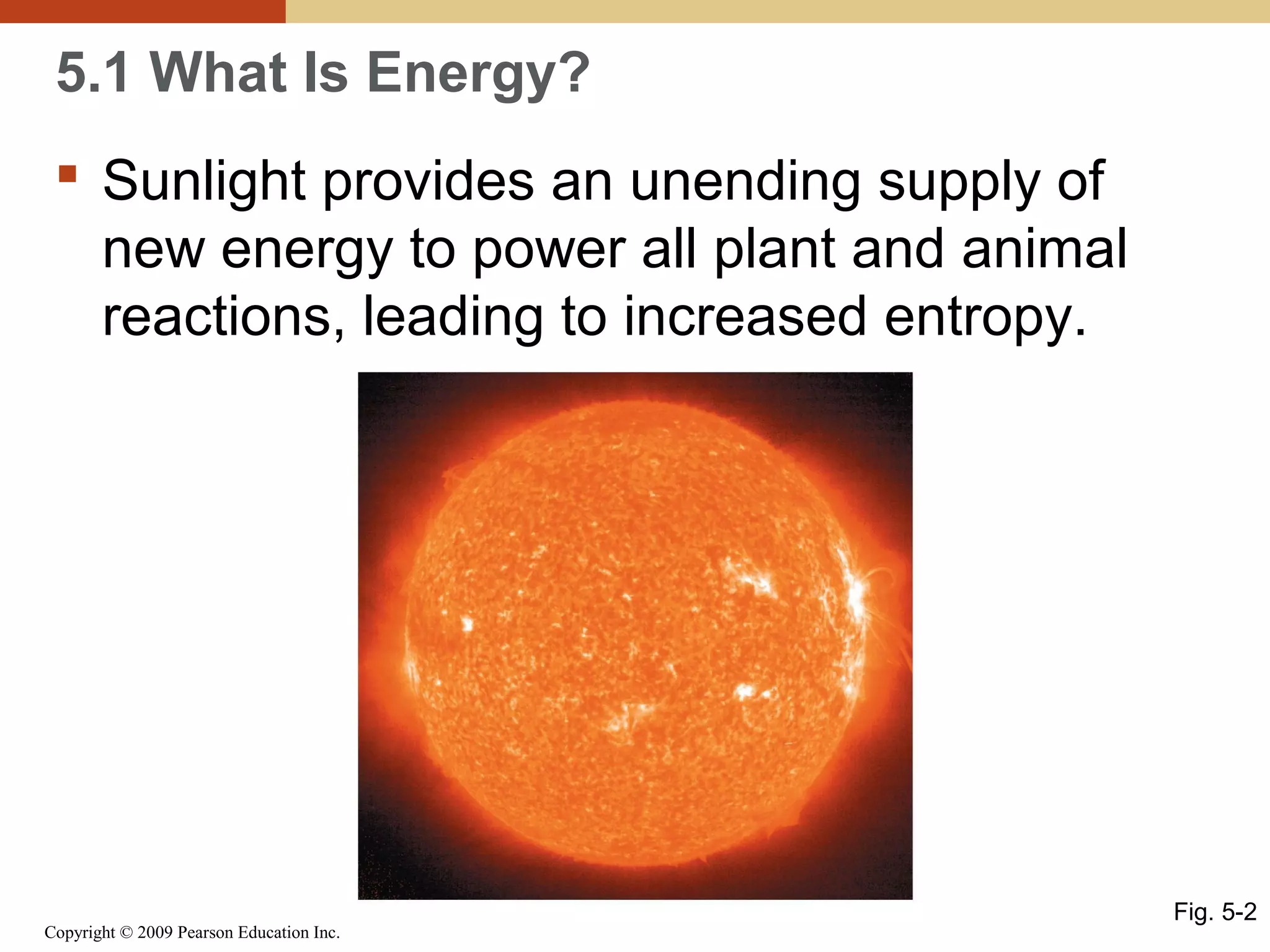
 Sunlight provides an unending supply of
new energy to power all plant and animal
reactions, leading to increased entropy.

Copyright © 2009 Pearson Education Inc.

Fig. 5-2
5.2 How Does Energy Flow In Chemical
Reactions?
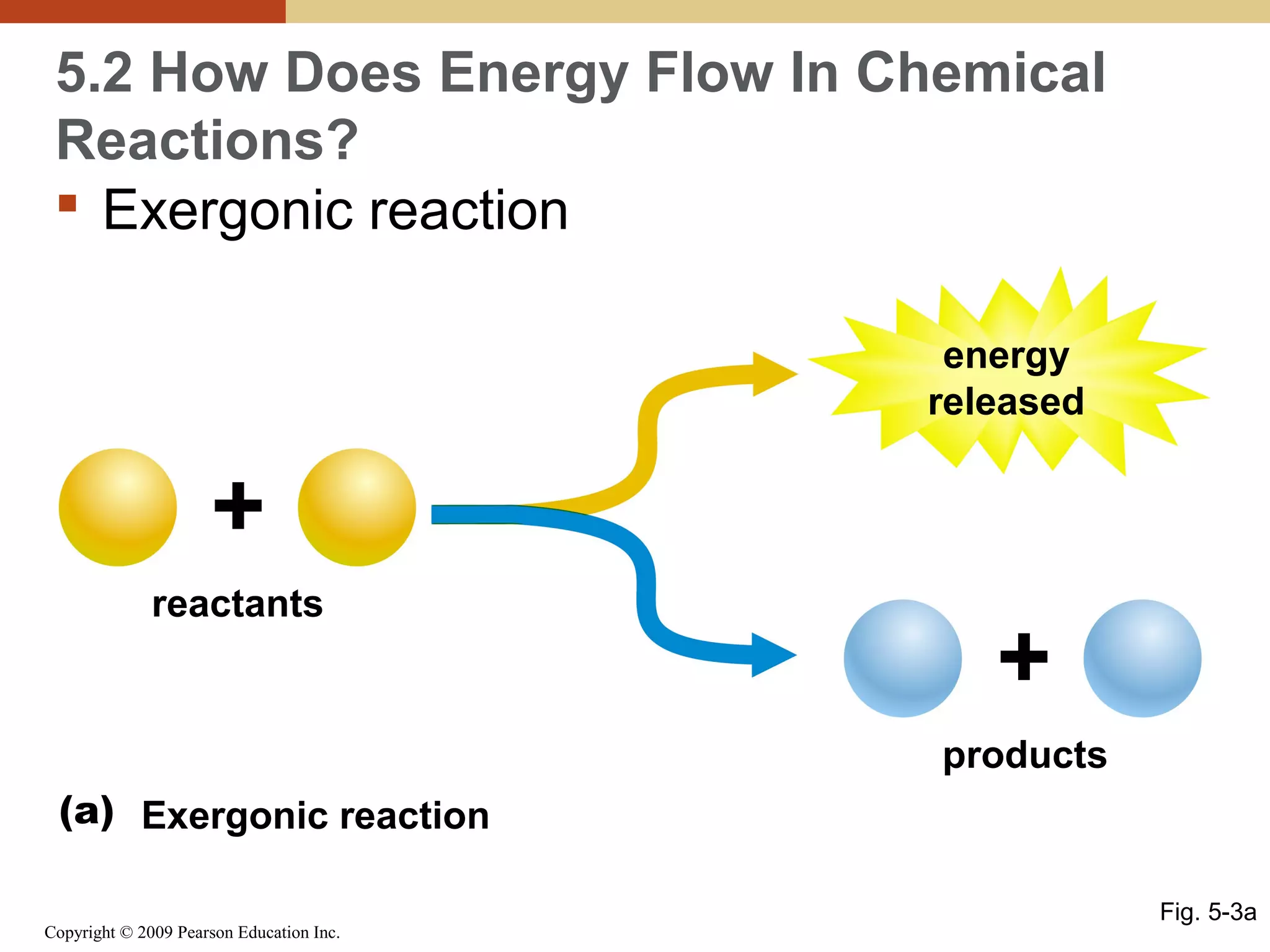
 Chemical reaction: the conversion of one
set of chemical substances (reactants) into
another (products)
• Exergonic reaction: a reaction that releases
energy; the products contain less energy than
the reactants

Copyright © 2009 Pearson Education Inc.
5.2 How Does Energy Flow In Chemical
Reactions?
 Exergonic reaction
energy
released

+
reactants

+
products

(a) Exergonic reaction
Copyright © 2009 Pearson Education Inc.

Fig. 5-3a
5.2 How Does Energy Flow In Chemical
Reactions?
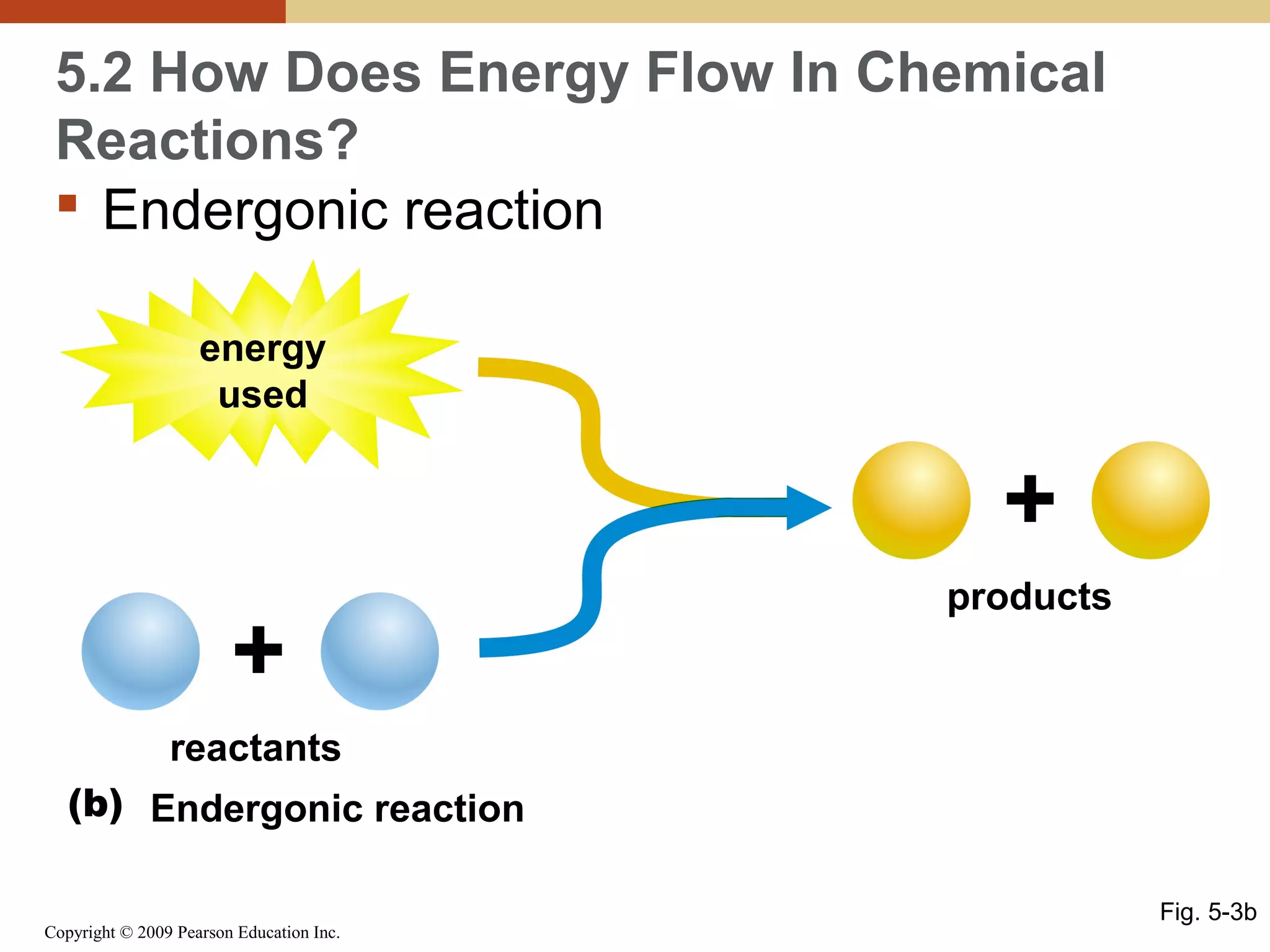
 Endergonic reaction: a reaction that
requires energy input from an outside
source; the products contain more energy
than the reactants

Copyright © 2009 Pearson Education Inc.
5.2 How Does Energy Flow In Chemical
Reactions?
 Endergonic reaction
energy
used

+
+

products

reactants
(b) Endergonic reaction
Copyright © 2009 Pearson Education Inc.

Fig. 5-3b
5.2 How Does Energy Flow In Chemical
Reactions?
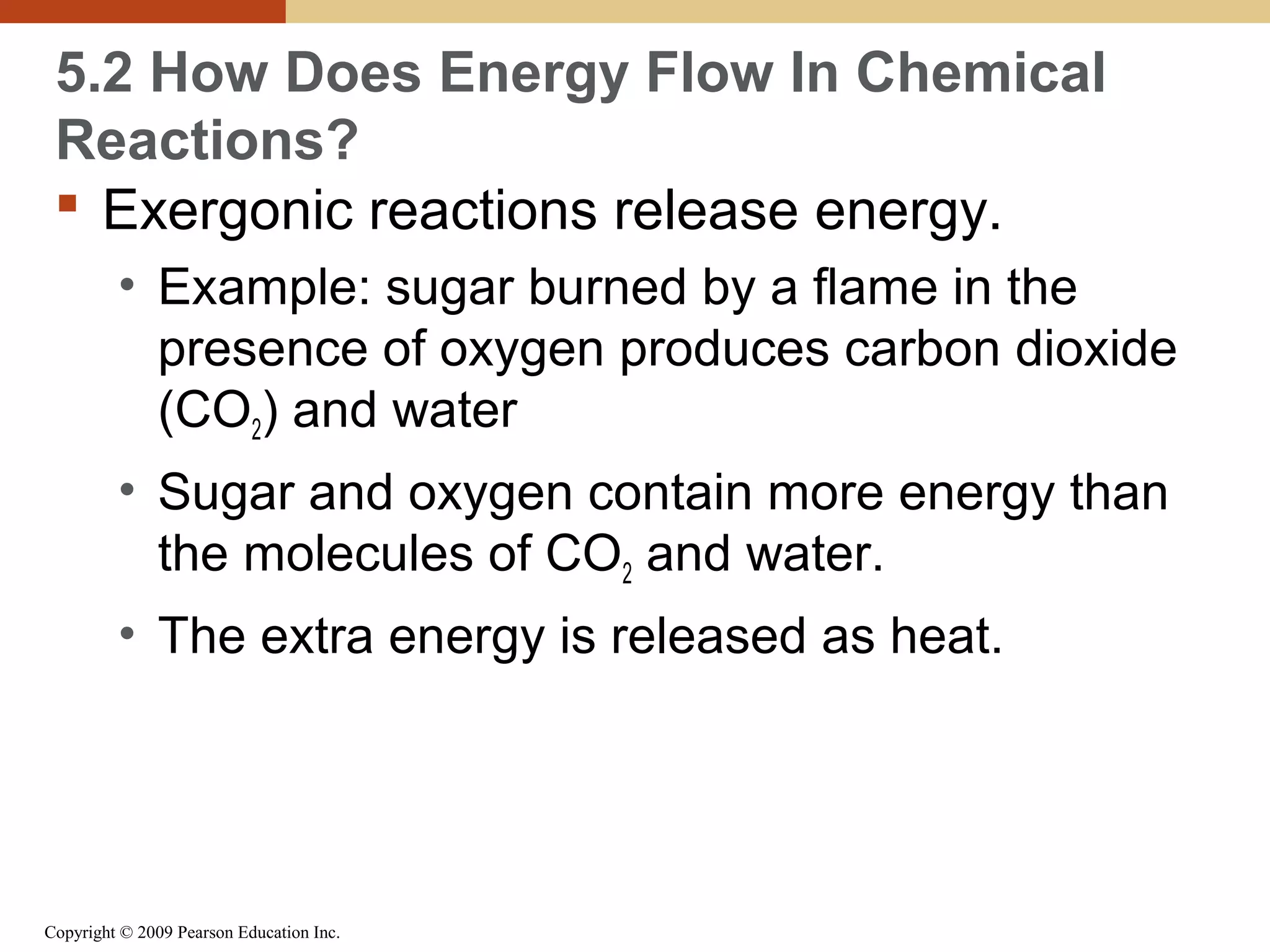
 Exergonic reactions release energy.
• Example: sugar burned by a flame in the
presence of oxygen produces carbon dioxide
(CO2) and water
• Sugar and oxygen contain more energy than
the molecules of CO2 and water.
• The extra energy is released as heat.

Copyright © 2009 Pearson Education Inc.
5.2 How Does Energy Flow In Chemical
Reactions?
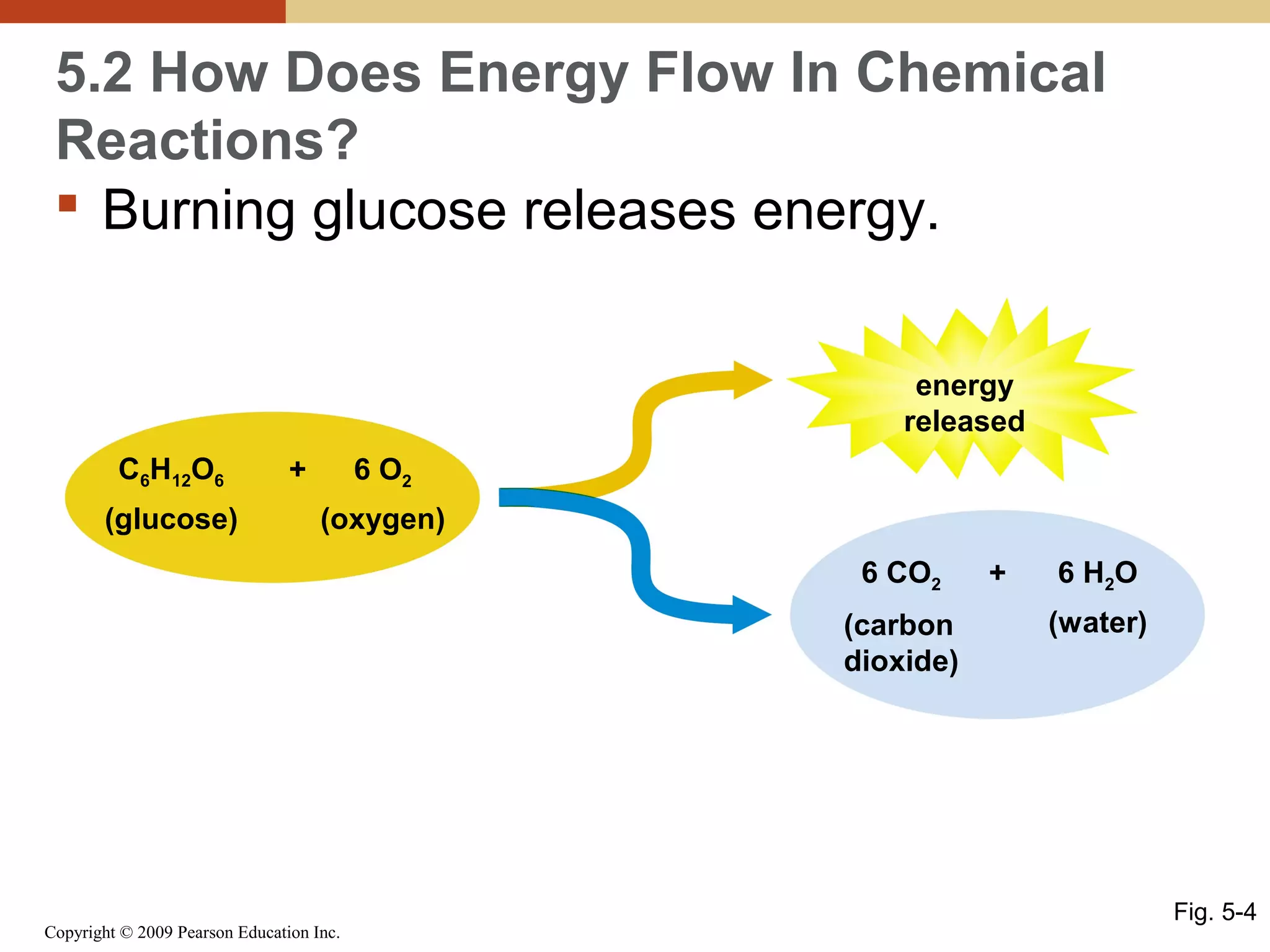
 Burning glucose releases energy.
energy
released
C6H12O6
(glucose)

+

6 O2
(oxygen)
6 CO2
(carbon
dioxide)

Copyright © 2009 Pearson Education Inc.

+

6 H2O
(water)

Fig. 5-4
5.2 How Does Energy Flow In Chemical
Reactions?
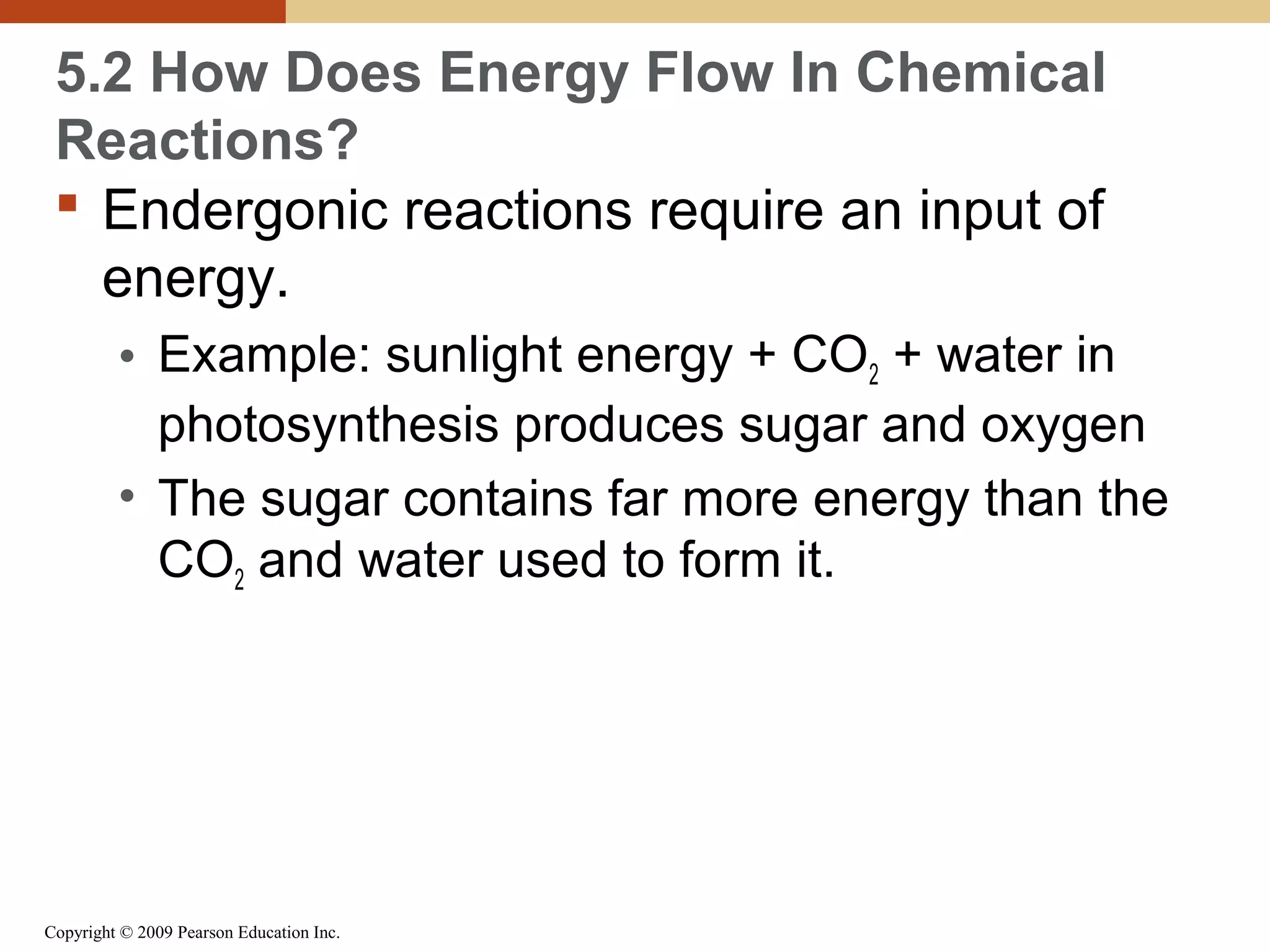
 Endergonic reactions require an input of
energy.
• Example: sunlight energy + CO2 + water in
photosynthesis produces sugar and oxygen
• The sugar contains far more energy than the
CO2 and water used to form it.

Copyright © 2009 Pearson Education Inc.
5.2 How Does Energy Flow In Chemical
Reactions?
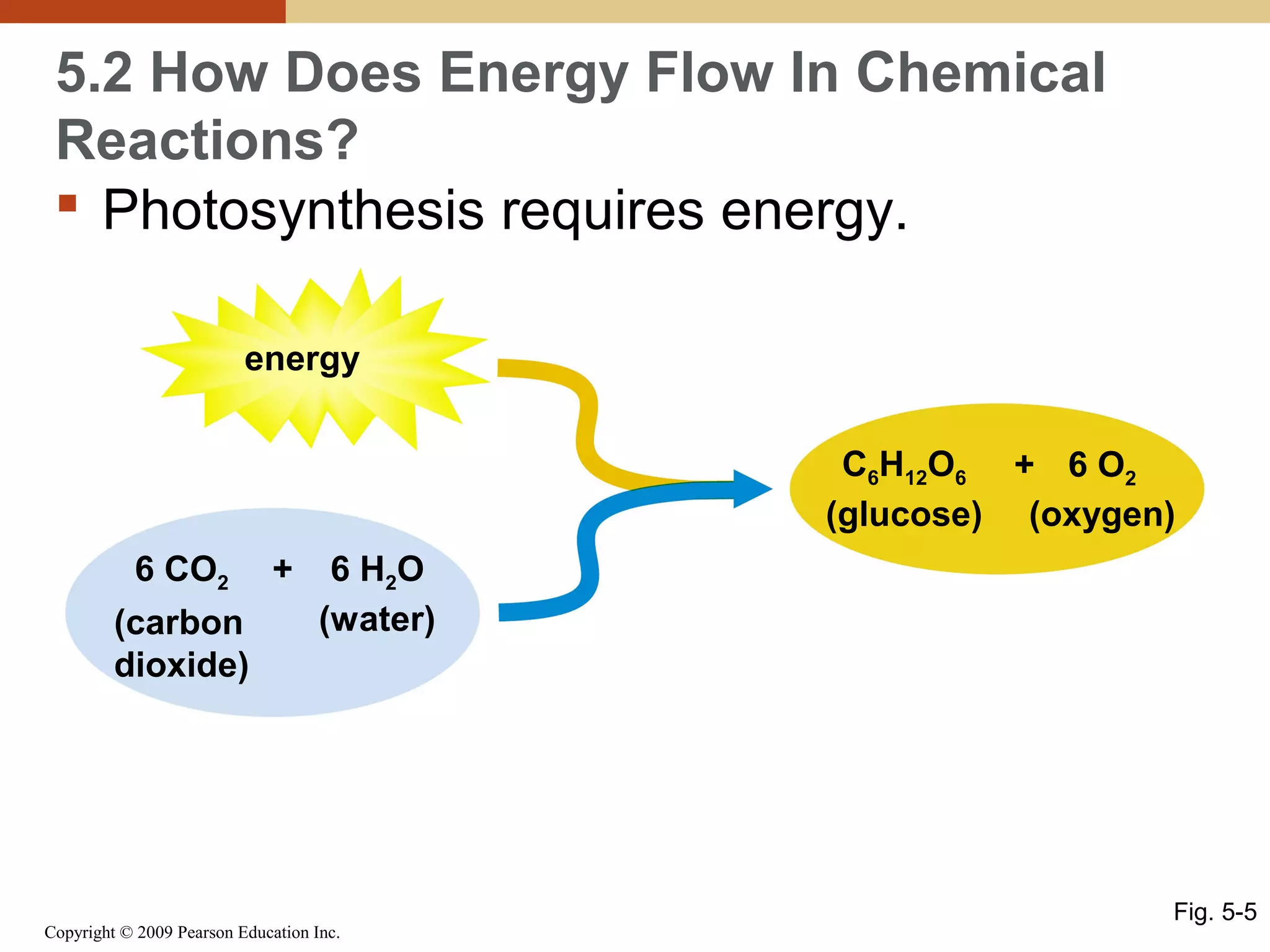
 Photosynthesis requires energy.
energy
C6H12O6 + 6 O2
(glucose) (oxygen)
6 CO2
(carbon
dioxide)

+

6 H 2O
(water)

Copyright © 2009 Pearson Education Inc.

Fig. 5-5
5.2 How Does Energy Flow In Chemical
Reactions?
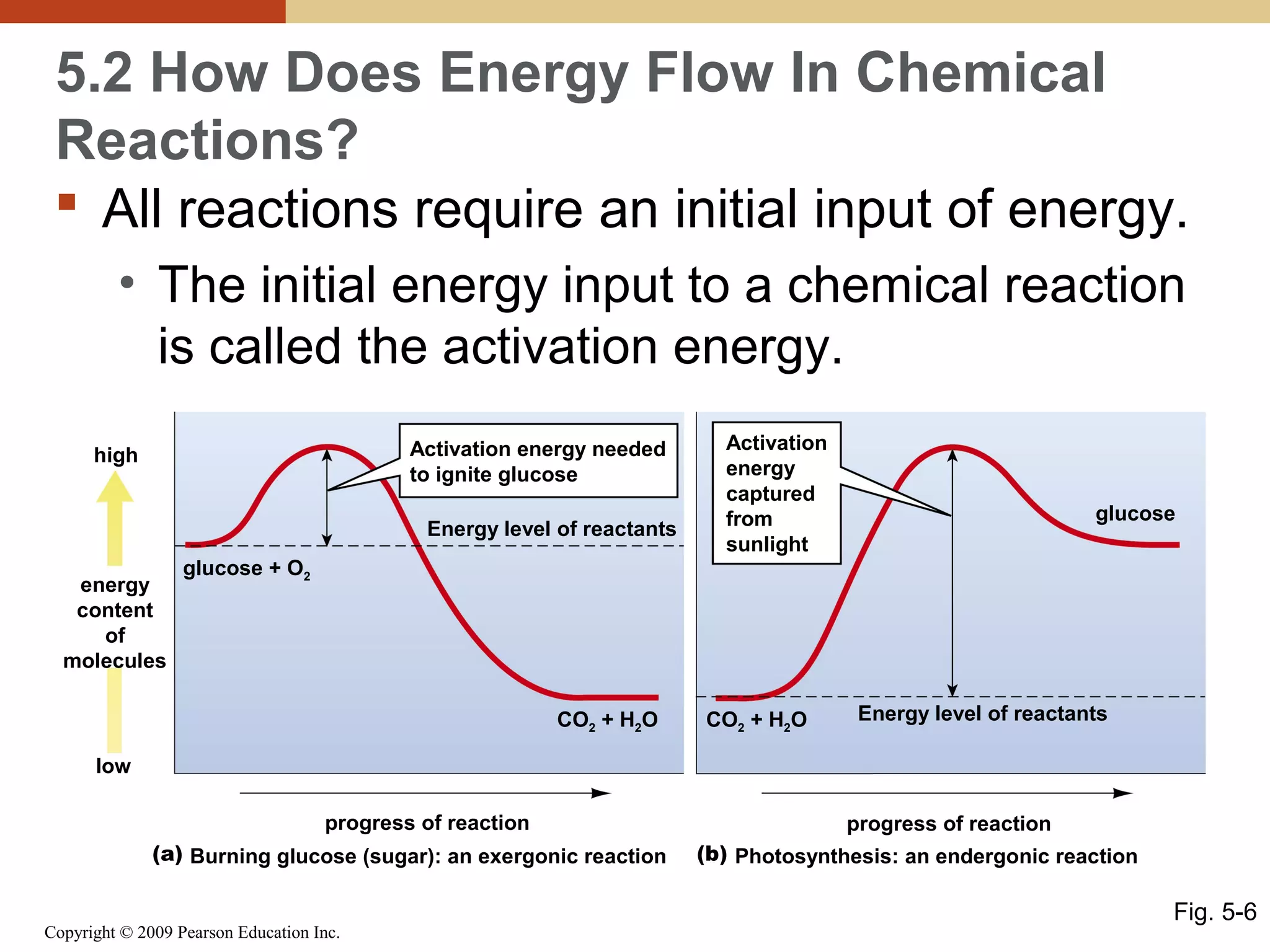
 All reactions require an initial input of energy.
• The initial energy input to a chemical reaction
is called the activation energy.
Activation energy needed
to ignite glucose

high

Energy level of reactants
energy
content
of
molecules

Activation
energy
captured
from
sunlight

glucose

glucose + O2

CO2 + H2O

CO2 + H2O

Energy level of reactants

low
progress of reaction
(a) Burning glucose (sugar): an exergonic reaction

Copyright © 2009 Pearson Education Inc.

progress of reaction
(b) Photosynthesis: an endergonic reaction

Fig. 5-6
5.2 How Does Energy Flow In Chemical
Reactions?
 The source of activation energy is the
kinetic energy of movement when
molecules collide.
 Molecular collisions force electron shells of
atoms to mingle and interact, resulting in
chemical reactions.

Copyright © 2009 Pearson Education Inc.
5.2 How Does Energy Flow in Chemical
Reactions?
 Exergonic reactions may be linked with
endergonic reactions.
• Endergonic reactions obtain energy from
energy-releasing exergonic reactions in
coupled reactions.
• Example: the exergonic reaction of burning
gasoline in a car provides the endergonic
reaction of moving the car
• Example: exergonic reactions in the sun
release light energy used to drive endergonic
sugar-making reactions in plants
Copyright © 2009 Pearson Education Inc.
5.3 How Is Energy Carried Between
Coupled Reactions?
 The job of transferring energy from one
place in a cell to another is done by energycarrier molecules.
• ATP (adenosine triphosphate) is the main
energy carrier molecule in cells, and provides
energy for many endergonic reactions.

Copyright © 2009 Pearson Education Inc.
5.3 How Is Energy Carried Between
Coupled Reactions?
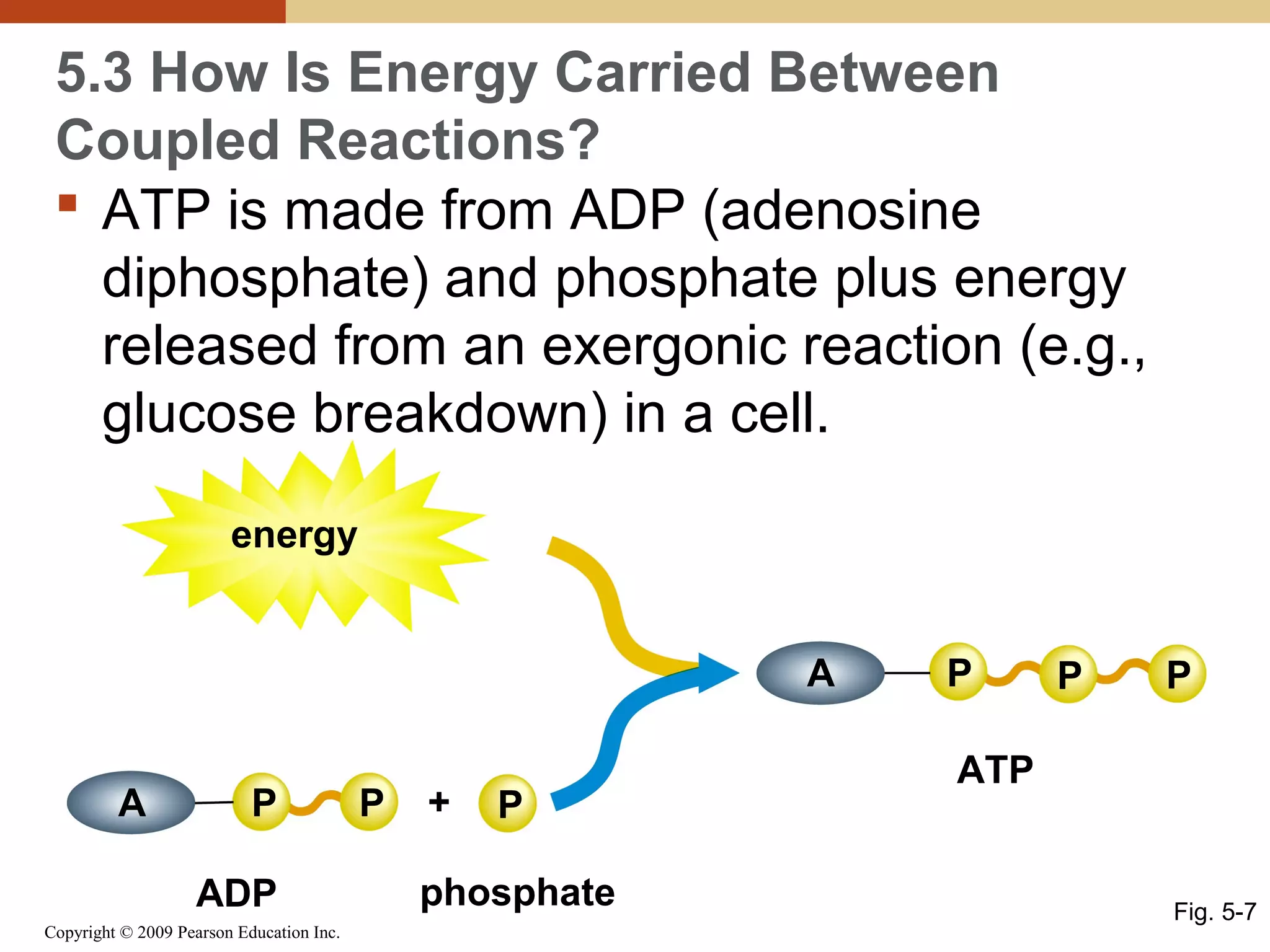
 ATP is made from ADP (adenosine
diphosphate) and phosphate plus energy
released from an exergonic reaction (e.g.,
glucose breakdown) in a cell.
energy
A
A

P
ADP

Copyright © 2009 Pearson Education Inc.

P

+

P

phosphate

P

P

P

ATP

Fig. 5-7
5.3 How Is Energy Carried Between
Coupled Reactions?
 ATP is the principal energy carrier in cells.
• ATP stores energy in its phosphate bonds and
carries the energy to various sites in the cell
where energy-requiring reactions occur.
• ATP’s phosphate bonds then break yielding
ADP, phosphate, and energy.
• This energy is then transferred to the energyrequiring reaction.

Copyright © 2009 Pearson Education Inc.
5.3 How Is Energy Carried Between
Coupled Reactions?
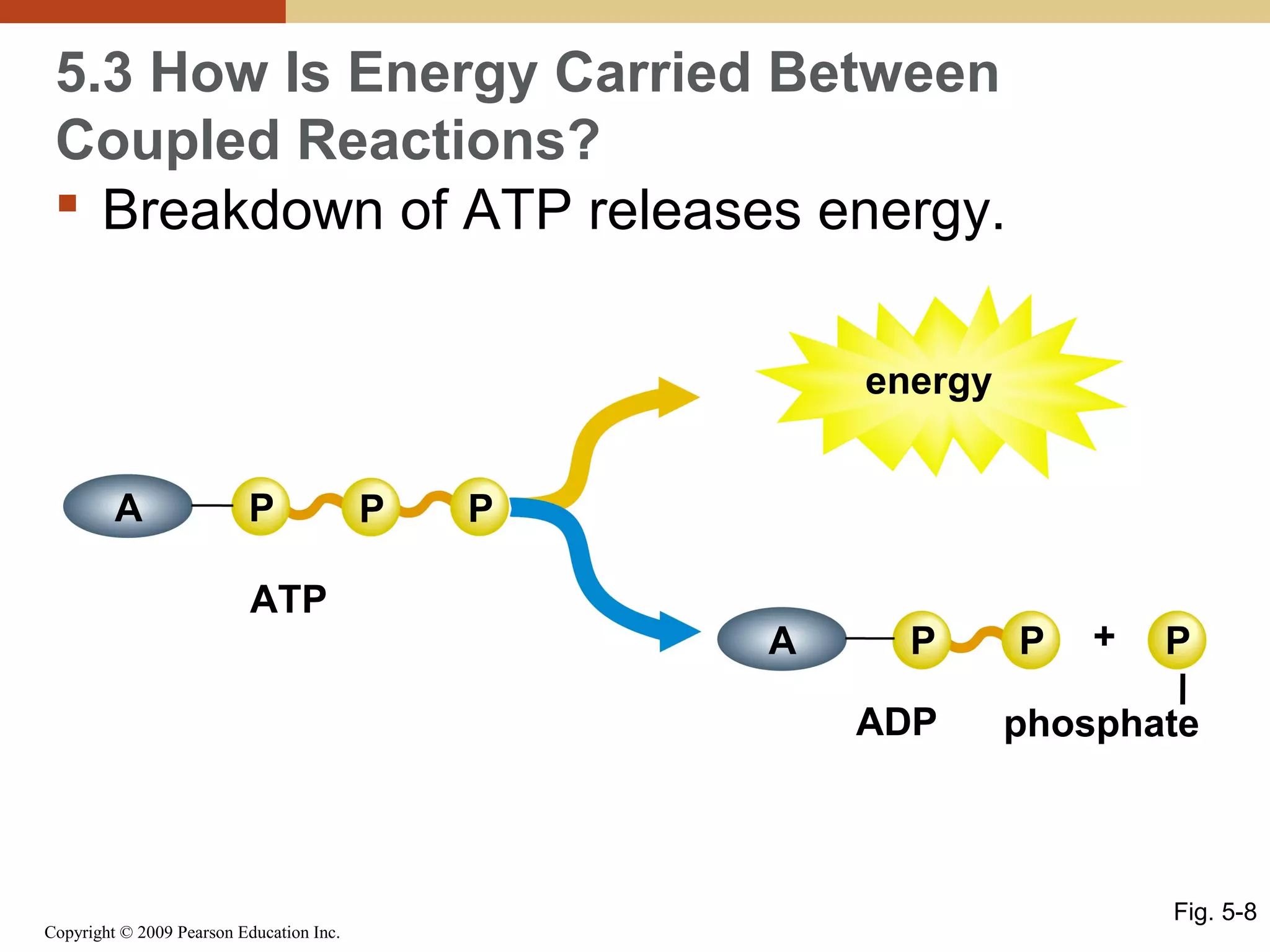
 Breakdown of ATP releases energy.
energy
A

P
ATP

P

P
A

P
ADP

Copyright © 2009 Pearson Education Inc.

P

+

P

phosphate

Fig. 5-8
5.3 How Is Energy Carried Between
Coupled Reactions?
 To summarize:
• Exergonic reactions (e.g., glucose breakdown)
drive endergonic reactions (e.g., the
conversion of ADP to ATP).
• ATP moves to different parts of the cell and is
broken down exergonically to liberate its
energy to drive endergonic reactions.

Copyright © 2009 Pearson Education Inc.
5.3 How Is Energy Carried Between
Coupled Reactions?
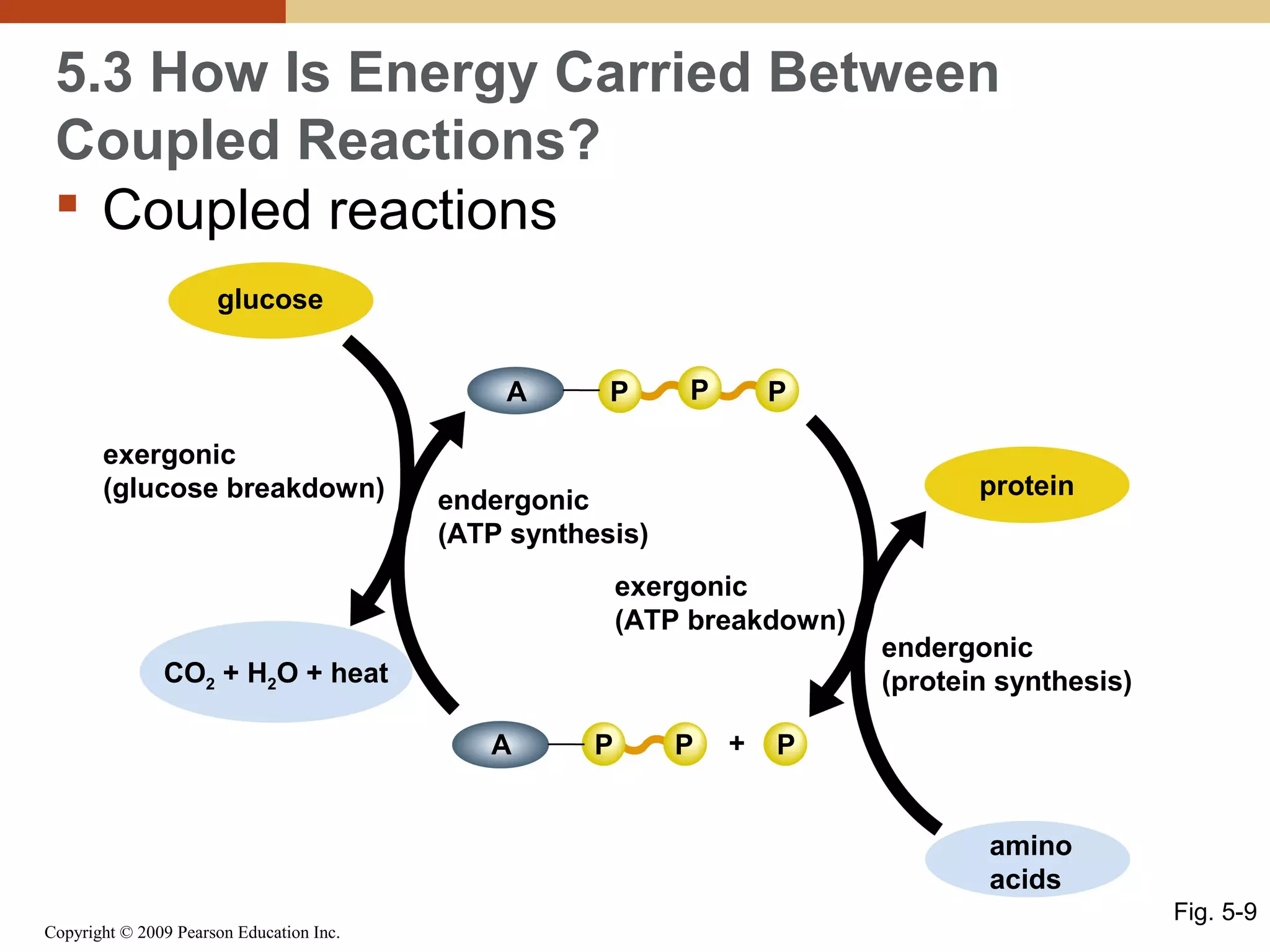
 Coupled reactions
glucose
A
exergonic
(glucose breakdown)

P

P

P
protein

endergonic
(ATP synthesis)
exergonic
(ATP breakdown)

CO2 + H2O + heat
A

P

P

+

endergonic
(protein synthesis)

P
amino
acids

Copyright © 2009 Pearson Education Inc.

Fig. 5-9
5.3 How Is Energy Carried Between
Coupled Reactions?
 A biological example of coupled reactions
• Muscle contraction (an endergonic reaction) is
powered by the exergonic breakdown of ATP.
• During energy transfer in this coupled
reaction, heat is given off, with overall loss of
usable energy.

Copyright © 2009 Pearson Education Inc.
5.3 How Is Energy Carried Between
Coupled Reactions?
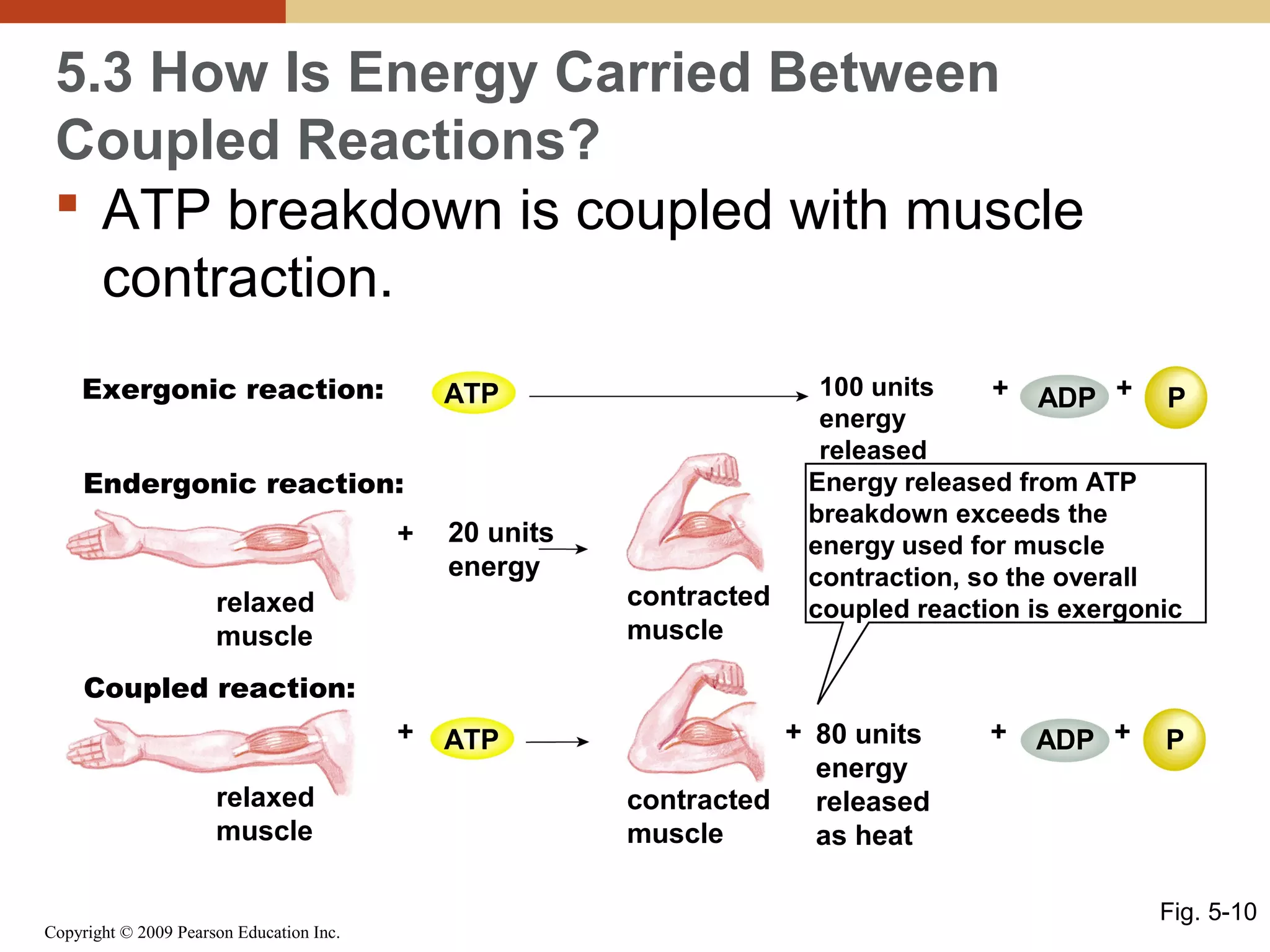
 ATP breakdown is coupled with muscle
contraction.
Exergonic reaction:

ATP

Endergonic reaction:
+

20 units
energy

relaxed
muscle

contracted
muscle

100 units
+ ADP + P
energy
released
Energy released from ATP
breakdown exceeds the
energy used for muscle
contraction, so the overall
coupled reaction is exergonic

Coupled reaction:
+
relaxed
muscle

Copyright © 2009 Pearson Education Inc.

ATP

+ 80 units
energy
contracted
released
muscle
as heat

+

ADP +

P

Fig. 5-10
5.3 How Is Energy Carried Between
Coupled Reactions?
PLAY

Animation—Energy and Chemical Reactions

Copyright © 2009 Pearson Education Inc.
5.3 How Is Energy Carried Between
Coupled Reactions?
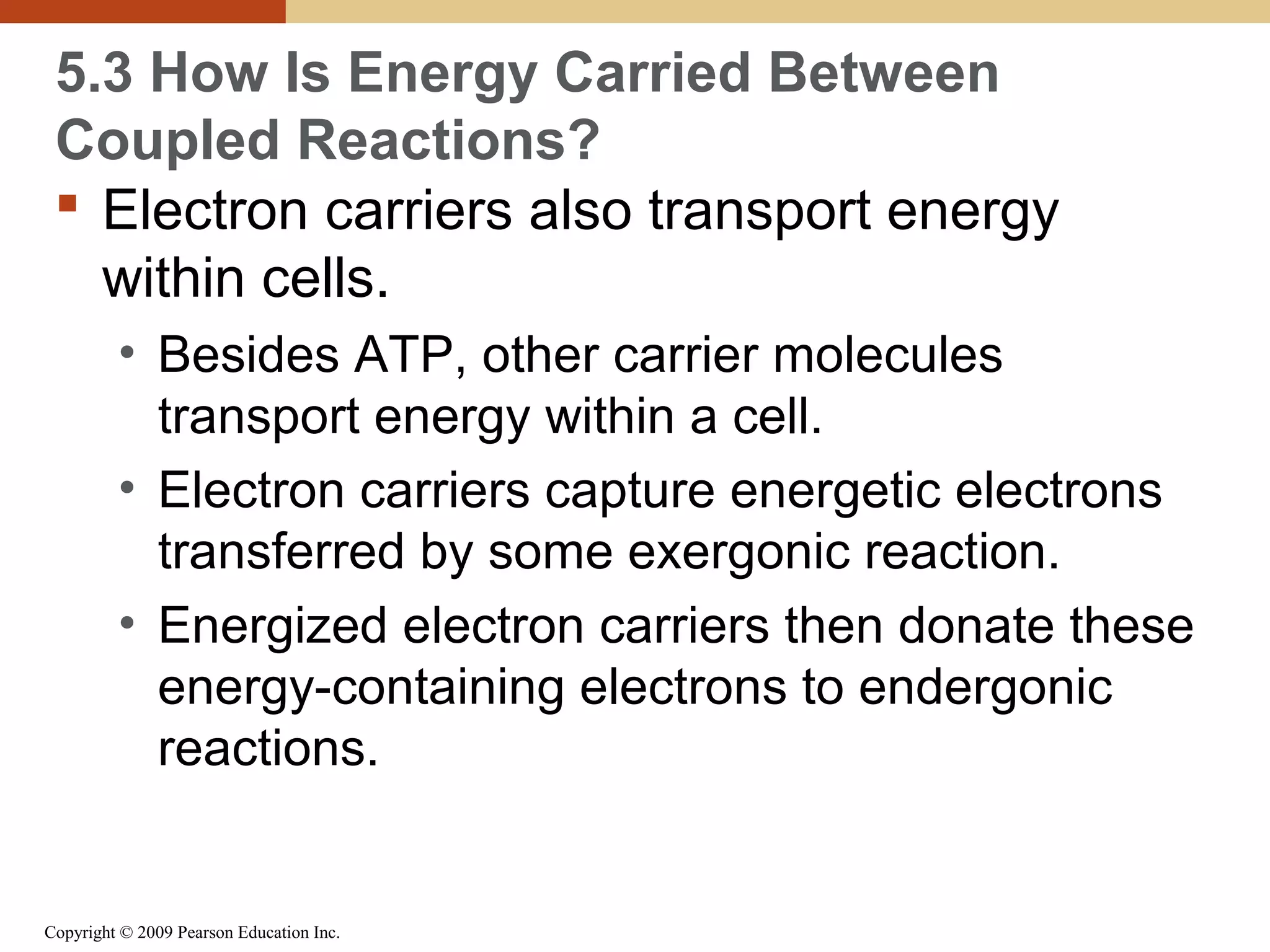
 Electron carriers also transport energy
within cells.
• Besides ATP, other carrier molecules
transport energy within a cell.
• Electron carriers capture energetic electrons
transferred by some exergonic reaction.
• Energized electron carriers then donate these
energy-containing electrons to endergonic
reactions.

Copyright © 2009 Pearson Education Inc.
5.3 How Is Energy Carried Between
Coupled Reactions?
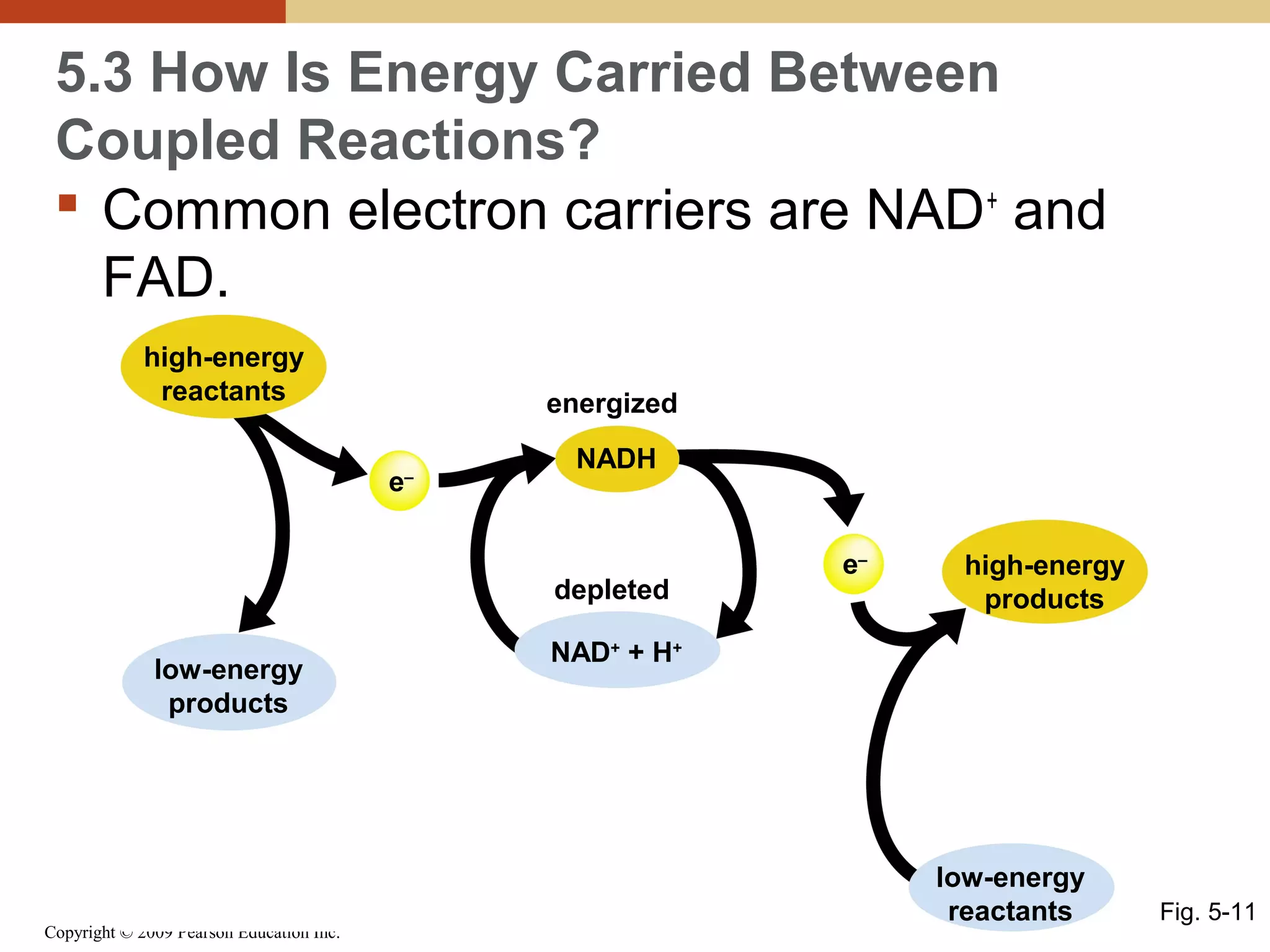
 Common electron carriers are NAD+ and
FAD.
high-energy
reactants

energized
e–

NADH

depleted
low-energy
products

Copyright © 2009 Pearson Education Inc.

e–

high-energy
products

NAD+ + H+

low-energy
reactants

Fig. 5-11
5.3 How Is Energy Carried Between
Coupled Reactions?
PLAY

Animation—Energy and Life

Copyright © 2009 Pearson Education Inc.
5.4 How Do Cells Control Their Metabolic
Reactions?
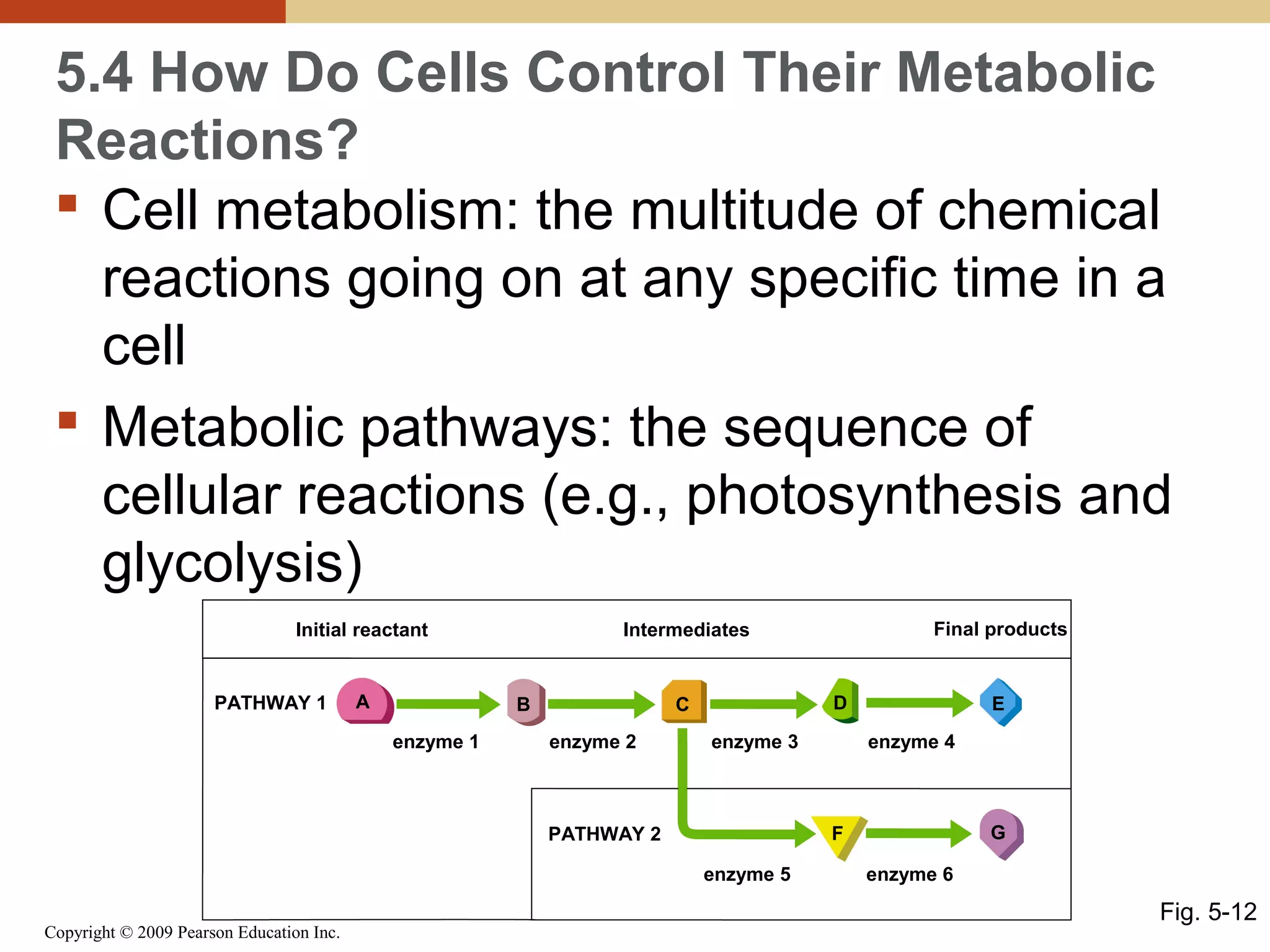
 Cell metabolism: the multitude of chemical
reactions going on at any specific time in a
cell
 Metabolic pathways: the sequence of
cellular reactions (e.g., photosynthesis and
glycolysis)
Initial reactant

PATHWAY 1

A

B
enzyme 1

D

C
enzyme 2

enzyme 3

E
enzyme 4

G

F

PATHWAY 2
enzyme 5
Copyright © 2009 Pearson Education Inc.

Final products

Intermediates

enzyme 6

Fig. 5-12
5.4 How Do Cells Control Their Metabolic
Reactions?
 At body temperature, many spontaneous
reactions proceed too slowly to sustain life.
• A reaction can be controlled by controlling its
activation energy (the energy needed to start
the reaction).
• At body temperature, reactions occur too
slowly because their activation energies are
too high.
• Molecules called catalysts are able to gain
access to energy that is not produced
spontaneously.
Copyright © 2009 Pearson Education Inc.
5.4 How Do Cells Control Their Metabolic
Reactions?
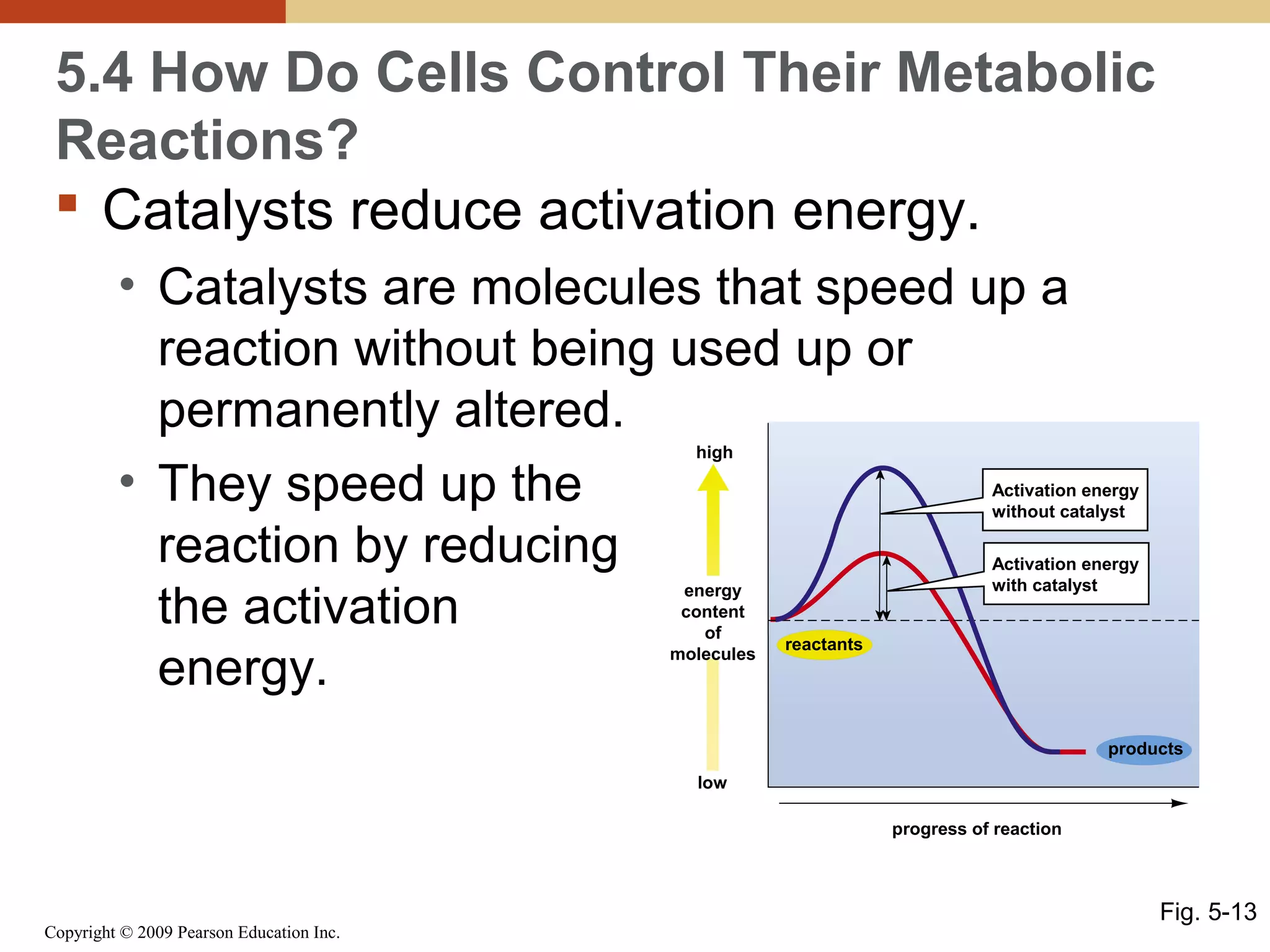
 Catalysts reduce activation energy.
• Catalysts are molecules that speed up a
reaction without being used up or
permanently altered.
• They speed up the
reaction by reducing
the activation
energy.
high

Activation energy
without catalyst

energy
content
of
molecules

Activation energy
with catalyst

reactants

products
low
progress of reaction

Copyright © 2009 Pearson Education Inc.

Fig. 5-13
5.4 How Do Cells Control Their Metabolic
Reactions?
 Three important principles about all
catalysts
• Catalysts speed up a reaction.
• They speed up reactions that would occur
anyway, if their activation energy could be
surmounted.
• Catalysts are not altered by the reaction.

Copyright © 2009 Pearson Education Inc.
5.4 How Do Cells Control Their Metabolic
Reactions?
 Enzymes are biological catalysts.
• Almost all enzymes are proteins.
• Enzymes are highly specialized, generally
catalyzing only a single reaction.
• In metabolic pathways involving multiple
reactions, each reaction is catalyzed by a
different enzyme.

Copyright © 2009 Pearson Education Inc.
5.4 How Do Cells Control Their Metabolic
Reactions?
 The structure of enzymes allows them to
catalyze specific reactions.
• Enzymes have an active site where the
reactant molecules, called substrates, enter
and undergo a chemical change as a result.
• The specificity of an enzyme reaction is due to
the distinctive shape of the active site, which
only allows proper substrate molecules to
enter.

Copyright © 2009 Pearson Education Inc.
5.4 How Do Cells Control Their Metabolic
Reactions?
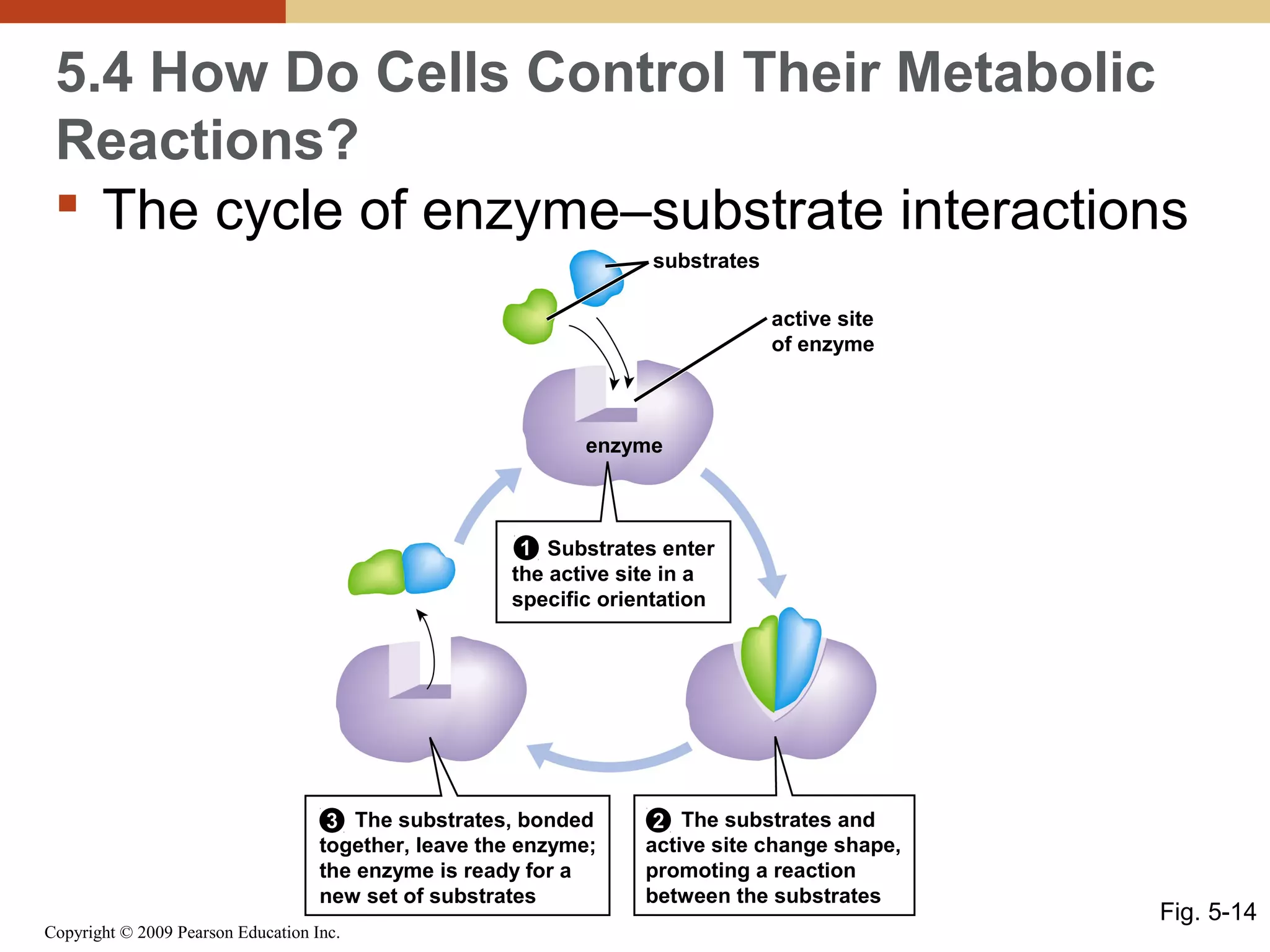
 How does an enzyme catalyze a reaction?
• Both substrates enter the enzyme’s active
site.
• Substrates enter an enzyme’s active site,
changing both of their shapes.
• The chemical bonds are altered in the
substrates, promoting the reaction.
• The substrates change into a new form that
will not fit the active site, and so are released.

Copyright © 2009 Pearson Education Inc.
5.4 How Do Cells Control Their Metabolic
Reactions?
 The cycle of enzyme–substrate interactions
substrates
active site
of enzyme

enzyme

1 Substrates enter
the active site in a
specific orientation

3 The substrates, bonded
together, leave the enzyme;
the enzyme is ready for a
new set of substrates
Copyright © 2009 Pearson Education Inc.

2 The substrates and
active site change shape,
promoting a reaction
between the substrates

Fig. 5-14
5.4 How Do Cells Control Their Metabolic
Reactions?
PLAY

Animation—Enzymes

Copyright © 2009 Pearson Education Inc.
5.4 How Do Cells Control Their Metabolic
Reactions?
 Cells regulate metabolism by controlling
enzymes.
• Allosteric regulation can increase or decrease
enzyme activity.
• In allosteric regulation, an enzyme’s activity
is modified by a regulator molecule.
• The regulator molecule binds to a special
regulatory site on the enzyme separate
from the enzyme’s active site.

Copyright © 2009 Pearson Education Inc.
5.4 How Do Cells Control Their Metabolic
Reactions?
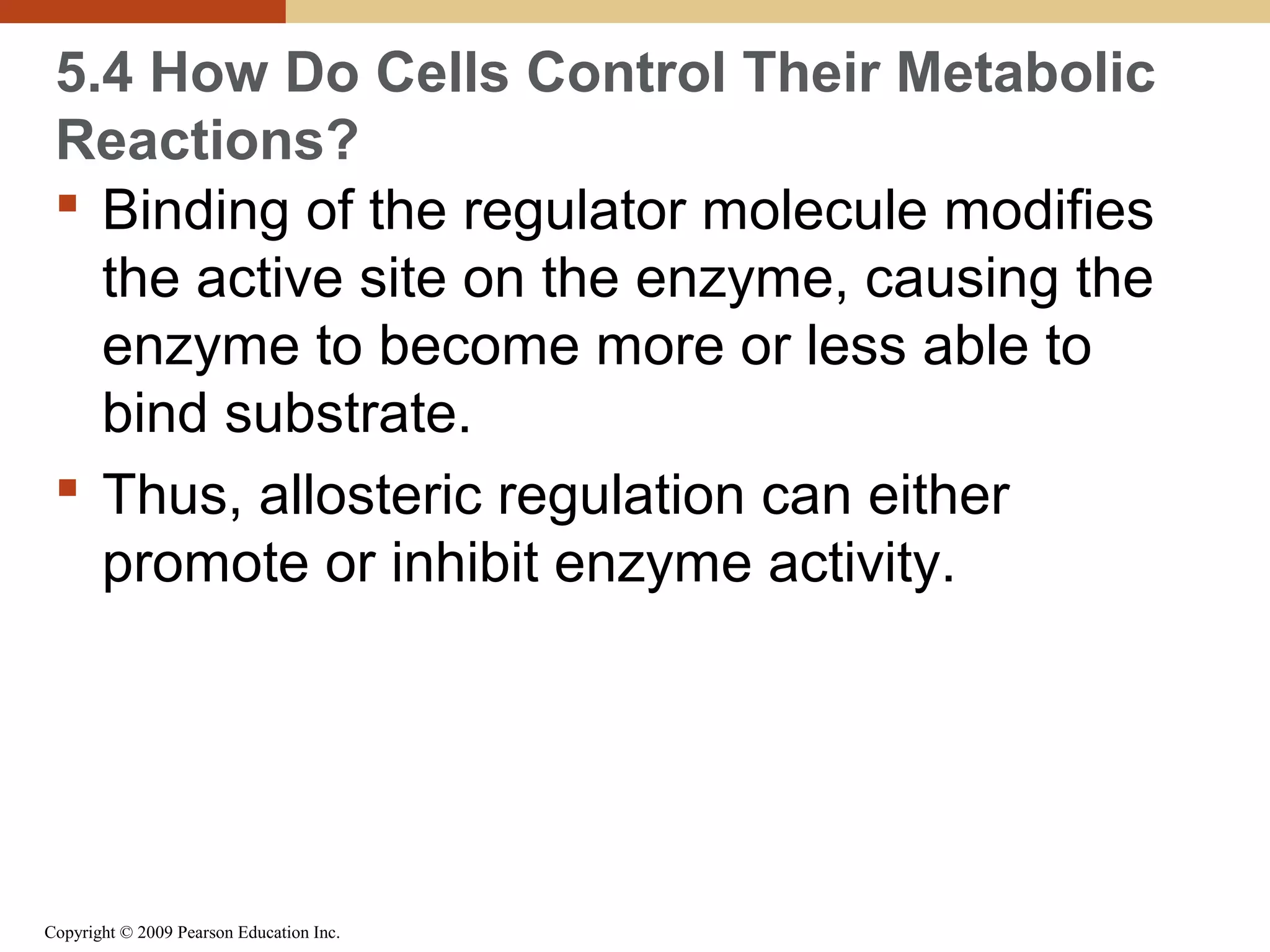
 Binding of the regulator molecule modifies
the active site on the enzyme, causing the
enzyme to become more or less able to
bind substrate.
 Thus, allosteric regulation can either
promote or inhibit enzyme activity.

Copyright © 2009 Pearson Education Inc.
5.4 How Do Cells Control Their Metabolic
Reactions?
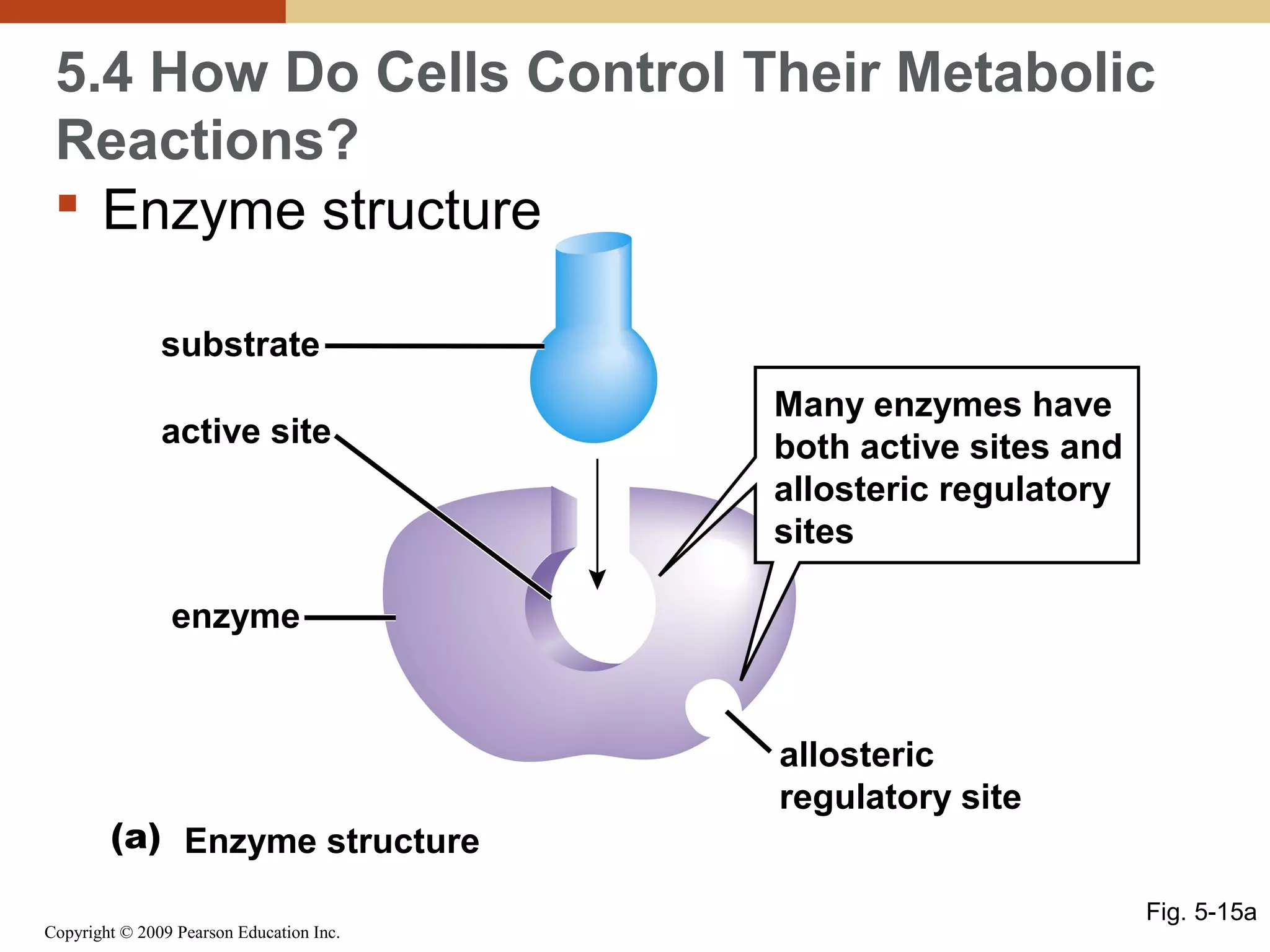
 Enzyme structure
substrate
active site

Many enzymes have
both active sites and
allosteric regulatory
sites

enzyme

(a) Enzyme structure
Copyright © 2009 Pearson Education Inc.

allosteric
regulatory site
Fig. 5-15a
5.4 How Do Cells Control Their Metabolic
Reactions?
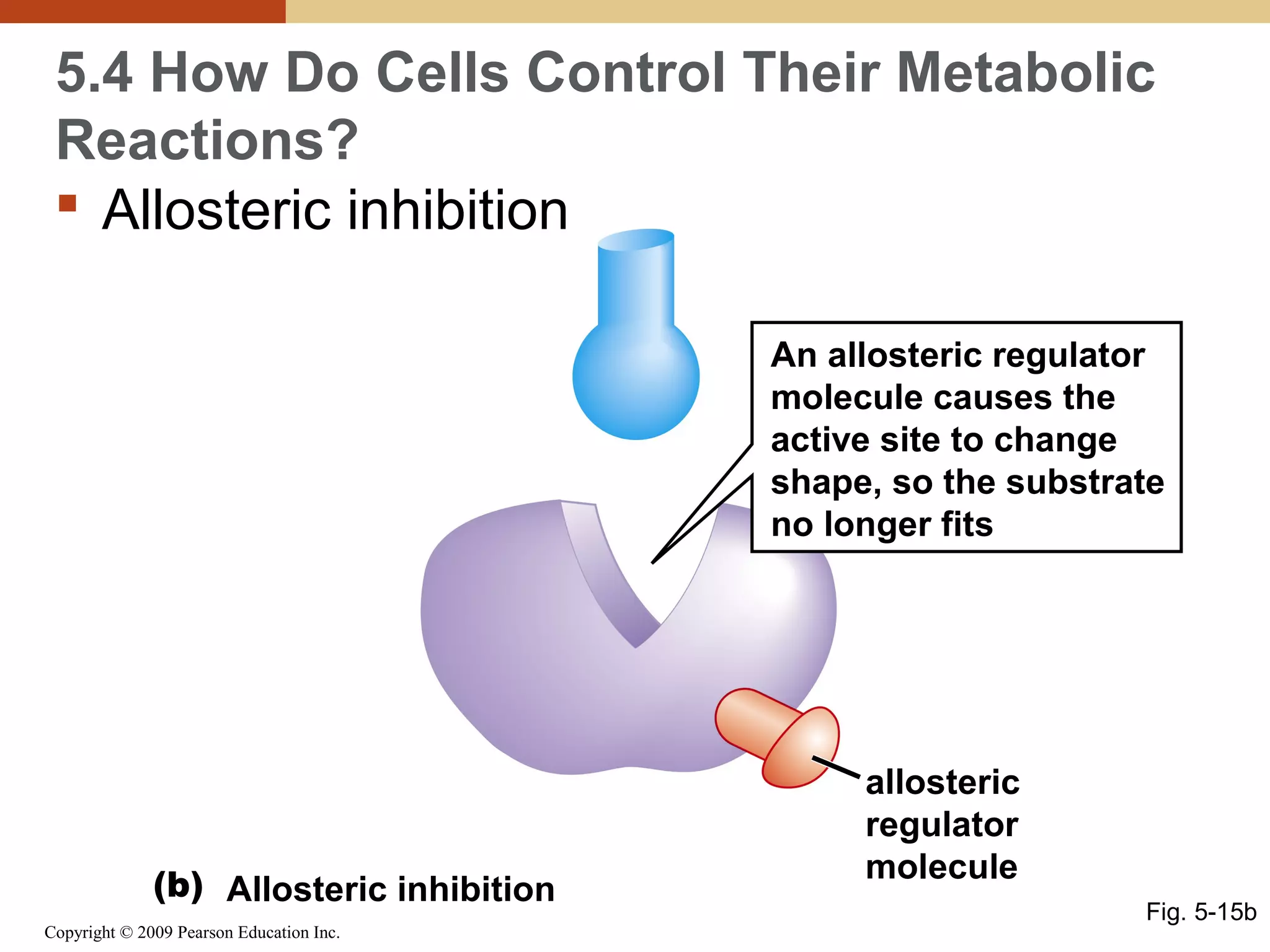
 Allosteric inhibition
An allosteric regulator
molecule causes the
active site to change
shape, so the substrate
no longer fits

(b) Allosteric inhibition
Copyright © 2009 Pearson Education Inc.

allosteric
regulator
molecule
Fig. 5-15b
5.4 How Do Cells Control Their Metabolic
Reactions?
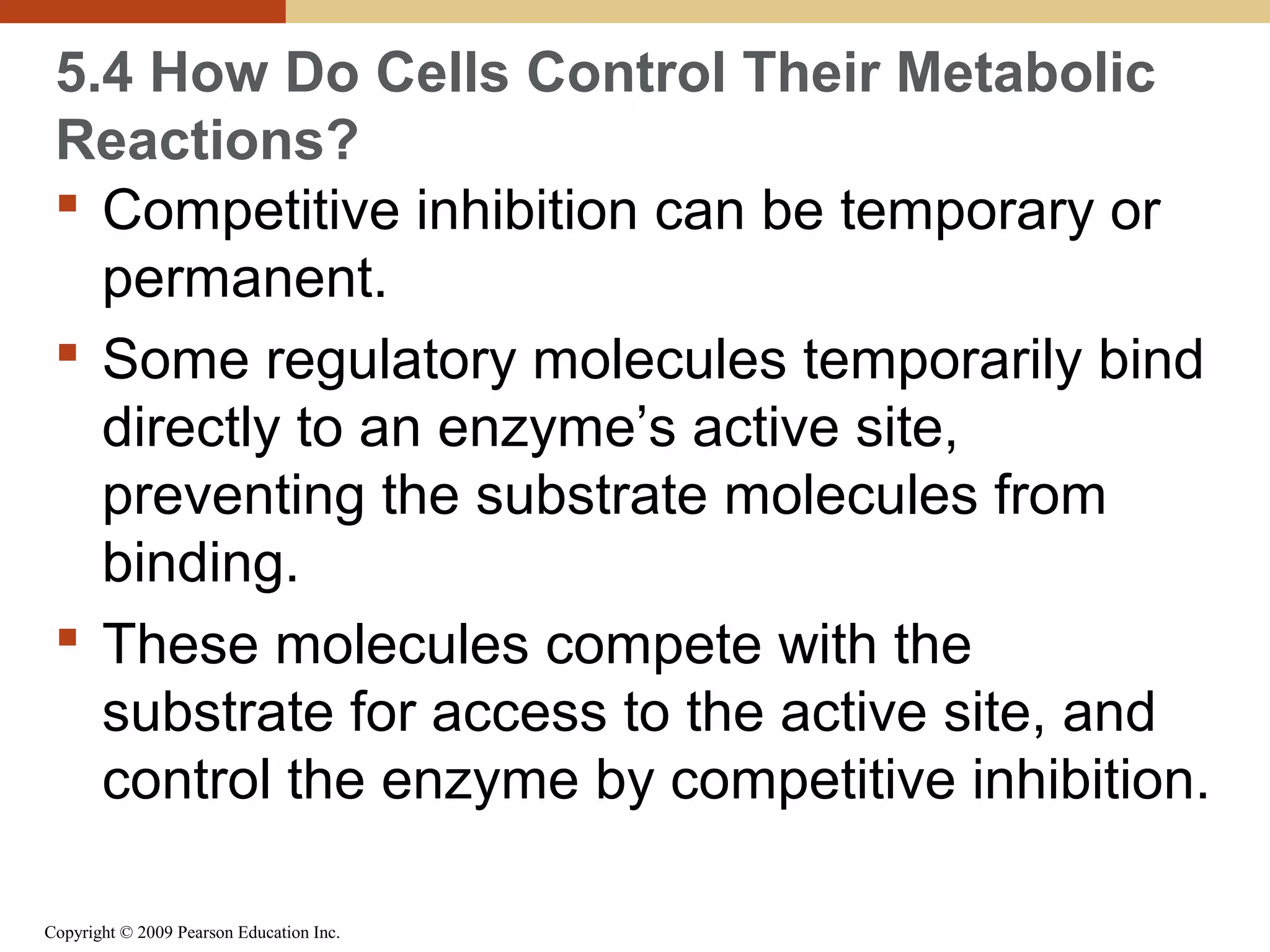
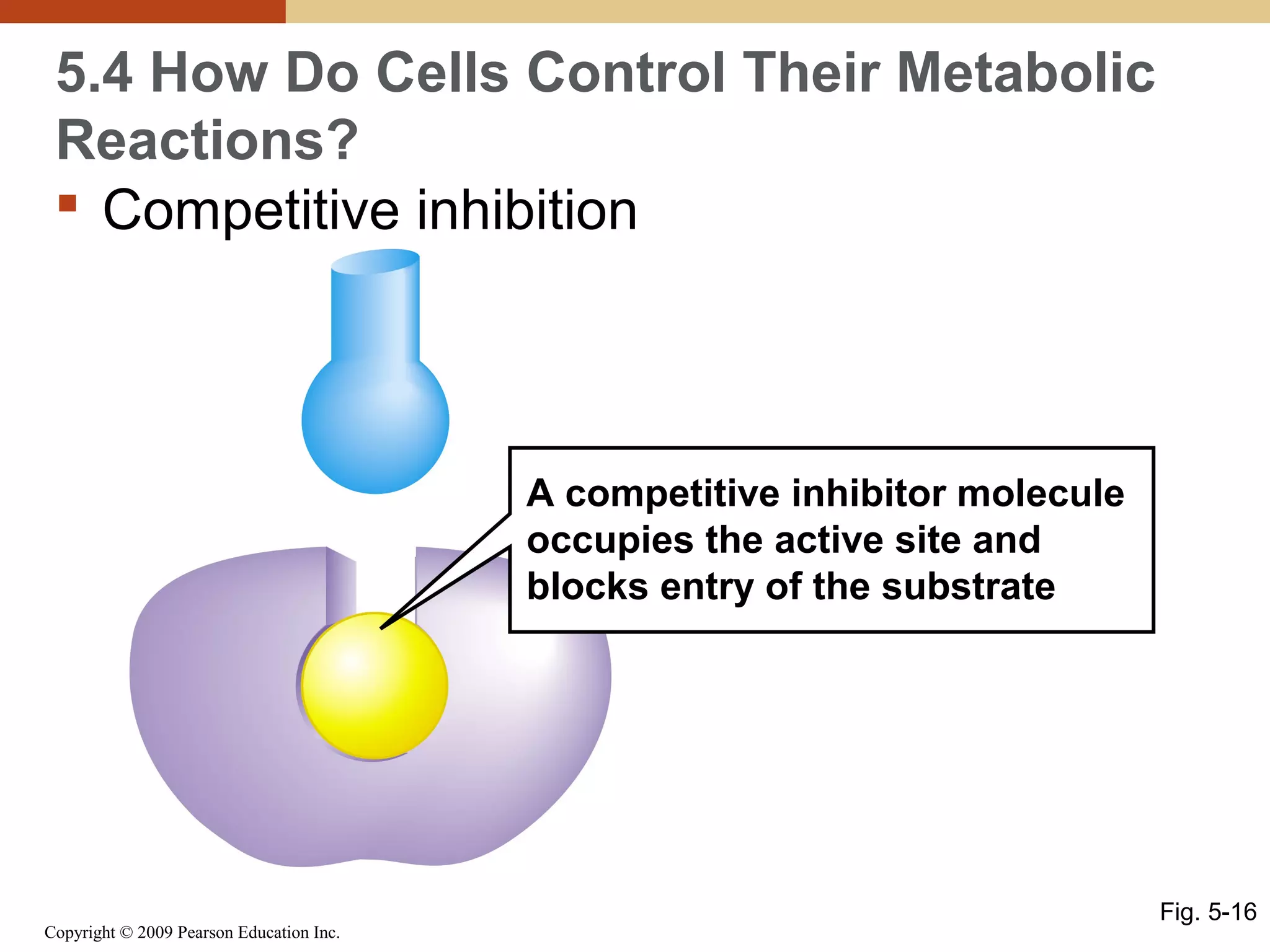
 Competitive inhibition can be temporary or
permanent.
 Some regulatory molecules temporarily bind
directly to an enzyme’s active site,
preventing the substrate molecules from
binding.
 These molecules compete with the
substrate for access to the active site, and
control the enzyme by competitive inhibition.
Copyright © 2009 Pearson Education Inc.
5.4 How Do Cells Control Their Metabolic
Reactions?
 Competitive inhibition

A competitive inhibitor molecule
occupies the active site and
blocks entry of the substrate

Copyright © 2009 Pearson Education Inc.

Fig. 5-16

Ch06 lecture

  • 1.
    Chapter 6 Energy Flowin the Life of a Cell Lectures by Gregory Ahearn University of North Florida Copyright © 2009 Pearson Education, Inc..
  • 2.
    5.1 What IsEnergy?  Energy is the capacity to do work. • Synthesizing molecules • Moving objects • Generating heat and light Copyright © 2009 Pearson Education Inc.
  • 3.
    5.1 What IsEnergy?  Types of energy • Kinetic: energy of movement • Potential: stored energy Copyright © 2009 Pearson Education Inc. Fig. 5-1
  • 4.
    5.1 What IsEnergy?  First Law of Thermodynamics • “Energy cannot be created nor destroyed, but it can change its form.” • Example: potential energy in gasoline can be converted to kinetic energy in a car, but the energy is not lost Copyright © 2009 Pearson Education Inc.
  • 5.
    5.1 What IsEnergy?  Second Law of Thermodynamics • “When energy is converted from one form to another, the amount of useful energy decreases.” • No process is 100% efficient. • Example: more potential energy is in the gasoline than is transferred to the kinetic energy of the car moving • Where is the rest of the energy? It is released in a less useful form as heat—the total energy is maintained. Copyright © 2009 Pearson Education Inc.
  • 6.
    5.1 What IsEnergy?  Matter tends to become less organized. • There is a continual decrease in useful energy, and a build up of heat and other nonuseful forms of energy. • Entropy: the spontaneous reduction in ordered forms of energy, and an increase in randomness and disorder as reactions proceed • Example: gasoline is made up of an eightcarbon molecule that is highly ordered • When broken down to single carbons in CO2, it is less ordered and more random. Copyright © 2009 Pearson Education Inc.
  • 7.
    5.1 What IsEnergy?  In order to keep useful energy flowing in ecosystems where the plants and animals produce more random forms of energy, new energy must be brought in. Copyright © 2009 Pearson Education Inc.
  • 8.
    5.1 What IsEnergy?  Sunlight provides an unending supply of new energy to power all plant and animal reactions, leading to increased entropy. Copyright © 2009 Pearson Education Inc. Fig. 5-2
  • 9.
    5.2 How DoesEnergy Flow In Chemical Reactions?  Chemical reaction: the conversion of one set of chemical substances (reactants) into another (products) • Exergonic reaction: a reaction that releases energy; the products contain less energy than the reactants Copyright © 2009 Pearson Education Inc.
  • 10.
    5.2 How DoesEnergy Flow In Chemical Reactions?  Exergonic reaction energy released + reactants + products (a) Exergonic reaction Copyright © 2009 Pearson Education Inc. Fig. 5-3a
  • 11.
    5.2 How DoesEnergy Flow In Chemical Reactions?  Endergonic reaction: a reaction that requires energy input from an outside source; the products contain more energy than the reactants Copyright © 2009 Pearson Education Inc.
  • 12.
    5.2 How DoesEnergy Flow In Chemical Reactions?  Endergonic reaction energy used + + products reactants (b) Endergonic reaction Copyright © 2009 Pearson Education Inc. Fig. 5-3b
  • 13.
    5.2 How DoesEnergy Flow In Chemical Reactions?  Exergonic reactions release energy. • Example: sugar burned by a flame in the presence of oxygen produces carbon dioxide (CO2) and water • Sugar and oxygen contain more energy than the molecules of CO2 and water. • The extra energy is released as heat. Copyright © 2009 Pearson Education Inc.
  • 14.
    5.2 How DoesEnergy Flow In Chemical Reactions?  Burning glucose releases energy. energy released C6H12O6 (glucose) + 6 O2 (oxygen) 6 CO2 (carbon dioxide) Copyright © 2009 Pearson Education Inc. + 6 H2O (water) Fig. 5-4
  • 15.
    5.2 How DoesEnergy Flow In Chemical Reactions?  Endergonic reactions require an input of energy. • Example: sunlight energy + CO2 + water in photosynthesis produces sugar and oxygen • The sugar contains far more energy than the CO2 and water used to form it. Copyright © 2009 Pearson Education Inc.
  • 16.
    5.2 How DoesEnergy Flow In Chemical Reactions?  Photosynthesis requires energy. energy C6H12O6 + 6 O2 (glucose) (oxygen) 6 CO2 (carbon dioxide) + 6 H 2O (water) Copyright © 2009 Pearson Education Inc. Fig. 5-5
  • 17.
    5.2 How DoesEnergy Flow In Chemical Reactions?  All reactions require an initial input of energy. • The initial energy input to a chemical reaction is called the activation energy. Activation energy needed to ignite glucose high Energy level of reactants energy content of molecules Activation energy captured from sunlight glucose glucose + O2 CO2 + H2O CO2 + H2O Energy level of reactants low progress of reaction (a) Burning glucose (sugar): an exergonic reaction Copyright © 2009 Pearson Education Inc. progress of reaction (b) Photosynthesis: an endergonic reaction Fig. 5-6
  • 18.
    5.2 How DoesEnergy Flow In Chemical Reactions?  The source of activation energy is the kinetic energy of movement when molecules collide.  Molecular collisions force electron shells of atoms to mingle and interact, resulting in chemical reactions. Copyright © 2009 Pearson Education Inc.
  • 19.
    5.2 How DoesEnergy Flow in Chemical Reactions?  Exergonic reactions may be linked with endergonic reactions. • Endergonic reactions obtain energy from energy-releasing exergonic reactions in coupled reactions. • Example: the exergonic reaction of burning gasoline in a car provides the endergonic reaction of moving the car • Example: exergonic reactions in the sun release light energy used to drive endergonic sugar-making reactions in plants Copyright © 2009 Pearson Education Inc.
  • 20.
    5.3 How IsEnergy Carried Between Coupled Reactions?  The job of transferring energy from one place in a cell to another is done by energycarrier molecules. • ATP (adenosine triphosphate) is the main energy carrier molecule in cells, and provides energy for many endergonic reactions. Copyright © 2009 Pearson Education Inc.
  • 21.
    5.3 How IsEnergy Carried Between Coupled Reactions?  ATP is made from ADP (adenosine diphosphate) and phosphate plus energy released from an exergonic reaction (e.g., glucose breakdown) in a cell. energy A A P ADP Copyright © 2009 Pearson Education Inc. P + P phosphate P P P ATP Fig. 5-7
  • 22.
    5.3 How IsEnergy Carried Between Coupled Reactions?  ATP is the principal energy carrier in cells. • ATP stores energy in its phosphate bonds and carries the energy to various sites in the cell where energy-requiring reactions occur. • ATP’s phosphate bonds then break yielding ADP, phosphate, and energy. • This energy is then transferred to the energyrequiring reaction. Copyright © 2009 Pearson Education Inc.
  • 23.
    5.3 How IsEnergy Carried Between Coupled Reactions?  Breakdown of ATP releases energy. energy A P ATP P P A P ADP Copyright © 2009 Pearson Education Inc. P + P phosphate Fig. 5-8
  • 24.
    5.3 How IsEnergy Carried Between Coupled Reactions?  To summarize: • Exergonic reactions (e.g., glucose breakdown) drive endergonic reactions (e.g., the conversion of ADP to ATP). • ATP moves to different parts of the cell and is broken down exergonically to liberate its energy to drive endergonic reactions. Copyright © 2009 Pearson Education Inc.
  • 25.
    5.3 How IsEnergy Carried Between Coupled Reactions?  Coupled reactions glucose A exergonic (glucose breakdown) P P P protein endergonic (ATP synthesis) exergonic (ATP breakdown) CO2 + H2O + heat A P P + endergonic (protein synthesis) P amino acids Copyright © 2009 Pearson Education Inc. Fig. 5-9
  • 26.
    5.3 How IsEnergy Carried Between Coupled Reactions?  A biological example of coupled reactions • Muscle contraction (an endergonic reaction) is powered by the exergonic breakdown of ATP. • During energy transfer in this coupled reaction, heat is given off, with overall loss of usable energy. Copyright © 2009 Pearson Education Inc.
  • 27.
    5.3 How IsEnergy Carried Between Coupled Reactions?  ATP breakdown is coupled with muscle contraction. Exergonic reaction: ATP Endergonic reaction: + 20 units energy relaxed muscle contracted muscle 100 units + ADP + P energy released Energy released from ATP breakdown exceeds the energy used for muscle contraction, so the overall coupled reaction is exergonic Coupled reaction: + relaxed muscle Copyright © 2009 Pearson Education Inc. ATP + 80 units energy contracted released muscle as heat + ADP + P Fig. 5-10
  • 28.
    5.3 How IsEnergy Carried Between Coupled Reactions? PLAY Animation—Energy and Chemical Reactions Copyright © 2009 Pearson Education Inc.
  • 29.
    5.3 How IsEnergy Carried Between Coupled Reactions?  Electron carriers also transport energy within cells. • Besides ATP, other carrier molecules transport energy within a cell. • Electron carriers capture energetic electrons transferred by some exergonic reaction. • Energized electron carriers then donate these energy-containing electrons to endergonic reactions. Copyright © 2009 Pearson Education Inc.
  • 30.
    5.3 How IsEnergy Carried Between Coupled Reactions?  Common electron carriers are NAD+ and FAD. high-energy reactants energized e– NADH depleted low-energy products Copyright © 2009 Pearson Education Inc. e– high-energy products NAD+ + H+ low-energy reactants Fig. 5-11
  • 31.
    5.3 How IsEnergy Carried Between Coupled Reactions? PLAY Animation—Energy and Life Copyright © 2009 Pearson Education Inc.
  • 32.
    5.4 How DoCells Control Their Metabolic Reactions?  Cell metabolism: the multitude of chemical reactions going on at any specific time in a cell  Metabolic pathways: the sequence of cellular reactions (e.g., photosynthesis and glycolysis) Initial reactant PATHWAY 1 A B enzyme 1 D C enzyme 2 enzyme 3 E enzyme 4 G F PATHWAY 2 enzyme 5 Copyright © 2009 Pearson Education Inc. Final products Intermediates enzyme 6 Fig. 5-12
  • 33.
    5.4 How DoCells Control Their Metabolic Reactions?  At body temperature, many spontaneous reactions proceed too slowly to sustain life. • A reaction can be controlled by controlling its activation energy (the energy needed to start the reaction). • At body temperature, reactions occur too slowly because their activation energies are too high. • Molecules called catalysts are able to gain access to energy that is not produced spontaneously. Copyright © 2009 Pearson Education Inc.
  • 34.
    5.4 How DoCells Control Their Metabolic Reactions?  Catalysts reduce activation energy. • Catalysts are molecules that speed up a reaction without being used up or permanently altered. • They speed up the reaction by reducing the activation energy. high Activation energy without catalyst energy content of molecules Activation energy with catalyst reactants products low progress of reaction Copyright © 2009 Pearson Education Inc. Fig. 5-13
  • 35.
    5.4 How DoCells Control Their Metabolic Reactions?  Three important principles about all catalysts • Catalysts speed up a reaction. • They speed up reactions that would occur anyway, if their activation energy could be surmounted. • Catalysts are not altered by the reaction. Copyright © 2009 Pearson Education Inc.
  • 36.
    5.4 How DoCells Control Their Metabolic Reactions?  Enzymes are biological catalysts. • Almost all enzymes are proteins. • Enzymes are highly specialized, generally catalyzing only a single reaction. • In metabolic pathways involving multiple reactions, each reaction is catalyzed by a different enzyme. Copyright © 2009 Pearson Education Inc.
  • 37.
    5.4 How DoCells Control Their Metabolic Reactions?  The structure of enzymes allows them to catalyze specific reactions. • Enzymes have an active site where the reactant molecules, called substrates, enter and undergo a chemical change as a result. • The specificity of an enzyme reaction is due to the distinctive shape of the active site, which only allows proper substrate molecules to enter. Copyright © 2009 Pearson Education Inc.
  • 38.
    5.4 How DoCells Control Their Metabolic Reactions?  How does an enzyme catalyze a reaction? • Both substrates enter the enzyme’s active site. • Substrates enter an enzyme’s active site, changing both of their shapes. • The chemical bonds are altered in the substrates, promoting the reaction. • The substrates change into a new form that will not fit the active site, and so are released. Copyright © 2009 Pearson Education Inc.
  • 39.
    5.4 How DoCells Control Their Metabolic Reactions?  The cycle of enzyme–substrate interactions substrates active site of enzyme enzyme 1 Substrates enter the active site in a specific orientation 3 The substrates, bonded together, leave the enzyme; the enzyme is ready for a new set of substrates Copyright © 2009 Pearson Education Inc. 2 The substrates and active site change shape, promoting a reaction between the substrates Fig. 5-14
  • 40.
    5.4 How DoCells Control Their Metabolic Reactions? PLAY Animation—Enzymes Copyright © 2009 Pearson Education Inc.
  • 41.
    5.4 How DoCells Control Their Metabolic Reactions?  Cells regulate metabolism by controlling enzymes. • Allosteric regulation can increase or decrease enzyme activity. • In allosteric regulation, an enzyme’s activity is modified by a regulator molecule. • The regulator molecule binds to a special regulatory site on the enzyme separate from the enzyme’s active site. Copyright © 2009 Pearson Education Inc.
  • 42.
    5.4 How DoCells Control Their Metabolic Reactions?  Binding of the regulator molecule modifies the active site on the enzyme, causing the enzyme to become more or less able to bind substrate.  Thus, allosteric regulation can either promote or inhibit enzyme activity. Copyright © 2009 Pearson Education Inc.
  • 43.
    5.4 How DoCells Control Their Metabolic Reactions?  Enzyme structure substrate active site Many enzymes have both active sites and allosteric regulatory sites enzyme (a) Enzyme structure Copyright © 2009 Pearson Education Inc. allosteric regulatory site Fig. 5-15a
  • 44.
    5.4 How DoCells Control Their Metabolic Reactions?  Allosteric inhibition An allosteric regulator molecule causes the active site to change shape, so the substrate no longer fits (b) Allosteric inhibition Copyright © 2009 Pearson Education Inc. allosteric regulator molecule Fig. 5-15b
  • 45.
    5.4 How DoCells Control Their Metabolic Reactions?  Competitive inhibition can be temporary or permanent.  Some regulatory molecules temporarily bind directly to an enzyme’s active site, preventing the substrate molecules from binding.  These molecules compete with the substrate for access to the active site, and control the enzyme by competitive inhibition. Copyright © 2009 Pearson Education Inc.
  • 46.
    5.4 How DoCells Control Their Metabolic Reactions?  Competitive inhibition A competitive inhibitor molecule occupies the active site and blocks entry of the substrate Copyright © 2009 Pearson Education Inc. Fig. 5-16