Chapter 22 The Muscular System
Objectives Describe the muscular system of the body. Explain the functions of muscle. Identify the types of muscle tissue. Lifespan considerations Patient teaching
Introduction The muscular system is composed of specialized cells called muscle fibers. These fibers are different lengths and shapes and form to become muscles. Muscles make up about 42% of a person’s total body weight. Muscle fibers are held together by connective tissue , enclosed in “fascia”. Muscles must have proper oxygen and nutrition to function properly.
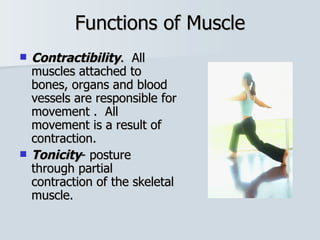
Functions of Muscle Contractibility .  All muscles attached to bones, organs and blood vessels are responsible for movement .  All movement is a result of contraction. Tonicity - posture through partial contraction of the skeletal muscle.
Functions of muscles con’t Heat production-  produce heat through chemical changes involved in muscular activity, maintains normal body temperature. Stability - muscles are responsibly for holding bones together .
Types of Muscle Tissue Muscle Tissue Skeletal Voluntary Stiated cells Smooth Involuntary Blood vessels,  Urinary bladder, Digestive system Cardiac Muscle   Tissue Found in the Heart Striated and Involuntary
 
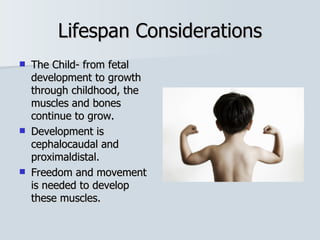
Lifespan Considerations The Child- from fetal development to growth through childhood, the muscles and bones continue to grow.  Development is cephalocaudal and proximaldistal. Freedom and movement is needed to develop these muscles.
Lifespan Considerations The Adult – changes related to mobility are most obvious in the older adult. Changes in strength, endurance, ROM, coordination, elasticity and flexibility of connective tissue. Regular exercise is important.
Patient education Healthy attitude towards exercise Good posture Dietary supplements Lifestyle modification

Chapter 22 Muscular System

  • 1.
    Chapter 22 TheMuscular System
  • 2.
    Objectives Describe themuscular system of the body. Explain the functions of muscle. Identify the types of muscle tissue. Lifespan considerations Patient teaching
  • 3.
    Introduction The muscularsystem is composed of specialized cells called muscle fibers. These fibers are different lengths and shapes and form to become muscles. Muscles make up about 42% of a person’s total body weight. Muscle fibers are held together by connective tissue , enclosed in “fascia”. Muscles must have proper oxygen and nutrition to function properly.
  • 4.
    Functions of MuscleContractibility . All muscles attached to bones, organs and blood vessels are responsible for movement . All movement is a result of contraction. Tonicity - posture through partial contraction of the skeletal muscle.
  • 5.
    Functions of musclescon’t Heat production- produce heat through chemical changes involved in muscular activity, maintains normal body temperature. Stability - muscles are responsibly for holding bones together .
  • 6.
    Types of MuscleTissue Muscle Tissue Skeletal Voluntary Stiated cells Smooth Involuntary Blood vessels, Urinary bladder, Digestive system Cardiac Muscle Tissue Found in the Heart Striated and Involuntary
  • 7.
  • 8.
    Lifespan Considerations TheChild- from fetal development to growth through childhood, the muscles and bones continue to grow. Development is cephalocaudal and proximaldistal. Freedom and movement is needed to develop these muscles.
  • 9.
    Lifespan Considerations TheAdult – changes related to mobility are most obvious in the older adult. Changes in strength, endurance, ROM, coordination, elasticity and flexibility of connective tissue. Regular exercise is important.
  • 10.
    Patient education Healthyattitude towards exercise Good posture Dietary supplements Lifestyle modification