

URINARY
ELIMINATION
Introduction
◦ The urinary system consists of organs that produce and excrete urine from the
body.
◦ Urine contains waste: mostly excess water, salts and nitrogen compounds.
◦ Primary organs are the kidneys
◦ Normal adult bladder can store up to 5 liters.
◦ Also responsible for regulating blood volume and blood pressure.
◦ Regulates electrolytes.
Organs of urinary system
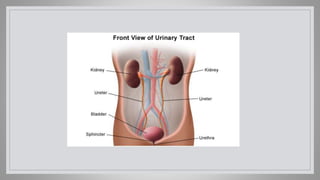
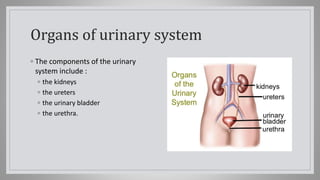
◦ The components of the urinary
system include :
◦ the kidneys
◦ the ureters
◦ the urinary bladder
◦ the urethra.
Kidney
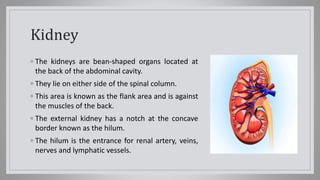
◦ The kidneys are bean-shaped organs located at
the back of the abdominal cavity.
◦ They lie on either side of the spinal column.
◦ This area is known as the flank area and is against
the muscles of the back.
◦ The external kidney has a notch at the concave
border known as the hilum.
◦ The hilum is the entrance for renal artery, veins,
nerves and lymphatic vessels.
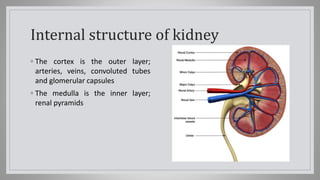
Internal structure of kidney
◦ The cortex is the outer layer;
arteries, veins, convoluted tubes
and glomerular capsules
◦ The medulla is the inner layer;
renal pyramids
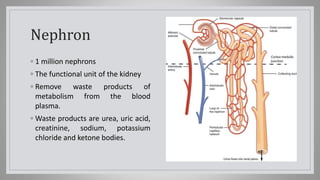
Nephron
◦ 1 million nephrons
◦ The functional unit of the kidney
◦ Remove waste products of
metabolism from the blood
plasma.
◦ Waste products are urea, uric acid,
creatinine, sodium, potassium
chloride and ketone bodies.
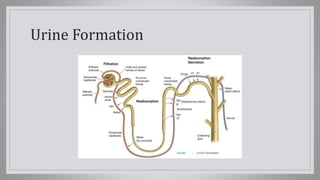
Urine Formation
Ureters, bladder and urethra
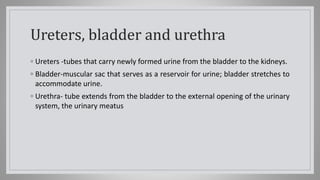
◦ Ureters -tubes that carry newly formed urine from the bladder to the kidneys.
◦ Bladder-muscular sac that serves as a reservoir for urine; bladder stretches to
accommodate urine.
◦ Urethra- tube extends from the bladder to the external opening of the urinary
system, the urinary meatus
Urine
◦ The formation of urine has 3 processes, filtration, reabsorption and tubular
secretion.
◦ Urine consists of 95% water and 5% solid substances.
◦ The need to urinate is usually felt at 300-350ml of urine in the bladder.
◦ Typically 1000-1500 mL is voided daily.
Physical Characteristics of Urine
◦ Odor
–Fresh urine is slightly aromatic –Standing urine develops an ammonia odor –
Some drugs and vegetables (asparagus) alter the usual odor
◦ pH
– Slightly acidic (pH 6) with a range of 4.5 to 8.0 – Diet can alter pH
◦ Specific gravity
– Ranges from 1.010 to 1.025 – Dependent on solute concentration
Chemical Characteristics of Urine
◦ Urine is 95% water and 5% solutes
◦ Nitrogenous wastes (organic solutes) include urea, ammonia, uric acid, and
creatinine
◦ Other normal solutes include: – Sodium, potassium, phosphate, and sulfate
ions – Calcium, magnesium, and bicarbonate ions
◦ NaCl is the most abundant inorganic salt in the urine.
◦ Urea is the chief organic solute.
◦ Abnormally high concentrations of any urinary constituents may indicate
pathology
◦ Disease states alter urine composition dramatically
Urination
◦ Micturation, voiding, and urination all refer to the process of emptying the
urinary bladder
◦ Stretch receptors- special sensory nerve endings in the bladder wall that is
stimulated when pressure is felt from the collection of urine
– Adult: 250-450mL of urine
– Children: 50-200mL of urine
Factors affecting urination
◦ Growth and development
◦ Psychosocial factors
◦ Fluid and food intake
◦ Medications
◦ Muscle tone and activity
◦ Pathologic conditions
◦ Surgical and diagnostic procedures
Altered urine production
◦ Polyuria- a.k.a. diuresis
– production of abnormally large amounts of urine by the kidneys
– 2500mL/day for adults
– Causes:
• Excessive fluid intake
• Intake of alcohol and caffeine
• Diabetes mellitus
• Hormone imbalances
• CKD
– Other signs associated with diuresis: polydipsia, dehydration and weight loss
◦ Oliguria
- Voiding scant amounts of urine
- Less than 500mL/day
◦ Anuria
- Voiding less than 100mL/day
- May result from low fluid intake, kidney disease, severe heart failure, burns
and shock
- Usually accompanied by fever and heavy respiration
◦ Frequency
- voiding at frequent intervals that is more often than usual.
- Total amount of urine voided may be normal but amount of each voiding
are small---50-100mL
- May result from increased fluid intake, cystitis, stress, or pressure on the
bladder
◦ Nocturia
- increased frequency at night that is not a result of an increased fluid intake
- Expressed in terms number of times the person gets out of bed to void
◦ Urgency
-feeling that the person must void.
-Usually accompanies psychologic stress, and irritation of the urethra
-Common in young children who have poor external sphincter control
◦ Dysuria
- voiding that is either painful or difficult
- May result from stricture of the urethra, urinary infections, injury to the
bladder and/ or the urethra.
- Described as a burning sensation during voiding
- Burning during micturation if often due to an irritated urethra. Burning
following urination may be a result of bladder infection
- Often associated with urinary hesitancy (delay and difficulty in initiating
voiding)
◦ Enuresis
- repeated involuntary urination in children beyond the age when voluntary
bladder control in normally acquired (4-5yrs)
◦ Urinary incontinence is considered a symptom, not a disease.
- Loss of bladder control
- Types:
• Functional incontinence- involuntary unpredictable passage of urine
• Reflex incontinence- involuntary loss of urine occurring at somewhat
predictable intervals when a specific bladder volume is reached.
• Stress incontinence- loss of urine of less than 50cc occurring with increased
intra-abdominal pressure
◦ Total incontinence- continuous and unpredictable loss of urine.
◦ Urge incontinence- involuntary passage of urine occurring soon after a
strong sense of urgency to void.
◦ urinary retention with overflow - dribbling incontinence that results when
the bladder is greatly distended with urine because of an obstruction
◦ Neurogenic bladder- describes any voiding problem related to neurologic
impairment or dysfunction.
◦ Urinary retention- accumulation of urine in the bladder (as much as 3L) with
associated inability of the bladder to empty itself.
◦ Adult- can hold 250-450ml of urine in the bladder before micturation reflex in
triggered.
◦ Prolonged retention leads to stasis (slowing of the flow of urine) and
stagnation of urine which increases the possibility of UTI.
◦ Retention if distinguished from oliguria or anuria by the distention of the
bladder.
◦ Characterized by small, frequent voiding or absence of urine output

Urinary elimination

  • 1.
  • 3.
    Introduction ◦ The urinarysystem consists of organs that produce and excrete urine from the body. ◦ Urine contains waste: mostly excess water, salts and nitrogen compounds. ◦ Primary organs are the kidneys ◦ Normal adult bladder can store up to 5 liters. ◦ Also responsible for regulating blood volume and blood pressure. ◦ Regulates electrolytes.
  • 4.
    Organs of urinarysystem ◦ The components of the urinary system include : ◦ the kidneys ◦ the ureters ◦ the urinary bladder ◦ the urethra.
  • 5.
    Kidney ◦ The kidneysare bean-shaped organs located at the back of the abdominal cavity. ◦ They lie on either side of the spinal column. ◦ This area is known as the flank area and is against the muscles of the back. ◦ The external kidney has a notch at the concave border known as the hilum. ◦ The hilum is the entrance for renal artery, veins, nerves and lymphatic vessels.
  • 6.
    Internal structure ofkidney ◦ The cortex is the outer layer; arteries, veins, convoluted tubes and glomerular capsules ◦ The medulla is the inner layer; renal pyramids
  • 7.
    Nephron ◦ 1 millionnephrons ◦ The functional unit of the kidney ◦ Remove waste products of metabolism from the blood plasma. ◦ Waste products are urea, uric acid, creatinine, sodium, potassium chloride and ketone bodies.
  • 8.
  • 9.
    Ureters, bladder andurethra ◦ Ureters -tubes that carry newly formed urine from the bladder to the kidneys. ◦ Bladder-muscular sac that serves as a reservoir for urine; bladder stretches to accommodate urine. ◦ Urethra- tube extends from the bladder to the external opening of the urinary system, the urinary meatus
  • 10.
    Urine ◦ The formationof urine has 3 processes, filtration, reabsorption and tubular secretion. ◦ Urine consists of 95% water and 5% solid substances. ◦ The need to urinate is usually felt at 300-350ml of urine in the bladder. ◦ Typically 1000-1500 mL is voided daily.
  • 11.
    Physical Characteristics ofUrine ◦ Odor –Fresh urine is slightly aromatic –Standing urine develops an ammonia odor – Some drugs and vegetables (asparagus) alter the usual odor ◦ pH – Slightly acidic (pH 6) with a range of 4.5 to 8.0 – Diet can alter pH ◦ Specific gravity – Ranges from 1.010 to 1.025 – Dependent on solute concentration
  • 12.
    Chemical Characteristics ofUrine ◦ Urine is 95% water and 5% solutes ◦ Nitrogenous wastes (organic solutes) include urea, ammonia, uric acid, and creatinine ◦ Other normal solutes include: – Sodium, potassium, phosphate, and sulfate ions – Calcium, magnesium, and bicarbonate ions ◦ NaCl is the most abundant inorganic salt in the urine. ◦ Urea is the chief organic solute. ◦ Abnormally high concentrations of any urinary constituents may indicate pathology ◦ Disease states alter urine composition dramatically
  • 13.
    Urination ◦ Micturation, voiding,and urination all refer to the process of emptying the urinary bladder ◦ Stretch receptors- special sensory nerve endings in the bladder wall that is stimulated when pressure is felt from the collection of urine – Adult: 250-450mL of urine – Children: 50-200mL of urine
  • 14.
    Factors affecting urination ◦Growth and development ◦ Psychosocial factors ◦ Fluid and food intake ◦ Medications ◦ Muscle tone and activity ◦ Pathologic conditions ◦ Surgical and diagnostic procedures
  • 15.
    Altered urine production ◦Polyuria- a.k.a. diuresis – production of abnormally large amounts of urine by the kidneys – 2500mL/day for adults – Causes: • Excessive fluid intake • Intake of alcohol and caffeine • Diabetes mellitus • Hormone imbalances • CKD – Other signs associated with diuresis: polydipsia, dehydration and weight loss
  • 16.
    ◦ Oliguria - Voidingscant amounts of urine - Less than 500mL/day ◦ Anuria - Voiding less than 100mL/day - May result from low fluid intake, kidney disease, severe heart failure, burns and shock - Usually accompanied by fever and heavy respiration
  • 17.
    ◦ Frequency - voidingat frequent intervals that is more often than usual. - Total amount of urine voided may be normal but amount of each voiding are small---50-100mL - May result from increased fluid intake, cystitis, stress, or pressure on the bladder ◦ Nocturia - increased frequency at night that is not a result of an increased fluid intake - Expressed in terms number of times the person gets out of bed to void
  • 18.
    ◦ Urgency -feeling thatthe person must void. -Usually accompanies psychologic stress, and irritation of the urethra -Common in young children who have poor external sphincter control
  • 19.
    ◦ Dysuria - voidingthat is either painful or difficult - May result from stricture of the urethra, urinary infections, injury to the bladder and/ or the urethra. - Described as a burning sensation during voiding - Burning during micturation if often due to an irritated urethra. Burning following urination may be a result of bladder infection - Often associated with urinary hesitancy (delay and difficulty in initiating voiding)
  • 20.
    ◦ Enuresis - repeatedinvoluntary urination in children beyond the age when voluntary bladder control in normally acquired (4-5yrs)
  • 21.
    ◦ Urinary incontinenceis considered a symptom, not a disease. - Loss of bladder control - Types: • Functional incontinence- involuntary unpredictable passage of urine • Reflex incontinence- involuntary loss of urine occurring at somewhat predictable intervals when a specific bladder volume is reached. • Stress incontinence- loss of urine of less than 50cc occurring with increased intra-abdominal pressure
  • 22.
    ◦ Total incontinence-continuous and unpredictable loss of urine. ◦ Urge incontinence- involuntary passage of urine occurring soon after a strong sense of urgency to void.
  • 23.
    ◦ urinary retentionwith overflow - dribbling incontinence that results when the bladder is greatly distended with urine because of an obstruction ◦ Neurogenic bladder- describes any voiding problem related to neurologic impairment or dysfunction.
  • 24.
    ◦ Urinary retention-accumulation of urine in the bladder (as much as 3L) with associated inability of the bladder to empty itself. ◦ Adult- can hold 250-450ml of urine in the bladder before micturation reflex in triggered. ◦ Prolonged retention leads to stasis (slowing of the flow of urine) and stagnation of urine which increases the possibility of UTI. ◦ Retention if distinguished from oliguria or anuria by the distention of the bladder. ◦ Characterized by small, frequent voiding or absence of urine output