Proteins Work Together in
DNA Replication & Repair

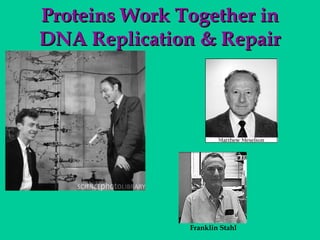
Franklin Stahl
The Basic Principle:
Base Pairing to a Template Strand

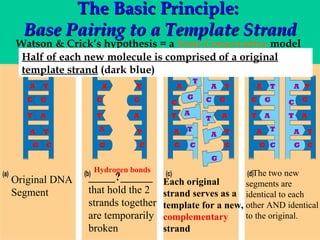
Watson & Crick’s hypothesis = a Semi-Conservative model
Half of each new molecule is comprised of a original
template strand (dark blue)
A

T

A

T

C

G

C

G

C

T

A

T

A

T

A
G

T
C

A
G

T
C

T

A

A
G

G
A
T

A

T

A

T

A T

C

G

C

G

C

G

T

A

T

A

T

A

A

C

T
C

T

A

T

G C

G

C

A

G

Original DNA
Segment

Hydrogen bonds

_____?______
that hold the 2
strands together
are temporarily
broken

The two new
Each original
segments are
strand serves as a identical to each
template for a new, other AND identical
to the original.
complementary

strand
Quick Think
How DOES DNA’s structure allow for it’s exact replication???
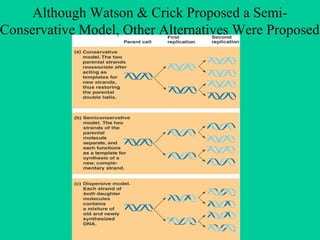
Although Watson & Crick Proposed a SemiConservative Model, Other Alternatives Were Proposed
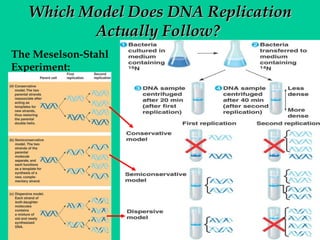
Which Model Does DNA Replication
Actually Follow?
The Meselson-Stahl
Experiment:
Quick Think
Describe what semiconservative replication means
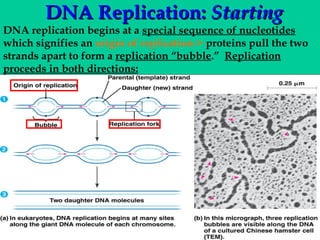
DNA Replication: Starting

DNA replication begins at a special sequence of nucleotides
which signifies an origin of replication-> proteins pull the two
strands apart to form a replication “bubble.” Replication
proceeds in both directions:
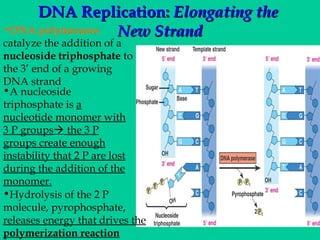
DNA Replication: Elongating the
•DNA polymerases
New Strand
catalyze the addition of a
nucleoside triphosphate to
the 3’ end of a growing
DNA strand
•A nucleoside
triphosphate is a
nucleotide monomer with
3 P groups the 3 P
groups create enough
instability that 2 P are lost
during the addition of the
monomer.
•Hydrolysis of the 2 P
molecule, pyrophosphate,
releases energy that drives the
polymerization reaction
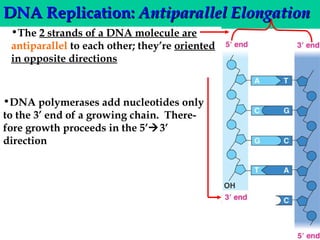
DNA Replication: Antiparallel Elongation
•The 2 strands of a DNA molecule are
antiparallel to each other; they’re oriented
in opposite directions

•DNA polymerases add nucleotides only
to the 3’ end of a growing chain. Therefore growth proceeds in the 5’3’
direction
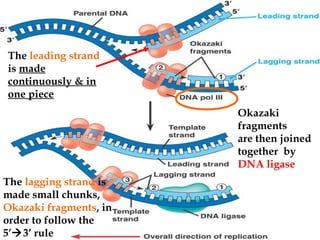
The leading strand
is made
continuously & in
one piece
Okazaki
fragments
are then joined
together by
DNA ligase
The lagging strand is
made small chunks,
Okazaki fragments, in
order to follow the
5’3’ rule
Leading vs. Lagging Strand

http://www3.interscience.wiley.com:8100/legacy/college/boyer/04716
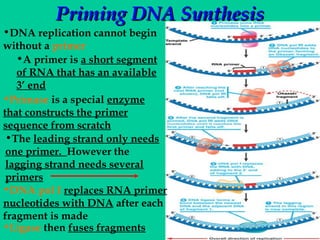
Priming DNA Synthesis

•DNA replication cannot begin
without a primer
•A primer is a short segment
of RNA that has an available
3’ end
•Primase is a special enzyme
that constructs the primer
sequence from scratch
•The leading strand only needs
one primer. However the
lagging strand needs several
primers
•DNA pol I replaces RNA primer
nucleotides with DNA after each
fragment is made
•Ligase then fuses fragments
Quick Think
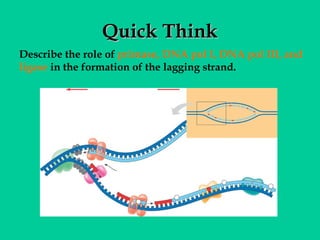
Describe the role of primase, DNA pol I, DNA pol III, and
ligase in the formation of the lagging strand.
Summary of Bacterial DNA Replication
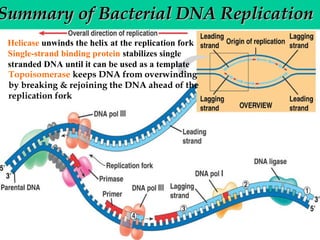
Helicase unwinds the helix at the replication fork
Single-strand binding protein stabilizes single
stranded DNA until it can be used as a template
Topoisomerase keeps DNA from overwinding
by breaking & rejoining the DNA ahead of the
replication fork
Misconceptions & the Replication
Machine
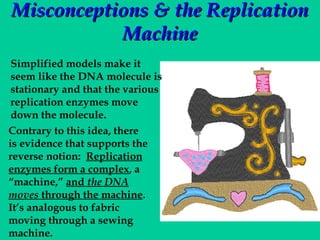
Simplified models make it
seem like the DNA molecule is
stationary and that the various
replication enzymes move
down the molecule.
Contrary to this idea, there
is evidence that supports the
reverse notion: Replication
enzymes form a complex, a
“machine,” and the DNA
moves through the machine.
It’s analogous to fabric
moving through a sewing
machine.
Proof Reading & Repairing DNA
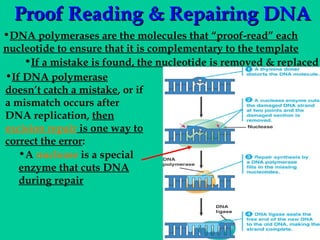
•DNA polymerases are the molecules that “proof-read” each
nucleotide to ensure that it is complementary to the template
•If a mistake is found, the nucleotide is removed & replaced
•If DNA polymerase
doesn’t catch a mistake, or if
a mismatch occurs after
DNA replication, then
excision repair is one way to
correct the error:
•A nuclease is a special
enzyme that cuts DNA
during repair
Quick Think
•What are some ways in which DNA may become damaged?

•Why is it important for DNA to be able to repair itself?
Replicating the Ends of DNA Molecules
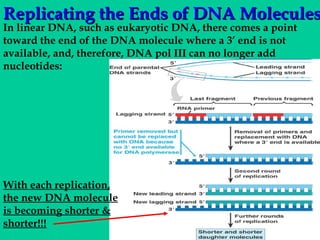
In linear DNA, such as eukaryotic DNA, there comes a point
toward the end of the DNA molecule where a 3’ end is not
available, and, therefore, DNA pol III can no longer add
nucleotides:

With each replication,
the new DNA molecule
is becoming shorter &
shorter!!!
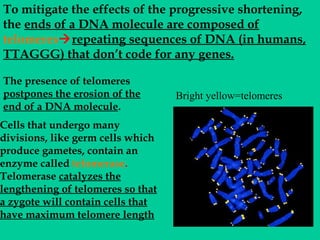
To mitigate the effects of the progressive shortening,
the ends of a DNA molecule are composed of
telomeresrepeating sequences of DNA (in humans,
TTAGGG) that don’t code for any genes.
The presence of telomeres
postpones the erosion of the
end of a DNA molecule.

Cells that undergo many
divisions, like germ cells which
produce gametes, contain an
enzyme called telomerase.
Telomerase catalyzes the
lengthening of telomeres so that
a zygote will contain cells that
have maximum telomere length

Bright yellow=telomeres
Quick Think
How are telomeres important in preserving eukaryotic genes?
Why does prokaryotic DNA lack telomeres?

AP Bio Ch 16 part 2

  • 1.
    Proteins Work Togetherin DNA Replication & Repair Franklin Stahl
  • 2.
    The Basic Principle: BasePairing to a Template Strand Watson & Crick’s hypothesis = a Semi-Conservative model Half of each new molecule is comprised of a original template strand (dark blue) A T A T C G C G C T A T A T A G T C A G T C T A A G G A T A T A T A T C G C G C G T A T A T A A C T C T A T G C G C A G Original DNA Segment Hydrogen bonds _____?______ that hold the 2 strands together are temporarily broken The two new Each original segments are strand serves as a identical to each template for a new, other AND identical to the original. complementary strand
  • 3.
    Quick Think How DOESDNA’s structure allow for it’s exact replication???
  • 4.
    Although Watson &Crick Proposed a SemiConservative Model, Other Alternatives Were Proposed
  • 5.
    Which Model DoesDNA Replication Actually Follow? The Meselson-Stahl Experiment:
  • 6.
    Quick Think Describe whatsemiconservative replication means
  • 7.
    DNA Replication: Starting DNAreplication begins at a special sequence of nucleotides which signifies an origin of replication-> proteins pull the two strands apart to form a replication “bubble.” Replication proceeds in both directions:
  • 8.
    DNA Replication: Elongatingthe •DNA polymerases New Strand catalyze the addition of a nucleoside triphosphate to the 3’ end of a growing DNA strand •A nucleoside triphosphate is a nucleotide monomer with 3 P groups the 3 P groups create enough instability that 2 P are lost during the addition of the monomer. •Hydrolysis of the 2 P molecule, pyrophosphate, releases energy that drives the polymerization reaction
  • 9.
    DNA Replication: AntiparallelElongation •The 2 strands of a DNA molecule are antiparallel to each other; they’re oriented in opposite directions •DNA polymerases add nucleotides only to the 3’ end of a growing chain. Therefore growth proceeds in the 5’3’ direction
  • 10.
    The leading strand ismade continuously & in one piece Okazaki fragments are then joined together by DNA ligase The lagging strand is made small chunks, Okazaki fragments, in order to follow the 5’3’ rule
  • 11.
    Leading vs. LaggingStrand http://www3.interscience.wiley.com:8100/legacy/college/boyer/04716
  • 12.
    Priming DNA Synthesis •DNAreplication cannot begin without a primer •A primer is a short segment of RNA that has an available 3’ end •Primase is a special enzyme that constructs the primer sequence from scratch •The leading strand only needs one primer. However the lagging strand needs several primers •DNA pol I replaces RNA primer nucleotides with DNA after each fragment is made •Ligase then fuses fragments
  • 13.
    Quick Think Describe therole of primase, DNA pol I, DNA pol III, and ligase in the formation of the lagging strand.
  • 14.
    Summary of BacterialDNA Replication Helicase unwinds the helix at the replication fork Single-strand binding protein stabilizes single stranded DNA until it can be used as a template Topoisomerase keeps DNA from overwinding by breaking & rejoining the DNA ahead of the replication fork
  • 15.
    Misconceptions & theReplication Machine Simplified models make it seem like the DNA molecule is stationary and that the various replication enzymes move down the molecule. Contrary to this idea, there is evidence that supports the reverse notion: Replication enzymes form a complex, a “machine,” and the DNA moves through the machine. It’s analogous to fabric moving through a sewing machine.
  • 16.
    Proof Reading &Repairing DNA •DNA polymerases are the molecules that “proof-read” each nucleotide to ensure that it is complementary to the template •If a mistake is found, the nucleotide is removed & replaced •If DNA polymerase doesn’t catch a mistake, or if a mismatch occurs after DNA replication, then excision repair is one way to correct the error: •A nuclease is a special enzyme that cuts DNA during repair
  • 17.
    Quick Think •What aresome ways in which DNA may become damaged? •Why is it important for DNA to be able to repair itself?
  • 18.
    Replicating the Endsof DNA Molecules In linear DNA, such as eukaryotic DNA, there comes a point toward the end of the DNA molecule where a 3’ end is not available, and, therefore, DNA pol III can no longer add nucleotides: With each replication, the new DNA molecule is becoming shorter & shorter!!!
  • 19.
    To mitigate theeffects of the progressive shortening, the ends of a DNA molecule are composed of telomeresrepeating sequences of DNA (in humans, TTAGGG) that don’t code for any genes. The presence of telomeres postpones the erosion of the end of a DNA molecule. Cells that undergo many divisions, like germ cells which produce gametes, contain an enzyme called telomerase. Telomerase catalyzes the lengthening of telomeres so that a zygote will contain cells that have maximum telomere length Bright yellow=telomeres
  • 20.
    Quick Think How aretelomeres important in preserving eukaryotic genes? Why does prokaryotic DNA lack telomeres?