Generalized Anxiety Disorder

• Anxiety can be conceptualized as a normal
  and adaptive response to threat that prepares
  the organism for flight or fight
• Persons who seem to be anxious about almost
  everything, however, are likely to be classified
  as having generalized
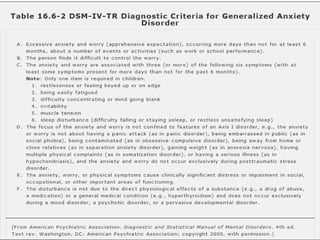
• anxiety disorder associated with somatic
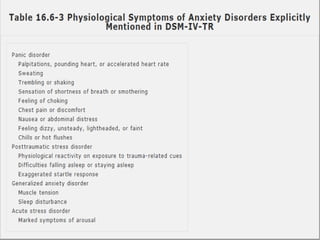
  symptoms, such as muscle tension, irritability,
  difficulty sleeping, and restlessness
• The anxiety is not focused on features of
  another Axis I disorder, is not caused by
  substance use or a general medical
  condition, and does not occur only during a
  mood or psychiatric disorder.
Epidemiology
• Generalized anxiety disorder is a common
  condition; reasonable estimates for its 1-year
  prevalence range from 3 to 8 percent.
• The ratio of women to men with the disorder is
  about 2 to 1, but the ratio of women to men who
  are receiving inpatient treatment for the disorder
  is about 1 to 1. A lifetime prevalence is close to 5
  percent with the Epidemiological Catchment Area
  (ECA) study suggesting a lifetime prevalence as
  high as 8 percent.
• In anxiety disorder clinics about 25 percent of
  patients have generalized anxiety disorder.
  The disorder usually has its onset in late
  adolescence or early adulthood, although
  cases are commonly seen in older adults
• Also, some evidence suggests that the
  prevalence of generalized anxiety disorder is
  particularly high in primary care settings
Comorbidity

• Generalized anxiety disorder coexists with
  another mental disorder, usually social
  phobia, specific phobia, panic disorder, or a
  depressive disorder
• As many as 25 percent of patients eventually
  experience panic disorder. Generalized anxiety
  disorder is differentiated from panic disorder
  by the absence of spontaneous panic attacks.
Biological Factors

• benzodiazepines and the azaspirones (e.g.,
  buspirone [BuSpar]) have focused biological
  research efforts on the γ-aminobutyric acid
  and serotonin neurotransmitter systems
• Benzodiazepines (which are benzodiazepine
  receptor agonists) are known to reduce
  anxiety
• Where as flumazenil (Romazicon) (a
  benzodiazepine receptor antagonist) and the
  β-carbolines (benzodiazepine receptor reverse
  agonists) are known to induce anxiety.
Treatment

• The most effective treatment of generalized
  anxiety disorder is probably one that
  combines psychotherapeutic,
  pharmacotherapeutic, and supportive
  approaches.
Psychotherapy

• The major techniques used in behavioral approaches
  are relaxation and biofeedback
• Insight-oriented psychotherapy focuses on uncovering
  unconscious conflicts and identifying ego strengths
• Psychodynamic therapy proceeds with the assumption
  that anxiety can increase with effective treatment. The
  goal of the dynamic approach may be to increase the
  patient's anxiety tolerance (a capacity to experience
  anxiety without having to discharge it), rather than to
  eliminate anxiety
Pharmacotherapy

I.     Benzodiazepines
II.    Buspirone
III.   Venlafaxine
IV.    Selective Serotonin Reuptake Inhibitors
V.     Other drugs
Anxiety Disorder due to a General
       Medical Condition
Etiology
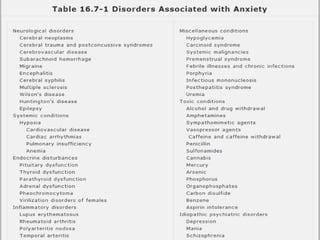
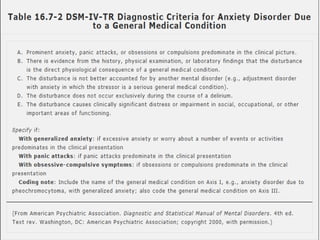
• A wide range of medical conditions can cause
  symptoms similar to those of anxiety disorders
  (Table 16.7-1).
  Hyperthyroidism, hypothyroidism, hypoparath
  yroidism, and vitamin B12 deficiency are
  frequently associated with anxiety symptoms
• A pheochromocytoma produces
  epinephrine, which can cause paroxysmal
  episodes of anxiety symptoms
Generalized Anxiety
• generalized anxiety disorder symptoms has
  been reported in patients with sjogren’s
  syndrome, and this rate may be related to the
  effects of sjogren’s syndrome on cortical and
  subcortical functions and thyroid function
• generalized anxiety disorder symptoms in a
  medical disorder seems to be in Graves'
  disease
Phobias

• 17 percent prevalence of symptoms of social
  phobia in patients with Parkinson's disease
• patients complain of a fear of falling, which
  may express itself by their being unwilling or
  fearful of walking
Differential Diagnosis

• A mental status examination is necessary to
  determine the presence of mood symptoms or
  psychotic symptoms that may suggest another
  psychiatric diagnosis
• For a clinician to conclude that a patient has an
  anxiety disorder caused by a general medical
  condition, the patient should clearly have anxiety
  as the predominant symptom and should have a
  specific causative nonpsychiatric medical disorder
Treatment

• the removal of the primary medical condition
  does not reverse the anxiety disorder
  symptoms, treatment of these symptoms
  should follow the treatment guidelines for the
  specific mental disorder
• In general, behavioral modification
  techniques, anxiolytic agents, and
  serotonergic antidepressants have been the
  most effective treatment modalities
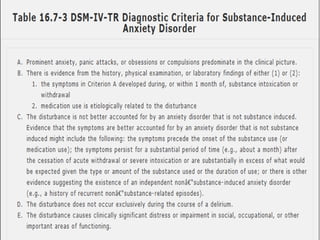
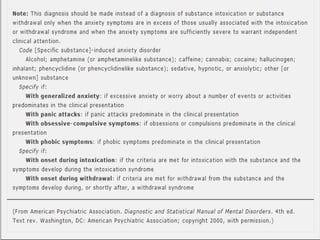
Substance-Induced Anxiety Disorder
• Substance-induced disorder is the direct result
  of a toxic substance, including drugs of
  abuse, medication, poison, and
  alcohol, among others.
Etiology

• as amphetamine, cocaine, and caffeine, have
  been most associated with the production of
  anxiety disorder symptoms, many
  serotonergic drugs (e.g., lysergic acid
  diethylamide [LSD] and
  methylenedioxymethamphetamine [MDMA])
  can also cause both acute and chronic anxiety
  syndromes in users
• wide range of prescription medications
Clinical Features
• Nevertheless, alcohol use disorders and other
  substance-related disorders are commonly
  associated with anxiety disorders.
• Alcohol use disorders are about four times more
  common among patients with panic disorder
  than among the general population, about three
  and a half times more common among patients
  with OCD, and about two and a half times more
  common among patients with phobias
Course and Prognosis
• The course and prognosis generally depend on
  removal of the causally involved substance and
  the long-term ability of the affected person to
  limit use of the substance.
• The anxiogenic effects of most drugs are
  reversible.
• When the anxiety does not reverse with cessation
  of the drug, clinicians should reconsider the
  diagnosis of substance-induced anxiety disorder
  or consider the possibility that the substance
  caused irreversible brain damage.
Treatment

• anxiety disorder symptoms continue even
  after stopping substance use, treatment of the
  anxiety disorder symptoms with appropriate
  psychotherapeutic or pharmacotherapeutic
  modalities may be appropriate
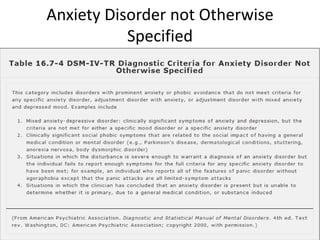
Anxiety Disorder not Otherwise
           Specified
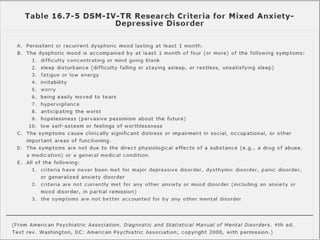
Mixed Anxiety-Depressive Disorder

• Mixed anxiety-depressive disorder describes
  patients with both anxiety and depressive
  symptoms who do not meet the diagnostic
  criteria for either an anxiety disorder or a mood
  disorder.
• The combination of depressive and anxiety
  symptoms results in significant functional
  impairment for the affected person.
• The condition may be particularly prevalent in
  primary care practices and outpatient mental
  health clinics
Diagnosis

• anxiety and depression and the presence of
  some autonomic symptoms, such as
  tremor, palpitations, dry mouth, and the
  sensation of a churning stomach.
Clinical Features

• anxiety disorders and some symptoms of
  depressive disorders are common symptoms
  of autonomic nervous system hyperactivity,
  such as gastrointestinal complaints, are
  common and contribute to the high frequency
  with which the patients are seen in outpatient
  medical clinics.
Treatment
• the anxiolytic drugs, some data indicate that
  the use of triazolobenzodiazepines
  (e.g., alprazolam [Xanax]) may be indicated
  because of their effectiveness in treating
  depression associated with anxiety

Anxiety disorder

  • 1.
    Generalized Anxiety Disorder •Anxiety can be conceptualized as a normal and adaptive response to threat that prepares the organism for flight or fight • Persons who seem to be anxious about almost everything, however, are likely to be classified as having generalized • anxiety disorder associated with somatic symptoms, such as muscle tension, irritability, difficulty sleeping, and restlessness
  • 2.
    • The anxietyis not focused on features of another Axis I disorder, is not caused by substance use or a general medical condition, and does not occur only during a mood or psychiatric disorder.
  • 3.
    Epidemiology • Generalized anxietydisorder is a common condition; reasonable estimates for its 1-year prevalence range from 3 to 8 percent. • The ratio of women to men with the disorder is about 2 to 1, but the ratio of women to men who are receiving inpatient treatment for the disorder is about 1 to 1. A lifetime prevalence is close to 5 percent with the Epidemiological Catchment Area (ECA) study suggesting a lifetime prevalence as high as 8 percent.
  • 4.
    • In anxietydisorder clinics about 25 percent of patients have generalized anxiety disorder. The disorder usually has its onset in late adolescence or early adulthood, although cases are commonly seen in older adults • Also, some evidence suggests that the prevalence of generalized anxiety disorder is particularly high in primary care settings
  • 5.
    Comorbidity • Generalized anxietydisorder coexists with another mental disorder, usually social phobia, specific phobia, panic disorder, or a depressive disorder • As many as 25 percent of patients eventually experience panic disorder. Generalized anxiety disorder is differentiated from panic disorder by the absence of spontaneous panic attacks.
  • 6.
    Biological Factors • benzodiazepinesand the azaspirones (e.g., buspirone [BuSpar]) have focused biological research efforts on the γ-aminobutyric acid and serotonin neurotransmitter systems • Benzodiazepines (which are benzodiazepine receptor agonists) are known to reduce anxiety
  • 7.
    • Where asflumazenil (Romazicon) (a benzodiazepine receptor antagonist) and the β-carbolines (benzodiazepine receptor reverse agonists) are known to induce anxiety.
  • 11.
    Treatment • The mosteffective treatment of generalized anxiety disorder is probably one that combines psychotherapeutic, pharmacotherapeutic, and supportive approaches.
  • 12.
    Psychotherapy • The majortechniques used in behavioral approaches are relaxation and biofeedback • Insight-oriented psychotherapy focuses on uncovering unconscious conflicts and identifying ego strengths • Psychodynamic therapy proceeds with the assumption that anxiety can increase with effective treatment. The goal of the dynamic approach may be to increase the patient's anxiety tolerance (a capacity to experience anxiety without having to discharge it), rather than to eliminate anxiety
  • 13.
    Pharmacotherapy I. Benzodiazepines II. Buspirone III. Venlafaxine IV. Selective Serotonin Reuptake Inhibitors V. Other drugs
  • 14.
    Anxiety Disorder dueto a General Medical Condition
  • 15.
    Etiology • A widerange of medical conditions can cause symptoms similar to those of anxiety disorders (Table 16.7-1). Hyperthyroidism, hypothyroidism, hypoparath yroidism, and vitamin B12 deficiency are frequently associated with anxiety symptoms • A pheochromocytoma produces epinephrine, which can cause paroxysmal episodes of anxiety symptoms
  • 18.
    Generalized Anxiety • generalizedanxiety disorder symptoms has been reported in patients with sjogren’s syndrome, and this rate may be related to the effects of sjogren’s syndrome on cortical and subcortical functions and thyroid function • generalized anxiety disorder symptoms in a medical disorder seems to be in Graves' disease
  • 19.
    Phobias • 17 percentprevalence of symptoms of social phobia in patients with Parkinson's disease • patients complain of a fear of falling, which may express itself by their being unwilling or fearful of walking
  • 20.
    Differential Diagnosis • Amental status examination is necessary to determine the presence of mood symptoms or psychotic symptoms that may suggest another psychiatric diagnosis • For a clinician to conclude that a patient has an anxiety disorder caused by a general medical condition, the patient should clearly have anxiety as the predominant symptom and should have a specific causative nonpsychiatric medical disorder
  • 21.
    Treatment • the removalof the primary medical condition does not reverse the anxiety disorder symptoms, treatment of these symptoms should follow the treatment guidelines for the specific mental disorder • In general, behavioral modification techniques, anxiolytic agents, and serotonergic antidepressants have been the most effective treatment modalities
  • 22.
    Substance-Induced Anxiety Disorder •Substance-induced disorder is the direct result of a toxic substance, including drugs of abuse, medication, poison, and alcohol, among others.
  • 23.
    Etiology • as amphetamine,cocaine, and caffeine, have been most associated with the production of anxiety disorder symptoms, many serotonergic drugs (e.g., lysergic acid diethylamide [LSD] and methylenedioxymethamphetamine [MDMA]) can also cause both acute and chronic anxiety syndromes in users • wide range of prescription medications
  • 26.
    Clinical Features • Nevertheless,alcohol use disorders and other substance-related disorders are commonly associated with anxiety disorders. • Alcohol use disorders are about four times more common among patients with panic disorder than among the general population, about three and a half times more common among patients with OCD, and about two and a half times more common among patients with phobias
  • 27.
    Course and Prognosis •The course and prognosis generally depend on removal of the causally involved substance and the long-term ability of the affected person to limit use of the substance. • The anxiogenic effects of most drugs are reversible. • When the anxiety does not reverse with cessation of the drug, clinicians should reconsider the diagnosis of substance-induced anxiety disorder or consider the possibility that the substance caused irreversible brain damage.
  • 28.
    Treatment • anxiety disordersymptoms continue even after stopping substance use, treatment of the anxiety disorder symptoms with appropriate psychotherapeutic or pharmacotherapeutic modalities may be appropriate
  • 29.
    Anxiety Disorder notOtherwise Specified
  • 30.
    Mixed Anxiety-Depressive Disorder •Mixed anxiety-depressive disorder describes patients with both anxiety and depressive symptoms who do not meet the diagnostic criteria for either an anxiety disorder or a mood disorder. • The combination of depressive and anxiety symptoms results in significant functional impairment for the affected person. • The condition may be particularly prevalent in primary care practices and outpatient mental health clinics
  • 31.
    Diagnosis • anxiety anddepression and the presence of some autonomic symptoms, such as tremor, palpitations, dry mouth, and the sensation of a churning stomach.
  • 32.
    Clinical Features • anxietydisorders and some symptoms of depressive disorders are common symptoms of autonomic nervous system hyperactivity, such as gastrointestinal complaints, are common and contribute to the high frequency with which the patients are seen in outpatient medical clinics.
  • 34.
    Treatment • the anxiolyticdrugs, some data indicate that the use of triazolobenzodiazepines (e.g., alprazolam [Xanax]) may be indicated because of their effectiveness in treating depression associated with anxiety