Submitted by:
Aishwarya Ghosh
Course: Academic Writing
Email: ghoshaishwarya08@gmail.com
Generalized anxiety disorder (or GAD) is characterized
by excessive, exaggerated anxiety and worry about
everyday life events with no obvious reasons for worry.
The worry is often unrealistic or out of proportion for
the situation. Daily life becomes a constant state of worry,
fear, and dread.
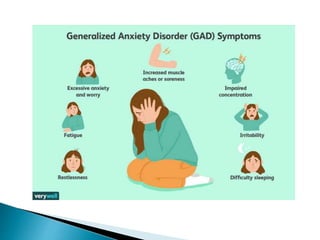
These symptoms include constant worry, restlessness
and trouble with concentration.
A. Excessive anxiety and worry (apprehensive expectation),
occurring more days than not for at least 6 months, about a
number of events or activities (such as work or school
performance).
B. The individual finds it difficult to control the worry.
C. The anxiety and worry are associated with three (or more) of
the following six symptoms (with at least some symptoms
present for more days than not for the past 6
months). Note: Only one item is required in children.
(1) restlessness or feeling keyed up or on edge
(2) being easily fatigued
(3) difficulty concentrating or mind going blank
(4) irritability
(5) muscle tension
(6) sleep disturbance (difficulty falling or staying asleep, or
restless unsatisfying sleep)
D. The anxiety, worry, or physical symptoms cause clinically
significant distress or impairment in social, occupational, or
other important areas of functioning.
E. The disturbance is not attributable to the physiological effects
of a substance (e.g., a drug of abuse, a medication) or another
medical condition (e.g., hyperthyroidism).
F. The disturbance is not better explained by another mental
disorder (e.g., anxiety or worry about having panic attacks in
panic disorder, negative evaluation in social anxiety disorder
[social phobia], contamination or other obsessions in
obsessive-compulsive disorder, separation from attachment
figures in separation anxiety disorder, reminders of traumatic
events in posttraumatic stress disorder, gaining weight in
anorexia nervosa, physical complaints in somatic symptom
disorder, perceived appearance flaws in body dysmorphic
disorder, having a serious illness in illness anxiety disorder, or
the content of delusional beliefs in schizophrenia or delusional
disorder).
 Temperamental. Behavioral inhibition, negative affectivity
(neuroticism), and harm avoidance have been associated with
generalized anxiety disorder.
 Environmental. Although childhood adversities and parental
overprotection have been associated with generalized anxiety
disorder, no environmental factors have been identified as specific
to generalized anxiety disorder or necessary or sufficient for making
the diagnosis.
 Genetic and physiological. One-third of the risk of experiencing
generalized anxiety disorder is genetic, and these genetic factors
overlap with the risk of neuroticism and are shared with other
anxiety and mood disorders, particularly major depressive disorder.
 The 12-month prevalence of generalized anxiety disorder is
0.9% among adolescents and 2.9% among adults in the
general community of the United States.
 The lifetime morbid risk is 9.0%.
 Females are twice as likely as males to experience
generalized anxiety disorder. The prevalence of the diagnosis
peaks in middle age and declines across the later years of
life.
 Individuals from developed countries are more likely than
individuals from non-developed countries to report that they
have experienced symptoms that meet criteria for generalized
anxiety disorder in their lifetime.
BIOLOGICAL FACTORS :
 The therapeutic efficacies of benzodiazepines and the azaspirones
(e.g., buspirone [BuSpar]) have focused biological research efforts on
the r-aminobutyric acid and serotonin neurotransmitter systems.
Whereas benzodiazepines (which are benzodiazepine receptor
agonists) are known to reduce anxiety, flumazenil (Romazicon) (a
benzodiazepine receptor antagonist) and the /3-carbolines
(benzodiazepine receptor reverse agonists) are known to induce
anxiety.
 Some researchers have focused on the occipital lobe, which has the
highest concentrations of benzodiazepine receptors in the brain.
Other brain areas hypothesized to be involved in generalized anxiety
disorder are the basal ganglia, the limbic system, and the frontal
cortex.
 Brain imaging studies of patients with generalized anxiety disorder
have revealed significant findings. One PET study reported a lower
metabolic rate in basal ganglia and white matter in patients with
generalized anxiety disorder than in normal control subjects.
 One study found that a genetic relation might exist between
generalized anxiety disorder and major depressive disorder in
women. About 25 percent of first-degree relatives of patients with
generalized anxiety disorder are also affected.
 Some twin studies report a concordance rate of 50 percent in
monozygotic twins and 1 5 percent in dizygotic twins.
 A variety of electroencephalogram (EEG) abnormalities has been
noted in alpha rhythm and evoked potentials. Sleep EEG studies have
reported increased sleep discontinuity, decreased delta sleep,
decreased stage 1 sleep, and reduced rapid eye movement sleep.
 According to the cognitive-behavioral school, patients with
generalized anxiety disorder respond to incorrectly and inaccurately
perceived dangers. The inaccuracy is generated by selective
attention to negative details in the environment, by distortions in
information processing, and by an overly negative view of the
person's own ability to cope.
 The psychoanalytic school hypothesizes that anxiety is a symptom
of unresolved, unconscious conflicts. Sigmund Freud first presented
this psychological theory in 1 909 with his description of Little Hans;
before then, Freud had conceptualized anxiety as having a
physiological basis.
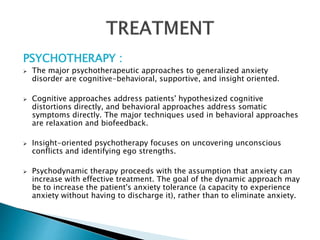
PSYCHOTHERAPY :
 The major psychotherapeutic approaches to generalized anxiety
disorder are cognitive-behavioral, supportive, and insight oriented.
 Cognitive approaches address patients' hypothesized cognitive
distortions directly, and behavioral approaches address somatic
symptoms directly. The major techniques used in behavioral approaches
are relaxation and biofeedback.
 Insight-oriented psychotherapy focuses on uncovering unconscious
conflicts and identifying ego strengths.
 Psychodynamic therapy proceeds with the assumption that anxiety can
increase with effective treatment. The goal of the dynamic approach may
be to increase the patient's anxiety tolerance (a capacity to experience
anxiety without having to discharge it), rather than to eliminate anxiety.
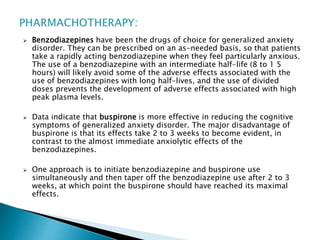
 Benzodiazepines have been the drugs of choice for generalized anxiety
disorder. They can be prescribed on an as-needed basis, so that patients
take a rapidly acting benzodiazepine when they feel particularly anxious.
The use of a benzodiazepine with an intermediate half-life (8 to 1 5
hours) will likely avoid some of the adverse effects associated with the
use of benzodiazepines with long half-lives, and the use of divided
doses prevents the development of adverse effects associated with high
peak plasma levels.
 Data indicate that buspirone is more effective in reducing the cognitive
symptoms of generalized anxiety disorder. The major disadvantage of
buspirone is that its effects take 2 to 3 weeks to become evident, in
contrast to the almost immediate anxiolytic effects of the
benzodiazepines.
 One approach is to initiate benzodiazepine and buspirone use
simultaneously and then taper off the benzodiazepine use after 2 to 3
weeks, at which point the buspirone should have reached its maximal
effects.
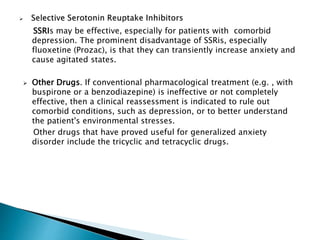
SSRIs may be effective, especially for patients with comorbid
depression. The prominent disadvantage of SSRis, especially
fluoxetine (Prozac), is that they can transiently increase anxiety and
cause agitated states.
 Other Drugs. If conventional pharmacological treatment (e.g. , with
buspirone or a benzodiazepine) is ineffective or not completely
effective, then a clinical reassessment is indicated to rule out
comorbid conditions, such as depression, or to better understand
the patient's environmental stresses.
Other drugs that have proved useful for generalized anxiety
disorder include the tricyclic and tetracyclic drugs.

Generalized anxiety disorder

  • 1.
    Submitted by: Aishwarya Ghosh Course:Academic Writing Email: ghoshaishwarya08@gmail.com
  • 2.
    Generalized anxiety disorder(or GAD) is characterized by excessive, exaggerated anxiety and worry about everyday life events with no obvious reasons for worry. The worry is often unrealistic or out of proportion for the situation. Daily life becomes a constant state of worry, fear, and dread. These symptoms include constant worry, restlessness and trouble with concentration.
  • 4.
    A. Excessive anxietyand worry (apprehensive expectation), occurring more days than not for at least 6 months, about a number of events or activities (such as work or school performance). B. The individual finds it difficult to control the worry. C. The anxiety and worry are associated with three (or more) of the following six symptoms (with at least some symptoms present for more days than not for the past 6 months). Note: Only one item is required in children. (1) restlessness or feeling keyed up or on edge (2) being easily fatigued (3) difficulty concentrating or mind going blank (4) irritability (5) muscle tension (6) sleep disturbance (difficulty falling or staying asleep, or restless unsatisfying sleep)
  • 5.
    D. The anxiety,worry, or physical symptoms cause clinically significant distress or impairment in social, occupational, or other important areas of functioning. E. The disturbance is not attributable to the physiological effects of a substance (e.g., a drug of abuse, a medication) or another medical condition (e.g., hyperthyroidism). F. The disturbance is not better explained by another mental disorder (e.g., anxiety or worry about having panic attacks in panic disorder, negative evaluation in social anxiety disorder [social phobia], contamination or other obsessions in obsessive-compulsive disorder, separation from attachment figures in separation anxiety disorder, reminders of traumatic events in posttraumatic stress disorder, gaining weight in anorexia nervosa, physical complaints in somatic symptom disorder, perceived appearance flaws in body dysmorphic disorder, having a serious illness in illness anxiety disorder, or the content of delusional beliefs in schizophrenia or delusional disorder).
  • 6.
     Temperamental. Behavioralinhibition, negative affectivity (neuroticism), and harm avoidance have been associated with generalized anxiety disorder.  Environmental. Although childhood adversities and parental overprotection have been associated with generalized anxiety disorder, no environmental factors have been identified as specific to generalized anxiety disorder or necessary or sufficient for making the diagnosis.  Genetic and physiological. One-third of the risk of experiencing generalized anxiety disorder is genetic, and these genetic factors overlap with the risk of neuroticism and are shared with other anxiety and mood disorders, particularly major depressive disorder.
  • 7.
     The 12-monthprevalence of generalized anxiety disorder is 0.9% among adolescents and 2.9% among adults in the general community of the United States.  The lifetime morbid risk is 9.0%.  Females are twice as likely as males to experience generalized anxiety disorder. The prevalence of the diagnosis peaks in middle age and declines across the later years of life.  Individuals from developed countries are more likely than individuals from non-developed countries to report that they have experienced symptoms that meet criteria for generalized anxiety disorder in their lifetime.
  • 8.
    BIOLOGICAL FACTORS : The therapeutic efficacies of benzodiazepines and the azaspirones (e.g., buspirone [BuSpar]) have focused biological research efforts on the r-aminobutyric acid and serotonin neurotransmitter systems. Whereas benzodiazepines (which are benzodiazepine receptor agonists) are known to reduce anxiety, flumazenil (Romazicon) (a benzodiazepine receptor antagonist) and the /3-carbolines (benzodiazepine receptor reverse agonists) are known to induce anxiety.  Some researchers have focused on the occipital lobe, which has the highest concentrations of benzodiazepine receptors in the brain. Other brain areas hypothesized to be involved in generalized anxiety disorder are the basal ganglia, the limbic system, and the frontal cortex.
  • 9.
     Brain imagingstudies of patients with generalized anxiety disorder have revealed significant findings. One PET study reported a lower metabolic rate in basal ganglia and white matter in patients with generalized anxiety disorder than in normal control subjects.  One study found that a genetic relation might exist between generalized anxiety disorder and major depressive disorder in women. About 25 percent of first-degree relatives of patients with generalized anxiety disorder are also affected.  Some twin studies report a concordance rate of 50 percent in monozygotic twins and 1 5 percent in dizygotic twins.  A variety of electroencephalogram (EEG) abnormalities has been noted in alpha rhythm and evoked potentials. Sleep EEG studies have reported increased sleep discontinuity, decreased delta sleep, decreased stage 1 sleep, and reduced rapid eye movement sleep.
  • 10.
     According tothe cognitive-behavioral school, patients with generalized anxiety disorder respond to incorrectly and inaccurately perceived dangers. The inaccuracy is generated by selective attention to negative details in the environment, by distortions in information processing, and by an overly negative view of the person's own ability to cope.  The psychoanalytic school hypothesizes that anxiety is a symptom of unresolved, unconscious conflicts. Sigmund Freud first presented this psychological theory in 1 909 with his description of Little Hans; before then, Freud had conceptualized anxiety as having a physiological basis.
  • 11.
    PSYCHOTHERAPY :  Themajor psychotherapeutic approaches to generalized anxiety disorder are cognitive-behavioral, supportive, and insight oriented.  Cognitive approaches address patients' hypothesized cognitive distortions directly, and behavioral approaches address somatic symptoms directly. The major techniques used in behavioral approaches are relaxation and biofeedback.  Insight-oriented psychotherapy focuses on uncovering unconscious conflicts and identifying ego strengths.  Psychodynamic therapy proceeds with the assumption that anxiety can increase with effective treatment. The goal of the dynamic approach may be to increase the patient's anxiety tolerance (a capacity to experience anxiety without having to discharge it), rather than to eliminate anxiety.
  • 12.
     Benzodiazepines havebeen the drugs of choice for generalized anxiety disorder. They can be prescribed on an as-needed basis, so that patients take a rapidly acting benzodiazepine when they feel particularly anxious. The use of a benzodiazepine with an intermediate half-life (8 to 1 5 hours) will likely avoid some of the adverse effects associated with the use of benzodiazepines with long half-lives, and the use of divided doses prevents the development of adverse effects associated with high peak plasma levels.  Data indicate that buspirone is more effective in reducing the cognitive symptoms of generalized anxiety disorder. The major disadvantage of buspirone is that its effects take 2 to 3 weeks to become evident, in contrast to the almost immediate anxiolytic effects of the benzodiazepines.  One approach is to initiate benzodiazepine and buspirone use simultaneously and then taper off the benzodiazepine use after 2 to 3 weeks, at which point the buspirone should have reached its maximal effects.
  • 13.
    SSRIs may beeffective, especially for patients with comorbid depression. The prominent disadvantage of SSRis, especially fluoxetine (Prozac), is that they can transiently increase anxiety and cause agitated states.  Other Drugs. If conventional pharmacological treatment (e.g. , with buspirone or a benzodiazepine) is ineffective or not completely effective, then a clinical reassessment is indicated to rule out comorbid conditions, such as depression, or to better understand the patient's environmental stresses. Other drugs that have proved useful for generalized anxiety disorder include the tricyclic and tetracyclic drugs.